REVIEW 1 cited by
Superconductivity in Spin-Orbit coupled SU(8) Dirac Fermions on Honeycomb lattice
T0 review · reviewed 2026-08-15 · deepseek-v4-flash
Pith's one-line read Spin-orbit-coupled $j=3/2$ electrons on the honeycomb lattice admit exactly 12 symmetry-distinct superconducting orders, five of them nodal, including non-unitary singlets and finite-momentum pair-density-wave triplets.
desk verdict Useful classification with a load-bearing gap: the triplet count presumes 3D irreps that D6h cannot have, and the paper never identifies the group generated by its symmetry matrices. read the letter →
The pith
A machine-rendered reading of the paper's core claim, the machinery that carries it, and where it could break.
The reading
What carries the argument
The load-bearing object is the 16-component Dirac spinor $\chi$ of the SU(8) Dirac semimetal, with four SU(4) flavours and two chiral (valley–band) sectors, and its Nambu extension to 32 components. In the Majorana representation the free theory has a manifest SO(16) symmetry whose 136 mass bilinears split into 64 normal (particle–hole) and 72 superconducting (particle–particle) masses; the superconducting ones are classified by decomposing the flavour sector ($6\oplus 10$ of U(4)) and the chiral sector ($A_{1g}\oplus T_{2g}$) under lattice symmetries and reassembling them into irreps. This machinery turns the question 'what superconductors can occur?' into a finite group-theory enumeration, and it also reveals which irreps are adiabatically connected to the same physical phase.
What would settle it
Look for the four Dirac points and their flavour degeneracy in a candidate material: angle-resolved photoemission or quantum oscillations on $\mathrm{MX}_3$ showing that the nodes are not at $\Gamma$ and the three $M$ points, or that the $j=3/2$ quartet is split even at the Dirac points, would falsify the underlying model and with it the 12-order enumeration. A positive test would be detection of zero-field finite-momentum pairing (pair-density-wave order) in a triplet channel, or of the predicted collapse of the smaller gap at isolated points of the order-parameter manifold.
Extended reading notes
Core claim
On the paper's own terms, the central discovery is the full symmetry-resolved catalogue of superconducting orders proximate to the SU(8) Dirac semimetal: 72 pairing bilinears, organized as real and imaginary parts of 36 amplitudes, reduce under the microscopic symmetries (translations, $C_2'$, $C_3$, $S_6$, inversion, dihedral reflection, and time reversal) to 12 inequivalent superconductors—two $A_{1g}$ singlets, one $A_{1u}$ and one $A_{2u}$ singlet, one gapped $E_u$ and one nodal $E_g$ doublet, and six triplets ($T_{1g}^I$, $T_{1g}^{II}$, $T_{1g}^{III}$, $T_{2g}$, $T_{1u}$, $T_{2u}$). Seven are gapped and five are nodal. Because spin and real space are locked by spin-orbit coupling, most of these orders are non-unitary even in the singlet channel, and the Cooper-pair wave functions carry total angular momentum $J_T=0,1,2,3$ with direction-dependent spin structure; the triplets pair at finite momentum and hence break translation symmetry as pair-density waves. The paper also shows that several formally distinct irreps are adiabatically connected and represent the same superconductor, so the physical list is shorter than the irrep list.
Load-bearing premise
The enumeration stands or falls on the low-energy description of the honeycomb $j=3/2$ model as an SU(8) Dirac semimetal with four flavours and four Dirac points (one at $\Gamma$, three at $M$); if the real band structure or the action of lattice symmetries on the Dirac spinors differs from Ref. [19], the list of superconductors and their nodal or gapped status changes.
Editorial extensions
If this is right
- The 12-order catalogue completes the phase diagram of the SU(8) Dirac semimetal when combined with the 24 normal phases from the companion work, so future strong-coupling studies can place superconducting and density-wave orders on one global map.
- In most of these superconductors the quasiparticle spectrum has two or more gaps whose magnitudes depend on the orientation of the order parameter in its manifold; rotating the order parameter can therefore drive a gapped superconductor into a nodal one without any additional tuning parameter.
- The triplet orders are finite-momentum pair-density waves that break translation symmetry even in zero magnetic field, with order-parameter manifolds $(S^1\times CP^2)/\mathbb{Z}_2$ (reducing to $(S^1\times S^2)/\mathbb{Z}_2$ on the time-reversal-invariant subspace); their vortices are classified by $\pi_1$ of these manifolds.
- For candidate $\mathrm{MX}_3$ materials, the classification predicts observable multi-gap features, possible inversion-odd Leggett modes in the $A_{1g}$ singlet, and gapless Dirac nodes in the $A_{1u}$, $A_{2u}$, $E_g$, $T_{1g}^{III}$, and $T_{2g}$ channels.
Reading between the lines
- If the SU(8) symmetry is only approximate in real materials, the 12 orders still provide the correct basis set: weak flavour-symmetry-breaking perturbations will select among these channels rather than create new ones, so the catalogue is a natural starting point for realistic pairing calculations.
- The SO(16) unification of normal and superconducting masses implies that transitions between a superconducting order and a nearby density-wave order may be describable by a single large-symmetry order parameter; the paper does not pursue this consequence.
- A testable extension is to compute leading pairing eigenvalues from microscopic four-fermion interactions in the $\mathrm{MX}_3$ model to see which of the 12 channels is energetically selected; the present work supplies the symmetry-allowed menu, not the energy ranking.
Signed reviews
Editorial analysis
A structured set of objections, weighed in public.
Circularity Check
No material circularity: the SC classification is a derivation from the assumed SU(8) Dirac model; the sole self-citation supplies the starting Hamiltonian and symmetry implementation, not the predicted target.
full rationale
The paper's central claims are the enumeration of 72 superconducting bilinears and their organization into 12 symmetry-distinct SCs (4 singlets, 2 doublets, 6 triplets), with gapped/nodal and unitary/non-unitary labels. These claims are obtained by an algebraic construction: all antisymmetric 16x16 pairing matrices X = Σβτγσδ consistent with the fermionic antisymmetry constraint (Eq. 24) are counted, decomposed under U(4) (Eqs. 41-49), then under the lattice-symmetry representation taken from Ref. [19] (Tables VII-IX). The nodal/gapped character is then checked by explicit diagonalization of the BdG Hamiltonians (e.g., Eqs. 61, 91-92, 99, 118). No parameter is fitted to a subset of the results and then renamed as a prediction; the paper predicts no material-specific Tc or gap magnitude. The only self-citation with load-bearing content is Ref. [19], which supplies the low-energy SU(8) Dirac Hamiltonian (Eq. 7) and the explicit 16x16 symmetry matrices Ω_S (Eq. 33). That prior result is an input premise of the classification, not an output of this paper; the SC classification is conditional on it, so using it is cumulative science rather than circularity. Even if the D6h point group of the honeycomb lattice has no three-dimensional irreps and the 'six triplets' count therefore needs a larger explicitly identified group (a correctness concern raised by the skeptic), that would be a mathematical-validity issue, not a reduction of the derived claim to its own inputs. Accordingly, no step satisfies the requirement of exhibiting Eq. X = Eq. Y by construction or a fitted parameter renamed as a prediction; the paper merits a low non-circularity score.
Assumptions & free parameters
assumptions (4)
- domain assumption The low-energy theory of j=3/2 electrons on the honeycomb lattice with the indirect hopping model is the SU(8) Dirac semimetal of Eq. 7 with the stated symmetry implementation.
- standard math All possible superconducting orders that can gap the Dirac fermions are represented by pairing matrices that anti-commute with the Dirac kinetic term and satisfy the antisymmetry constraint of Eq. 24.
- domain assumption Distinct superconducting phases are identified up to adiabatic deformations that keep the spectral gap open and do not break additional microscopic symmetries.
- standard math The mean-field decoupling of the short-range four-fermion interaction (Eq. 16) is valid for studying proximate SC orders.
Cite this review
Pith. "Pith review of Superconductivity in Spin-Orbit coupled SU(8) Dirac Fermions on Honeycomb lattice." pith.science (2026). https://pith.science/paper/CRXES2K6
@misc{pith2026250504945,
  author       = {Pith},
  title        = {Pith review of: Superconductivity in Spin-Orbit coupled SU(8) Dirac Fermions on Honeycomb lattice},
  year         = {2026},
  howpublished = {\url{https://pith.science/paper/CRXES2K6}},
  note         = {Machine review of arXiv:2505.04945}
}
abstract
We study superconducting (SC) phases that are naturally proximate to a spin-orbit coupled SU(8) Dirac semi-metal on a honeycomb lattice. This system, which offers enhanced low-energy symmetries, presents an interesting platform for realizing unconventional superconductivity in j=3/2 electrons. In particular, we find 72 superconducting charge-$2e$ fermion bilinears which, under classification of microscopic symmetries, lead to 12 different SCs -- four singlets, two doublets, and six triplets -- 7 of them are gapped and 5 are symmetry-protected nodal SCs. The strong spin-orbit coupling leads to locking of the spin of the Cooper pairs with real-space direction -- as is evident from the structure of the Cooper pair wave-functions -- leading to unusual non-unitary superconductors (even singlets), and with finite momentum pairing (for the triplets). This results, in many cases, in the magnitude of multiple pairing gaps being intricately dependent on the direction of the SC order-parameter. The present classification of SCs along with normal phases (Phys. Rev. B 108, 245106 (2023)) provides the complete list of naturally occurring phases in the vicinity of such a SU(8) Dirac semi-metal. This study allows for understanding the global phase diagram of such systems, stimulating further experimental work on candidate materials such as metallic halides (MX$_3$ with M=Zr, Hf, and X=Cl, Br). Further, it provides the starting point for the exploration of unconventional phase transitions in such systems.
Figures


Figures from the paper (12 more)




Forward citations
Cited by 1 Pith paper
-
Multiple Dirac Spin-Orbital Liquids in SU(4) Heisenberg Antiferromagnets on the Honeycomb Lattice
SU(4) Heisenberg antiferromagnets on the honeycomb lattice realize multiple inequivalent U(1) Dirac spin-orbital liquids, distinguished by their microscopic symmetry implementation and by measurable dynamical structur...
Reference graph
Works this paper leans on
- [19]
-
[1]
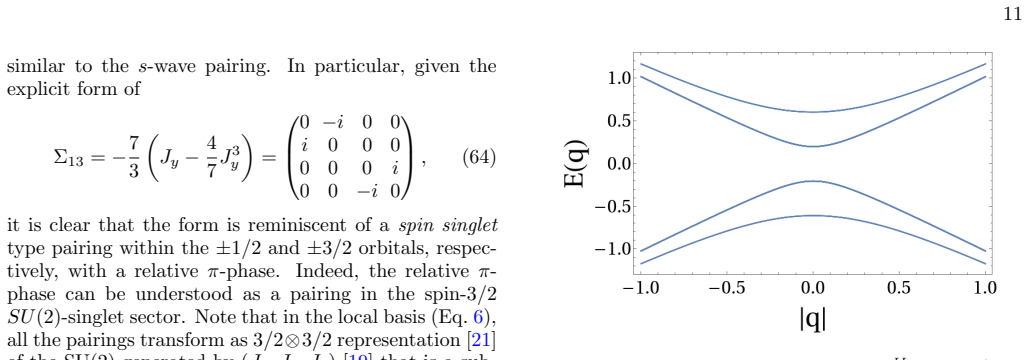
AI 1g Singlet Diagonalising the mean field Hamiltonian (Eq. 22) for singlet-I (Eq. 57) provides two bands with gapped dis- persion for the Bogoliubov quasi-particles of the form E±(kx,ky, ∆AI 1g) =± q k2x +k2y +|∆AI 1g|2, (61) where, as usual, 2|∆AI 1g| is the gap in the spectrum. Each band is 16-fold degenerate. This single gap is a direct outcome of the...
-
[2]
54 and the corresponding pair- ing matrix is given in Eq
AII 1g Singlet The AII 1g singlet originates from the direct product of T2g lattice triplets in both the flavour and valley-subband sectors, as outlined in Eq. 54 and the corresponding pair- ing matrix is given in Eq. 58. Due to the non-unitary pairing (Eq. 60), the spectrum (Fig. 3) has a double gap structure, which can be checked by diagonalising the me...
-
[3]
Comparing the lattice Hamiltonians in Eqs
Are the two A1g superconductors distinct ? Given that both the A1g SCs discussed above belong to the same Irrep, it is useful to understand the sense in which they represent distinct SCs, if at all. Comparing the lattice Hamiltonians in Eqs. 62 and 67, it is clear that they respectively correspond to on-site s−wave and extended (NNN) s-wave SCs for the j ...
-
[4]
T2 Non-unitary Gapless Triplet Superconductor This non-unitary superconductor breaks all the lattice symmetries, with mass components: T2 1 1√ 2 M2112 + − 1√ 2 M2222 2 − 1√ 2 M2102 + − 1√ 2 M2132 3 − 1√ 2 M2012 + − 1√ 2 M2312 There is a four-fold degenerate Dirac cone quasi- particle band at the Γ point, and a four-fold degener- ate gapped quasi-particle ...
-
[5]
T1 Non-unitary Gapless Triplet Superconductor All lattice symmetries are broken in this superconduct- ing phase, which carries a distinct three-dimensional rep- resentation (compared to the triplet discussed in the pre- vious section) of the symmetry group of the system. The mass components are: T1 1 1√ 2 M2112 + 1√ 2 M2222 2 − 1√ 2 M2102 + 1√ 2 M2132 3 −...
-
[6]
are anti-symmetric and given by |Φa⟩ =1 2|JT = 2,mT = 0⟩ + r 3 8|JT = 2,mT = 2⟩ − r 3 8|JT = 2,mT =−2⟩, (78) |Φb⟩ =|JT = 2,mT = 0⟩, (79) |Φc⟩ =− 1 2|JT = 2,mT = 0⟩ + r 3 8|JT = 2,mT = 2⟩ − r 3 8|JT = 2,mT =−2⟩, (80) for A1u and |Φa⟩ = √ 3 2 |JT = 2,mT = 0⟩ + r 1 8|JT = 2,mT = 2⟩, − r 1 8|JT = 2,mT =−2⟩ (81) |Φb⟩ = 1√ 2 (|JT = 2,mT = 2⟩−| JT = 2,mT =−2⟩), ...
-
[7]
EI u Doublet We rewrite the mass matrix (Eq. 35) as mEI u(d) = ∆E1 u dEI u 1 mEI u 1 +dEI u 2 mEI u 2 =|∆EI u| d· mEI u, (88) where d = ei˜ϕ cosθ, sinθ ei˜γ (89) is a two-component complex vector and|∆EI u| is the mag- nitude of the pairing. Checking for unitarity, we have h ∆EI u· mEI u i · h ∆EI u· mEI u i† = |∆EI u|2 Σ0τ0σ0 + i 2 sin(2θ) sin(˜γ) h mE1 ...
Show all 74 references
-
[8]
is a 3-component complex vec- tor that spans the order parameter manifold ( S1× CP 2)/Z2 [40, 41] via (dx 1,dx 2,dx
-
[9]
(106) where, ˜ϕ is the superconducting phase and θ, ˜γ1 and ˜γ2 specify the direction in the triplet space
=ei˜ϕ(cosθ,ei˜γ1 sinθ cosϕ,ei˜γ2 sinθ sinϕ). (106) where, ˜ϕ is the superconducting phase and θ, ˜γ1 and ˜γ2 specify the direction in the triplet space. Note that the TRI sub-manifold is given by ˜γ1 = ˜γ2 = 0 or θ = 0,π whence the order parameter manifold reduces to ( S1× S2)...
-
[10]
On the other hand, on the TRB man- ifold, there are two gaps (as can be obtained by diagonal- izing Eq
TI 1g Triplet A general mass term for this triplet is written as, mTI 1g(d) =|∆TI 1g| dI 1m TI 1g 1 +dI 2m TI 1g 2 +dI 3m TI 1g 3 = ∆TI 1g· mTI 1g, (107) such that the unitarity condition leads to h ∆TI 1g· mTI 1g i · h ∆TI 1g· mTI 1g i† =|∆TI 1g|2× Σ0τ0σ0 + 1 2 dI× dI∗ · mTI ...
-
[11]
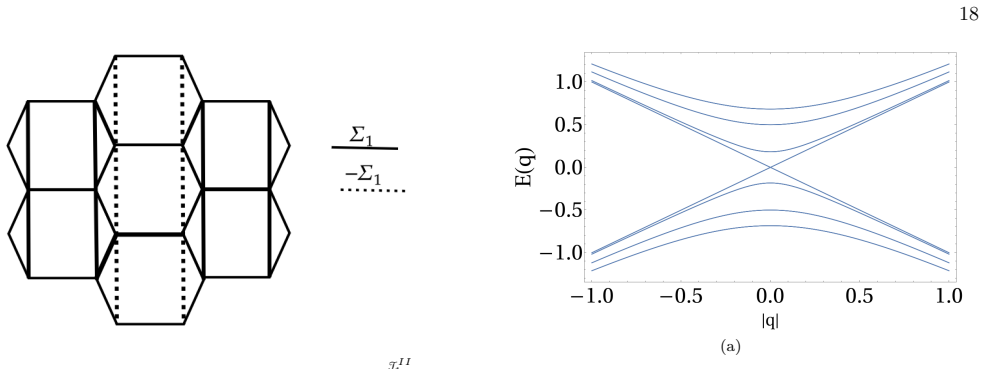
TII 1g triplet The analysis of this triplet (spectrum and unitarity condition) is very similar to TI 1g discussed above, leading 18 FIG. 11. Schematic of NNN pairing for the bilinearm TII 1g 1 (Eq
-
[12]
Bhattacharjee and K
S. Bhattacharjee and K. Sengupta, Tunneling conduc- tance of graphene nis junctions, Phys. Rev. Lett. 97, 217001 (2006)
2006
-
[13]
TIII 1g triplet Finally, we turn to the TIII 1g triplet that arises from the direct product of the flavour and valley sub-band triplets (Eq. 54). This results in a nodal PDW SC with excitation spectrum given in Fig. 12(a). The structure of the Bogoliubov spectrum is best un- d...
2021
-
[14]
linearly
is obtained by performing a unitary transformation on the Dirac spinors in the local basis, χ (Eq. 11), χg =Uglobal χ. (A1) where Uglobal is a 16× 16 unitary matrix whose explicit form is given in Ref. [19] and χg is the spinor in the global basis, i.e., χg = (χgΓ,χgM1,χgM2,χg...
-
[15]
While this phase is analogous to the AI 1g phase in the system with j = 3/2 discussed in the main text (see sec
A1 Unitary Singlet Superconductor This phase breaks theσd symmetry, with a mass term AI 1 1 (1)M2002 This fully gapped superconductor has 8-fold- degenerate Bogoliubov quasi-particle bands and corresponds to the regular s-wave SC for j = 1 /2 electrons. While this phase is ana...
-
[16]
The Bogoliubov bands break up into 2-fold degenerate bands around the Γ point and 6-fold degenerate bands around the M points
AII 1 Non-unitary Double-Gapped Singlet Superconductor This double gapped superconductor breaks the σd symmetry with a mass term 27 AII 1 1 1√ 3 M2032 + 1√ 3 M2302 + 1√ 3 M2332 The pairing matrix is non-unitary. The Bogoliubov bands break up into 2-fold degenerate bands around...
-
[17]
E Non-unitary Gapless Doublet Superconductor This superconducting phase breaks C3 andσd symme- tries. The doublet mass components are E 1 1√ 2 M2032 + − 1√ 2 M2332 2 1√ 6 M2032 + − q 2 3 M2302 + 1√ 6 M2332 This nodal superconductor has a quasi-particle band (doubly degenerate)...
-
[18]
M. G. Yamada, M. Oshikawa, and G. Jackeli, Emergent SU(4) symmetry in α−zrcl3 and crystalline spin-orbital liquids, Phys. Rev. Lett. 121, 097201 (2018)
2018
-
[20]
Boyack, H
R. Boyack, H. Yerzhakov, and J. Maciejko, Quantum phase transitions in dirac fermion systems, The Euro- pean Physical Journal Special Topics 230, 979 (2021)
2021
-
[21]
N. B. Kopnin and E. B. Sonin, Bcs superconductivity of dirac electrons in graphene layers, Phys. Rev. Lett. 100, 246808 (2008)
2008
-
[22]
Uchoa, G
B. Uchoa, G. G. Cabrera, and A. H. Castro Neto, Nodal liquid and s-wave superconductivity in transition metal dichalcogenides, Phys. Rev. B 71, 184509 (2005)
2005
-
[23]
A. H. Castro Neto, Charge density wave, superconduc- tivity, and anomalous metallic behavior in 2d transition metal dichalcogenides, Phys. Rev. Lett. 86, 4382 (2001)
2001
-
[24]
bcs super- conductivity of dirac electrons in graphene layers
B. Uchoa and A. H. C. Neto, Comment on “bcs super- conductivity of dirac electrons in graphene layers”, Phys. Rev. Lett. 102, 109701 (2009)
2009
-
[25]
I. F. Herbut, Interactions and phase transitions on 28 graphene’s honeycomb lattice, Phys. Rev. Lett. 97, 146401 (2006)
2006
-
[26]
Roy and I
B. Roy and I. F. Herbut, Unconventional superconduc- tivity on honeycomb lattice: Theory of kekule order pa- rameter, Phys. Rev. B 82, 035429 (2010)
2010
-
[27]
Tinkham, Introduction to superconductivity (Courier Corporation, 2004)
M. Tinkham, Introduction to superconductivity (Courier Corporation, 2004)
2004
-
[28]
R. A. Wilson, A discrete model for gell-mann matrices (2024), arXiv:2401.13000 [math.GR]
2024 arXiv
-
[29]
C. W. J. Beenakker, Specular andreev reflection in graphene, Phys. Rev. Lett. 97, 067007 (2006)
2006
-
[30]
Bhattacharjee, M
S. Bhattacharjee, M. Maiti, and K. Sengupta, Theory of tunneling conductance of graphene normal metal- insulator-superconductor junctions, Phys. Rev. B 76, 184514 (2007)
2007
-
[31]
Ozaki and K
M.-a. Ozaki and K. Machida, Superconducting classes of heavy-fermion materials, Phys. Rev. B 39, 4145 (1989)
1989
-
[32]
Huang, B
C. Huang, B. T. Zhou, H. Zhang, B. Yang, R. Liu, H. Wang, Y. Wan, K. Huang, Z. Liao, E. Zhang, et al. , Proximity-induced surface superconductivity in dirac semimetal cd3as2, Nature communications10, 2217 (2019)
2019
-
[33]
Santos, T
L. Santos, T. Neupert, C. Chamon, and C. Mudry, Super- conductivity on the surface of topological insulators and in two-dimensional noncentrosymmetric materials, Phys. Rev. B 81, 184502 (2010)
2010
-
[34]
Kobayashi and M
S. Kobayashi and M. Sato, Topological superconductivity in dirac semimetals, Phys. Rev. Lett.115, 187001 (2015)
2015
-
[35]
L. Zhao, H. Deng, I. Korzhovska, M. Begliarbekov, Z. Chen, E. Andrade, E. Rosenthal, A. Pasupathy, V. Oganesyan, and L. Krusin-Elbaum, Emergent surface superconductivity in the topological insulator sb2te3, Na- ture communications 6, 8279 (2015)
2015
-
[36]
S. Ryu, C. Mudry, C.-Y. Hou, and C. Chamon, Masses in graphenelike two-dimensional electronic systems: Topo- logical defects in order parameters and their fractional exchange statistics, Phys. Rev. B 80, 205319 (2009)
2009
-
[37]
Himeda, T
A. Himeda, T. Kato, and M. Ogata, Stripe states with spatially oscillating d-wave superconductivity in the two- dimensional t−t ′ −J model, Phys. Rev. Lett. 88, 117001 (2002)
2002
-
[38]
E. Berg, E. Fradkin, E.-A. Kim, S. A. Kivelson, V. Oganesyan, J. M. Tranquada, and S. C. Zhang, Dy- namical layer decoupling in a stripe-ordered high- Tc su- perconductor, Phys. Rev. Lett. 99, 127003 (2007)
2007
-
[39]
P. R. Wallace, The band theory of graphite, Phys. Rev. 71, 622 (1947)
1947
-
[40]
H. Kim, K. Wang, Y. Nakajima, R. Hu, S. Ziemak, P. Syers, L. Wang, H. Hodovanets, J. D. Denlinger, P. M. Brydon, et al., Beyond triplet: Unconventional supercon- ductivity in a spin-3/2 topological semimetal, Science ad- vances 4, eaao4513 (2018)
2018
-
[41]
Anderson, Structure of” triplet” superconducting en- ergy gaps, Physical Review B 30, 4000 (1984)
P. Anderson, Structure of” triplet” superconducting en- ergy gaps, Physical Review B 30, 4000 (1984)
1984
-
[42]
Ramires, Nonunitary superconductivity in complex quantum materials, Journal of Physics: Condensed Mat- ter 34, 304001 (2022)
A. Ramires, Nonunitary superconductivity in complex quantum materials, Journal of Physics: Condensed Mat- ter 34, 304001 (2022)
2022
-
[43]
Pfleiderer, Superconducting phases of f-electron com- pounds, Rev
C. Pfleiderer, Superconducting phases of f-electron com- pounds, Rev. Mod. Phys. 81, 1551 (2009)
2009
-
[44]
Joynt and L
R. Joynt and L. Taillefer, The superconducting phases of upt3, Rev. Mod. Phys. 74, 235 (2002)
2002
-
[45]
multipole
T. Nomoto, K. Hattori, and H. Ikeda, Classification of “multipole” superconductivity in multiorbital systems and its implications, Phys. Rev. B 94, 174513 (2016)
2016
-
[46]
Sigrist and K
M. Sigrist and K. Ueda, Phenomenological theory of un- conventional superconductivity, Rev. Mod. Phys.63, 239 (1991)
1991
-
[47]
Volovik and L
G. Volovik and L. Gor’kov, Superconducting classes in heavy-fermion systems, in Ten Years of Superconductiv- ity: 1980–1990 (Springer, 1985) pp. 144–155
1980
-
[48]
Yarzhemsky and E
V. Yarzhemsky and E. Murav’Ev, Space group approach to the wavefunction of a cooper pair, Journal of Physics: Condensed Matter 4, 3525 (1992)
1992
-
[49]
E. I. Blount, Symmetry properties of triplet supercon- ductors, Phys. Rev. B 32, 2935 (1985)
1985
-
[50]
Hatsugai and S
Y. Hatsugai and S. Ryu, Topological quantum phase transitions in superconductivity on lattices, Phys. Rev. B 65, 212510 (2002)
2002
-
[51]
Leggett, Number-phase fluctuations in two-band su- perconductors, Progress of Theoretical Physics 36, 901 (1966)
A. Leggett, Number-phase fluctuations in two-band su- perconductors, Progress of Theoretical Physics 36, 901 (1966)
1966
-
[52]
Nanda, K
A. Nanda, K. Dhochak, and S. Bhattacharjee, Phases and quantum phase transitions in an anisotropic ferro- magnetic kitaev-heisenberg-Γ magnet, Physical Review B 102, 10.1103/physrevb.102.235124 (2020)
2020 doi
-
[53]
Zhou, Spin correlation and discrete symmetry in spinor bose-einstein condensates, Phys
F. Zhou, Spin correlation and discrete symmetry in spinor bose-einstein condensates, Phys. Rev. Lett. 87, 080401 (2001)
2001
-
[54]
Ueda, Topological aspects in spinor bose–einstein con- densates, Reports on Progress in Physics 77, 122401 (2014)
M. Ueda, Topological aspects in spinor bose–einstein con- densates, Reports on Progress in Physics 77, 122401 (2014)
2014
-
[55]
Mukerjee, C
S. Mukerjee, C. Xu, and J. E. Moore, Topological defects and the superfluid transition of the s = 1 spinor con- densate in two dimensions, Phys. Rev. Lett. 97, 120406 (2006)
2006
-
[58]
D. F. Agterberg, J. S. Davis, S. D. Edkins, E. Fradkin, D. J. Van Harlingen, S. A. Kivelson, P. A. Lee, L. Radz- ihovsky, J. M. Tranquada, and Y. Wang, The physics of pair-density waves: cuprate superconductors and be- yond, Annual Review of Condensed Matter Physics 11, 231 (2020)
2020
-
[59]
W.S.Massey, The quotient space of the complex projec- tive plane under conjugation is a 4-sphere, Geom Dedi- cata 2, 371–374 (1973)
1973
-
[60]
N.H.Kuiper, The quotient space of cp(2) by complex conjugation is the 4-sphere, Math. Ann. 208, 175–177 (1974)
1974
-
[61]
Gupta, B
M. Gupta, B. Mondal, S. Bhattacharjee, and T. Saha Dasgupta, Ab initio insights on the fermi- ology of d1 transition metals on the honeycomb lattice: Hierarchy of hopping pathways and spin-orbit coupling, Phys. Rev. Res. 5, 043219 (2023)
2023
-
[62]
I. F. Herbut and S. Mandal, so(8) unification and the large-n theory of superconductor-insulator transition of two-dimensional dirac fermions, Phys. Rev. B 108, L161108 (2023)
2023
-
[63]
J. J. Cuozzo, W. Yu, P. Davids, T. M. Nenoff, D. B. Soh, W. Pan, and E. Rossi, Leggett modes in a dirac semimetal, Nature Physics 20, 1118 (2024)
2024
-
[64]
Chamon, C.-Y
C. Chamon, C.-Y. Hou, C. Mudry, S. Ryu, and L. San- 29 tos, Masses and majorana fermions in graphene, Physica Scripta 2012, 014013 (2012)
2012
-
[65]
This relativeπ-phase is therefore a di- rect outcome of the symmetry implementation
studied in Section VII A 1 resulting in breaking of in- version symmetry. This relativeπ-phase is therefore a di- rect outcome of the symmetry implementation. One can therefore conceive of fluctuations in relative phase that would correspond to an inversion-odd Leggett mode [3...
-
[66]
D. J. Scalapino, A common thread: The pairing inter- action for unconventional superconductors, Reviews of Modern Physics 84, 1383 (2012)
2012
-
[67]
P. M. R. Brydon, L. Wang, M. Weinert, and D. F. Agter- berg, Pairing of j = 3/2 fermions in half-heusler super- conductors, Phys. Rev. Lett. 116, 177001 (2016)
2016
-
[68]
C.-K. Chiu, J. C. Teo, A. P. Schnyder, and S. Ryu, Classi- fication of topological quantum matter with symmetries, Reviews of Modern Physics 88, 035005 (2016)
2016
-
[69]
A. P. Schnyder, S. Ryu, A. Furusaki, and A. W. Ludwig, Classification of topological insulators and superconduc- tors, in AIP conference proceedings, Vol. 1134 (American Institute of Physics, 2009) pp. 10–21
2009
-
[70]
70 (the other twelve eigenvalues are non-zero equal and hence give rise to 12 fold degenerate gapped excita- tions) and is evident from Fig
Thus, both the SCs have a double gap structure, with one of the gaps being exactly zero corresponding to four zero eigenvalues of the matrix on the right-hand-side of Eq. 70 (the other twelve eigenvalues are non-zero equal and hence give rise to 12 fold degenerate gapped excit...
-
[71]
Hatsugai, S
Y. Hatsugai, S. Ryu, and M. Kohmoto, Superconductiv- ity and abelian chiral anomalies, Phys. Rev. B70, 054502 (2004)
2004
-
[72]
Sato and S
M. Sato and S. Fujimoto, Topological phases of noncen- trosymmetric superconductors: Edge states, majorana fermions, and non-abelian statistics, Phys. Rev. B 79, 094504 (2009)
2009
-
[73]
Cornfeld, M
E. Cornfeld, M. S. Rudner, and E. Berg, Spin-polarized superconductivity: Order parameter topology, current dissipation, and multiple-period josephson effect, Phys. Rev. Res. 3, 013051 (2021)
2021
-
[74]
Zhang, L.-H
S.-B. Zhang, L.-H. Hu, and T. Neupert, Finite- momentum cooper pairing in proximitized altermagnets, Nature Communications 15, 1801 (2024)
2024
-
[75]
Grover and T
T. Grover and T. Senthil, Topological spin hall states, charged skyrmions, and superconductivity in two di- mensions, Physical Review Letters 100, 10.1103/phys- revlett.100.156804 (2008)
2008 doi
-
[102]
component of (TII 1g ) in global basis (Eq. 113). Here dot- ted (Solid) line represents pairing in the flavour sector with Pairing matrix Σ1(−Σ1). Pairing amplitudes oscillate at mo- menta corresponding to the M2 point in the BZ(Fig. 2).Pair- ings for the two other components ...
Reviewed August 15, 2026 · model on record in the stance chip above.
Discussion (0). Continue with ORCID to comment.