Intrinsic Indistinguishability of Identical Particles and How Particle Labels Affect It
Pith reviewed 2026-06-30 07:26 UTC · model grok-4.3
The pith
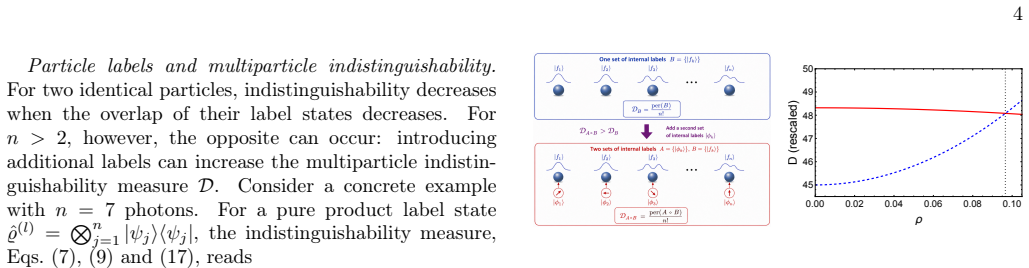
Introducing additional particle label states can increase the multiparticle indistinguishability of identical particles through cancellation of collective phases.
A machine-rendered reading of the paper's core claim, the machinery that carries it, and where it could break.
Core claim
For the projective indistinguishability measure, an equivalent expression is derived in terms of the dynamically invariant internal state. The textbook symmetrization framework is generalized to arbitrary partial distinguishability via an explicit reconstruction formula for the multiparticle visible state from the indistinguishability function. The class-functions of indistinguishability are characterized completely by projective measures on generalized symmetries. Introducing additional particle label states increases multiparticle indistinguishability due to cancellation of collective multiparticle phases.
What carries the argument
The indistinguishability function that encodes the dynamical invariants and allows reconstruction of the multiparticle visible state from it.
If this is right
- The multiparticle visible state can be explicitly reconstructed from the indistinguishability function for any degree of partial distinguishability.
- Indistinguishability admits a complete characterization via class-functions defined by projective measures on generalized symmetries.
- The effect of particle labels is quantified directly through cancellation of collective multiparticle phases.
- The projective measure depends only on the internal state under the stated evolution restrictions.
Where Pith is reading between the lines
- This points to a method for tuning effective indistinguishability by engineering internal label states alone.
- Phase cancellation mechanisms could extend to other many-particle interference settings with hidden degrees of freedom.
- The reconstruction formula opens modeling of partial distinguishability in systems where labels are controllable.
- The approach separates visible and internal dynamics in a way that may apply to hybrid quantum systems.
Load-bearing premise
Evolutions are restricted to particle-number-preserving operations on visible degrees of freedom while the internal state remains dynamically invariant.
What would settle it
A calculation or experiment demonstrating that additional label states fail to increase the projective indistinguishability measure when collective multiparticle phases are present.
Figures
read the original abstract
We investigate indistinguishability of identical bosons and fermions undergoing arbitrary particle-number-preserving evolutions of their visible degrees of freedom. For the projective indistinguishability measure, defined by the projection of the visible state onto the symmetric/anti-symmetric subspace, we derive an equivalent expression in terms of the dynamically invariant internal state. We further generalize the textbook symmetrization/anti-symmetrization framework for bosons and fermions to arbitrary partial distinguishability by deriving an explicit reconstruction formula for the multiparticle visible state in terms of the indistinguishability function encoding the dynamical invariants. We give complete characterization of the class-functions of indistinguishability by projective measures on generalized symmetries. Finally, we reveal a strikingly counterintuitive effect: introducing additional particle label states can increase the multiparticle indistinguishability of identical particles. The effect originates from the cancellation of collective multiparticle phases.
Editorial analysis
A structured set of objections, weighed in public.
Referee Report
Summary. The manuscript derives an equivalent expression for the projective indistinguishability measure (projection onto the symmetric/antisymmetric subspace) in terms of the dynamically invariant internal state, under the assumption of particle-number-preserving operations on visible degrees of freedom. It generalizes the standard symmetrization postulate to partial distinguishability by providing an explicit reconstruction formula for the multiparticle visible state from the indistinguishability function. The work gives a complete characterization of class-functions of indistinguishability via projective measures on generalized symmetries and demonstrates that additional particle label states can increase multiparticle indistinguishability through cancellation of collective phases.
Significance. If the derivations hold, the results are significant because they supply a parameter-free reconstruction formula and a full characterization of indistinguishability class-functions directly from the standard symmetrization postulate and dynamical assumptions. The counterintuitive demonstration that extra label states can raise indistinguishability via phase cancellation is a clear, falsifiable prediction with potential implications for quantum optics and many-body simulations. The absence of free parameters or invented entities strengthens the contribution.
minor comments (2)
- [Introduction] The assumption that the internal state remains dynamically invariant is load-bearing for the rewriting of the projective measure; it should be stated explicitly in the introduction or as a numbered assumption before the derivations begin.
- A brief numerical example or low-particle illustration of the collective phase cancellation would improve accessibility without altering the formal results.
Simulated Author's Rebuttal
We thank the referee for their positive assessment of the manuscript and for recommending acceptance. The report accurately captures the main contributions, including the reconstruction formula, the characterization of indistinguishability class-functions, and the counterintuitive effect of additional label states increasing indistinguishability via phase cancellation.
Circularity Check
No significant circularity
full rationale
The derivation begins from the standard symmetrization postulate together with the explicit dynamical assumptions (particle-number-preserving operations on visible degrees of freedom and dynamically invariant internal state). The equivalent expression for the projective measure, the reconstruction formula for the visible multiparticle state, and the characterization of class-functions are obtained by algebraic rewriting under those assumptions. The reported increase in indistinguishability is traced to explicit cancellation of collective phases permitted by additional label states; none of these steps is shown to reduce by construction to a fitted parameter, a self-referential definition, or a load-bearing self-citation. The paper therefore remains self-contained against external benchmarks.
Axiom & Free-Parameter Ledger
axioms (3)
- standard math Symmetrization postulate for identical bosons and fermions
- domain assumption Particle-number-preserving evolutions of visible degrees of freedom
- domain assumption Dynamically invariant internal state
Reference graph
Works this paper leans on
-
[1]
Intrinsic Indistinguishability of Identical Particles and How Particle Labels Affect It
and phenomena arising from more general symmetry principles [8–11]. A complete characterization of partial distinguishabil- ity for more than two identical particles remains a sur- prisingly challenging problem [12–14]. Genuinely multi- particleeffectsareremarkablyabundantandincludenon- monotonic quantum-to-classical transitions [15], collec- tive multipa...
work page internal anchor Pith review Pith/arXiv arXiv 2026
-
[2]
C. K. Hong, Z. Y. Ou, and L. Mandel, Phys. Rev. Lett. 59, 2044 (1987)
2044
-
[3]
R. C. Liu, B. Odom, Y. Yamamoto, and S. Tarucha, Nature391, 263 (1998)
1998
-
[4]
Lopes, A
R. Lopes, A. Imanaliev, A. Aspect M. Cheneau, D. Bo- iron and C. I. Westbrook, Nature 520 66 (2015)
2015
-
[5]
Sansoni, F
L. Sansoni, F. Sciarrino, G. Vallone, P. Mataloni, A. Crespi, R. Ramponi, and R. Osellame, Phys. Rev. Lett. 108, 010502 (2012)
2012
-
[6]
Z. Y. Ou, Phys. Rev. A74, 063808 (2006)
2006
-
[7]
Z. Y. Ou, Phys. Rev. A77, 043829 (2008)
2008
-
[8]
Y. L. Lim and A. Beige, New J. Phys.7, 155 (2005)
2005
-
[9]
M. C. Tichy, M. Tiersch, F. Mintert, and A. Buchleitner, New J. Phys.14, 093015 (2012)
2012
-
[10]
Dittel, G
C. Dittel, G. Dufour, M. Walschaers, G. Weihs, A. Buch- leitner, and R. Keil, Phys. Rev. A97, 062116 (2018)
2018
-
[11]
Münzberg, C
J. Münzberg, C. Dittel, M. Lebugle, A. Buchleitner, A. Szameit, G.Weihs, andR.Keil, PRXQuantum2, 020326 (2021)
2021
-
[12]
Descamps, A
E. Descamps, A. Keller, and P. Milman, Phys. Rev. Lett. 136, 060807 (2026)
2026
-
[13]
V. S. Shchesnovich, Phys. Rev. A91, 013844 (2015)
2015
-
[14]
M. C. Tichy, Phys. Rev. A91, 022316 (2015)
2015
-
[15]
Tillmann, S.-H
M. Tillmann, S.-H. Tan, S. E. Stoeckl, B. C. Sanders, H. de Guise, R. Heilmann, S. Nolte, A. Szameit, and P. Walther, Phys. Rev. X5, 041015 (2015)
2015
-
[16]
Y.-S. Ra, M. C. Tichy, H.-T. Lim, O. Kwon, F. Mintert, A. Buchleitner, Y.-H. Kim, Proc. Natl. Acad. Sci. U.S.A. 110, 1227 (2013)
2013
-
[17]
A. J. Menssen, A. E. Jones, B. J. Metcalf, M. C. Tichy, S. Barz, W. S. Kolthammer, and I. A. Walmsley, Phys. Rev. Lett.118, 153603 (2017)
2017
-
[18]
A. E. Jones, S. Kumar, S. D’Aurelio, M. Bayerbach, A. J. Menssen, and S. Barz, Phys. Rev. A108, 053701 (2023)
2023
-
[19]
V. S. Shchesnovich and M. E. O. Bezerra, Phys. Rev. A 98, 033805 (2018)
2018
-
[20]
A. E. Jones, A. J. Menssen, H. M. Chrzanowski, T. A. W. Wolterink, V. S. Shchesnovich, I. A. Walmsley, Phys. Rev. Lett.125, 123603 (2020)
2020
-
[21]
M. Pont, R. Albiero, S. E. Thomas, N. Spagnolo, F. Cec- carelli, G.Corrielli,et al, Phys.Rev.X12, 031033(2022)
2022
- [22]
-
[23]
V. S. Shchesnovich, Phys. Rev. Lett.116, 123601 (2016)
2016
-
[24]
Seron, L
B. Seron, L. Novo and N. J. Cerf, Nat. Photon.17, 702 (2023)
2023
-
[25]
Geller and E
S. Geller and E. Knill, Phys. Rev A113, 042606 (2026)
2026
-
[26]
V. S. Shchesnovich, Phys. Rev. A89, 022333 (2014)
2014
-
[27]
V. S. Shchesnovich, Phys. Rev. A91, 063842 (2015)
2015
-
[28]
Aaronson and A
S. Aaronson and A. Arkhipov, Theory of Computing9, 143 (2013)
2013
-
[29]
H. Wang, J. Qin, X. Ding, M.-C. Chen, S. Chen, X. You et al, Phys. Rev. Lett.123, 250503 (2019)
2019
-
[30]
J. J. Renema, A. Menssen, W. R. Clements, G. Triginer, W. S. Kolthammer, and I. A. Walmsley, Phys. Rev. Lett. 120, 220502 (2018)
2018
-
[31]
Knill, R
E. Knill, R. Laflamme and G. J. Milburn, Nature409, 46 (2001)
2001
-
[32]
P. Kok, W. J. Munro, K. Nemoto, T. C. Ralph, J. P. Dowling and G. J. Milburn, Rev. Mod. Phys.79, 135 (2007)
2007
-
[33]
E.g., forn≥2fermions per visible mode ˆS(−) ˆϱ(vis) = 0
-
[34]
Urbina, J
J.-D. Urbina, J. Kuipers, S. Matsumoto, Q. Hummel, and K. Richter, Boson Sampling, Phys. Rev. Lett.116, 100401 (2016)
2016
-
[35]
Brünner, G
T. Brünner, G. Dufour, A. Rodríguez, and A. Buchleit- ner, Phys. Rev. Lett.120, 210401 (2018)
2018
-
[36]
Spagnolo, D
N. Spagnolo, D. J. Brod, E. F. Galvão, and F. Sciarrino, npj Quant. Inform.9, 3 (2023)
2023
-
[37]
Sinceˆϱcommutes with the projector ˆS(±), we can use observables having no definite symmetry
-
[38]
M. A. Nielsen and I. L. Chuang,Quantum Computa- tion and Quantum Information, Quantum Information: 10th Anniversary Edition, 10th ed. (Cambridge Univer- sity Press, New York, NY, 2011)
2011
-
[39]
V. S. Shchesnovich, Int. Journal of Quant. Inf.13, 1550013 (2015)
2015
-
[40]
Englbrecht, T
M. Englbrecht, T. Kraft, C. Dittel, A. Buchleitner, G. Giedke and B. Kraus, Phys. Rev. Lett.132, 050201 (2024)
2024
- [41]
-
[42]
S. W. Drury, Electron. J. Linear Algebra31, 69 (2016)
2016
-
[43]
Michler, A
P. Michler, A. Kiraz, C. Becher, W. V. Schoenfeld, P. M. Petroff, L. Zhang, E. Hu, and A. Imamoglu, Science290, 228 (2000)
2000
-
[44]
Santori, D
C. Santori, D. Fattal, J. Vučkovi` c, G. S. Solomon and Y. Yamamoto, Nature419, 594 (2002)
2002
-
[45]
Margaria, F
N. Margaria, F. Pastier, T. Bennour, M. Billard, E. Ivanov, W. Heaseet al, Nat. Commun.16, 7553 (2025)
2025
-
[46]
D. Gèrard, S. Buil, K. Watanabe, T. Taniguchi, J.-P. Hermier, and A. Delteil, Nat. Commun.17, 1843 (2026). 6 APPENDIX A: INDISTINGUISHABILITY MEASURE To prove Theorem 1, the key step is to decompose the differenceˆϱ(i) (vis) −ˆϱ(vis) into its positive semidefinite and negative semidefinite parts: ˆϱ(i) (vis) −ˆϱ(vis) = ˆϱ(i) (vis) − ˆS(±) ˆϱ(vis) ˆS(±) − ...
work page internal anchor Pith review Pith/arXiv arXiv 2026
discussion (0)
Sign in with ORCID, Apple, or X to comment. Anyone can read and Pith papers without signing in.