REVIEW 4 major objections 6 minor 27 references
MVP-CBM:Multi-layer Visual Preference-enhanced Concept Bottleneck Model for Explainable Medical Image Classification
T0 review · 4 major / 6 minor · reviewed 2026-08-07 · deepseek-v4-flash
Pith's one-line read A concept-bottleneck model that lets each concept choose its preferred visual layer beats previous explainable and black-box medical classifiers across seven benchmarks without sacrificing interpretability.
desk verdict A useful CBM extension whose core training loss depends on per-image concept labels the paper never accounts for; otherwise competent and worth a careful referee. read the letter →
The pith
A machine-rendered reading of the paper's core claim, the machinery that carries it, and where it could break.
The reading
What carries the argument
The two load-bearing modules are Intra-layer Concept Preference Modeling (ICPM) and Multi-layer Concept Sparse Activation Fusion (MCSAF). ICPM takes each layer's class token $v^{\mathrm{cls}}_{\ell}$ and an attribute-level text feature $T_i$ obtained by encoding all concept names of attribute $A_i$, turns their cosine similarity into a preference $p_{\ell,i}$ with a sigmoid and a learnable temperature $\tau_1$, and normalizes it across attributes. MCSAF pools patch tokens per attribute per layer to get $v^{\mathrm{pool}}_{\ell,i}$, scores each concept $t^j_i$ against it, multiplies by $p_{\ell,i}$, re-weights across layers, and applies a hard mask whose threshold $\theta_\ell$ is controlled by learnable parameters $\tau_2$ and $K$; the sparse weighted scores are summed to form the concept bottleneck $s^{\mathrm{agg}}$. A sparsity loss $L_{\mathrm{sparse}}$ penalizes the mean number of active mask entries. The design lets each concept draw evidence from its preferred layers while suppressing layer-level noise.
What would settle it
On a dataset with official per-image concept annotations, compare MVP-CBM against a last-layer concept bottleneck trained with the same concept-label supervision. If the multi-layer preference fusion does not lower concept prediction error or raise classification accuracy, the central claim of concept preference variation is empirically empty; a second check is whether the paper's reported ISIC2018 drop from 87.83 to 82.68 balanced accuracy when ICPM is removed reproduces on the released code.
Extended reading notes
Core claim
The central discovery is the empirical phenomenon of concept preference variation in concept bottleneck models, formalized as the claim that each concept has one or more layers of the visual encoder whose features best activate and explain it, and that the default final layer is not generally that layer. The paper operationalizes the phenomenon through two modules: ICPM computes a per-layer, per-attribute preference from the layer's class token and an attribute-level text feature, and MCSAF computes fine-grained concept activation scores from pooled patch tokens, weights them by that preference, applies a thresholded hard mask to sparsify across layers, and aggregates the survivors into a concept bottleneck for a linear classifier. The training objective combines disease classification, concept classification, and a sparsity penalty. Across ISIC2018, NCT-CRC-HE, IDRiD, BUSI, CMMD, Cardiomegaly, and SIIM-ACR, the paper reports MVP-CBM as state of the art on both balanced accuracy and accuracy, including gains over the strongest prior explainable method and over ResNet-50 and ViT-Base black-box models.
Load-bearing premise
Training relies on per-image concept labels in the loss $L_{ce}(y_c, s_c)$, but the paper never states how those labels are obtained, and none of the seven datasets provides official dense concept annotations, so the method as written cannot be reproduced without an undisclosed labeling step.
Editorial extensions
If this is right
- If MVP-CBM is right, interpretable concept-bottleneck classifiers can outperform black-box models on medical benchmarks, which changes the usual accuracy-versus-explainability trade-off.
- Explanations become layer-aware: each concept's contribution can be attributed to the visual layer(s) that most strongly activate it, so clinicians see the level of visual evidence behind terms such as 'well-defined borders'.
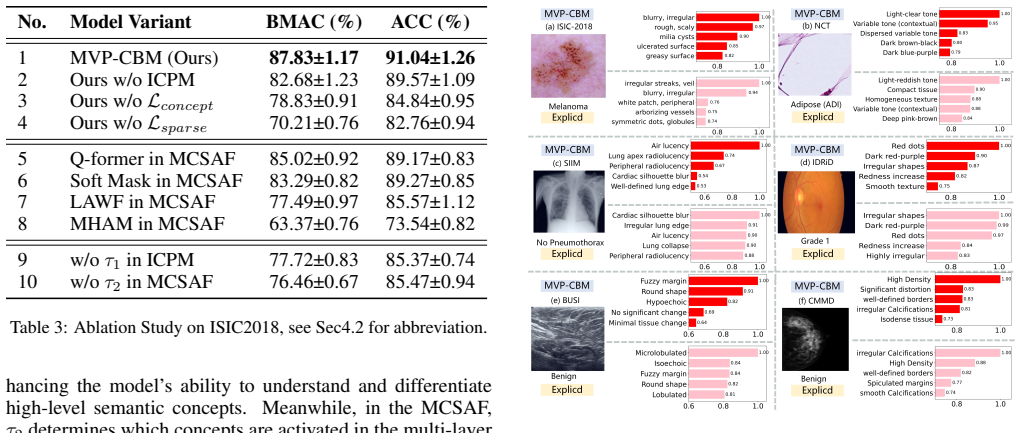
- Sparse fusion acts as a noise filter: ablations in the paper tie large accuracy drops to removing the sparsity loss (balanced accuracy on ISIC2018 falls from 87.83 to 70.21), implying sparsity is load-bearing, not decoration.
- Because the mechanism only needs class and patch tokens at multiple layers, the same preference modeling and sparse aggregation could be applied to other transformer encoders and to any concept-bottleneck task.
- LLM-generated diagnostic criteria can continue to serve as the concept vocabulary, keeping the pipeline in the automatic-concept family of CBMs.
Reading between the lines
- The paper does not explain where per-image concept labels $y_c$ come from; since no benchmark used here carries official dense concept annotations, the concept cross-entropy term may rely on an undisclosed pseudo-labeling procedure, and the interpretability numbers should be re-read with that caveat.
- If the learned per-layer preferences are stable within a disease class, the preference vectors themselves could be audited as a shortcut detector: a concept whose preferred layer is an unexpectedly shallow texture layer might indicate the model is latching onto color or artifact cues rather than clinical structure.
- A direct transfer test is to apply the same two modules to a different large vision-language encoder or to a non-medical dataset with real concept annotations; the paper's phenomenon claim predicts qualitative agreement, while its accuracy claim would be domain-dependent.
Editorial analysis
A structured set of objections, weighed in public.
Referee Report
Summary. The manuscript proposes MVP-CBM, a concept bottleneck model for medical image classification that uses multi-layer visual features instead of only the final encoder layer. Two modules are introduced: Intra-layer Concept Preference Modeling (ICPM), which computes per-layer preferences for concept attributes from class tokens and text embeddings, and Multi-layer Concept Sparse Activation Fusion (MCSAF), which sparsely aggregates concept activations across layers. The authors report state-of-the-art accuracy and interpretability on seven medical benchmark datasets, with ablations on ISIC2018 supporting the contribution of each module. The training objective in Eq. (18) includes a concept-label term L_ce(y_c, s_c), but the paper does not state where per-image concept labels come from; none of the seven datasets provides such labels, and the Implementation Details only describe per-class diagnostic criteria generated with GPT-o1. The interpretability claims are supported only by qualitative top-5 concept visualizations, not by quantitative evaluation.
Significance. If the missing concept-label provenance is resolved, the paper makes a useful and clearly described contribution to explainable medical image classification. The multi-layer preference idea is a reasonable extension of concept bottleneck models, and the authors provide code, report ablations, and evaluate on multiple datasets. The strengths are the clear module design and the breadth of benchmarks. However, the central training loss depends on an undisclosed per-image concept-label signal, the interpretability claim lacks quantitative support, and several reported accuracy gains overlap within one standard deviation of the baselines. These issues currently prevent full verification of the stated contributions.
major comments (4)
- [§3.2, Eq. (18)] The training loss is L = L_ce(y, ŷ) + λ1 L_ce(y_c, s_c) + λ2 L_sparse, but no passage in the manuscript states how the per-image concept labels y_c are obtained. The seven datasets described in Section 4 do not provide official per-image concept annotations, and Implementation Details only mention GPT-o1-generated diagnostic criteria (Fig. 3), which are per-class textual descriptions rather than per-image labels. Ablation No.3 in Table 3 shows that removing L_concept reduces BMAC on ISIC2018 from 87.83 to 78.83, so this term is load-bearing for the reported performance. Please specify whether y_c comes from human experts, LLM-generated pseudo-labels, automatic extraction, or another procedure; if such labels are not available, the objective and the corresponding ablation need to be revised or removed.
- [§4.4] The claim of 'state-of-the-art interpretability' is supported only by selected top-5 concept visualizations in Fig. 6. There is no quantitative evaluation of explanation quality, such as concept fidelity, intervention accuracy, or comparison against human judgments. The preference values p_{ℓ,i} are computed from the model's own class tokens and text embeddings, so the current evidence cannot distinguish a faithful explanation from an internally consistent rationalization. Please add a concrete interpretability evaluation protocol before claiming superiority in interpretability.
- [Tables 1 and 2] Several reported advantages over baselines are within one standard deviation of the baseline mean, e.g., ISIC2018 BMAC 87.83±1.17 versus ViT-Base 87.31±1.17 and Explicd 86.85±0.94, and ACC 91.04±1.26 versus ViT-Base 89.34±0.97 and Explicd 90.44±1.21. The text treats these as decisive wins, but the overlap means the conclusion is not statistically grounded for those datasets. Please either report significance tests or soften the claims for cases where differences are not significant.
- [Table 3, No. 4] Removing L_sparse (Eq. 16) causes BMAC to drop from 87.83 to 70.21, a decrease of 17.6 percentage points. This is a surprisingly large effect for a sparsity regularizer that is defined on deterministic masks, and the mechanism is unclear. Since Eq. 16 is a penalty on the average number of active masks, removing it should weaken the sparsity pressure but should not normally cause such a large accuracy collapse under the same classification loss. Please clarify the mechanism or check for a typo in the ablation.
minor comments (6)
- [Abstract] The abstract states that MVP-CBM achieves state-of-the-art accuracy and 'interoperability'; this should be 'interpretability'.
- [§3.2, Eq. (18)] The symbol y_c is used in Eq. (18) but is not defined before its first use; please define it explicitly in the text even if the labeling provenance is clarified.
- [Implementation Details] The text says the concept details are 'listed in appendix', but no appendix is present in the submitted manuscript. Please include the appendix or remove the reference.
- [Figure 2] Figure 2 contains garbled or overlapping mathematical symbols (e.g., 's(𝑚𝑚·𝑘𝑘)' and '𝑐𝑐𝑝𝑝𝑝𝑝𝑠𝑠𝑐𝑐𝑠𝑠'); the figure should be typeset cleanly so that the notation matches the equations.
- [Throughout] The method name 'Explicd' appears to be a typo for 'Explicit' or is otherwise inconsistent with the reference [Gao et al., 2024]; please use one consistent name.
- [Tables 1 and 2] The tables use '±' standard deviations but no significance tests; adding p-values or confidence intervals would improve the statistical rigor of the comparison.
Circularity Check
No significant circularity: the architecture's preference weights are learned internal mixture coefficients, and the reported performance comparisons rest on an end-to-end training procedure, not on a quantity that equals its own input by construction.
full rationale
The paper's central mechanism is an architectural proposal: Eq. (7)-(8) define per-layer attribute preference values as normalized cosine similarities between layer class tokens and attribute text embeddings, and Eq. (10)-(15) use those values to weight and sparsely fuse concept activation scores before classification in Eq. (17). This is a learned internal weighting scheme, not a derivation in which a target quantity is defined in terms of itself. The concept activation scores s_{agg} are computed from the same visual features used for classification, but that is inherent to all concept bottleneck models and does not make the reported accuracy results circular: the class predictions are compared against held-out disease labels y, and the ablations in Table 3 evaluate concrete design choices against the same external labels. The interpretability demonstrations are qualitative and self-referential in the sense that the model defines its own top activated concepts, but the paper does not claim to derive interpretability from an independent ground-truth measure, so this is a limitation of validation rather than a circular derivation. The self-citations to Zhang et al. (2022, 2023a) concern image-text matching background and are not load-bearing for any central claim. The most significant weakness is that Eq. (18) includes L_ce(y_c, s_c) with per-image concept labels y_c, while the paper never states how y_c is obtained or which of the seven datasets supplies such dense annotations; this is a reproducibility and correctness gap, not circularity, because it does not make any reported result equal to an input by construction. No step in the derivation chain reduces to a fitted parameter renamed as a prediction, a self-citation chain, or a definitional identity.
Assumptions & free parameters
free parameters (5)
- τ1 =
learned, initialized to 0.2
- τ2 =
learned, initialized to 0.2
- K =
learned, initialized to 0
- λ1 and λ2 =
not specified
- Linear classifier Ψ weights =
learned
assumptions (4)
- domain assumption Pre-trained BioMedCLIP visual and text encoders provide semantically aligned features.
- domain assumption Cosine similarity between pooled visual features and concept text embeddings measures concept activation.
- ad hoc to paper Per-image concept labels y_c exist and are available for the concept loss.
- domain assumption The sparse hard-mask thresholding preserves useful information while removing noise.
Cite this review
Pith. "Pith review of MVP-CBM:Multi-layer Visual Preference-enhanced Concept Bottleneck Model for Explainable Medical Image Classification." pith.science (2026). https://pith.science/paper/CSVKNDUG
@misc{pith2026250612568,
  author       = {Pith},
  title        = {Pith review of: MVP-CBM:Multi-layer Visual Preference-enhanced Concept Bottleneck Model for Explainable Medical Image Classification},
  year         = {2026},
  howpublished = {\url{https://pith.science/paper/CSVKNDUG}},
  note         = {Machine review of arXiv:2506.12568}
}
read the original abstract
The concept bottleneck model (CBM), as a technique improving interpretability via linking predictions to human-understandable concepts, makes high-risk and life-critical medical image classification credible. Typically, existing CBM methods associate the final layer of visual encoders with concepts to explain the model's predictions. However, we empirically discover the phenomenon of concept preference variation, that is, the concepts are preferably associated with the features at different layers than those only at the final layer; yet a blind last-layer-based association neglects such a preference variation and thus weakens the accurate correspondences between features and concepts, impairing model interpretability. To address this issue, we propose a novel Multi-layer Visual Preference-enhanced Concept Bottleneck Model (MVP-CBM), which comprises two key novel modules: (1) intra-layer concept preference modeling, which captures the preferred association of different concepts with features at various visual layers, and (2) multi-layer concept sparse activation fusion, which sparsely aggregates concept activations from multiple layers to enhance performance. Thus, by explicitly modeling concept preferences, MVP-CBM can comprehensively leverage multi-layer visual information to provide a more nuanced and accurate explanation of model decisions. Extensive experiments on several public medical classification benchmarks demonstrate that MVP-CBM achieves state-of-the-art accuracy and interoperability, verifying its superiority. Code is available at https://github.com/wcj6/MVP-CBM.
Figures


Figures from the paper (2 more)

Reference graph
Works this paper leans on
-
[1]
Walid Al-Dhabyani, Mohammed Gomaa, Hussien Khaled, and Fahmy Aly. Deep learning approaches for data augmentation and classification of breast masses using ultrasound images. Int. J. Adv. Comput. Sci. Appl , 10(5):1--11, 2019
work page 2019
-
[2]
Chunyan Cui, Li Li, Hongmin Cai, Zhihao Fan, Ling Zhang, Tingting Dan, Jiao Li, and Jinghua Wang. The chinese mammography database (cmmd): An online mammography database with biopsy confirmed types for machine diagnosis of breast. The Cancer Imaging Archive , 1, 2021
work page 2021
-
[3]
An image is worth 16x16 words: Transformers for image recognition at scale
Alexey Dosovitskiy. An image is worth 16x16 words: Transformers for image recognition at scale. arXiv preprint arXiv:2010.11929 , 2020
arXiv 2010
-
[4]
Aligning human knowledge with visual concepts towards explainable medical image classification
Yunhe Gao, Difei Gu, Mu Zhou, and Dimitris Metaxas. Aligning human knowledge with visual concepts towards explainable medical image classification. In International Conference on Medical Image Computing and Computer-Assisted Intervention , pages 46--56. Springer, 2024
work page 2024
-
[5]
Deep residual learning for image recognition
Kaiming He, Xiangyu Zhang, Shaoqing Ren, and Jian Sun. Deep residual learning for image recognition. In Proceedings of the IEEE Conference on Computer Vision and Pattern Recognition , pages 770--778, 2016
2016
-
[6]
Self-explainable ai for medical image analysis: A survey and new outlooks
Junlin Hou, Sicen Liu, Yequan Bie, Hongmei Wang, Andong Tan, Luyang Luo, and Hao Chen. Self-explainable ai for medical image analysis: A survey and new outlooks. arXiv preprint arXiv:2410.02331 , 2024
arXiv 2024
-
[7]
Mimic-cxr, a de-identified publicly available database of chest radiographs with free-text reports
Alistair EW Johnson, Tom J Pollard, Seth J Berkowitz, Nathaniel R Greenbaum, Matthew P Lungren, Chih-ying Deng, Roger G Mark, and Steven Horng. Mimic-cxr, a de-identified publicly available database of chest radiographs with free-text reports. Scientific Data , 6(1):317, 2019
work page 2019
-
[8]
100,000 histological images of human colorectal cancer and healthy tissue
Jakob Nikolas Kather, Niels Halama, and Alexander Marx. 100,000 histological images of human colorectal cancer and healthy tissue. Zenodo10 , 5281(9), 2018
work page 2018
Show all 27 references
-
[9]
Probabilistic concept bottleneck models
Eunji Kim, Dahuin Jung, Sangha Park, Siwon Kim, and Sungroh Yoon. Probabilistic concept bottleneck models. arXiv preprint arXiv:2306.01574 , 2023
2023 arXiv
-
[10]
Concept bottleneck models
Pang Wei Koh, Thao Nguyen, Yew Siang Tang, Stephen Mussmann, Emma Pierson, Been Kim, and Percy Liang. Concept bottleneck models. In International Conference on Machine Learning , pages 5338--5348. PMLR, 2020
2020
-
[11]
Label-free concept bottleneck models
Tuomas Oikarinen, Subhro Das, Lam Nguyen, and Lily Weng. Label-free concept bottleneck models. In International Conference on Learning Representations , 2023
2023
-
[12]
Indian diabetic retinopathy image dataset (idrid): a database for diabetic retinopathy screening research
Prasanna Porwal, Samiksha Pachade, Ravi Kamble, Manesh Kokare, Girish Deshmukh, Vivek Sahasrabuddhe, and Fabrice Meriaudeau. Indian diabetic retinopathy image dataset (idrid): a database for diabetic retinopathy screening research. Data , 3(3):25, 2018
2018
-
[13]
Learning transferable visual models from natural language supervision
Alec Radford and et al. Learning transferable visual models from natural language supervision. In Proceedings of the International Conference on Machine Learning (ICML) , pages 8748--8763, 2021
2021
-
[14]
Incremental residual concept bottleneck models
Chenming Shang, Shiji Zhou, Hengyuan Zhang, Xinzhe Ni, Yujiu Yang, and Yuwang Wang. Incremental residual concept bottleneck models. In Proceedings of the IEEE/CVF Conference on Computer Vision and Pattern Recognition , pages 11030--11040, 2024
2024
-
[15]
Conceptnet 5.5: An open multilingual graph of general knowledge
Robyn Speer, Joshua Chin, and Catherine Havasi. Conceptnet 5.5: An open multilingual graph of general knowledge. In Proceedings of the AAAI conference on Artificial Intelligence , volume 31, 2017
2017
-
[16]
The ham10000 dataset, a large collection of multi-source dermatoscopic images of common pigmented skin lesions
Philipp Tschandl, Cliff Rosendahl, and Harald Kittler. The ham10000 dataset, a large collection of multi-source dermatoscopic images of common pigmented skin lesions. Scientific Data , 5(1):1--9, 2018
2018
-
[17]
Molecular classification of breast cancer
Darina Vuong, Peter T Simpson, Benjamin Green, Margaret C Cummings, and Sunil R Lakhani. Molecular classification of breast cancer. Virchows Archiv , 465:1--14, 2014
2014
-
[18]
Medclip: Contrastive learning from unpaired medical images and text
Zifeng Wang, Zhenbang Wu, Dinesh Agarwal, and Jimeng Sun. Medclip: Contrastive learning from unpaired medical images and text. arXiv preprint arXiv:2210.10163 , 2022
2022 arXiv
-
[19]
Language in a bottle: Language model guided concept bottlenecks for interpretable image classification
Yue Yang, Artemis Panagopoulou, Shenghao Zhou, Daniel Jin, Chris Callison-Burch, and Mark Yatskar. Language in a bottle: Language model guided concept bottlenecks for interpretable image classification. In Proceedings of the IEEE/CVF Conference on Computer Vision and Pattern R...
2023
-
[20]
Deco: Decoupling token compression from semantic abstraction in multimodal large language models
Linli Yao, Lei Li, Shuhuai Ren, Lean Wang, Yuanxin Liu, Xu Sun, and Lu Hou. Deco: Decoupling token compression from semantic abstraction in multimodal large language models. arXiv preprint arXiv:2405.20985 , 2024
2024 arXiv
-
[21]
Post-hoc concept bottleneck models
Mert Yuksekgonul, Maggie Wang, and James Zou. Post-hoc concept bottleneck models. arXiv preprint arXiv:2205.15480 , 2022
2022 arXiv
-
[22]
Concept embedding models
Mateo Espinosa Zarlenga, Pietro Barbiero, Gabriele Ciravegna, Giuseppe Marra, Francesco Giannini, Michelangelo Diligenti, Frederic Precioso, Stefano Melacci, Adrian Weller, Pietro Lio, et al. Concept embedding models. In NeurIPS 2022-36th Conference on Neural Information Proce...
2022
-
[23]
Siim-acr pneumothorax segmentation
Anna Zawacki, Carol Wu, George Shih, Julia Elliott, Mikhail Fomitchev, Mohannad Hussain, ParasLakhani, Phil Culliton, and Shunxing Bao. Siim-acr pneumothorax segmentation. https://kaggle.com/competitions/siim-acr-pneumothorax-segmentation, 2019. Kaggle
2019
-
[24]
Negative-aware attention framework for image-text matching
Kun Zhang, Zhendong Mao, Quan Wang, and Yongdong Zhang. Negative-aware attention framework for image-text matching. In Proceedings of the IEEE/CVF conference on computer vision and pattern recognition , pages 15661--15670, 2022
2022
-
[25]
Unified adaptive relevance distinguishable attention network for image-text matching
Kun Zhang, Zhendong Mao, An-An Liu, and Yongdong Zhang. Unified adaptive relevance distinguishable attention network for image-text matching. IEEE Transactions on Multimedia , 25:1320--1332, 2023
2023
-
[26]
Biomedclip: A multimodal biomedical foundation model pretrained from fifteen million scientific image-text pairs
Sheng Zhang, Yanbo Xu, Naoto Usuyama, Hanwen Xu, Jaspreet Bagga, Robert Tinn, Sam Preston, Rajesh Rao, Mu Wei, Naveen Valluri, et al. Biomedclip: A multimodal biomedical foundation model pretrained from fifteen million scientific image-text pairs. arXiv preprint arXiv:2303.009...
2023 arXiv
-
[27]
write newline
" write newline "" before.all 'output.state := FUNCTION fin.entry add.period write newline FUNCTION new.block output.state before.all = 'skip after.block 'output.state := if FUNCTION new.sentence output.state after.block = 'skip output.state before.all = 'skip after.sentence '...
Reviewed August 7, 2026 · model on record in the stance chip above.
Discussion (0). Sign in to comment.