fPINN-DeepONet: A Physics-Informed Operator Learning Framework for Multi-term Time-fractional Mixed Diffusion-wave Equations
Pith reviewed 2026-05-19 21:13 UTC · model grok-4.3
The pith
The fPINN-DeepONet framework solves multi-term time-fractional mixed diffusion-wave equations with variable fractional orders by combining operator learning and an L2 approximation for Caputo derivatives.
A machine-rendered reading of the paper's core claim, the machinery that carries it, and where it could break.
Core claim
We develop the fPINN-DeepONet by deriving an L2 approximation which achieves first-order accuracy for the Caputo fractional derivative of order β ∈ (1,2). This approximation is integrated into the operator learning framework to solve the equations, and numerical experiments confirm its accuracy, robustness to noise, and ability to handle space-time varying fractional orders.
What carries the argument
fPINN-DeepONet, which embeds the derived L2 approximation for Caputo derivatives inside a physics-informed DeepONet to learn solution operators for fractional PDEs.
If this is right
- The framework solves multi-term time-fractional mixed diffusion-wave equations.
- It handles dynamically varying fractional orders in both space and time.
- It remains accurate and robust when input data contain noise.
- It applies equally to fixed-order and variable-order versions of the target equations.
Where Pith is reading between the lines
- The same embedding of the L2 scheme could be tested on other fractional operators such as Riemann-Liouville derivatives.
- Once the operator is learned, repeated queries for new initial conditions or source terms become cheap, suggesting use in real-time control of anomalous-diffusion systems.
- Scaling experiments in three or more spatial dimensions would test whether the current training cost grows acceptably with problem size.
Load-bearing premise
The derived L2 approximation achieves first-order accuracy for the Caputo fractional derivative of order β ∈ (1,2) and integrates directly into the operator learning architecture without loss of stability or consistency.
What would settle it
Run the L2 approximation on a test function with known Caputo derivative of order 1.5 and verify that the error decreases linearly with the time-step size; any deviation from first-order convergence would falsify the accuracy claim.
Figures



read the original abstract
In this paper, we develop a physics-informed deep operator learning framework for solving multi-term time-fractional mixed diffusion-wave equations (TFMDWEs). We begin by deriving an $L_2$ approximation, which achieves first-order accuracy for the Caputo fractional derivative of order $\beta \in (1,2)$. Building upon this foundation, we propose the fPINN-DeepONet framework, a novel approach that integrates operator learning with the $L_2$ approximation to efficiently solve fractional partial differential equations (FPDEs). Our framework is successfully applied to both fixed and variable fractional-order PDEs, demonstrating the framework's versatility and broad applicability. To evaluate the performance of the proposed model, we conduct a series of numerical experiments that involve dynamically varying fractional orders in both space and time, as well as scenarios with noisy data. These results highlight the accuracy, robustness, and efficiency of the fPINN-DeepONet framework.
Editorial analysis
A structured set of objections, weighed in public.
Referee Report
Summary. The paper develops the fPINN-DeepONet framework for multi-term time-fractional mixed diffusion-wave equations. It derives an L2 approximation to the Caputo derivative of order β ∈ (1,2) that is claimed to be first-order accurate, then embeds this approximation inside a physics-informed DeepONet architecture to handle both fixed-order and variable-order (space- and time-dependent) fractional PDEs. Numerical experiments are reported for dynamically varying fractional orders and for noisy data, with the abstract asserting that the resulting method is accurate, robust, and efficient.
Significance. If the central consistency claim holds, the work would supply a practical operator-learning route to variable-order fractional PDEs that avoids repeated re-derivation of discretizations when the order function changes. The combination of an explicit L2 history integral with DeepONet branch-trunk structure could be useful for parametric or inverse problems in anomalous transport. However, the absence of quantitative error tables, convergence rates, or baseline comparisons in the provided text leaves the practical gain over existing PINN or DeepONet treatments of fractional operators unquantified.
major comments (2)
- [Abstract] Abstract: the central claim that the derived L2 approximation integrates into the DeepONet loss without degrading consistency or stability when fractional orders vary in both space and time is not supported by any displayed error analysis or residual bound. Standard L2 schemes for fixed β rely on uniform time-step assumptions; the variable-order case introduces commutator terms between β(x,t) and the history integral that are not automatically O(Δt) and must be controlled explicitly in the physics-informed residual.
- [Numerical experiments] The manuscript supplies no quantitative error tables, baseline comparisons against other fractional PINN or DeepONet variants, or observed convergence rates under mesh refinement. Without these data the assertions of first-order accuracy for the L2 scheme and of robustness under noise cannot be verified from the given text.
minor comments (2)
- [Section 3] Notation for the multi-term operator and the precise definition of the L2 quadrature weights should be stated explicitly before the DeepONet loss is written.
- [Figures] Figure captions should include the exact values of the noise level σ and the range of the variable order β(x,t) used in each experiment.
Simulated Author's Rebuttal
We thank the referee for the constructive feedback on our manuscript. We address each major comment point by point below and indicate the revisions we will make to strengthen the presentation of the error analysis and numerical results.
read point-by-point responses
-
Referee: [Abstract] Abstract: the central claim that the derived L2 approximation integrates into the DeepONet loss without degrading consistency or stability when fractional orders vary in both space and time is not supported by any displayed error analysis or residual bound. Standard L2 schemes for fixed β rely on uniform time-step assumptions; the variable-order case introduces commutator terms between β(x,t) and the history integral that are not automatically O(Δt) and must be controlled explicitly in the physics-informed residual.
Authors: We agree that a rigorous treatment of the commutator terms is necessary for the variable-order case. The manuscript derives the L2 approximation for fixed β ∈ (1,2) and then applies it within the DeepONet framework by allowing β to be a space-time dependent input to the operator. However, the current text does not explicitly bound the additional terms that arise when β(x,t) varies. In the revised manuscript we will add a dedicated error analysis subsection that derives the consistency error for the variable-order L2 scheme, showing that the commutator contribution remains O(Δt) under standard smoothness assumptions on β, and we will incorporate the corresponding residual bound into the physics-informed loss discussion. revision: yes
-
Referee: [Numerical experiments] The manuscript supplies no quantitative error tables, baseline comparisons against other fractional PINN or DeepONet variants, or observed convergence rates under mesh refinement. Without these data the assertions of first-order accuracy for the L2 scheme and of robustness under noise cannot be verified from the given text.
Authors: We acknowledge that the numerical section currently emphasizes visual results and qualitative statements rather than tabulated metrics. In the revision we will add tables reporting L² and L^∞ errors for representative fixed- and variable-order problems, observed convergence rates under successive time-step refinement to confirm the first-order accuracy of the L2 scheme, and direct comparisons against a standard fractional PINN baseline and a non-physics-informed DeepONet. We will also include quantitative error statistics for the noisy-data experiments to substantiate the robustness claims. revision: yes
Circularity Check
No circularity: derivation builds on independently derived L2 approximation
full rationale
The provided abstract and description state that the authors derive an L2 approximation achieving first-order accuracy for the Caputo derivative at fixed β ∈ (1,2), then integrate this approximation into the fPINN-DeepONet operator-learning architecture. Numerical experiments test the combined framework on variable-order and noisy cases. No equations, claims, or self-citations in the given text reduce reported performance or consistency to quantities defined by the same fitted parameters or prior self-referential results. The central claim remains independent of its inputs by construction, consistent with the reader's assessment of score 2.0 and the absence of any load-bearing self-definition, fitted-input-as-prediction, or ansatz-smuggling patterns.
Axiom & Free-Parameter Ledger
free parameters (1)
- fractional order β
axioms (1)
- domain assumption The L2 approximation is first-order accurate for the Caputo derivative when β ∈ (1,2).
Lean theorems connected to this paper
-
IndisputableMonolith/Cost/FunctionalEquation.leanwashburn_uniqueness_aczel unclear?
unclearRelation between the paper passage and the cited Recognition theorem.
We begin by deriving an L2 approximation, which achieves first-order accuracy for the Caputo fractional derivative of order β ∈ (1,2). ... fPINN-DeepONet framework ... dynamically varying fractional orders in both space and time
-
IndisputableMonolith/Foundation/AlphaCoordinateFixation.leancostAlphaLog_high_calibrated_iff unclear?
unclearRelation between the paper passage and the cited Recognition theorem.
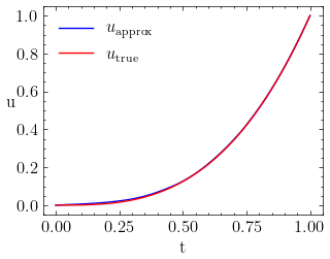
Use the L2 approximation to solve u_approx for f_approx using Eqs. (2.1) and (2.2)
What do these tags mean?
- matches
- The paper's claim is directly supported by a theorem in the formal canon.
- supports
- The theorem supports part of the paper's argument, but the paper may add assumptions or extra steps.
- extends
- The paper goes beyond the formal theorem; the theorem is a base layer rather than the whole result.
- uses
- The paper appears to rely on the theorem as machinery.
- contradicts
- The paper's claim conflicts with a theorem or certificate in the canon.
- unclear
- Pith found a possible connection, but the passage is too broad, indirect, or ambiguous to say the theorem truly supports the claim.
Reference graph
Works this paper leans on
-
[1]
Hao Zhaopeng, Lin Guang, Finite difference schemes for multi-term time-fractional mixed diffusion-wave equa- tions, arXiv preprint arXiv:1607.07104 (2016)
work page internal anchor Pith review Pith/arXiv arXiv 2016
-
[2]
J. F. Kelly, R. J. McGough, M. M. Meerschaert, Analytical time-domain Green’s functions for power-law media, J. Acoust. Soc. Am. 124 (5) (2008) 2861-2872
work page 2008
-
[3]
J. Chen, F. Liu, V. Anh, S. Shen, Q. Liu, C. Liao, The analytical solution and numerical solution of the fractional diffusion-wave equation with damping, Appl. Math. Comput. 219 (2012) 1737-1748
work page 2012
-
[4]
R. Schumer, D. A. Benson, M. M. Meerschaert, B. Baeumer, Fractal mobile/immobile solute transport, Water Res. Research. 39 (10) (2003) 1296
work page 2003
-
[5]
R. Metzler, J. Klafter, I. M. Sokolov, Anomalous transport in external fields: Continuous time random walks and fractional diffusion equations extended, Phys. Rev. E 58 (2) (1998) 1621-1633
work page 1998
-
[6]
E. Orsingher, L. Beghin, Time-fractional telegraph equations and telegraph processes with Brownian time, Prob. Theory Rel. Fields 128 (2004) 141-160
work page 2004
-
[7]
Xu Xingjian, Chen Minghua, Discovery of subdiffusion problem with noisy data via deep learning, Journal of Scientific Computing 92 (2022) 23
work page 2022
-
[8]
Pang Guofei, Lu Lu, Karniadakis George Em, fPINNs: Fractional physics-informed neural networks, SIAM Journal on Scientific Computing 41 (2019) A2603–A2626
work page 2019
-
[9]
Y. Luchko, Initial-boundary-value problems for the generalized multi-term time-fractional diffusion equation, J. Math. Anal. Appl. 374 (2011) 538-548
work page 2011
-
[10]
V. Daftardar-Gejji, S. Bhalekar, Boundary value problems for multi-term fractional differential equations, J. Math. Anal. Appl. 345 (2008) 754-765
work page 2008
-
[11]
Stojanovic, Numerical method for solving diffusion-wave phenomena, J
M. Stojanovic, Numerical method for solving diffusion-wave phenomena, J. Comput. Appl. Math. 235 (2011) 3121-3137
work page 2011
- [12]
-
[13]
X. Ding, Y. Jiang, Analytical solutions for the multi-term time-space fractional advection diffusion equations with mixed boundary conditions, Nonliear Anal. RWA 14 (2013) 1026-1033
work page 2013
-
[14]
X. Fang, L. Qiao, F. Zhang, and F. Sun, ”Explore deep network for a class of fractional partial differential equations,”Chaos, Solitons & Fractals, vol. 172, p. 113528, 2023. 21
work page 2023
-
[15]
L. Guo, H. Wu, X. Yu, and T. Zhou, ”Monte Carlo fPINNs: Deep learning method for forward and inverse problems involving high dimensional fractional partial differential equations,”Computer Methods in Applied Mechanics and Engineering, vol. 400, p. 115523, 2022
work page 2022
-
[16]
lu lu, Jin Pengzhan, Karniadakis George Em, Deeponet: Learning nonlinear operators for identifying differential equations based on the universal approximation theorem of operators, arXiv preprint arXiv:1910.03193
work page internal anchor Pith review Pith/arXiv arXiv 1910
-
[17]
M. Stojanovic, Regularity of solutions to nonlinear time fractional differential equation, Acta Mathematica Scientia 33 (6) (2013) 1721-1735
work page 2013
-
[18]
Moya, Christian, and Guang Lin. ”Fed-deeponet: Stochastic gradient-based federated training of deep operator networks.”Algorithms, vol. 15, no. 9, 2022, p. 325. MDPI
work page 2022
-
[19]
Lu, Binghang, Christian Moya, and Guang Lin. ”NSGA-PINN: A multi-objective optimization method for physics-informed neural network training.”Algorithms, vol. 16, no. 4, 2023, p. 194. MDPI
work page 2023
-
[20]
Z.Z. Sun, Numerical methods of partial differential equations, 2D Edition, Science Press, Beijing, (2012) (in Chinese)
work page 2012
-
[21]
Y. Liu, B. H. Lu, J. Peng, and Z. Zhang. Research on the use of YOLOv5 object detection algorithm in mask wearing recognition.World Scientific Research Journal, 6(11):276–284, 2020
work page 2020
-
[22]
B. Lu, C. Mou, and G. Lin. iPINNER: An iterative physics-informed neural network with ensemble Kalman filter.Journal of Computational Physics, 114592, 2025
work page 2025
-
[23]
B. Lu, C. Mou, and G. Lin. Morephy-Net: An evolutionary multi-objective optimization for replica-exchange- based physics-informed neural operator learning networks. Available at SSRN 6253351, 2025
work page 2025
-
[24]
B. Lu, Z. Deng, R. Zhang, B. Hu, Y. Zhao, Y. Tian, C. Mou, G. Lin, and X. Li. Muon-OGD: Muon-based spectral orthogonal gradient projection for LLM continual learning.arXiv preprint arXiv:2605.08949, 2026
work page internal anchor Pith review Pith/arXiv arXiv 2026
-
[25]
B. Lu, R. Zhang, C. Mou, N. Li, and G. Lin. AdamFLIP: Adaptive momentum feedback linearization opti- mization for hard constrained PINN training.arXiv preprint arXiv:2605.08408, 2026
work page internal anchor Pith review Pith/arXiv arXiv 2026
-
[26]
X. Li, J. Hou, Z. Deng, Z. Zhang, T. Li, B. Lu, B. Hu, Y. Zhao, and Y. Hao. Chain of Risk: Safety failures in large reasoning models and mitigation via adaptive multi-principle steering.arXiv preprint arXiv:2605.05678, 2026
work page internal anchor Pith review Pith/arXiv arXiv 2026
- [27]
- [28]
-
[29]
B. Jin, R. Lazarov, Y. Liu, Z. Zhou, The Galerkin finite element method for a multi-term time-fractional diffusion equation, J. Comput. Phys. 281 (2015) 825-843
work page 2015
- [30]
-
[31]
H. Ye, F. Liu, V. Anh, I. Turner, Numerical analysis for the time distributed-order and Riesz space fractional diffusions on bounded domains, IMA. J. Appl. Math. 79 (6) (2014)
work page 2014
-
[32]
Paszke, A., Gross, S., Chintala, S., Chanan, G., Yang, E., DeVito, Z., Lin, Z., Desmaison, A., Antiga, L., & Lerer, A. (2017). Automatic differentiation in PyTorch. In *NIPS Workshop on Machine Learning Systems*
work page 2017
-
[33]
M.L. Morgado, M. Rebelo, Numerical approximation of distributed order reaction-diffusion equations, J. Com- put. Appl. Math. 275 (2014) 216-227
work page 2014
-
[34]
A. A. Alikhanov, A new difference scheme for the time fractional diffusion equation, J. Comput. Phys. 280 (2015) 424-438
work page 2015
-
[35]
A.A. Alikhanov, A priori estimates for solutions of boundary value problems for fractional-order equations, Differ. Equ. 46(5) (2010) 660-666. 22
work page 2010
discussion (0)
Sign in with ORCID, Apple, or X to comment. Anyone can read and Pith papers without signing in.