REVIEW 2 major objections 4 minor 130 references
How does nonmetricity shape quantum emission from rotating bumblebee black holes?
T0 review · 2 major / 4 minor · reviewed 2026-08-06 · deepseek-v4-flash
Pith's one-line read In a rotating metric-affine black hole, the horizon temperature depends on latitude, so no single Hawking temperature exists.
desk verdict Careful and honest comparison of rotating bumblebee black holes; the no-global-temperature claim is real but conditional on a global regularity extension that is not supplied. read the letter →
The pith
A machine-rendered reading of the paper's core claim, the machinery that carries it, and where it could break.
The reading
What carries the argument
The central object is the metric-affine rotating line element (Eq. 7), whose off-diagonal component $g_{r\theta} = 2rXa\cos\theta \sqrt{\alpha}\,\beta^{3/2}/\sqrt{\Delta}$ couples the radial and angular sectors and prevents separation of the Klein-Gordon equation. The argument is carried by the local surface-gravity formula $\kappa_{\rm MA}(\theta) = \sqrt{q}\,\Delta'(r_+)/(2(r_+^2+a^2)) \, \sqrt{R_+/(\alpha \Sigma_+)}$, with $R_+ = \beta r_+^2 + \alpha a^2\cos^2\theta$ and $\Sigma_+ = r_+^2 + a^2\cos^2\theta$; the latitude dependence of this quantity is what forbids a global Hawking temperature. The other load-bearing move is the normalization of the stationary Killing vector at spatial inf
What would settle it
Solve the exact scalar field equation for the metric-affine geometry (Eq. 7) numerically with a coupled angular-radial expansion that includes modes with $L' \neq L$. If the flux at future null infinity nevertheless reduces to a Planck distribution with a single temperature after mode mixing, the no-global-temperature claim fails. Conversely, constructing a smooth globally regular bumblebee profile on the full manifold including the poles would settle whether the claimed obstruction is avoidable.
Extended reading notes
Core claim
The paper's central claim is that nonmetricity shapes rotating bumblebee-black-hole emission through the horizon geometry and the meridional sector, not through a displacement of the horizon. In the metric-affine rotating solution, the coordinate locations of the horizons and stationary limit surfaces coincide with Kerr's, $r_\pm = M \pm \sqrt{M^2-a^2}$, but the local surface gravity $\kappa_{\rm MA}(\theta)$ depends on the polar angle whenever $aX \neq 0$. As a result, the thermal exponent $(\omega - m\Omega_{\rm MA})/T_{\rm MA}(\theta)$ is latitude-dependent, so no single equilibrium Hawking temperature exists and a factorized Planck distribution over independent angular channels is invali
Load-bearing premise
The metric-affine rotating geometry is assumed to be a physically valid black hole with a regular horizon and polar axis; if a smooth bumblebee field cannot extend through the poles or the geometry is not globally regular, the latitude-dependent surface gravity may be a coordinate artifact rather than a physical horizon property.
Editorial extensions
If this is right
- For any rotating metric-affine bumblebee black hole with $aX \neq 0$, there is no single horizon temperature; the emission spectrum must be described by a coupled-channel greybody matrix, and a product over angular modes would double-count degrees of freedom.
- Time normalization at infinity is not optional: comparing unnormalized coordinate temperatures makes the two formulations look identical at first order, while normalized clocks give $\ell = 3X/4$ and reverse the ordering of the deformed solutions.
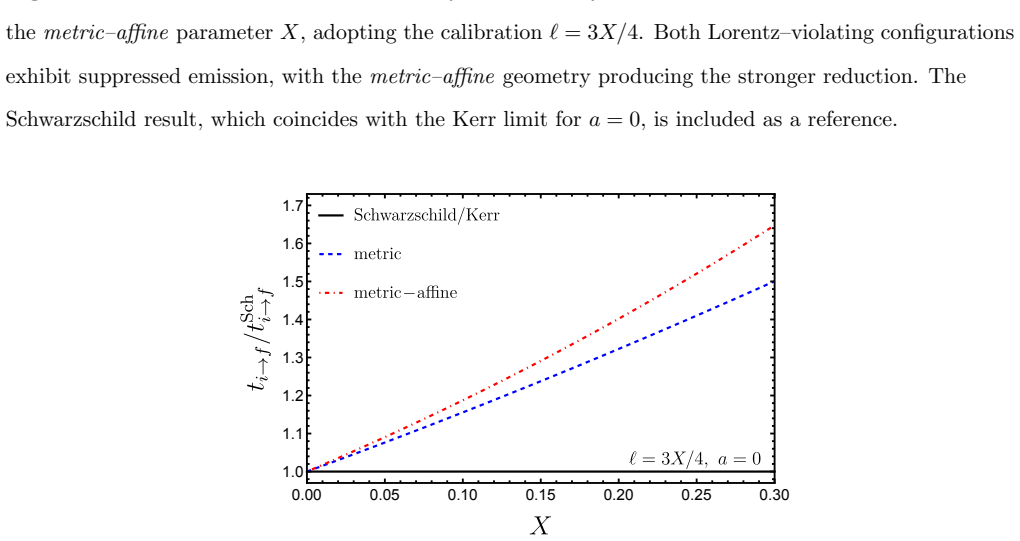
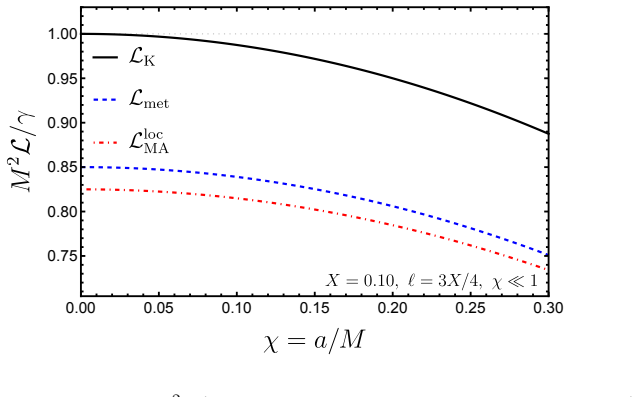
- In the static limit, both Lorentz-violating geometries are dimmer and longer-lived than Schwarzschild, with the hierarchy $L_{\rm Sch} > L_{\rm met} > L_{\rm MA}$ and $t_{\rm Sch} < t_{\rm met} < t_{\rm MA}$ under the same Stefan-Boltzmann prescription.
- The slow-rotation weak-deformation expansion preserves this tendency, but it does not yield a global rotating evaporation hierarchy; the exact rotating order is left open.
- Existing weak-field bounds on $\ell$ and $X$ imply fractional corrections to static temperatures, areas, angular velocities, luminosities, and lifetimes below $1.3\times 10^{-11}$.
Reading between the lines
- If the latitude-dependent surface gravity is a genuine horizon property, a rotating metric-affine black hole would emit a locally varying Hawking flux whose angular pattern could in principle be computed from the coupled scalar equation; no global Planck spectrum exists, but ray-wise local temperatures might still be meaningful.
- A known regularity obstruction to smooth symmetry-inheriting constant-norm bumblebee fields raises the possibility that no globally regular rotating metric-affine solution exists; in that case the no-global-temperature result would apply only to the exterior local patch, not to the complete spacetime.
- The coupled-channel structure suggests a concrete numerical test: solve the truncated coupled radial system for the greybody matrix and check whether mode mixing moves energy flux toward or away from the diagonal approximation; this would quantify how strongly nonmetricity reshapes rotating emission.
- The calibration $\ell = 3X/4$ could be turned into a cross-theory prediction: if future observations constrain one parameter, the other follows only under the assumption that both formulations describe the same underlying Lorentz violation; the paper itself treats the bounds as independent.
Editorial analysis
A structured set of objections, weighed in public.
Referee Report
Summary. The paper studies quantum emission from two rotating bumblebee-black-hole geometries: a Kerr-like metric constructed by a corrected Newman-Janis procedure (Eq. 1) and an exact stationary axisymmetric metric-affine solution (Eq. 7). The author normalizes the stationary Killing vector at spatial infinity, which changes the static temperature/evaporation comparison and yields the calibration ℓ=3X/4. For the metric geometry, Lorentz violation shifts the horizons and extremal boundary, increases the normalized horizon angular velocity, preserves a uniform surface gravity, and keeps the scalar wave equation separable; the paper derives tunneling factors, occupation numbers, a radial potential, and an analytic greybody bound. For the metric-affine geometry, nonmetricity leaves the Kerr coordinate positions of horizons and stationary limits unchanged but modifies the horizon area, angular velocity, and meridional sector; g_rθ couples angular channels and the local surface gravity, Eq. (31), becomes latitude-dependent for aX≠0. The central conclusion is that a single global Hawking temperature and independent channel-by-channel emission spectrum cannot be assigned to the generic rotating metric-affine configuration. The static limit yields exact luminosity and evaporation hierarchies, and the paper propagates weak-field bounds to show fractional corrections below ~1.3×10^{-11}.
Significance. If the central claim holds, the paper would be a useful contribution to the quantum-emission phenomenology of Lorentz-violating black holes. The careful normalization of asymptotic Killing vectors is a genuine improvement over earlier comparisons, and the explicit distinction between area-entropy and Wald entropy, the use of signed absorption probabilities in the superradiant sector, and the honest labeling of the metric solution as a benchmark are all commendable. The exact static hierarchies and the analytical greybody bound for the separable metric geometry are concrete results that do not depend on the rotating regularity issue. The paper is also unusually candid about the limitations of its rotating metric-affine construction.
major comments (2)
- [Sec. II.C and Sec. IV.B (Eq. 31)] The no-global-temperature claim is the central result, but it rests on the metric-affine geometry in Eq. (7) being a globally regular black hole. Sec. II.C explicitly restricts all results to "local exterior and nonpolar" and cites Guo-Fan [73], which obstructs smooth symmetry-inheriting constant-norm one-forms through the poles. Without a globally regular extension of the bumblebee field, the latitude-dependent κ_MA(θ) in Eq. (31) and the local tunneling factor in Eq. (86) are quantities in a local coordinate patch: they do not establish that a physical global black hole cannot have a uniform temperature. The abstract and conclusion state the no-global-temperature result unconditionally. The authors should either supply/verify a global regular extension or reformulate the central claim as explicitly conditional on such an extension.
- [Sec. II.A and Sec. II.C (Eq. 1)] The quantitative comparison of the two formulations uses the metric geometry in Eq. (1) as a benchmark, but no rotating bumblebee field profile or field-equation check is provided. The paper acknowledges this in Sec. II.C, yet subsequent sections treat the metric solution on the same footing as the metric-affine solution in deriving temperatures, greybody bounds, and evaporation hierarchies. The static hierarchies are unaffected, but the rotating metric-side predictions (e.g., Figs. 2, 5, and the hierarchy Ω_met>Ω_MA>Ω_K in Sec. VIII.A) should be presented as properties of a metric benchmark, not of a verified rotating bumblebee black hole. A short discussion of what would be needed to upgrade the benchmark to a solution would make the comparison more rigorous.
minor comments (4)
- [Sec. VII.C, Fig. 11 caption] The caption refers to the local non-equilibrium luminosity "defined in Eq. (155)", but Eq. (155) is the mass/angular-momentum evolution system. The local luminosity is defined in Eq. (165). Please correct the cross-reference.
- [Introduction, Sec. IX, Sec. X.C] Several typos appear: "regardindg", "seing", "Analogouslly", "crutial". A careful proofreading pass is recommended.
- [Sec. IV.B, Eq. (33)] The numerator a² cos²θ − 3r_+² is unambiguous, but adding parentheses, e.g., (a² cos²θ − 3r_+²)/(8(...)), would improve readability because the equation is quoted without a displayed fraction in the text.
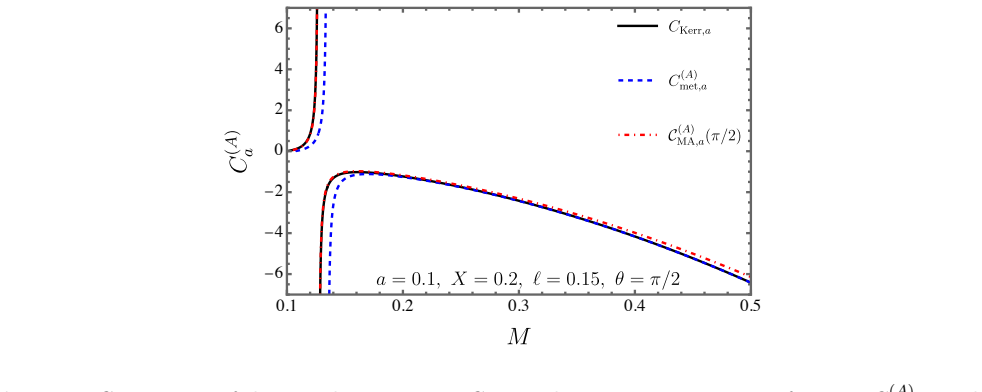
- [Sec. IV.D, Eq. (58)] The local response C_MA,a(θ) is defined through D_θ(r), but the notation for the partial derivative in Eq. (58) is not fully explicit; specifying whether r or M is held fixed in the derivative would remove ambiguity.
Circularity Check
No significant circularity: the central results are algebraic consequences of the stated metrics; the ℓ=3X/4 calibration is an explicit comparison convention, and the global-regularity caveat in Sec. II.C is a validity limitation, not a circular step.
full rationale
The paper's central claim—that the rotating metric-affine geometry has a latitude-dependent surface gravity and hence no single global Hawking temperature when aX≠0—is a direct calculation from the line element in Eq. (7). The local temperature in Eq. (31) and the detailed-balance factor in Eq. (86) follow algebraically; Eq. (86) is said to 'reproduce the latitude–dependent temperature in Eq. (31)', which is a consistency check, not a circular reuse. The calibration ℓ=3X/4 is introduced as a comparison convention: 'Matching these leading corrections, it turns out that ℓ=3X/4+O(X^2)' (Sec. VIII). It is not fitted to the emission observables and does not define the temperatures; the paper explicitly notes the ordering is sensitive to this lead-order matching (Sec. VIII.E). The metric-affine geometry is taken from the author's earlier solution [62], but it is a parameter-free, externally checkable input with stated assumptions (M, a, X), and it is not defined in terms of the target no-global-temperature result. The manuscript itself flags the crucial validity caveat at Sec. II.C: 'The results below are consequently local exterior and nonpolar results unless a globally regular extension of the bumblebee field is supplied.' This is a limitation on the physical interpretation of the central claim, not a circular step: the local surface gravity calculation is what it is even if the global regularity remains open. No fitted parameter is renamed as a prediction, and no uniqueness theorem is imported from the author's own work to forbid alternatives. The greybody bound, Bogoliubov coefficients, and flux formulas are standard results evaluated on the given metrics. Therefore the derivation chain is not circular.
Assumptions & free parameters
free parameters (5)
- ℓ (metric Lorentz-violating parameter)
- X (metric-affine Lorentz-violating parameter)
- calibration ℓ = 3X/4 =
3X/4 (leading order)
- frequency-averaged emissivity ϵ_em
- effective degrees of freedom g⋆
assumptions (4)
- domain assumption The rotating metric solution Eq. (1) is treated as a bumblebee black hole benchmark despite no explicit rotating bumblebee vector field or field-equation check.
- domain assumption The metric-affine solution Eq. (7) is assumed to be physically valid on and outside the horizon away from polar singularities.
- standard math Standard semiclassical methods (Hamilton-Jacobi tunneling, Bogoliubov transformations, transfer-matrix greybody bounds) apply to these geometries.
- domain assumption The Stefan-Boltzmann luminosity estimate uses the physical horizon area and a single temperature or a latitude-local temperature.
Cite this review
Pith. "Pith review of How does nonmetricity shape quantum emission from rotating bumblebee black holes?." pith.science (2026). https://pith.science/paper/CUYQIM56
@misc{pith2026260801398,
  author       = {Pith},
  title        = {Pith review of: How does nonmetricity shape quantum emission from rotating bumblebee black holes?},
  year         = {2026},
  howpublished = {\url{https://pith.science/paper/CUYQIM56}},
  note         = {Machine review of arXiv:2608.01398}
}
abstract
We investigate how nonmetricity affects particle creation and evaporation in rotating bumblebee black holes by comparing metric and metric-affine solutions. We normalize the stationary Killing vectors at spatial infinity before defining physical frequencies, angular velocities, and temperatures. This procedure changes the static comparison and gives the leading calibration $\ell=3X/4$. In the metric solution, $\ell$ shifts the horizons, stationary limit surfaces, and extremal boundary, increases the normalized horizon angular velocity, and suppresses the Hawking temperature. Nevertheless, the surface gravity remains uniform and the scalar wave equation separable. We derive the tunneling factors, quantum occupation numbers, radial potential, and an analytical lower bound for the axisymmetric greybody factor. In the metric-affine geometry, nonmetricity preserves the Kerr coordinate locations of the horizons and stationary limit surfaces, but changes the physical horizon area, normalized angular velocity, and meridional sector. The component $g_{r\theta}$ couples angular channels, whereas the local surface gravity depends on latitude when $aX\neq0$. Consequently, the generic rotating configuration admits neither a single global Hawking temperature nor an independent channel-by-channel emission spectrum. In the static limit, under the same Stefan-Boltzmann prescription, both Lorentz-violating geometries have lower luminosities and longer lifetimes, with the metric-affine black hole radiating less and evaporating more slowly. A local slow-rotation expansion preserves this tendency but does not establish a global rotating evaporation hierarchy. Existing weak-field constraints limit fractional corrections to static quantum-emission observables to below $1.3\times10^{-11}$.
Figures


Figures from the paper (9 more)




Reference graph
Works this paper leans on
-
[73]
F. P. Poulis and M. A. C. Soares, “Exact modifications on a vacuum spacetime due to a gradient bumblebee field at its vacuum expectation value,”The European Physical Journal C, vol. 82, p. 613, 2022
work page 2022
-
[1]
Preservation of the canonical com- mutation relations requires |αc,met|2 − |βc,met|2 = 1,(96) with |βc,met|2 |αc,met|2 =B c,met = exp −x(met) c , x (met) c >0.(97) Combining Eqs
Bogoliubov transformation for the metric solution For a nonsuperradiant bosonic channel, the near horizon operators may be related by bac,in =α c,metbac,ext −β ∗ c,metba† ec,int,(94) baec,in=α c,metbaec,int−β ∗ c,metba† c,ext,(95) whereecdenotes the interior partner of the exterior channelc. Preservation of the canonical com- mutation relations requires |...
-
[2]
Horizon-straddling quantum state The state annihilated by the operators in Eqs. (94) and (95) is Ψ(H) met E = ′Y c Ψ(H) c,met E ,(101) with Ψ(H) c,met E = 1 |αc,met| ∞X n=0 eiϑc |βc,met| |αc,met| n |nc⟩ext |nec⟩int = q 1−e −x(met) c ∞X n=0 e−nx(met) c /2einϑc |nc⟩ext |nec⟩int .(102) 25 The prime excludes bosonic superradiant channels. Indeed,x (met) c <0 ...
-
[3]
(102) creates the exterior and interior particles in correlated pairs
Pair correlations and decoherence The state in Eq. (102) creates the exterior and interior particles in correlated pairs. Its anomalous correlator satisfies |⟨bac,extbaec,int⟩|2 =⟨n c⟩(H) met h 1 +⟨n c⟩(H) met i .(109) 26 The corresponding number covariance is D ∆ bN ext c ∆ bN int ec E =⟨n c⟩(H) met h 1 +⟨n c⟩(H) met i .(110) Since the complete two-mode ...
-
[4]
Fermionic channels For a fermionic channel, the canonical anticommutation relations give α(F) c,met 2 + β(F) c,met 2 = 1, β(F) c,met 2 α(F) c,met 2 =e −x(met) c .(114) Then, β(F) c,met 2 = 1 ex(met) c + 1 ,(115) and the pair state contains only the empty and singly occupied sectors: Ψ(F) c,met E = |0c,0 ec⟩+e iϑce−x(met) c /2 |1c,1 ec⟩p 1 +e −x(met) c .(1...
-
[5]
The mean occupation number becomes ⟨nc⟩out met =A (met) c |βc,met|2 ,(119) which is the Page occupation number already derived above
Propagation to future null infinity For a nonsuperradiant scalar channel of the separable metric geometry, the exterior potential barrier may be represented as a quantum attenuation channel, bac,I+ = q A(met) c bac,ext + q 1− A(met) c bvc,0≤ A (met) c ≤1,(118) wherebvc is an environmental vacuum mode accounting for the reflected component. The mean occupa...
-
[6]
It is important to mention that the coordinateθlabels the horizon crossing position and is not an additional asymptotic quantum number
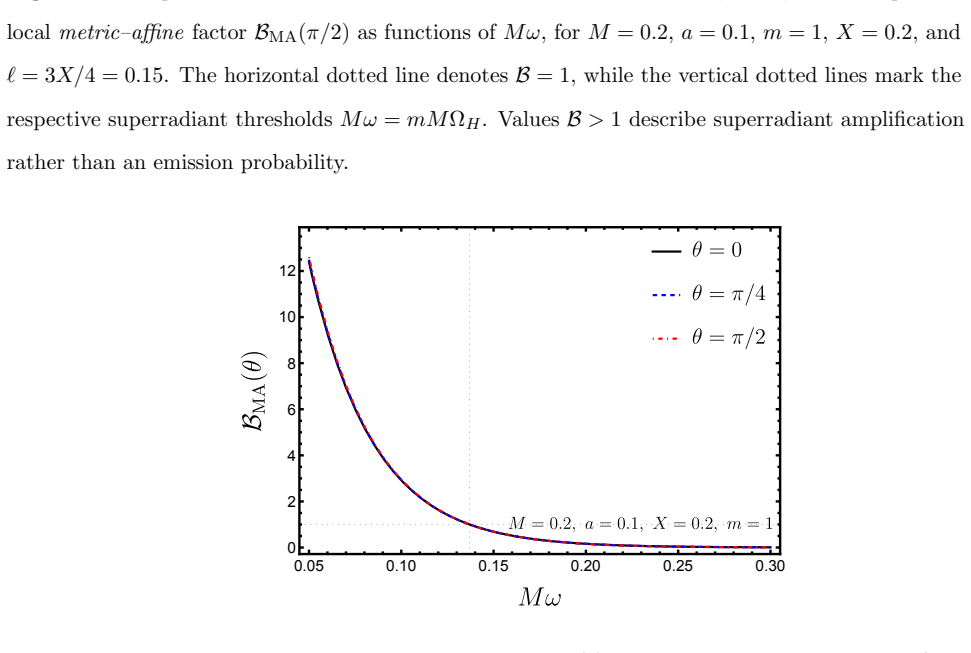
Local and multimode structure in the metric–affine geometry At a fixed nonpolar latitude, themetric–affinetunneling residue defines xc,MA(θ) = ωj −mΩ MA TMA(θ) .(123) Forx c,MA(θ)>0, the local ratio of WKB amplitudes may be expressed as βloc c,MA(θ) αloc c,MA(θ) 2 ≡B c,MA(θ) =e −xc,MA(θ).(124) Accordingly, one may associate with an individual horizon cros...
2025
-
[7]
Spontaneous breaking of lorentz symmetry in string theory,
V. A. Kosteleck´ y and S. Samuel, “Spontaneous breaking of lorentz symmetry in string theory,”Phys. Rev. D, vol. 39, pp. 683–685, 1989
1989
Show all 130 references
-
[8]
Gravitational phenomenology in higher-dimensional theories and strings,
V. A. Kosteleck´ y and S. Samuel, “Gravitational phenomenology in higher-dimensional theories and strings,”Physical Review D, vol. 40, pp. 1886–1903, 1989
1903
-
[9]
Lorentz-violating extension of the standard model,
D. Colladay and V. A. Kosteleck´ y, “Lorentz-violating extension of the standard model,”Physical Review D, vol. 58, p. 116002, 1998
1998
-
[10]
Gravity, lorentz violation, and the standard model,
V. A. Kosteleck´ y, “Gravity, lorentz violation, and the standard model,”Physical Review D, vol. 69, p. 105009, 2004
2004
-
[11]
Signals for lorentz violation in post-newtonian gravity,
Q. G. Bailey and V. A. Kosteleck´ y, “Signals for lorentz violation in post-newtonian gravity,”Physical Review D, vol. 74, p. 045001, 2006
2006
-
[12]
Spontaneous lorentz violation, nambu–goldstone modes, and grav- ity,
R. Bluhm and V. A. Kosteleck´ y, “Spontaneous lorentz violation, nambu–goldstone modes, and grav- ity,”Phys. Rev. D, vol. 71, p. 065008, 2005
2005
-
[13]
Spontaneous lorentz and diffeomorphism violation, massive modes, and gravity,
R. Bluhm, S.-H. Fung, and V. A. Kosteleck´ y, “Spontaneous lorentz and diffeomorphism violation, massive modes, and gravity,”Physical Review D, vol. 77, p. 065020, 2008
2008
-
[14]
Constraints and stability in vector theories with spontaneous lorentz violation,
R. Bluhm, N. L. Gagn´ e, R. Potting, and A. Vrublevskis, “Constraints and stability in vector theories with spontaneous lorentz violation,”Physical Review D, vol. 77, p. 125007, 2008. Erratum: Phys. Rev. D 79, 029902 (2009)
2008
-
[15]
The flight of the bumblebee: Vacuum solutions of a gravity model with vector-induced spontaneous lorentz symmetry breaking,
O. Bertolami and J. P´ aramos, “The flight of the bumblebee: Vacuum solutions of a gravity model with vector-induced spontaneous lorentz symmetry breaking,”Physical Review D, vol. 72, p. 044001, 2005. 51
2005
-
[16]
Exact schwarzschild-like solution in a bumblebee gravity model,
R. Casana, A. Cavalcante, F. P. Poulis, and E. B. Santos, “Exact schwarzschild-like solution in a bumblebee gravity model,”Phys. Rev. D, vol. 97, p. 104001, 2018
2018
-
[17]
Black holes with a cosmological constant in bumblebee gravity,
R. V. Maluf and J. C. S. Neves, “Black holes with a cosmological constant in bumblebee gravity,” Physical Review D, vol. 103, p. 044002, 2021
2021
-
[18]
Wormholes in Lorentz-violating gravity,
R. B. Magalh˜ aes, L. A. Lessa, and M. M. Ferreira, “Wormholes in Lorentz-violating gravity,”Eur. Phys. J. Plus, vol. 141, no. 3, p. 269, 2026
2026
-
[19]
Self-consistency of compact objects in Lorentz-violating gravity theories,
L. A. Lessa, R. B. Magalh˜ aes, and M. M. Ferreira Junior, “Self-consistency of compact objects in Lorentz-violating gravity theories,”Phys. Rev. D, vol. 112, no. 6, p. 064031, 2025
2025
-
[20]
Schwarzschild-like black hole with a topological defect in bumblebee gravity,
˙I. G¨ ull¨ u and A.¨Ovg¨ un, “Schwarzschild-like black hole with a topological defect in bumblebee gravity,” Annals of Physics, vol. 436, p. 168721, 2022
2022
-
[21]
Einstein–gauss–bonnet gravity coupled to bumblebee field in four- dimensional spacetime,
C. Ding, X. Chen, and X. Fu, “Einstein–gauss–bonnet gravity coupled to bumblebee field in four- dimensional spacetime,”Nuclear Physics B, vol. 975, p. 115688, 2022
2022
-
[22]
High-dimensional AdS-like black hole and phase transition in einstein–bumblebee gravity,
C. Ding, Y. Shi, J. Chen, Y. Zhou, and C. Liu, “High-dimensional AdS-like black hole and phase transition in einstein–bumblebee gravity,”Chinese Physics C, vol. 47, p. 045102, 2023
2023
-
[23]
New Exact Vacuum Solutions in Extended Bumblebee Gravity,
J. Zhu and H. Li, “New Exact Vacuum Solutions in Extended Bumblebee Gravity,” 4 2026
2026
-
[24]
Einstein–bumblebee–dilaton black hole solution,
L. A. Lessa and J. E. G. Silva, “Einstein–bumblebee–dilaton black hole solution,”The European Physical Journal C, vol. 83, p. 1035, 2023
2023
-
[25]
Static spherical vacuum solutions in the bumblebee gravity model,
R. Xu, D. Liang, and L. Shao, “Static spherical vacuum solutions in the bumblebee gravity model,” Physical Review D, vol. 107, p. 024011, 2023
2023
-
[26]
A four-parameter black hole solution in the bumblebee gravity model,
R. Xu, “A four-parameter black hole solution in the bumblebee gravity model,” inProceedings of the Ninth Meeting on CPT and Lorentz Symmetry, World Scientific, 2023
2023
-
[27]
Bumblebee gravity: Spherically symmetric solutions away from the potential minimum,
Q. G. Bailey, H. S. Murray, and D. T. Walter-Cardona, “Bumblebee gravity: Spherically symmetric solutions away from the potential minimum,”Physical Review D, vol. 112, p. 024069, 2025
2025
-
[28]
Static spherical vacuum solution to bumblebee gravity with timelike VEVs,
H. Li and J. Zhu, “Static spherical vacuum solution to bumblebee gravity with timelike VEVs,”The European Physical Journal C, 2025
2025
-
[29]
Asymptotically flat black holes in bumblebee gravity: Exact solutions and thermodynamics,
J. Yang, Z.-F. Mai, D. Liang, and L. Shao, “Asymptotically flat black holes in bumblebee gravity: Exact solutions and thermodynamics,”arXiv preprint arXiv:2606.05801, 2026
2026 arXiv
-
[30]
Exact black hole solutions in bumblebee gravity with lightlike or spacelike VEVs,
J.-Z. Liu, S.-P. Wu, S.-W. Wei, and Y.-X. Liu, “Exact black hole solutions in bumblebee gravity with lightlike or spacelike VEVs,”Science China Physics, Mechanics & Astronomy, vol. 69, p. 270411, 2026
2026
-
[31]
Full classification of static spherical vacuum solutions to bumblebee gravity with general VEVs,
J. Zhu and H. Li, “Full classification of static spherical vacuum solutions to bumblebee gravity with general VEVs,”Phys. Lett. B, vol. 876, p. 140396, 2026
2026
-
[32]
The flight of the bumblebee in a noncommutative geometry: A new black hole solution,
A. A. Ara´ ujo Filho, N. Heidari, I. P. Lobo, Y. Shi, and F. S. N. Lobo, “The flight of the bumblebee in a noncommutative geometry: A new black hole solution,”Annals of Physics, vol. 490, p. 170487, 2026. 52
2026
-
[33]
Charged spherically symmetric and slowly rotating charged black hole solutions in bumblebee gravity,
J.-Z. Liu, W.-D. Guo, S.-W. Wei, and Y.-X. Liu, “Charged spherically symmetric and slowly rotating charged black hole solutions in bumblebee gravity,”The European Physical Journal C, vol. 85, p. 145, 2025
2025
-
[34]
Taub–nut-like black holes in einstein–bumblebee gravity,
Y.-Q. Chen and H.-S. Liu, “Taub–nut-like black holes in einstein–bumblebee gravity,”Physical Re- view D, vol. 112, p. 084040, 2025
2025
-
[35]
Dyonic reissner–nordstr¨ om-like and taub–nut-like black holes in einstein– bumblebee gravity,
S. Li, L. Liang, and L. Ma, “Dyonic reissner–nordstr¨ om-like and taub–nut-like black holes in einstein– bumblebee gravity,”Journal of Cosmology and Astroparticle Physics, vol. 2026, no. 03, p. 005, 2026
2026
-
[36]
Exact kerr–newman–(a)ds and other spacetimes in bumblebee gravity: Employing a novel generating technique,
H. Ovcharenko, “Exact kerr–newman–(a)ds and other spacetimes in bumblebee gravity: Employing a novel generating technique,”arXiv preprint arXiv:2601.16037, 2026
2026 arXiv
-
[37]
Quasinormal modes of massive scalar per- turbations in slow-rotation bumblebee black holes with traceless conformal electrodynamics,
Y. Sekhmani, W. Liu, W. Deng, and K. Boshkayev, “Quasinormal modes of massive scalar per- turbations in slow-rotation bumblebee black holes with traceless conformal electrodynamics,”arXiv preprint arXiv:2510.16639, 2025
2025
-
[38]
When bumblebee meets NLED: Lorentz-violating black holes and regular spacetimes,
Z.-C. Li and H. L¨ u, “When bumblebee meets NLED: Lorentz-violating black holes and regular spacetimes,”arXiv preprint arXiv:2605.13963, 2026
2026 arXiv
-
[39]
Thermodynamics and optical properties of charged black holes in bumblebee gravity sourced by a cloud of strings,
F. Ahmed, S. Kala, and A. Al-Badawi, “Thermodynamics and optical properties of charged black holes in bumblebee gravity sourced by a cloud of strings,”arXiv preprint arXiv:2603.08764, 2026
2026
-
[40]
ModMax black hole surrounded by a cloud of strings in bumblebee gravity,
F. M. Belchior, A. R. P. Moreira, A. Bouzenada, and F. Ahmed, “ModMax black hole surrounded by a cloud of strings in bumblebee gravity,”arXiv preprint arXiv:2605.20570, 2026
2026 arXiv
-
[41]
Gravitational lensing under the effect of weyl and bumblebee gravities: Applications of the gauss–bonnet theorem,
A. ¨Ovg¨ un, K. Jusufi, and˙I. Sakallı, “Gravitational lensing under the effect of weyl and bumblebee gravities: Applications of the gauss–bonnet theorem,”Annals of Physics, vol. 399, pp. 193–203, 2018
2018
-
[42]
Finite-distance gravitational deflection of massive particles by a kerr-like black hole in the bumblebee gravity model,
Z. Li and A. ¨Ovg¨ un, “Finite-distance gravitational deflection of massive particles by a kerr-like black hole in the bumblebee gravity model,”Physical Review D, vol. 101, p. 024040, 2020
2020
-
[43]
Thermodynamics of schwarzschild-like black holes in modified gravity models,
D. A. Gomes, R. V. Maluf, and C. A. S. Almeida, “Thermodynamics of schwarzschild-like black holes in modified gravity models,”Annals of Physics, vol. 418, p. 168198, 2020
2020
-
[44]
Quasinormal frequencies for a black hole in bumblebee gravity,
R. Oliveira, D. M. Dantas, and C. A. S. Almeida, “Quasinormal frequencies for a black hole in bumblebee gravity,”EPL, vol. 135, p. 10003, 2021
2021
-
[45]
Quasinormal modes and hawking-radiation sparsity of GUP- corrected black holes in bumblebee gravity with topological defects,
D. J. Gogoi and U. D. Goswami, “Quasinormal modes and hawking-radiation sparsity of GUP- corrected black holes in bumblebee gravity with topological defects,”Journal of Cosmology and Astroparticle Physics, vol. 2022, no. 06, p. 029, 2022
2022
-
[46]
Quasinormal modes of bumblebee black holes with a global monopole,
Z. Malik, “Quasinormal modes of bumblebee black holes with a global monopole,”International Journal of Theoretical Physics, vol. 63, p. 199, 2024
2024
-
[47]
Lorentz violation induces isospectrality breaking in einstein– bumblebee gravity theory,
W. Liu, X. Fang, J. Jing, and J. Wang, “Lorentz violation induces isospectrality breaking in einstein– bumblebee gravity theory,”Science China Physics, Mechanics & Astronomy, vol. 67, p. 280413, 2024
2024
-
[48]
Some observable physical properties of higher-dimensional ds/ads black holes in einstein–bumblebee gravity theory,
A. Uniyal, S. Kanzi, and ˙I. Sakallı, “Some observable physical properties of higher-dimensional ds/ads black holes in einstein–bumblebee gravity theory,”The European Physical Journal C, vol. 83, p. 668, 53 2023
2023
-
[49]
Quasinormal modes of spherical bumblebee black holes with a global monopole,
R.-H. Lin, R. Jiang, and X.-H. Zhai, “Quasinormal modes of spherical bumblebee black holes with a global monopole,”The European Physical Journal C, vol. 83, p. 720, 2023
2023
-
[50]
Testing black holes with cosmological constant in einstein–bumblebee gravity through the black hole shadow using EHT data and deflection angle,
R. C. Pantig, S. Kala, A. ¨Ovg¨ un, and N. J. L. S. Lobos, “Testing black holes with cosmological constant in einstein–bumblebee gravity through the black hole shadow using EHT data and deflection angle,”International Journal of Geometric Methods in Modern Physics, p. 2550240, 2025
2025
-
[51]
Greybody factor and quasinormal modes of scalar and dirac field perturbations in a schwarzschild–de sitter-like black hole in the bumblebee gravity model,
Y. P. Singh and T. I. Singh, “Greybody factor and quasinormal modes of scalar and dirac field perturbations in a schwarzschild–de sitter-like black hole in the bumblebee gravity model,”The European Physical Journal C, vol. 84, p. 1245, 2024
2024
-
[52]
Particle dynamics and optical appearance of charged spherically symmetric black holes in bumblebee gravity,
M. Xu, J. Lu, R. Li, Y. Liu, and S.-M. Wu, “Particle dynamics and optical appearance of charged spherically symmetric black holes in bumblebee gravity,”Classical and Quantum Gravity, vol. 42, p. 135008, 2025
2025
-
[53]
Quasinormal modes and greybody factors of charged black holes in the bumblebee gravity model,
Y. P. Singh, J. Choudhury, T. I. Singh, and D. J. Gogoi, “Quasinormal modes and greybody factors of charged black holes in the bumblebee gravity model,”arXiv preprint arXiv:2506.02508, 2025
2025 arXiv
-
[54]
Quasinormal modes of a charged spherically sym- metric black hole in bumblebee gravity,
B.-R. Li, J.-Z. Liu, W.-D. Guo, and Y.-X. Liu, “Quasinormal modes of a charged spherically sym- metric black hole in bumblebee gravity,”arXiv preprint arXiv:2510.20503, 2025
2025
-
[55]
Periodic orbits and gravitational waveforms of black holes in bumblebee gravity,
Z. Shi, X. Zhang, and Y. Liu, “Periodic orbits and gravitational waveforms of black holes in bumblebee gravity,”arXiv preprint arXiv:2603.14413, 2026
2026 arXiv
-
[56]
Metric-affine bumblebee gravity: Classical aspects,
A. Delhom, J. R. Nascimento, G. J. Olmo, A. Y. Petrov, and P. J. Porf ´ ırio, “Metric-affine bumblebee gravity: Classical aspects,”The European Physical Journal C, vol. 81, p. 287, 2021
2021
-
[57]
Radiative corrections in the metric-affine bumblebee model,
A. Delhom, J. R. Nascimento, G. J. Olmo, A. Y. Petrov, and P. J. Porf ´ ırio, “Radiative corrections in the metric-affine bumblebee model,”Physics Letters B, vol. 826, p. 136932, 2022
2022
-
[58]
Spontaneous lorentz symmetry breaking and one-loop effective action in metric-affine bumblebee gravity,
A. Delhom, T. Mariz, J. R. Nascimento, G. J. Olmo, A. Y. Petrov, and P. J. Porf ´ ırio, “Spontaneous lorentz symmetry breaking and one-loop effective action in metric-affine bumblebee gravity,”Journal of Cosmology and Astroparticle Physics, vol. 2022, no. 07, p. 018, 2022
2022
-
[59]
One-loop corrections in maxwell– metric-affine bumblebee gravity,
A. C. Lehum, J. R. Nascimento, A. Y. Petrov, and P. J. Porf ´ ırio, “One-loop corrections in maxwell– metric-affine bumblebee gravity,”General Relativity and Gravitation, vol. 57, p. 66, 2025
2025
-
[60]
Vacuum solution within a metric-affine bumblebee gravity,
A. A. Ara´ ujo Filho, J. R. Nascimento, A. Y. Petrov, and P. J. Porf ´ ırio, “Vacuum solution within a metric-affine bumblebee gravity,”Phys. Rev. D, vol. 108, p. 085010, 2023
2023
-
[61]
Probing schwarzschild-like black holes in metric-affine bumblebee gravity with accretion disk, deflection angle, greybody bounds, and neutrino propagation,
G. Lambiase, L. Mastrototaro, R. C. Pantig, and A. ¨Ovg¨ un, “Probing schwarzschild-like black holes in metric-affine bumblebee gravity with accretion disk, deflection angle, greybody bounds, and neutrino propagation,”Journal of Cosmology and Astroparticle Physics, vol. 2023, ...
2023
-
[62]
Gravitational traces of bumblebee gravity in metric-affine formalism,
A. A. Ara´ ujo Filho, H. Hassanabadi, N. Heidari, J. Kˇ r ´ ıˇ z, and S. Zare, “Gravitational traces of bumblebee gravity in metric-affine formalism,”Classical and Quantum Gravity, vol. 41, p. 055003, 2024. 54
2024
-
[63]
Scattering effects of bum- blebee gravity in metric-affine formalism,
N. Heidari, C. F. B. Macedo, A. A. Ara´ ujo Filho, and H. Hassanabadi, “Scattering effects of bum- blebee gravity in metric-affine formalism,”arXiv preprint arXiv:2407.05321, 2024
2024 arXiv
-
[64]
Gravitational lensing and shadow by a schwarzschild-like black hole in metric-affine bumblebee gravity,
X.-J. Gao, “Gravitational lensing and shadow by a schwarzschild-like black hole in metric-affine bumblebee gravity,”The European Physical Journal C, vol. 84, p. 973, 2024
2024
-
[65]
Quasinormal modes and different aspects of hawking radiation within the metric-affine bumblebee gravity framework,
S. K. Jha and A. Rahaman, “Quasinormal modes and different aspects of hawking radiation within the metric-affine bumblebee gravity framework,”Nuclear Physics B, vol. 1002, p. 116536, 2024
2024
-
[66]
Constraining the metric-affine bumblebee gravity parameter using black hole shadows and quasiperiodic oscillations of galactic microquasars,
S. K. Jha and A. Rahaman, “Constraining the metric-affine bumblebee gravity parameter using black hole shadows and quasiperiodic oscillations of galactic microquasars,”The European Physical Journal C, vol. 85, p. 441, 2025
2025
-
[67]
How does non-metricity affect particle creation and evaporation in bumblebee gravity?,
A. A. Ara´ ujo Filho, “How does non-metricity affect particle creation and evaporation in bumblebee gravity?,”JCAP, vol. 06, p. 026, 2025
2025
-
[68]
An exact stationary axisym- metric vacuum solution within a metric-affine bumblebee gravity,
A. A. Ara´ ujo Filho, J. R. Nascimento, A. Y. Petrov, and P. J. Porf ´ ırio, “An exact stationary axisym- metric vacuum solution within a metric-affine bumblebee gravity,”JCAP, vol. 07, p. 004, 2024
2024
-
[69]
Rotating black hole shadows in metric-affine bumblebee gravity,
J. R. Nascimento, A. R. M. Oliveira, A. Y. Petrov, P. J. Porf ´ ırio, and A. R. Queiroz, “Rotating black hole shadows in metric-affine bumblebee gravity,”arXiv preprint arXiv:2603.28722, 2026 (to appear in JCAP)
2026 arXiv
-
[70]
Exact kerr-like solution and its shadow in a gravity model with spontaneous lorentz symmetry breaking,
C. Ding, C. Liu, R. Casana, and A. Cavalcante, “Exact kerr-like solution and its shadow in a gravity model with spontaneous lorentz symmetry breaking,”Eur. Phys. J. C, vol. 80, p. 178, 2020
2020
-
[71]
Slowly rotating einstein–bumblebee black hole solution and its greybody factor in a lorentz-violation model,
C. Ding and X. Chen, “Slowly rotating einstein–bumblebee black hole solution and its greybody factor in a lorentz-violation model,”Chinese Physics C, vol. 45, p. 025106, 2021
2021
-
[72]
Comment on “greybody radiation and quasinormal modes of kerr-like black hole in bumblebee gravity model
R. V. Maluf and C. R. Muniz, “Comment on “greybody radiation and quasinormal modes of kerr-like black hole in bumblebee gravity model”,”The European Physical Journal C, vol. 82, p. 94, 2022
2022
-
[74]
Bumblebee gravity with a kerr–sen-like solution and its shadow,
S. K. Jha and A. Rahaman, “Bumblebee gravity with a kerr–sen-like solution and its shadow,”The European Physical Journal C, vol. 81, p. 345, 2021
2021
-
[75]
Rotating BTZ-like black hole and central charges in einstein–bumblebee gravity,
C. Ding, Y. Shi, J. Chen, Y. Zhou, C. Liu, and Y. Xiao, “Rotating BTZ-like black hole and central charges in einstein–bumblebee gravity,”The European Physical Journal C, vol. 83, p. 573, 2023
2023
-
[76]
Rotating black holes and the kerr/CFT correspondence in einstein–bumblebee gravity,
Y.-Q. Chen, J.-Y. Shen, and H.-S. Liu, “Rotating black holes and the kerr/CFT correspondence in einstein–bumblebee gravity,”arXiv preprint arXiv:2607.01884, 2026
2026 arXiv
-
[77]
The stealth kerr solution in bumblebee gravity,
R. Xu, Z.-F. Mai, and D. Liang, “The stealth kerr solution in bumblebee gravity,”Physics Letters B, vol. 875, p. 140364, 2026
2026
-
[78]
Probing lorentz symmetry violation through lensing observables of rotating black holes,
A. Kumar, S. U. Islam, and S. G. Ghosh, “Probing lorentz symmetry violation through lensing observables of rotating black holes,”Phys. Dark Univ., vol. 52, p. 102307, 2026. 55
2026
-
[79]
Axial obstructions to rotating bumblebee vacuum solutions,
M. Guo and Z.-Y. Fan, “Axial obstructions to rotating bumblebee vacuum solutions,”arXiv e-prints, 2026
2026
-
[80]
Thin accretion disk around a rotating kerr-like black hole in the einstein–bumblebee gravity model,
C. Liu, C. Ding, and J. Jing, “Thin accretion disk around a rotating kerr-like black hole in the einstein–bumblebee gravity model,”arXiv preprint arXiv:1910.13259, 2019
1910 arXiv
-
[81]
Strong gravitational lensing and shadow constraint from M87* of a slowly rotating kerr-like black hole,
X.-M. Kuang and A. ¨Ovg¨ un, “Strong gravitational lensing and shadow constraint from M87* of a slowly rotating kerr-like black hole,”Annals of Physics, vol. 447, p. 169147, 2022
2022
-
[82]
Probing lorentz-invariance violation via gravitational lensing and analytical eigenmodes of perturbed slowly rotating bumblebee black holes,
M. Mangut, H. G¨ ursel, S. Kanzi, and˙I. Sakallı, “Probing lorentz-invariance violation via gravitational lensing and analytical eigenmodes of perturbed slowly rotating bumblebee black holes,”Universe, vol. 9, p. 225, 2023
2023
-
[83]
Shadow cast by a kerr-like black hole in the presence of plasma in einstein–bumblebee gravity,
H.-M. Wang and S.-W. Wei, “Shadow cast by a kerr-like black hole in the presence of plasma in einstein–bumblebee gravity,”The European Physical Journal Plus, vol. 137, p. 571, 2022
2022
-
[84]
Investigating rotating black holes in bumblebee gravity: Insights from EHT observations,
S. U. Islam, S. G. Ghosh, and S. D. Maharaj, “Investigating rotating black holes in bumblebee gravity: Insights from EHT observations,”Journal of Cosmology and Astroparticle Physics, vol. 2024, no. 12, p. 047, 2024
2024
-
[85]
Superradiant instability of a kerr-like black hole in einstein– bumblebee gravity,
R. Jiang, R.-H. Lin, and X.-H. Zhai, “Superradiant instability of a kerr-like black hole in einstein– bumblebee gravity,”Physical Review D, vol. 104, p. 124004, 2021
2021
-
[86]
Constraint on parameters of a rotating black hole in einstein– bumblebee theory by quasiperiodic oscillations,
Z. Wang, S. Chen, and J. Jing, “Constraint on parameters of a rotating black hole in einstein– bumblebee theory by quasiperiodic oscillations,”The European Physical Journal C, vol. 82, p. 528, 2022
2022
-
[87]
Probing bumblebee gravity with black hole x-ray data,
J. Gu, S. Riaz, A. B. Abdikamalov, D. Ayzenberg, and C. Bambi, “Probing bumblebee gravity with black hole x-ray data,”The European Physical Journal C, vol. 82, p. 708, 2022
2022
-
[88]
Spontaneous lorentz-symmetry-breaking effects on GRB jets arising from neutrino-pair annihilation near a black hole,
M. Khodadi, G. Lambiase, and L. Mastrototaro, “Spontaneous lorentz-symmetry-breaking effects on GRB jets arising from neutrino-pair annihilation near a black hole,”The European Physical Journal C, vol. 83, p. 239, 2023
2023
-
[89]
Quasinormal modes of a slowly rotating einstein–bumblebee black hole,
W. Liu, X. Fang, J. Jing, and J. Wang, “Quasinormal modes of a slowly rotating einstein–bumblebee black hole,”The European Physical Journal C, vol. 83, p. 83, 2023
2023
-
[90]
Quasinormal modes of a scalar perturbation around a rotating BTZ-like black hole in einstein–bumblebee gravity,
C. Chen, Q. Pan, and J. Jing, “Quasinormal modes of a scalar perturbation around a rotating BTZ-like black hole in einstein–bumblebee gravity,”Physics Letters B, vol. 846, p. 138186, 2023
2023
-
[91]
GUP-modified hawking radiation in bumblebee gravity,
S. Kanzi and ˙I. Sakallı, “GUP-modified hawking radiation in bumblebee gravity,”Nuclear Physics B, vol. 946, p. 114703, 2019
2019
-
[92]
Modified hawking radiation of a schwarzschild-like black hole in the bum- blebee gravity model,
˙I. Sakallı and E. Y¨ or¨ uk, “Modified hawking radiation of a schwarzschild-like black hole in the bum- blebee gravity model,”Physica Scripta, vol. 98, p. 125307, 2023
2023
-
[93]
Greybody radiation and quasinormal modes of a kerr-like black hole in the bumblebee gravity model,
S. Kanzi and ˙I. Sakallı, “Greybody radiation and quasinormal modes of a kerr-like black hole in the bumblebee gravity model,”The European Physical Journal C, vol. 81, p. 501, 2021. 56
2021
-
[94]
Particle emission rates from a black hole: Massless particles from an uncharged, non- rotating hole,
D. N. Page, “Particle emission rates from a black hole: Massless particles from an uncharged, non- rotating hole,”Physical Review D, vol. 13, no. 2, pp. 198–206, 1976
1976
-
[95]
Particle emission rates from a black hole. ii. massless particles from a rotating hole,
D. N. Page, “Particle emission rates from a black hole. ii. massless particles from a rotating hole,” Physical Review D, vol. 14, no. 12, pp. 3260–3273, 1976
1976
-
[96]
Observational constraints on local lorentz invariance,
R. Bluhm, “Observational constraints on local lorentz invariance,” inSpringer Handbook of Spacetime (A. Ashtekar and V. Petkov, eds.), pp. 485–507, Berlin: Springer, 2014
2014
-
[97]
The flight of the bumblebee in a non-commutative geometry: A new black hole solution,
A. A. Ara´ ujo Filho, N. Heidari, I. P. Lobo, Y. Shi, and F. S. N. Lobo, “The flight of the bumblebee in a non-commutative geometry: A new black hole solution,”Annals Phys., vol. 490, p. 170487, 2026
2026
-
[98]
Black hole entropy is the noether charge,
R. M. Wald, “Black hole entropy is the noether charge,”Phys. Rev. D, vol. 48, pp. R3427–R3431, 1993
1993
-
[99]
Some properties of noether charge and a proposal for dynamical black hole entropy,
V. Iyer and R. M. Wald, “Some properties of noether charge and a proposal for dynamical black hole entropy,”Phys. Rev. D, vol. 50, pp. 846–864, 1994
1994
-
[100]
Tunnelling methods and hawking’s radiation: achievements and prospects,
L. Vanzo, G. Acquaviva, and R. Di Criscienzo, “Tunnelling methods and hawking’s radiation: achievements and prospects,”Class. Quant. Grav., vol. 28, p. 183001, 2011
2011
-
[101]
Implications of a simpson–visser solution in verlinde’s framework,
A. A. Ara´ ujo Filho, “Implications of a simpson–visser solution in verlinde’s framework,”The Euro- pean Physical Journal C, vol. 84, no. 1, p. 73, 2024
2024
-
[102]
Hawking radiation as tunneling,
M. K. Parikh and F. Wilczek, “Hawking radiation as tunneling,”Phys. Rev. Lett., vol. 85, pp. 5042– 5045, 2000
2000
-
[103]
Hawking radiation as tunneling for extremal and rotating black holes,
M. Angheben, M. Nadalini, L. Vanzo, and S. Zerbini, “Hawking radiation as tunneling for extremal and rotating black holes,”JHEP, vol. 05, p. 014, 2005
2005
-
[104]
Radiative corrections in metric-affine bumblebee model,
A. Delhom, J. R. Nascimento, G. J. Olmo, A. Y. Petrov, and P. J. Porf ´ ırio, “Radiative corrections in metric-affine bumblebee model,”Phys. Lett. B, vol. 826, p. 136932, 2022
2022
-
[105]
Spontaneous lorentz symmetry breaking and one-loop effective action in the metric-affine bumblebee gravity,
A. Delhom, T. Mariz, J. R. Nascimento, G. J. Olmo, A. Y. Petrov, and P. J. Porf ´ ırio, “Spontaneous lorentz symmetry breaking and one-loop effective action in the metric-affine bumblebee gravity,” JCAP, vol. 07, p. 018, 2022
2022
-
[106]
Particle creation by black holes,
S. W. Hawking, “Particle creation by black holes,”Commun. Math. Phys., vol. 43, pp. 199–220, 1975
1975
-
[107]
Notes on black-hole evaporation,
W. G. Unruh, “Notes on black-hole evaporation,”Physical Review D, vol. 14, pp. 870–892, 1976
1976
-
[108]
Thermo-field dynamics of black holes,
W. Israel, “Thermo-field dynamics of black holes,”Physics Letters A, vol. 57, pp. 107–110, 1976
1976
-
[109]
Bounding the bogoliubov coefficients,
P. Boonserm and M. Visser, “Bounding the bogoliubov coefficients,”Annals Phys., vol. 323, pp. 2779– 2798, 2008
2008
-
[110]
Transmission probabilities and the miller–good transformation,
P. Boonserm and M. Visser, “Transmission probabilities and the miller–good transformation,”J. Phys. A, vol. 42, p. 045301, 2009
2009
-
[111]
Greybody factors for schwarzschild black holes: Path-ordered exponentials and product integrals,
F. Gray and M. Visser, “Greybody factors for schwarzschild black holes: Path-ordered exponentials and product integrals,”Universe, vol. 4, no. 9, p. 93, 2018. 57
2018
-
[112]
Particle creation and evaporation in Kalb-Ramond gravity,
A. A. Ara´ ujo Filho, “Particle creation and evaporation in Kalb-Ramond gravity,”JCAP, vol. 04, p. 076, 2025
2025
-
[113]
Particle production induced by a Lorentzian non-commutative spacetime,
A. A. Ara´ ujo Filho, “Particle production induced by a Lorentzian non-commutative spacetime,” Annals Phys., vol. 481, p. 170167, 2025
2025
-
[114]
Absorption, greybody factors of bosonic particles and thermodynamic properties in ModMax-black holes sourced by global monopole in Kalb–Ramond gravity,
F. M. Belchior, A. R. P. Moreira, A. Bouzenada, and F. Ahmed, “Absorption, greybody factors of bosonic particles and thermodynamic properties in ModMax-black holes sourced by global monopole in Kalb–Ramond gravity,”Annals Phys., vol. 492, p. 170548, 2026
2026
-
[115]
Motions of test particles in gravitational field, perturbations and greybody factor of Bardeen-like AdS black hole with phantom global monopoles,
F. Ahmed, A. Al-Badawi, ˙I. Sakallı, and S. Kanzi, “Motions of test particles in gravitational field, perturbations and greybody factor of Bardeen-like AdS black hole with phantom global monopoles,” Phys. Dark Univ., vol. 48, p. 101907, 2025
2025
-
[116]
Photon spheres, gravitational lensing/mirroring, and grey- body radiation in deformed AdS-Schwarzschild black holes with phantom global monopole,
F. Ahmed, A. Al-Badawi, and ˙I. Sakallı, “Photon spheres, gravitational lensing/mirroring, and grey- body radiation in deformed AdS-Schwarzschild black holes with phantom global monopole,”Phys. Dark Univ., vol. 49, p. 101988, 2025
2025
-
[117]
Quasinormal modes and greybody factors of charged sym- mergent black hole,
D. J. Gogoi, B. Puli¸ ce, and A. ¨Ovg¨ un, “Quasinormal modes and greybody factors of charged sym- mergent black hole,”Eur. Phys. J. C, vol. 85, no. 11, p. 1243, 2025
2025
-
[118]
An effective model for the quantum Schwarzschild black hole: Weak deflection angle, quasinormal modes and bounding of greybody factor,
´A. Rinc´ on, A.¨Ovg¨ un, and R. C. Pantig, “An effective model for the quantum Schwarzschild black hole: Weak deflection angle, quasinormal modes and bounding of greybody factor,”Phys. Dark Univ., vol. 46, p. 101623, 2024
2024
-
[119]
Probing Schwarzschild-like black holes in metric-affine bumblebee gravity with accretion disk, deflection angle, greybody bounds, and neutrino propagation,
G. Lambiase, L. Mastrototaro, R. C. Pantig, and A. Ovgun, “Probing Schwarzschild-like black holes in metric-affine bumblebee gravity with accretion disk, deflection angle, greybody bounds, and neutrino propagation,”JCAP, vol. 12, p. 026, 2023
2023
-
[120]
Amplification of waves during reflection from a rotating black hole,
A. A. Starobinsky, “Amplification of waves during reflection from a rotating black hole,”Sov. Phys. JETP, vol. 37, pp. 28–32, 1973
1973
-
[121]
Particle emission rates from a black hole. massless particles from an uncharged, nonro- tating hole,
D. N. Page, “Particle emission rates from a black hole. massless particles from an uncharged, nonro- tating hole,”Phys. Rev. D, vol. 13, pp. 198–206, 1976
1976
-
[122]
Particle emission rates from a black hole. ii. massless particles from a rotating hole,
D. N. Page, “Particle emission rates from a black hole. ii. massless particles from a rotating hole,” Phys. Rev. D, vol. 14, pp. 3260–3273, 1976
1976
-
[123]
Re-estimating the spin parameter of the black hole in cygnus x-1,
X. Zhao, L. Gou, Y. Dong, X. Zheng, J. F. Steiner, J. C. A. Miller-Jones, A. Bahramian, J. A. Orosz, and Y. Feng, “Re-estimating the spin parameter of the black hole in cygnus x-1,”Astrophys. J., vol. 908, p. 117, 2021
2021
-
[124]
Measuring the kerr spin parameter of a non-kerr compact object with the continuum- fitting and the iron line methods,
C. Bambi, “Measuring the kerr spin parameter of a non-kerr compact object with the continuum- fitting and the iron line methods,”JCAP, vol. 08, p. 055, 2013
2013
-
[125]
Lorentz-violating modifications to particle dynamics, thermodynamics, and vacuum energy in bumblebee gravity,
A. A. Ara´ ujo Filho, K. E. L. de Farias, E. Passos, F. A. Brito, A. ¨Ovg¨ un, H. Hassanabadi, V. B. Bezerra, and A. R. Queiroz, “Lorentz-violating modifications to particle dynamics, thermodynamics, and vacuum energy in bumblebee gravity,”Eur. Phys. J. Plus, vol. 141, no. 7, ...
2026
-
[126]
Thermal analysis of photon-like particles in rainbow gravity,
J. Furtado, H. Hassanabadi, J. A. A. S. Reis,et al., “Thermal analysis of photon-like particles in rainbow gravity,”arXiv preprint arXiv:2305.08587, 2023
2023 arXiv
-
[127]
Bouncing universe in a heat bath,
A. A. Ara´ ujo Filho and A. Y. Petrov, “Bouncing universe in a heat bath,”International Journal of Modern Physics A, vol. 36, no. 34n35, p. 2150242, 2021
2021
-
[128]
The relativistic aharonov– bohm–coulomb system with position-dependent mass,
R. R. S. Oliveira, A. A. Ara´ ujo Filho, R. V. Maluf, and C. A. S. Almeida, “The relativistic aharonov– bohm–coulomb system with position-dependent mass,”Journal of Physics A: Mathematical and Theoretical, vol. 53, no. 4, p. 045304, 2020
2020
-
[129]
Particles in loop quantum gravity formalism: a thermodynamical description,
A. A. Ara´ ujo Filho, “Particles in loop quantum gravity formalism: a thermodynamical description,” Annalen der Physik, vol. 534, no. 12, p. 2200383, 2022
2022
-
[130]
Particle motion and thermal effects around a Kalb–Ramond black hole,
A. A. Ara´ ujo Filho, “Particle motion and thermal effects around a Kalb–Ramond black hole,”Eur. Phys. J. C, vol. 85, no. 9, p. 1002, 2025. 59
2025
Reviewed August 6, 2026 · model on record in the stance chip above.
Discussion (0). Sign in to comment.