Algebra of Bivariate-Bicycle Surface Codes
Pith reviewed 2026-06-27 18:15 UTC · model grok-4.3
The pith
Bivariate-bicycle surface code dimension equals the multiplicity-weighted count of finite nonzero common roots of the two polynomials.
A machine-rendered reading of the paper's core claim, the machinery that carries it, and where it could break.
Core claim
The dimension of bivariate-bicycle-surface codes is determined by the number of roots (x, y) with finite, non-zero coordinates, counted with algebraic multiplicity. This dimension is invariant under monomial automorphisms of the Laurent polynomial ring. Roots with zero or infinite coordinates indicate that specialized generators are required near the corresponding boundary. These roots can appear or disappear under monomial transformations, revealing the structure of tilted boundaries. A prescription for constructing the codes works for regions with rectangular, diagonal, and arbitrarily tilted boundaries without corner corrections, provided the polynomials satisfy orientation-specific edge
What carries the argument
The common roots of the pair of bivariate polynomials over a finite field, together with their locations relative to zero and infinity.
If this is right
- The code dimension can be read off directly from the roots without constructing the full stabilizer matrix.
- Monomial changes of variables leave the dimension fixed but can move roots to or from the boundaries.
- Boundary modifications are localized to edges where roots have zero or infinite coordinates.
- The same polynomials generate valid codes on any tilt angle once the edge conditions hold.
Where Pith is reading between the lines
- Choosing polynomials whose roots avoid the axes could yield families of codes on arbitrary lattices with uniform dimension formulas.
- The invariance under monomial maps suggests a way to optimize code parameters by transforming to convenient coordinates.
- This root-based view may help classify which polynomial pairs produce high-distance codes.
Load-bearing premise
The two polynomials obey orientation-specific edge conditions that let the boundary generators be defined uniformly.
What would settle it
For a concrete pair of polynomials and a tilted rectangular region, compute the predicted dimension from the roots and compare it to the rank of the actual parity-check matrix built from the prescription; disagreement would show the claim fails.
Figures
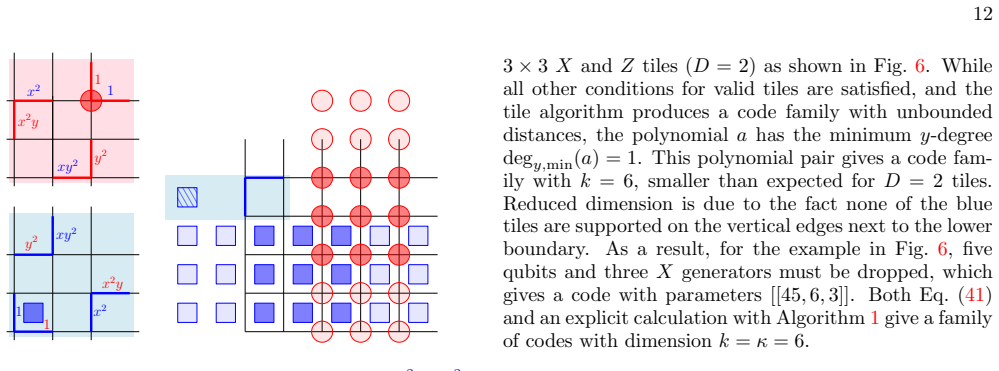
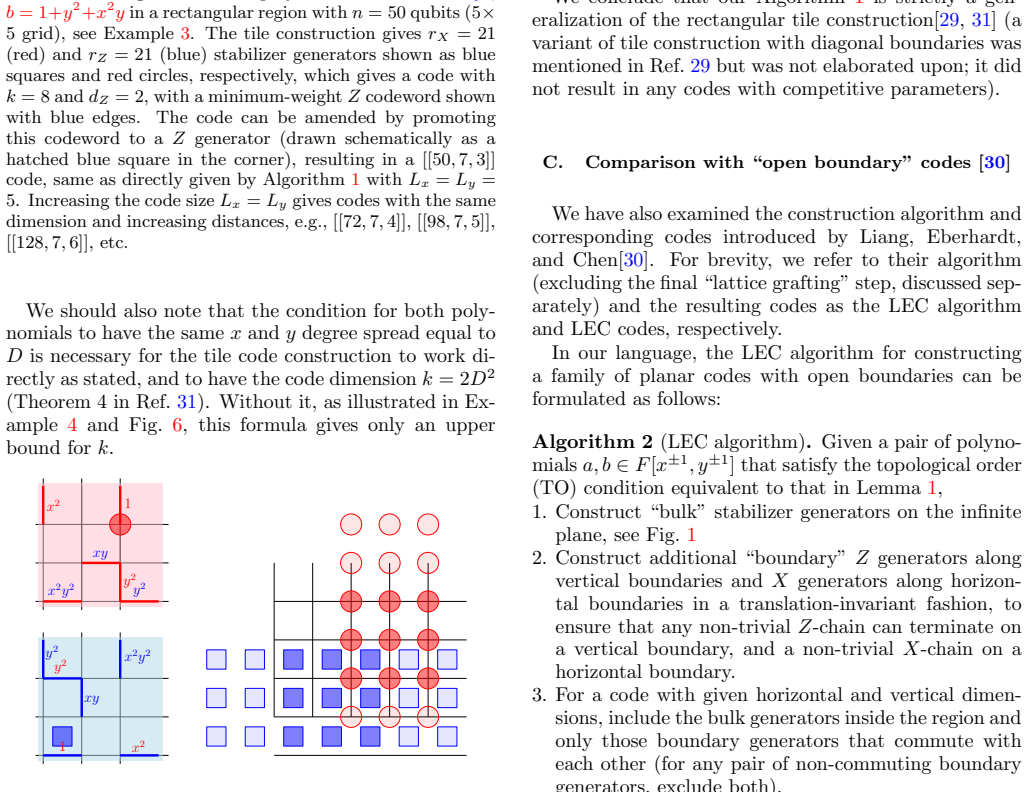
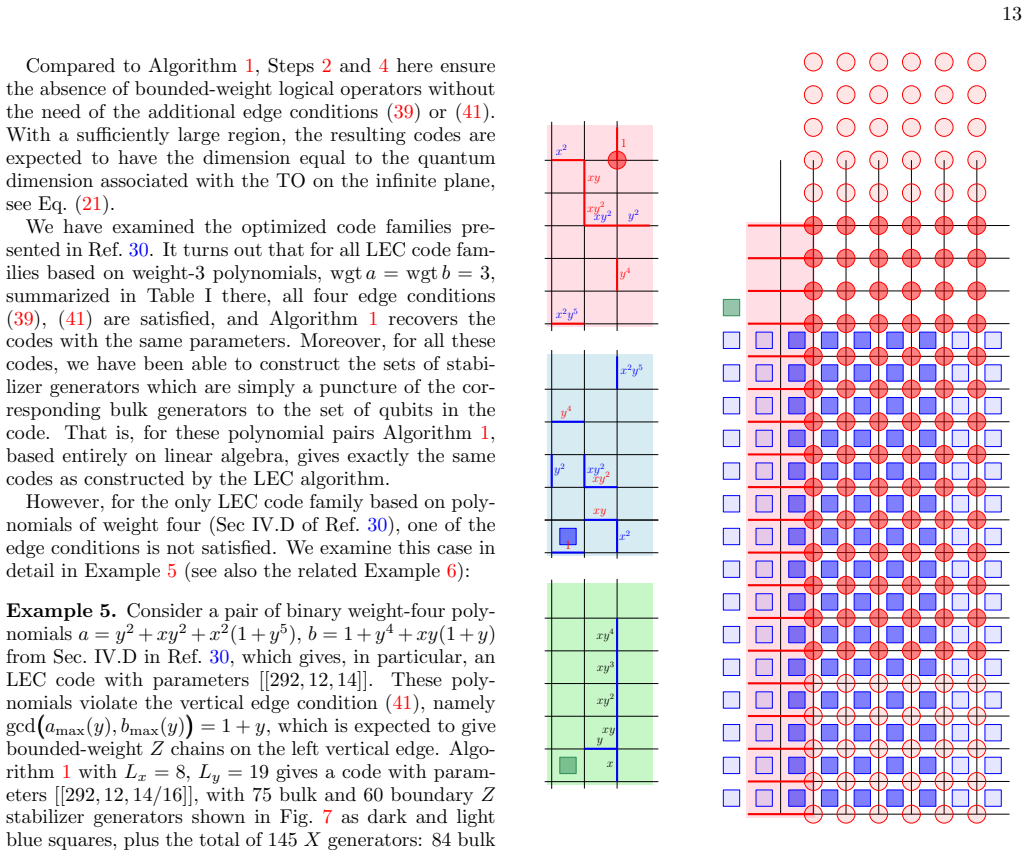
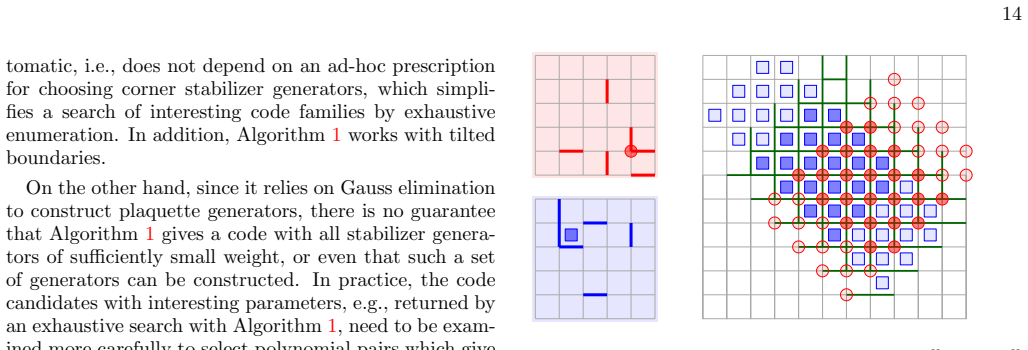
read the original abstract
We relate the properties of bivariate-bicycle-surface (BBS) codes, constructed from a pair of bivariate polynomials over a finite field, to the number and location of their common roots in the extension field. The number of roots $(x,y)$ with finite, non-zero coordinates -- counted with algebraic multiplicity -- determines the dimension of the codes. This dimension is invariant under monomial automorphisms of the Laurent polynomial ring. Conversely, roots with zero or infinite $x$- or $y$-coordinates indicate that specialized generators are required near the corresponding boundary (e.g., the left or right boundary for a root where $x$ is zero or infinite, respectively). These roots can appear or disappear under monomial transformations, which reveals the structure of tilted boundaries. Based on these results, we formulate a prescription for constructing BBS codes that works for regions with rectangular, diagonal, and arbitrarily tilted boundaries. A key advantage of this approach is that no corner corrections are needed, provided the polynomials satisfy orientation-specific edge conditions.
Editorial analysis
A structured set of objections, weighed in public.
Referee Report
Summary. The paper claims that the dimension of bivariate-bicycle-surface (BBS) codes, built from a pair of bivariate polynomials over a finite field, equals the number of common roots (x,y) with finite nonzero coordinates counted with algebraic multiplicity. Roots at zero or infinity indicate the need for specialized boundary generators, and these roots transform under monomial automorphisms. The authors give a construction prescription that applies to rectangular, diagonal, and arbitrarily tilted boundaries without corner corrections, provided the polynomials obey orientation-specific edge conditions.
Significance. If the algebraic root-counting rule for dimension is proven and the boundary prescription is shown to be compatible with arbitrary tilts, the work would supply a systematic algebraic tool for predicting and controlling the parameters of BBS codes on non-rectangular regions. The invariance under monomial automorphisms and the explicit link between root locations and boundary generators are potentially useful for code design.
major comments (1)
- [Abstract] Abstract: the central construction claim—that the same root count continues to give the dimension on arbitrarily tilted boundaries with no corner corrections once orientation-specific edge conditions are imposed—rests on the unverified assertion that such conditions can be satisfied for a given tilt angle without altering the finite nonzero root set. No derivation or explicit check of compatibility is supplied.
minor comments (1)
- [Abstract] The abstract refers to 'orientation-specific edge conditions' without defining them or indicating where in the manuscript they are stated formally.
Simulated Author's Rebuttal
We thank the referee for the detailed review and for identifying the need to strengthen the justification of the central construction claim. We address the single major comment below and will revise the manuscript accordingly.
read point-by-point responses
-
Referee: [Abstract] Abstract: the central construction claim—that the same root count continues to give the dimension on arbitrarily tilted boundaries with no corner corrections once orientation-specific edge conditions are imposed—rests on the unverified assertion that such conditions can be satisfied for a given tilt angle without altering the finite nonzero root set. No derivation or explicit check of compatibility is supplied.
Authors: The referee correctly notes that the abstract asserts compatibility without an explicit derivation or check that the orientation-specific edge conditions can always be chosen for an arbitrary tilt without changing the finite nonzero common roots. The manuscript establishes that the dimension equals the algebraic multiplicity of those roots and that monomial automorphisms preserve this count while possibly moving roots at zero or infinity; the edge conditions are defined precisely to absorb the latter without affecting the former. However, a general proof that, for any prescribed tilt angle, there exist polynomials satisfying the edge conditions while leaving the finite nonzero root set invariant is not supplied. We will add a dedicated subsection deriving the compatibility condition (via the action of the relevant monomial automorphism on the Laurent polynomial ring) together with an explicit verification for a non-trivial tilt angle, confirming that the root count and hence the dimension remain unchanged. revision: yes
Circularity Check
No circularity; dimension follows from algebraic root count in Laurent ring
full rationale
The central claim equates code dimension to the count of finite nonzero common roots (with multiplicity). This is a direct algebraic correspondence once the bivariate polynomials and monomial action on the ring are fixed; it does not reduce to a fitted parameter or self-referential definition. The boundary-prescription claim is presented as a consequence of the same root analysis plus stated orientation-specific edge conditions, without any quoted reduction showing the conditions are defined in terms of the dimension result itself or imported via self-citation chains. No fitted-input-called-prediction, ansatz smuggling, or renaming of known results appears in the provided abstract or described derivation. The construction is therefore self-contained against external algebraic benchmarks.
Axiom & Free-Parameter Ledger
axioms (1)
- domain assumption BBS codes are constructed from a pair of bivariate polynomials over a finite field
Reference graph
Works this paper leans on
-
[1]
We define the maximumy-degree ∆≡ max(degy a,deg y b), and assume without loss of gener- ality that ∆ = deg y a≥deg y b
Rescale them to contain only non-negativexand ydegrees with non-zero constant termsa(0,0)̸= 0, b(0,0)̸= 0. We define the maximumy-degree ∆≡ max(degy a,deg y b), and assume without loss of gener- ality that ∆ = deg y a≥deg y b. To construct a finite-widthZ-chain fitting within a horizontal strip of widthm, we expand the boundary equations in powers ofy, ta...
-
[2]
un- balanced,
yields finite chains and infinite co-chains. By variable counting, a non-trivial solution generically exists form≥∆. Whenm= ∆,M Z is empty (meaning µj = 0 for allj), andM X is a square Sylvester matrix[40] whose determinant—the product of its SNF invariants δj(x)—is proportional to they-resultant of the two poly- nomials: detM (∆) X =±a ∆(x)∆−degy b Resy(...
-
[3]
Construct infinite groupsS X 1 (punctured to the re- gionR 1) andS Z 1 (shortened toR 1), respectively, using vertex generators of the parent infinite-plane complex with at least one edge inR 1, and plaquette generators withalledges inR 1 (simplified shortening)
-
[4]
Construct groupsS X 2 andS Z 2 , respectively, by short- eningS X 1 and puncturingS Z 1 to the intersection of the two strips,R 1 ∩R 2
-
[5]
total topological order
Puncture out any qubits outside of the intersection of supports of the groupsS X 2 andS Z 2 , which gives theX andZstabilizer subgroups of the resulting BBS code. Balanced boundaries for each region can be con- structed using the associated coordinates introduced in Sec. IV B. Namely, the regionR1 can be defined using the coordinatesξ ′,η ′ associated wit...
-
[6]
open boundary
Increasing the code sizeL x =L y gives codes with the same dimension and increasing distances, e.g., [[72,7,4]], [[98,7,5]], [[128,7,6]], etc. We should also note that the condition for both poly- nomials to have the samexandydegree spread equal to Dis necessary for the tile code construction to work di- rectly as stated, and to have the code dimensionk= ...
-
[7]
Construct “bulk” stabilizer generators on the infinite plane, see Fig. 1
-
[8]
boundary
Construct additional “boundary”Zgenerators along vertical boundaries andXgenerators along horizon- tal boundaries in a translation-invariant fashion, to ensure that any non-trivialZ-chain can terminate on a vertical boundary, and a non-trivialX-chain on a horizontal boundary
-
[9]
For a code with given horizontal and vertical dimen- sions, include the bulk generators inside the region and only those boundary generators that commute with each other (for any pair of non-commuting boundary generators, exclude both)
-
[10]
Do this by promotingXorZlogical operators toXorZstabilizer generators, respectively, with an ad hoc rule to give preference to higher-weight operators
If needed, complete the stabilizer group by adding “corner” generators to get rid of local non-trivial log- ical operators. Do this by promotingXorZlogical operators toXorZstabilizer generators, respectively, with an ad hoc rule to give preference to higher-weight operators
-
[11]
Finally, drop any qubits which support weight-one generators. (Since the group is abelian by construc- tion, this step is identical to Step 3 in Algorithm 1.) 13 Compared to Algorithm 1, Steps 2 and 4 here ensure the absence of bounded-weight logical operators without the need of the additional edge conditions (39) or (41). With a sufficiently large regio...
-
[12]
S. B. Bravyi and A. Y. Kitaev, Quantum codes on a lattice with boundary, quant-ph/9811052 (1998), unpub- lished
Pith/arXiv arXiv 1998
-
[13]
Dennis, A
E. Dennis, A. Kitaev, A. Landahl, and J. Preskill, Topo- logical quantum memory, J. Math. Phys.43, 4452 (2002)
2002
-
[14]
Google Quantum AI, Suppressing quantum errors by scaling a surface code logical qubit, Nature614, 676 (2023), arXiv:2207.06431 [quant-ph]
arXiv 2023
-
[15]
A. Paetznick, M. P. da Silva, C. Ryan-Anderson, J. M. Bello-Rivas, J. P. Campora III, A. Chernoguzov, J. M. Dreiling, C. Foltz, F. Frachon, J. P. Gaebler, T. M. Gatterman, L. Grans-Samuelsson, D. Gresh, D. Hayes, N. Hewitt, C. Holliman, C. V. Horst, J. Johansen, D. Lucchetti, Y. Matsuoka, M. Mills, S. A. Moses, B. Neyenhuis, A. Paz, J. Pino, P. Siegfried,...
Pith/arXiv arXiv 2024
-
[16]
Bluvstein, S
D. Bluvstein, S. J. Evered, A. A. Geim, S. H. Li, H. Zhou, T. Manovitz, S. Ebadi, M. Cain, M. Kalinowski, D. Hangleiter, J. P. B. Ataides, N. Maskara, I. Cong, X. Gao, P. S. Rodriguez, T. Karolyshyn, G. Semeghini, M. J. Gullans, M. Greiner, V. Vuleti´ c, and M. D. Lukin, Logical quantum processor based on reconfigurable atom arrays, Nature626, 58 (2024)
2024
-
[17]
R. Acharya, D. A. Abanin, L. Aghababaie-Beni, I. Aleiner, T. I. Andersen, M. Ansmann, F. Arute, K. Arya, A. Asfaw, N. Astrakhantsev, J. Atalaya, R. Babbush, D. Bacon, B. Ballard, J. C. Bardin, 21 J. Bausch, A. Bengtsson, A. Bilmes, S. Blackwell, S. Boixo, G. Bortoli, A. Bourassa, J. Bovaird, L. Brill, M. Broughton, D. A. Browne, B. Buchea, B. B. Buck- ley...
arXiv 2025
-
[18]
A. G. Fowler, M. Mariantoni, J. M. Martinis, and A. N. Cleland, Surface codes: Towards practical large-scale quantum computation, Phys. Rev. A86, 032324 (2012)
2012
-
[19]
B. M. Terhal, Quantum error correction for quantum memories, Rev. Mod. Phys.87, 307 (2015)
2015
-
[20]
Roffe, Quantum error correction: an introductory guide, Contemporary Physics60, 226 (2019)
J. Roffe, Quantum error correction: an introductory guide, Contemporary Physics60, 226 (2019)
2019
-
[21]
Bravyi and B
S. Bravyi and B. Terhal, A no-go theorem for a two- dimensional self-correcting quantum memory based on stabilizer codes, New Journal of Physics11, 043029 (2009)
2009
-
[22]
S. Bravyi, D. Poulin, and B. Terhal, Tradeoffs for reliable quantum information storage in 2D systems, Phys. Rev. Lett.104, 050503 (2010), 0909.5200
Pith/arXiv arXiv 2010
-
[23]
A. A. Kovalev and L. P. Pryadko, Fault tolerance of quantum low-density parity check codes with sublinear distance scaling, Phys. Rev. A87, 020304(R) (2013)
2013
-
[24]
Gottesman, Fault-tolerant quantum computation with constant overhead, Quant
D. Gottesman, Fault-tolerant quantum computation with constant overhead, Quant. Information and Computation 14, 1338 (2014), 1310.2984
Pith/arXiv arXiv 2014
-
[25]
I. Dumer, A. A. Kovalev, and L. P. Pryadko, Thresh- olds for correcting errors, erasures, and faulty syndrome measurements in degenerate quantum codes, Phys. Rev. Lett.115, 050502 (2015), 1412.6172
Pith/arXiv arXiv 2015
-
[26]
P. Panteleev and G. Kalachev, Asymptotically good quantum and locally testable classical LDPC codes, in Proceedings of the 54th Annual ACM SIGACT Sympo- sium on Theory of Computing, STOC 2022 (Association for Computing Machinery, New York, NY, USA, 2022) pp. 375–388, arXiv:2111.03654
arXiv 2022
-
[27]
Leverrier and G
A. Leverrier and G. Z´ emor, Quantum Tanner codes, in FOCS 2022 - IEEE 63rd Annual Symposium on Founda- tions of Computer Science(Denver, United States, 2022) pp. 872–883
2022
-
[28]
I. Dinur, M.-H. Hsieh, T.-C. Lin, and T. Vidick, Good quantum LDPC codes with linear time decoders, 2206.07750 (2023), unpublished
arXiv 2023
-
[29]
A. A. Kovalev and L. P. Pryadko, Quantum Kronecker sum-product low-density parity-check codes with finite rate, Phys. Rev. A88, 012311 (2013)
2013
-
[30]
P. Panteleev and G. Kalachev, Degenerate quantum LDPC codes with good finite length performance, Quan- tum5, 585 (2021), 1904.02703
arXiv 2021
-
[31]
Wang and L
R. Wang and L. P. Pryadko, Distance bounds for gener- alized bicycle codes, Symmetry14, 1348 (2022)
2022
- [32]
- [33]
-
[34]
J. N. Eberhardt and V. Steffan, Logical operators and fold-transversal gates of bivariate bicycle codes, 2407.03973 (2024), unpublished
arXiv 2024
-
[35]
B. C. B. Symons, A. Rajput, and D. E. Browne, Se- quences of bivariate bicycle codes from covering graphs, 2511.13560 (2025), unpublished
Pith/arXiv arXiv 2025
-
[36]
J. J. Postema and S. J. J. M. F. Kokkelmans, Ex- istence and characterisation of bivariate bicycle codes, 2502.17052 (2025), unpublished
Pith/arXiv arXiv 2025
- [37]
-
[38]
N. Delfosse, P. Iyer, and D. Poulin, Generalized surface codes and packing of logical qubits, arXiv:1606.07116 (2016), unpublished
Pith/arXiv arXiv 2016
-
[39]
J. N. Eberhardt, F. R. F. Pereira, and V. Steffan, Prun- ing qLDPC codes: Towards bivariate bicycle codes with open boundary conditions, arXiv:2412.04181 [quant-ph] (2024), unpublished
arXiv 2024
-
[40]
V. Steffan, S. H. Choe, N. P. Breuckmann, F. R. F. Pereira, and J. N. Eberhardt, Tile codes: High- efficiency quantum codes on a lattice with boundary, arXiv:2504.09171 (2025), unpublished
arXiv 2025
-
[41]
Liang, J
Z. Liang, J. N. Eberhardt, and Y.-A. Chen, Planar quan- tum low-density parity-check codes with open bound- aries, PRX Quantum6, 040330 (2025)
2025
-
[42]
N. P. Breuckmann, S. H. Choe, J. N. Eberhardt, F. R. F. Pereira, and V. Steffan, Logical operators and derived automorphisms of tile codes, 2511.14589 (2025), unpub- lished
arXiv 2025
-
[43]
Tillich and G
J.-P. Tillich and G. Z´ emor, Quantum LDPC codes with positive rate and minimum distance proportional to the square root of the blocklength, IEEE Transactions on Information Theory60, 1193 (2014)
2014
-
[44]
A. R. Calderbank and P. W. Shor, Good quantum error- correcting codes exist, Phys. Rev. A54, 1098 (1996)
1996
-
[45]
A. M. Steane, Simple quantum error-correcting codes, Phys. Rev. A54, 4741 (1996)
1996
-
[46]
Haah, Commuting Pauli Hamiltonians as maps be- tween free modules, Communications in Mathematical Physics324, 351 (2013)
J. Haah, Commuting Pauli Hamiltonians as maps be- tween free modules, Communications in Mathematical Physics324, 351 (2013)
2013
-
[47]
Liang, Y
Z. Liang, Y. Xu, J. T. Iosue, and Y.-A. Chen, Extracting topological orders of generalized pauli stabilizer codes in two dimensions, PRX Quantum5, 030328 (2024). 22
2024
-
[48]
Yoshida, Information storage capacity of discrete spin systems, Annals of Physics338, 134 (2013)
B. Yoshida, Information storage capacity of discrete spin systems, Annals of Physics338, 134 (2013)
2013
-
[49]
Yoshida, Exotic topological order in fractal spin liq- uids, Phys
B. Yoshida, Exotic topological order in fractal spin liq- uids, Phys. Rev. B88, 125122 (2013)
2013
-
[50]
G. V. Kalachev and P. A. Panteleev, On the minimum distance in one class of quantum LDPC codes, Intelligent systems. Theory and applications24, 87–117 (2020), [In Russian]
2020
-
[51]
J. J. Sylvester, On a theory of the syzygetic relations of two rational integral functions, comprising an appli- cation to the theory of Sturm’s functions, and that of the greatest algebraical common measure, Phil. Trans. R. Soc.143, 407 (1853)
-
[52]
For consistency, when calculating resultants, we always reduce polynomials to a form with non-negative degrees and non-zero free terms, which guarantees the correct code dimension
-
[53]
L. P. Pryadko, vecdec — vectorized decoder and LER estimator,https://github.com/QEC-pages/vecdec (2025)
2025
-
[54]
D. A. Cox, J. Little, and D. O’Shea,Using Algebraic Geometry, 2nd ed., Graduate Texts in Mathematics, Vol. 185 (Springer New York, New York, NY, 2005)
2005
-
[55]
R. Wang, H.-K. Lin, and L. P. Pryadko, Abelian and non- abelian quantum two-block codes, in2023 12th Interna- tional Symposium on Topics in Coding (ISTC)(IEEE, New York, NY, 2023) pp. 1–5, arXiv:2305.06890
arXiv 2023
-
[56]
W. Zeng and L. P. Pryadko, Minimal distances for cer- tain quantum product codes and tensor products of chain complexes, Phys. Rev. A102, 062402 (2020), arXiv:2007.12152
arXiv 2020
discussion (0)
Sign in with ORCID, Apple, or X to comment. Anyone can read and Pith papers without signing in.