REVIEW 3 major objections 5 minor 100 references
"It's Like Not Being Able to Read and Write": Narrowing the Digital Divide for Older Adults and Leveraging the Role of Digital Educators in Ireland
T0 review · 3 major / 5 minor · reviewed 2026-08-07 · deepseek-v4-flash
Pith's one-line read Digital educators in Ireland say older adults learn best through personalized, step-by-step, learner-led instruction, with fear and systemic barriers such as underfunding and rural broadband as the main obstacles.
desk verdict Solid Irish educator-interview study with useful applied findings; the 'learning outcomes' framing overclaims what self-reported interviews can support, and one unsourced 25% statistic should be cut. read the letter →
The pith
A machine-rendered reading of the paper's core claim, the machinery that carries it, and where it could break.
The reading
What carries the argument
The central mechanism is a qualitative study design: semi-structured interviews with 34 digital educators across Ireland, analyzed through reflexive thematic analysis that produced 39 codes and 16 themes. The load-bearing thematic cluster is learner-led, step-by-step instruction, which emerged most frequently (23 of 34 interviews) and is tied to the specific recommendation of a simulated, or 'dummy', online banking platform that lets older adults practice digital transactions without exposing personal financial data.
What would settle it
A randomized comparison in which older adults receive either the described personalized, step-by-step, learner-led instruction or a standardized curriculum, measuring digital literacy gains and anxiety, would settle whether the approach is the active ingredient; the claim is undercut if learning gains are equal in both arms.
Extended reading notes
Core claim
The paper claims that, in the words of Irish digital educators, older adults learn digital skills most effectively when instruction is personalized, step-by-step, and learner-led, with the learner's own interests and questions steering the content. It reports that fear of making mistakes and of scams is the most frequently mentioned barrier, appearing in 25 of 34 interviews, and that systemic failings—underfunding, poor rural broadband, scarce transport, and inadequate promotion—prevent programmes from reaching older adults. It further claims that a risk-free simulated online banking platform would reduce anxiety and build digital confidence. The paper presents these findings as a guide for policymakers, programme designers, and corporations digitizing essential services.
Load-bearing premise
The paper's conclusions rest on the assumption that what 34 educators say about older adults' barriers and learning needs accurately reflects older adults' actual experiences and outcomes, without direct triangulation from learners themselves.
Editorial extensions
If this is right
- Programme funders should prioritize flexible, one-to-one contact hours and learner-led curricula over fixed syllabi.
- Public investment in rural broadband and transport infrastructure is a necessary condition for digital inclusion, not a luxury.
- Banks and other digitizing services should provide safe practice environments, such as dummy online banking platforms, and retain human support channels.
- Free, up-to-date cybersecurity training and simple-language course materials for educators would improve programme quality.
- Advertising through radio, libraries, and community venues is needed because online ads miss the target audience.
Reading between the lines
- If educator testimony is accurate, the same barriers likely appear in other countries with comparable rural broadband and transport gaps; the Irish findings could generalize to similar European contexts, but this is an inference rather than a claim in the paper.
- The proposed simulated banking platform is testable: a pilot comparing older adults who practice on a dummy platform with those who receive only verbal instruction could quantify the anxiety-reduction effect the paper anticipates.
- The paper's emphasis on the educator's role suggests that upskilling educators in cybersecurity may have a multiplier effect on older adults' safety; a cost-effectiveness study could make the funding case explicit.
- Because most interviewees were Education and Training Board staff, the views of volunteer-only organisations may be underrepresented; a stratified replication by organisation type could test whether the theme frequencies hold.
Signed reviews
Editorial analysis
A structured set of objections, weighed in public.
Referee Report
Summary. This paper reports a qualitative study of 34 digital educators in the Republic of Ireland who teach digital skills to older adults. Using semi-structured interviews and reflexive thematic analysis (Braun and Clarke), the authors derive 16 themes from 39 codes and report prevalence counts for key themes, including learner-led instruction (23/34), fear as a barrier (25/34), inaccessible language (13/34), and lack of family support (11/34). The paper argues that personalized, step-by-step, learner-centered teaching is most effective; that fear, outdated devices, poor rural broadband, limited transport, and underfunding are the main barriers; and that simulated online banking platforms could reduce anxiety. It concludes with policy and programme recommendations for funding, infrastructure, educator upskilling, and corporate responsibility.
Significance. If its conclusions hold, the paper provides a useful counterpoint to the predominantly learner-focused literature by surfacing educators' perspectives on what works in digital inclusion programmes for older adults in Ireland. Its strengths include the use of a recognized qualitative method, the inclusion of representative quotations for each theme, the transparent reporting of theme frequencies, and an explicit limitations section. However, the central claim about what 'maximises learning outcomes' rests entirely on educator self-reports, with no measurement of learning outcomes, and the paper contains one unsupported quantitative claim (the '25%' figure in Section 4.2.4). These issues are fixable through re-framing and tightening, but they currently limit the evidential weight of the headline conclusions.
major comments (3)
- [Section 4.2.4] The statement 'our preliminary study found that 25% of older adults have no sense of family support when it comes to cyber safety' is unsupported. No dataset, methodology, or citation is provided for this figure anywhere in the manuscript, and it is unclear how a percentage was derived from 34 educator interviews, since the preceding text (11 of 34) is expressed as a count of interviews, not a percentage of older adults. This statistic is load-bearing because it is used to argue that family support cannot substitute for formal digital education. It must be removed or replaced with a properly sourced and described statistic.
- [Sections 3.5, 4.1, and 6] RQ1 asks what factors 'maximise learning outcomes', but no learning outcome was measured. The prevalence counts in Section 4.1 (e.g., learner-led 23/34, step-by-step instruction) are counts of what educators said about their practices and perceptions, not evidence of learning gains; the interview protocol asked about programme strengths and barriers, and Section 6 explicitly discloses that interviewees 'often hesitated to critique their organisations' and initially claimed 'no barriers until we prompted for more detailed answers.' Consequently, the paper's central claim that these factors are what most improve outcomes is not established. The findings should be re-framed as educators' reported practices and perceived benefits, and RQ1 or the related conclusions should be softened accordingly.
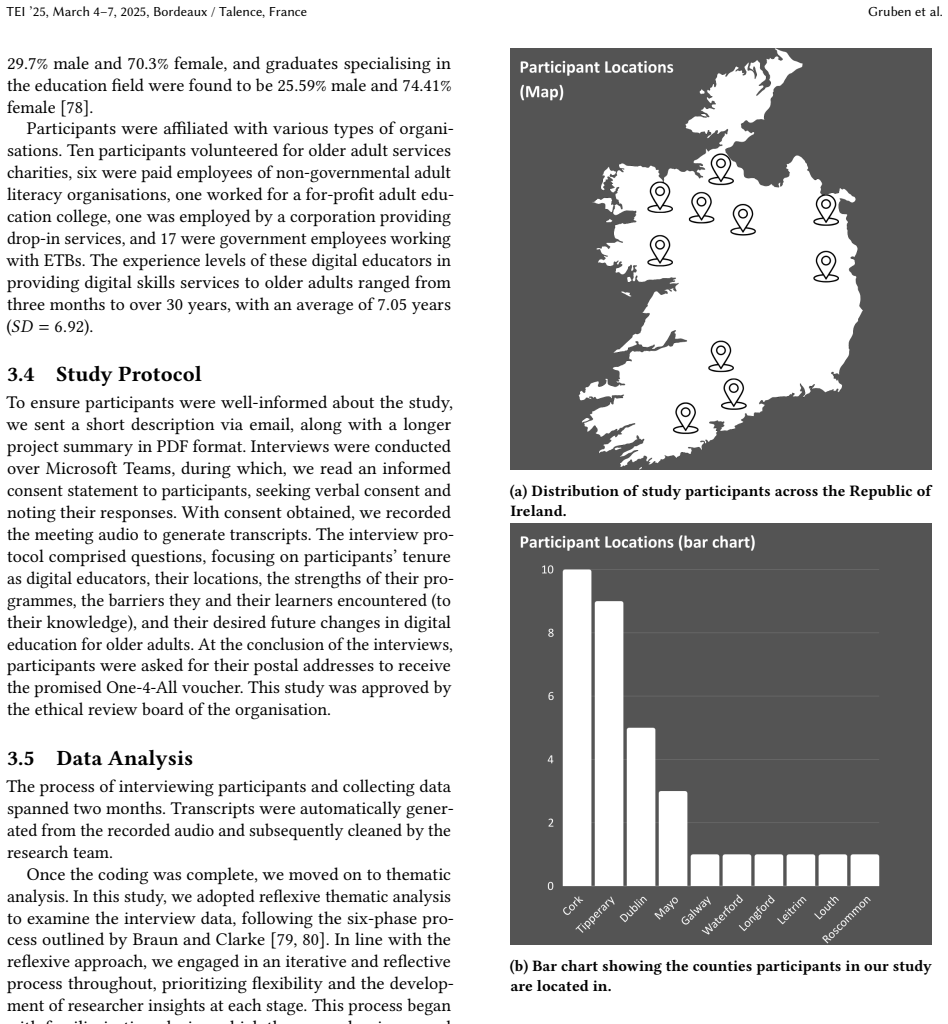
- [Section 3.3 and Section 5.5] The convenience sample is heavily skewed toward ETB staff (17 of 34) and unpaid volunteers (10 of 34), with only one for-profit college and one corporate drop-in service represented. The paper nevertheless generalizes to 'Ireland' and makes broad policy recommendations (e.g., increased public funding, corporate responsibility) in Section 5.5. The discussion should acknowledge how sector representation and the geographic distribution shown in Figure 1 limit the generalizability of theme frequencies, and the policy recommendations should be tempered accordingly.
minor comments (5)
- [Section 4.1.3, quote P26] The quotation contains a duplicated word: 'we we don't really know why it works.' This should be corrected to 'we don't really know why it works' or marked as a verbatim hesitation if that was intended.
- [ACM Reference Format] The reference line reads 'InNine-teenth International Conference'—the spacing between 'In' and 'Nineteenth' is missing, and 'Nineteenth' should be spelled out without a hyphen.
- [Section 3.4] The sentence 'This study was approved by the ethical review board of the organisation' is vague; please name the approving institutional review board or ethics committee for transparency.
- [Section 4.3.3] The phrase 'In 2021 the Eurobarometer research findings found' is redundant; consider writing 'In 2021, Eurobarometer research found' for clarity.
- [References [2] and [28]] Reference [2] contains a garbled URL ('WH0?sequence=1'), and reference [28] would benefit from a direct stable link or DOI to aid retrieval.
Circularity Check
No significant circularity: the paper's findings are inductively derived from educator interviews, and the one unsupported numeric claim is a missing-support issue, not a self-referential derivation.
full rationale
This is a qualitative interview study; there is no mathematical derivation, fitted parameter, or predicted quantity that reduces to an input. The central themes (learner-led instruction, step-by-step guidance, fear, inaccessible language, outdated devices, lack of family support, funding, rural broadband, and transport) are induced from 34 semi-structured educator interviews via reflexive thematic analysis, as described in Section 3.5, and are supported by prevalence counts and representative quotations. The interview protocol did ask about barriers and desired changes, so the themes naturally reflect those question categories; this is a standard feature of qualitative inquiry and is disclosed in Section 6: 'Interviewees often hesitated to critique their organisations, possibly due to confidentiality limits or cultural reasons, leading to initial claims of no barriers until we prompted for more detailed answers.' Acknowledged prompting and social-desirability risk weaken the evidential strength of the prevalence counts, but they do not make the findings equivalent to the protocol by construction. The only self-citation identified is reference [39] (Das et al., phishing literature review) in the Background section, and it supports a general claim about phishing prevalence rather than serving as load-bearing evidence for the paper's conclusions. One claim in Section 4.2.4, 'Family caregivers are not a replacement for digital skills services; our preliminary study found that 25% of older adults have no sense of family support when it comes to cyber safety,' is unsupported by the reported methods and its provenance is missing; this is a reporting and validity problem, not a circular step. The recommendations, such as simulated online banking platforms, are explicitly grounded in educator suggestions and are proposals rather than predictions derived from fitted data. Overall, the paper is self-contained as a thematic qualitative study and does not derive its claims from themselves or from author-imported uniqueness assumptions.
Assumptions & free parameters
assumptions (3)
- domain assumption The 34 interviewed educators' self-reports accurately represent the experiences and barriers of older adults in Ireland.
- domain assumption Reflexive thematic analysis as implemented by the research team yields valid, reproducible themes.
- domain assumption The UK Essential Digital Skills Framework is an appropriate operational definition of digital skills for the Irish context.
Cite this review
Pith. "Pith review of "It's Like Not Being Able to Read and Write": Narrowing the Digital Divide for Older Adults and Leveraging the Role of Digital Educators in Ireland." pith.science (2026). https://pith.science/paper/CWPWCUMR
@misc{pith2026250210166,
  author       = {Pith},
  title        = {Pith review of: "It's Like Not Being Able to Read and Write": Narrowing the Digital Divide for Older Adults and Leveraging the Role of Digital Educators in Ireland},
  year         = {2026},
  howpublished = {\url{https://pith.science/paper/CWPWCUMR}},
  note         = {Machine review of arXiv:2502.10166}
}
abstract
As digital services increasingly replace traditional analogue systems, ensuring that older adults are not left behind is critical to fostering inclusive access. This study explores how digital educators support older adults in developing essential digital skills, drawing insights from interviews with $34$ educators in Ireland. These educators, both professional and volunteer, offer instruction through a range of formats, including workshops, remote calls, and in-person sessions. Our findings highlight the importance of personalized, step-by-step guidance tailored to older adults' learning needs, as well as fostering confidence through hands-on engagement with technology. Key challenges identified include limited transportation options, poor internet connectivity, outdated devices, and a lack of familial support for learning. To address these barriers, we propose enhanced public funding, expanded access to resources, and sustainable strategies such as providing relevant and practical course materials. Additionally, innovative tools like simulated online platforms for practicing digital transactions can help reduce anxiety and enhance digital literacy among older adults. This study underscores the vital role that digital educators play in bridging the digital divide, creating a more inclusive, human-centered approach to digital learning for older adults.
Figures
Reference graph
Works this paper leans on
-
[1]
World population ageing, 2017
United Nations. World population ageing, 2017. https: //www.un.org/en/development/desa/population/publications/pdf/ ageing/WPA2017_Report.pdf
2017
-
[2]
Active ageing a policy framework,
World Health Organisation. Active ageing a policy framework,
-
[3]
The‘grey digital divide’: Perception, exclusion and barriers of access to the internet for older people
Peter Millward. The‘grey digital divide’: Perception, exclusion and barriers of access to the internet for older people. First monday, 2003
2003
-
[4]
Essential digital skills framework, 2019
GOV UK. Essential digital skills framework, 2019
2019
-
[5]
The digital economy and society index (desi), 2022
European Commission. The digital economy and society index (desi), 2022. https://digital-strategy.ec.europa.eu/en/policies/desi
2022
-
[6]
The digital age: new approaches to supporting people in later life get online, 2018
Centre For Aging Better. The digital age: new approaches to supporting people in later life get online, 2018. https://ageing-better.org.uk/sites/ default/files/2018-06/The-digital-age.pdf
2018
-
[7]
Immigrant integration and settlement services in ireland, 2018
Mary Gilmartin and Jennifer Dagg. Immigrant integration and settlement services in ireland, 2018
2018
-
[8]
young” and the “old
Ben Davies. Healthcare priorities: the “young” and the “old”. Cambridge Quarterly of Healthcare Ethics , 32(2):174–185, 2023
2023
Show all 100 references
-
[9]
Ageism, older people and covid-19
Malcolm Payne. Ageism, older people and covid-19. In Social work in health emergencies, pages 201–215. Routledge, 2022
2022
-
[10]
Perceptions and conse- quences of ageism: views of older people
Victor Minichiello, Jan Browne, and Hal Kendig. Perceptions and conse- quences of ageism: views of older people. Ageing & Society, 20(3):253–278, 2000
2000
-
[11]
The history of economic development in ireland, north and south
John Bradley. The history of economic development in ireland, north and south. In Proceedings-British Academy, volume 98, pages 35–68. Oxford University Press Inc., 1999
1999
-
[12]
Learning digital skills online: empowering older adults through one-to-one, online digital training provision
Gemma Wilson-Menzfeld, Jessica Raven Gates, Mary Moreland, Helen Raw, and Amy Johnson. Learning digital skills online: empowering older adults through one-to-one, online digital training provision. Frontiers in Psychology, 14:1122277, 2023
2023
-
[13]
Zooming in on embodied social sensemaking: Mapping the design space in the context of videoconferencing
Jelle Van Dijk. Zooming in on embodied social sensemaking: Mapping the design space in the context of videoconferencing. In Proceedings of the Sixteenth International Conference on Tangible, Embedded, and Embodied Interaction, pages 1–10, 2022
2022
-
[14]
Together alone: a tangible online narrative
Daniel Harley, Stefan Grambart, Rodrigo Skazufka Bergel, and Ali Mazalek. Together alone: a tangible online narrative. In Proceedings of the Sixteenth International Conference on Tangible, Embedded, and Embodied Interaction , pages 1–11, 2022
2022
-
[15]
Older adults’ reasons to participate in digital skills learn- ing: An interdisciplinary, multiple case study from austria, finland, and germany
Kaisa Pihlainen, Anja Ehlers, Rebekka Rohner, Katerina Cerna, Eija Kärnä, Moritz Hess, Lisa Hengl, Lotta Aavikko, Susanne Frewer-Graumann, Vera Gallistl, et al. Older adults’ reasons to participate in digital skills learn- ing: An interdisciplinary, multiple case study from au...
2023
-
[16]
Internet usage and the prospective risk of dementia: A population-based cohort study
Gawon Cho, Rebecca A Betensky, and Virginia W Chang. Internet usage and the prospective risk of dementia: A population-based cohort study. Journal of the American Geriatrics Society , 71(8):2419–2429, 2023
2023
-
[17]
Gp crisis investigation: Ru- ral ireland worst hit as two-thirds unable to take on new patients,
Maeve McTaggart and Cian Ó Broin. Gp crisis investigation: Ru- ral ireland worst hit as two-thirds unable to take on new patients,
-
[18]
Hse telehealth roadmap 2024 - 2027,
Health Service Executive. Hse telehealth roadmap 2024 - 2027,
2024
-
[19]
Covid-19, internet, and mobility: The rise of telework, telehealth, e-learning, and e-shopping
Kostas Mouratidis and Apostolos Papagiannakis. Covid-19, internet, and mobility: The rise of telework, telehealth, e-learning, and e-shopping. Sustainable cities and society , 74:103182, 2021
2021
-
[20]
Workshops in tei: Development, evaluation, exploration, and implementation: Development, evaluation, exploration, and implementation
Amy Chen and Dominic Co. Workshops in tei: Development, evaluation, exploration, and implementation: Development, evaluation, exploration, and implementation. In Proceedings of the Sixteenth International Confer- ence on Tangible, Embedded, and Embodied Interaction , pages 1–9, 2022
2022
-
[21]
https://www.ehealthireland.ie/media/eo5nuaju/hse_telehealth_ roadmap_full_report.pdf
-
[22]
Performative prototyping in collaborative mixed reality environments: an embodied design method for ideation and development in virtual reality
Joris Weijdom. Performative prototyping in collaborative mixed reality environments: an embodied design method for ideation and development in virtual reality. In Proceedings of the Sixteenth International Conference on Tangible, Embedded, and Embodied Interaction , pages 1–13, 2022
2022
-
[23]
Digital inclusion and an ageing population
Age Action. Digital inclusion and an ageing population. https://www.ageaction.ie/sites/default/files/digital_inclusion_and_ an_ageing_population.pdf, 2021
2021
-
[24]
Tablecanvas: Re- mote open-ended play in physical-digital environments
Yongxin Zhang, Charlotte Mejlvang Guldbæk, Christian Fog Dalsgaard Jensen, Nicolai Brodersen Hansen, and Florian Echtler. Tablecanvas: Re- mote open-ended play in physical-digital environments. In Proceedings of the Eighteenth International Conference on Tangible, Embedded, an...
2024
-
[25]
Intensity and frequency of extreme novel epidemics
Marco Marani, Gabriel G Katul, William K Pan, and Anthony J Parolari. Intensity and frequency of extreme novel epidemics. Proceedings of the National Academy of Sciences , 118(35):e2105482118, 2021
2021
-
[26]
Aging in covid-19: Vulnerability, immunity and intervention
Yiyin Chen, Sabra L Klein, Brian T Garibaldi, Huifen Li, Cunjin Wu, Nicole M Osevala, Taisheng Li, Joseph B Margolick, Graham Pawelec, and Sean X Leng. Aging in covid-19: Vulnerability, immunity and intervention. Ageing research reviews, 65:101205, 2021
2021
-
[27]
Remote, but tangible: Activities for grandparents and grandchildren across physical spaces
Verena Fuchsberger and Lisa Hofer. Remote, but tangible: Activities for grandparents and grandchildren across physical spaces. In Proceedings of the Eighteenth International Conference on Tangible, Embedded, and Embodied Interaction, pages 1–7, 2024
2024
-
[28]
Dr. John A. Weafer and Dr. Fergal Rhatigan. A review of older people’s capacity to access financial services online and to independently conduct their own financial affairs, 2022. https://www.citizensinformationboard.ie/downloads/social_policy/ Accessing_financial_services_onl...
2022
-
[29]
Exploring older people’s challenges on online banking/finance systems: Early findings
Dain Thomas, Gobinda Chowdhury, and Ian Ruthven. Exploring older people’s challenges on online banking/finance systems: Early findings. In Proceedings of the 2023 Conference on Human Information Interaction and Retrieval, pages 333–337, 2023
2023
-
[30]
Research highlights increased loneliness in lock-down for the over-70s, 2020
The Irish Longitudinal Study on Ageing (TILDA). Research highlights increased loneliness in lock-down for the over-70s, 2020. https://tilda.tcd. ie/publications/reports/pdf/Report_Covid19SocialIsolation.pdf
2020
-
[31]
Vulnerability of older adults to government impersonation scams
Lei Yu, Gary Mottola, Christine N Kieffer, Robert Mascio, Olivia Valdes, David A Bennett, and Patricia A Boyle. Vulnerability of older adults to government impersonation scams. JAMA Network Open, 6(9):e2335319– e2335319, 2023
2023
-
[32]
The scope of elder financial exploitation: What it costs victims, 2023
Jilenne Gunther. The scope of elder financial exploitation: What it costs victims, 2023. https://www.aarp.org/content/dam/aarp/money/scams- and-fraud/2023/true-cost-elder-financial-exploitation.doi.10.26419- 2Fppi.00194.001.pdf
2023
-
[33]
Elderly forgotten? digital exclu- sion in the information age and the rising grey digital divide
Farooq Mubarak and Reima Suomi. Elderly forgotten? digital exclu- sion in the information age and the rising grey digital divide. IN- QUIRY: The Journal of Health Care Organization, Provision, and Financing , 59:00469580221096272, 2022
2022
-
[34]
The top 5 financial scams targeting older adults,
Genevieve Waterman. The top 5 financial scams targeting older adults,
-
[35]
Prevalence of financial fraud and scams among older adults in the united states: A systematic review and meta- analysis
David Burnes, Charles R Henderson Jr, Christine Sheppard, Rebecca Zhao, Karl Pillemer, and Mark S Lachs. Prevalence of financial fraud and scams among older adults in the united states: A systematic review and meta- analysis. American journal of public health , 107(8):e13–e21, 2017
2017
-
[36]
The psychology of the internet fraud victimization of older adults: A systematic review
Yuxi Shang, Zhongxian Wu, Xiaoyu Du, Yanbin Jiang, Beibei Ma, and Meihong Chi. The psychology of the internet fraud victimization of older adults: A systematic review. Frontiers in psychology, 13:912242, 2022
2022
-
[37]
if it’s important it will be a headline
James Nicholson, Lynne Coventry, and Pamela Briggs. " if it’s important it will be a headline" cybersecurity information seeking in older adults. In Proceedings of the 2019 CHI Conference on Human Factors in Computing Systems, pages 1–11, 2019
2019
-
[38]
Recognising diversity in older adults’ cybersecurity needs
Benjamin Alan Morrison, James Nicholson, Lynne Coventry, and Pam Briggs. Recognising diversity in older adults’ cybersecurity needs. In Proceedings of the 2023 ACM Conference on Information Technology for Social Good, pages 437–445, 2023
2023
-
[39]
All about phishing: Exploring user research through a systematic literature review
Sanchari Das, Andrew Kim, Zachary Tingle, and Christena Nippert-Eng. All about phishing: Exploring user research through a systematic literature review. arXiv preprint arXiv:1908.05897, 2019
1908 arXiv
-
[40]
Experiences with scams among older adults,
University of Michigan. Experiences with scams among older adults,
-
[41]
https://www.healthyagingpoll.org/reports-more/report/experiences- scams-among-older-adults
-
[42]
woe is me
Hirak Ray, Flynn Wolf, Ravi Kuber, and Adam J Aviv. " woe is me" exam- ining older adults’ perceptions of privacy. In Extended abstracts of the 2019 CHI conference on human factors in computing systems , pages 1–6, 2019
2019
-
[43]
Reflecting ireland, an insight into consumer behavioural change in ireland, 2022
Permanent TSB. Reflecting ireland, an insight into consumer behavioural change in ireland, 2022. https://www.ptsb.ie/globalassets/pdf-documents/ reflecting-ireland---fraud.pdf
2022
-
[44]
Older irish people losing almost six times more money to scammers than younger generation – fraudsmart survey, 2019
Banking & Payments Federation Ireland. Older irish people losing almost six times more money to scammers than younger generation – fraudsmart survey, 2019. https://bpfi.ie/older-irish-people-losing-almost-six-times- money-scammers-younger-generation-fraudsmart-survey/
2019
-
[45]
Headline phishing statistics, 2024
Charles Griffiths. Headline phishing statistics, 2024. https://aag-it.com/the- latest-phishing-statistics/
2024
-
[46]
Privacy and data security in everyday online services for older adults
Jonas Ellefsen and Weiqin Chen. Privacy and data security in everyday online services for older adults. In Proceedings of the 10th International Conference on Software Development and Technologies for Enhancing Acces- sibility and Fighting Info-exclusion , pages 203–207, 2022
2022
-
[47]
Psychological barriers to digital living in older adults: computer anxiety as predictive mechanism for technophobia
Dina Di Giacomo, Jessica Ranieri, Meny D’Amico, Federica Guerra, and Domenico Passafiume. Psychological barriers to digital living in older adults: computer anxiety as predictive mechanism for technophobia. Be- havioral Sciences, 9(9):96, 2019
2019
-
[48]
Cybersecurity and digital exclusion of seniors: What do they fear? In International Symposium on Human Aspects of Information Security and Assurance , pages 12–21
Jesper Holgersson, Joakim Kävrestad, and Marcus Nohlberg. Cybersecurity and digital exclusion of seniors: What do they fear? In International Symposium on Human Aspects of Information Security and Assurance , pages 12–21. Springer, 2021
2021
-
[49]
Understanding older adults’ use of social technology and the factors influencing use
Gemma Wilson, Jessica R Gates, Santosh Vijaykumar, and Deborah J Mor- gan. Understanding older adults’ use of social technology and the factors influencing use. Ageing & Society, 43(1):222–245, 2023
2023
-
[50]
Consumer fraud against older adults in digital society: Examining victimization and its impact
Steven Kemp and Nieves Erades Pérez. Consumer fraud against older adults in digital society: Examining victimization and its impact. International Journal of Environmental Research and Public Health , 20(7):5404, 2023
2023
-
[51]
Achieving digital inclu- sion of older adults through interest-driven curriculums
Jeanie Beh, Sonja Pedell, and Bruno Mascitelli. Achieving digital inclu- sion of older adults through interest-driven curriculums. The Journal of Community Informatics, 14(1), 2018
2018
-
[52]
because i’m old
Hannah Barrie, Tara La Rose, Brian Detlor, Heidi Julien, and Alexander Serenko. “because i’m old”: The role of ageism in older adults’ experiences of digital literacy training in public libraries. Journal of Technology in human ServiceS, 39(4):379–404, 2021
2021
-
[53]
Multi-stakeholder perspectives on information communica- tion technology training for older adults: implications for teaching and learning
Sajay Arthanat, Kerryellen G Vroman, Catherine Lysack, and Joseph Grizzetti. Multi-stakeholder perspectives on information communica- tion technology training for older adults: implications for teaching and learning. Disability and Rehabilitation: Assistive Technology , 14(5):...
2019
-
[54]
Technology use by older adults and barriers to using tech- nology
Lynn Gitlow. Technology use by older adults and barriers to using tech- nology. Physical & Occupational Therapy in Geriatrics , 32(3):271–280, 2014
2014
-
[55]
Understanding older adults’ safety perceptions and risk mitigation strategies when accessing online services
Dandi Feng, Hiba Rafih, and Cosmin Munteanu. Understanding older adults’ safety perceptions and risk mitigation strategies when accessing online services. In International Conference on Human-Computer Interac- tion, pages 467–491. Springer, 2023
2023
-
[56]
but at the age of 85? forget it!
Hanna Köttl, Vera Gallistl, Rebekka Rohner, and Liat Ayalon. “but at the age of 85? forget it!”: Internalized ageism, a barrier to technology use. Journal of Aging Studies , 59:100971, 2021
2021
-
[57]
How older adults learn ict—guided and self-regulated learning in individuals with and without disabilities
Anna Schlomann, Christiane Even, and Torsten Hammann. How older adults learn ict—guided and self-regulated learning in individuals with and without disabilities. Frontiers in Computer Science , 3:803740, 2022
2022
-
[58]
Łukasz Tomczyk, Maria Lidia Mascia, Dorota Gierszewski, and Christopher Walker. Barriers to digital inclusion among older people: a intergenera- tional reflection on the need to develop digital competences for the group with the highest level of digital exclusion. Innoeduca, 9...
2023
-
[59]
Older adults and smart technology: facilitators and barriers to use.Frontiers in Computer Science, 4:835927, 2022
Maurita T Harris, Kenneth A Blocker, and Wendy A Rogers. Older adults and smart technology: facilitators and barriers to use.Frontiers in Computer Science, 4:835927, 2022. Narrowing the Digital Divide for Older Adults TEI ’25, March 4–7, 2025, Bordeaux / Talence, France
2022
-
[60]
Older adults and their acquisition of digital skills: A review of current research evi- dence
Priyankar Bhattacharjee, Steven Baker, and Jenny Waycott. Older adults and their acquisition of digital skills: A review of current research evi- dence. In Proceedings of the 32nd Australian conference on human-computer Interaction, pages 437–443, 2020
2020
-
[61]
Barriers to digital transformation of the silver economy: Challenges to adopting digital skills by the silver generation
Sidra Azmat Butt, Silvia Lips, Rahul Sharma, Ingrid Pappel, and Dirk Dra- heim. Barriers to digital transformation of the silver economy: Challenges to adopting digital skills by the silver generation. Proceedings of AHFE , pages 151–163, 2023
2023
-
[62]
Improving transport options in urban and rural areas,
Social Justice Ireland. Improving transport options in urban and rural areas,
-
[63]
A long term vision for eu rural areas, 2021
European Union Barometer. A long term vision for eu rural areas, 2021. https://europa.eu/eurobarometer/surveys/detail/2278
2021
-
[64]
Keeping up with the times in ireland: Older adults bridging the age-based digital divide together? Studies in the Education of Adults , pages 1–19, 2024
Sandra Flynn. Keeping up with the times in ireland: Older adults bridging the age-based digital divide together? Studies in the Education of Adults , pages 1–19, 2024
2024
-
[65]
Older adults and community-based tech- nological literacy programs: barriers & benefits to learning
Heidi McKee and Kristine Blair. Older adults and community-based tech- nological literacy programs: barriers & benefits to learning. Community Literacy Journal, 1(2):13–39, 2006
2006
-
[66]
The digital divide has grown old: Determinants of a digital divide among seniors
Thomas N Friemel. The digital divide has grown old: Determinants of a digital divide among seniors. New media & society , 18(2):313–331, 2016
2016
-
[67]
these devices have not been made for older people’s needs
Jari Pirhonen, Luciana Lolich, Katariina Tuominen, Outi Jolanki, and Virpi Timonen. “these devices have not been made for older people’s needs”– older adults’ perceptions of digital technologies in finland and ireland. Technology in Society, 62:101287, 2020
2020
-
[68]
https://www.socialjustice.ie/article/improving-transport-options- urban-and-rural-areas
-
[69]
Trends in peer learning
Keith J Topping. Trends in peer learning. Developments in Educational Psychology, pages 53–68, 2013
2013
-
[70]
About hi digital, 2023
Vodafone-Alone. About hi digital, 2023. https://hidigital.ie/about
2023
-
[71]
Ireland one of europe’s worst for rural broadband gap, says eu report, 2021
Adrian Weckler. Ireland one of europe’s worst for rural broadband gap, says eu report, 2021. https://www.independent.ie/business/technology/ ireland-one-of-europes-worst-for-rural-broadband-gap-says-eu- report/40606621.html
2021
-
[72]
Technophobia amongst older adults in ireland
Mairéad Hogan. Technophobia amongst older adults in ireland. Irish Journal of Management, 27(1):57, 2006
2006
-
[73]
Digital skills training for older people: The importance of the ‘lifeworld’
Werner Schirmer, Nelly Geerts, Anina Vercruyssen, Ignace Glorieux, Dig- ital Ageing Consortium, et al. Digital skills training for older people: The importance of the ‘lifeworld’. Archives of gerontology and geriatrics, 101:104695, 2022
2022
-
[74]
Informal and incidental learning in the workplace (Routledge revivals)
Victoria J Marsick and Karen Watkins. Informal and incidental learning in the workplace (Routledge revivals) . Routledge, 2015
2015
-
[75]
What role does geragogy play in the delivery of digital skills programs for middle and older age adults? a systematic narrative review
Jessica R Gates and Gemma Wilson-Menzfeld. What role does geragogy play in the delivery of digital skills programs for middle and older age adults? a systematic narrative review. Journal of Applied Gerontology , 41(8):1971–1980, 2022
1971
-
[76]
How “basic” is basic digital literacy for older adults? insights from digital skills instructors
Anina Vercruyssen, Werner Schirmer, Nelly Geerts, and Dimitri Mortel- mans. How “basic” is basic digital literacy for older adults? insights from digital skills instructors. In Frontiers in Education, volume 8, page 1231701. Frontiers Media SA, 2023
2023
-
[77]
Digital inclusion from the perspective of teachers of older adults- expectations, experiences, challenges and supporting measures
Łukasz Tomczyk, Anna Mróz, Katarzyna Potyrała, and Joanna Wnęk- Gozdek. Digital inclusion from the perspective of teachers of older adults- expectations, experiences, challenges and supporting measures. Gerontol- ogy & geriatrics education , 43(1):132–147, 2022
2022
-
[78]
Teaching tech- nology to older adults: modalities used by student mentors and reasons for continued program participation
Dara L LoBuono, Skye N Leedahl, and Elycia Maiocco. Teaching tech- nology to older adults: modalities used by student mentors and reasons for continued program participation. Journal of gerontological nursing , 46(1):14–20, 2020
2020
-
[79]
Reflecting on reflexive thematic analysis
Virginia Braun and Victoria Clarke. Reflecting on reflexive thematic analysis. Qualitative Research in Sport, Exercise and Health , 11(4):589–597, 2019
2019
-
[80]
Bridging the ‘instruction gap’: how ict instructors help older adults with the acquisition of digital skills
Nelly Geerts, Werner Schirmer, Anina Vercruyssen, and Ignace Glorieux. Bridging the ‘instruction gap’: how ict instructors help older adults with the acquisition of digital skills. International Journal of Lifelong Education , 42(2):195–207, 2023
2023
-
[81]
Effectiveness of instructional strategies de- signed for older adults in learning digital technologies: a systematic litera- ture review
Nahdatul Akma Ahmad, Muhammad Fairuz Abd Rauf, Najmi Najiha Mohd Zaid, Azaliza Zainal, Tengku Shahrom Tengku Shahdan, and Fariza Hanis Abdul Razak. Effectiveness of instructional strategies de- signed for older adults in learning digital technologies: a systematic litera- ture...
2022
-
[82]
Circumspect users: Older adults as critical adopters and resistors of tech- nology
Belen Barros Pena, Rachel E Clarke, Lars Erik Holmquist, and John Vines. Circumspect users: Older adults as critical adopters and resistors of tech- nology. In Proceedings of the 2021 CHI Conference on Human Factors in Computing Systems, pages 1–14, 2021
2021
-
[83]
How to help older adults learn new technology? results from a multiple case research interviewing the internet technology instructors at the senior learning center
Ching-Ju Chiu, Wan-Chen Tasi, Wan-Lin Yang, and Jong-Long Guo. How to help older adults learn new technology? results from a multiple case research interviewing the internet technology instructors at the senior learning center. Computers & Education, 129:61–70, 2019
2019
-
[84]
Women and men in ireland 2019 - education
Central Statistics Office (CSO). Women and men in ireland 2019 - education. https://www.cso.ie/en/releasesandpublications/ep/p-wamii/ womenandmeninireland2019/education/, 2019. Accessed: 2024-07-31
2019
-
[85]
Digital technology and older people: Towards a sociological approach to technology adoption in later life
Barbara Barbosa Neves and Geoffrey Mead. Digital technology and older people: Towards a sociological approach to technology adoption in later life. Sociology, 55(5):888–905, 2021
2021
-
[86]
Thematic analysis
Virginia Braun and Victoria Clarke. Thematic analysis. American Psycho- logical Association, 2012
2012
-
[87]
Explicit and implicit intergenera- tional digital literacy dynamics: How families contribute to overcome the digital divide of grandmothers
Andrea Rosales and Daniel Blanche-T. Explicit and implicit intergenera- tional digital literacy dynamics: How families contribute to overcome the digital divide of grandmothers. Journal of Intergenerational Relationships , 20(3):328–346, 2022
2022
-
[88]
Welcome to national broadband ireland, 2024
National Broadband Ireland. Welcome to national broadband ireland, 2024. https://nbi.ie/
2024
-
[89]
Loneliness, social isola- tion, and their discordance among older adults, 2019
Rose Anne Kenny Mark Ward, Richard Layte. Loneliness, social isola- tion, and their discordance among older adults, 2019. https://tilda.tcd.ie/ publications/reports/pdf/Report_Loneliness.pdf
2019
-
[90]
Older adults’ perceptions of ict: Main findings from the technology in later life (till) study
Hannah Ramsden Marston, Rebecca Genoe, Shannon Freeman, Cory Kul- czycki, and Charles Musselwhite. Older adults’ perceptions of ict: Main findings from the technology in later life (till) study. In Healthcare, vol- ume 7, page 86. MDPI, 2019
2019
-
[91]
The Growth of Digitization of Retail Banking in Ireland, and the impact FinTechs’ have on the adoption and actual usage
Patrick Keogh. The Growth of Digitization of Retail Banking in Ireland, and the impact FinTechs’ have on the adoption and actual usage . PhD thesis, Dublin Business School, 2021
2021
-
[92]
How do older adults feel about engaging with cyber-security? Human behavior and emerging technologies, 3(5):1033–1049, 2021
Benjamin Morrison, Lynne Coventry, and Pam Briggs. How do older adults feel about engaging with cyber-security? Human behavior and emerging technologies, 3(5):1033–1049, 2021
2021
-
[93]
Unofficial proxies: How close others help older adults with banking
Celine Latulipe, Ronnie Dsouza, and Murray Cumbers. Unofficial proxies: How close others help older adults with banking. In Proceedings of the 2022 CHI Conference on Human Factors in Computing Systems , pages 1–13, 2022
2022
-
[94]
Directives and politeness in spice-ireland
Patricia Ronan. Directives and politeness in spice-ireland. Corpus Prag- matics, 6(2):175–199, 2022
2022
-
[95]
Failure to connect: How has the national broadband plan crashed so badly?, 2021
Cianan Brennan. Failure to connect: How has the national broadband plan crashed so badly?, 2021. https://www.irishexaminer.com/opinion/ commentanalysis/arid-40721490.html
2021
-
[96]
Digital inclusion in ireland: Con- nectivity, devices & skills, 2021
National Economic & Social Council. Digital inclusion in ireland: Con- nectivity, devices & skills, 2021. http://files.nesc.ie/nesc_reports/en/154_ Digital.pdf
2021
-
[98]
The impact of online banking attributes on customer satisfaction: A study from the Irish retail banking customer perspective
Sagar Singh Kirpalsingh Rajput. The impact of online banking attributes on customer satisfaction: A study from the Irish retail banking customer perspective. PhD thesis, Dublin, National College of Ireland, 2019
2019
-
[2002]
https://iris.who.int/bitstream/handle/10665/67215/WH0?sequence= 1#page=19.10
-
[2023]
https://www.ncoa.org/article/top-5-financial-scams-targeting- older-adults
-
[2024]
rural-ireland-worst-hit-as-two-thirds-unable-to-take-on-new- patients/a988706887.html, Accessed: 25-06-2024
https://www.independent.ie/irish-news/gp-crisis-investigation- TEI ’25, March 4–7, 2025, Bordeaux / Talence, France Gruben et al. rural-ireland-worst-hit-as-two-thirds-unable-to-take-on-new- patients/a988706887.html, Accessed: 25-06-2024
2025
Reviewed August 7, 2026 · model on record in the stance chip above.
Discussion (0). Continue with ORCID to comment.