REVIEW 2 major objections 3 minor 54 references
On warped topological-insulator surfaces, in-plane pure spin currents appear at second order in the applied electric field, with directions fixed by crystal symmetry.
Reviewed by Pith at T0; open to challenge. T0 means a machine referee read the full paper against a public rubric. the ladder, T0–T4 →
T0 review · deepseek-v4-flash
2026-08-04 21:06 UTC pith:CWUQ5YWR
load-bearing objection The intrinsic second-order spin current in Bi2Te3 surface states is a real result, but the extrinsic collinear spin current vanishes by time-reversal symmetry, so the paper's main new claim is unsupported. the 2 major comments →
Non-linear spin current in the surface states of topological insulators
The pith
A machine-rendered reading of the paper's core claim, the machinery that carries it, and where it could break.
Core claim
On the paper's own terms, the central discovery is that the second-order response of the conserved spin current is not empty for time-reversal-invariant hexagonal-warped surface states. The linear spin Hall conductivity is purely out-of-plane; the in-plane spin components vanish not because of time-reversal symmetry alone, but because the C3 anisotropy makes their momentum integrals cancel. At order E^2, the same anisotropy selects nonzero components: the intrinsic conductivity Γ^x is polarized along the applied field, and the extrinsic Fermi-surface conductivity Γ^y is collinear with the current. Both are expressed through band-geometric quantities—spin-weighted Berry curvature, Berry conne
What carries the argument
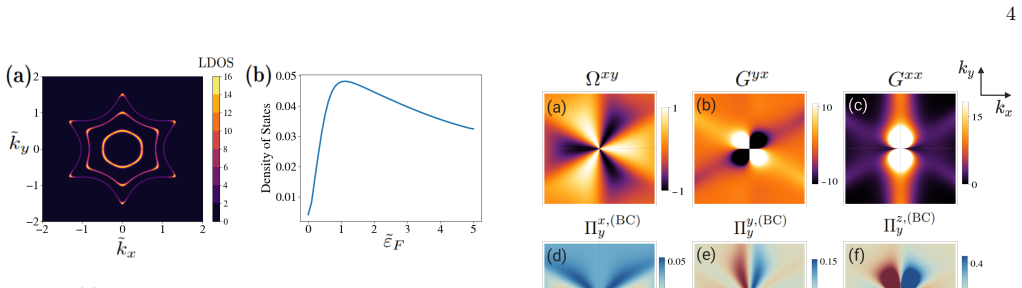
The central object is the spin-weighted Berry curvature, Ξ^l_ab = Ω^ab S^l, the product of the band Berry curvature and the spin polarization. At linear order it produces the out-of-plane spin Hall conductivity; at second order its Fermi-surface dipole generates the extrinsic in-plane spin current. The intrinsic second-order channel is carried by the Berry connection polarizability (BCP) dipole and by a Berry-curvature/spin-matrix-element term that arise from first-order corrections to the Bloch states. The enabling ingredient is the k^3 hexagonal warping term in the surface Hamiltonian, which makes the Berry curvature finite and anisotropic while leaving time-reversal symmetry intact.
Load-bearing premise
The central calculation depends on the spin-weighted Berry curvature having a nonzero Fermi-surface dipole; if symmetry forces that dipole to vanish, the extrinsic second-order spin current disappears and only the intrinsic terms remain.
What would settle it
Compute the Fermi-surface integral in Eq. (35) at a single Fermi energy with the paper's own Ξ^l(k). The extrinsic second-order conductivity survives only if this integral is nonzero; a second-harmonic spin-current measurement on Bi2Te3 can then check whether the predicted collinear component actually appears.
If this is right
- Linear response on these surfaces carries only out-of-plane spin polarization; in-plane spin currents are a second-order phenomenon, so they appear at twice the driving frequency in ac experiments.
- The intrinsic second-order spin conductivity is predicted to be on the order of 0.4 e µm/V, large enough to produce measurable edge spin accumulation or spin-orbit torque.
- The extrinsic contribution is a Fermi-surface effect and is much smaller than the intrinsic one, so it should be distinguishable by its relaxation-time scaling.
- The C3v symmetry acts as a selection switch: among the three spin components, only the components even under the mirror symmetries survive the momentum integration.
- A collinear spin current, with spins parallel to the travel direction, emerges from the extrinsic channel and could apply field-free torques to an adjacent magnet.
Where Pith is reading between the lines
- Extension: strain or a tilted surface that lowers the C3v symmetry to C_s should unlock additional spin-conductivity tensor components, since the selection rules derived here are purely symmetry-driven.
- Extension: the same spin-weighted-Berry-curvature machinery could be applied to other hexagonal-warped Dirac materials, such as Bi2Se3 or Sb2Te3, to predict the sign and magnitude of their nonlinear spin currents without new formalism.
- Extension: a first-principles band-structure calculation of Bi2Te3's surface states could test whether the low-energy C3v model captures the dominant contributions or whether higher-order warping terms change the surviving components.
Editorial analysis
A structured set of objections, weighed in public.
Referee Report
Summary. This paper studies linear and second-order pure spin currents in the hexagonal-warping surface states of Bi2Te3 within the conserved-spin-current formalism. Starting from the Fu model, the authors derive the k-resolved Berry curvature, BCP, and spin-weighted Berry curvature, and combine first-order perturbation theory with a Boltzmann relaxation-time description. They report (i) a purely out-of-plane linear spin Hall conductivity, (ii) a second-order intrinsic in-plane spin current polarized along the applied electric field, arising from BCP and Berry-curvature terms, and (iii) a second-order extrinsic in-plane collinear spin current attributed to a spin-weighted Berry curvature dipole. The paper also discusses experimental probes and potential applications of the collinear spin current.
Significance. If correct, the paper would identify a new extrinsic nonlinear spin response in topological insulator surfaces. The linear out-of-plane result and the intrinsic second-order field-polarized response are indeed consistent with the symmetries of the model, and the derivations in Eqs. (32)-(34) and Eqs. (23)-(24) have the expected parity properties. The work usefully shows that the conserved-spin-current formalism can be applied to the warped TI surface without introducing a mass term. However, the extrinsic second-order response is the paper's main new predictive claim, and it vanishes identically under time reversal. Since the abstract, Sec. IV, and Fig. 4(b) all rely on this extrinsic result, the central claim of the paper is unsupported by the paper's own equations.
major comments (2)
- [III.B, Eq. (35) and Appendix B] The extrinsic SOSC vanishes identically. From Eq. (26), d(-k) = -d(k), so the dispersion is even, ε(-k)=ε(k); the spin expectation is odd, S^l(-k)=-S^l(k); and Eq. (28) gives Ω^xy(-k)=-Ω^xy(k). Therefore Ξ^l_yx(-k)=Ω^xy(-k)S^l(-k)=Ξ^l_yx(k), i.e. the spin-weighted Berry curvature is even under k→-k. Since f^(0)(k) is even, ∂f/∂k_x is odd, so the integrand in Eq. (35) is an odd function of k. The integral over the inversion-symmetric Brillouin zone is therefore zero for every spin component l and for both bands. The same conclusion follows from the Fermi-surface form in Eq. (B2): k_F and the denominator are even under φ→φ+π, while ∂ε/∂k_x is odd, so the angular integral vanishes. Thus Γ^{l,ext}=0; the nonzero Γ^{y,ext} in Fig. 4(b) cannot be reproduced from the paper's own formulas.
- [Abstract and Sec. IV] The abstract's claim that the second-order response exhibits an extrinsic in-plane spin current 'induced by ... Berry curvature dipole (BCD)', and Sec. IV's conclusion that 'The extrinsic SOSC ... leads to a collinearly polarized spin current', rest entirely on Γ^{l,ext} in Eq. (35). Since that quantity is zero by time-reversal symmetry, these statements are unsupported. This is not a matter of numerical magnitude or of the relaxation-time approximation; it is a symmetry property of the model. A revision that wishes to retain an extrinsic response would need to break time-reversal symmetry (e.g. by magnetic doping) or change the definition of the distribution function, neither of which is present in the manuscript.
minor comments (3)
- [Sec. IV] The terminology 'spin-dependent BCD' is misleading: the quantity in Eq. (35) is the product of Berry curvature and spin expectation, and its dipole is not a standard Berry curvature dipole. The vanishing of this dipole is a direct consequence of time-reversal symmetry, and the text should reflect that.
- [Fig. 4(b)] The figure shows a nonzero extrinsic y-polarized conductivity, but the analytic integral in Eq. (B2) is odd under φ→φ+π and hence integrates to zero. The figure should be re-examined; if it was obtained numerically, the integration grid or the inclusion of the Jacobian may have broken the symmetry.
- [Sec. II.A] The relaxation-time approximation in Eq. (13) is applied to the surface states without modeling surface-bulk coupling. This is a secondary issue for the intrinsic response, but it would need discussion if the extrinsic response were retained.
Circularity Check
No significant circularity: the paper computes model-dependent response coefficients from a published Hamiltonian and external transport formalism without fitting the target observable or importing a load-bearing self-citation.
full rationale
The derivation chain is self-contained in the relevant sense. The model Hamiltonian (Eq. 25) is taken from the established topological-insulator surface literature (Fu, Ref. [25]; Zhang et al., Refs. [21,22]), and the conserved-spin-current response formalism is taken from external references (Refs. [14,15,17]). The linear and second-order spin conductivities are obtained by direct perturbative expansion of Bloch states (Eqs. 2-11) and by solving the Boltzmann equation in the relaxation-time approximation (Eqs. 13-15); no parameter is fitted to the quantity being predicted. The spin-weighted Berry curvature Xi^l = Omega^ab S^l is introduced by definition, not as an input that already encodes the final conductivities. The intrinsic second-order terms are derived from the BCP and Berry curvature, and the extrinsic term (Eq. 35) is an integral over the same defined quantity with the Fermi-function gradient; even if that integral has a symmetry-based problem, that is a correctness or mathematical-validity concern, not circularity. The self-citations present (Refs. [18,27,45]) are used as background or as comparisons of magnitude, not as the load-bearing justification for the main results. The paper does not rename a known result as a new one, does not invoke a uniqueness theorem from the authors' own prior work, and does not smuggle an ansatz in via self-citation. Therefore no circular step is exhibited.
Axiom & Free-Parameter Ledger
free parameters (1)
- Relaxation time tau =
1 ps (assumed)
axioms (6)
- domain assumption Conserved spin current definition j^l_a = e Omega^ab S^l E_b (Eq. 1) from Refs 14 and 17
- domain assumption Relaxation-time approximation with a single scalar tau (Eq. 13)
- domain assumption The Fu model Hamiltonian (Eq. 25) with v0 = 2.55 eV Angstrom and lambda = 250 eV Angstrom^3 from Ref 25, bulk and surface-bulk coupling neglected
- standard math First-order perturbative correction to Bloch states (Eq. 2) and truncation of the response at second order in E
- domain assumption Low-temperature limit with d f / d epsilon = - delta(epsilon - mu) for the extrinsic term (Appendix B)
- standard math Two-level BCP metric relation G^ab_+/- = +/- hbar^2 g^ab_+/- / (4 d) (Eq. 21)
invented entities (1)
-
Spin-weighted Berry curvature dipole (spin-BCD)
no independent evidence
Cite this review
Pith. "Pith review of Non-linear spin current in the surface states of topological insulators." pith.science (2026). https://pith.science/paper/CWUQ5YWR
@misc{pith2026260801782,
  author       = {Pith},
  title        = {Pith review of: Non-linear spin current in the surface states of topological insulators},
  year         = {2026},
  howpublished = {\url{https://pith.science/paper/CWUQ5YWR}},
  note         = {Machine review of arXiv:2608.01782}
}
read the original abstract
Spin Hall effect is one of the primary sources of pure spin current in spintronic devices, observed in spin-orbit coupled materials. In this work, we investigate linear and non-linear pure spin currents in the hexagonally warped surface states of topological insulators like $\rm Bi_2Te_3$, using the formalism of conserved spin transport. The hexagonal warping effect enables the application of this formalism by providing a well-defined Berry curvature without breaking the time-reversal symmetry. The absence of in-plane spin currents in the linear response motivates the extension of the formalism to the non-linear regime, by combining the perturbation of Bloch states with the Boltzmann transport equation. The second-order response exhibits both intrinsic and extrinsic in-plane spin currents induced by the spin-weighted Berry curvature, Berry connection polarizability (BCP) dipole and Berry curvature dipole (BCD) respectively. The band anisotropy due to the $C_{3v}$ symmetry of the material ($\rm Bi_2Te_3$) propagates through the spin textures and the band geometric quantities, resulting in the selection of certain components of the spin conductivity tensors.
Figures


Reference graph
Works this paper leans on
-
[1]
Herek x andk y are in units ofk 0 and range from−1 to 1. as, Gyx ± =− 2v2 0 16ε3 0 ˜d3 9 2 ˜k4 sin(4ϕ) + 1 2 ˜d2 n ˜k2 sin(2ϕ) −6 ˜k6 sinϕcos(3ϕ)−9 ˜k10 sin(4ϕ) cos2(3ϕ) o , (29) Gxx ± = v2 0 16ε3 0 ˜d3 1 + 9˜k4 cos2(2ϕ) − 1 ˜d2 n ˜kcosϕ+ 3 ˜k5 cos(2ϕ) cos(3ϕ) o2 ,(30) where ˜d= q ˜k2 + ˜k6 cos2(3ϕ). They have been plotted in Fig. (2(b),(c)).G yx shows a ...
-
[2]
Converting to real units, Γ x,int y turns out to be close to 0.4e µm/V, which is of the same order as the intrinsic second-order spin conductivity, reported in the 2D Rashba-Dresselhaus electron gas. Similar to the second-order spin conductivity in 2D hole gas[45], we find that the intrinsic response is much larger in magnitude than the extrinsic one. The...
-
[3]
ˇZuti´ c, J
I. ˇZuti´ c, J. Fabian, and S. Das Sarma, Spintronics: Fun- damentals and applications, Rev. Mod. Phys.76, 323 (2004)
2004
-
[4]
S. Bandyopadhyay and M. Cahay,Introduction to Spin- tronics (2nd ed.)(CRC Press, 2015)
work page 2015
-
[5]
J. Fabian, A. Matos-Abiague, C. Ertler, P. Stano, and I. ˇZuti´ c, Semiconductor spintronics, Acta Physica Slo- vaca. Reviews and Tutorials57, 10.2478/v10155-010- 0086-8 (2007)
-
[6]
Sinova, D
J. Sinova, D. Culcer, Q. Niu, N. A. Sinitsyn, T. Jung- wirth, and A. H. MacDonald, Universal intrinsic spin Hall effect, Phys. Rev. Lett.92, 126603 (2004)
2004
-
[7]
Murakami, N
S. Murakami, N. Nagaosa, and S.-C. Zhang, Dissipation- less quantum spin current at room temperature, Science 301, 1348 (2003)
2003
-
[8]
Sinova, S
J. Sinova, S. O. Valenzuela, J. Wunderlich, C. H. Back, and T. Jungwirth, Spin Hall effects, Rev. Mod. Phys.87, 1213 (2015)
2015
-
[9]
S. G. Tan, M. B. A. Jalil, C. S. Ho, Z. Siu, and S. Mu- rakami, Gauge physics of spin Hall effect, Sci Rep5, 18409 (2015)
work page 2015
-
[10]
Y. K. Kato, R. C. Myers, A. C. Gossard, and D. D. Awschalom, Observation of the spin Hall ef- fect in semiconductors, Science306, 1910 (2004), https://www.science.org/doi/pdf/10.1126/science.1105514
-
[11]
Schliemann and D
J. Schliemann and D. Loss, Anisotropic transport in a two-dimensional electron gas in the presence of spin-orbit coupling, Phys. Rev. B68, 165311 (2003)
2003
-
[12]
J. Schliemann and D. Loss, Spin-Hall transport of heavy holes in III-V semiconductor quantum wells, Phys. Rev. B71, 085308 (2005)
work page 2005
-
[13]
B. A. Bernevig and S.-C. Zhang, Intrinsic spin Hall effect in the two-dimensional hole gas, Phys. Rev. Lett.95, 016801 (2005)
work page 2005
-
[14]
Y. A. Bychkov and E. I. Rashba, Oscillatory effects and the magnetic susceptibility of carriers in inversion layers, Journal of Physics C: Solid State Physics17, 6039 (1984)
work page 1984
-
[15]
Dresselhaus, Spin-orbit coupling effects in zinc blende structures, Phys
G. Dresselhaus, Spin-orbit coupling effects in zinc blende structures, Phys. Rev.100, 580 (1955)
1955
-
[16]
Xiao and Q
C. Xiao and Q. Niu, Conserved current of nonconserved quantities, Phys. Rev. B104, L241411 (2021)
2021
-
[17]
J. Shi, P. Zhang, D. Xiao, and Q. Niu, Proper definition of spin current in spin-orbit coupled systems, Phys. Rev. Lett.96, 076604 (2006)
2006
-
[18]
Xiang, H
L. Xiang, H. Jin, and J. Wang, Spin transport revealed by spin quantum geometry, Phys. Rev. Lett.135, 146303 (2025)
2025
-
[19]
H. Liu, J. H. Cullen, and D. Culcer, Topological nature of the proper spin current and the spin-Hall torque, Phys. Rev. B108, 195434 (2023)
work page 2023
- [20]
- [21]
-
[22]
M.-C. Chang, Effect of in-plane magnetic field on the spin Hall effect in a Rashba-Dresselhaus system, Phys. Rev. B71, 085315 (2005)
work page 2005
-
[23]
H. Zhang, C.-X. Liu, X.-L. Qi, X. Dai, Z. Fang, and S.- C. Zhang, Topological insulators in Bi 2Se3,Bi 2Te3 and Sb2Te3 with a single Dirac cone on the surface, Nature Phys5, 438 (2009)
work page 2009
-
[24]
Liu, X.-L
C.-X. Liu, X.-L. Qi, H. Zhang, X. Dai, Z. Fang, and S.- C. Zhang, Model Hamiltonian for topological insulators, Phys. Rev. B82, 045122 (2010)
2010
-
[25]
S. Saha and A. Narayan, Nonlinear Hall effect in Rashba systems with hexagonal warping, Journal of Physics: 8 Condensed Matter35, 485301 (2023)
work page 2023
-
[26]
T. Nag, S. K. Das, C. Zeng, and S. Nandy, Third-order Hall effect in the surface states of a topological insulator, Phys. Rev. B107, 245141 (2023)
work page 2023
-
[27]
Fu, Hexagonal warping effects in the surface states of the topological insulator Bi 2Te3, Phys
L. Fu, Hexagonal warping effects in the surface states of the topological insulator Bi 2Te3, Phys. Rev. Lett.103, 266801 (2009)
work page 2009
-
[28]
A. Wong and F. Mireles, Spin Hall and longitudinal con- ductivity of a conserved spin current in two dimensional heavy-hole gases, Phys. Rev. B81, 085304 (2010)
work page 2010
- [29]
-
[30]
C. M. Wang and F. J. Yu, Effects of hexagonal warping on surface transport in topological insulators, Phys. Rev. B84, 155440 (2011)
work page 2011
-
[31]
R. S. Akzyanov and A. L. Rakhmanov, Surface charge conductivity of a topological insulator in a magnetic field: The effect of hexagonal warping, Phys. Rev. B97, 075421 (2018)
work page 2018
- [32]
-
[33]
Y. Imai, T. Yamaguchi, A. Yamakage, and H. Kohno, Spintronic properties of topological surface Dirac elec- trons with hexagonal warping, Phys. Rev. B103, 054402 (2021)
work page 2021
-
[34]
A. R. Mellnik, J. S. Lee, A. Richardella, J. L. Grab, P. J. Mintun, M. H. Fischer, A. Vaezi, A. Manchon, E.-A. Kim, N. Samarth, and D. C. Ralph, Spin-transfer torque generated by a topological insulator, Nature511, 449 (2014)
2014
-
[35]
R. S. Akzyanov and A. L. Rakhmanov, Bulk and surface spin conductivity in topological insulators with hexago- nal warping, Phys. Rev. B99, 045436 (2019)
work page 2019
-
[36]
J. H. Cullen and D. Culcer, Spin-Hall effect due to the bulk states of topological insulators: Extrinsic contribu- tion to the proper spin current, Phys. Rev. B108, 245418 (2023)
work page 2023
-
[37]
A. Asgharpour, C. Gorini, S. Essert, K. Richter, and i. d. I. m. c. Adagideli, Gate-controlled spin extraction from topological insulator surfaces, Phys. Rev. B102, 035401 (2020)
work page 2020
-
[38]
A. Yar, Jasra, and K. Sabeeh, Nonlinear Hall effect in topological insulator Bi 2Te3 with hexagonal warping, Journal of Applied Physics131, 184401 (2022)
work page 2022
-
[39]
H. Wang, H. Liu, X. Feng, J. Cao, W. Wu, S. Lai, W. Gao, C. Xiao, and S. A. Yang, Intrinsic nonlinear spin Hall effect and manipulation of perpendicular mag- netization, Phys. Rev. Lett.134, 056301 (2025)
work page 2025
-
[40]
H. Pan, Z. Liu, D. Hou, Y. Gao, and Q. Niu, Thermody- namic ground and Berry-phase origin of the planar spin Hall effect, Phys. Rev. Res.6, L012034 (2024)
work page 2024
-
[41]
W. Ding, X. Ma, X. Cheng, and X. Zhai, Intrinsic spin Hall effect in two-dimensional Dirac-Rashba systems, Phys. Rev. B112, 085403 (2025)
work page 2025
- [42]
-
[43]
N. W. Ashcroft and N. D. Mermin,Solid State Physics (Holt-Saunders, 1976)
1976
-
[44]
Liu, X.-B
T. Liu, X.-B. Qiang, H.-Z. Lu, and X. C. Xie, Quantum geometry in condensed matter, National Science Review 12, nwae334 (2024)
2024
-
[45]
S.-Q. Shen, Three-dimensional topological insulators, in Topological Insulators: Dirac Equation in Condensed Matter(Springer Singapore, Singapore, 2017) pp. 125– 152
work page 2017
-
[46]
Y. Liu, G. Shi, D. Kumar, T. Kim, S. Shi, D. Yang, J. Zhang, C. Zhang, F. Wang, S. Yang, Y. Pu, P. Yu, K. Cai, and H. Yang, Field-free switching of perpen- dicular magnetization at room temperature using out- of-plane spins from TaIrTe 4, Nature Electronics6, 732 (2023)
work page 2023
-
[47]
S. Chatterjee and T. K. Ghosh, Non-linear in-plane spin current in spin–orbit coupled 2D hole gases, Journal of Applied Physics140, 044301 (2026)
work page 2026
-
[48]
Wunderlich, B
J. Wunderlich, B. Kaestner, J. Sinova, and T. Jung- wirth, Experimental observation of the spin-Hall effect in a two-dimensional spin-orbit coupled semiconductor system, Phys. Rev. Lett.94, 047204 (2005)
2005
-
[49]
Stamm, C
C. Stamm, C. Murer, M. Berritta, J. Feng, M. Gabureac, P. M. Oppeneer, and P. Gambardella, Magneto-optical detection of the spin Hall effect in Pt and W thin films, Phys. Rev. Lett.119, 087203 (2017)
2017
-
[50]
Saitoh, M
E. Saitoh, M. Ueda, H. Miyajima, and G. Tatara, Conver- sion of spin current into charge current at room temper- ature: Inverse spin-Hall effect, Applied Physics Letters 88, 182509 (2006)
2006
-
[51]
E. A. Karashtin and A. A. Fraerman, Spin current and second harmonic generation in non-collinear magnetic systems: the hydrodynamic model, Journal of Physics: Condensed Matter30, 165801 (2018)
work page 2018
-
[52]
L. Liu, T. Moriyama, D. C. Ralph, and R. A. Buhrman, Spin-torque ferromagnetic resonance induced by the spin Hall effect, Phys. Rev. Lett.106, 036601 (2011)
work page 2011
-
[53]
L. Liu, C.-F. Pai, Y. Li, H. W. Tseng, D. C. Ralph, and R. A. Buhrman, Spin-torque switching with the giant spin Hall effect of tantalum, Science336, 555 (2012), https://www.science.org/doi/pdf/10.1126/science.1218197
-
[54]
K. Garello, C. O. Avci, I. M. Miron, M. Baumgartner, A. Ghosh, S. Auffret, O. Boulle, G. Gaudin, and P. Gam- bardella, Ultrafast magnetization switching by spin-orbit torques, Applied Physics Letters105, 212402 (2014)
work page 2014
discussion (0)
Sign in with ORCID, Apple, or X to comment. Anyone can read and Pith papers without signing in.