REVIEW 4 major objections 6 minor 68 references
Internet of Things Enabled Policing Processes
T0 review · 4 major / 6 minor · reviewed 2026-08-14 · deepseek-v4-flash
Pith's one-line read The paper proposes an IoT-enabled analytics pipeline that turns device data into navigable narratives for police investigators.
desk verdict A coherent but incremental thesis: the iCOP mobile prototype is new, yet the summary-generation algorithms are never specified and the evaluation never exercises the pipeline end-to-end. read the letter →
The pith
A machine-rendered reading of the paper's core claim, the machinery that carries it, and where it could break.
The reading
What carries the argument
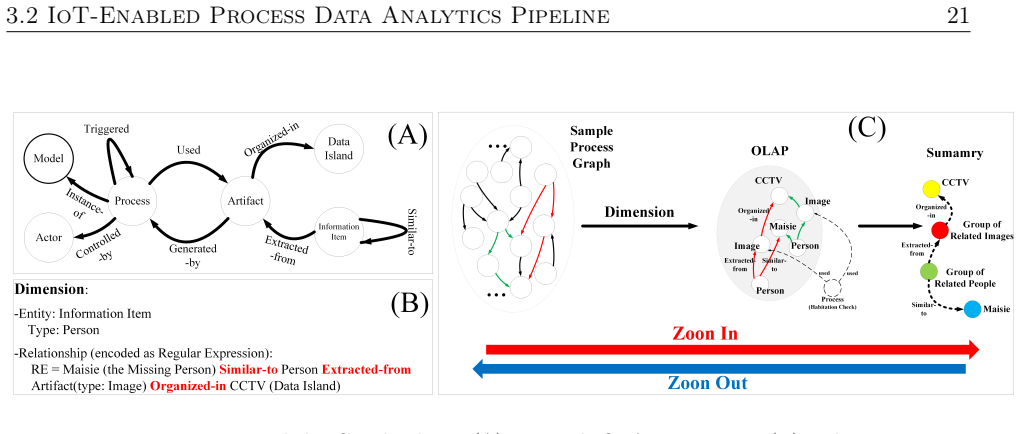
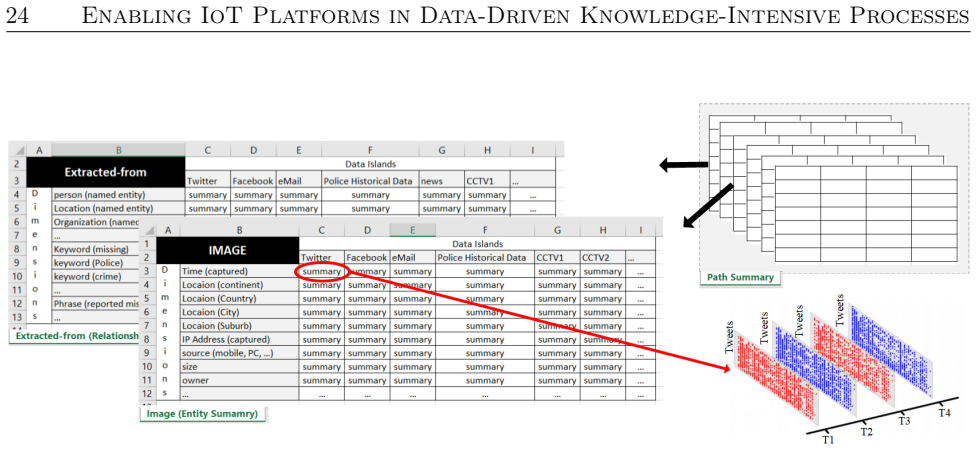
The carrying mechanism is the Process Knowledge Graph together with the process-cube summarization built on it. A Process Knowledge Graph is a typed directed graph in which police-relevant entities, from a missing person's name extracted from a tweet to a CCTV image or a police-car location stream, are nodes and their relationships are typed edges. Process cubes generalize graph OLAP: regular expressions, correlation conditions on node attributes, and path conditions on paths define entity, relationship, and path summaries, and a Narrative packages a set of summaries with part-of links so the analyst can roll up, drill down, and slice and dice. The spreadsheet-like dashboard maps dimensions to rows and data islands to columns, with each cell holding one summary, and machine-learning services are exposed to help the analyst manipulate these cells.
What would settle it
A controlled field trial in which trained police investigators work a staged missing-person scene with real IoT devices, comparing iCOP against conventional evidence collection, would settle the claim: if the pipeline does not reduce the time to assemble a timeline or increase the number of relevant device data items recovered, the claimed acceleration is not supported.
Extended reading notes
Core claim
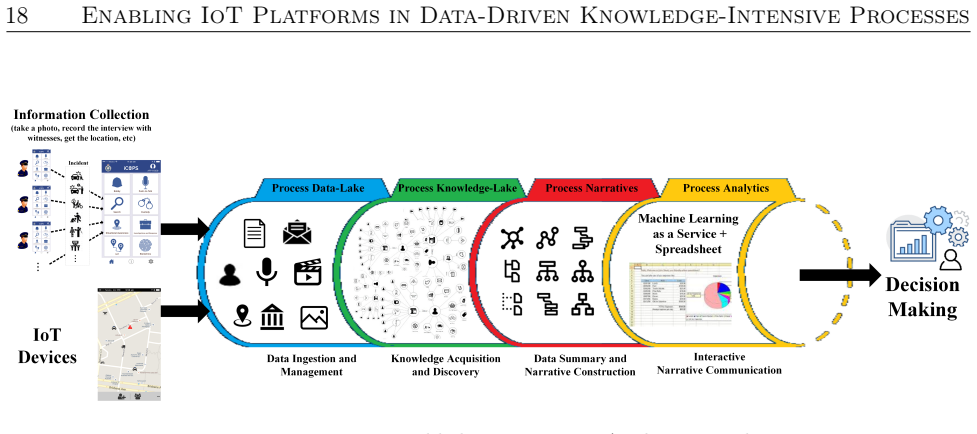
The central claim is that IoT data and process execution data can be joined in a single knowledge graph and then summarized into narratives that support criminal investigation. The thesis defines a Process Knowledge Graph whose nodes are entities (process instances, process models, artifacts, actors, data sources, and information items such as named entities and keywords) and whose edges are typed relationships such as 'used', 'generated-by', 'extracted-from', and 'similar-to'. Over this graph it defines process cubes, an OLAP-style structure in which correlation conditions and path conditions group entities into entity summaries, relationship summaries, and path summaries. A narrative is a set of such summaries connected by 'part-of' relationships, allowing zoom-in and zoom-out operations. The iCOP system implements the pipeline's three layers, IoT-enabled data collection, data transformation into the knowledge graph, and summary/analytics dashboard, and the evaluation reports positive qualitative feedback from a demonstration at a service-oriented computing conference.
Load-bearing premise
The usability claim rests on the assumption that positive feedback from attendees of a conference demonstration of iCOP is representative of how real police investigators would use the system in the field; the evaluation reports qualitative impressions without a survey instrument, a comparison baseline, or statistical testing.
Editorial extensions
If this is right
- A patrol officer using the iCOP mobile app can automatically discover nearby IoT devices and stream their data into the case's data lake without a separate data-engineering step.
- Investigators can navigate a whole case as zoomable summaries: start from a dashboard overview, drill down to one CCTV camera at one timestamp, and follow path summaries that connect the missing person's name across tweets, emails, and images.
- Because each summary carries provenance documenting how it was built, the narrative can be revisited and re-derived as new data arrives, supporting evolving investigations.
- The machine-learning-as-a-service layer lets analysts apply roll-up, drill-down, and slice-and-dice operations to evidence summaries directly in a spreadsheet-like interface, rather than writing queries.
Reading between the lines
- Beyond policing, the same pipeline design should transfer to other knowledge-intensive investigations where device data must be tied to a process, such as fraud examination, disaster response, or industrial accident analysis; the paper demonstrates only the policing scenario.
- The provenance attached to summaries makes the approach a natural fit for evidence auditability: a court or oversight body could in principle inspect how a narrative was constructed, but the paper does not develop legal or chain-of-custody requirements.
- The reported usability evidence is a conference demo impression; a field trial with real investigators is the test that would decide whether the claimed reduction in training effort and usefulness for crime investigation actually holds.
Signed reviews
Editorial analysis
A structured set of objections, weighed in public.
Referee Report
Summary. This is an MRes thesis posted to arXiv, not a standard journal article. It proposes an 'IoT-Enabled Process Data Analytics Pipeline' (Section 3.2) that ingests raw IoT/private/social/open data into a data lake, contextualizes it into a knowledge lake, builds a process knowledge graph, summarizes the graph into entity/relationship/path summaries, and links the summaries into 'process narratives' (Section 3.2.3). It also describes the iCOP prototype, a mobile dashboard for police investigators, and claims a scalability experiment and a demo-based usability evaluation (Chapter 4). The stated contributions are the pipeline, the summarization/'narrative' techniques, the spreadsheet-like ML-as-a-service dashboard, and the iCOP system.
Significance. The motivating scenario—missing-person investigation—is real and the general idea of relating IoT evidence to process execution data is timely; if the system worked as described it could be practically relevant. The manuscript gives formal definitions for the process knowledge graph and process cube, and it is transparent about building on the author's earlier CoreDB/CoreKG/iSheets components. However, the text does not provide the algorithms that are claimed to be the core contribution, and neither evaluation component exercises the full pipeline or uses domain users. There are no machine-checked proofs, no released code, and no falsifiable evaluation of narrative correctness; the contribution as presented is an architectural proposal rather than a validated system.
major comments (4)
- [Section 3.2.3] The chapter refers three times to 'Algorithm 1/2/3 in Figure 3.3' for entity, relationship, and path summaries, but no algorithm is actually given; Figure 3.3 is a diagram of the summary-generation process, not a pseudocode or formal specification. Because these algorithms are the claimed core novelty ('novel techniques to summarize... to construct process narratives'), the omission is load-bearing: a reader cannot reproduce, verify, or falsify the central technique. Please provide the actual algorithms or precise formal definitions and complexity statements.
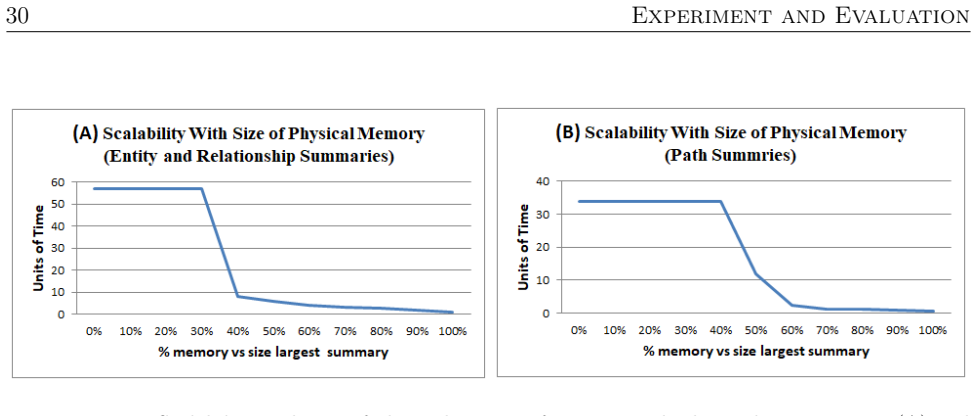
- [Section 4.2] Figure 4.3 does not evaluate the proposed pipeline. The experiment measures the memory behavior of a partition-level hash access structure over a 15-million-tweet collection; it does not involve IoT ingestion, knowledge extraction, linking to process execution data, or narrative construction. No baseline, no repeated runs or variance information, and no specification of the access structure or query workload are reported, and the only stated parameter—maximum path depth of three—is an unjustified free parameter. This experiment therefore cannot support the 'scalable and extensible' claim for the end-to-end pipeline.
- [Section 4.2.1] The usability study has no sample size, no recruitment criteria, no survey instruments, no task-based measurements, and no statistical analysis; the participants were attendees of the authors' ICSOC 2018 demonstration session, not police investigators. The statement that 'all participants ... strongly agreed' is qualitative self-report, and hypotheses H1 and H2 are nevertheless declared supported. This does not provide evidence for reduced training effort or usefulness for crime investigation in the field.
- [Section 4.2] The implementation description is too thin to establish that the described architecture exists end-to-end. The text says the system 'leverages' CoreDB, CoreKG, and iSheets and 'we develop ingestion services', but it does not state what new code was written, how the components are wired together, or how the claimed IoT device discovery and communication are realized. No end-to-end trace from raw IoT data to a constructed narrative is shown, so the reader cannot tell which parts of the pipeline are implemented and which are envisioned.
minor comments (6)
- [Section 3.2.3] In the path-summary paragraph, 'loation' should be 'location', and the example is twice introduced as a 'relationship summary' when it is clearly describing a path summary.
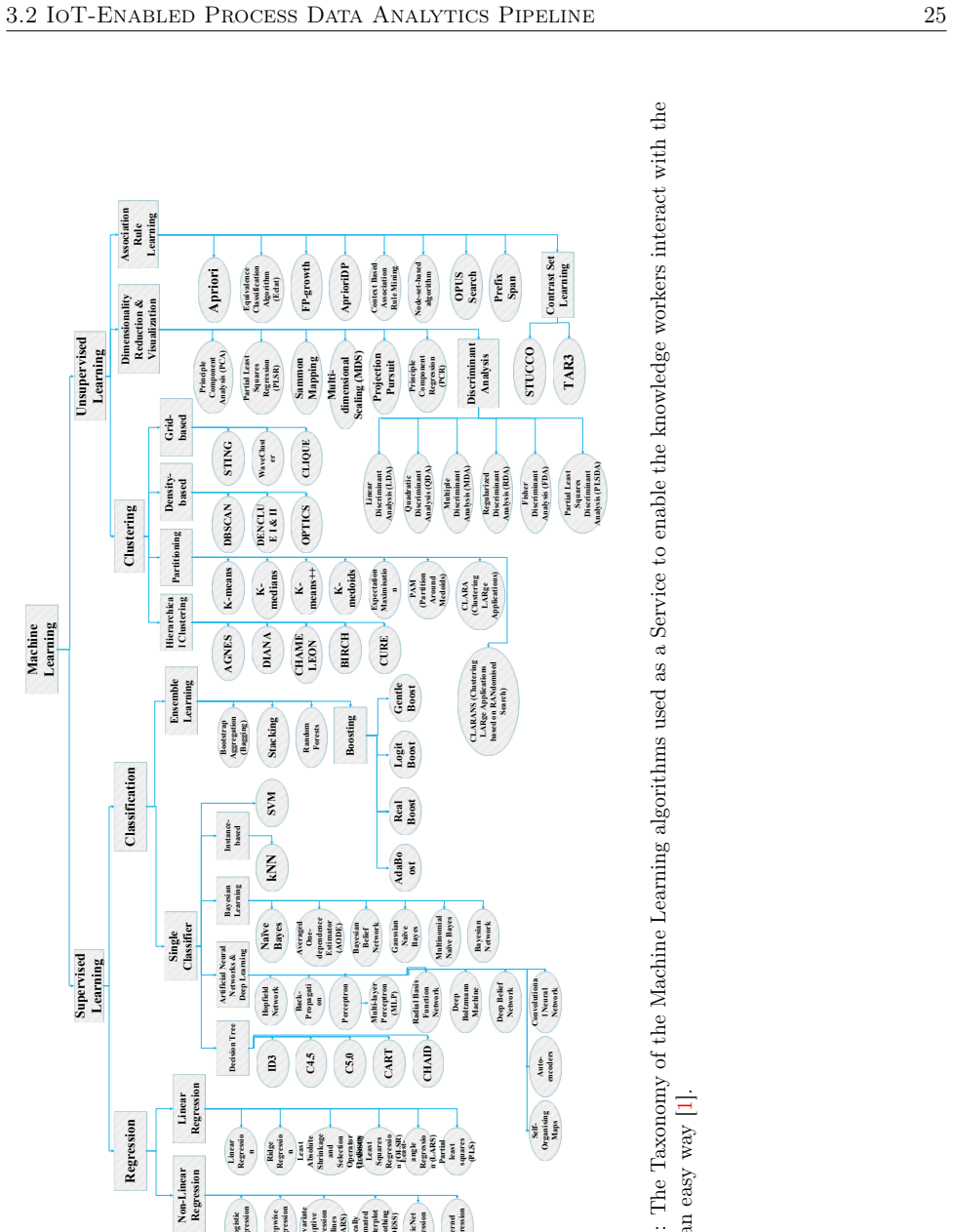
- [Figure 3.5] The caption contains 'sumamries' for 'summaries', and the figure lists a large taxonomy of machine-learning algorithms while the text never specifies which of these are actually wrapped as services in the implemented prototype.
- [Section 3.2.4] The text says 'twitted in different counties' where 'tweeted' is intended, and the repeated word 'different' in the same sentence should be cleaned up.
- [Chapter 3] The opening paragraph contains 'processes [2, 2, 3]' with a duplicated reference [2], and Section 2.3.2 contains 'iniProcess' where a proper-noun form appears intended.
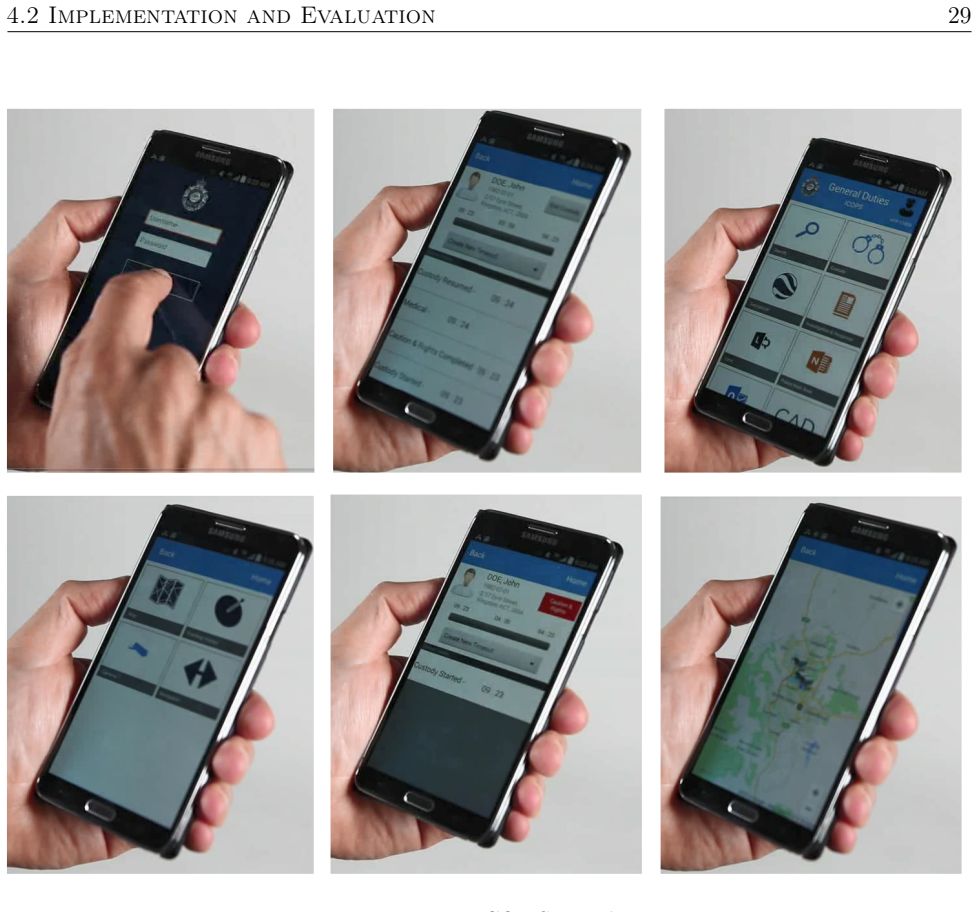
- [Figure 4.2] The iCOP screenshots are not described or walked through in the text; adding a concrete explanation of what each screenshot shows would help the reader understand the prototype's functionality.
- [Chapter 2] The long historical survey of technology-led policing (Sections 2.1.1 to 2.1.6) is only loosely connected to the proposed contribution; condensing it and citing more recent IoT-for-policing literature would improve focus.
Circularity Check
No significant circularity: the thesis is an architectural/integration proposal whose claims rest on weak evaluation, not on a derivation that reduces to its own inputs.
full rationale
The paper does not contain a formal derivation chain in which an output quantity is defined in terms of the target quantity, nor a fitted parameter that is later renamed a prediction. Section 3.2 defines process cubes, summaries, and narratives (N = {S,R}) and explicitly reuses graph-cube and summarization notions from earlier group publications ([39], [1]), but these are presented as building blocks rather than as evidence for the system's effectiveness. The usability evaluation (Section 4.2.1) is methodologically weak: hypotheses H1 and H2 are supported only by qualitative self-reports from ICSOC demo attendees, with no participant count, no police-subject sample, and no statistical analysis. The scalability experiment (Figure 4.3) uses a 15-million-tweet collection and does not exercise IoT ingestion, knowledge extraction, process linking, or narrative construction. These are serious validity and completeness problems, and the absence of the stated Algorithms 1-3 from the text makes the central techniques hard to verify; however, they are not cases of a claim reducing to its inputs by construction. Self-citations to CoreDB, CoreKG, and iSheets are load-bearing in the sense that the prototype is an integration of those systems, but the thesis does not derive a prediction from them or use them to forbid alternatives. Under the stated rules, that is reliance on prior work, not circularity.
Assumptions & free parameters
free parameters (1)
- path_depth_limit =
3
assumptions (3)
- domain assumption CoreDB Data Lake and CoreKG Knowledge Lake provide the described ingestion, curation, and contextualization capabilities.
- domain assumption The process knowledge graph, including entities, relationships, correlation conditions, and path conditions (definitions from [39], [41], [2]), is an adequate representation for linking IoT data to investigation processes.
- ad hoc to paper A conference demo audience is a representative proxy for police investigators in the field.
invented entities (1)
-
Process Narrative
Cite this review
Pith. "Pith review of Internet of Things Enabled Policing Processes." pith.science (2026). https://pith.science/paper/CXFMTQEG
@misc{pith2026190809232,
  author       = {Pith},
  title        = {Pith review of: Internet of Things Enabled Policing Processes},
  year         = {2026},
  howpublished = {\url{https://pith.science/paper/CXFMTQEG}},
  note         = {Machine review of arXiv:1908.09232}
}
read the original abstract
The Internet of Things (IoT) has the potential to transform many industries. This includes harnessing real-time intelligence to improve risk-based decision making and supporting adaptive processes from core to edge. For example, modern police investigation processes are often extremely complex, data-driven and knowledge-intensive. In such processes, it is not sufficient to focus on data storage and data analysis; as the knowledge workers (e.g., police investigators) will need to collect, understand and relate the big data (scattered across various systems) to process analysis. In this thesis, we analyze the state of the art in knowledge-intensive and data-driven processes. We present a scalable and extensible IoT-enabled process data analytics pipeline to enable analysts ingest data from IoT devices, extract knowledge from this data and link them to process execution data. We focus on a motivating scenario in policing, where a criminal investigator will be augmented by smart devices to collect data and to identify devices around the investigation location, to communicate with them to understand and analyze evidence. We design and implement a system (namely iCOP, IoT-enabled COP) to assist investigators collect large amounts of evidence and dig for the facts in an easy way.
Figures
Figures from the paper (6 more)


Reference graph
Works this paper leans on
-
[1]
F. Amouzgar, A. Beheshti, S. Ghodratnama, B. Benatallah, J. Yang, and Q. Z. Sheng. isheets: A spreadsheet-based machine learning development platform for data-driven process analytics. In Service-Oriented Computing - ICSOC 2018 Workshops - ADMS, ASOCA, ISYyCC, CloTS, DDBS, and NLS4IoT, Hangzhou, China, November 12-15, 2018, Revised Selected Papers, pp. 45...
work page 2018
-
[2]
A. Beheshti, B. Benatallah, and H. R. Motahari-Nezhad.Processatlas: A scalable and extensible platform for business process analytics. Softw., Pract. Exper.48(4), 842 (2018). URL https://doi.org/10.1002/spe.2558. 1, 15, 16, 20, 28
doi:10.1002/spe.2558 2018
-
[3]
S. Beheshti, B. Benatallah, H. R. M. Nezhad, and S. Sakr.A query language for analyzing business processes execution. In Business Process Management - 9th International Confer- ence, BPM 2011, Clermont-Ferrand, France, August 30 - September 2, 2011. Proceedings, pp. 281–297 (2011). 1, 16, 22
work page 2011
-
[4]
S. Dustdar, S. Nastic, and O. Scekic.Smart Cities - The Internet of Things, People and Systems (Springer, 2017). 2, 35
work page 2017
-
[5]
D. Bandyopadhyay and J. Sen.Internet of things: Applications and challenges in technology and standardization. Wireless Personal Communications58(1) (2011). 2, 12, 35
work page 2011
-
[6]
A. Beheshti, F. Schiliro, S. Ghodratnama, F. Amouzgar, B. Benatallah, J. Yang, Q. Z. Sheng, F. Casati, and H. R. Motahari-Nezhad.iprocess: Enabling iot platforms in data- driven knowledge-intensive processes. In Business Process Management Forum - BPM Forum 2018, Sydney, NSW, Australia, pp. 108–126 (2018). 2, 12, 27, 35
work page 2018
-
[7]
A. Beheshti, B. Benatallah, R. Nouri, V. M. Chhieng, H. Xiong, and X. Zhao.Coredb: a data lake service. In Proceedings of the 2017 ACM on Conference on Information and Knowledge Management, CIKM 2017, Singapore, November 06 - 10, 2017, pp. 2451–2454 (2017). 2, 17, 18
work page 2017
-
[8]
S. Beheshti, A. Tabebordbar, B. Benatallah, and R. Nouri.On automating basic data curation tasks. In WWW 2017. 2, 17, 19, 30
work page 2017
Show all 68 references
-
[9]
Beheshti, B
A. Beheshti, B. Benatallah, R. Nouri, and A. Tabebordbar.Corekg: a knowledge lake service. PVLDB (2018). 2, 12, 17, 18, 19, 28, 31
2018
-
[10]
Rowe.Introduction to policing(Sage, 2013)
M. Rowe.Introduction to policing(Sage, 2013). 7 36 References 37
2013
-
[11]
M. G. Grossman and J. V. Roberts.Criminal justice in Canada: A reader(Cengage Learning, 2011). 7
2011
-
[12]
Griffiths, K
K. Griffiths, K. Birdi, V. Alsina, D. Andrei, A. Baban, P. S. Bayeral, F. Bisogni, S. Chirca, P. Constanzo, M. Gascó,et al. Knowledge sharing practices and issues in policing contexts: a systematic review of the literature.European journal of policing studies3(3), 267 (2016). 7, 8, 9
2016
-
[13]
T. Newburn. Handbook of policing(Routledge, 2012). 7, 10, 34
2012
-
[14]
D. P. Rosenbaum, L. M. Graziano, C. D. Stephens, and A. M. Schuck.Understanding community policing and legitimacy-seeking behavior in virtual reality: A national study of municipal police websites. Police Quarterly 14(1), 25 (2011). 7
2011
-
[15]
P. P. Purpura.Security: An Introduction(CRC Press, 2016). 8
2016
-
[16]
C. Lum. Technology and mythology of progress in american law enforcement. Science Progress (2010). 8, 12
2010
-
[17]
Groff and J
E. Groff and J. T. McEwen.Identifying and Measuring the Effects of Information Technolo- gies on Law Enforcement Agencies: The Making Officer Redeployment Effective Program: a Guide for Law Enforcement(Institute for Law and Justice Alexandria, Va, 2008). 8
2008
-
[18]
De Pauw, P
E. De Pauw, P. Ponsaers, W. Bruggeman, K. Van Der Vijver, and P. Deelman.Technology- led policing. 20 (Maklu, 2011). 8
2011
-
[19]
C. Harris. Police and soft technology: How information technology contributes to police decision making. The new technology of crime, law and social control pp. 153–183 (2007). 8, 9
2007
-
[20]
J. M. Byrne and D. J. Rebovich.The new technology of crime, law and social control (Criminal Justice Press Monsey, NY, 2007). 9, 34
2007
-
[21]
Schiliro and K.-K
F. Schiliro and K.-K. Choo.The role of mobile devices in enhancing the policing system to improve efficiency and effectiveness: A practitioner’s perspective. In Mobile Security and Privacy, pp. 85–99 (Elsevier, 2017). 9, 10, 11, 14
2017
-
[22]
Hekim, S
H. Hekim, S. K. Gul, and B. K. Akcam.Police use of information technologies in criminal investigations. European Scientific Journal, ESJ9(4) (2013). 10
2013
-
[23]
Soulliére
N. Soulliére. Police and technology: Historical review and current status(Canadian Police College Ottawa, 1999). 10
1999
-
[24]
J. T. Ready and J. T. Young.The impact of on-officer video cameras on police–citizen contacts: Findings from a controlled experiment in mesa, az. Journal of experimental criminology 11(3), 445 (2015). 11
2015
-
[25]
A. H. H. Ngu, M. A. Gutierrez, V. Metsis, S. Nepal, and Q. Z. Sheng.Iot middleware: A survey on issues and enabling technologies. IEEE Internet of Things Journal4(1), 1 (2017). 12 38 References
2017
-
[26]
Y. Sun, H. Song, A. J. Jara, and R. Bie.Internet of things and big data analytics for smart and connected communities. IEEE Access4, 766 (2016). 12
2016
-
[27]
Da Xu, W
L. Da Xu, W. He, and S. Li.Internet of things in industries: A survey. IEEE Transactions on industrial informatics10(4), 2233 (2014). 12
2014
-
[28]
Beheshti, K
A. Beheshti, K. Vaghani, B. Benatallah, and A. Tabebordbar.Crowdcorrect: A curation pipeline for social data cleansing and curation. InInformation Systems in the Big Data Era - CAiSE Forum 2018, Tallinn, Estonia, June 11-15, 2018, Proceedings, pp. 24–38 (2018). 12
2018
-
[29]
Beheshti, B
A. Beheshti, B. Benatallah, A. Tabebordbar, H. R. Motahari-Nezhad, M. C. Barukh, and R. Nouri.Datasynapse: A social data curation foundry. Distributed and Parallel Databases (2018). URL https://doi.org/10.1007/s10619-018-7245-1. 12
2018 doi
-
[30]
Schiliro, A
F. Schiliro, A. Beheshti, S. Ghodratnama, F. Amouzgar, B. Benatallah, J. Yang, Q. Z. Sheng, F. Casati, and H. R. Motahari-Nezhad.icop: Iot-enabled policing processes. In Service-Oriented Computing - ICSOC 2018 Workshops - ADMS, ASOCA, ISYyCC, CloTS, DDBS, and NLS4IoT, Hangzhou...
2018
-
[31]
X. Li, R. Lu, X. Liang, X. Shen, J. Chen, and X. Lin.Smart community: an internet of things application. IEEE Communications Magazine49(11), 68 (2011). 13
2011
-
[32]
L. W. Sherman and J. E. Eck. Policing for crime prevention. Evidence-based crime prevention 295 (2002). 13
2002
-
[33]
Garicano and P
L. Garicano and P. Heaton.Information technology, organization, and productivity in the public sector: Evidence from police departments. Journal of Labor Economics28(1), 167 (2010). 13
2010
-
[34]
Beheshti, B
S. Beheshti, B. Benatallah, S. Sakr, D. Grigori, H. R. Motahari-Nezhad, M. C. Barukh, A. Gater, and S. H. Ryu.Process Analytics - Concepts and Techniques for Querying and Analyzing Process Data(Springer, 2016). 14, 28
2016
-
[35]
Y. J. Sun, M. C. Barukh, B. Benatallah, and S. Beheshti.Scalable saas-based process cus- tomization with casewalls. In Service-Oriented Computing - 13th International Conference, ICSOC 2015, Goa, India, November 16-19, 2015, Proceedings, pp. 218–233 (2015). URL https://doi.org...
2015 doi
-
[36]
Van Der Aalst and et al.Process mining manifesto
W. Van Der Aalst and et al.Process mining manifesto. In International Conference on Business Process Management, pp. 169–194 (Springer, 2011). 14
2011
-
[37]
Casati, M
F. Casati, M. Castellanos, U. Dayal, and N. Salazar.A generic solution for warehousing business process data. In Proceedings of the 33rd international conference on Very large data bases, pp. 1128–1137 (VLDB Endowment, 2007). 14
2007
-
[38]
M. J. Carey, N. Onose, and M. Petropoulos.Data services. Communications of the ACM 55(6), 86 (2012). 14 References 39
2012
-
[39]
Beheshti, B
S. Beheshti, B. Benatallah, and H. R. Motahari-Nezhad. Scalable graph-based OLAP analytics over process execution data. Distributed and Parallel Databases34(3), 379 (2016). 14, 21, 22
2016
-
[40]
Tabebordbar and A
A. Tabebordbar and A. Beheshti.Adaptive rule monitoring system. InProceedings of the 1st International Workshop on Software Engineering for Cognitive Services, SE4COG@ICSE 2018, Gothenburg, Sweden, May 28-2, 2018, pp. 45–51 (2018). 14
2018
-
[41]
H. R. M. Nezhad, R. Saint-Paul, F. Casati, and B. Benatallah.Event correlation for process discovery from web service interaction logs. VLDB J. 20(3), 417 (2011). 14, 22
2011
-
[42]
Beheshti, B
S. Beheshti, B. Benatallah, and H. R. M. Nezhad.Enabling the analysis of cross-cutting aspects in ad-hoc processes. In CAiSE, pp. 51–67 (2013). 14, 15, 22
2013
-
[43]
Gerede and J
C. Gerede and J. Su.Specification and verification of artifact behaviors in business process models. In ICSOC, pp. 181–192 (2007). 15
2007
-
[44]
Bhattacharya, C
K. Bhattacharya, C. E. Gerede, R. Hull, R. Liu, and J. Su.Towards formal analysis of artifact-centric business process models. In BPM, pp. 288–304 (2007). 15
2007
-
[45]
Y. Sun, J. Su, and J. Yang. Universal artifacts: A new approach to business process management (BPM) systems. ACM Trans. Management Inf. Syst.7(1), 3:1 (2016). 15
2016
-
[46]
J. Kuo. A document-driven agent-based approach for business processes management. Information and Software Technology46(6), 373 (2004). 15
2004
-
[47]
Reijers, J
H. Reijers, J. Rigter, and W. Aalst.The case handling case. Int. J. Cooperative Inf. Syst. 12(3), 365 (2003). 15
2003
-
[48]
Schonenberg, B
H. Schonenberg, B. Weber, B. F. van Dongen, and W. M. P. van der Aalst.Supporting flexible processes through recommendations based on history. In BPM, pp. 51–66 (2008). 15
2008
-
[49]
D. Benson. The police and information technology. Technology in working order: Studies of work, interaction, and technology pp. 81–97 (1993). 17
1993
-
[50]
A. A. Braga and D. L. Weisburd.Police innovation and crime prevention: Lessons learned from police research over the past 20 years(2015). 17
2015
-
[51]
Hammoud, D
M. Hammoud, D. A. Rabbou, R. Nouri, S. Beheshti, and S. Sakr.DREAM: distributed RDF engine with adaptive query planner and minimal communication. PVLDB 8(6), 654 (2015). URL http://www.vldb.org/pvldb/vol8/p654-Hammoud.pdf. 19
2015
-
[52]
Batarfi, R
O. Batarfi, R. E. Shawi, A. G. Fayoumi, R. Nouri, S. Beheshti, A. Barnawi, and S. Sakr. Large scale graph processing systems: survey and an experimental evaluation. Cluster Computing 18(3), 1189 (2015). URL https://doi.org/10.1007/s10586-015-0472-6. 20
2015 doi
-
[53]
W. M. Van der Aalst, B. F. van Dongen, C. W. Günther, A. Rozinat, E. Verbeek, and T. Weijters.Prom: The process mining toolkit.BPM (Demos) 489(31), 2 (2009). 20 40 References
2009
-
[54]
Beheshti, B
S. Beheshti, B. Benatallah, H. R. M. Nezhad, and M. Allahbakhsh.A framework and a lan- guage for on-line analytical processing on graphs. In Web Information Systems Engineering - WISE 2012 - 13th International Conference, Paphos, Cyprus, November 28-30, 2012. Pro- ceedings, pp...
2012 doi
-
[55]
S. M. Beheshti.Organizing, querying, and analyzing ad-hoc processes’ data.Ph.D. thesis, University of New South Wales, Sydney, Australia (2012). 22, 28
2012
-
[56]
Beheshti, H
S. Beheshti, H. R. M. Nezhad, and B. Benatallah.Temporal provenance model (TPM): model and query language. CoRR abs/1211.5009 (2012). 22
2012 arXiv
-
[57]
A. Singhal. Introducing the knowledge graph. Google Blog (2012). 28
2012
-
[58]
Beheshti, S
S.-M.-R. Beheshti, S. Venugopal, S. H. Ryu, B. Benatallah, and W. Wang.Big data and cross-document coreference resolution: Current state and future opportunities. arXiv preprint arXiv:1311.3987 (2013). 28
2013 arXiv
-
[59]
Beheshti, B
S. Beheshti, B. Benatallah, and H. R. Motahari-Nezhad.Galaxy: A platform for explo- rative analysis of open data sources. In Proceedings of the 19th International Conference on Extending Database Technology, EDBT 2016, Bordeaux, France, March 15-16, 2016, Bordeaux, France, Mar...
2016
-
[60]
Beheshti, A
S. Beheshti, A. Tabebordbar, B. Benatallah, and R. Nouri.Data curation apis. CoRR abs/1612.03277 (2016). 1612.03277, URL http://arxiv.org/abs/1612.03277. 30
2016 arXiv
-
[61]
Maamar, S
Z. Maamar, S. Sakr, A. Barnawi,et al. A framework of enriching business processes life-cycle with tagging information. In Australasian Database Conference, pp. 309–313 (Springer, 2015). 31
2015
-
[62]
Tanner and M
S. Tanner and M. Meyer.Police work and new ’security devices’: A tale from the beat. Security dialogue 46(4), 384 (2015). 33
2015
-
[63]
Wessels.Inside the digital revolution: Policing and changing communication with the public (Routledge, 2016)
B. Wessels.Inside the digital revolution: Policing and changing communication with the public (Routledge, 2016). 33, 34
2016
-
[64]
A. D. Hart and S. H. Frejd.The digital invasion: how technology is shaping you and your relationships (Baker Books, 2013). 33
2013
-
[65]
C. S. Koper, B. G. Taylor, and B. Kubu.Law enforcement technology needs assessment: Future technologies to address the operational needs of law enforcement(Police Executive Research Forum, 2009). 33, 34
2009
-
[66]
J. M. Caplan, L. W. Kennedy, and G. Petrossian.Police-monitored cctv cameras in newark, nj: A quasi-experimental test of crime deterrence. Journal of Experimental Criminology 7(3), 255 (2011). 33
2011
-
[67]
Murray.Police and the challenge of the twenty-first century: Managing change in police organisations
T. Murray.Police and the challenge of the twenty-first century: Managing change in police organisations. Gazette 62(1), 6 (2000). 34 References 41
2000
-
[68]
Schwabe, L
W. Schwabe, L. M. Davis, and B. A. Jackson.Challenges and Choices for Crime-Fighting Technology Federal Support of State and Local Law Enforcement(Rand Corporation, 2001). 34
2001
Reviewed August 14, 2026 · model on record in the stance chip above.
Discussion (0). Continue with ORCID to comment.