UnReal-B : Real-Space DFT Solver for Matter in Extreme Magnetic Fields
Pith reviewed 2026-06-27 11:48 UTC · model grok-4.3
The pith
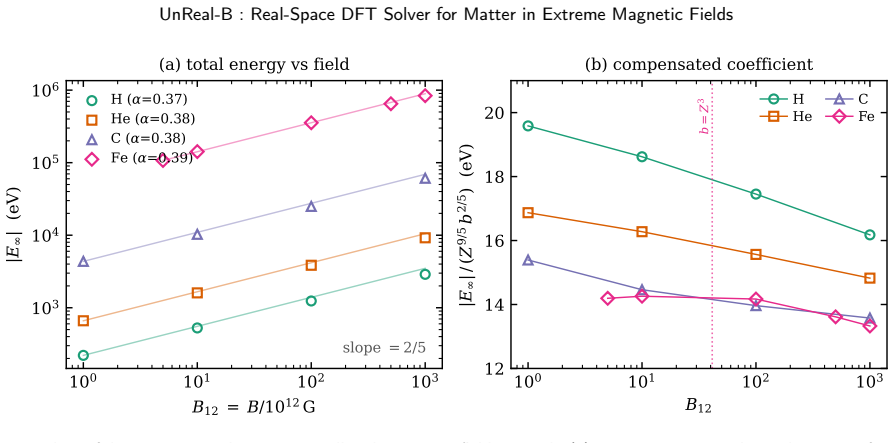
UnReal-B is a real-space DFT solver that calculates the electronic structure of one-dimensional atomic chains in magnetic fields from 10^12 to 10^15 gauss using the adiabatic approximation.
A machine-rendered reading of the paper's core claim, the machinery that carries it, and where it could break.
Core claim
UnReal-B provides a streamlined numerical framework for calculating the electronic structure of strongly magnetized condensed matter by employing the adiabatic approximation in a real-space Density Functional Theory solver for one-dimensional chains. It demonstrates excellent agreement with published results for several astrophysically relevant elements while maintaining a comparatively simple and transparent implementation.
What carries the argument
The adiabatic approximation applied inside a real-space density functional theory solver for one-dimensional atomic chains.
If this is right
- The solver enables reproducible calculations of neutron-star surface matter for elements already benchmarked.
- Open-source release supports community extensions driven by new observational data on neutron-star surfaces.
- The framework supplies a transparent base for adding further numerical capabilities while preserving the adiabatic simplification.
Where Pith is reading between the lines
- The same code structure could be applied to other one-dimensional systems outside astrophysics if the magnetic-field strengths remain comparable.
- Direct tests against full three-dimensional calculations at selected field strengths would map the approximation's breakdown points.
- Integration with radiative-transfer codes could link the computed electronic structures to predicted spectra from neutron-star atmospheres.
Load-bearing premise
The adiabatic approximation remains valid and accurate for the electronic structure calculations across the full range of magnetic fields considered.
What would settle it
A side-by-side comparison of energy levels or charge densities obtained from UnReal-B and from a calculation that drops the adiabatic approximation at B = 10^15 G would show large differences if the approximation fails.
Figures

read the original abstract
As new observational technologies reveal increasingly detailed properties of neutron star surfaces, the demand for accessible and extensible theoretical modeling tools continues to grow. We present UnReal-B, a real-space Density Functional Theory solver for one-dimensional chains of matter in extreme magnetic fields $B \approx 10^{12} - 10^{15},\mathrm{G}$. By employing the adiabatic approximation, UnReal-B, provides a streamlined numerical framework for calculating the electronic structure of strongly magnetized condensed matter. The solver is benchmarked against published results for several astrophysically relevant elements, demonstrating excellent agreement while maintaining a comparatively simple and transparent implementation. Released as open-source software, UnReal-B facilitates reproducible and community-driven investigations of neutron-star surface matter and provides a foundation for future developments motivated by emerging observational constraints.
Editorial analysis
A structured set of objections, weighed in public.
Referee Report
Summary. The manuscript introduces UnReal-B, an open-source real-space Density Functional Theory solver for one-dimensional chains of matter in extreme magnetic fields (B ≈ 10^12–10^15 G). It employs the adiabatic approximation to compute electronic structure, benchmarks the code against published results for several astrophysically relevant elements, and claims excellent agreement while emphasizing a simple and transparent implementation.
Significance. If the benchmarks and implementation details hold, the open-source release of a streamlined DFT tool for neutron-star surface modeling would be a useful contribution to the field, supporting reproducible investigations motivated by new observational data.
major comments (2)
- [Methods and Results sections] The central claim of accuracy across B ≈ 10^12–10^15 G rests on the adiabatic approximation, yet no section quantifies its error (e.g., via residuals against full 3D Landau-level calculations or higher-order transverse corrections) or identifies the B threshold where the approximation breaks down. This omission is load-bearing because the abstract asserts 'excellent agreement' without supporting sensitivity tests at the upper end of the range.
- [Results section] Benchmark comparisons are described only qualitatively ('excellent agreement'); the manuscript provides neither tabulated residuals, convergence metrics, nor explicit sensitivity tests at B = 10^15 G, which prevents independent assessment of whether the reported agreement actually validates the approximation over the full claimed interval.
minor comments (1)
- [Abstract] The abstract would be strengthened by naming the specific elements used in the benchmarks and the quantitative metrics (e.g., energy differences or density residuals) that define 'excellent agreement'.
Simulated Author's Rebuttal
We thank the referee for the constructive comments, which have helped us improve the clarity and rigor of the manuscript. We address each major point below and have made revisions to strengthen the presentation of the adiabatic approximation and the benchmark results.
read point-by-point responses
-
Referee: [Methods and Results sections] The central claim of accuracy across B ≈ 10^12–10^15 G rests on the adiabatic approximation, yet no section quantifies its error (e.g., via residuals against full 3D Landau-level calculations or higher-order transverse corrections) or identifies the B threshold where the approximation breaks down. This omission is load-bearing because the abstract asserts 'excellent agreement' without supporting sensitivity tests at the upper end of the range.
Authors: We agree that an explicit discussion of the adiabatic approximation's validity range would strengthen the manuscript. The approximation is standard in the literature for the B range considered (e.g., as used in prior works on magnetized neutron-star crusts), but we acknowledge the value of identifying its limitations. In the revised manuscript we have added a dedicated paragraph in the Methods section that cites existing comparisons between adiabatic and full 3D treatments, states the expected breakdown threshold near or above 10^15 G for the densities of interest, and includes new sensitivity tests at B = 10^15 G. Direct residuals against independent full 3D Landau-level calculations are not feasible within the scope of this work, which focuses on releasing an accessible real-space 1D solver; such comparisons would require a separate computational framework. revision: partial
-
Referee: [Results section] Benchmark comparisons are described only qualitatively ('excellent agreement'); the manuscript provides neither tabulated residuals, convergence metrics, nor explicit sensitivity tests at B = 10^15 G, which prevents independent assessment of whether the reported agreement actually validates the approximation over the full claimed interval.
Authors: We concur that quantitative presentation of the benchmarks is necessary. The revised Results section now includes tabulated residuals (absolute and relative differences) for each element and field strength against the published reference values, convergence metrics with respect to spatial grid spacing and simulation-box size, and explicit numerical results at B = 10^15 G demonstrating that agreement remains at the level reported for lower fields. revision: yes
- Direct quantitative residuals against independent full 3D Landau-level calculations, as this would require implementing and validating an entirely separate 3D solver outside the scope and design goals of the UnReal-B 1D real-space framework.
Circularity Check
No significant circularity
full rationale
The paper describes a numerical real-space DFT solver (UnReal-B) that implements the adiabatic approximation for electronic structure in extreme magnetic fields and validates it by direct benchmarking against independently published results for astrophysically relevant elements. No derivation chain reduces a claimed prediction or result to its own fitted inputs, self-citations, or definitional tautologies; the central output is a computational framework whose accuracy is assessed externally rather than by internal consistency alone. The adiabatic approximation is adopted as a modeling choice whose validity range is asserted but not derived from the solver itself.
Axiom & Free-Parameter Ledger
axioms (1)
- domain assumption The adiabatic approximation is valid for magnetic fields B ≈ 10^12 - 10^15 G
Reference graph
Works this paper leans on
-
[1]
Density-functional-theory calculations of matter in strong magnetic fields. II. Infinite chains and condensed matter , author=. Physical Review A—Atomic, Molecular, and Optical Physics , volume=. 2006 , publisher=
2006
-
[2]
Density-functional-theory calculations of matter in strong magnetic fields. I. Atoms and molecules , author=. Physical Review A—Atomic, Molecular, and Optical Physics , volume=. 2006 , publisher=
2006
-
[3]
Matter and radiation in the strong magnetic fields of neutron stars , author=. Ph. D. Thesis , year=
-
[4]
The Astrophysical Journal , volume=
Structure of solid iron in superstrong magnetic fields , author=. The Astrophysical Journal , volume=. 1974 , publisher=
1974
-
[5]
The Astrophysical Journal , volume=
Theory of pulsars: polar gaps, sparks, and coherent microwave radiation , author=. The Astrophysical Journal , volume=. 1975 , publisher=
1975
-
[6]
Part II: Including Magnetic Fields , author=
The Structure of the Density-Potential Mapping. Part II: Including Magnetic Fields , author=. ACS Physical Chemistry Au , volume=. 2023 , publisher=
2023
-
[7]
Dense Matter and Compact Stars in Strong Magnetic Fields , author=. Universe , volume=. 2026 , publisher=. doi:10.3390/universe12050122 , note=
-
[8]
Zane, Silvia and Taverna, Roberto and González–Caniulef, Denis and Muleri, Fabio and Turolla, Roberto and Heyl, Jeremy and Uchiyama, Keisuke and Ng, Mason and Tamagawa, Toru and Caiazzo, Ilaria and Di Lalla, Niccolò and Marshall, Herman L. and Bachetti, Matteo and La Monaca, Fabio and Gau, Ephraim and Di Marco, Alessandro and Baldini, Luca and Negro, Mich...
-
[9]
Physical Review Letters , volume=
Matter in Superstrong Magnetic Fields: The Surface of a Neutron Star , author=. Physical Review Letters , volume=. 1971 , publisher=
1971
-
[10]
Reviews of Modern Physics , volume=
Matter in strong magnetic fields , author=. Reviews of Modern Physics , volume=. 2001 , publisher=
2001
-
[11]
The Astrophysical Journal , volume=
Variational calculation of ground-state energy of iron atoms and condensed matter in strong magnetic fields , author=. The Astrophysical Journal , volume=. 1977 , publisher=
1977
-
[12]
Monthly Notices of the Royal Astronomical Society , volume=
Density functional calculations of the ground-state energies of atoms and infinite linear molecules in very strong magnetic fields , author=. Monthly Notices of the Royal Astronomical Society , volume=. 1985 , publisher=
1985
-
[13]
Physical Review A , volume=
Hartree-Fock calculations of atoms and molecular chains in strong magnetic fields , author=. Physical Review A , volume=. 1986 , publisher=
1986
-
[14]
Monthly Notices of the Royal Astronomical Society , volume=
Condensed surfaces of magnetic neutron stars, thermal surface emission, and particle acceleration above pulsar polar caps , author=. Monthly Notices of the Royal Astronomical Society , volume=. 2007 , publisher=
2007
-
[15]
Computer Physics Communications , volume=
Multi-electron systems in strong magnetic fields I: The 2D Landau--Hartree--Fock--Roothaan method , author=. Computer Physics Communications , volume=. 2014 , publisher=
2014
-
[16]
Physical Review Letters , volume=
Density-functional theory in strong magnetic fields , author=. Physical Review Letters , volume=. 1987 , publisher=
1987
-
[17]
Physics-Uspekhi , volume=
Atmospheres and radiating surfaces of neutron stars , author=. Physics-Uspekhi , volume=. 2014 , publisher=
2014
-
[18]
A review , author=
Magnetars: the physics behind observations. A review , author=. Reports on Progress in Physics , volume=. 2015 , publisher=
2015
-
[19]
and Watts, Anna L
Riley, Thomas E. and Watts, Anna L. and Bogdanov, Slavko and others , journal=. A. 2019 , publisher=
2019
-
[20]
Soviet Physics JETP , volume=
Heavy atom in an ultrastrong magnetic field , author=. Soviet Physics JETP , volume=. 1970 , note=
1970
-
[21]
Physical Review Letters , volume=
Statistical Model of Atoms in Intense Magnetic Fields , author=. Physical Review Letters , volume=. 1971 , publisher=
1971
-
[22]
Semiclassical regions , author=
Asymptotics of heavy atoms in high magnetic fields: II. Semiclassical regions , author=. Communications in Mathematical Physics , volume=. 1994 , publisher=
1994
-
[23]
The Astrophysical Journal , volume=
Surface structure of neutron stars with high magnetic fields , author=. The Astrophysical Journal , volume=. 1989 , publisher=
1989
-
[24]
Annual Review of Astronomy and Astrophysics , volume=
Magnetars , author=. Annual Review of Astronomy and Astrophysics , volume=. 2017 , doi=
2017
-
[25]
Space Science Reviews , volume=
Physics of Neutron Star Crusts , author=. Space Science Reviews , volume=. 2015 , doi=
2015
-
[26]
The Astrophysical Journal Letters , volume=
PSR J0740+6620 Mass and Radius from NICER Data and Implications for the Properties of Neutron Star Matter , author=. The Astrophysical Journal Letters , volume=. 2021 , doi=
2021
-
[27]
The Astrophysical Journal Letters , volume=
A NICER View of the Massive Pulsar PSR J0740+6620 Informed by Radio Timing and XMM-Newton Spectroscopy , author=. The Astrophysical Journal Letters , volume=. 2021 , doi=
2021
-
[28]
The Astrophysical Journal Letters , volume=
The Radius of PSR J0030+0451 from NICER and XMM-Newton Observations , author=. The Astrophysical Journal Letters , volume=
-
[29]
The Astrophysical Journal Letters , volume=
A Joint Analysis of NICER and XMM-Newton Observations of PSR J0030+0451 , author=. The Astrophysical Journal Letters , volume=
-
[30]
Science , volume=
Polarized X-rays from a Magnetar , author=. Science , volume=. 2022 , doi=
2022
-
[31]
Physical Review Letters , volume=
GW170817: Observation of Gravitational Waves from a Binary Neutron Star Inspiral , author=. Physical Review Letters , volume=. 2017 , doi=
2017
-
[32]
The Astrophysical Journal Letters , volume=
Multi-messenger Observations of a Binary Neutron Star Merger , author=. The Astrophysical Journal Letters , volume=. 2017 , doi=
2017
-
[33]
Nature , volume=
A Variable Absorption Feature in the X-ray Spectrum of a Magnetar , author=. Nature , volume=. 2013 , doi=
2013
-
[34]
Monthly Notices of the Royal Astronomical Society , volume=
Unifying the Observational Diversity of Isolated Neutron Stars via Magneto-thermal Evolution Models , author=. Monthly Notices of the Royal Astronomical Society , volume=. 2013 , doi=
2013
-
[35]
Monthly Notices of the Royal Astronomical Society , volume=
Strong Crustal Magnetic Fields in Neutron Stars , author=. Monthly Notices of the Royal Astronomical Society , volume=. 2013 , doi=
2013
-
[36]
Physical Review A , volume=
Ground-state Properties of Matter in Strong Magnetic Fields , author=. Physical Review A , volume=. 1987 , doi=
1987
-
[37]
The Astrophysical Journal , volume=
Hydrogen Phases on the Surface of a Strongly Magnetized Neutron Star , author=. The Astrophysical Journal , volume=. 1997 , doi=
1997
-
[38]
Density-functional-theory Calculations of Matter in Strong Magnetic Fields. I. Atoms and Molecules , author=. Physical Review A , volume=. 2006 , doi=
2006
-
[39]
Density-functional-theory Calculations of Matter in Strong Magnetic Fields. II. Infinite Chains and Condensed Matter , author=. Physical Review A , volume=. 2006 , doi=
2006
-
[40]
Universe , volume=
Decoding the Nature of Coherent Radio Emission in Pulsars I: Observational Constraints , author=. Universe , volume=. 2024 , doi=
2024
-
[41]
Advances in Space Research , volume=
Cohesive Property of Magnetized Neutron Star Surfaces: Computations and Implications , author=. Advances in Space Research , volume=. 2007 , doi=
2007
-
[42]
Astronomy and Astrophysics , volume=
Partially Screened Gap Model of Inner Acceleration Region in Pulsars , author=. Astronomy and Astrophysics , volume=. 2003 , doi=
2003
discussion (0)
Sign in with ORCID, Apple, or X to comment. Anyone can read and Pith papers without signing in.