REVIEW 2 major objections 3 minor 47 references
Every mixture of three Gaussian densities with a common covariance matrix has at most eight modes, with no extra assumptions on degeneracy or finiteness.
Reviewed by Pith at T0; open to challenge. T0 means a machine referee read the full paper against a public rubric. the ladder, T0–T4 →
T0 review · deepseek-v4-flash
2026-08-01 17:46 UTC pith:CXWJ7ECN
load-bearing objection A real improvement: an unconditional 15-critical-point bound for three homoscedastic Gaussians, with an 8-mode corollary that leans on a black-box citation. the 2 major comments →
On Mixtures of Three Homoscedastic Gaussian Densities: An Unconditional Sharper Bound on the Number of Modes
The pith
A machine-rendered reading of the paper's core claim, the machinery that carries it, and where it could break.
Core claim
The paper's central result is Theorem 2: every homoscedastic three-component Gaussian mixture density has at most 8 modes, with no finiteness or non-degeneracy assumption imposed. The theorem rests on Theorem 1, which bounds the number of critical points by 15 and proves every critical point is isolated. After a log-ratio reparameterization, critical points become intersections of two planar curves, and a zero-counting lemma for exponential polynomials bounds those intersections. A case split handles a possible higher-order degeneracy, yielding the final 15-critical-point bound. Previously available bounds (42,592 and 72) applied to far broader mixture classes and required the modal set to b
What carries the argument
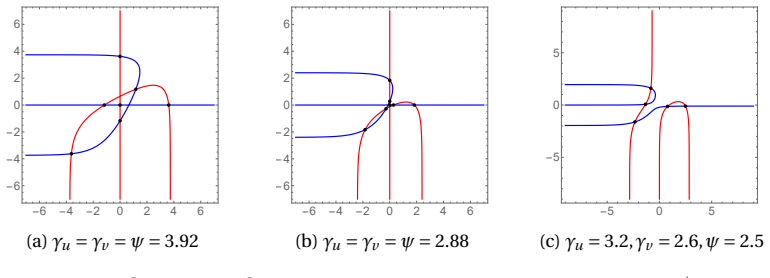
The load-bearing device is a reparameterization of the weight simplex into (s,t) = (log(alpha/(1-alpha-beta)), log(beta/(1-alpha-beta))), which turns the critical-point equations into two planar curves P(s,t)=0 and Q(s,t)=0 whose intersections are exactly the critical points. The intersection count is bounded by an elementary zero-counting lemma for exponential polynomials, applied to a derived function G(s) whose zeros control the derivative of a curve function; the case of a higher-order degeneracy requires a four-fold multiplicity correction. Together these give the 15-critical-point bound, and a transfer result converts it to the 8-mode bound.
Load-bearing premise
The 8-mode conclusion depends on a transfer proposition cited from prior work that turns a bound on non-degenerate critical points into a bound on modes via exponential tilting; the paper uses but does not prove that proposition, and if its hypotheses fail for this mixture class, Theorem 2 would not follow even though Theorem 1 still stands.
What would settle it
Exhibit a three-component homoscedastic Gaussian mixture with nine or more distinct local maxima (a numerical search over centers, weights, and covariance would do), or check that the cited transfer proposition's hypotheses hold for the full class studied; either check would settle the claim.
If this is right
- Every three-component homoscedastic Gaussian mixture, in any dimension, has a finite modal set with at most eight elements.
- The earlier conditional upper bounds (42,592 and 72) are superseded for this class; the finiteness assumption they required is dropped.
- All critical points of such a mixture are isolated, ruling out non-isolated modes and degenerate critical curves.
- The mode bound is dimension-free: the proof confines all critical points to a plane spanned by the centers (or to a line in collinear cases).
- The bound holds uniformly over arbitrary non-collinear centers and arbitrary positive weights, covering fully asymmetric configurations.
Where Pith is reading between the lines
- The same two-curve intersection counting with exponential polynomials may generalize to k-component homoscedastic mixtures, likely yielding polynomial-in-k bounds rather than the exponential bounds currently in the literature.
- If the conjectured sharp maximum of four modes (the equilateral-triangle ghost-mode configuration) is correct, the gap from eight suggests the true obstruction is geometric rather than analytic; a finer analysis of the two curves might close it.
- Because the reduction to a plane does not use dimension, the 15-critical-point/8-mode bound should also apply to mixtures whose centers lie in any affine subspace of dimension at most two — a testable extension for coplanar configurations.
- The proof's use of an external transfer proposition suggests that a direct topological argument for this class could eliminate that external step and possibly sharpen the bound.
Editorial analysis
A structured set of objections, weighed in public.
Referee Report
Summary. The paper studies the number of modes of three-component homoscedastic Gaussian mixtures in R^d. It first proves Theorem 1: every such mixture, including zero-weight, coincident-center, and collinear-center cases, has at most 15 critical points, each isolated, with no non-degeneracy or finiteness assumption. The proof passes through a two-dimensional reparameterization to equations P(s,t)=Q(s,t)=0 and counts intersections using an elementary exponential-polynomial zero bound; the algebraic coefficients are checked by a Mathematica script. It then claims Theorem 2: every such mixture has at most 8 modes. The deduction of Theorem 2 from Theorem 1 uses Proposition 3.4 and Proposition 3.7 of Nguyen (2026), the latter removing the Morse assumption via exponential tilting; neither proposition is stated in the manuscript.
Significance. If Theorem 2 is fully substantiated, the paper gives a substantial improvement over the previous conditional general bounds (42592 and 72) and provides the first unconditional uniform modal-set bound for the homoscedastic three-component family. The 15-critical-point portion is a self-contained, constructive result and is an interesting contribution in its own right; the accompanying Mathematica verification of the polynomial expansion is a useful reproducibility feature. The main significance is tempered by the fact that the last step is not self-contained and depends on an unstated external result.
major comments (2)
- [Section 3, Theorem 2 (paragraph after Theorem 1)] The paper's main mode-count result, Theorem 2, is not proven inside the manuscript: the last step invokes Nguyen (2026), Proposition 3.7, but that proposition is never stated and its hypotheses are never listed. The sentence 'Proposition 3.7 ... therefore applies with U=15' cannot be checked by the reader. The authors need to state the exact hypotheses of the proposition—in particular whether it requires a uniform bound on non-degenerate critical points over a tilt-closed class and a finite modal set for every density in that class—and verify each hypothesis for G. The paper verifies tilt-closure and Theorem 1 gives the uniform 15-critical-point bound, but this does not by itself establish the implication unless Proposition 3.7 has exactly the advertised form. Please quote Proposition 3.7 (and Proposition 3.4 if used) or give a self-contained proof of the (U+1)/2 mode bound.
- [Section 3, Theorem 2 paragraph] The sentence 'By Theorem 1, every density in G has at most 15 non-degenerate critical points, and the modal set of φ is finite' is ambiguous: Theorem 1 gives a global bound on all critical points for every density in G, so it implies both the non-degenerate bound and finiteness for every tilted density. As written, the finiteness assertion is only for φ. Because Proposition 3.7, if applied through tilting, needs finiteness for the tilted densities, the uniform statement should be made explicit.
minor comments (3)
- [Section 3.5] The phrase 'Sets †' should be 'Set'.
- [Section 2.2] The displayed evaluation of the 42592 bound is garbled; if the intended formula is 2^(d+3)(5+3d)^3, please correct the superscripts.
- [Lemma 1 proof] The sentence 'Repeated application of Rolle’s theorem gives ...' is terse; a one-line explanation of the multiplicity accounting would improve readability.
Circularity Check
No significant circularity; Theorem 2's mode bound depends on an external unstated transfer proposition (Nguyen 2026, Prop. 3.7), which is a proof-completeness concern, not a self-referential construction.
full rationale
The main derivation is not circular. Theorem 1, the paper's central technical result, is proved self-contained: Lemma 1 gives a Rolle-induction bound on zeros of exponential polynomials; Lemma 2 handles the univariate case; Section 3.2 removes degenerate and collinear cases; Sections 3.3-3.5 reduce critical-point counting to intersections of the curves P=0 and Q=0 and bound those intersections directly. No parameter is fitted to produce the 15-critical-point or 8-mode claim, and no equation is defined in terms of the target conclusion. Theorem 2 is derived from Theorem 1 together with an external result, Nguyen (2026), Proposition 3.7, which transfers a uniform bound on non-degenerate critical points to an unconditional mode bound via exponential tilting. The paper verifies that the homoscedastic three-component class G is closed under normalized exponential tilting, but it does not state or prove the proposition's hypotheses, so Theorem 2 inherits an unexamined external premise. That is a correctness/completeness gap, not circularity. The only self-citation in the paper (Kabata et al. 2025) is used for an illustrative example of two-component mode creation and is not load-bearing. Accordingly, no circular step is identified; score 1 reflects the mild external dependency while making clear that the derivation itself is not circular.
Axiom & Free-Parameter Ledger
axioms (4)
- domain assumption Nguyen (2026), Prop. 3.7: for a tilting-closed class of Gaussian mixtures, a uniform bound U on non-degenerate critical points implies at most (U+1)/2 modes without a Morse assumption.
- standard math Morse inequalities on R^d give #local maxima ≤ (N+1)/2 for a Morse density with N critical points.
- standard math Lemma 1 zero-counting for real exponential polynomials (proved in the paper).
- standard math Affine whitening by Σ^{-1/2} preserves the mode count of a homoscedastic mixture.
read the original abstract
It is known that a mixture of three homoscedastic multivariate Gaussian densities whose centers form an equilateral triangle can have four modes, owing to the emergence of a ``ghost'' mode at the center. Nevertheless, obtaining a sharp upper bound on the number of modes remains open even in this seemingly simple setting. The best previously available upper bounds applicable to the homoscedastic three-component setting were 42592 and, more recently, 72. These bounds were derived for substantially more general classes of Gaussian mixtures and are therefore not optimized for the present setting. Moreover, they are conditional on the assumption that the modal set is finite. In this paper, as a sharper bound, we prove that every mixture of three homoscedastic Gaussian densities has at most 8 modes, without imposing any finiteness or non-degeneracy assumption a priori. To the best of our knowledge, this is the first unconditional finiteness result for the modal set that holds uniformly over the full class of multivariate three-component homoscedastic Gaussian mixtures. In particular, it covers genuinely multivariate asymmetric configurations with arbitrary non-collinear centers and arbitrary positive mixture weights.
Figures
Reference graph
Works this paper leans on
-
[1]
2013 , type =
Wallace, Benjamin , title =. 2013 , type =
2013
-
[2]
Algebraic Statistics of Gaussian Mixtures , school =
Am. Algebraic Statistics of Gaussian Mixtures , school =. 2017 , type =
2017
-
[3]
Coppel , title =
William A. Coppel , title =
-
[4]
Studden , title =
Samuel Karlin and William J. Studden , title =
-
[5]
Guillemin, Victor and Pollack, Alan , title =
-
[6]
Transactions of the American Mathematical Society , volume =
Pillay, Anand and Steinhorn, Charles , title =. Transactions of the American Mathematical Society , volume =. 1986 , doi =
1986
-
[7]
Wilkie, A. J. , title =. Journal of the American Mathematical Society , volume =. 1996 , doi =
1996
-
[8]
1998 , doi =
van den Dries, Lou , title =. 1998 , doi =
1998
-
[9]
and Parks, Harold R
Krantz, Steven G. and Parks, Harold R. , title =
-
[10]
Rudin, Walter , title =
-
[11]
2026 , eprint=
Bounds on the Number of Modes of a Gaussian Mixture Density , author=. 2026 , eprint=
2026
-
[12]
Elementary
O'Neill, Barrett , year=. Elementary
-
[13]
Transactions of the American Mathematical Society , volume=
On the generalization of the Lambert W function , author=. Transactions of the American Mathematical Society , volume=
-
[14]
2012 , author =
On the upper bound of the number of modes of a multivariate normal mixture , journal =. 2012 , author =
2012
-
[15]
Information Geometry , volume=
Singularities in bivariate normal mixtures , author=. Information Geometry , volume=. 2025 , publisher=
2025
-
[16]
2000 , publisher=
Geoffrey McLachlan and David Peel , series=. 2000 , publisher=
2000
-
[17]
Inference and applications to clustering , author=
Mixture models. Inference and applications to clustering , author=
-
[18]
István Mező , year=. The
-
[19]
Vorobjov , year=
Andrei Gabrielov and Nicolai N. Vorobjov , year=. Complexity of computations with Pfaffian and Noetherian functions , booktitle=
-
[20]
1991 , doi=
Fewnomials , author=. 1991 , doi=
1991
-
[21]
Soviet Mathematics Doklady , volume=
On a class of systems of transcendental equations , author=. Soviet Mathematics Doklady , volume=. 1980 , organization=
1980
-
[22]
Selecta Mathematica , series =
Andrei Gabrielov , title =. Selecta Mathematica , series =
-
[23]
Rolin and P
J.-P. Rolin and P. Speissegger and A. J. Wilkie , title =. Journal of the American Mathematical Society , volume =
-
[24]
1963 , publisher=
Morse Theory , author=. 1963 , publisher=
1963
-
[25]
1965 , volume=
Lectures on the h -Cobordism Theorem , author=. 1965 , volume=
1965
-
[26]
Global Analysis of Expectation Maximization for Mixtures of Two Gaussians , volume =
Xu, Ji and Hsu, Daniel J and Maleki, Arian , booktitle =. Global Analysis of Expectation Maximization for Mixtures of Two Gaussians , volume =
-
[27]
Are There Local Maxima in the Infinite-Sample Likelihood of Gaussian Mixture Estimation?
Srebro, Nathan. Are There Local Maxima in the Infinite-Sample Likelihood of Gaussian Mixture Estimation?. Learning Theory. 2007
2007
-
[28]
Local Maxima in the Likelihood of Gaussian Mixture Models: Structural Results and Algorithmic Consequences , volume =
Jin, Chi and Zhang, Yuchen and Balakrishnan, Sivaraman and Wainwright, Martin J and Jordan, Michael I , booktitle =. Local Maxima in the Likelihood of Gaussian Mixture Models: Structural Results and Algorithmic Consequences , volume =
-
[29]
Corless, Robert M and Gonnet, Gaston H and Hare, David EG and Jeffrey, David J and Knuth, Donald E , journal=. On the. 1996 , publisher=
1996
-
[30]
1995 , author =
Local Morse Theory for Solutions to the Heat Equation and Gaussian Blurring , journal =. 1995 , author =
1995
-
[31]
Lifshitz, L. M. and Pizer, S. M. , title =. IEEE Transactions on Pattern Analysis and Machine Intelligence , pages =. 1990 , publisher =
1990
-
[32]
and Williams, Christopher K
Carreira-Perpi \ n \'a n, Miguel \'A . and Williams, Christopher K. I. An isotropic Gaussian mixture can have more modes than components. 2003
2003
-
[33]
Technometrics , volume =
Isidore Eisenberger , title =. Technometrics , volume =. 1964 , publisher =
1964
-
[34]
Clifford
Cohen, A. Clifford. On some conditions under which a compound normal distribution is unimordal. 1953
1953
-
[35]
1995 , publisher=
Mixture Models: Theory, Geometry, and Applications , author=. 1995 , publisher=
1995
-
[36]
Technometrics , volume =
Javad Behboodian , title =. Technometrics , volume =. 1970 , publisher =
1970
-
[37]
2008 , publisher=
Optimal Transport: Old and New , author=. 2008 , publisher=
2008
-
[38]
2024 , eprint=
Optimal Transport for Domain Adaptation through Gaussian Mixture Models , author=. 2024 , eprint=
2024
-
[39]
A Wasserstein-Type Distance in the Space of Gaussian Mixture Models , journal =
Delon, Julie and Desolneux, Agn\`. A Wasserstein-Type Distance in the Space of Gaussian Mixture Models , journal =
-
[40]
and Tannenbaum, Allen , journal=
Chen, Yongxin and Georgiou, Tryphon T. and Tannenbaum, Allen , journal=. Optimal Transport for Gaussian Mixture Models , year=
-
[41]
and Hostetler, L
Fukunaga, K. and Hostetler, L. , journal=. The estimation of the gradient of a density function, with applications in pattern recognition , year=
-
[42]
Gaussian Mixture Models
Reynolds, Douglas. Gaussian Mixture Models. Encyclopedia of Biometrics. 2009
2009
-
[43]
The R Journal , volume=
mclust 5: clustering, classification and density estimation using Gaussian finite mixture models , author=. The R Journal , volume=. 2016 , publisher=
2016
-
[44]
and Williams, Christopher K
Carreira-Perpi \ n \'a n, Miguel \'A . and Williams, Christopher K. I. On the Number of Modes of a Gaussian Mixture. Scale Space Methods in Computer Vision. 2003
2003
-
[45]
Lindsay , title =
Surajit Ray and Bruce G. Lindsay , title =. 2005 , journal =
2005
-
[46]
Maximum number of modes of Gaussian mixtures
Am. Maximum number of modes of Gaussian mixtures. Information and Inference: A Journal of the IMA , volume =
-
[47]
2013 , title =
Edelsbrunner, Herbert and Fasy, Brittany Terese and Rote, Gunter , journal =. 2013 , title =
2013
discussion (0)
Sign in with ORCID, Apple, or X to comment. Anyone can read and Pith papers without signing in.