Geometric Matching of Local Static Regions in Cosmological Spacetimes with an Evolving Lapse
Pith reviewed 2026-06-27 15:51 UTC · model grok-4.3
The pith
Embedding a static Schwarzschild region into a GCT-FLRW spacetime with evolving lapse produces a geometric consistency condition from extrinsic curvature continuity.
A machine-rendered reading of the paper's core claim, the machinery that carries it, and where it could break.
Core claim
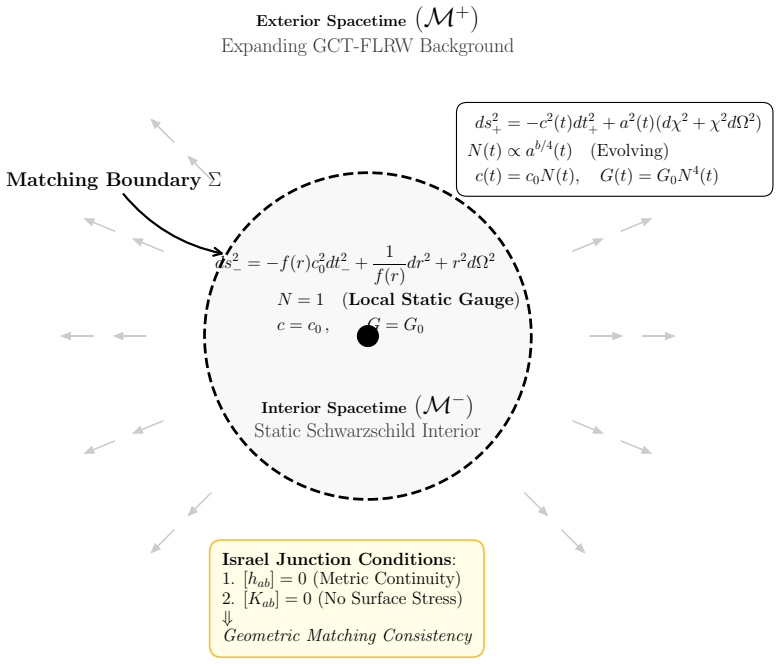
By embedding a static Schwarzschild interior into an expanding GCT-FLRW exterior, the Israel junction conditions are used to determine the class of background expansions that admit such a matching in the absence of a thin shell. The continuity of the extrinsic curvature yields a Friedmann-type relation that coincides with the GCT background equations of motion. This relation should be interpreted not as a new dynamical equation, but as a geometric consistency condition (GCC) associated with the matching of the two spacetime regions. In this sense, the junction does not introduce new dynamics, but provides a GCC under which a region with fixed local clocks can be embedded in a cosmological sp
What carries the argument
The geometric consistency condition (GCC) obtained from continuity of the extrinsic curvature across the junction surface between the static Schwarzschild interior and the GCT-FLRW exterior.
If this is right
- The specific lapse form N(t)∝a^{b/4} permits junction without a thin shell.
- Local gravitational physics retains its standard description under the GCC.
- The junction supplies no additional dynamical equations beyond the background GCT equations.
- Regions with fixed local clocks can sit inside a cosmology whose time normalization differs from local proper time.
Where Pith is reading between the lines
- The same junction procedure might be tested on other interior solutions such as charged or rotating black holes.
- The GCC could be checked numerically in simulations that evolve both regions simultaneously to confirm the curvature continuity holds throughout expansion.
Load-bearing premise
The interior is exactly the static Schwarzschild metric, the exterior is exactly the GCT-FLRW spacetime with lapse N(t) proportional to a to the b/4, and the matching occurs without a thin shell.
What would settle it
A direct computation showing that the extrinsic curvature cannot be made continuous for the stated lapse form and metrics would demonstrate that the matching requires a thin shell or is impossible.
Figures
read the original abstract
The generalized cosmological time (GCT) framework introduces a modified lapse function, N(t)\propto a^{b/4}, as a geometric extension of the standard FLRW description. Like other departures from $\Lambda$CDM, such constructions must remain compatible with the observed stability of local gravitational and laboratory physics. In scalar--tensor theories, this compatibility is usually achieved through dynamical screening mechanisms that suppress additional degrees of freedom in dense environments. In this work, we examine whether a locally static spacetime region can be consistently embedded within a cosmological background described by a time-dependent lapse. By embedding a static Schwarzschild interior into an expanding GCT--FLRW exterior, the Israel junction conditions are used to determine the class of background expansions that admit such a matching in the absence of a thin shell. The continuity of the extrinsic curvature yields a Friedmann-type relation that coincides with the GCT background equations of motion. This relation should be interpreted not as a new dynamical equation, but as a geometric consistency condition (GCC) associated with the matching of the two spacetime regions. In this sense, the junction does not introduce new dynamics, but provides a GCC under which a region with fixed local clocks can be embedded in a cosmological spacetime with an evolving lapse. Therefore, the analysis clarifies how locally static gravitational systems can remain compatible with a cosmological time normalization that differs from that of local proper time while preserving the standard description of local physics.
Editorial analysis
A structured set of objections, weighed in public.
Referee Report
Summary. The manuscript examines whether a locally static Schwarzschild interior can be consistently matched to a GCT-FLRW exterior with modified lapse N(t)∝a^{b/4} using Israel junction conditions in the absence of a thin shell. The continuity of the extrinsic curvature is shown to produce a Friedmann-type relation that coincides exactly with the GCT background equations of motion; this is interpreted not as new dynamics but as a geometric consistency condition (GCC) that permits fixed local clocks within a cosmology whose time normalization differs from local proper time.
Significance. If the matching derivation holds without hidden assumptions, the result clarifies that GCT models remain compatible with stable local gravitational physics through a purely geometric requirement rather than dynamical screening. The paper supplies a falsifiable geometric interpretation (the GCC must hold for any such embedding) and avoids introducing free parameters beyond the existing b in the lapse. Its value is interpretive rather than predictive, as the relation follows from the junction assumptions applied to the stated metrics.
major comments (1)
- [Abstract / derivation section] Abstract and main derivation: the claim that the extrinsic-curvature continuity condition 'coincides with the GCT background equations of motion' is presented without the explicit metric ansatz, coordinate chart, or step-by-step computation of the extrinsic curvature components. Without these, it is impossible to confirm that the coincidence is not tautological (i.e., generated by the same assumptions that define the GCT lapse and FLRW background). This is load-bearing for the central assertion that the relation functions only as a GCC.
minor comments (1)
- The precise definition of the lapse exponent (b/4) and the normalization of the scale factor a(t) should be stated once in a dedicated notation paragraph to avoid ambiguity when the same symbols appear in both interior and exterior metrics.
Simulated Author's Rebuttal
We thank the referee for their careful reading of the manuscript and for highlighting the need for greater explicitness in the derivation. We address the single major comment below and will revise the manuscript accordingly.
read point-by-point responses
-
Referee: [Abstract / derivation section] Abstract and main derivation: the claim that the extrinsic-curvature continuity condition 'coincides with the GCT background equations of motion' is presented without the explicit metric ansatz, coordinate chart, or step-by-step computation of the extrinsic curvature components. Without these, it is impossible to confirm that the coincidence is not tautological (i.e., generated by the same assumptions that define the GCT lapse and FLRW background). This is load-bearing for the central assertion that the relation functions only as a GCC.
Authors: We agree that the current presentation would benefit from an expanded derivation section containing the explicit metric ansatz and component-wise calculation. In the revised manuscript we will insert the GCT-FLRW line element ds² = −N(t)² dt² + a(t)² [dr²/(1−kr²) + r² dΩ²] with N(t) ∝ a^{b/4}, the interior Schwarzschild metric in standard coordinates matched across a timelike hypersurface at fixed comoving radius R, and the full computation of the extrinsic curvature K_{ij} on both sides using the standard projection onto the induced metric. The resulting continuity condition K_{ij}^{int} = K_{ij}^{ext} will be shown to recover precisely the GCT background Friedmann equation without additional assumptions, thereby confirming that the relation is a geometric consistency condition rather than a tautology arising from the lapse choice alone. revision: yes
Circularity Check
No significant circularity detected
full rationale
The paper derives a geometric consistency condition by applying Israel junction conditions to match a static Schwarzschild interior to a GCT-FLRW exterior with the given lapse. The resulting Friedmann-type relation is shown to coincide with the background EOM and is explicitly labeled a consistency condition rather than new dynamics. This is the expected outcome of enforcing continuity on metrics that already satisfy the background equations; it does not reduce the claim to its inputs by construction, nor does it rely on fitted parameters renamed as predictions, self-citation load-bearing, or ansatz smuggling. The derivation is self-contained under the stated assumptions of exact metric forms and no thin shell.
Axiom & Free-Parameter Ledger
free parameters (1)
- b
axioms (1)
- standard math Israel junction conditions require continuity of the induced metric and extrinsic curvature across the boundary in the absence of a thin shell.
Reference graph
Works this paper leans on
-
[1]
Astrophys.641A1 (2020) [arXiv:1807.06205 [astro- ph.CO]]
Aghanim Net al.[Planck] 2020Astron. Astrophys.641A1 (2020) [arXiv:1807.06205 [astro- ph.CO]]
Pith/arXiv arXiv 2020
-
[2]
Astrophys.641A6 [erratum: Astron
Aghanim Net al.[Planck] 2020Astron. Astrophys.641A6 [erratum: Astron. Astrophys. 652C4 (2021)] [arXiv:1807.06209 [astro-ph.CO]]
Pith/arXiv arXiv 2021
-
[3]
J.633560 [arXiv:astro-ph/0501171 [astro-ph]]
Eisenstein D Jet al.[SDSS] 2005Astrophys. J.633560 [arXiv:astro-ph/0501171 [astro-ph]]
-
[4]
Abazajian K Net al.[SDSS] 2009Astrophys. J. Suppl.182543 [arXiv:0812.0649 [astro-ph]]
-
[5]
Astrophys.574A59 [arXiv:1404.1801 [astro-ph.CO]]
Delubac Tet al.[BOSS] 2015Astron. Astrophys.574A59 [arXiv:1404.1801 [astro-ph.CO]]
-
[6]
Alam Set al.[BOSS] 2017Mon. Not. Roy. Astron. Soc.4702617 [arXiv:1607.03155 [astro- ph.CO]]. 15
-
[7]
Alam Set al.[eBOSS] 2021Phys. Rev. D103083533 [arXiv:2007.08991 [astro-ph.CO]]
Pith/arXiv arXiv 2007
-
[8]
de Mattia Aet al.[eBOSS] 2021Mon. Not. Roy. Astron. Soc.5015616 [arXiv:2007.09008 [astro-ph.CO]]
arXiv 2007
-
[9]
Di Valentino E, Mena O, Pan S, Visinelli L, Yang W, Melchiorri A, Mota D F, Riess A G and Silk J 2021Class. Quant. Grav.38153001 [arXiv:2103.01183 [astro-ph.CO]]
-
[10]
Riess A G, Yuan W, Macri L M, Scolnic D, Brout D, Casertano S, Jones D O, Murakami Y, Breuval L and Brink T Get al.2022Astrophys. J. Lett.934L7 [arXiv:2112.04510 [astro-ph.CO]]
-
[11]
Astrophys.646A140 [arXiv:2007.15632 [astro-ph.CO]]
Heymans Cet al.2021Astron. Astrophys.646A140 [arXiv:2007.15632 [astro-ph.CO]]
arXiv 2007
-
[12]
Abbott T M Cet al.[DES] 2022Phys. Rev. D105023520 [arXiv:2105.13549 [astro-ph.CO]]
-
[13]
Poulin V, Smith T L, Karwal T and Kamionkowski M 2019Phys. Rev. Lett.122221301 [arXiv:1811.04083 [astro-ph.CO]]
-
[14]
Smith T L, Poulin V and Amin M A 2020Phys. Rev. D101063523 [arXiv:1908.06995 [astro-ph.CO]]
arXiv 1908
-
[15]
Hill J C, McDonough E, Toomey M W and Alexander S 2020Phys. Rev. D102043507 [arXiv:2003.07355 [astro-ph.CO]]
arXiv 2003
-
[16]
Di Valentino E, Melchiorri A and Silk J 2016Phys. Lett. B761242 [arXiv:1606.00634 [astro-ph.CO]]
-
[17]
Ivanov M M, Simonovi´ c M and Zaldarriaga M 2020JCAP05042 [arXiv:1909.05277 [astro- ph.CO]]
arXiv 1909
-
[18]
Yang W, Di Valentino E, Pan S, Wu Y and Lu J 2021Mon. Not. Roy. Astron. Soc.501 5845 [arXiv:2101.02168 [astro-ph.CO]]
-
[19]
Rev.95101659 [arXiv:2105.05208 [astro- ph.CO]]
Perivolaropoulos L and Skara F 2022New Astron. Rev.95101659 [arXiv:2105.05208 [astro- ph.CO]]
-
[20]
Kamionkowski M and Riess A G 2023Ann. Rev. Nucl. Part. Sci.73153 [arXiv:2211.04492 [astro-ph.CO]]
-
[21]
Lee S 2021JCAP08054 [arXiv:2011.09274 [astro-ph.CO]]
arXiv 2011
-
[22]
Phys.5340 [arXiv:2303.13772 [physics.gen-ph]]
Lee S 2023Found. Phys.5340 [arXiv:2303.13772 [physics.gen-ph]]
-
[23]
Dark Univ.48101947 [arXiv:2505.15838 [physics.gen-ph]]
Lee S 2025Phys. Dark Univ.48101947 [arXiv:2505.15838 [physics.gen-ph]]
-
[24]
Lee S 2023Mon. Not. Roy. Astron. Soc.5244019 [arXiv:2302.09735 [astro-ph.CO]]
-
[25]
Dark Univ.46101703 [arXiv:2407.09532 [physics.gen-ph]]
Lee S 2024Phys. Dark Univ.46101703 [arXiv:2407.09532 [physics.gen-ph]]
-
[26]
Dark Univ.42101286 [arXiv:2212.03728 [astro-ph.CO]]
Lee S 2023Phys. Dark Univ.42101286 [arXiv:2212.03728 [astro-ph.CO]]
-
[27]
Lee S 2025 Alleviating the Hubble Tension via Cosmological Time Dilation in the meVSL Model [arXiv:2509.08840 [physics.gen-ph]]
arXiv 2025
-
[28]
Lee S 2026Eur. Phys. J. C86196 [arXiv:2603.00427 [hep-ph]]
-
[29]
Rel.142 [arXiv:1009.5514 [astro-ph.CO]]
Uzan J P 2011Living Rev. Rel.142 [arXiv:1009.5514 [astro-ph.CO]]
-
[30]
Rel.174 [arXiv:1403.7377 [gr-qc]]
Will C M 2014Living Rev. Rel.174 [arXiv:1403.7377 [gr-qc]]. 16
-
[31]
Khoury J and Weltman A 2004Phys. Rev. Lett.93171104 [arXiv:astro-ph/0309300 [astro- ph]]
-
[32]
Khoury J and Weltman A 2004Phys. Rev. D69044026 [arXiv:astro-ph/0309411 [astro- ph]]
-
[33]
Vainshtein A I 1972Phys. Lett. B39393
-
[34]
Wald R M 1984General Relativity, (Chicago University Press)
-
[35]
Gourgoulhon E 2012 3 + 1Formalism in General Relativity, (Springer)
2012
-
[36]
Ellis G F R 1971Relativistic cosmology, Proc. Int. Sch. Phys. Fermi47, 104-182 (1971)
1971
-
[37]
Lee S 2025Class. Quant. Grav.42025026 [arXiv:2412.19049 [gr-qc]]
-
[38]
B44S101 [erratum: Nuovo Cim
Israel W 1966Nuovo Cim. B44S101 [erratum: Nuovo Cim. B48463 (1967)]
1967
-
[39]
Arnowitt R L, Deser S and Misner C W 2008Gen. Rel. Grav.401997 [arXiv:gr-qc/0405109 [gr-qc]]
-
[40]
Introduction to General Relativity,
Ryder L, “Introduction to General Relativity,” Cambridge University Press, 2009
2009
-
[41]
Lee S 2023 [arXiv:2305.09367 [astro-ph.CO]]
arXiv 2023
-
[42]
Ellis G F R 1992Gen. Rel. Grav.24, 1047
-
[43]
Kerner R and Martin J (1993)Class. Quant. Grav.10, 2111-2122
1993
-
[44]
Phys.5635 [arXiv:1412.2040 [hep-th]]
Duff M J 2015Contemp. Phys.5635 [arXiv:1412.2040 [hep-th]]
Pith/arXiv arXiv 2040
-
[45]
Lee S 2025Geometric Shielding II: Dynamical Establishment from Turn-Around to Virial- ization(in preparation)
-
[46]
Ellis G F R and Stoeger W (1987)Class. Quant. Grav.4, 1697-1729
1987
-
[47]
Buchert T 2000Gen. Rel. Grav.32, 105-125 [arXiv:gr-qc/9906015 [gr-qc]]
-
[48]
Clarkson C, Ellis, G, Larena J, and Umeh O (2011)Rept. Prog. Phys.74, 112901 [arXiv:1109.2314 [astro-ph.CO]]. 17
Pith/arXiv arXiv 2011
discussion (0)
Sign in with ORCID, Apple, or X to comment. Anyone can read and Pith papers without signing in.