REVIEW 3 major objections 4 minor 2 cited by
Dark Matter-Independent Orbital Decay Bounds on Ultralight Bosons from OJ287
T0 review · 3 major / 4 minor · reviewed 2026-08-15 · deepseek-v4-flash
Pith's one-line read Century-long timing of the OJ287 black-hole binary rules out ultralight bosons with masses (8.5–22)×10⁻²² eV by excluding the orbital drag their superradiant clouds would cause.
desk verdict A genuinely new DM-independent ULB probe from OJ287, but the headline excluded window is undercut by a spin-saturation inconsistency and an unexplained statistical mapping. read the letter →
The pith
A machine-rendered reading of the paper's core claim, the machinery that carries it, and where it could break.
The reading
What carries the argument
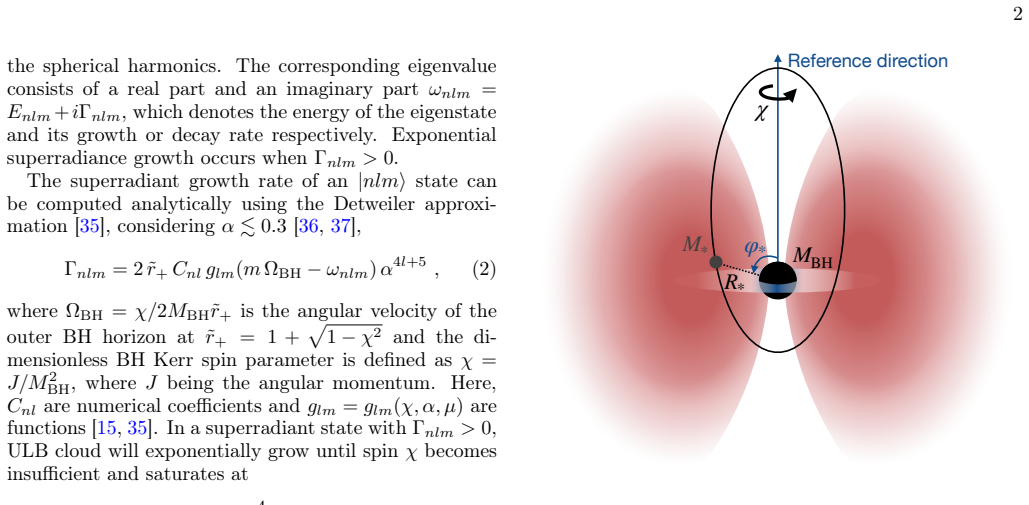
The engine is the gravitational atom: an ultralight scalar field bound to a spinning black hole in hydrogen-like eigenstates $|n\ell m\rangle$, with the fastest-growing $|211\rangle$ state forming a dense boson cloud of Bohr radius $r_0=1/(\mu\alpha)$ and density profile $\rho=A_{211}\,\beta M_{\rm BH}/r_0^3$. The companion's drag is computed with the wave dynamical-friction force $F_{\rm DF}=4\pi M_*^2\rho/v^2\, C_\Lambda(kr_\Lambda)$, where $v$ is the relative speed and $C_\Lambda$ a Coulomb logarithm; averaging this force over one OJ287 orbit gives the decay power compared with the standard quadrupole gravitational-wave formula. The bound follows from requiring that this average power stay below one percent of the gravitational-wave power while the cloud is both formed ($170\,\Gamma_{211}^{-1}<\tau_U$) and stable (the primary spin stays below the saturated value).
What would settle it
Run a self-consistent simulation of a compact companion orbiting inside a saturated |211> gravitational-atom cloud with OJ287 parameters, including resonant transitions, ionization, and back-reaction, and compute the orbit-averaged drag power; the excluded window stands only if that power is below one percent of the quadrupole gravitational-wave power across mu=(8.5–22)×$10^{-22}$ eV. A future OJ287 timing measurement that resolves an excess within that window would also falsify the null-excess premise.
Extended reading notes
Core claim
The central claim is that OJ287's orbital decay is a budget: the observed period decay is consistent with quadrupole gravitational-wave emission, so any superradiant cloud's dynamical friction must contribute no more than $\langle P_{\mathrm{DF}}\rangle/\langle P_{\mathrm{GW}}\rangle \lesssim 0.01$. The paper evaluates that friction for a saturated $|211\rangle$ gravitational-atom cloud around the primary, averaging the position-dependent density over the precessing eccentric orbit, and finds the condition is violated for boson masses $\mu\simeq(8.5\text{--}22)\times 10^{-22}$ eV, while also requiring the cloud to form within cosmic time and leave the primary's spin at its observed value. It further asserts that the same drag can push supermassive-black-hole binaries through the final-parsec bottleneck in under a gigayear, and that a cosmic population of such clouds would suppress the pulsar-timing-array gravitational-wave background by roughly ten to thirty percent and imprint a spectral turnover at a calculable frequency.
Load-bearing premise
The bound assumes the boson halo around the primary keeps its shape while the companion passes through it, so the extra orbital decay is set only by the halo's smooth density; if the companion's gravity drains, ionizes, or reshapes the halo on orbital timescales, the computed drag and the excluded mass range would not follow.
Editorial extensions
If this is right
- If a boson mass in the excluded window $\mu=(8.5\text{--}22)\times 10^{-22}$ eV exists, OJ287's primary must either have started spinning below the superradiance threshold or lost its cloud; otherwise the measured orbit would have decayed faster than observed.
- Superradiant cloud drag can carry supermassive-black-hole binaries of roughly $10^8$–$10^{10}\,M_\odot$ through their final sub-parsec separations in under a gigayear, offering a dark-matter-free route past the final-parsec bottleneck.
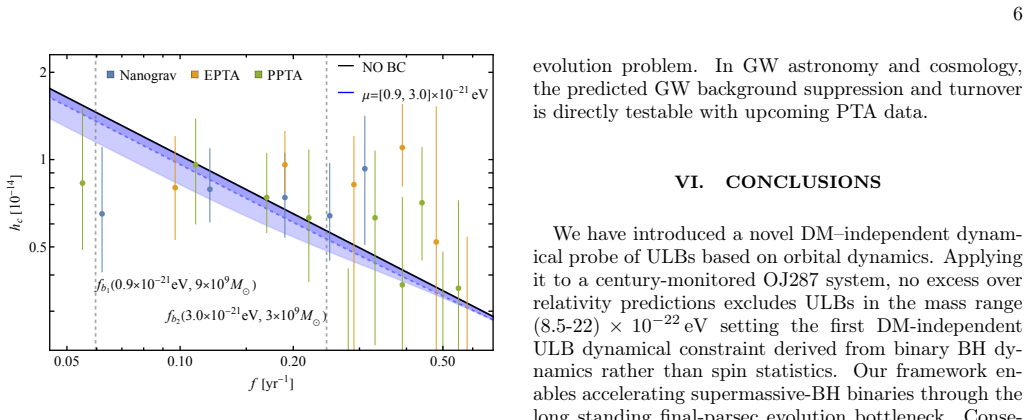
- The cosmic population of such clouds suppresses the nanohertz gravitational-wave background by about ten to thirty percent and produces a turnover at $f_b\simeq 3.2\,\mathrm{nHz}\,(\mu/10^{-21}\,\mathrm{eV})^3(M_{\rm BH}/10^{10}M_\odot)^2$, a signature pulsar-timing arrays can test.
- If the claimed OJ287 orbital-decay excess is confirmed, cloud drag for $\mu\simeq(8.8\text{--}9.3)\times 10^{-22}$ eV provides a new-physics explanation; under the current conservative null reading, the drag channel alone already forbids bosons heavier than $6.4\times 10^{-22}$ eV.
Reading between the lines
- The same timing-ratio method transfers to any well-measured supermassive or intermediate-mass black-hole binary: wherever observed decay matches general relativity to percent level, the mass window whose cloud Bohr radius overlaps the orbit can be excluded, making OJ287 a template rather than an isolated case.
- A null detection of the predicted gravitational-wave-background turnover would not immediately falsify the boson; it would first constrain the fraction of supermassive black holes that start with near-maximal spin, since the background calculation assumes maximal initial spins.
- A laboratory or cosmological discovery of a boson inside the excluded window would create a sharp testable tension: the particle would have to avoid forming a superradiant cloud on OJ287's primary, for example through self-interactions or low initial spins, and that avoidance is exactly what the paper's conservative limits leave open.
Signed reviews
Editorial analysis
A structured set of objections, weighed in public.
Referee Report
Summary. The paper proposes a dark-matter-independent probe of ultralight bosons (ULBs) using the dynamical friction that a superradiant boson cloud exerts on the secondary black hole in the SMBH binary OJ287. The authors compute the orbit-averaged frictional power from a saturated |211> cloud, compare it with the observed orbital decay relative to the general-relativistic quadrupole prediction, and claim a new excluded ULB mass window mu ~ (8.5-22) x 10^-22 eV. They further argue that the same dynamical friction could alleviate the final-parsec problem for SMBH binaries and imprint a characteristic turnover in the nanohertz gravitational-wave background.
Significance. If the central bound is correct, this would be the first DM-independent constraint on ULBs derived from binary orbital decay rather than from black-hole spin statistics, and it would open a genuinely new observational channel in the mu ~ 10^-21 eV window. The extension to the final-parsec problem and the predicted PTA turnover are testable and give the framework predictive content beyond OJ287. The paper also contains original, genuinely useful estimates in Appendix B for the survival of the |211> state against resonances and ionization. The main strengths are that the orbital parameters are taken from external timing data rather than fitted, the null-excess assumption is deliberately conservative, and the derived PTA signatures are falsifiable. However, the analysis is currently built on an internally inconsistent saturated-cloud assumption and on an unexplained choice of the power-ratio threshold, so the claimed window is not yet supported.
major comments (3)
- [Sec. III, Eq. (3) and Table I] The saturated-cloud assumption is inconsistent with the measured primary spin at the lower edge of the claimed window. For mu = 8.5 x 10^-22 eV, alpha = 0.121, and Eq. (3) gives chi_sat = 2 alpha/(1+alpha^2) = 0.238, which is more than 35 sigma below the measured chi_P2 = 0.381 +/- 0.004. Since the paper states that 170 Gamma^-1 < tau_U throughout this band, a saturated |211> cloud would have spun the primary down to chi_sat long ago, contradicting the spin value used in the orbital fit. Thus Eq. (15) and Fig. 3 are evaluated for a configuration that cannot simultaneously have a saturated cloud and the adopted OJ287 orbital parameters. Moreover, the text condition 'chi < chi_211,sat' appears to be the reverse of the superradiance condition: superradiant growth requires chi > chi_sat, not chi < chi_sat. This issue directly undermines the lower boundary of the claimed exclusion window and must be resolved by a self-consistent treatment of the cloud mass and the primary spin.
- [Sec. III, paragraph after Eq. (15)] The mapping from a 0.41-sigma null excess to the power-ratio limit <P_DF>/<P_GW> < 0.01 is not derived. A 0.41-sigma deviation is a statement about the statistical significance of the difference between observed and GR-expected power, and it does not by itself imply a 1% upper limit on an additional power component. The value R_lim = 0.01 is load-bearing because it defines the boundary of the red excluded region in Fig. 3; changing it by a factor of a few would shift or eliminate the claimed mass window. The authors should either derive R_lim from the uncertainties in [27] or state explicitly which upper-tail probability and which error propagation they use.
- [Sec. III, Eq. (9) and App. B] The central drag calculation applies the collisionless wave dynamical-friction formula (Eq. 9) to a coherent, quasi-static superradiant cloud. Appendix B gives careful order-of-magnitude estimates for resonance and ionization depletion, but it does not demonstrate that the coherent cloud's response to the companion produces the same Coulomb logarithm C_Lambda as the wave formula for an incoherent medium. A concrete test would be to compare Eq. (9) with the gravitational-atom dynamical-friction result of Ref. [24] for the same density profile and orbital parameters; if the results differ at O(1), the quoted excluded window and the PTA predictions would need to be revised accordingly.
minor comments (4)
- [Sec. III] The sentence 'Throughout this band the superradiance growth time obeys 170 x Gamma^-1_211 < tau_U and the primary spin satisfies chi < chi_211,sat, with chi_P2 being more conservative compared to considering chi_P1' is duplicated verbatim in the manuscript.
- [Fig. 3 caption] The caption should clarify whether the light-blue region (saturated spin below chi_P2) is part of the excluded region or a separate consistency condition, since the text does not make this clear.
- [Eq. (13)] The definitions of x_p and x_97 are given only in the text following the equation; the equation would be easier to read if all symbols were defined immediately in the caption or with the equation.
- [Sec. V] The notation 'fb1 (0.9e-21eV, 9e9M_sun)' in Fig. 5 is not explained in the caption; the reader has to infer that fb is the turnover frequency from Eq. (22). Please define these labels explicitly.
Circularity Check
No significant circularity: the OJ287 limit is an externally anchored comparison, with no fitted cloud parameter.
full rationale
The central exclusion window mu = (8.5-22) x 10^-22 eV is obtained by computing the saturated |211> cloud drag from standard superradiance inputs and comparing the period-averaged dynamical friction power to the null-excess constraint <P_DF>/<P_GW> <~ 0.01 from the external OJ287 reanalysis [27] and the Peters gravitational-wave formula. The boson mass is scanned, not fitted to the orbital decay; no parameter is calibrated to the OJ287 timing data in a way that would force the result. The growth rates, saturation spin, density profile, and dynamical friction formula come from established external literature (Detweiler [35], Baumann et al. [15], Hui et al. [52]), not from same-author constructions that presuppose the bound. The self-citations in Appendix B ([70]-[72]) estimate binary-companion effects on cloud survival; these are supporting estimates, not the load-bearing source of the exclusion window. One non-circular caveat is the internally inconsistent repeated claim, 'Throughout this band the superradiance growth time obeys 170 x Gamma^-1_211 < tau_U and the primary spin satisfies chi < chi_211,sat, with chi_P2 being more conservative compared to considering chi_P1': at the low-alpha edge with chi_P2 = 0.381 +- 0.004, Eq. (3) gives chi_sat ~ 0.24 for alpha ~ 0.121, so the stated condition is not satisfied. This is a physical-validity/correctness concern rather than a circular reduction, because the excluded region is not obtained by using the orbital-decay measurement to define the cloud density or mass. Overall, the derivation is self-contained against external timing and GW benchmarks, so no circular step is exhibited.
Assumptions & free parameters
free parameters (3)
- power ratio threshold R_lim =
0.01
- cloud e-folding factor N_eff =
170
- saturation cloud mass ratio beta =
beta ~ alpha
assumptions (6)
- domain assumption Non-relativistic hydrogenic approximation for the cloud (alpha <~ 0.3)
- standard math Superradiant growth rate Eq. (2)/(A5) and saturation spin Eq. (3)
- domain assumption OJ287 primary had high initial spin and a saturated cloud can exist with current spin below chi_sat
- domain assumption Wave dynamical friction formula Eq. (9) applies to a coherent bound cloud
- domain assumption Null-excess interpretation of OJ287 timing
- domain assumption Cosmic population model for final-parsec and PTA sections
Cite this review
Pith. "Pith review of Dark Matter-Independent Orbital Decay Bounds on Ultralight Bosons from OJ287." pith.science (2026). https://pith.science/paper/CZMR5LIA
@misc{pith2026250509696,
  author       = {Pith},
  title        = {Pith review of: Dark Matter-Independent Orbital Decay Bounds on Ultralight Bosons from OJ287},
  year         = {2026},
  howpublished = {\url{https://pith.science/paper/CZMR5LIA}},
  note         = {Machine review of arXiv:2505.09696}
}
abstract
Ultralight bosons, predicted in scenarios beyond the Standard Model and viable dark matter (DM) candidates, can form superradiant clouds around spinning black holes influencing their dynamics. Using century-long monitored OJ287 supermassive black hole binary we set first DM-independent, dynamical constraints on their masses $\mu = (8.5-22) \times 10^{-22}$ eV. These dynamical constraints, driven by boson cloud friction, are robust against DM-model uncertainties and offer a novel ultralight boson probe. We show that analogous superradiant dynamics across the cosmic population of supermassive black hole systems could help resolve final-parsec evolution stalling problem and imprint a detectable suppression and break in the gravitational wave background.
Figures


Figures from the paper (4 more)



Forward citations
Cited by 2 Pith papers
-
Ultralight Boson Ionization from Comparable-Mass Binaries
Ionization of boson molecules bound to a black hole binary can dominate gravitational-wave losses during early inspiral, imprinting a turnover in the nanohertz GW background and circularizing the orbit.
-
Can Orbital Decay of Accreting Binary Pulsars Probe Dark Matter?
Dark matter accretion onto binary pulsars is far too weak to affect observed orbital decay, so existing pulsar timing data cannot probe dark matter microphysics.
Reference graph
Works this paper leans on
-
[27]
On the evidence of a dark matter density spike around the primary black hole in OJ 287,
D. Deb, A. Gopakumar, and M. J. Valtonen, “On the evidence of a dark matter density spike around the primary black hole in OJ 287,”arXiv:2504.05715 [astro-ph.HE]
-
[24]
Dynamical friction in gravitational atoms,
G. M. Tomaselli, T. F. M. Spieksma, and G. Bertone, “Dynamical friction in gravitational atoms,”JCAP 07 (2023) 070, arXiv:2305.15460 [gr-qc]
arXiv 2023
-
[1]
CP Conservation in the Presence of Instantons,
R. D. Peccei and H. R. Quinn, “CP Conservation in the Presence of Instantons,”Phys. Rev. Lett.38 (1977) 1440–1443
1977
-
[2]
S. Weinberg, “A New Light Boson?,”Phys. Rev. Lett. 40 (1978) 223–226
work page 1978
-
[3]
Problem of StrongP and T Invariance in the Presence of Instantons,
F. Wilczek, “Problem of StrongP and T Invariance in the Presence of Instantons,”Phys. Rev. Lett.40 (1978) 279–282
work page 1978
-
[4]
A. Arvanitaki, S. Dimopoulos, S. Dubovsky, N. Kaloper, and J. March-Russell, “String Axiverse,”Phys. Rev. D 81 (2010) 123530, arXiv:0905.4720 [hep-th]
arXiv 2010
-
[5]
Coherent Scalar Field Oscillations in an Expanding Universe,
M. S. Turner, “Coherent Scalar Field Oscillations in an Expanding Universe,”Phys. Rev. D28 (1983) 1243
1983
-
[6]
Single Mechanism for Generating Large Scale Structure and Providing Dark Missing Matter,
W. H. Press, B. S. Ryden, and D. N. Spergel, “Single Mechanism for Generating Large Scale Structure and Providing Dark Missing Matter,”Phys. Rev. Lett.64 (1990) 1084
work page 1990
Show all 79 references
-
[7]
Late time cosmological phase transition and galactic halo as Bose liquid,
S.-J. Sin, “Late time cosmological phase transition and galactic halo as Bose liquid,”Phys. Rev. D50 (1994) 3650–3654, arXiv:hep-ph/9205208
1994 arXiv
-
[8]
Cold and fuzzy dark matter,
W. Hu, R. Barkana, and A. Gruzinov, “Cold and fuzzy dark matter,” Phys. Rev. Lett.85 (2000) 1158–1161, arXiv:astro-ph/0003365
2000 arXiv
-
[9]
Repulsive dark matter,
J. Goodman, “Repulsive dark matter,”New Astron. 5 (2000) 103, arXiv:astro-ph/0003018
2000 arXiv
-
[10]
Are There Real Goldstone Bosons Associated with Broken Lepton Number?,
Y. Chikashige, R. N. Mohapatra, and R. D. Peccei, “Are There Real Goldstone Bosons Associated with Broken Lepton Number?,” Phys. Lett. B98 (1981) 265–268
1981
-
[11]
Left-Handed Neutrino Mass Scale and Spontaneously Broken Lepton Number,
G. B. Gelmini and M. Roncadelli, “Left-Handed Neutrino Mass Scale and Spontaneously Broken Lepton Number,” Phys. Lett. B99 (1981) 411–415
1981
-
[12]
D. F. J. Kimball and K. van Bibber, eds.,The Search for Ultralight Bosonic Dark Matter. Springer, 2023
2023
-
[13]
Exploring the String Axiverse with Precision Black Hole Physics,
A. Arvanitaki and S. Dubovsky, “Exploring the String Axiverse with Precision Black Hole Physics,”Phys. Rev. D 83 (2011) 044026, arXiv:1004.3558 [hep-th]
2011 arXiv
-
[14]
Superradiance: New Frontiers in Black Hole Physics,
R. Brito, V. Cardoso, and P. Pani, “Superradiance: New Frontiers in Black Hole Physics,”Lect. Notes Phys. 906 (2015) pp.1–237, arXiv:1501.06570 [gr-qc]
2015 arXiv
-
[15]
The Spectra of Gravitational Atoms,
D. Baumann, H. S. Chia, J. Stout, and L. ter Haar, “The Spectra of Gravitational Atoms,”JCAP 12 (2019) 006, arXiv:1908.10370 [gr-qc]
2019 arXiv
-
[16]
Coherence in Spontaneous Radiation Processes,
R. H. Dicke, “Coherence in Spontaneous Radiation Processes,” Phys. Rev. 93 (1954) 99–110
1954
-
[18]
Extracting ultralight boson properties from boson clouds around postmerger remnants,
K. H. M. Chan and O. A. Hannuksela, “Extracting ultralight boson properties from boson clouds around postmerger remnants,” Phys. Rev. D109 no. 2, (2024) 023009, arXiv:2209.03536 [gr-qc]
2024 arXiv
-
[19]
Constraints on Ultralight Scalar Bosons within Black Hole Spin Measurements from the LIGO-Virgo GWTC-2,
K. K. Y. Ng, S. Vitale, O. A. Hannuksela, and T. G. F. Li, “Constraints on Ultralight Scalar Bosons within Black Hole Spin Measurements from the LIGO-Virgo GWTC-2,” Phys. Rev. Lett.126 no. 15, (2021) 151102, arXiv:2011.06010 [gr-qc]
2021 arXiv
-
[20]
Ultralight Bosonic Field Mass Bounds from Astrophysical Black Hole Spin,
M. J. Stott, “Ultralight Bosonic Field Mass Bounds from Astrophysical Black Hole Spin,” arXiv:2009.07206 [hep-ph]
2009 arXiv
-
[21]
Ultralight Boson Dark Matter and Event Horizon Telescope Observations 12 of M87*,
H. Davoudiasl and P. B. Denton, “Ultralight Boson Dark Matter and Event Horizon Telescope Observations 12 of M87*,” Phys. Rev. Lett.123 no. 2, (2019) 021102, arXiv:1904.09242 [astro-ph.CO]
2019 arXiv
-
[22]
Gravitational Collider Physics,
D. Baumann, H. S. Chia, R. A. Porto, and J. Stout, “Gravitational Collider Physics,”Phys. Rev. D101 no. 8, (2020) 083019,arXiv:1912.04932 [gr-qc]
2020 arXiv
-
[23]
Gravitational Collider Physics via Pulsar-Black Hole Binaries,
Q. Ding, X. Tong, and Y. Wang, “Gravitational Collider Physics via Pulsar-Black Hole Binaries,”Astrophys. J. 908 no. 1, (2021) 78,arXiv:2009.11106 [astro-ph.HE]
2021 arXiv
-
[25]
Probing Boson Clouds with Supermassive Black Hole Binaries,
X. Li, J. Ren, and X.-L. Zhang, “Probing Boson Clouds with Supermassive Black Hole Binaries,” arXiv:2505.02866 [hep-ph]
-
[26]
Bounds on ultralight bosons from the Event Horizon Telescope observation of Sgr A∗,
A. K. Saha, P. Parashari, T. N. Maity, A. Dubey, S. Bouri, and R. Laha, “Bounds on ultralight bosons from the Event Horizon Telescope observation of Sgr A∗,” Eur. Phys. J. C84 no. 9, (2024) 901, arXiv:2208.03530 [astro-ph.HE]
2024 arXiv
-
[28]
Dark matter constraints from the eccentric supermassive black hole binary OJ 287,
A. Alachkar, J. Ellis, and M. Fairbairn, “Dark matter constraints from the eccentric supermassive black hole binary OJ 287,”Phys. Rev. D107 no. 10, (2023) 103033, arXiv:2207.10021 [hep-ph]
2023 arXiv
-
[29]
The First Robust Evidence Showing a Dark Matter Density Spike Around the Supermassive Black Hole in OJ 287,
M. H. Chan and C. M. Lee, “The First Robust Evidence Showing a Dark Matter Density Spike Around the Supermassive Black Hole in OJ 287,”Astrophys. J. Lett. 962 no. 2, (Feb., 2024) L40,arXiv:2402.03751 [astro-ph.GA]
2024 arXiv
-
[30]
Black hole superradiance of self-interacting scalar fields,
M. Baryakhtar, M. Galanis, R. Lasenby, and O. Simon, “Black hole superradiance of self-interacting scalar fields,” Phys. Rev. D103 no. 9, (2021) 095019, arXiv:2011.11646 [hep-ph]
2021 arXiv
-
[31]
Impact of multiple modes on the evolution of self-interacting axion condensate around rotating black holes,
H. Omiya, T. Takahashi, T. Tanaka, and H. Yoshino, “Impact of multiple modes on the evolution of self-interacting axion condensate around rotating black holes,” JCAP 06 (2023) 016, arXiv:2211.01949 [gr-qc]
2023 arXiv
-
[32]
Self-interacting gravitational atoms in the strong-gravity regime,
H. S. Chia, C. Doorman, A. Wernersson, T. Hinderer, and S. Nissanke, “Self-interacting gravitational atoms in the strong-gravity regime,”JCAP 04 (2023) 018, arXiv:2212.11948 [gr-qc]
2023 arXiv
-
[33]
The self-interaction effects on the Kerr black hole superradiance and their observational implications,
N. Xie and F. P. Huang, “The self-interaction effects on the Kerr black hole superradiance and their observational implications,” arXiv:2503.10347 [hep-ph]
-
[34]
Impact of the cosmic neutrino background on black hole superradiance,
G. Lambiase, T. K. Poddar, and L. Visinelli, “Impact of the cosmic neutrino background on black hole superradiance,” arXiv:2503.02940 [hep-ph]
-
[35]
KLEIN-GORDON EQUATION AND ROTATING BLACK HOLES,
S. L. Detweiler, “KLEIN-GORDON EQUATION AND ROTATING BLACK HOLES,”Phys. Rev. D22 (1980) 2323–2326
1980
-
[36]
Brito, V
R. Brito, V. Cardoso, and P. Pani,Superradiance : energy extraction, black-hole bombs and implications for astrophysics and particle physics. Cham: Springer, New York, 2015
2015
-
[37]
Relativistic perturbation theory for black-hole boson clouds,
E. Cannizzaro, L. Sberna, S. R. Green, and S. Hollands, “Relativistic perturbation theory for black-hole boson clouds,” (9, 2023) ,arXiv:2309.10021 [gr-qc]
2023 arXiv
-
[38]
Signatures of ultralight bosons in compact binary inspiral and outspiral,
Y. Cao and Y. Tang, “Signatures of ultralight bosons in compact binary inspiral and outspiral,”Phys. Rev. D 108 no. 12, (2023) 123017,arXiv:2307.05181 [gr-qc]
2023 arXiv
-
[39]
Authenticating the Presence of a Relativistic Massive Black Hole Binary in OJ 287 Using its General Relativity Centenary Flare: Improved Orbital Parameters,
L. Deyet al., “Authenticating the Presence of a Relativistic Massive Black Hole Binary in OJ 287 Using its General Relativity Centenary Flare: Improved Orbital Parameters,”Astrophys. J. 866 no. 1, (2018) 11, arXiv:1808.09309 [astro-ph.HE]
2018 arXiv
-
[40]
Outbursts in OJ 287: A New Test for the General Theory of Relativity,
M. J. Valtonen and H. J. Lehto, “Outbursts in OJ 287: A New Test for the General Theory of Relativity,” Astrophys. J. 481 no. 1, (May, 1997) L5–L7
1997
-
[41]
A helical jet model for OJ287,
M. Valtonen and P. Pihajoki, “A helical jet model for OJ287,” Astron. Astrophys.557 (2013) A28, arXiv:1307.1364 [astro-ph.HE]
2013 arXiv
-
[42]
Gravitational Radiation and the Motion of Two Point Masses,
P. C. Peters, “Gravitational Radiation and the Motion of Two Point Masses,”Phys. Rev. 136 (1964) B1224–B1232
1964
-
[43]
The Distribution and cosmic evolution of massive black hole spins,
M. Volonteri, P. Madau, E. Quataert, and M. J. Rees, “The Distribution and cosmic evolution of massive black hole spins,” Astrophys. J. 620 (2005) 69–77, arXiv:astro-ph/0410342
2005 arXiv
-
[44]
First search for a stochastic gravitational-wave background from ultralight bosons,
L. Tsukada, T. Callister, A. Matas, and P. Meyers, “First search for a stochastic gravitational-wave background from ultralight bosons,”Phys. Rev. D99 no. 10, (2019) 103015,arXiv:1812.09622 [astro-ph.HE]
2019 arXiv
-
[45]
Black holes as particle detectors: evolution of superradiant instabilities,
R. Brito, V. Cardoso, and P. Pani, “Black holes as particle detectors: evolution of superradiant instabilities,” Class. Quant. Grav.32 no. 13, (2015) 134001, arXiv:1411.0686 [gr-qc]
2015 arXiv
-
[46]
Gravitational radiation from an axion cloud around a black hole: Superradiant phase,
H. Yoshino and H. Kodama, “Gravitational radiation from an axion cloud around a black hole: Superradiant phase,” PTEP 2014 (2014) 043E02, arXiv:1312.2326 [gr-qc]
2014 arXiv
-
[47]
Axion cloud evaporation during inspiral of black hole binaries: The effects of backreaction and radiation,
T. Takahashi, H. Omiya, and T. Tanaka, “Axion cloud evaporation during inspiral of black hole binaries: The effects of backreaction and radiation,”PTEP 2022 no. 4, (2022) 043E01,arXiv:2112.05774 [gr-qc]
2022 arXiv
-
[48]
Gravitational Collider Physics via Pulsar–Black Hole Binaries II: Fine and Hyperfine Structures Are Favored,
X. Tong, Y. Wang, and H.-Y. Zhu, “Gravitational Collider Physics via Pulsar–Black Hole Binaries II: Fine and Hyperfine Structures Are Favored,”Astrophys. J. 924 no. 2, (2022) 99,arXiv:2106.13484 [astro-ph.HE]
2022 arXiv
-
[49]
Evolution of binary systems accompanying axion clouds in extreme mass ratio inspirals,
T. Takahashi, H. Omiya, and T. Tanaka, “Evolution of binary systems accompanying axion clouds in extreme mass ratio inspirals,”Phys. Rev. D107 no. 10, (2023) 103020, arXiv:2301.13213 [gr-qc]
2023 arXiv
-
[50]
Ionization of gravitational atoms,
D. Baumann, G. Bertone, J. Stout, and G. M. Tomaselli, “Ionization of gravitational atoms,”Phys. Rev. D 105 no. 11, (2022) 115036,arXiv:2112.14777 [gr-qc]
2022 arXiv
-
[51]
Dynamical Friction. I. General Considerations: the Coefficient of Dynamical Friction.,
S. Chandrasekhar, “Dynamical Friction. I. General Considerations: the Coefficient of Dynamical Friction.,” Astrophys. J. 97 (Mar., 1943) 255
1943
-
[52]
Ultralight scalars as cosmological dark matter,
L. Hui, J. P. Ostriker, S. Tremaine, and E. Witten, “Ultralight scalars as cosmological dark matter,”Phys. Rev. D 95 no. 4, (2017) 043541,arXiv:1610.08297 [astro-ph.CO]
2017 arXiv
-
[53]
Dynamic Signatures of Black Hole Binaries with Superradiant Clouds,
J. Zhang and H. Yang, “Dynamic Signatures of Black Hole Binaries with Superradiant Clouds,”Phys. Rev. D 101 no. 4, (2020) 043020,arXiv:1907.13582 [gr-qc]
2020 arXiv
-
[54]
Primary black hole spin in OJ287 as determined by the General Relativity centenary flare,
M. J. Valtonenet al., “Primary black hole spin in OJ287 as determined by the General Relativity centenary flare,”Astrophys. J. Lett.819 no. 2, (2016) L37, arXiv:1603.04171 [astro-ph.HE] . 13
2016 arXiv
-
[55]
The Final parsec problem,
M. Milosavljevic and D. Merritt, “The Final parsec problem,” AIP Conf. Proc.686 no. 1, (2003) 201–210, arXiv:astro-ph/0212270
2003 arXiv
-
[56]
The NANOGrav 15 yr Data Set: Evidence for a Gravitational-wave Background,
NANOGrav Collaboration, G. Agazieet al., “The NANOGrav 15 yr Data Set: Evidence for a Gravitational-wave Background,”Astrophys. J. Lett. 951 no. 1, (2023) L8,arXiv:2306.16213 [astro-ph.HE]
2023 arXiv
-
[57]
The second data release from the European Pulsar Timing Array - III. Search for gravitational wave signals,
EPT A, InPT A:Collaboration, J. Antoniadiset al., “The second data release from the European Pulsar Timing Array - III. Search for gravitational wave signals,” Astron. Astrophys.678 (2023) A50, arXiv:2306.16214 [astro-ph.HE]
2023 arXiv
-
[58]
The Parkes Pulsar Timing Array third data release,
A. Zicet al., “The Parkes Pulsar Timing Array third data release,” Publ. Astron. Soc. Austral.40 (2023) e049, arXiv:2306.16230 [astro-ph.HE]
2023 arXiv
-
[59]
Searching for the Nano-Hertz Stochastic Gravitational Wave Background with the Chinese Pulsar Timing Array Data Release I,
H. Xuet al., “Searching for the Nano-Hertz Stochastic Gravitational Wave Background with the Chinese Pulsar Timing Array Data Release I,”Res. Astron. Astrophys. 23 no. 7, (2023) 075024,arXiv:2306.16216 [astro-ph.HE]
2023 arXiv
-
[60]
Comparing Recent Pulsar Timing Array Results on the Nanohertz Stochastic Gravitational-wave Background,
International Pulsar Timing Array Collaboration, G. Agazieet al., “Comparing Recent Pulsar Timing Array Results on the Nanohertz Stochastic Gravitational-wave Background,”Astrophys. J. 966 no. 1, (2024) 105,arXiv:2309.00693 [astro-ph.HE]
2024 arXiv
-
[61]
The NANOGrav 15 yr Data Set: Constraints on Supermassive Black Hole Binaries from the Gravitational-wave Background,
NANOGrav Collaboration, G. Agazieet al., “The NANOGrav 15 yr Data Set: Constraints on Supermassive Black Hole Binaries from the Gravitational-wave Background,”Astrophys. J. Lett. 952 no. 2, (2023) L37,arXiv:2306.16220 [astro-ph.HE]
2023 arXiv
-
[62]
Self-Interacting Dark Matter Solves the Final Parsec Problem of Supermassive Black Hole Mergers,
G. Alonso-Álvarez, J. M. Cline, and C. Dewar, “Self-Interacting Dark Matter Solves the Final Parsec Problem of Supermassive Black Hole Mergers,”Phys. Rev. Lett.133 no. 2, (2024) 021401,arXiv:2401.14450 [astro-ph.CO]
2024 arXiv
-
[63]
The second data release from the European Pulsar Timing Array - IV. Implications for massive black holes, dark matter, and the early Universe,
EPT A, InPT ACollaboration, J. Antoniadiset al., “The second data release from the European Pulsar Timing Array - IV. Implications for massive black holes, dark matter, and the early Universe,”Astron. Astrophys. 685 (2024) A94, arXiv:2306.16227 [astro-ph.CO]
2024 arXiv
-
[64]
Search for an Isotropic Gravitational-wave Background with the Parkes Pulsar Timing Array,
D. J. Reardonet al., “Search for an Isotropic Gravitational-wave Background with the Parkes Pulsar Timing Array,”Astrophys. J. Lett.951 no. 1, (2023) L6, arXiv:2306.16215 [astro-ph.HE]
2023 arXiv
-
[65]
Stochastic and resolvable gravitational waves from ultralight bosons,
R. Brito, S. Ghosh, E. Barausse, E. Berti, V. Cardoso, I. Dvorkin, A. Klein, and P. Pani, “Stochastic and resolvable gravitational waves from ultralight bosons,” Phys. Rev. Lett.119 no. 13, (2017) 131101, arXiv:1706.05097 [gr-qc]
2017 arXiv
-
[66]
Bounds on ultralight dark matter from NANOGrav,
M. Aghaie, G. Armando, A. Dondarini, and P. Panci, “Bounds on ultralight dark matter from NANOGrav,” Phys. Rev. D109 no. 10, (2024) 103030, arXiv:2308.04590 [astro-ph.CO]
2024 arXiv
-
[67]
S. A. Teukolsky, “Perturbations of a rotating black hole
-
[68]
Fundamental equations for gravitational electromagnetic and neutrino field perturbations,” Astrophys. J. 185 (1973) 635–647
1973
-
[69]
An Analytic representation for the quasi normal modes of Kerr black holes,
E. W. Leaver, “An Analytic representation for the quasi normal modes of Kerr black holes,”Proc. Roy. Soc. Lond. A 402 (1985) 285–298
1985
-
[70]
Probing Ultralight Bosons with Binary Black Holes,
D. Baumann, H. S. Chia, and R. A. Porto, “Probing Ultralight Bosons with Binary Black Holes,”Phys. Rev. D 99 no. 4, (2019) 044001,arXiv:1804.03208 [gr-qc]
2019 arXiv
-
[71]
Termination of superradiance from a binary companion,
X. Tong, Y. Wang, and H.-Y. Zhu, “Termination of superradiance from a binary companion,”Phys. Rev. D 106 no. 4, (2022) 043002,arXiv:2205.10527 [gr-qc]
2022 arXiv
-
[72]
Survival of the Fittest: Testing Superradiance Termination with Simulated Binary Black Hole Statistics,
H.-Y. Zhu, X. Tong, G. Manzoni, and Y. Ma, “Survival of the Fittest: Testing Superradiance Termination with Simulated Binary Black Hole Statistics,”Astrophys. J. 981 no. 2, (2025) 165,arXiv:2409.14159 [gr-qc]
2025 arXiv
-
[73]
Modulating binary dynamics via the termination of black hole superradiance,
K. Fan, X. Tong, Y. Wang, and H.-Y. Zhu, “Modulating binary dynamics via the termination of black hole superradiance,” Phys. Rev. D109 no. 2, (2024) 024059, arXiv:2311.17013 [gr-qc]
2024 arXiv
-
[74]
Resonant history of gravitational atoms in black hole binaries,
G. M. Tomaselli, T. F. M. Spieksma, and G. Bertone, “Resonant history of gravitational atoms in black hole binaries,” Phys. Rev. D110 no. 6, (2024) 064048, arXiv:2403.03147 [gr-qc]
2024 arXiv
-
[75]
Tidal effects and disruption in superradiant clouds: a numerical investigation,
V. Cardoso, F. Duque, and T. Ikeda, “Tidal effects and disruption in superradiant clouds: a numerical investigation,” Phys. Rev. D101 no. 6, (2020) 064054, arXiv:2001.01729 [gr-qc]
2020 arXiv
-
[76]
Constraining astrophysical observables of Galaxy and Supermassive Black Hole Binary Mergers using Pulsar Timing Arrays,
S. Chen, A. Sesana, and C. J. Conselice, “Constraining astrophysical observables of Galaxy and Supermassive Black Hole Binary Mergers using Pulsar Timing Arrays,” Mon. Not. Roy. Astron. Soc.488 no. 1, (2019) 401–418, arXiv:1810.04184 [astro-ph.GA]
2019 arXiv
-
[77]
Planck 2018 results. VI. Cosmological parameters,
Planck Collaboration, N. Aghanimet al., “Planck 2018 results. VI. Cosmological parameters,”Astron. Astrophys. 641 (2020) A6, arXiv:1807.06209 [astro-ph.CO]. [Erratum: Astron.Astrophys. 652, C4 (2021)]
2020 arXiv
-
[78]
Coevolution (Or Not) of Supermassive Black Holes and Host Galaxies,
J. Kormendy and L. C. Ho, “Coevolution (Or Not) of Supermassive Black Holes and Host Galaxies,”Ann. Rev. Astron. Astrophys.51 (2013) 511–653, arXiv:1304.7762 [astro-ph.CO]
2013 arXiv
-
[79]
Bulge Growth and Quenching sincez = 2.5 in CANDELS/3D-HST,
P. Langet al., “Bulge Growth and Quenching sincez = 2.5 in CANDELS/3D-HST,”Astrophys. J. 788 (2014) 11, arXiv:1402.0866 [astro-ph.GA]
2014 arXiv
-
[80]
Bulge mass is king: The dominant role of the bulge in determining the fraction of passive galaxies in the Sloan Digital Sky Survey,
A. F. L. Bluck, J. T. Mendel, S. L. Ellison, J. Moreno, L. Simard, D. R. Patton, and E. Starkenburg, “Bulge mass is king: The dominant role of the bulge in determining the fraction of passive galaxies in the Sloan Digital Sky Survey,”Mon. Not. Roy. Astron. Soc.441 no. 1, (2014...
2014 arXiv
Reviewed August 15, 2026 · model on record in the stance chip above.
Discussion (0). Continue with ORCID to comment.