Multi-Scale Coherence of Represented Flows
Pith reviewed 2026-07-01 17:00 UTC · model grok-4.3
The pith
Second-order statistics do not determine the geometry of finite-separation increments across observational resolutions in represented flows.
A machine-rendered reading of the paper's core claim, the machinery that carries it, and where it could break.
Core claim
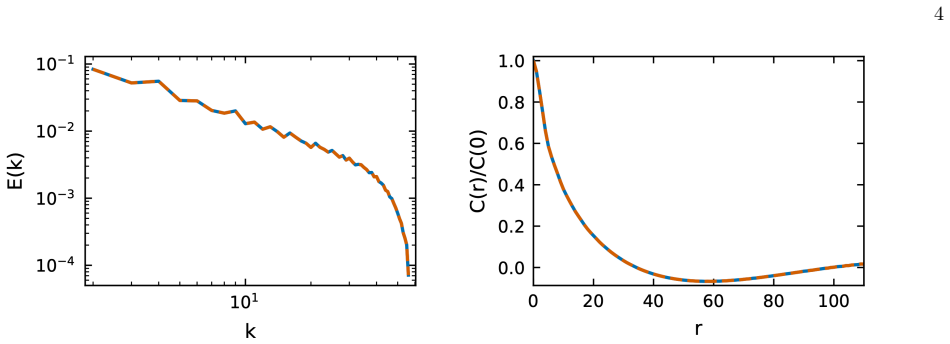
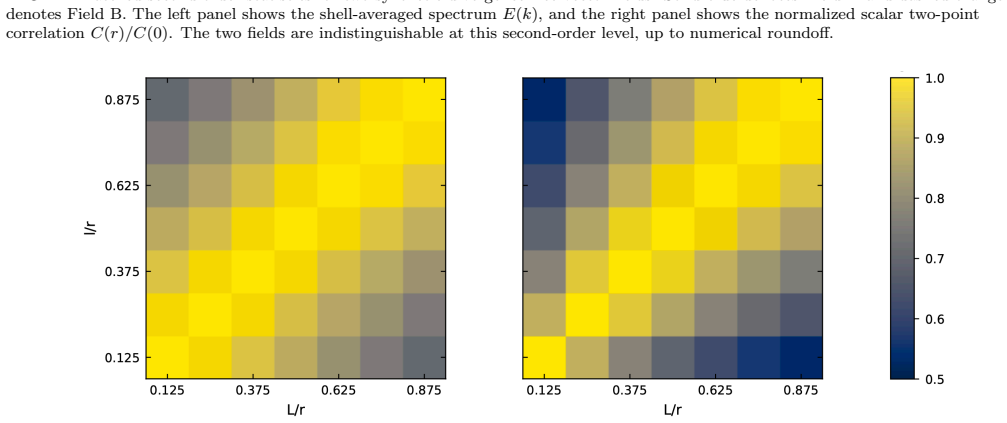
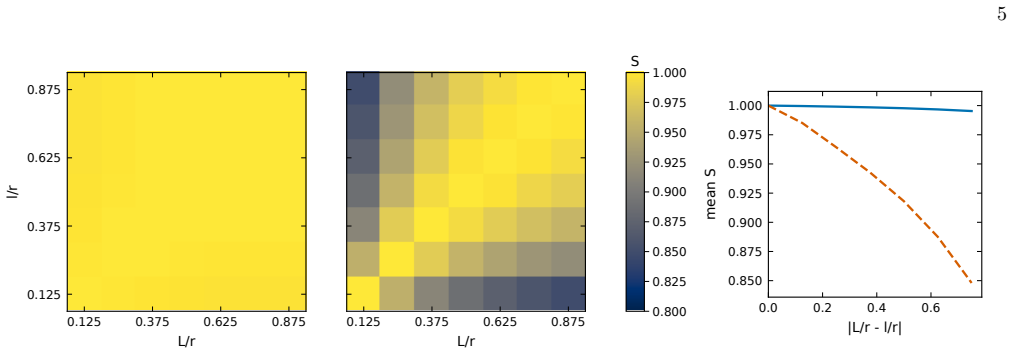
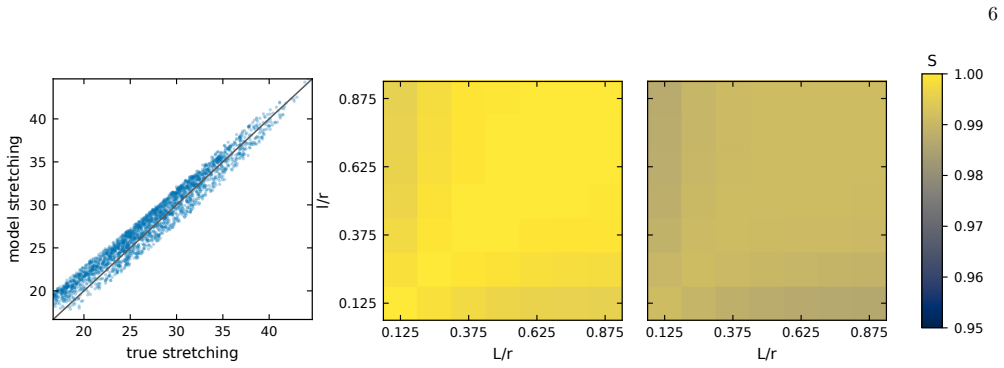
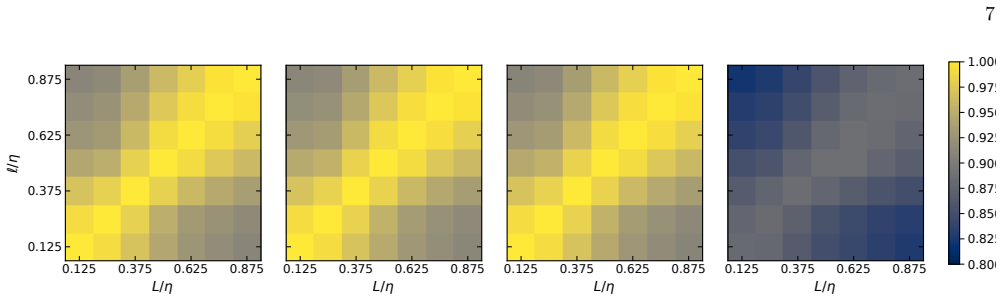
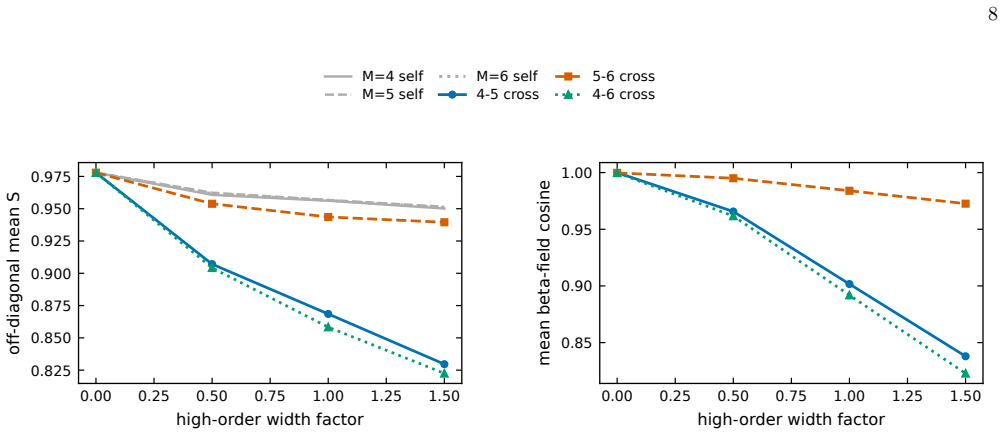
Synthetic divergence-free fields with identical Fourier amplitudes, spectra, and scalar two-point correlations nevertheless produce distinct coherence matrices, showing that second-order statistics do not determine cross-resolution increment geometry. Lorenz phase-space tests show that a smooth coordinate wrinkling changes represented drift geometry without changing the underlying dynamics, and that a weak model perturbation lowers finite-separation coherence even when local stretching proxies remain closely matched. For functional renormalization-group flows of the three-dimensional O(1) scalar theory, projected M=4,5,6 LPA beta fields remain internally coherent, while cross-truncation cohe
What carries the argument
The coherence matrix formed by averaging the normalized directional comparison of vector-field increments after smoothing at two resolutions.
If this is right
- Second-order statistics alone are insufficient to fix the cross-resolution geometry of increments in represented flows.
- Coordinate changes can alter represented drift geometry in phase space without affecting the underlying dynamical equations.
- Model perturbations can reduce finite-separation coherence even when local stretching diagnostics remain matched.
- Projected LPA beta fields stay internally coherent within a fixed truncation order but lose coherence when higher-order couplings are activated across different truncations.
- The diagnostic supplies a field-level consistency check that complements local, spectral, and fixed-point analyses.
Where Pith is reading between the lines
- The method could serve as a practical validation step when comparing different numerical discretizations of the same continuous flow.
- It offers a way to quantify how truncation order affects stability of functional flows beyond the usual fixed-point location checks.
- Different choices of smoothing kernel or sampling density might expose distinct layers of geometric stability not visible in the current protocol.
- The coherence matrix might be adapted to test consistency of learned vector fields in data-driven modeling of dynamical systems.
Load-bearing premise
The particular smoothing, metric, and sampling protocol used to build the coherence matrix captures the physically relevant stability of finite-separation flow geometry.
What would settle it
Construct two divergence-free vector fields that match in every second-order statistic yet produce identical coherence matrices under the fixed smoothing and sampling protocol; or find a coordinate transformation in the Lorenz system that leaves the coherence matrix unchanged while visibly wrinkling the drift field.
Figures
read the original abstract
Many problems in nonlinear and statistical physics are formulated through represented flows, including physical-space vector fields, phase-space drift fields, and truncated renormalization-group beta functions. We introduce a complementary representation-dependent diagnostic for testing whether finite-separation flow geometry is stable across observational resolution. For two separated points, states, or theories, the method compares the direction of the corresponding vector-field increment after the field has been smoothed at two resolutions. Averaging this normalized comparison over sampled separations gives a coherence matrix tied to the chosen variables, coarse graining, metric, and sampling protocol; it is a consistency test, not a coordinate-invariant quantity. We demonstrate the diagnostic in three settings. Synthetic divergence-free fields with identical Fourier amplitudes, spectra, and scalar two-point correlations nevertheless produce distinct coherence matrices, showing that second-order statistics do not determine cross-resolution increment geometry. Lorenz phase-space tests show that a smooth coordinate wrinkling changes represented drift geometry without changing the underlying dynamics, and that a weak model perturbation lowers finite-separation coherence even when local stretching proxies remain closely matched. Finally, for functional renormalization-group flows of the three-dimensional \(O(1)\) scalar theory, projected \(M=4,5,6\) LPA beta fields remain internally coherent, while cross-truncation coherence decreases as higher-order coupling directions are activated. The diagnostic provides a practical field-level check of how representations, models, and truncations preserve finite-separation flow geometry, complementing rather than replacing standard local, spectral, or fixed-point diagnostics.
Editorial analysis
A structured set of objections, weighed in public.
Referee Report
Summary. The manuscript introduces a representation-dependent coherence matrix diagnostic that compares the direction of vector-field increments at two smoothing resolutions for separated points (or states or theories), averaged over sampled separations. The diagnostic is explicitly protocol-dependent and is demonstrated on three classes of represented flows: (i) synthetic divergence-free fields constructed to share identical Fourier amplitudes, spectra, and scalar two-point correlations yet yield distinct coherence matrices; (ii) the Lorenz system, where smooth coordinate wrinkling and weak model perturbations alter finite-separation coherence while leaving local stretching proxies largely unchanged; and (iii) functional RG beta-function flows for the 3D O(1) scalar theory, where projected LPA truncations at M=4,5,6 remain internally coherent but show decreasing cross-truncation coherence as higher-order couplings are activated.
Significance. If the numerical constructions and coherence calculations hold, the work supplies a practical, field-level consistency test that distinguishes finite-separation geometry from second-order statistics alone. This complements existing local, spectral, and fixed-point diagnostics in statistical mechanics and nonlinear dynamics, particularly for assessing truncation stability in renormalization-group flows. The explicit statement that the matrix is not coordinate-invariant but a protocol-dependent check is a strength that prevents over-interpretation.
minor comments (3)
- [§2] The abstract and introduction describe the coherence matrix only verbally; adding the explicit definition (including the normalization and averaging steps) as an equation in §2 would improve reproducibility and allow readers to verify the claimed distinction from two-point statistics.
- [synthetic-field demonstration] The synthetic-field construction (identical Fourier amplitudes and spectra but distinct coherence) is central; the manuscript should state the precise divergence-free projection method, the number of independent realizations, and any error bars or convergence checks on the reported matrix differences.
- [FRG section] For the FRG example, the statement that cross-truncation coherence decreases with higher-order couplings would be strengthened by reporting the actual matrix entries or a quantitative measure of the decrease rather than a qualitative trend.
Simulated Author's Rebuttal
We thank the referee for the positive assessment of the manuscript, the clear summary of its contributions, and the recommendation for minor revision. No specific major comments are provided in the report.
Circularity Check
No significant circularity
full rationale
The coherence matrix is introduced as an explicit average of normalized increment comparisons after smoothing at two resolutions; the definition is procedural and does not presuppose any result about second-order statistics. The central claim is established by direct numerical construction of divergence-free fields that are forced to share Fourier amplitudes, spectra, and scalar two-point functions yet yield distinct matrices; this is a counter-example built from the stated protocol rather than a derivation that reduces to fitted inputs or prior self-citations. Protocol dependence is declared up front and the matrices are labeled consistency tests, not invariants. No load-bearing step equates a prediction to its own construction or imports uniqueness via self-citation chains.
Axiom & Free-Parameter Ledger
Reference graph
Works this paper leans on
-
[1]
A. N. Kolmogorov, The local structure of turbulence in incompressible viscous fluid for very large Reynolds num- bers, Proceedings of the Royal Society of London. Series A: Mathematical and Physical Sciences434, 9 (1991)
1991
-
[2]
Germano, Turbulence: the filtering approach, Journal of Fluid Mechanics238, 325 (1992)
M. Germano, Turbulence: the filtering approach, Journal of Fluid Mechanics238, 325 (1992)
1992
-
[3]
E. N. Lorenz, Deterministic nonperiodic flow, Journal of the Atmospheric Sciences20, 130 (1963)
1963
-
[4]
Eckmann and D
J.-P. Eckmann and D. Ruelle, Ergodic theory of chaos and strange attractors, Reviews of Modern Physics57, 617 (1985)
1985
-
[5]
K. G. Wilson and J. Kogut, The renormalization group and theϵexpansion, Physics Reports12, 75 (1974)
1974
-
[6]
Wetterich, Exact evolution equation for the effective potential, Physics Letters B301, 90 (1993)
C. Wetterich, Exact evolution equation for the effective potential, Physics Letters B301, 90 (1993)
1993
-
[7]
Non-Perturbative Renormalization Flow in Quantum Field Theory and Statistical Physics
J. Berges, N. Tetradis, and C. Wetterich, Non- perturbative renormalization flow in quantum field theory and statistical physics, Physics Reports363, 223 (2002), arXiv:hep-ph/0005122
work page internal anchor Pith review Pith/arXiv arXiv 2002
discussion (0)
Sign in with ORCID, Apple, or X to comment. Anyone can read and Pith papers without signing in.