REVIEW 3 major objections 5 minor 55 references
Concurrent Parsing of Constituency and Dependency
T0 review · 3 major / 5 minor · reviewed 2026-08-14 · deepseek-v4-flash
Pith's one-line read A single model parses both constituency and dependency structure at once, and joint training improves both tasks to new state-of-the-art levels.
desk verdict Useful joint-parsing study with a clean ablation, but the abstract's SOTA claim for PTB dependency does not survive its own Table 3. read the letter →
The pith
A machine-rendered reading of the paper's core claim, the machinery that carries it, and where it could break.
The reading
What carries the argument
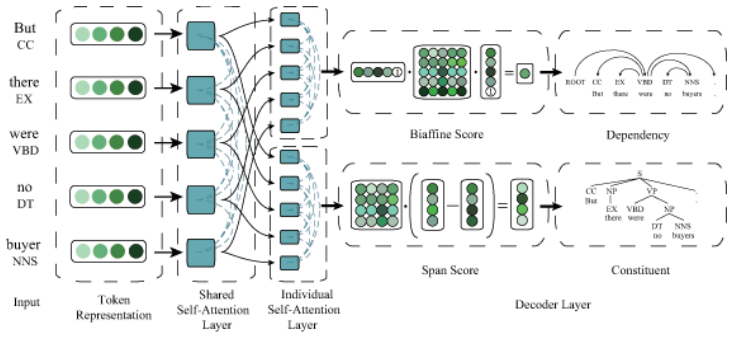
The central object is an encoder-decoder network in which one self-attention encoder is shared by two decoders: a CKY-style span scorer for constituency trees and a biaffine-attention head selector for dependency trees. The sharing is complete: token representations and all eight self-attention layers are common, and only the final per-task layers diverge. This lets the gradient of the dependency loss reshape the same representations that the constituent decoder reads, and vice versa; the authors vary the number of shared layers from 0 to 8 and find full sharing best.
What would settle it
Train the identical architecture twice on the same corpus: once with dependency labels produced by automatic conversion from constituent trees, and once with dependency labels produced directly by human annotators. If the joint model's UAS/LAS advantage over the separately trained parser disappears or reverses under human-annotated dependencies, the paper's conclusion that constituent structure broadly benefits dependency parsing would be refuted; if it holds, the conclusion survives.
Extended reading notes
Core claim
The paper's central claim is that constituent and dependency parsing should be done concurrently by one model, and that doing so pushes both tasks past previous state-of-the-art performance without any external parser or reranker. The model extends a self-attentive constituent parser by adding a biaffine dependency decoder on top of the shared encoder; the two decoders are trained jointly with a weighted sum of a structured hinge loss for spans and a cross-entropy loss for dependency heads and labels. The strongest reported evidence is on the Chinese treebank, where the joint model beats separately trained versions by about 0.5 F1 for constituents and more than 2 points UAS for dependencies, and on English, where it beats the separately trained counterpart and prior single models. The authors conclude that dependency parsing is much more beneficial from knowing the constituent structure.
Load-bearing premise
The load-bearing premise is that the automatically converted dependency treebanks used as training targets are faithful enough to real dependency syntax; if the conversion injects systematic bias, the reported dependency gains may just be the model learning the converter's quirks.
Editorial extensions
If this is right
- A single encoder can serve both annotation schemes, so systems that need both parse types for downstream tasks can compute them in one forward pass.
- Constituent structure can act as an auxiliary training signal for dependency parsers, giving more than 1 point UAS and LAS improvement over the same model trained separately.
- On Chinese, the joint model exceeds previous state of the art by a larger margin than on English, suggesting the benefit is not limited to one language family.
- The optimal loss weight of λ=1.0 indicates the two tasks are naturally balanced, so no heavy tuning of the relative supervision strength is needed.
- With BERT as the token representation, the joint model reaches performance competitive with ensemble models, narrowing the usual gap between single models and ensembles.
Reading between the lines
- Because the paper only tests the shared architecture on treebank pairs where the dependency annotation was converted from the constituent annotation, the cleanest next experiment is to repeat the comparison on a language whose dependency treebank was annotated independently; if the benefit shrinks, the gain is tied to annotation conversion rather than syntax.
- The finding that full sharing beats partial sharing suggests the two decoders are not competing for encoder capacity; this predicts that even deeper shared encoders, or adding a third syntactic task, should continue to help.
- The reported asymmetry, where dependency gains more than constituency, could be turned into a diagnostic by measuring how much of the dependency improvement comes from the auxiliary loss versus the shared token representation, since the separate baseline still shares some components.
Signed reviews
Editorial analysis
A structured set of objections, weighed in public.
Referee Report
Summary. The paper proposes a joint neural model that decodes constituent and dependency trees from the same input sentence, sharing token representations and a self-attention encoder, with separate task-specific self-attention and decoding layers. The empirical study on English PTB and Chinese CTB5.1 consists of an ablation over token representations and the number of shared self-attention layers, followed by main results against published baselines, including ELMo- and BERT-augmented versions. The central empirical claim is that joint training improves both parsing tasks relative to separate training and that dependency parsing benefits more from the shared architecture; the abstract further claims new state-of-the-art results for both tasks on both benchmarks.
Significance. If the central ablation is taken at face value, the paper makes a useful contribution: Table 2 cleanly isolates the joint-training effect by varying only the number of shared self-attention layers while holding the model family, data, and training loss fixed, and the gains on dependency parsing are substantial (more than one UAS/LAS point on PTB and more than two on CTB). The use of standard splits, evalb evaluation, and published baselines makes the comparison transparent. The claimed broader significance, however, is larger than the evidence: the state-of-the-art claim is contradicted by the paper's own Table 3 for PTB dependency parsing, and the PTB constituent margin over the best pretrained baseline is within what could be run-to-run noise. The paper is best understood as demonstrating the internal benefit of concurrent parsing in one architecture, not as establishing a new state of the art everywhere it claims.
major comments (3)
- [Abstract; §3.3, Table 3] The headline claim that the parser "achieves new state-of-the-art performance for both parsing tasks ... on PTB and CTB" is not supported for PTB dependency parsing by the paper's own Table 3. The best PTB LAS reported for the joint model is 93.99 (Sum), below Ma et al. (2018) at 94.19 in the single-model block; with pre-trained representations the best LAS is 95.12 (BERT), below Wang et al. (2018) at 95.25 (ELMo). The dependency-parsing half of the abstract's claim therefore fails on PTB, and the same overstatement reappears in the Introduction and Conclusion. The SOTA claim should be restricted to CTB dependency parsing and to PTB/CTB constituent parsing, or the PTB dependency results should be repositioned as competitive but not state-of-the-art.
- [§3, first paragraph; §3.3, Table 3] The dependency evaluation uses Stanford basic dependencies automatically converted from the same constituent treebanks used for the constituent task, rather than an independently annotated dependency treebank. Because the joint model is simultaneously trained on both views of the same gold annotation, the observed dependency gains (e.g., +1.54 LAS on PTB and +2.76 LAS on CTB in Table 3) may partly reflect the model learning the converter's particular mapping rather than a genuinely general syntactic synergy. The paper should at least acknowledge this limitation, report conversion quality or agreement of the converted dependencies with an external standard where available, and ideally test whether the joint-training gains persist with native dependency annotations.
- [§3.3, Table 4] The claimed PTB constituent state of the art with pre-training rests on a 0.10 F1 margin over Kitaev and Klein (2018b) (95.69 vs. 95.59, BERT rows in Table 4), and no multiple-seed variance or significance test is reported. Given typical parser run-to-run variation, a single-run margin of this size is not sufficient evidence of an improvement over the prior state of the art; at least three seeds with standard deviations, or a paired test, should be reported for the main claims.
minor comments (5)
- [§3.3, Tables 3–5] The text reports the Concat row (95.91 UAS, 93.86 LAS, 93.90 F1) as "our model," but the best dependency LAS in Table 3 is actually the Sum row (93.99), while the best constituent F1 is from Concat. The paper should state a single policy for selecting and reporting the main configuration and apply it consistently across Tables 3, 4, and 5.
- [Abstract; §1] The phrase "first attempt" is contradicted by the paper's own citations of earlier joint constituent/dependency parsing work (e.g., Collins 1997, Charniak 2000). If the intended claim is "first neural concurrent parser," it should be stated explicitly with the appropriate scope.
- [§2.1; §3.2] The final token representation for PTB excludes POS tags while the CTB setting includes them, and the footnote justifies this only in one sentence; a small table or at least a sentence reporting the CTB POS ablation would make the decision reproducible.
- [Abstract; throughout] Several sentences have grammatical and punctuation issues, e.g., "Constituent and dependency representation ... share," "lets either of the parsers enhance each other," and the missing comma after "this paper thus makes the first attempt." The paper needs careful proofreading.
- [References] Reference formatting is inconsistent (e.g., "Cocke, John" and "Kasami, Tadao" appear in the author position, and some entries lack page numbers or venue abbreviations); the reference list should be normalized.
Circularity Check
No circularity: the joint parser's improvements are measured against external benchmarks, with no fitted quantity relabeled as a prediction.
full rationale
The paper's derivation chain is empirical rather than analytical: the model is an encoder-decoder with shared self-attention layers and two separate decoders, trained by minimizing J1(theta) + lambda*J2(theta), where J1 is a hinge loss over constituent spans and J2 is a negative log-likelihood over dependency heads and labels. Both losses are supervised by gold trees from the PTB and CTB benchmarks, and the dependency gold standard is produced by the external Stanford converter rather than by the model itself. Hyperparameters such as lambda and the number of shared self-attention layers are selected on the development set (Tables 1 and 2) and are not fit to test predictions. The advertised gains are reported as measured F1, UAS, and LAS scores against published baselines in Tables 3-5, so no target quantity is embedded in the model or derived from its own output. The abstract's state-of-the-art claim is internally inconsistent with Table 3 for PTB dependency LAS, where the paper's own numbers fall below Ma et al. (2018) and Wang et al. (2018); however, that is a correctness/consistency issue rather than a circularity issue. The use of constituent-derived dependency annotations may explain why the two tasks are highly correlated, but the paper does not claim to derive the dependency parse from the constituent parse by construction; it only reports an empirical multitask benefit. There is no load-bearing self-citation, no imported uniqueness theorem, no ansatz smuggled in via citation, and no fitted parameter renamed as a prediction. The paper is therefore self-contained against external benchmarks for the purposes of the circularity analysis.
Assumptions & free parameters
free parameters (2)
- λ (joint loss weight) =
1.0
- number of shared self-attention layers =
8
assumptions (5)
- standard math CKY algorithm correctly solves the span-scoring maximization for constituency trees
- standard math Eisner algorithm correctly finds the highest-scoring projective dependency tree
- domain assumption Stanford basic dependencies converted from constituent trees are a valid target for dependency parsing
- domain assumption PTB and CTB with standard train/dev/test splits and evalb/UAS/LAS metrics faithfully measure parsing quality
- domain assumption A shared self-attention encoder can learn representations useful to both constituent and dependency decoding
Cite this review
Pith. "Pith review of Concurrent Parsing of Constituency and Dependency." pith.science (2026). https://pith.science/paper/D3O7OXHM
@misc{pith2026190806379,
  author       = {Pith},
  title        = {Pith review of: Concurrent Parsing of Constituency and Dependency},
  year         = {2026},
  howpublished = {\url{https://pith.science/paper/D3O7OXHM}},
  note         = {Machine review of arXiv:1908.06379}
}
read the original abstract
Constituent and dependency representation for syntactic structure share a lot of linguistic and computational characteristics, this paper thus makes the first attempt by introducing a new model that is capable of parsing constituent and dependency at the same time, so that lets either of the parsers enhance each other. Especially, we evaluate the effect of different shared network components and empirically verify that dependency parsing may be much more beneficial from constituent parsing structure. The proposed parser achieves new state-of-the-art performance for both parsing tasks, constituent and dependency on PTB and CTB benchmarks.
Figures

Reference graph
Works this paper leans on
-
[1]
URL: " 'urlintro :=
ENTRY address author booktitle chapter edition editor howpublished institution journal key month note number organization pages publisher school series title type volume year eprint doi pubmed url lastchecked label extra.label sort.label short.list INTEGERS output.state before.all mid.sentence after.sentence after.block STRINGS urlintro eprinturl eprintpr...
-
[2]
write newline
" write newline "" before.all 'output.state := FUNCTION n.dashify 't := "" t empty not t #1 #1 substring "-" = t #1 #2 substring "--" = not "--" * t #2 global.max substring 't := t #1 #1 substring "-" = "-" * t #2 global.max substring 't := while if t #1 #1 substring * t #2 global.max substring 't := if while FUNCTION word.in bbl.in capitalize " " * FUNCT...
-
[3]
Daniel Andor, Chris Alberti, David Weiss, Aliaksei Severyn, Alessandro Presta, Kuzman Ganchev, Slav Petrov, and Michael Collins. 2016. https://doi.org/10.18653/v1/P16-1231 Globally Normalized Transition-Based Neural Networks . In Proceedings of the 54th Annual Meeting of the Association for Computational Linguistics (ACL), pages 2442--2452
-
[4]
Joan Bresnan. 2001. Lexical-Functional Syntax
work page 2001
-
[5]
Eugene Charniak. 2000. http://aclweb.org/anthology/A00-2018 A Maximum-Entropy-Inspired Parser . In 1st Meeting of the North American Chapter of the Association for Computational Linguistics (NAACL)
work page 2000
-
[6]
Eugene Charniak and Mark Johnson. 2005. http://aclweb.org/anthology/P05-1022 Coarse-to-Fine n-Best Parsing and MaxEnt Discriminative Reranking . In Proceedings of the 43rd Annual Meeting of the Association for Computational Linguistics (ACL'05), pages 173--180
work page 2005
-
[7]
Jason Chiu and Eric Nichols. 2016. http://aclweb.org/anthology/Q16-1026 Named Entity Recognition with Bidirectional LSTM-CNNs . Transactions of the Association for Computational Linguistics(TACL), 4:357--370
work page 2016
-
[8]
Do Kook Choe and Eugene Charniak. 2016. https://doi.org/10.18653/v1/D16-1257 Parsing as Language Modeling . In Proceedings of the 2016 Conference on Empirical Methods in Natural Language Processing (EMNLP), pages 2331--2336
Show all 55 references
-
[9]
N. Chomsky. 1981. Lectures on government and binding
1981
-
[10]
Cocke, John . 1970 . Programming languages and their compilers :preliminary notes
1970
-
[11]
Michael Collins. 1997. http://aclweb.org/anthology/P97-1003 Three Generative, Lexicalised Models for Statistical Parsing . In 35th Annual Meeting of the Association for Computational Linguistics (ACL)
1997
-
[12]
Ronan Collobert, Jason Weston, Leon Bottou, Michael Karlen, Koray Kavukcuoglu, and Pavel Kuksa. 2011. Natural Language Processing (almost) from Scratch . Journal of Machine Learning Research, 12(1):2493--2537
2011
-
[13]
James Cross and Liang Huang. 2016. https://doi.org/10.18653/v1/D16-1001 Span-Based Constituency Parsing with a Structure-Label System and Provably Optimal Dynamic Oracles . In Proceedings of the 2016 Conference on Empirical Methods in Natural Language Processing (EMNLP), pages 1--11
2016 doi
-
[14]
Jacob Devlin, Ming - Wei Chang, Kenton Lee, and Kristina Toutanova. 2018. http://arxiv.org/abs/1810.04805 BERT: Pre - training of Deep Bidirectional Transformers for Language Understanding . CoRR, abs/1810.04805
2018 arXiv
-
[15]
Timothy Dozat and Christopher D Manning. 2017. Deep biaffine attention for neural dependency parsing. arXiv preprint arXiv:1611.01734
2017 arXiv
-
[16]
Chris Dyer, Miguel Ballesteros, Wang Ling, Austin Matthews, and Noah A. Smith. 2015. https://doi.org/10.3115/v1/P15-1033 Transition-Based Dependency Parsing with Stack Long Short-Term Memory . In Proceedings of the 53rd Annual Meeting of the Association for Computational Lingu...
2015 doi
-
[17]
Jason Eisner. 1996. http://aclweb.org/anthology/P96-1011 Efficient Normal-Form Parsing for Combinatory Categorial Grammar . In 34th Annual Meeting of the Association for Computational Linguistics(ACL)
1996
-
[18]
Rich \`a rd Farkas, Bernd Bohnet, and Helmut Schmid. 2011. http://aclweb.org/anthology/W11-2924 Features for Phrase-Structure Reranking from Dependency Parses . In Proceedings of the 12th International Conference on Parsing Technologies, pages 209--214
2011
-
[19]
Daniel Fried and Dan Klein. 2018. http://aclweb.org/anthology/P18-2075 Policy Gradient as a Proxy for Dynamic Oracles in Constituency Parsing . In Proceedings of the 56th Annual Meeting of the Association for Computational Linguistics (ACL), pages 469--476
2018
-
[20]
Daniel Fried, Mitchell Stern, and Dan Klein. 2017. https://doi.org/10.18653/v1/P17-2025 Improving Neural Parsing by Disentangling Model Combination and Reranking Effects . In Proceedings of the 55th Annual Meeting of the Association for Computational Linguistics (ACL), pages 161--166
2017 doi
-
[21]
David Gaddy, Mitchell Stern, and Dan Klein. 2018. https://doi.org/10.18653/v1/N18-1091 What's Going On in Neural Constituency Parsers? An Analysis . In Proceedings of the 2018 Conference of the North American Chapter of the Association for Computational Linguistics: Human Lang...
2018 doi
-
[22]
Nathan Green and Zden e k Z abokrtsk \'y . 2012. http://aclweb.org/anthology/W12-0503 Hybrid Combination of Constituency and Dependency Trees into an Ensemble Dependency Parser . In Proceedings of the Workshop on Innovative Hybrid Approaches to the Processing of Textual Data, ...
2012
-
[23]
Kazuma Hashimoto, caiming xiong, Yoshimasa Tsuruoka, and Richard Socher. 2017. https://doi.org/10.18653/v1/D17-1206 A Joint Many-Task Model: Growing a Neural Network for Multiple NLP Tasks . In Proceedings of the 2017 Conference on Empirical Methods in Natural Language Process...
2017 doi
-
[24]
Aravind K Joshi and Yves Schabes. 1997. Tree-adjoining grammars . In Handbook of formal languages, pages 69--123
1997
-
[25]
Kasami, Tadao . 1965 . AN EFFICIENT RECOGNITION AND SYNTAXANALYSIS ALGORITHM FOR CONTEXT-FREE LANGUAGES . Technical Report Air Force Cambridge Research Lab
1965
-
[26]
Nikita Kitaev and Dan Klein. 2018 a . http://aclweb.org/anthology/P18-1249 Constituency Parsing with a Self-Attentive Encoder . In Proceedings of the 56th Annual Meeting of the Association for Computational Linguistics (ACL), pages 2676--2686
2018
-
[27]
Nikita Kitaev and Dan Klein. 2018 b . Multilingual Constituency Parsing with Self - Attention and Pre - Training . arXiv preprint arXiv:1812.11760
2018 arXiv
-
[28]
Dan Klein and Christopher Manning. 2004. http://aclweb.org/anthology/P04-1061 Corpus-Based Induction of Syntactic Structure: Models of Dependency and Constituency . In Proceedings of the 42nd Annual Meeting of the Association for Computational Linguistics (ACL)
2004
-
[29]
Adhiguna Kuncoro, Miguel Ballesteros, Lingpeng Kong, Chris Dyer, Graham Neubig, and Noah A. Smith. 2017. http://aclweb.org/anthology/E17-1117 What Do Recurrent Neural Network Grammars Learn About Syntax? In Proceedings of the 15th Conference of the European Chapter of the Asso...
2017
-
[30]
Wang Ling, Chris Dyer, Alan W Black, and Isabel Trancoso. 2015. https://doi.org/10.3115/v1/N15-1142 Two/Too Simple Adaptations of Word2Vec for Syntax Problems . In Proceedings of the 2015 Conference of the North American Chapter of the Association for Computational Linguistics...
2015 doi
-
[31]
Jiangming Liu and Yue Zhang. 2017 a . http://aclweb.org/anthology/Q17-1029 In-Order Transition-based Constituent Parsing . Transactions of the Association for Computational Linguistics(TACL), 5:413--424
2017
-
[32]
Jiangming Liu and Yue Zhang. 2017 b . http://aclweb.org/anthology/Q17-1004 Shift-Reduce Constituent Parsing with Neural Lookahead Features . Transactions of the Association for Computational Linguistics(TACL), 5:45--58
2017
-
[33]
Xuezhe Ma and Eduard Hovy. 2016. https://doi.org/10.18653/v1/P16-1101 End-to-end Sequence Labeling via Bi-directional LSTM-CNNs-CRF . In Proceedings of the 54th Annual Meeting of the Association for Computational Linguistics (ACL), pages 1064--1074
2016 doi
-
[34]
Xuezhe Ma, Zecong Hu, Jingzhou Liu, Nanyun Peng, Graham Neubig, and Eduard Hovy. 2018. http://aclweb.org/anthology/P18-1130 Stack-Pointer Networks for Dependency Parsing . In Proceedings of the 56th Annual Meeting of the Association for Computational Linguistics (ACL), pages 1...
2018
-
[35]
Xuezhe Ma, Xiaotian Zhang, Hai Zhao, and Bao-Liang Lu. 2010. http://aclweb.org/anthology/W10-4146 Dependency Parser for Chinese Constituent Parsing . In CIPS-SIGHAN Joint Conference on Chinese Language Processing(CLP)
2010
-
[36]
Marneffe, B
M. Marneffe, B. Maccartney, and C. Manning. 2006. Generating typed dependency parses from phrase structure parses . In IN PROC. INT’L CONF. ON LANGUAGE RESOURCES AND EVALUATION (LREC), pages 449--454
2006
-
[37]
Jeffrey Pennington, Richard Socher, and Christopher Manning. 2014. https://doi.org/10.3115/v1/D14-1162 Glove: Global Vectors for Word Representation . In Proceedings of the 2014 Conference on Empirical Methods in Natural Language Processing (EMNLP), pages 1532--1543
2014 doi
-
[38]
Matthew Peters, Mark Neumann, Mohit Iyyer, Matt Gardner, Christopher Clark, Kenton Lee, and Luke Zettlemoyer. 2018. https://doi.org/10.18653/v1/N18-1202 Deep Contextualized Word Representations . In Proceedings of the 2018 Conference of the North American Chapter of the Associ...
2018 doi
-
[39]
Carl Pollard and Ivan A Sag. 1994. Head-driven phrase structure grammar. University of Chicago Press
1994
-
[40]
Xiaona Ren, Xiao Chen, and Chunyu Kit. 2013. http://dl.acm.org/citation.cfm?id=2540128.2540438 Combine Constituent and Dependency Parsing via Reranking . In Proceedings of the Twenty-Third International Joint Conference on Artificial Intelligence (IJCAI), pages 2155--2161
2013
-
[41]
Yikang Shen, Zhouhan Lin, Athul Paul Jacob, Alessandro Sordoni, Aaron Courville, and Yoshua Bengio. 2018. http://aclweb.org/anthology/P18-1108 Straight to the Tree: Constituency Parsing with Neural Syntactic Distance . In Proceedings of the 56th Annual Meeting of the Associati...
2018
-
[42]
Anders S gaard and Yoav Goldberg. 2016. https://doi.org/10.18653/v1/P16-2038 Deep multi-task learning with low level tasks supervised at lower layers . In Proceedings of the 54th Annual Meeting of the Association for Computational Linguistics (ACL), pages 231--235
2016 doi
-
[43]
Mitchell Stern, Jacob Andreas, and Dan Klein. 2017 a . https://doi.org/10.18653/v1/P17-1076 A Minimal Span-Based Neural Constituency Parser . In Proceedings of the 55th Annual Meeting of the Association for Computational Linguistics (ACL), pages 818--827
2017 doi
-
[44]
Mitchell Stern, Daniel Fried, and Dan Klein. 2017 b . https://doi.org/10.18653/v1/D17-1178 Effective Inference for Generative Neural Parsing . In Proceedings of the 2017 Conference on Empirical Methods in Natural Language Processing (EMNLP), pages 1695--1700
2017 doi
-
[45]
Michalina Strzyz, David Vilares, and Carlos G \'o mez-Rodr \' guez. 2019. https://www.aclweb.org/anthology/P19-1531 Sequence Labeling Parsing by Learning across Representations . In Proceedings of the 57th Annual Meeting of the Association for Computational Linguistics
2019
-
[46]
Zhiyang Teng and Yue Zhang. 2018. http://aclweb.org/anthology/C18-1011 Two Local Models for Neural Constituent Parsing . In Proceedings of the 27th International Conference on Computational Linguistics (COLING), pages 119--132
2018
-
[47]
Manning, and Yoram Singer
Kristina Toutanova, Dan Klein, Christopher D. Manning, and Yoram Singer. 2003. https://doi.org/10.3115/1073445.1073478 Feature-rich Part-of-speech Tagging with a Cyclic Dependency Network . In Proceedings of the 2003 Conference of the North American Chapter of the Association ...
2003
-
[48]
Ashish Vaswani, Noam Shazeer, Niki Parmar, Jakob Uszkoreit, Llion Jones, Aidan N Gomez, ukasz Kaiser, and Illia Polosukhin. 2017. http://papers.nips.cc/paper/7181-attention-is-all-you-need.pdf Attention is All you Need . In Advances in Neural Information Processing Systems 30(...
2017
-
[49]
Wenhui Wang, Baobao Chang, and Mairgup Mansur. 2018. http://aclweb.org/anthology/D18-1311 Improved Dependency Parsing using Implicit Word Connections Learned from Unlabeled Data . In Proceedings of the 2018 Conference on Empirical Methods in Natural Language Processing(EMNLP),...
2018
-
[50]
David Weiss, Chris Alberti, Michael Collins, and Slav Petrov. 2015. https://doi.org/10.3115/v1/P15-1032 Structured Training for Neural Network Transition-Based Parsing . In Proceedings of the 53rd Annual Meeting of the Association for Computational Linguistics and the 7th Inte...
2015 doi
-
[51]
Wenduan Xu, Stephen Clark, and Yue Zhang. 2014. https://doi.org/10.3115/v1/P14-1021 Shift-Reduce CCG Parsing with a Dependency Model . In Proceedings of the 52nd Annual Meeting of the Association for Computational Linguistics (ACL), pages 218--227
2014 doi
-
[52]
Masashi Yoshikawa, Hiroshi Noji, and Yuji Matsumoto. 2017. https://doi.org/10.18653/v1/P17-1026 A* CCG Parsing with a Supertag and Dependency Factored Model . In Proceedings of the 55th Annual Meeting of the Association for Computational Linguistics (ACL), pages 277--287
2017 doi
-
[53]
Younger, Daniel H. 1975 . Recognition and parsing of context-free languages in time n3 . Information & Control , 10 ( 2 ): 189--208
1975
-
[54]
Xingxing Zhang, Jianpeng Cheng, and Mirella Lapata. 2017. http://aclweb.org/anthology/E17-1063 Dependency Parsing as Head Selection . In Proceedings of the 15th Conference of the European Chapter of the Association for Computational Linguistics: Volume 1, Long Papers(EACL), pa...
2017
-
[55]
Yue Zhang and Stephen Clark. 2008. http://aclweb.org/anthology/D08-1059 A Tale of Two Parsers: Investigating and Combining Graph-based and Transition-based Dependency Parsing . In Proceedings of the 2008 Conference on Empirical Methods in Natural Language Processing (EMNLP), p...
2008
Reviewed August 14, 2026 · model on record in the stance chip above.
Discussion (0). Continue with ORCID to comment.