REVIEW 3 major objections 6 minor 1 cited by
NormXLogit: The Head-on-Top Never Lies
T0 review · 3 major / 6 minor · reviewed 2026-08-12 · deepseek-v4-flash
Pith's one-line read Applying the model's own classification head to every token yields faithful attributions in a single forward pass.
desk verdict A cheap single-pass token attribution that mostly works, but the headline numbers need error bars and the head-on-top assumption needs a control before I'd sign off. read the letter →
The pith
A machine-rendered reading of the paper's core claim, the machinery that carries it, and where it could break.
The reading
What carries the argument
The load-bearing object is the product of two per-token scalars: the $\ell^2$ norm of the input word embedding, $\|x_i^0\|_2$, and the logit assigned to token $i$ by applying the head-on-top (the classification, regression, or language-modeling head trained on the [CLS] or final token) to the token's last-layer representation $x_i^L$. The norm term imports the information-gain property of embeddings, while the logit term imports the task-specific decision boundary; the preserving effect of the residual connection is what justifies treating per-token head outputs as reflections of each token's causal contribution rather than noise. The same machinery yields per-label attributions by indexing logits for classes other than the predicted one, and yields per-layer explanations by applying it to intermediate layers.
What would settle it
Replace the fine-tuned head with a randomly initialized head of the same shape and rerun the AOPC experiment: if the rankings still match the model's sensitivity to token deletion as well as the trained-head version, then the logit term is not carrying task information; a second check is to measure, across many examples, whether the per-token logit magnitude correlates with the actual drop in the predicted-class probability when that token is deleted.
Extended reading notes
Core claim
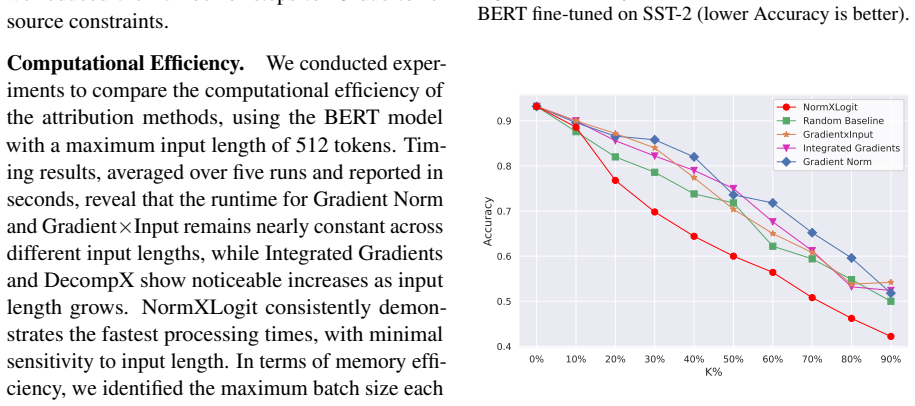
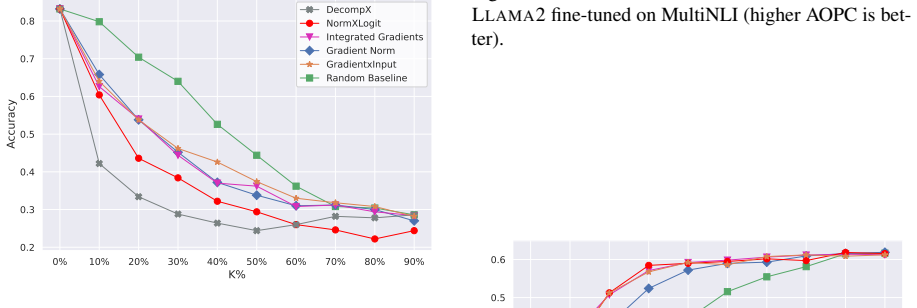
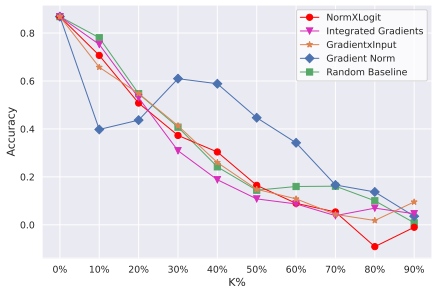
The central claim is that the head-on-top never lies: for a model with $L$ layers, computing $\mathrm{Att}_{\mathrm{LogAt}}(x_i) = \mathrm{HoT}_{\mathrm{clas}}(x_i^L)[\hat{p}]$ for classification (or the absolute distance from the [CLS] prediction for regression) turns the task head into an attribution function over every input token, and the full method $\mathrm{Att}_{\mathrm{NormXLogit}}(x_i) = \|x_i^0\|_2 \cdot \mathrm{Att}_{\mathrm{LogAt}}(x_i)$ adds the information content carried by the word embedding norm. The paper argues this works because attention's preserving effect keeps token identity in the final-layer representations, so the logits reflect each token's contribution to the decision, and because higher-norm embeddings carry more information and therefore should weight attributions more heavily. The paper then claims, with the perturbation-based AOPC/Accuracy experiments and the BLiMP evidence-alignment experiments, that these attributions are more faithful than gradient-based methods and competitive with vector-based, architecture-specific methods.
Load-bearing premise
The argument assumes that a classification or regression head trained only on the [CLS] token still outputs meaningful task-specific scores when applied to the final representation of any other token; if those outputs are arbitrary, NormXLogit shrinks to a norm-weighted noise signal.
Editorial extensions
If this is right
- NormXLogit turns any transformer with a task head into its own explainer: attributions for a prediction cost one forward pass and no gradients, so they scale to models where Integrated Gradients or DecompX would be impractical.
- Per-label scoring means one can ask which tokens support a specific class, not just the predicted one; in language modeling this extends to arbitrary vocabulary items, as the paper's LogAt("plural") result demonstrates.
- Applying the same formula at each layer produces layer-wise explanations without rollout-style aggregation, and on BLiMP these layer-wise alignments increase with depth for the target token.
- Since only the head and the last-layer representations are used, the method transfers across BERT-like, DeBERTa-like, and decoder-only architectures with no architecture-specific code.
Reading between the lines
- A natural test the paper does not run: randomize or swap the task head; if NormXLogit still tracks the model's behavior after perturbation, the logit term is not doing task-specific work, so this experiment would isolate how much of the attribution comes from the head versus the norm.
- Because the method reads hidden states rather than gradients, it is immune to the gradient-manipulation attacks the paper cites as a motivation; however, adversarial perturbations of the input still alter the embeddings and therefore the attributions, so 'manipulable' explanations may simply move to input space.
- The same construction should transfer to non-text transformers with a pooling token, e.g., vision transformers, by substituting the [CLS] convention with the equivalent pooled representation; this is a testable extension in the spirit of the paper's stated future work.
- The BLiMP layer curves suggest a diagnostic use: the layer at which target-vs-foil logit alignment diverges may localize where a grammatical feature becomes task-decisive, which could be compared across models or fine-tuning checkpoints.
Editorial analysis
A structured set of objections, weighed in public.
Referee Report
Summary. The paper proposes NormXLogit, a token-attribution method for transformer models. The attribution of token i is the product of the ℓ2 norm of its input embedding and a logit-attribution score (LogAt), obtained by applying the model's classification or regression head to the token's final-layer representation and reading off the predicted-class logit (or, in regression, the absolute distance from the head's output for the [CLS] token). The method requires only a single forward pass. The authors evaluate faithfulness via AOPC and accuracy-drop metrics on SST-2, MNLI, QNLI, and STS-B with BERT, DeBERTa, and LLAMA 2, comparing against gradient-based baselines, DecompX, a random baseline, and an ℓ2-norm-only baseline. They also evaluate plausibility by measuring alignment between attributions and known evidence tokens in a BLiMP subset with RoBERTa. The central claims are that NormXLogit is more faithful than gradient-based methods and competitive with architecture-specific methods, while being computationally much cheaper.
Significance. If the head-on-top assumption is valid, NormXLogit is an appealing method: it is model-agnostic, task-specific, per-label, and extremely efficient (one forward pass, no backpropagation, with reported speedups and large memory savings). The paper provides a broad empirical comparison across three model families, four tasks, and several baselines, which is a useful contribution. The method's simplicity and the clear presentation of the AOPC and accuracy-drop protocols are strengths. However, the core assumption that a head trained only on [CLS] produces meaningful logits for all token representations is not validated, and several empirical claims are stronger than the reported results warrant. The BLiMP plausibility experiment is weakened by a post hoc probe-word selection. These issues are addressable but require additional experiments and careful rephrasing.
major comments (3)
- [Section 3.3, Eq. (2)] The central assumption that applying the [CLS]-trained classification head to every token's final-layer representation yields meaningful task-specific logits is not validated. The cited 'preserving effect' from Kobayashi et al. (2021) concerns the dominance of the residual connection in the decomposition of attention outputs; it does not establish that a head trained only on the [CLS] token produces valid out-of-distribution logits for non-[CLS] token representations. If those logits are arbitrary or dominated by position/frequency artifacts, NormXLogit in Eq. (4) reduces to a norm-weighted heuristic. I request a control-head AOPC experiment: compare NormXLogit with the actual task head against NormXLogit with (a) a randomly initialized head and (b) a head trained on a different task. If the random-head variant achieves comparable AOPC, the task-specificity claim is falsified. This is the load-bearing step for the paper's central claim.
- [Table 1 and Section 4.2] The claim that NormXLogit 'surpasses' gradient-based methods is not supported in all reported configurations. In DeBERTa/MNLI, Integrated Gradients achieves AOPC 0.571 versus NormXLogit's 0.566; in DeBERTa/STS-B, IG has Accuracy 0.227 versus NormXLogit's 0.320 (lower is better). Several other cells differ by less than 0.01. The paper should either qualify the claim (e.g., 'in most settings') or provide statistical significance testing and error bars. Without variance estimates, differences of 0.005-0.01 in AOPC cannot be distinguished from noise, and the current presentation overstates the consistency of the advantage.
- [Section 5.2 and Appendix A.3] The BLiMP evidence-alignment experiment is weakened by post hoc probe selection. The paper reports that LogAt('plural') achieves notably high alignment and attributes this to the number-agreement phenomena in the data, but 'plural' is semantically related to the phenomena under study and is not a random probe. The comparison to two other randomly selected words does not constitute a systematic evaluation. The plausibility claim should be supported by a pre-specified set of probe words or by aggregating over a larger vocabulary subset, rather than by selecting a single word after observing the results.
minor comments (6)
- [Abstract and title] The title and abstract contain a spacing typo: 'Head-on-T opNever Lies' should read 'Head-on-Top Never Lies'.
- [Section 3.3, Eq. (3)] The regression attribution, defined as the absolute distance of the head's output for token i from its output for [CLS], needs a more explicit justification; as written, any out-of-distribution token representation will tend to have a large distance, and the paper does not explain why this measures task contribution rather than representation shift.
- [Section 4.1] No code or detailed implementation settings are provided for the baselines (e.g., the exact parameters for Integrated Gradients beyond the number of steps, or the handling of subword tokens in aggregation); releasing code would substantially improve reproducibility.
- [Table 1] The table reports single values without error bars or information about multiple runs; adding variance estimates (or at least a statement that results are deterministic given a fixed seed) would help readers interpret small differences.
- [Section 4.2] The explanation for the strength of the ℓ2 norm on STS-B ('similar openings... less frequent words toward the end') is speculative; either provide supporting analysis (e.g., token-level norm statistics) or soften the claim.
- [Figures 4 and 5] The captions report the layer-0 alignment for the ℓ2 norm but not for LogAt or NormXLogit; including those values would make the layer-wise comparison more complete.
Circularity Check
No significant circularity; the method combines fixed model components and is evaluated against independent faithfulness metrics, with at most a minor self-citation concern.
full rationale
NormXLogit's attribution (Eq. 4) is the product of the input-embedding ℓ2 norm and the head logit (Eq. 2) or head-distance (Eq. 3). Neither term is fitted to the evaluation metrics: the head is a fixed component of the fine-tuned model and the norm is a fixed property of the input embedding. The faithfulness results are measured by AOPC, Accuracy, and BLiMP evidence alignment, which are independent of how the attribution scores are produced. The one potentially load-bearing premise is that the [CLS]-trained head, applied to every token's final representation, yields meaningful task logits; the paper justifies this via the 'preserving' effect from Kobayashi et al. (2021), which is an external citation, and the reasoning is an assumption about transfer rather than a definitional identity with the conclusion. The comparison baselines GlobEnc, ALTI, and DecompX are from the same research group, but they are evaluated competitors, not premises of the derivation, so this is at most a minor self-citation concern. The Limitations section's caveat about lacking a gold standard does not indicate circularity. Overall, no step in the derivation reduces, by construction, to its own input.
Assumptions & free parameters
assumptions (4)
- domain assumption The 'preserving effect' ensures final-layer token representations retain the identity of the original input token, so logits from the head are meaningful per-token scores.
- domain assumption The l2 norm of input word embeddings encodes token information gain or importance.
- ad hoc to paper Applying the head-on-top to non-[CLS] token representations yields valid out-of-distribution logits.
- domain assumption Deleting or masking the K% top-attributed tokens is a valid faithfulness measure.
Cite this review
Pith. "Pith review of NormXLogit: The Head-on-Top Never Lies." pith.science (2026). https://pith.science/paper/D3RAQSGX
@misc{pith2026241116252,
  author       = {Pith},
  title        = {Pith review of: NormXLogit: The Head-on-Top Never Lies},
  year         = {2026},
  howpublished = {\url{https://pith.science/paper/D3RAQSGX}},
  note         = {Machine review of arXiv:2411.16252}
}
read the original abstract
With new large language models (LLMs) emerging frequently, it is important to consider the potential value of model-agnostic approaches that can provide interpretability across a variety of architectures. While recent advances in LLM interpretability show promise, many rely on complex, model-specific methods with high computational costs. To address these limitations, we propose NormXLogit, a novel technique for assessing the significance of individual input tokens. This method operates based on the input and output representations associated with each token. First, we demonstrate that during the pre-training of LLMs, the norms of word embeddings effectively capture token importance. Second, we reveal a significant relationship between a token's importance and the extent to which its representation can resemble the model's final prediction. Extensive analyses reveal that our approach outperforms existing gradient-based methods in terms of faithfulness and offers competitive performance in layer-wise explanations compared to leading architecture-specific techniques.
Figures


Figures from the paper (15 more)








Forward citations
Cited by 1 Pith paper
-
Demystifying Reasoning Dynamics with Mutual Information: Thinking Tokens are Information Peaks in LLM Reasoning
Reasoning tokens like 'Hmm' and 'Wait' mark steps where a model's internal state carries unusually high dependence with the correct answer, and suppressing them hurts accuracy.
Reference graph
Works this paper leans on
-
[1]
Samira Abnar and Willem Zuidema. 2020. https://doi.org/10.18653/v1/2020.acl-main.385 Quantifying attention flow in transformers . In Proceedings of the 58th Annual Meeting of the Association for Computational Linguistics, pages 4190--4197, Online. Association for Computational Linguistics
-
[2]
Daniel Cer, Mona Diab, Eneko Agirre, I \ n igo Lopez-Gazpio, and Lucia Specia. 2017. https://doi.org/10.18653/v1/S17-2001 S em E val-2017 task 1: Semantic textual similarity multilingual and crosslingual focused evaluation . In Proceedings of the 11th International Workshop on Semantic Evaluation ( S em E val-2017) , pages 1--14, Vancouver, Canada. Associ...
-
[3]
Ian Covert, Scott Lundberg, and Su-In Lee. 2022. https://arxiv.org/abs/2011.14878 Explaining by removing: A unified framework for model explanation . Preprint, arXiv:2011.14878
arXiv 2022
-
[4]
Jacob Devlin, Ming-Wei Chang, Kenton Lee, and Kristina Toutanova. 2019. https://doi.org/10.18653/v1/N19-1423 BERT : Pre-training of deep bidirectional transformers for language understanding . In Proceedings of the 2019 Conference of the North A merican Chapter of the Association for Computational Linguistics: Human Language Technologies, Volume 1 (Long a...
-
[5]
Javier Ferrando, Gerard I. G \'a llego, and Marta R. Costa-juss \`a . 2022. https://doi.org/10.18653/v1/2022.emnlp-main.595 Measuring the mixing of contextual information in the transformer . In Proceedings of the 2022 Conference on Empirical Methods in Natural Language Processing, pages 8698--8714, Abu Dhabi, United Arab Emirates. Association for Computa...
-
[6]
Pengcheng He, Jianfeng Gao, and Weizhu Chen. 2023. https://arxiv.org/abs/2111.09543 Debertav3: Improving deberta using electra-style pre-training with gradient-disentangled embedding sharing . Preprint, arXiv:2111.09543
arXiv 2023
-
[7]
Matthew Honnibal and Ines Montani. 2017. spaCy 2 : Natural language understanding with B loom embeddings, convolutional neural networks and incremental parsing. To appear
2017
-
[8]
Hu, Yelong Shen, Phillip Wallis, Zeyuan Allen-Zhu, Yuanzhi Li, Shean Wang, Lu Wang, and Weizhu Chen
Edward J. Hu, Yelong Shen, Phillip Wallis, Zeyuan Allen-Zhu, Yuanzhi Li, Shean Wang, Lu Wang, and Weizhu Chen. 2021. https://arxiv.org/abs/2106.09685 Lora: Low-rank adaptation of large language models . Preprint, arXiv:2106.09685
arXiv 2021
Show all 33 references
-
[9]
Sarthak Jain and Byron C. Wallace. 2019. https://doi.org/10.18653/v1/N19-1357 A ttention is not E xplanation . In Proceedings of the 2019 Conference of the North A merican Chapter of the Association for Computational Linguistics: Human Language Technologies, Volume 1 (Long and...
2019 doi
-
[10]
Pieter-Jan Kindermans, Kristof Schütt, Klaus-Robert Müller, and Sven Dähne. 2016. https://arxiv.org/abs/1611.07270 Investigating the influence of noise and distractors on the interpretation of neural networks . Preprint, arXiv:1611.07270
2016 arXiv
-
[11]
Goro Kobayashi, Tatsuki Kuribayashi, Sho Yokoi, and Kentaro Inui. 2021. https://doi.org/10.18653/v1/2021.emnlp-main.373 I ncorporating R esidual and N ormalization L ayers into A nalysis of M asked L anguage M odels . In Proceedings of the 2021 Conference on Empirical Methods ...
2021 doi
-
[12]
Yinhan Liu, Myle Ott, Naman Goyal, Jingfei Du, Mandar Joshi, Danqi Chen, Omer Levy, Mike Lewis, Luke Zettlemoyer, and Veselin Stoyanov. 2019. https://arxiv.org/abs/1907.11692 Roberta: A robustly optimized bert pretraining approach . Preprint, arXiv:1907.11692
2019 arXiv
-
[13]
Scott Lundberg and Su-In Lee. 2017. https://arxiv.org/abs/1705.07874 A unified approach to interpreting model predictions . Preprint, arXiv:1705.07874
2017 arXiv
-
[14]
Faridoun Mehri, Mohsen Fayyaz, Mahdieh Soleymani Baghshah, and Mohammad Taher Pilehvar. 2024. Skipplus: Skip the first few layers to better explain vision transformers. In Proceedings of the IEEE/CVF Conference on Computer Vision and Pattern Recognition (CVPR) Workshops, pages...
2024
-
[15]
Ali Modarressi, Mohsen Fayyaz, Ehsan Aghazadeh, Yadollah Yaghoobzadeh, and Mohammad Taher Pilehvar. 2023. https://doi.org/10.18653/v1/2023.acl-long.149 D ecomp X : Explaining transformers decisions by propagating token decomposition . In Proceedings of the 61st Annual Meeting ...
2023 doi
-
[16]
Ali Modarressi, Mohsen Fayyaz, Yadollah Yaghoobzadeh, and Mohammad Taher Pilehvar. 2022. https://doi.org/10.18653/v1/2022.naacl-main.19 G lob E nc: Quantifying global token attribution by incorporating the whole encoder layer in transformers . In Proceedings of the 2022 Confer...
2022 doi
-
[17]
Hosein Mohebbi, Willem Zuidema, Grzegorz Chrupa a, and Afra Alishahi. 2023. https://doi.org/10.18653/v1/2023.eacl-main.245 Quantifying context mixing in transformers . In Proceedings of the 17th Conference of the European Chapter of the Association for Computational Linguistic...
2023 doi
-
[18]
Momose Oyama, Sho Yokoi, and Hidetoshi Shimodaira. 2023. https://doi.org/10.18653/v1/2023.emnlp-main.131 Norm of word embedding encodes information gain . In Proceedings of the 2023 Conference on Empirical Methods in Natural Language Processing, pages 2108--2130, Singapore. As...
2023 doi
-
[19]
why should i trust you?
Marco Tulio Ribeiro, Sameer Singh, and Carlos Guestrin. 2016. https://arxiv.org/abs/1602.04938 "why should i trust you?": Explaining the predictions of any classifier . Preprint, arXiv:1602.04938
2016 arXiv
-
[20]
Wojciech Samek, Alexander Binder, Gr \' e goire Montavon, Sebastian Bach, and Klaus - Robert M \" u ller. 2015. https://arxiv.org/abs/1509.06321 Evaluating the visualization of what a deep neural network has learned . CoRR, abs/1509.06321
2015 arXiv
-
[21]
Sofia Serrano and Noah A. Smith. 2019. https://doi.org/10.18653/v1/P19-1282 Is attention interpretable? In Proceedings of the 57th Annual Meeting of the Association for Computational Linguistics, pages 2931--2951, Florence, Italy. Association for Computational Linguistics
2019 doi
-
[22]
Karen Simonyan, Andrea Vedaldi, and Andrew Zisserman. 2014. https://arxiv.org/abs/1312.6034 Deep inside convolutional networks: Visualising image classification models and saliency maps . Preprint, arXiv:1312.6034
2014 arXiv
-
[23]
Manning, Andrew Ng, and Christopher Potts
Richard Socher, Alex Perelygin, Jean Wu, Jason Chuang, Christopher D. Manning, Andrew Ng, and Christopher Potts. 2013. https://aclanthology.org/D13-1170 Recursive deep models for semantic compositionality over a sentiment treebank . In Proceedings of the 2013 Conference on Emp...
2013
-
[24]
Mukund Sundararajan, Ankur Taly, and Qiqi Yan. 2017. https://proceedings.mlr.press/v70/sundararajan17a.html Axiomatic attribution for deep networks . In Proceedings of the 34th International Conference on Machine Learning, volume 70 of Proceedings of Machine Learning Research,...
2017
-
[25]
Stone, Peter Albert, Amjad Almahairi, Yasmine Babaei, Nikolay Bashlykov, Soumya Batra, Prajjwal Bhargava, Shruti Bhosale, Daniel M
Hugo Touvron, Louis Martin, Kevin R. Stone, Peter Albert, Amjad Almahairi, Yasmine Babaei, Nikolay Bashlykov, Soumya Batra, Prajjwal Bhargava, Shruti Bhosale, Daniel M. Bikel, Lukas Blecher, Cristian Cant \'o n Ferrer, Moya Chen, Guillem Cucurull, David Esiobu, Jude Fernandes,...
2023 arXiv
-
[26]
Alex Wang, Amanpreet Singh, Julian Michael, Felix Hill, Omer Levy, and Samuel Bowman. 2018. https://doi.org/10.18653/v1/W18-5446 GLUE : A multi-task benchmark and analysis platform for natural language understanding . In Proceedings of the 2018 EMNLP Workshop B lackbox NLP : A...
2018 doi
-
[27]
Junlin Wang, Jens Tuyls, Eric Wallace, and Sameer Singh. 2020. https://doi.org/10.18653/v1/2020.findings-emnlp.24 Gradient-based analysis of NLP models is manipulable . In Findings of the Association for Computational Linguistics: EMNLP 2020, pages 247--258, Online. Associatio...
2020 doi
-
[28]
Alex Warstadt, Alicia Parrish, Haokun Liu, Anhad Mohananey, Wei Peng, Sheng-Fu Wang, and Samuel R. Bowman. 2020. https://aclanthology.org/2020.scil-1.47 BL i MP : A benchmark of linguistic minimal pairs for E nglish . In Proceedings of the Society for Computation in Linguistic...
2020
-
[29]
Adina Williams, Nikita Nangia, and Samuel Bowman. 2018. https://doi.org/10.18653/v1/N18-1101 A broad-coverage challenge corpus for sentence understanding through inference . In Proceedings of the 2018 Conference of the North A merican Chapter of the Association for Computation...
2018 doi
-
[30]
Thomas Wolf, Lysandre Debut, Victor Sanh, Julien Chaumond, Clement Delangue, Anthony Moi, Pierric Cistac, Tim Rault, Remi Louf, Morgan Funtowicz, Joe Davison, Sam Shleifer, Patrick von Platen, Clara Ma, Yacine Jernite, Julien Plu, Canwen Xu, Teven Le Scao, Sylvain Gugger, Mari...
2020 doi
-
[31]
Kayo Yin and Graham Neubig. 2022. https://arxiv.org/abs/2202.10419 Interpreting language models with contrastive explanations . Preprint, arXiv:2202.10419
2022 arXiv
-
[32]
online" 'onlinestring :=
ENTRY address archivePrefix author booktitle chapter edition editor eid eprint eprinttype howpublished institution journal key month note number organization pages publisher school series title type volume year doi pubmed url lastchecked label extra.label sort.label short.list...
-
[33]
write newline
" write newline "" before.all 'output.state := FUNCTION n.dashify 't := "" t empty not t #1 #1 substring "-" = t #1 #2 substring "--" = not "--" * t #2 global.max substring 't := t #1 #1 substring "-" = "-" * t #2 global.max substring 't := while if t #1 #1 substring * t #2 gl...
Reviewed August 12, 2026 · model on record in the stance chip above.
Discussion (0). Continue with ORCID to comment.