REVIEW 5 major objections 5 minor 38 references
An improved PPO that fuses a hybrid risk field, attention, a balanced reward, and a safety filter claims safer and faster-learning highway driving than seven baselines.
Reviewed by Pith at T0; open to challenge. T0 means a machine referee read the full paper against a public rubric. the ladder, T0–T4 →
T0 review · deepseek-v4-flash
2026-08-04 22:12 UTC pith:D5BPWMDN
load-bearing objection Safety filter confounds the results and the manuscript is internally inconsistent; the combination of ideas is reasonable but the evidence doesn't support the claims. the 5 major comments →
Attention and Risk-Aware Decision Framework for Safe Autonomous Driving
The pith
A machine-rendered reading of the paper's core claim, the machinery that carries it, and where it could break.
Core claim
RIBPPO-S is a PPO-based decision framework for a highway-driving agent. The environment state fed to the policy is not a raw image but a risk-attention state: a local driving image overlaid with a hybrid risk field built from a static, distance-based risk field around each human-driven vehicle and a dynamic field modulated by relative velocity and vehicle length. The actor-critic network processes this state through convolutional layers plus channel and spatial attention, the reward mixes current and historical terms with a balancing coefficient so recent risky situations are not averaged away, and a safety-assisted mechanism samples a cubic-polynomial lane-change trajectory, sums static and
What carries the argument
The load-bearing object is the hybrid risk field—a sum of a static, distance-based risk field around each obstacle and a velocity-dependent dynamic field—used twice: as an attention map over the image input, and as the basis for the lane-change safety filter. The filter discretizes the planned cubic lane-change trajectory, accumulates weighted static and dynamic risk at N sample points, and discards the maneuver when the cumulative risk exceeds R_safe. This gives the policy both a perceptual bias toward high-risk regions and a hard constraint that no high-risk lane change reaches the actuators.
Load-bearing premise
The safety-assisted mechanism blocks lane changes whose cumulative risk exceeds a threshold R_safe, but the paper never specifies that threshold or the risk-field constants; if they were hand-tuned to the test scenarios, the reported collision reduction may come from the safety filter rather than from learning.
What would settle it
Disable the safety-assisted mechanism, or set R_safe so large that no lane change is blocked, and retrain or reevaluate RIBPPO-S under the same traffic flows; if the collision rate rises to the level of the PPO baselines, the safety gain is caused by the hard filter, not the learned policy. A second check is to sweep R_safe and plot collision rate versus threshold: if the curve moves with R_safe, the threshold is doing the work.
If this is right
- RIBPPO-S is claimed to reach higher converged reward and lower collision rate than PPO, BPPO, RPPO, PPO-S, DDPG, A2C, and DQN in Highway-env.
- The risk-attention state lets the decision network process key image regions instead of averaging attention over the whole scene.
- The balanced reward function prevents long-sequence averaging from hiding recent high-risk steps, improving training efficiency on long driving sequences.
- The safety-assisted mechanism filters high-risk lane changes before execution, reducing useless training sequences and lowering collision rates.
- The proposed agent maintains near-target average speed while spending less time in risky areas.
Where Pith is reading between the lines
- A single ablation that removes only the safety-assisted mechanism would separate the learned policy's contribution from the hard R_safe filter; the paper does not report this, so the source of the collision reduction is not yet isolated.
- Sweeping R_safe from permissive to strict would show how much of the safety gain is tunable threshold behavior rather than learned behavior.
- The same cumulative-risk gating idea could be ported to merging, roundabout, or intersection decision-making, but the paper only tests straight highway lane changes.
- A reader of the full text will find the concluding section describes a different ramp-planner system (prediction-error ellipse, driving-style grading, TTR, IDM) rather than the RIBPPO-S algorithm tested in the body; that section should not be read as a summary of the tested method.
Editorial analysis
A structured set of objections, weighed in public.
Referee Report
Summary. The paper proposes RIBPPO-S, an improved proximal policy optimization (PPO) framework for highway autonomous driving. The method combines a hybrid risk field (static and dynamic), an attention-augmented actor-critic network, a balanced reward function, and a safety-assisted mechanism that filters risky lane changes before execution. The authors claim that RIBPPO-S outperforms PPO, BPPO, RPPO, PPO-S, DDPG, A2C, and DQN in collision avoidance, training efficiency, and speed in Highway-env simulations.
Significance. The motivating problem is real: learning-based driving policies need better risk awareness and sample efficiency in long-horizon highway scenarios. The hybrid risk field and attention mechanism are reasonable ingredients, and a careful comparison with DRL baselines could be valuable. However, the current evidence does not support the central claims. The safety-assisted mechanism directly filters lane changes using an unparameterized threshold, and all baseline comparisons include this filter only for RIBPPO-S. Key risk-field constants are never specified, the claimed 'risky-area time' metric is absent from the results, and the conclusion section describes a different planner. The paper does not release code or full configuration details, so the experiments are not reproducible. If the claims were properly validated with ablations and full parameter disclosure, the work could be useful; as presented, the contribution is not established.
major comments (5)
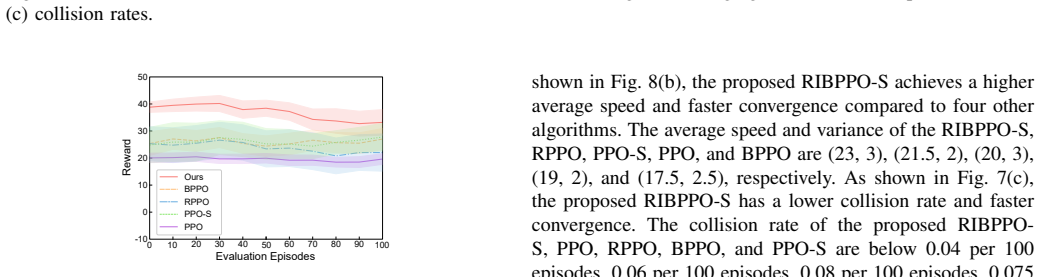
- [Section V, Eqs. (15)-(16)] The safety-assisted mechanism rejects any lane change whose cumulative risk R_total exceeds R_safe before execution. This hard filter is part of RIBPPO-S but is not applied to any baseline, so lower collision rates in Figs. 7(c) and 9(c) may be entirely caused by the filter. The paper does not specify R_safe nor report an ablation without the filter, so the central claim that the learning algorithm improves collision avoidance is unsupported. Please report results with and without the safety filter, and specify the threshold and how it is chosen.
- [Section III, Eqs. (1)-(2); Section V, Eqs. (11)-(14)] Key parameters are never assigned values: epsilon_obs, epsilon_HDV, xi_x, xi_y, xi_v, rho, lambda, sigma, w_s, and w_d are all undefined, as is R_safe in Eq. (16). Without these values and the procedure for setting them, the experiments are not reproducible and the safety filter could be hand-tuned to make the proposed method look better. Please provide the full parameter settings and a sensitivity study.
- [Abstract vs. Section VI] The abstract claims 'shorter driving time remaining on the risky areas,' but no such metric is reported anywhere in Section VI. The results contain reward, speed, and collision rate curves only. This claim must either be removed or supported with a definition, measurement, and figure/table of the 'risky area' time metric.
- [Section VII (Conclusion)] The conclusion describes a 'top-down safe planner' for ramps that uses a prediction error ellipse, a data-based driving style grading system, TTR-based collision detection, and an IDM model. This is not the RIBPPO-S method, the Highway-env environment, or any content in Sections III-VI. This section appears to be from a different paper and must be replaced with a conclusion that summarizes the actual contribution presented herein.
- [Section VI] The experimental methodology is insufficient. The baselines BPPO, RPPO, and PPO-S are not defined in terms of architecture or hyperparameters. No number of seeds, standard deviations, or error bars are reported, and the figures show single training curves. Figure references are also inconsistent (e.g., 'Fig. 8(a)' appears while the training curves are in Fig. 7; 'PPO-CS' is used at one point while 'PPO-S' is used elsewhere). Without seeds and variance information, the claimed superiority over benchmarks is not statistically demonstrated.
minor comments (5)
- [Section IV-A-1, Eqs. (3)-(4)] Equations (3) and (4) are identical. The duplicate should be removed.
- [Figures 2-4] Figure numbering and captions are confused: two figures share the caption 'Structure of the image-efficient actor-critic network,' and the text refers to network details across Figures 3 and 4 inconsistently. Please renumber and re-caption.
- [Section III, Eqs. (1)-(2)] Notation is inconsistent: 'HV' appears where 'AV' is intended, and the ε weight in Eq. (1) is written as ε_obs in one place and ε elsewhere. The definition of v_relative in Eq. (2) should be cleaned up; the current formula mixes an indicator variable with a velocity term in an ambiguous way.
- [Abstract and Section I] 'Physical engine' should be 'physics engine' or 'simulation engine.' The paper uses Highway-env, which is a simulation library, not a physical engine.
- [Section IV organization] The paper's overview says Section IV describes 'curiosity-assisted training optimization,' but the actual Section IV is titled 'Decision Network and Balanced Reward Function' and no curiosity mechanism appears. Please align the overview with the actual section content.
Circularity Check
Safety-improvement claim is partially circular: Eq. (16) hard filter defines safety by the risk threshold, so reported collision-avoidance gains are partly by construction rather than learned.
specific steps
-
self definitional
[Section V, Eqs. (15)-(16); Results Section VI-A/VI-B, Figs. 7-10]
"Finally, the lane change is considered safe if: Rtotal ≤ Rsafe, (16) where Rsafe is a predefined safety threshold. If the condition in (16) is not met, the lane change is discarded before policy execution. ... the safety-assisted mechanism predicts and filters out high-risk lane changes before execution, preventing the generation of useless training sequences."
The headline comparison (Figs. 7(c) and 9(c)) attributes lower collision rates to the learned RIBPPO-S policy, but the proposed agent uses Eq. (16), which discards every lane change whose cumulative risk exceeds Rsafe before execution. Thus any collision that would have come from a high-risk lane change is prevented by the filter, not by the learned policy. Since Rsafe and the risk-field constants in Eqs. (1)-(15) are never specified, the safety improvement is inseparable from hand-set inputs; the claimed collision-avoidance prediction is built into the safety criterion itself, making the central safety gain partly circular by construction.
full rationale
The paper's derivation chain is largely self-contained: the risk-attention network, balanced reward, and PPO update are all described with explicit equations, and the comparison to PPO/BPPO/RPPO/PPO-S/DDPG/A2C/DQN is an empirical claim rather than a formal derivation. I do not find load-bearing self-citation or an imported uniqueness theorem; the prior-work citations are contextual, not essential to the new algorithm. However, the central safety claim is partially circular: the safety-assisted mechanism uses the same hybrid risk field that defines the reward and attention input, and Eq. (16) makes safe lane changes equivalent to satisfying the threshold condition, discarding all other lane changes before execution. Because the threshold and field constants are not reported, the collision-rate reduction in Figs. 7(c) and 9(c) cannot be attributed to the learned policy; it may be entirely produced by the hard filter. The abstract's additional claim of 'shorter driving time remaining on the risky areas' is also not reported in the results, and the conclusion section appears to describe a different planner, but those are integrity/reproducibility concerns rather than circularity. Overall, the safety improvement is at least partly forced by the filter's definition, warranting a score of 6.
Axiom & Free-Parameter Ledger
free parameters (9)
- epsilon_obs
- epsilon_HDV
- xi_x, xi_y, xi_v
- rho, lambda
- sigma
- w_s, w_d
- R_safe
- gamma
- Reward weights r_s, r_st, r_e, r_a
axioms (4)
- domain assumption The hybrid risk field (Eqs. 1-2) is a valid model of collision risk.
- domain assumption The lane-change trajectory follows the cubic polynomial y(x) in Eq. (10).
- domain assumption PPO with the described network and reward converges to a good policy in this environment.
- domain assumption The baseline algorithms are implemented and tuned fairly.
invented entities (1)
-
Hybrid risk field
no independent evidence
Cite this review
Pith. "Pith review of Attention and Risk-Aware Decision Framework for Safe Autonomous Driving." pith.science (2026). https://pith.science/paper/D5BPWMDN
@misc{pith2026250907412,
  author       = {Pith},
  title        = {Pith review of: Attention and Risk-Aware Decision Framework for Safe Autonomous Driving},
  year         = {2026},
  howpublished = {\url{https://pith.science/paper/D5BPWMDN}},
  note         = {Machine review of arXiv:2509.07412}
}
read the original abstract
Autonomous driving has attracted great interest due to its potential capability in full-unsupervised driving. Model-based and learning-based methods are widely used in autonomous driving. Model-based methods rely on pre-defined models of the environment and may struggle with unforeseen events. Proximal policy optimization (PPO), an advanced learning-based method, can adapt to the above limits by learning from interactions with the environment. However, existing PPO faces challenges with poor training results, and low training efficiency in long sequences. Moreover, the poor training results are equivalent to collisions in driving tasks. To solve these issues, this paper develops an improved PPO by introducing the risk-aware mechanism, a risk-attention decision network, a balanced reward function, and a safety-assisted mechanism. The risk-aware mechanism focuses on highlighting areas with potential collisions, facilitating safe-driving learning of the PPO. The balanced reward function adjusts rewards based on the number of surrounding vehicles, promoting efficient exploration of the control strategy during training. Additionally, the risk-attention network enhances the PPO to hold channel and spatial attention for the high-risk areas of input images. Moreover, the safety-assisted mechanism supervises and prevents the actions with risks of collisions during the lane keeping and lane changing. Simulation results on a physical engine demonstrate that the proposed algorithm outperforms benchmark algorithms in collision avoidance, achieving higher peak reward with less training time, and shorter driving time remaining on the risky areas among multiple testing traffic flow scenarios.
Figures




Reference graph
Works this paper leans on
-
[1]
Multi- agent monte carlo tree search for safe decision making at unsignalized intersections,
Z. Lin, J. Lan, C. Anagnostopoulos, Z. Tian, and D. Flynn, “Multi- agent monte carlo tree search for safe decision making at unsignalized intersections,” 2025
work page 2025
-
[2]
Safety-critical multi-agent mcts for mixed traffic coordination at unsignalized intersections,
——, “Safety-critical multi-agent mcts for mixed traffic coordination at unsignalized intersections,”IEEE Transactions on Intelligent Trans- portation Systems, 2025
work page 2025
-
[3]
Safety-critical multi-agent mcts for mixed traffic coordination at unsignalized roundabout,
Z. Lin, S. Liu, Z. Tian, D. Zhao, and J. Lan, “Safety-critical multi-agent mcts for mixed traffic coordination at unsignalized roundabout,”arXiv preprint arXiv:2509.01856, 2025
-
[4]
Enhanced visual slam for collision-free driving with lightweight autonomous cars,
Z. Lin, Z. Tian, Q. Zhang, H. Zhuang, and J. Lan, “Enhanced visual slam for collision-free driving with lightweight autonomous cars,”Sensors, vol. 24, no. 19, p. 6258, 2024
work page 2024
-
[5]
Efficient and safe planner for automated driving on ramps considering unsatisfication,
Q. Li, Z. Tian, X. Wang, J. Yang, and Z. Lin, “Efficient and safe planner for automated driving on ramps considering unsatisfication,” arXiv preprint arXiv:2504.15320, 2025
Pith/arXiv arXiv 2025
-
[6]
Adaptive field effect planner for safe interactive autonomous driving on curved roads,
——, “Adaptive field effect planner for safe interactive autonomous driving on curved roads,”arXiv preprint arXiv:2504.14747, 2025
Pith/arXiv arXiv 2025
-
[7]
Z. Tian, Z. Lin, D. Zhao, C. Anagnostopoulos, Q. Wang, W. Zhao, X. Wang, and C. Wei, “A risk-aware spatial-temporal trajectory planning framework for autonomous vehicles using qp-mpc and dynamic hazard fields,”arXiv preprint arXiv:2509.00643, 2025
work page internal anchor Pith review Pith/arXiv arXiv 2025
-
[8]
Y . Liuet al., “Data-driven evolutionary game-based model predictive control for hybrid renewable energy dispatch in autonomous ships,” in 2025 4th International Conference on New Energy System and Power Engineering (NESP), 2025, pp. 482–490
work page 2025
-
[9]
Enhanced mean field game for interactive decision-making with varied stylish multi-vehicles,
L. Zheng, Z. Tianet al., “Enhanced mean field game for interactive decision-making with varied stylish multi-vehicles,”arXiv preprint arXiv:2509.00981, 2025
Pith/arXiv arXiv 2025
-
[10]
A mean-field-game-integrated mpc-qp framework for collision-free multi-vehicle control,
L. Zheng, X. Wang, F. Li, Z. Mao, Z. Tian, Y . Peng, F. Yuan, and C. Yuan, “A mean-field-game-integrated mpc-qp framework for collision-free multi-vehicle control,”Drones, vol. 9, no. 5, p. 375, 2025
work page 2025
-
[11]
A novel of repulsive function on artificial potential field for robot path planning,
H. H. Triharminto, O. Wahyunggoro, T. Adji, A. Cahyadi, and I. Ardiyanto, “A novel of repulsive function on artificial potential field for robot path planning,”International Journal of Electrical and Computer Engineering, vol. 6, no. 6, p. 3262, 2016
work page 2016
-
[12]
Path planning method with improved artificial potential field—a reinforcement learning perspective,
Q. Yao, Z. Zheng, L. Qi, H. Yuan, X. Guo, M. Zhao, Z. Liu, and T. Yang, “Path planning method with improved artificial potential field—a reinforcement learning perspective,”IEEE access, vol. 8, pp. 135 513–135 523, 2020
work page 2020
-
[13]
J. Lu, L. Han, Q. Wei, X. Wang, X. Dai, and F.-Y . Wang, “Event- triggered deep reinforcement learning using parallel control: A case study in autonomous driving,”IEEE Transactions on Intelligent Vehicles, vol. 8, no. 4, pp. 2821–2831, 2023
work page 2023
-
[14]
J. Wu, Z. Huang, and C. Lv, “Uncertainty-aware model-based reinforce- ment learning: Methodology and application in autonomous driving,” IEEE Transactions on Intelligent Vehicles, vol. 8, no. 1, pp. 194–203, 2022
work page 2022
-
[15]
Deep reinforcement learning based autonomous driving with collision free for mobile robots,
K. Yeom, “Deep reinforcement learning based autonomous driving with collision free for mobile robots,”International Journal of Mechanical Engineering and Robotics Research, vol. 11, no. 5, pp. 338–344, 2022
work page 2022
-
[16]
A. J. M. Muzahid, S. F. Kamarulzaman, M. A. Rahman, and A. H. Alenezi, “Deep reinforcement learning-based driving strategy for avoid- ance of chain collisions and its safety efficiency analysis in autonomous vehicles,”IEEE Access, vol. 10, pp. 43 303–43 319, 2022
work page 2022
-
[17]
The advance of reinforcement learning and deep reinforcement learning,
L. Lyu, Y . Shen, and S. Zhang, “The advance of reinforcement learning and deep reinforcement learning,” inProceedings of the IEEE Interna- tional Conference on Electrical Engineering, Big Data and Algorithms, 2022, pp. 644–648
work page 2022
-
[18]
A methodology based on deep reinforcement learning to autonomous driving with double Q-learning,
Z. Liu, J. Hu, T. Song, and Z. Huang, “A methodology based on deep reinforcement learning to autonomous driving with double Q-learning,” inProceedings of the IEEE International Conference on Computer and Communications. IEEE, 2021, pp. 1266–1271
work page 2021
-
[19]
Exploiting multi-modal fusion for urban autonomous driving using latent deep reinforcement learning,
Y . H. Khalil and H. T. Mouftah, “Exploiting multi-modal fusion for urban autonomous driving using latent deep reinforcement learning,” IEEE Transactions on Vehicular Technology, vol. 72, no. 3, pp. 2921– 2935, 2022
work page 2022
-
[20]
Pomdp motion planning algorithm based on multi-modal driving intention,
L. Li, W. Zhao, and C. Wang, “Pomdp motion planning algorithm based on multi-modal driving intention,”IEEE Transactions on Intelligent Vehicles, vol. 8, no. 2, pp. 1777–1786, 2022
work page 2022
-
[21]
C. Xu, W. Zhao, L. Li, Q. Chen, D. Kuang, and J. Zhou, “A Nash Q- learning based motion decision algorithm with considering interaction to traffic participants,”IEEE Transactions on Vehicular Technology, vol. 69, no. 11, pp. 12 621–12 634, 2020
work page 2020
-
[22]
Towards robust decision-making for autonomous driving on highway,
K. Yang, X. Tang, S. Qiu, S. Jin, Z. Wei, and H. Wang, “Towards robust decision-making for autonomous driving on highway,”IEEE Transactions on Vehicular Technology, vol. 72, no. 9, pp. 11 251–11 263, 2023
work page 2023
-
[23]
Soft actor-critic algorithms and applications,
T. Haarnoja, A. Zhou, K. Hartikainen, G. Tucker, S. Ha, J. Tan, V . Ku- mar, H. Zhu, A. Gupta, P. Abbeelet al., “Soft actor-critic algorithms and applications,”arXiv preprint arXiv:1812.05905, 2018
Pith/arXiv arXiv 2018
-
[24]
Communication scheduling by deep reinforcement learning for remote traffic state estimation with bayesian inference,
B. Peng, Y . Xie, G. Seco-Granados, H. Wymeersch, and E. A. Jorswieck, “Communication scheduling by deep reinforcement learning for remote traffic state estimation with bayesian inference,”IEEE Transactions on Vehicular Technology, vol. 71, no. 4, pp. 4287–4300, 2022
2022
-
[25]
Deep Q learning based high level driving policy determination,
K. Min, H. Kim, and K. Huh, “Deep Q learning based high level driving policy determination,” inProceedings of the IEEE Intelligent Vehicles Symposium, 2018, pp. 226–231
work page 2018
-
[26]
Continuous deep Q- learning with model-based acceleration,
S. Gu, T. Lillicrap, I. Sutskever, and S. Levine, “Continuous deep Q- learning with model-based acceleration,” inProceedings of the Interna- tional Conference on Machine Learning, 2016, pp. 2829–2838
work page 2016
-
[27]
G. Basile, A. Petrillo, and S. Santini, “DDPG based end-to-end driving enhanced with safe anomaly detection functionality for autonomous vehicles,” inProceedings of the IEEE International Conference on Metrology for Extended Reality, Artificial Intelligence and Neural En- gineering, 2022, pp. 248–253
work page 2022
-
[28]
Mobile robot path planning based on improved DDPG reinforcement learning algorithm,
Y . Dong and X. Zou, “Mobile robot path planning based on improved DDPG reinforcement learning algorithm,” inProceedings of the IEEE International Conference on Software Engineering and Service Science, 2020, pp. 52–56
work page 2020
-
[29]
Towards safe and effi- cient modular path planning using twin delayed DDPG,
M. A. Hebaish, A. Hussein, and A. El-Mougy, “Towards safe and effi- cient modular path planning using twin delayed DDPG,” inProceedings of the IEEE Vehicular Technology Conference, 2022, pp. 1–7
work page 2022
-
[30]
Velocity control in car-following behavior with autonomous vehicles using reinforcement learning,
Z. Wang, H. Huang, J. Tang, X. Meng, and L. Hu, “Velocity control in car-following behavior with autonomous vehicles using reinforcement learning,”Accident Analysis & Prevention, vol. 174, p. 106729, 2022
work page 2022
-
[31]
An em- pirical study of ddpg and ppo-based reinforcement learning algorithms for autonomous driving,
S. Siboo, A. Bhattacharyya, R. Naveen Raj, and S. H. Ashwin, “An em- pirical study of ddpg and ppo-based reinforcement learning algorithms for autonomous driving,”IEEE Access, vol. 11, pp. 125 094–125 108, 2023
work page 2023
-
[32]
Mixed-autonomy traffic control with proximal policy optimization,
H. Wei, X. Liu, L. Mashayekhy, and K. Decker, “Mixed-autonomy traffic control with proximal policy optimization,” inProceedings of the IEEE Vehicular Networking Conference, 2019, pp. 1–8
work page 2019
-
[33]
Automated lane change strategy using proximal policy optimization-based deep reinforcement learning,
F. Ye, X. Cheng, P. Wang, C.-Y . Chan, and J. Zhang, “Automated lane change strategy using proximal policy optimization-based deep reinforcement learning,” inProceedings of the IEEE Intelligent Vehicles Symposium, 2020, pp. 1746–1752
work page 2020
-
[34]
Convolutional neural networks for image classification,
J. Bharadiya, “Convolutional neural networks for image classification,” International Journal of Innovative Science and Research Technology, vol. 8, no. 5, pp. 673–677, 2023
work page 2023
-
[35]
D. Bala, M. S. Hossainet al., “Monkeynet: A robust deep convolutional neural network for monkeypox disease detection and classification,” Neural Networks, vol. 161, pp. 757–775, 2023
work page 2023
-
[36]
D. Zhai, D. Yang, J. Chen, Z. Luo, M. Yu, and Z. Zhou, “Model for the cooperative obstacle-avoidance of the automated vehicle swarm in a connected vehicles environment,”IET intelligent transport systems, vol. 17, no. 6, pp. 1137–1151, 2023
work page 2023
-
[37]
Automated driving maneuvers under interactive environment based on deep reinforcement learning,
P. Wang, C.-Y . Chanet al., “Automated driving maneuvers under interactive environment based on deep reinforcement learning,”arXiv preprint arXiv:1803.09200, 2018
Pith/arXiv arXiv 2018
-
[38]
An environment for autonomous driving decision-making,
E. Leurent, “An environment for autonomous driving decision-making,” https://github.com/eleurent/highway-env, 2018
2018
discussion (0)
Sign in with ORCID, Apple, or X to comment. Anyone can read and Pith papers without signing in.