REVIEW 2 major objections 4 minor 43 references
Multistate ring polymer instantons and nonadiabatic reaction rates
T0 review · 2 major / 4 minor · reviewed 2026-08-14 · deepseek-v4-flash
Pith's one-line read Two path-integral instanton formulations give multistate reaction rates across three orders of magnitude in electronic coupling.
desk verdict A genuinely new mapping-variable instanton with useful bead-resolved populations, but the constrained saddle search undercuts the intermediate-coupling rate claims. read the letter →
The pith
A machine-rendered reading of the paper's core claim, the machinery that carries it, and where it could break.
The reading
What carries the argument
The load-bearing object is the multistate ring polymer potential, a discretized imaginary-time action whose saddle points are the instantons. In the mean-field representation the effective potential is $V_{\mathrm{MF}}(\{R_\alpha\}) = U(\{R_\alpha\}) - \frac{1}{\beta}\ln|\mathrm{Re}\,\Gamma_{\mathrm{MF}}|$, where $U$ is the harmonic bead coupling and $\Gamma_{\mathrm{MF}}$ is the transfer matrix obtained by tracing over electronic states. In the mapping-variable representation it is $V_{\mathrm{MV}}(\{R_\alpha\},\{x_\alpha\}) = U(\{R_\alpha\}) + \frac{1}{\beta}\sum_\alpha x_\alpha^T x_\alpha - \frac{1}{\beta}\ln|\mathrm{Re}\,\Gamma_{\mathrm{MV}}|$, with $x_\alpha$ continuous Cartesian variables for the electronic states. The argument works by solving the stationarity conditions on all coordinates and then classifying the solution through the stability matrix: exactly one negative eigenvalue certifies a first-order saddle, and the zero eigenvalue is identified analytically with the collective velocity mode $\dot{X}(\tau)$ in all degrees of freedom. The rate follows from Gaussian integration around the saddle after analytically continuing the unstable mode.
What would settle it
Take the symmetric two-state model at inverse temperature $\beta=3.25$ a.u. with the weak coupling $\Delta=0.0077$ a.u. and search for a first-order saddle of the full multistate ring polymer potential without fixing any beads at the crossing. An unconstrained saddle with a different action, bead distribution, or stability spectrum than the constrained $N_1/N_2$-scanned solution would falsify the paper's central claim.
Extended reading notes
Core claim
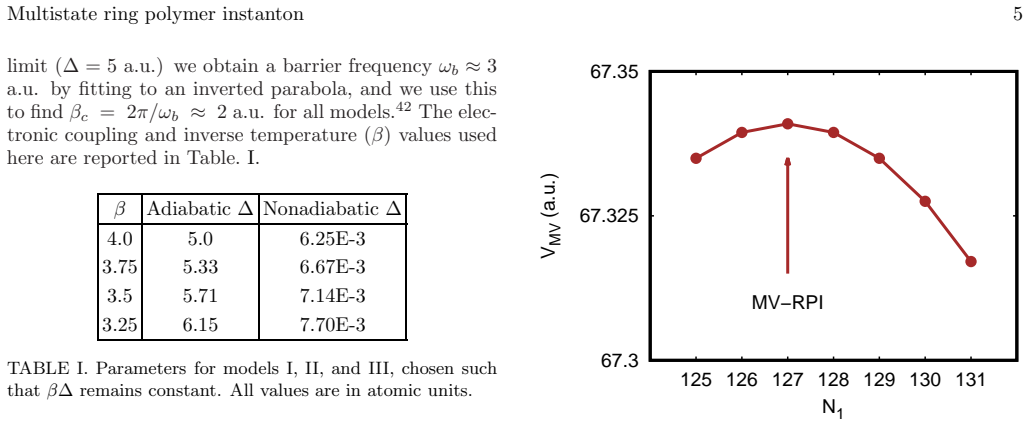
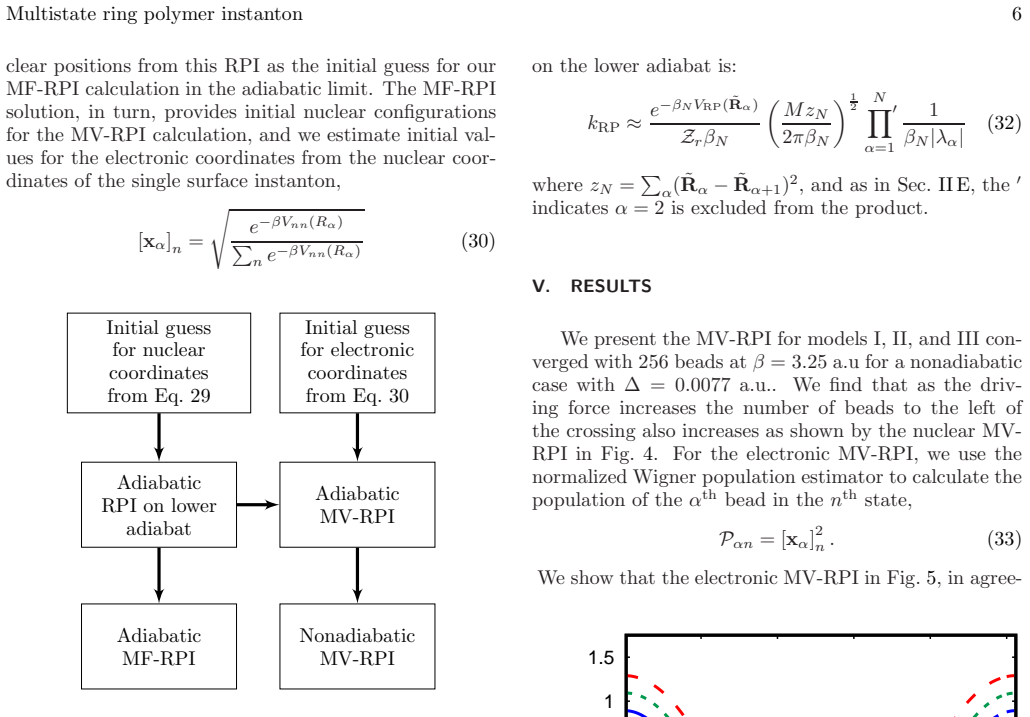
The central claim is that multistate ring polymer instantons can be computed from the exact path-integral partition function in two ways, and both are genuine instantons: analytically they possess the zero mode associated with imaginary-time translation, and numerically their stability matrices show exactly one unstable mode. The mean-field and mapping-variable nuclear paths nearly coincide for the two-state single-mode models studied, so the nuclear tunneling mechanism is robust to the electronic representation. The mapping-variable version goes beyond the mean-field one by assigning every bead a fractional donor/acceptor population; in the nonadiabatic limit these populations change smoothly along the path, while in the adiabatic limit they change sharply and with oscillatory structure near the crossing. The paper also supplies an MF-RPI rate expression and shows it reproduces golden-rule results at weak coupling and single-surface ring polymer instanton results at strong coupling, interpolating accurately across the intermediate regime.
Load-bearing premise
The load-bearing premise is that pinning two ring-polymer beads exactly at the crossing point of the two electronic-state curves and scanning how many remaining beads sit on each side locates the true first-order saddle of the unconstrained multistate ring polymer potential; if that constraint biases the saddle, the instanton paths and rates inherit the bias.
Editorial extensions
If this is right
- The MF-RPI rate formula can serve as a single expression for reaction rates in both the nonadiabatic and adiabatic limits, matching golden-rule results at weak coupling and single-surface ring polymer instanton results at strong coupling.
- The MV-RPI provides per-bead electronic state populations along the instanton path, giving a mechanism-level picture of where the donor-to-acceptor transition occurs without assuming the nuclear geometry of the transition.
- Both formulations are first-order saddles with one unstable mode and a zero mode, so they fit into the standard ring polymer instanton framework, including its rate expression.
- Because the mean-field and mapping-variable path integrals are equivalent representations of the same partition function, their nuclear instantons coincide; no separate MV rate formula is needed.
Reading between the lines
- The two-bead pinning protocol is a natural stress point: repeating the calculation with an unconstrained saddle search on an asymmetric model would show whether the scanned ratio $N_1/N_2$ is a genuine saddle coordinate or an artifact of the optimizer's basin.
- The MV-RPI population profiles suggest a measurable nonadiabatic reaction coordinate—for instance, the bead index at which donor population crosses 1/2—that could be plugged into a transition state theory calculation, something the paper does not do.
- All reported models lie in the normal electron-transfer regime; applying the method in the inverted regime or near the crossover temperature would test whether the single-unstable-mode instanton picture holds outside the demonstrated conditions.
- Because the MV-RPI carries explicit electronic coordinates, it is a plausible seed for mapping-variable ring polymer molecular dynamics trajectories, an extension the authors flag but do not execute.
Signed reviews
Editorial analysis
A structured set of objections, weighed in public.
Referee Report
Summary. The paper presents two multistate ring polymer instanton (RPI) formulations, a Mean-Field (MF)-RPI and a Mapping-Variable (MV)-RPI, both derived from exact path integral representations of the canonical partition function. The MF-RPI rate expression, Eq. (27), is used to compute rate constants for model two-state systems with coupling strengths spanning three orders of magnitude, and is compared to Fermi's Golden Rule rates in the nonadiabatic limit and to single-surface RPI rates in the adiabatic limit. The MV-RPI is shown to provide electronic state populations along the instanton path, which the MF-RPI populations obtained from Eq. (34) do not. The authors also claim analytic zero modes and numerical verification of a single unstable mode for both formulations. The paper concludes that the MF-RPI accurately calculates adiabatic and nonadiabatic reaction rates and that the MV-RPI gives mechanistic population information.
Significance. If fully validated, the paper would be a valuable contribution: it offers a practical instanton-based rate theory for nonadiabatic processes across coupling regimes, and the MV-RPI population analysis is a novel mechanistic diagnostic. The limit checks are meaningful: Table IV shows agreement with FGR to three decimal places, and in the adiabatic regime the MF-RPI is within a factor of about 2 of single-surface RPI. The analytic zero-mode derivations in the appendices are useful. However, the central rate-accuracy claim rests on the identification of the computed configurational as a true first-order saddle of the full ring-polymer potential, and the intermediate-coupling accuracy claim currently lacks a benchmark. These issues are load-bearing for the abstract's claim of accurate rates over three orders of magnitude in coupling.
major comments (2)
- [Sec. IV.A and Eq. (27)] The optimization protocol fixes two ring-polymer beads exactly at the diabatic crossing and scans the discrete integer ratio N1/N2, selecting the ratio that maximizes the effective potential. These fixed beads are not optimized, and N1/N2 is not a degree of freedom of the ring-polymer potential; it is a property of the bead labeling. Consequently, the final configuration generally has nonzero gradient components in the directions of the fixed beads, especially for the asymmetric models II and III, and is not a stationary point of the full potential V_MF(R_1,...,R_N). A Hessian with one negative eigenvalue at a point with nonzero gradient does not establish that the point is a first-order saddle. The rate expression in Eq. (27) is derived from a Gaussian fluctuation integral about a true saddle of the full potential, including the zero-mode normalization z_N and the product over the N-1 stable modes (Eqs. 24-26). If the configuration is only a constrained stationary point, the fluctuation prefactor omits contributions from the constrained variables and the semiclassical derivation does not apply. The paper should demonstrate that the constrained solution is the true unconstrained saddle, for example by reporting the gradient norm after relaxation of the constraints or by locating the saddle with an algorithm that does not fix beads.
- [Table III and Sec. V] The claim that the MF-RPI rate expression 'interpolates smoothly and accurately' between the nonadiabatic and adiabatic regimes is not supported by the data. In Table III at Δ=5.0 a.u., the MF-RPI rate is about 50 times the FGR rate (log10 k = -30.269 vs -31.997), and while the adiabatic single-surface RPI is closer, the intermediate coupling regime has no exact benchmark. Agreement with FGR in the weak-coupling limit and with single-surface RPI in the strong-coupling limit brackets the two ends but does not establish accuracy in between. The abstract's claim of 'accurately calculate rate constants ... with the coupling strength varying over three orders of magnitude' is therefore an overstatement. The authors should either provide a benchmark in the intermediate regime (e.g., a numerically exact quantum rate or a converged golden-rule instanton result where valid) or soften the accuracy claim to 'smoothly interpolates between the two limiting rate expressions'.
minor comments (4)
- [Abstract] The phrase 'we numerically and that these solutions are true instantons' is missing a verb; it should read 'we numerically find that these solutions are true instantons'.
- [Eq. (9)] In the definition of M_nn, the argument 'V_nn(R_α)+V_nn(R_α)' appears twice; based on the structure of M_nm it likely should be V_nn(R_α)+V_nn(R_{α+1}). Please correct the typo.
- [Fig. 5 caption] The caption reports 'Δ = 0.077 a.u.' for the nonadiabatic case, but the text and Table I give Δ = 0.0077 a.u. at β = 3.25 a.u. The factor-of-10 discrepancy is misleading.
- [Appendix B] The zero-mode proof for the MV instanton is formal because the electronic variables enter the action only through a total derivative, so the equation of motion for x is first-order and the second variation in x has no differential operator. The claim that the collective velocity mode in both R and x is a zero mode of the stability matrix in Eq. (41) should be justified more carefully, or the scope of the analytic zero-mode statement should be limited to the MF case.
Circularity Check
No circular derivation: the MF-RPI and MV-RPI rates are benchmarked against independent FGR and single-surface RPI results, and no target rate or population enters as an input.
full rationale
The paper derives the MF-RPI and MV-RPI from path-integral representations of the canonical partition function and computes rates with Eq. 27, whose prefactor is carried over from previous instanton rate theory (Richardson/Althorpe and Schwieters/Voth) rather than fitted to the models. The benchmark quantities are external: Fermi Golden Rule rates for weak coupling and single-surface RPI rates on the lower adiabat for strong coupling, so the reported agreement is a genuine test, not a restatement of input data. The mapping-variable and mean-field partition function expressions cite prior work including Ananth's own papers, but these are parameter-free mathematical identities (MMST mapping, trace identities) whose assumptions (SEO subspace, exact trace) do not include the target rates or populations, so under the review rules they do not constitute load-bearing self-citation. The constrained saddle-search protocol (two beads fixed at the crossing, N1/N2 scan) is a numerical/correctness concern about whether the configuration is a true stationary point of the full ring-polymer potential, but it is not circular: it does not feed the FGR or adiabatic RPI rates into the instanton calculation.
Assumptions & free parameters
free parameters (1)
- barrier frequency omega_b =
~3 a.u.
assumptions (5)
- standard math Trotter factorization and cyclic bead representation of e^{-beta H}
- domain assumption Instanton rate theory: the rate is dominated by a first-order saddle of the ring polymer potential with quadratic fluctuation corrections and analytic continuation of the unstable mode
- domain assumption MMST mapping and singly-excited oscillator projection exactly represent the electronic trace
- ad hoc to paper Fixing two beads at the diabatic crossing and scanning N1/N2 locates the true first-order saddle
- domain assumption MF and MV path integrals are equivalent, so MV-RPI rates would match MF-RPI rates
Cite this review
Pith. "Pith review of Multistate ring polymer instantons and nonadiabatic reaction rates." pith.science (2026). https://pith.science/paper/D5W76RMH
@misc{pith2026190803772,
  author       = {Pith},
  title        = {Pith review of: Multistate ring polymer instantons and nonadiabatic reaction rates},
  year         = {2026},
  howpublished = {\url{https://pith.science/paper/D5W76RMH}},
  note         = {Machine review of arXiv:1908.03772}
}
read the original abstract
We present two multistate ring polymer instanton (RPI) formulations, both obtained from an exact path integral representation of the quantum canonical partition function for multistate systems. The two RPIs differ in their treatment of the electronic degrees of freedom; whereas the Mean-Field (MF)-RPI averages over the electronic state contributions, the Mapping Variable (MV)-RPI employs explicit continuous Cartesian variables to represent the electronic states. We compute both RPIs for a series of model two-state systems coupled to a single nuclear mode with electronic coupling values chosen to describe dynamics in both adiabatic and nonadiabatic regimes. We show that the MF-RPI for symmetric systems are in good agreement with previous literature, and we show that our numerical techniques are robust for systems with non-zero driving force. The nuclear MF-RPI and the nuclear MV-RPI are similar, but the MV-RPI uniquely reports on the changes in the electronic state populations along the instanton path. In both cases, we analytically demonstrate the existence of a zero-mode and we numerically and that these solutions are true instantons with a single unstable mode as expected for a first order saddle point. Finally, we use the MF-RPI to accurately calculate rate constants for adiabatic and nonadiabatic model systems with the coupling strength varying over three orders of magnitude.
Figures

Figures from the paper (7 more)


Reference graph
Works this paper leans on
-
[1]
author author R. A. \ Marcus \ and\ author N. Sutin ,\ 10.1016/0304-4173(85)90014-X journal journal Biochim. Biophys. Acta \ volume 811 ,\ pages 265 ( year 1985 ) NoStop
- [2]
-
[3]
author author R. A. \ Marcus ,\ 10.1103/RevModPhys.65.599 journal journal Rev. Mod. Phys. \ volume 65 ,\ pages 599 ( year 1993 ) NoStop
-
[4]
author author R. I. \ Cukier \ and\ author D. G. \ Nocera ,\ 10.1146/annurev.physchem.49.1.337 journal journal Annu. Rev. Phys. Chem. \ volume 49 ,\ pages 337 ( year 1998 ) NoStop
- [5]
-
[6]
author author W. H. \ Miller ,\ 10.1063/1.430676 journal journal J. Chem. Phys. \ volume 62 ,\ pages 1899 ( year 1975 ) NoStop
doi:10.1063/1.430676 1975
-
[7]
author author J. S. \ Langer ,\ @noop journal journal Ann. Phys. \ volume 281 ,\ pages 941 ( year 2000 ) NoStop
work page 2000
-
[8]
author author S. Coleman ,\ title The uses of instantons , \ in\ 10.1007/978-1-4684-0991-8_16 booktitle The Whys of Subnuclear Physics \ ( publisher Springer US ,\ address Boston, MA ,\ year 1979 )\ pp.\ pages 805--941 NoStop
Show all 43 references
-
[9]
Chapman , author B
author author S. Chapman , author B. C. \ Garrett , \ and\ author W. H. \ Miller ,\ 10.1063/1.431620 journal journal J. Chem. Phys. \ volume 63 ,\ pages 2710 ( year 1975 ) NoStop
1975 doi
-
[10]
author author W. H. \ Miller , author S. D. \ Schwartz , \ and\ author J. W. \ Tromp ,\ @noop journal journal J. Chem. Phys. \ volume 79 ,\ pages 4889 ( year 1983 ) NoStop
1983
-
[11]
author author C. G. \ Callan \ and\ author S. Coleman ,\ 10.1103/PhysRevD.16.1762 journal journal Phys. Rev. D \ volume 16 ,\ pages 1762 ( year 1977 ) NoStop
1977 doi
-
[12]
Coleman ,\ 10.1103/PhysRevD.15.2929 journal journal Phys
author author S. Coleman ,\ 10.1103/PhysRevD.15.2929 journal journal Phys. Rev. D \ volume 15 ,\ pages 2929 ( year 1977 ) NoStop
1977 doi
-
[13]
Kryvohuz ,\ 10.1063/1.3565425 journal journal J
author author M. Kryvohuz ,\ 10.1063/1.3565425 journal journal J. Chem. Phys. \ volume 134 ,\ pages 114103 ( year 2011 ) NoStop
2011 doi
-
[14]
author author W. H. \ Miller , author Y. Zhao , author M. Ceotto , \ and\ author S. Yang ,\ @noop journal journal J. Chem. Phys. \ volume 119 ,\ pages 1329 ( year 2003 ) NoStop
2003
-
[15]
author author J. O. \ Richardson \ and\ author S. C. \ Althorpe ,\ 10.1063/1.3267318 journal journal J. Chem. Phys. \ volume 131 ,\ pages 214106 ( year 2009 ) NoStop
2009 doi
-
[16]
author author S. C. \ Althorpe ,\ 10.1063/1.3563045 journal journal J. Chem. Phys. \ volume 134 ,\ pages 114104 ( year 2011 ) NoStop
2011 doi
-
[17]
author author J. O. \ Richardson ,\ @noop journal journal J. Chem. Phys. \ volume 144 ,\ pages 114106 ( year 2016 ) NoStop
2016
-
[18]
author author C. D. \ Schwieters \ and\ author G. A. \ Voth ,\ @noop journal journal J. Chem. Phys. \ volume 108 ,\ pages 1055 ( year 1998 ) NoStop
1998
-
[19]
author author C. D. \ Schwieters \ and\ author G. A. \ Voth ,\ @noop journal journal J. Chem. Phys. \ volume 111 ,\ pages 2869 ( year 1999 ) NoStop
1999
-
[20]
Jang \ and\ author J
author author S. Jang \ and\ author J. Cao ,\ 10.1063/1.1371262 journal journal J. Chem. Phys. \ volume 114 ,\ pages 9959 ( year 2001 ) NoStop
2001 doi
-
[21]
author author P. G. \ Wolynes ,\ @noop journal journal J. Chem. Phys. \ volume 87 ,\ pages 6559 ( year 1987 ) NoStop
1987
-
[22]
author author J. E. \ Lawrence \ and\ author D. E. \ Manolopoulos ,\ @noop journal journal J. Chem. Phys. \ volume 148 ,\ pages 102313 ( year 2018 ) NoStop
2018
-
[23]
author author M. C. \ Gutzwiller ,\ @noop journal journal J. Math. Phys. \ volume 8 ,\ pages 1979 ( year 1967 ) NoStop
1979
-
[24]
author author M. C. \ Gutzwiller ,\ @noop journal journal J. Math. Phys. \ volume 12 ,\ pages 343 ( year 1971 ) NoStop
1971
-
[25]
author author J. O. \ Richardson , author R. Bauer , \ and\ author M. Thoss ,\ @noop journal journal J. Chem. Phys. \ volume 143 ,\ pages 134115 ( year 2015 ) NoStop
2015
-
[26]
author author J. O. \ Richardson ,\ @noop journal journal J. Chem. Phys. \ volume 143 ,\ pages 134116 ( year 2015 ) NoStop
2015
-
[27]
Stock \ and\ author M
author author G. Stock \ and\ author M. Thoss ,\ 10.1103/PhysRevLett.78.578 journal journal Phys. Rev. Lett. \ volume 78 ,\ pages 578 ( year 1997 ) NoStop
1997 doi
-
[28]
Meyer \ and\ author W
author author H. Meyer \ and\ author W. H. \ Miller ,\ 10.1063/1.437910 journal journal J. Chem. Phys. \ volume 70 ,\ pages 3214 ( year 1979 a ) NoStop
1979 doi
-
[29]
Ananth \ and\ author T
author author N. Ananth \ and\ author T. F. \ Miller III ,\ @noop journal journal J. Chem. Phys. \ volume 133 ,\ pages 234103 ( year 2010 ) NoStop
2010
-
[30]
Huo \ and\ author D
author author P. Huo \ and\ author D. F. \ Coker ,\ @noop journal journal J. Chem. Phys. \ volume 135 ,\ pages 201101 ( year 2011 ) NoStop
2011
-
[31]
Kelly , author R
author author A. Kelly , author R. van Zon , author J. Schofield , \ and\ author R. Kapral ,\ @noop journal journal J. Chem. Phys. \ volume 136 ,\ pages 084101 ( year 2012 ) NoStop
2012
-
[32]
Ananth ,\ 10.1063/1.4821590 journal journal J
author author N. Ananth ,\ 10.1063/1.4821590 journal journal J. Chem. Phys. \ volume 139 ,\ pages 124102 ( year 2013 ) NoStop
2013 doi
-
[33]
author author S. N. \ Chowdhury \ and\ author P. Huo ,\ 10.1063/1.4995616 journal journal J. Chem. Phys. \ volume 147 ,\ pages 214109 ( year 2017 ) NoStop
2017 doi
-
[34]
author author W. H. \ Miller \ and\ author S. J. \ Cotton ,\ @noop journal journal Farad. Discuss. \ volume 195 ,\ pages 9 ( year 2017 ) NoStop
2017
-
[35]
Zhu , author R
author author C. Zhu , author R. H. \ Byrd , author P. Lu , \ and\ author J. Nocedal ,\ @noop journal journal ACM Transactions on Mathematical Software (TOMS) \ volume 23 ,\ pages 550 ( year 1997 ) NoStop
1997
-
[36]
author author J. O. \ Richardson \ and\ author M. Thoss ,\ 10.1063/1.4816124 journal journal J. Chem. Phys. \ volume 139 ,\ pages 31102 ( year 2013 ) NoStop
2013 doi
-
[37]
author author J. R. \ Duke \ and\ author N. Ananth ,\ 10.1039/C6FD00123H journal journal Farad. Discuss. \ volume 195 ,\ pages 253 ( year 2017 ) NoStop
2017 doi
-
[38]
Schmidt \ and\ author J
author author J. Schmidt \ and\ author J. C. \ Tully ,\ @noop journal journal J. Chem. Phys. \ volume 127 ,\ pages 094103 ( year 2007 ) NoStop
2007
-
[39]
author author T. J. H. \ Hele ,\ http://arxiv.org/abs/1308.3950 \ ( year 2013 ) ,\ note An Electronically Non-Adiabatic Generalization of Ring Polymer Molecular Dynamics , MChem thesis, Exeter College, University of Oxford, 2011 ,\ http://arxiv.org/abs/1308.3950 arXiv:1308.3950 NoStop
2013 arXiv
-
[40]
Pierre , author J
author author S. Pierre , author J. R. \ Duke , author T. J. H. \ Hele , \ and\ author N. Ananth ,\ 10.1063/1.4986517 journal journal J. Chem. Phys. \ volume 147 ,\ pages 234103 ( year 2017 ) NoStop
2017 doi
-
[41]
\ Meyer \ and\ author W
author author H.-D. \ Meyer \ and\ author W. H. \ Miller ,\ 10.1063/1.438598 journal journal J. Chem. Phys. \ volume 71 ,\ pages 2156 ( year 1979 b ) NoStop
1979 doi
-
[42]
author author V. A. \ Benderskiĭ , author D. E. \ Makarov , \ and\ author C. A. \ Wight ,\ https://www.wiley.com/en-us/Chemical+Dynamics+at+Low+Temperatures-p-9780471585855 title Chemical dynamics at low temperatures \ ( publisher Wiley ,\ year 1994 )\ p.\ pages 385 NoStop
1994
-
[43]
Cao , author C
author author J. Cao , author C. Minichino , \ and\ author G. A. \ Voth ,\ 10.1063/1.469762 journal journal J. Chem. Phys. \ volume 103 ,\ pages 1391 ( year 1995 ) NoStop
1995 doi
Reviewed August 14, 2026 · model on record in the stance chip above.
Discussion (0). Continue with ORCID to comment.