REVIEW 2 major objections 5 minor 60 references
Comparing Quantum Machine Learning Approaches in Astrophysical Signal Detection
T0 review · 2 major / 5 minor · reviewed 2026-08-06 · deepseek-v4-flash
Pith's one-line read Data encoding, not just circuit size, decides how well quantum ML detects gamma-ray bursts.
desk verdict The FP-vs-DR comparison that drives the abstract is unfair (DR sees half the input features), so the central claim is unsupported; still, enough solid empirical work exists to merit a serious referee. read the letter →
The pith
A machine-rendered reading of the paper's core claim, the machinery that carries it, and where it could break.
The reading
What carries the argument
The load-bearing objects are two data-encoding circuits plus the four-step workflow that frames them. Quantum fingerprinting encoding maps each feature $x_{i,j}$ into a separate subspace, producing $|\psi(x_i)\rangle = \frac{1}{\sqrt{f}}\sum_{j=1}^f |j\rangle(\cos(\theta_j x_{i,j})|0\rangle + \sin(\theta_j x_{i,j})|1\rangle)$, and compresses a long input into $\lceil\log f\rceil+1$ qubits. Data reuploading interleaves single-qubit rotations with entangling layers so the same input enters the circuit repeatedly, giving the model a partial Fourier-series structure whose frequencies are set by the encoding gates. The comparison of these two encodings, with the same ansatz and optimizer, is what carries the argument that encoding choice controls performance.
What would settle it
Train both fingerprinting and data reuploading models on the same 12-feature GRB light curves but run them on a real noisy quantum processor, measuring wall-clock time per inference and accuracy; if fingerprinting's accuracy drops below the classical RBF baseline or the real time exceeds the estimated $N_{\mathrm{reps}}\cdot d\cdot 50\,\mathrm{ns}$, the paper's central encoding and speed claims would be contradicted.
Extended reading notes
Core claim
The central claim is that data encoding significantly affects QML model performance, and in the GRB case study fingerprinting encoding can achieve better accuracy than data reuploading. On the 12-feature simulated light curves, fingerprinting with random coefficients reaches 97.5% accuracy and matches a classical RBF kernel from 12 training samples onward, whereas data reuploading stays near 50% accuracy until the training set has at least 60 samples. The paper also argues that, under a noiseless model where each gate costs a constant 50 ns, the estimated real-hardware runtime of the quantum circuits is comparable to or shorter than the classical RBF kernel for small training sets, suggesting quantum methods are most promising in the small-data regime.
Load-bearing premise
The speed comparison rests on assuming that executing a circuit on real hardware takes exactly the number of repetitions times the circuit depth times a constant 50 ns per gate, with no noise, readout, or control overhead; if those overheads are significant, the claimed quantum speed advantage for small training sets disappears.
Editorial extensions
If this is right
- Encoding choice should be treated as a first-class hyperparameter in QML pipelines for astrophysical data, since the same ansatz and optimizer give very different results depending on how data is encoded.
- Quantum fingerprinting with random coefficients is a practical default: it reaches about 97.5% accuracy on the 12-feature GRB dataset while avoiding hours of parameter optimization, and with Pegasos training takes minutes rather than hours.
- Data reuploading is not competitive for very small training sets: below about 60 training samples it stays near chance accuracy on this task, so it needs more data or a different setup.
- Quantum kernel methods with fingerprinting encoding can match a classical RBF kernel in accuracy once 12 training samples are available, so the quantum approach does not sacrifice accuracy in the small-data regime.
- The estimated hardware runtime of the tested quantum circuits is comparable to or smaller than classical RBF up to $n_{tr}=12$, so the case for QML is strongest when training data are scarce.
Reading between the lines
- If encoding, not circuit depth, is the dominant lever, then QML benchmarks that vary only the ansatz while keeping one encoding fixed may miss the main design choice; a natural follow-up is an encoding-by-ansatz grid on the same GRB data.
- The success of random fingerprinting coefficients suggests the subspace structure of the encoding, rather than the specific rotation angles, carries the discriminative information; this could be tested by comparing fingerprinting against amplitude and angle encodings at equal qubit counts.
- Fingerprinting is a compression technique, so the same workflow could be tried on other sparse astrophysical transients, such as supernova or fast radio burst light curves, which the paper does not test.
- The timing model ignores noise and readout overhead, so a direct hardware run could change the speed ranking; that is the paper's unstated boundary condition.
Editorial analysis
A structured set of objections, weighed in public.
Referee Report
Summary. The paper proposes a four-step quantum machine learning (QML) workflow—data encoding, circuit design, training, and testing—and applies it to the detection of gamma-ray burst (GRB) signals in simulated Cherenkov Telescope Array (CTAO) light curves. The authors compare several encoding techniques, focusing on quantum fingerprinting (FP) and data reuploading (DR), and report that FP achieves higher accuracy than DR, that a random fingerprinting kernel with the Pegasos classifier matches a classical RBF kernel in accuracy, and that an estimated real-hardware runtime for the FP kernel is comparable to or faster than classical ML for small training sets. The paper also documents a negative result: optimizing FP parameters does not improve over random parameter initialization.
Significance. If the central comparison were controlled, the paper would offer a practically useful empirical message for QML in astrophysics: encoding choice can dominate accuracy, random fingerprinting is a cheap and robust option, and quantum kernels can match classical kernels on small datasets. The strengths are the realistic simulation setup (Gammapy with CTAO instrument response functions), the systematic sweep over feature dimensions and training sizes, the explicit negative result on FP parameter optimization, and the comparison against a classical RBF baseline. However, the paper's main quantitative claims are currently weakened by a confounded encoding comparison and an unvalidated runtime model, so the significance of the results as presented is limited.
major comments (2)
- [§VI-B4, Table V] The FP-versus-DR comparison is not a controlled comparison of encoding techniques. Section III-C defines DR by choosing qubits q and layers l with f=lq, so l layers encode lq features (Eq. (1)). In the experiments, however, the authors set l=f/(2q), meaning DR encodes only f/2 of the f features, while FP encodes all f features through the superposition in Eq. (2). For f=12, q=6, l=1, DR encodes 6 features; for f=120, q=6, l=10 or q=10, l=6, DR encodes 60 features. The reported FP advantage (97.5% vs 66.1% at f=12) could therefore be an artifact of incomplete feature coverage rather than of the encoding method itself. To support the abstract's claim that data encoding significantly affects QML performance, the DR experiments should be rerun with l=f/q (or otherwise use the same number of features as FP) and the accuracy comparison repeated.
- [§VI-B3, Table IV] The runtime comparison rests on an unvalidated linear model: T_sim = Nreps·d·t_sim,1 and T_real = Nreps·d·t_real,1, with t_real,1=50 ns. State-vector simulation wall time is not a product of a constant per-gate time and gate count; it depends on memory bandwidth, circuit layout, and implementation overhead. Replacing t_sim,1 with a 50 ns hardware gate time assumes no measurement, reset, control, error-correction, or noise-induced repetition overhead. This model is the sole basis for the claim that QML could be faster than classical ML for small training sets, and it should either be removed or presented explicitly as an idealized lower bound with its limitations stated. In addition, the text says 'the quantum method Treal value is smaller than the classical one up to ntr=12', but Table IV shows FP T_real=1.061 ms versus RBF 0.457 ms at ntr=12; the data support the claim only for ntr=6.
minor comments (5)
- [§III-D] There is a typo: 'inps ts' should be 'inputs' in the sentence introducing the fingerprinting protocol.
- [References [29] and [30]] References [29] and [30] appear to contain placeholder DOIs and nonstandard journal details; they should be corrected or removed.
- [§VI-B1] The source code is said to be 'available on request' but no repository or public link is provided; for reproducibility, the authors should make the code available in a permanent archive.
- [Table II and §VI-B2] The label 'FP' changes meaning between Table II (optimized fingerprinting) and the rest of the paper (Pegasos random fingerprinting). The captions and text should define the acronym consistently, e.g., FP-Rand for the random variant.
- [§VI-B4] The statement that DR 'has some flexibility in the number of qubits' is vague; the authors should specify the exact constraints on q and l that were used to generate the configurations in Table V.
Circularity Check
No circularity: the paper's claims are empirical benchmarks, and the FP/DR comparison issue is a comparability confound rather than a derivation from inputs.
full rationale
The core claims are measured accuracies and F1 scores on a held-out GRB test set, not quantities derived from the paper's own fitted parameters. The FP coefficients are either optimized (Table II, with the explicit finding that optimization gives no significant gain) or randomly initialized; the Pegasos regularization parameter C is a standard hyperparameter selected in Table III, not a fitted quantity renamed as a prediction. The speed comparison in Section VI-B3 is an explicit linear extrapolation using an assumed 50 ns per-gate time, so any weakness there is an unvalidated modeling assumption, not circularity. The self-citation [7] supplies the dataset, workflow, and ansatz selection, but it does not determine the reported FP-vs-DR accuracy values, so it is not load-bearing. The notable internal inconsistency between Section III-C (which defines data reuploading with f = lq, so all f features are encoded over l layers) and Section VI-B4 (which sets l = f/(2q), so only f/2 features are encoded) is a genuine fairness/validity concern that may explain part of the fingerprinting advantage, but it does not make the empirical comparison circular: the accuracy numbers are still measured, not forced by an equation. Accordingly, no circular step is exhibited, and the paper is not circular in the sense targeted by this analysis.
Assumptions & free parameters
free parameters (3)
- Pegasos regularization hyperparameter C =
1000
- COBYLA iteration budget =
150
- Quantum gate time treal,1 =
50 ns
assumptions (5)
- domain assumption Noiseless state-vector simulation faithfully represents QML performance
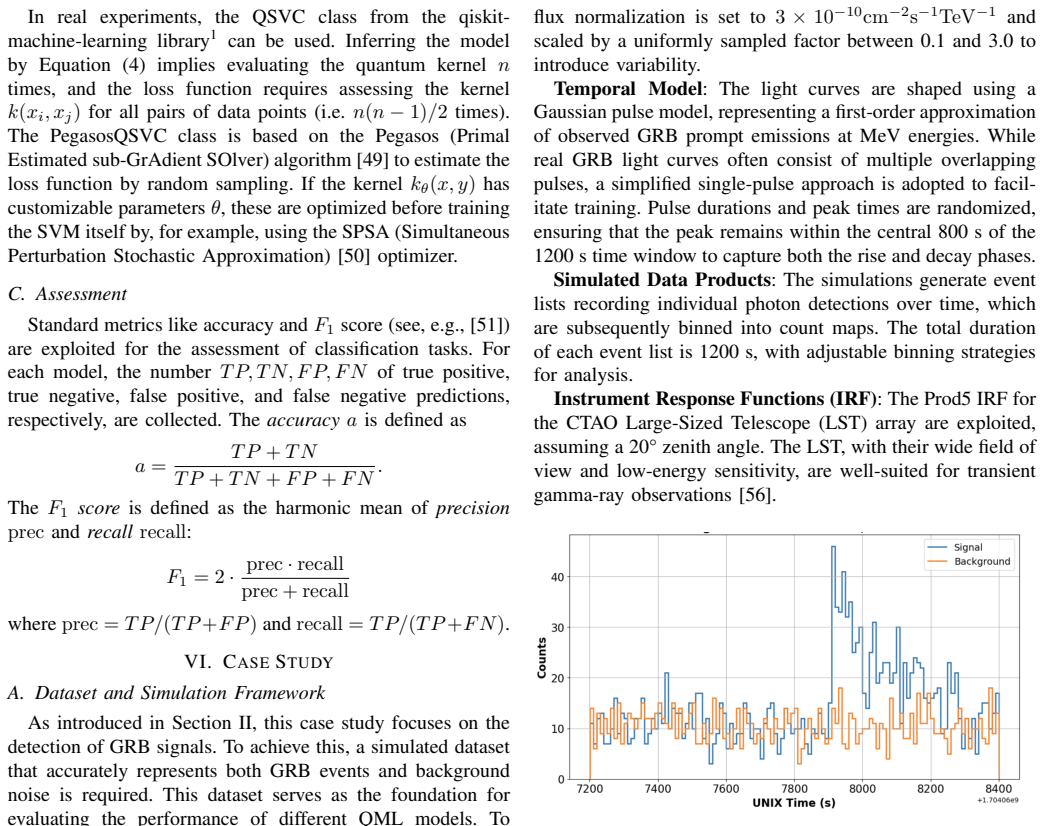
- domain assumption Simulated Gammapy GRB dataset is representative of real GRB light curves
- ad hoc to paper Linear runtime model Treal = Nreps * d * treal,1 is valid
- domain assumption The Sim et al. ansatz is suitable for GRB classification
- standard math Standard QML theory for fingerprinting, reuploading, and kernel methods
Cite this review
Pith. "Pith review of Comparing Quantum Machine Learning Approaches in Astrophysical Signal Detection." pith.science (2026). https://pith.science/paper/D5Z3GV3O
@misc{pith2026250719505,
  author       = {Pith},
  title        = {Pith review of: Comparing Quantum Machine Learning Approaches in Astrophysical Signal Detection},
  year         = {2026},
  howpublished = {\url{https://pith.science/paper/D5Z3GV3O}},
  note         = {Machine review of arXiv:2507.19505}
}
read the original abstract
Machine Learning (ML) serves as a general-purpose, highly adaptable, and versatile framework for investigating complex systems across domains. However, the resulting computational resource demands, in terms of the number of parameters and the volume of data required to train ML models, can be high, often prohibitive. This is the case in astrophysics, where multimedia space data streams usually have to be analyzed. In this context, quantum computing emerges as a compelling and promising alternative, offering the potential to address these challenges in a feasible way. Specifically, a four-step quantum machine learning (QML) workflow is proposed encompassing data encoding, quantum circuit design, model training and evaluation. Then, focusing on the data encoding step, different techniques and models are investigated within a case study centered on the Gamma-Ray Bursts (GRB) signal detection in the astrophysics domain. The results thus obtained demonstrate the effectiveness of QML in astrophysics, highlighting the critical role of data encoding, which significantly affects the QML model performance.
Figures


Figures from the paper (2 more)

Reference graph
Works this paper leans on
-
[29]
Quantum-enhanced support vector machines for galaxy classification,
B. Hassanshahi and et al., “Quantum-enhanced support vector machines for galaxy classification,” Journal of Quantum Computing Applications, 2023. DOI: 10.1234/ jqca.2023.456789
-
[30]
Quantum neural networks in radio astronomy: Pulsar classification,
B. Kordzanganeh and et al., “Quantum neural networks in radio astronomy: Pulsar classification,” Astrophysical Journal, 2021. DOI: 10.1088/0004-637X/123/4/789
-
[1]
The future of machine learning in astronomy: A perspective,
C. J. Fluke and A. H. Hassan, “The future of machine learning in astronomy: A perspective,” Frontiers in Astronomy and Space Sciences, vol. 7, p. 30, 2020. DOI: 10.3389/fspas.2020.00030
arXiv 2020
-
[2]
Machine learning in astronomy: A practical overview,
D. Baron, “Machine learning in astronomy: A practical overview,” Publications of the Astronomical Society of the Pacific, vol. 131, no. 1005, p. 083 001, 2019. DOI: 10.1088/1538-3873/ab16c1
-
[3]
A quantum-enhanced support vector machine for galaxy classification,
M. H. Hassanshahi, M. Jastrzebski, S. Malik, and O. La- hav, “A quantum-enhanced support vector machine for galaxy classification,” RAS Techniques and Instruments, vol. 2, no. 1, pp. 752–759, 2023
work page 2023
-
[4]
Data analysis for gravitational waves using neural networks on quan- tum computers,
M.-C. A. I. FAN, L.-I. CARAMETE, A. CARAMETE, V .-A. BASCEANU, and T. POPESCU, “Data analysis for gravitational waves using neural networks on quan- tum computers,” Romanian Reports in Physics , vol. 75, p. 113, 2023
work page 2023
-
[5]
Machine learning of high dimensional data on a noisy quantum processor,
E. Peters, J. Caldeira, A. Ho, et al., “Machine learning of high dimensional data on a noisy quantum processor,” npj Quantum Information , vol. 7, no. 1, p. 161, 2021
work page 2021
-
[6]
Machine learning and the physical sciences,
G. Carleo, I. Cirac, K. Cranmer, et al. , “Machine learning and the physical sciences,” Reviews of Modern Physics, vol. 91, no. 4, p. 045 002, 2019
work page 2019
Show all 60 references
-
[7]
Benchmarking Quantum Convolu- tional Neural Networks for Signal Classification in Simulated Gamma-Ray Burst Detection,
F. Farsian et al. , “Benchmarking Quantum Convolu- tional Neural Networks for Signal Classification in Simulated Gamma-Ray Burst Detection,” Jan. 2025. arXiv: 2501.17041 [astro-ph.HE]
2025 arXiv
-
[8]
Short versus long gamma-ray bursts: spectra, energetics, and luminosities,
G. Ghirlanda, L. Nava, G. Ghisellini, A. Celotti, and C. Firmani, “Short versus long gamma-ray bursts: spectra, energetics, and luminosities,” Astronomy and Astro- physics, vol. 496, no. 3, pp. 585–595, Mar. 2009. DOI: 10 . 1051 / 0004 - 6361 / 200811209. arXiv: 0902 . 0983 [a...
2009
-
[9]
Probing cosmic chemical evo- lution with gamma-ray bursts: grb060206 at z=4.048,
J. P. U. Fynbo et al. , “Probing cosmic chemical evo- lution with gamma-ray bursts: grb060206 at z=4.048,” Astron. Astrophys., vol. 451, pp. L47–L50, 2006. DOI: 10 . 1051 / 0004 - 6361 : 20065056. arXiv: astro - ph / 0602444
2006
-
[10]
Multi-Messenger Astronomy with GRBs: A White Paper for the Astro2010 Decadal Survey,
M. Stamatikos, N. Gehrels, F. Halzen, P. M ´esz´aros, and P. W. A. Roming, “Multi-Messenger Astronomy with GRBs: A White Paper for the Astro2010 Decadal Survey,” in astro2010: The Astronomy and Astrophysics Decadal Survey , vol. 2010, Jan. 2009, p. 284. DOI: 10 . 48550 / arXiv...
2010
-
[11]
Fermi Gamma-ray Space Telescope,
D. J. Thompson and C. A. Wilson-Hodge, “Fermi Gamma-ray Space Telescope,” Oct. 2022. DOI: 10 . 1007/978- 981- 16- 4544- 0 58- 1. arXiv: 2210.12875 [astro-ph.HE]
2022 arXiv
-
[12]
The Fourth Fermi-GBM Gamma-Ray Burst Catalog: A Decade of Data,
A. von Kienlin, C. A. Meegan, W. S. Paciesas, et al. , “The Fourth Fermi-GBM Gamma-Ray Burst Catalog: A Decade of Data,” Astrophysical Journal, vol. 893, no. 1, 46, p. 46, Apr. 2020. DOI: 10.3847/1538-4357/ab7a18. arXiv: 2002.11460 [astro-ph.HE]
2020 arXiv
-
[13]
The Fermi- GBM Gamma-Ray Burst Spectral Catalog: 10 yr of Data,
S. Poolakkil, R. Preece, C. Fletcher, et al., “The Fermi- GBM Gamma-Ray Burst Spectral Catalog: 10 yr of Data,” Astrophysical Journal, vol. 913, no. 1, 60, p. 60, May 2021. DOI: 10 . 3847 / 1538 - 4357 / abf24d. arXiv: 2103.13528 [astro-ph.HE]
2021 arXiv
-
[14]
The Swift Gamma-Ray Burst Mis- sion,
N. Gehrels et al. , “The Swift Gamma-Ray Burst Mis- sion,” Astrophys. J. , vol. 611, pp. 1005–1020, 2004, [Erratum: Astrophys.J. 621, 558 (2005)]. DOI: 10.1086/ 422091. arXiv: astro-ph/0405233
2005 arXiv
-
[15]
The AGILE Mission,
M. Tavani et al. , “The AGILE Mission,” Astron. As- trophys., vol. 502, pp. 995–1013, 2009. DOI: 10 . 1051 / 0004 - 6361 / 200810527. arXiv: 0807 . 4254 [astro-ph]
2009
-
[16]
The Second AGILE MCAL Gamma-Ray Burst Catalog: 13 yr of Observations,
A. Ursi, M. Romani, F. Verrecchia, et al., “The Second AGILE MCAL Gamma-Ray Burst Catalog: 13 yr of Observations,” Astrophysical Journal, vol. 925, no. 2, 152, p. 152, Feb. 2022. DOI: 10 . 3847 / 1538 - 4357 / ac3df7
2022
-
[17]
B. S. Acharya et al. , Science with the Cherenkov Telescope Array . WSP, Nov. 2018, ISBN : 978-981- 327-008-4. DOI: 10 . 1142 / 10986. arXiv: 1709 . 07997 [astro-ph.IM]
2018
-
[18]
Survey of encoding techniques for quantum machine learning,
S. Sharma and N. Renugadevi, “Survey of encoding techniques for quantum machine learning,” Cybernetics and Physics, vol. 13, no. 2, 2024
2024
-
[19]
Quantum machine learning: Ex- ploring the role of data encoding techniques, challenges, and future directions,
D. Ranga, A. Rana, S. Prajapat, P. Kumar, K. Kumar, and A. V . Vasilakos, “Quantum machine learning: Ex- ploring the role of data encoding techniques, challenges, and future directions,” Mathematics, vol. 12, no. 21, p. 3318, 2024
2024
-
[20]
Quantum data encoding as a distinct abstraction layer in the design of quantum circuits,
G. Agliardi and E. Prati, “Quantum data encoding as a distinct abstraction layer in the design of quantum circuits,” Quantum Science and Technology , vol. 10, no. 2, p. 025 008, 2025
2025
-
[21]
Data rotation and its influence on quantum encoding,
D. Sierra-Sosa, S. Pal, and M. Telahun, “Data rotation and its influence on quantum encoding,” Quantum In- formation Processing, vol. 22, no. 1, p. 89, 2023
2023
-
[22]
Hybrid quantum encoding: Combining amplitude and basis encoding for enhanced data storage and processing in quantum com- puting,
B. Bhabhatsatam and S. Smanchat, “Hybrid quantum encoding: Combining amplitude and basis encoding for enhanced data storage and processing in quantum com- puting,” in 2023 20th International Joint Conference on Computer Science and Software Engineering (JCSSE) , IEEE, 2023, pp...
2023
-
[23]
Hybrid classical-quantum transfer learning for text classification,
E. Ardeshir-Larijani and M. M. Nasiri Fatmehsari, “Hybrid classical-quantum transfer learning for text classification,” Quantum Machine Intelligence , vol. 6, no. 1, p. 19, 2024
2024
-
[24]
Towards autoqml: A cloud- based automated circuit architecture search framework,
R. B. G ´omez, C. O’Meara, G. Cortiana, C. B. Mendl, and J. Bernab ´e-Moreno, “Towards autoqml: A cloud- based automated circuit architecture search framework,” in 2022 IEEE 19th International Conference on Soft- ware Architecture Companion (ICSA-C) , IEEE, 2022, pp. 129–136
2022
-
[25]
Resource frugal optimizer for quantum machine learning,
C. Moussa, M. H. Gordon, M. Baczyk, M. Cerezo, L. Cincio, and P. J. Coles, “Resource frugal optimizer for quantum machine learning,” Quantum Science and Technology, vol. 8, no. 4, p. 045 019, 2023
2023
-
[26]
Quantifying the performance of quantum machine learning algorithms for heart valve detection using h- bert classifier,
K. S. Kumar, T. A. Kumar, Y .-C. Hu, and R. Nishanth, “Quantifying the performance of quantum machine learning algorithms for heart valve detection using h- bert classifier,” in Exploring Intelligent Healthcare with Quantum Computing. IET, ch. Chapter 14, pp. 279–298. DOI: 10....
-
[27]
General- ization in quantum machine learning from few training data,
M. C. Caro, H.-Y . Huang, M. Cerezo, et al., “General- ization in quantum machine learning from few training data,” Nature communications, vol. 13, no. 1, p. 4919, 2022
2022
-
[28]
Surveying the reach and maturity of machine learning and artificial intelligence in astronomy,
C. Fluke and C. Jacobs, “Surveying the reach and maturity of machine learning and artificial intelligence in astronomy,” Wiley Interdisciplinary Reviews: Data Mining and Knowledge Discovery , vol. 10, no. 5, 2- s2.0-85076878415, 2020. DOI: 10 . 1002 / widm . 1354. [Online]. Av...
2020
-
[31]
Quantum machine learning: A re- view and current status,
N. Mishra, M. Kapil, H. Rakesh, R. Doriya, P. Singh, and P. Panigrahi, “Quantum machine learning: A re- view and current status,” in Advances in Intelligent Systems and Computing , S. Bhattacharyya, S. Chat- terjee, N. Dey, and F. Shi, Eds., vol. 1324, Springer Science and Bus...
2021 doi
-
[32]
New trends in quan- tum machine learning,
L. Buffoni and F. Caruso, “New trends in quan- tum machine learning,” EPL, vol. 129, no. 6, 2-s2.0- 85102992851, 2020. DOI: 10 . 1209 / 0295 - 5075 / 129 / 60004. [Online]. Available: https://www.scopus.com/ record / display. uri ? eid = 2 - s2 . 0 - 85102992851 % 5C & origin=scopusAI
2020
-
[33]
Comparing quantum and clas- sical machine learning for vector boson scattering background reduction at the large hadron collider,
D. Cugini, D. Gerace, P. Govoni, G. Grosso, T. Mac- chi, and D. Valsecchi, “Comparing quantum and clas- sical machine learning for vector boson scattering background reduction at the large hadron collider,” Quantum Machine Intelligence , vol. 6, no. 3, 2-s2.0- 85168313271, 202...
2023 doi
-
[34]
Available: https://www.scopus.com/record/ display.uri?eid=2- s2.0- 85168313271%5C&origin= scopusAI
[Online]. Available: https://www.scopus.com/record/ display.uri?eid=2- s2.0- 85168313271%5C&origin= scopusAI
-
[35]
The state of quantum learning: A comparative review towards classical machine learning,
T. Mahim, A. Rahim, and M. Rahman, “The state of quantum learning: A comparative review towards classical machine learning,” in 2023 26th International Conference on Computer and Information Technology, ICCIT 2023, I. Ahad, M. Hossain, S. Roy, S. Das, and M. Islam, Eds., 2023,...
2023
-
[36]
Image data augmentation for the taiga-iact experiment with conditional generative adversarial networks,
Y . Dubenskaya, A. Kryukov, E. Gres, A. Kalinin, A. Koksharov, and D. Zhurov, “Image data augmentation for the taiga-iact experiment with conditional generative adversarial networks,” Moscow University Physics Bul- letin, vol. 79, no. 1, 2-s2.0-105000674810, pp. 49–53,
-
[37]
Parallel hybrid quantum-classical machine learning for kernelized time- series classification,
J. Baker, G. Park, K. Yu, and S. Radha, “Parallel hybrid quantum-classical machine learning for kernelized time- series classification,” Quantum Machine Intelligence , vol. 7, no. 1, 2-s2.0-85187193661, 2024. DOI: 10.1007/ s42484 - 024 - 00113 - x. [Online]. Available: https :...
2024
-
[38]
Data re-uploading for a universal quantum classifier,
A. P ´erez-Salinas, A. Cervera-Lierta, E. Gil-Fuster, and J. I. Latorre, “Data re-uploading for a universal quantum classifier,” Quantum, vol. 4, p. 226, Feb. 2020, ISSN : 2521-327X. DOI: 10 . 22331 / q - 2020 - 02 - 06 - 226. [Online]. Available: https://doi.org/10.22331/q-20...
2020 doi
-
[39]
Effect of data encoding on the expressive power of variational quantum-machine-learning models,
M. Schuld, R. Sweke, and J. J. Meyer, “Effect of data encoding on the expressive power of variational quantum-machine-learning models,” Physical Review A, vol. 103, no. 3, Mar. 2021, ISSN : 2469-9934. DOI: 10. 1103/physreva.103.032430. [Online]. Available: http: //dx.doi.org/1...
2021 doi
-
[40]
Schuld and F
M. Schuld and F. Petruccione, Machine learning with quantum computers. Springer, 2021, vol. 676
2021
-
[41]
Quantum Fingerprinting and Quantum Hashing. Computational and Cryptographical Aspects,
F. Ablayev, M. Ablayev, A. Vasiliev, and M. Ziatdi- nov, “Quantum Fingerprinting and Quantum Hashing. Computational and Cryptographical Aspects,” Baltic J. Modern Computing , vol. 4, no. 4, pp. 860–875, 2016. DOI: 10.22364/bjmc.2016.4.4.17
2016 doi
-
[42]
Hybrid classical–quantum text search based on hashing,
F. Ablayev, N. Salikhova, and M. Ablayev, “Hybrid classical–quantum text search based on hashing,” Math- ematics, vol. 12, no. 12, 2024, ISSN : 2227-7390. DOI: 10 . 3390 / math12121858. [Online]. Available: https : / / www.mdpi.com/2227-7390/12/12/1858
2024
-
[43]
Quantum fingerprinting,
H. Buhrman, R. Cleve, J. Watrous, and R. de Wolf, “Quantum fingerprinting,”Physical review letters, vol. 87, no. 16, p. 167 902, 2001
2001
-
[44]
Khadiev, A
K. Khadiev, A. Khadieva, Z. Chen, and J. Wu, Im- plementation of quantum fourier transform and quan- tum hashing for a quantum device with arbitrary qubits connection graphs , 2025. arXiv: 2501 . 18677 [quant-ph]. [Online]. Available: https://arxiv.org/ abs/2501.18677
2025
-
[45]
GAPs for Shallow Implementation of Quantum Fi- nite Automata,
M. Ziiatdinov, A. Khadieva, and A. Yakaryılmaz, “GAPs for Shallow Implementation of Quantum Fi- nite Automata,” Electronic Proceedings in Theoretical Computer Science , vol. 386, pp. 269–280, Sep. 2023, ISSN : 2075-2180. DOI: 10.4204/eptcs.386.21. [Online]. Available: http://d...
2023 doi
-
[46]
Efficient implementation of amplitude form of quantum hashing using state-of-the-art quantum processors,
I. Zinnatullin, K. Khadiev, and A. Khadieva, “Efficient implementation of amplitude form of quantum hashing using state-of-the-art quantum processors,” Russian Mi- croelectronics, vol. 52, no. 1, S390–S394, Dec. 2023, ISSN : 1608-3415. DOI: 10.1134/S1063739723600620. [Online]....
2023 doi
-
[47]
General parameter-shift rules for quantum gradients,
D. Wierichs, J. Izaac, C. Wang, and C. Y .-Y . Lin, “General parameter-shift rules for quantum gradients,” Quantum, vol. 6, p. 677, Mar. 2022, ISSN : 2521-327X. DOI: 10.22331/q-2022-03-30-677. [Online]. Available: https://doi.org/10.22331/q-2022-03-30-677
2022 doi
-
[48]
SciPy 1.0: Fundamental Algorithms for Scientific Computing in Python,
P. Virtanen, R. Gommers, T. E. Oliphant, et al., “SciPy 1.0: Fundamental Algorithms for Scientific Computing in Python,” Nature Methods, vol. 17, pp. 261–272, 2020. DOI: 10.1038/s41592-019-0686-2. [Online]. Available: https://doi.org/10.1038/s41592-019-0686-2
2020 doi
-
[49]
Ex- pressibility and entangling capability of parameter- ized quantum circuits for hybrid quantum-classical al- gorithms,
S. Sim, P. D. Johnson, and A. Aspuru-Guzik, “Ex- pressibility and entangling capability of parameter- ized quantum circuits for hybrid quantum-classical al- gorithms,” Advanced Quantum Technologies , vol. 2, no. 12, p. 1 900 070, 2019. DOI: https : / / doi . org / 10 . 1002/qu...
2019
-
[50]
An overview of the simultaneous perturba- tion method for efficient optimization,
J. C. Spall, “An overview of the simultaneous perturba- tion method for efficient optimization,” Johns Hopkins apl technical digest , vol. 19, no. 4, pp. 482–492, 1998
1998
-
[51]
A. C. M ¨uller and S. Guido, Introduction to machine learning with Python: a guide for data scientists . ” O’Reilly Media, Inc.”, 2016
2016
-
[52]
Pegasos: Primal estimated sub-gradient solver for svm,
S. Shalev-Shwartz, Y . Singer, N. Srebro, and A. Cot- ter, “Pegasos: Primal estimated sub-gradient solver for svm,” Mathematical Programming , vol. 127, no. 1, pp. 3–30, Mar. 2011, ISSN : 1436-4646. DOI: 10.1007/ s10107- 010- 0420- 4. [Online]. Available: https://doi. org/10.1...
2011 doi
-
[53]
Evolution of data formats in very-high-energy gamma-ray astron- omy,
C. Nigro, T. Hassan, and L. Olivera-Nieto, “Evolution of data formats in very-high-energy gamma-ray astron- omy,” Universe, vol. 7, no. 10, 2021, ISSN : 2218-1997. DOI: 10 . 3390 / universe7100374. [Online]. Available: https://www.mdpi.com/2218-1997/7/10/374
2021
-
[54]
Acero, J
F. Acero, J. Bernete, N. Biederbeck, et al. , Gammapy: Python toolbox for gamma-ray astronomy, https://doi.org/10.5281/zenodo.10726484, version v1.2, Feb. 2024. DOI: 10.5281/zenodo.10726484. [Online]. Available: https://doi.org/10.5281/zenodo.10726484
2024 doi
-
[55]
Gammapy: A python package for gamma-ray astronomy,
A. Donath, R. Terrier, Q. Remy, et al. , “Gammapy: A python package for gamma-ray astronomy,” A&A, vol. 678, A157, 2023. DOI: 10 . 1051 / 0004 - 6361 / 202346488. [Online]. Available: https : / / doi . org / 10 . 1051/0004-6361/202346488
2023
-
[56]
C. T. A. Observatory and C. T. A. Consortium, CTAO Instrument Response Functions - prod5 version v0.1, https://doi.org/10.5281/zenodo.5499840, version v0.1, Zenodo, Sep. 2021. DOI: 10 . 5281 / zenodo . 5499840. [Online]. Available: https://doi.org/10.5281/zenodo. 5499840
2021 doi
-
[57]
Abdurakhimov, J
L. Abdurakhimov, J. Adam, H. Ahmad, et al. , Tech- nology and performance benchmarks of iqm’s 20- qubit quantum computer , 2024. arXiv: 2408 . 12433 [quant-ph]. [Online]. Available: https://arxiv.org/ abs/2408.12433
2024 arXiv
-
[58]
Searching for very-high-energy electromagnetic counterparts to gravitational-wave events with the Cherenkov Telescope Array,
B. Patricelli, A. Carosi, L. Nava, et al. , “Searching for very-high-energy electromagnetic counterparts to gravitational-wave events with the Cherenkov Telescope Array,” in 37th International Cosmic Ray Conference , Mar. 2022, 998, p. 998. DOI: 10.22323/1.395.0998. arXiv: 210...
2022 arXiv
-
[127]
1109 / ICCIT58146
DOI: 10 . 1109 / ICCIT58146 . 2023 . 10343363. [Online]. Available: https://www.scopus.com/record/ display.uri?eid=2- s2.0- 85187324325%5C&origin= scopusAI
2023
-
[2024]
3103 / S002713462401004X
DOI: 10 . 3103 / S002713462401004X. [Online]. Available: https : / / www. scopus . com / record / display. uri?eid=2-s2.0-105000674810%5C&origin=scopusAI
Reviewed August 6, 2026 · model on record in the stance chip above.
Discussion (0). Sign in to comment.