REVIEW 4 major objections 4 minor 21 references
$K$-MSHC: Unmasking Minimally Sufficient Head Circuits in Large Language Models with Experiments on Syntactic Classification Tasks
T0 review · 4 major / 4 minor · reviewed 2026-08-15 · deepseek-v4-flash
Pith's one-line read Gemma-9B's grammar and arithmetic skills live in mostly separate attention-head circuits.
desk verdict New K-sufficiency circuit definition and a Gemma-9B head map, but the load-bearing linear-separability proxy is unvalidated, so the headline claims about task-specific circuits are shaky. read the letter →
The pith
A machine-rendered reading of the paper's core claim, the machinery that carries it, and where it could break.
The reading
What carries the argument
The central object is the (K, ε)-Minimum Sufficient Head Circuit: the smallest set of attention heads H such that every K-head subset of H restores the model's separability score above an ε-understanding threshold, enforcing both minimality and redundant sufficiency. To find it, the paper uses the LS (low-dimensional linear separability) score—a linear SVM trained on the top five PCA components of the final-layer EOS token—as a cheap proxy for task performance under ablation, and Search-K-MSHC, a two-phase stochastic search that first ablates layer windows to select candidate layers, then repeatedly samples K-subsets and prunes the worst-performing heads until the threshold is met. A Hoeffding-style bound (Theorem 1) states that the expected number of missed 'prunable sets' decreases exponentially with the sample count N, the subset size K, and the squared margin between the contamination rate and threshold.
What would settle it
Retrain the LS probe after each ablation and compare against direct classification accuracy on the same inputs; if ablating the reported super-heads leaves direct accuracy high while the LS score drops, the circuits disappear. Alternatively, patch in the super-heads of one task while running another task: the paper's overlap claims predict these patches should not restore performance on the second task.
Extended reading notes
Core claim
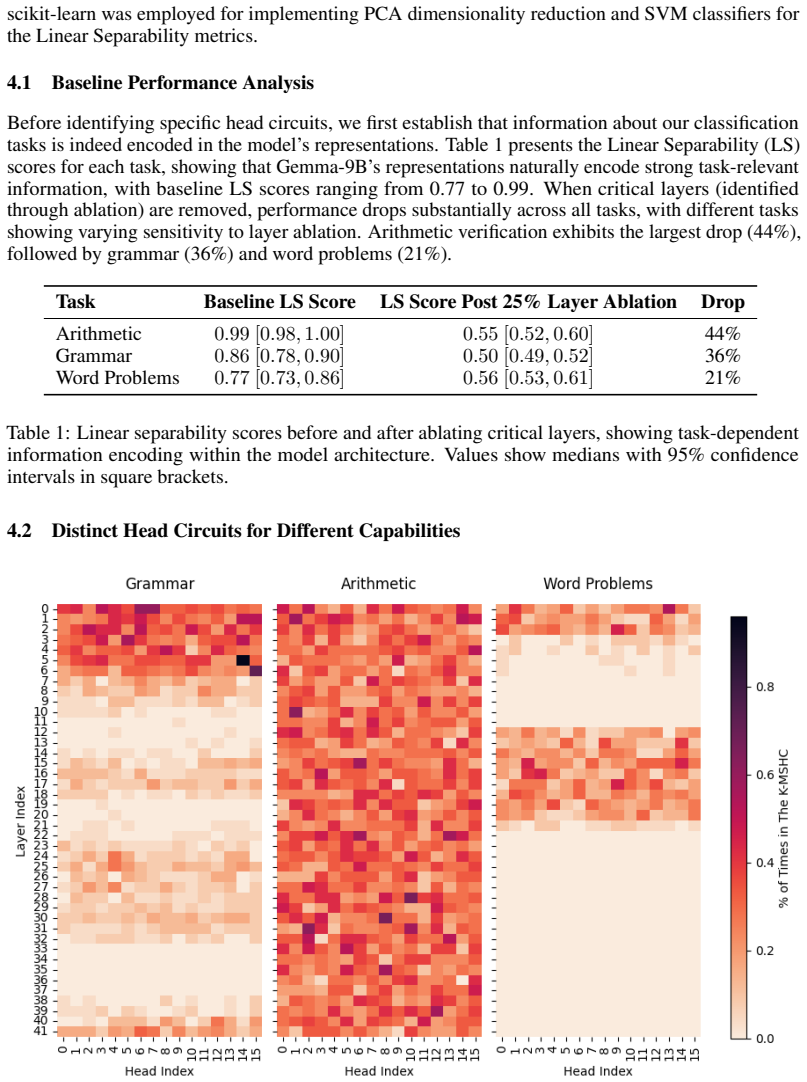
The reported finding is that Gemma-9B's competence on the three task families decomposes into minimal sufficient head circuits that are discoverable in practice. Grammar acceptability is concentrated in early layers (0–6); word problems show a bimodal pattern with activity in shallow (0–3) and deep (11–20) layers; arithmetic verification is broadly distributed across the network. Circuit overlap is threshold-dependent: at the 50% selection threshold, grammar and arithmetic share about 20% of heads, while at the 75% threshold arithmetic and word problems share more critical heads (about 10%) than grammar and arithmetic (about 9%); at the 95% threshold, the strongest heads barely overlap at all. The paper interprets this as each task maintaining dedicated 'super-heads' while reusing weaker heads across related tasks.
Load-bearing premise
The whole pipeline assumes that the LS score—a linear SVM's accuracy on the top five PCA components of the final-layer EOS token—faithfully tracks the task competence that head ablation is meant to measure; if zeroing heads changes representations in ways the probe cannot see, the reported circuits and overlap patterns are probe artifacts rather than properties of the model.
Editorial extensions
If this is right
- Interventions can be targeted: ablating the super-heads of one task should degrade that task much more than the others, offering a handle for controlled behavior editing.
- Improvements to one capability should transfer only weakly to related tasks, because core heads are not shared even where weak heads overlap.
- Arithmetic reasoning in language models is not a single circuit: verification and word problems use largely distinct strong heads, so analyses that treat 'arithmetic' as one mechanism are incomplete.
- Circuit discovery with K-sufficiency is feasible on models with thousands of heads, since the stochastic search avoids enumerating all 2^{|M|} subsets.
- The spatial organization of circuits (early for grammar, bimodal for word problems, distributed for verification) provides an architectural signature that can be compared across tasks and models.
Reading between the lines
- Editorial inference: if the reported super-heads are stable across random seeds and input batches, the overlap matrix at high thresholds could serve as a transfer-learning predictor: tasks with more shared strong heads should show more positive transfer, a testable claim beyond this paper.
- Editorial inference: the LS probe's reliance on final-layer EOS tokens means the method finds heads whose removal changes the final-layer linear code; replacing it with direct behavioral accuracy would test whether the same circuits appear, and might reveal that some 'weak shared heads' only matter to the probe.
- Editorial inference: because the circuits are found by stochastic search and the paper reports trial-to-trial variation, multiple functionally equivalent circuits likely exist; measuring invariance across seeds could turn circuit discovery from a point estimate into a distribution over circuits.
Signed reviews
Editorial analysis
A structured set of objections, weighed in public.
Referee Report
Summary. The paper introduces the (K,ε)-Minimum Sufficient Head Circuit (K-MSHC) framework and the Search-K-MSHC algorithm, which seek to identify small sets of attention heads whose K-subsets restore a task separability score. The method is applied to Gemma-9B on three binary classification tasks: grammar acceptability, arithmetic verification, and arithmetic word problems. The authors report task-specific layer distributions, threshold-dependent overlap patterns, and dedicated "super-heads" with minimal cross-task overlap. The paper also proves a bound on the expected number of missed prunable K-subsets under a contamination model. The main evidence throughout consists of low-dimensional linear separability (LS) scores computed on the final-layer EOS token.
Significance. If the reported circuits are genuinely causal, the paper offers a scalable method and a useful organizational picture of a 9B model: sparse, task-specialized but partially reusable attention heads. The formalization of K-sufficiency and the stochastic search are reasonable contributions, and the authors are transparent about several limitations. However, the significance is currently conditional: every empirical claim is mediated by the LS score, which is never validated against actual task behavior, and the theoretical bound does not close that gap. With additional validation, the framework could be a useful addition to mechanistic interpretability tooling.
major comments (4)
- [Section 3.4 and Definition 1] The LS score is the only measure of task competence used throughout the ablation pipeline, yet it is never validated against the model's actual classification accuracy or next-token probabilities. For example, Table 1 reports baseline LS scores of 0.99, 0.86, and 0.77 for arithmetic, grammar, and word problems, but these numbers are not compared with the model's true accuracy on the same minimal pairs. If final-layer EOS linear separability diverges from behavioral competence, or if zeroing heads changes later representations in ways a fixed linear probe cannot capture, then the circuits, overlap statistics, and super-head claims in Section 4 would be properties of the probe rather than of the model. Please add a validation experiment, such as reporting model accuracy under the same head ablations or using activation patching on a held-out set, and report the agreement between LS-selected circuits and behaviorally verified circuits.
- [Section 3.3 and Definition 3] Theorem 1 bounds the expected number of missed prunable sets under a synthetic contamination model, but it does not establish that the returned set C is a (K,ε)-MSHC as defined in Definition 3. The definition of low-impact heads in Definition 4 already conditions on the threshold τ, so the "contamination" is defined relative to the LS threshold the algorithm uses; the bound therefore does not independently validate the algorithm's output. No theorem or experiment checks that every K-subset of the returned C achieves LS ≥ U_ε(M,B); Section 4 reports selection frequencies only. Please either prove a guarantee for the returned set under stated assumptions or empirically verify the K-sufficiency condition on the final circuits.
- [Section 4.3] The overlap and super-head findings are summaries of the algorithm's own outputs, so without independent causal confirmation they are partly circular. Figure 2 and the accompanying text report Jaccard overlaps among heads selected by LS-based search, but no experiment patches or ablates the shared heads to confirm that the same heads are actually responsible for the tasks. A concrete test would be to take the union of the three circuits at the 50% threshold, ablate the shared heads, and measure the behavioral drop on each task; if the shared heads are not behaviorally important, the "weak sharing" conclusion would need to be revised.
- [Section 4 and Section 5] The empirical claims are based on a single model, a single hyperparameter setting (K=10, ε=0.25, W=5, p=0.75, N=10), and small evaluation sets of 50 examples per mini-batch with 20 trials. The limitations section acknowledges parameter sensitivity, but the abstract-level claims about "distinct task-specific head circuits" and "dedicated super-heads" are stated without this caveat. Please add a robustness study over K and ε, at least for the super-head and overlap conclusions, or soften the claims to match the current evidence.
minor comments (4)
- [Section 3.1] Definitions 2 and 3 both introduce the same named object, (K,ε)-Minimum Sufficient Head Circuit; the first should be a preliminary definition or the numbering should be adjusted so each definition has a distinct name.
- [Equations (2) and Algorithm 1] Equation (2) defines U_ε(M,B), but Algorithm 1 line 15 uses U^S_DT(M,B); the superscript S and subscript DT are not defined in the text, and the notation should be made consistent.
- [Section 2 and Section 3.5] There is a typo in the related work section: "V oita et al." should be "Voita et al."; also "numerocity" in the grammar task description is likely "numerosity".
- [Figures 1 and 2] The captions for Figures 1 and 2 do not specify the exact quantities plotted, such as the units for selection frequency or the precise definition of the thresholds used; please clarify these details so the heat map and overlap matrix can be interpreted independently of the prose.
Circularity Check
No significant circularity: the reported circuits are empirical outputs of an LS-guided search, and the paper's own limitations treat them as provisional rather than definitionally forced.
full rationale
The derivation chain is LS (PCA + SVM on final-layer EOS tokens) to Search-K-MSHC to discovered head sets to layer heatmaps and overlap statistics. These are empirical outputs of an optimization procedure, not analytic consequences of the definitions. Definition 3 defines a circuit as the smallest head set restoring S_DT to the threshold U_epsilon, and Section 3.4 instantiates S_DT as LS; this makes 'sufficiency' relative to the fitted linear probe, so the abstract's causal reading ('circuits crucial for classification tasks') is a construct-validity risk rather than a circularity. The spatial distribution and overlap patterns are not entailed by the definitions and differ across tasks, so they are not equivalent to the inputs by construction. No load-bearing self-citations appear in the reference list, and Theorem 1 is a concentration bound about the algorithm's own stopping rule, not an imported uniqueness theorem. Section 5 explicitly concedes circuit instability, parameter sensitivity, and functional redundancy, which confirms the findings are empirical and provisional. The main weakness, namely the absence of behavioral-accuracy or activation-patching validation of LS, belongs to correctness and validity risk, not to circularity under the criteria used here.
Assumptions & free parameters
free parameters (5)
- K (circuit subset size) =
10
- epsilon (threshold offset) =
0.25
- W, p, N (algorithm hyperparameters) =
W=5, p=0.75, N=10
- D (PCA dimension for LS) =
<=5, exact value not specified
- SVM regularization C =
10
assumptions (3)
- domain assumption Final-layer EOS linear separability (LS) is a faithful proxy for task competence under head ablation.
- domain assumption Ablating a head and adding a K-subset only modifies task-relevant information through the final EOS embedding as measured by a linear classifier; interactions with other heads are captured by the score.
- ad hoc to paper Low-impact heads are distributed so that prunable K-subsets are approximately caught by independent random sampling (uniform contamination model).
Cite this review
Pith. "Pith review of $K$-MSHC: Unmasking Minimally Sufficient Head Circuits in Large Language Models with Experiments on Syntactic Classification Tasks." pith.science (2026). https://pith.science/paper/D6C4AJOB
@misc{pith2026250512268,
  author       = {Pith},
  title        = {Pith review of: $K$-MSHC: Unmasking Minimally Sufficient Head Circuits in Large Language Models with Experiments on Syntactic Classification Tasks},
  year         = {2026},
  howpublished = {\url{https://pith.science/paper/D6C4AJOB}},
  note         = {Machine review of arXiv:2505.12268}
}
abstract
Understanding which neural components drive specific capabilities in mid-sized language models ($\leq$10B parameters) remains a key challenge. We introduce the $(\bm{K}, \epsilon)$-Minimum Sufficient Head Circuit ($K$-MSHC), a methodology to identify minimal sets of attention heads crucial for classification tasks as well as Search-K-MSHC, an efficient algorithm for discovering these circuits. Applying our Search-K-MSHC algorithm to Gemma-9B, we analyze three syntactic task families: grammar acceptability, arithmetic verification, and arithmetic word problems. Our findings reveal distinct task-specific head circuits, with grammar tasks predominantly utilizing early layers, word problems showing pronounced activity in both shallow and deep regions, and arithmetic verification demonstrating a more distributed pattern across the network. We discover non-linear circuit overlap patterns, where different task pairs share computational components at varying levels of importance. While grammar and arithmetic share many "weak" heads, arithmetic and word problems share more consistently critical "strong" heads. Importantly, we find that each task maintains dedicated "super-heads" with minimal cross-task overlap, suggesting that syntactic and numerical competencies emerge from specialized yet partially reusable head circuits.
Figures

Reference graph
Works this paper leans on
-
[4]
What does bert look at? an analysis of bert’s attention
Kevin Clark, Urvashi Khandelwal, Omer Levy, and Christopher D Manning. What does bert look at? an analysis of bert’s attention. In Proceedings of the 2019 ACL Workshop BlackboxNLP: Analyzing and Interpreting Neural Networks for NLP, pages 276–286,
work page 2019
-
[6]
Clément Dumas, Jiannan Gu, Charles Wang, and Jiuqiang Huang
URL https://arxiv.org/abs/2309.08600. Clément Dumas, Jiannan Gu, Charles Wang, and Jiuqiang Huang. How do llamas process multilingual text? activation patching study. In Proceedings of the ICML 2024 Workshop on Multilingual Representation Learning,
arXiv 2024
-
[8]
URL https://arxiv.org/abs/2406.04093. Xinyun Ge and Torsten Hoefler. Automatically identifying local and global circuits with linear computation graphs
-
[9]
Mor Geva, Roei Schuster, Jonathan Berant, and Omer Levy
URL https://arxiv.org/abs/2405.13868. Mor Geva, Roei Schuster, Jonathan Berant, and Omer Levy. Transformer feed-forward layers are key-value memories. In Proceedings of the 2021 Conference on Empirical Methods in Natural Language Processing, pages 5484–5495,
arXiv 2021
-
[10]
A structural probe for finding syntax in word representations
John Hewitt and Christopher D Manning. A structural probe for finding syntax in word representations. In Proceedings of the 2019 Conference of the North American Chapter of the Association for Computational Linguistics: Human Language Technologies, Volume 1 (Long and Short Papers), pages 4129–4138,
work page 2019
-
[11]
10 Jack Lindsey, Henry Cunningham, and Chris Olah
URL https://arxiv.org/abs/2502.00873. 10 Jack Lindsey, Henry Cunningham, and Chris Olah. Sparse crosscoders for cross-layer features and model diffing
-
[12]
URL https://arxiv.org/abs/2403.17677. Transformer Circuits Thread. Sam Marks, Joseph Raul, Illia Vaswani, and Neel Nanda. Sparse feature circuits: Discovering and editing interpretable causal graphs in language models
-
[13]
Paul Michel, Omer Levy, and Graham Neubig
URL https://arxiv.org/abs/ 2403.19647. Paul Michel, Omer Levy, and Graham Neubig. Are sixteen heads really better than one? In Advances in Neural Information Processing Systems, pages 14014–14024,
Show all 21 references
-
[15]
Moin Taufeeque, John Lynch, Mario Lucic, and Nicholas Frosst
URL https: //arxiv.org/abs/2305.15054. Moin Taufeeque, John Lynch, Mario Lucic, and Nicholas Frosst. Planning in a recurrent neural network that plays sokoban
-
[16]
Alexander Templeton, Chris Olah, and Neel Nanda
URL https://arxiv.org/abs/2407.15421. Alexander Templeton, Chris Olah, and Neel Nanda. Scaling monosemanticity: Extracting inter- pretable features from claude 3 sonnet
-
[17]
Transformer Circuits Thread
URL https://arxiv.org/abs/2406.06061. Transformer Circuits Thread. Ian Tenney, Dipanjan Das, and Ellie Pavlick. Bert rediscovers the classical nlp pipeline. In Pro- ceedings of the 57th Annual Meeting of the Association for Computational Linguistics , pages 4593–4601,
-
[18]
Zeming Yu, Wenxuan Zhang, Jie Zhou, and Rui Cao
URL https://arxiv.org/abs/2402.16837. Zeming Yu, Wenxuan Zhang, Jie Zhou, and Rui Cao. Back attention: Understanding and enhancing multi-hop reasoning in llms
-
[19]
Rui Zhang, Ziyang Liu, and Ge Fu
URL https://arxiv.org/abs/2502.10835. Rui Zhang, Ziyang Liu, and Ge Fu. Structural similarities and differences in multilingual language modeling
-
[20]
Wayne Xin Zhao, Kun Zhou, Junyi Li, Tianyi Tang, Xiaolei Wang, Yupeng Hou, Yingqian Min, Beichen Zhang, Junjie Zhang, Zican Dong, et al
URL https://arxiv.org/abs/2410.09223. Wayne Xin Zhao, Kun Zhou, Junyi Li, Tianyi Tang, Xiaolei Wang, Yupeng Hou, Yingqian Min, Beichen Zhang, Junjie Zhang, Zican Dong, et al. A survey of large language models. arXiv preprint arXiv:2303.18223,
-
[21]
URL https://arxiv.org/abs/2406.03445. 11
-
[2019]
Training verifiers to solve math word problems
Karl Cobbe, Vineet Kosaraju, Mohammad Bavarian, et al. Training verifiers to solve math word problems. arXiv preprint arXiv:2110.14168,
-
[2020]
Andrew Stolfo, Atticus Geiger, David Friedman, and Vivek Srikumar
doi: 10.23915/distill.00024. Andrew Stolfo, Atticus Geiger, David Friedman, and Vivek Srikumar. A mechanistic interpretation of arithmetic reasoning in language models using causal mediation analysis
-
[2021]
Lucy Gao, Lachlan Reynolds, Neel Nanda, and Chris Olah
https://transformer-circuits.pub/2021/ framework/index.html. Lucy Gao, Lachlan Reynolds, Neel Nanda, and Chris Olah. Scaling and evaluating sparse autoen- coders
2021
-
[2023]
Transformer Circuits Thread
URL https://arxiv.org/abs/2301.04709. Transformer Circuits Thread. Johannes Brinkmann, Gisbert Fanselow, and Jon Gauthier. Large language models share latent grammatical concepts across languages
-
[2024]
Thomas Bricken, Catherine Olsson, Matthew Ziegler, Nelson Elhage, Neel Nanda, and Chris Olah
URL https://arxiv.org/abs/2406.12775. Thomas Bricken, Catherine Olsson, Matthew Ziegler, Nelson Elhage, Neel Nanda, and Chris Olah. Towards monosemanticity: Decomposing language models with dictionary learning
-
[2025]
Tristan Bush, Rohin Shah, and Jan Leike
URL https://arxiv.org/abs/2501.06346. Tristan Bush, Rohin Shah, and Jan Leike. Interpreting emergent planning in model-free reinforcement learning. In Proceedings of the Twelfth International Conference on Learning Representations (ICLR 2024),
2024 arXiv
Reviewed August 15, 2026 · model on record in the stance chip above.
Discussion (0). Continue with ORCID to comment.