REVIEW 3 major objections 4 minor 72 references
Abundance of $\mathbb{Z}_2$ topological order in exfoliable two-dimensional insulators
T0 review · 3 major / 4 minor · reviewed 2026-08-14 · deepseek-v4-flash
Pith's one-line read Thirteen exfoliable monolayers are quantum spin Hall insulator candidates, about 1% of the pool.
desk verdict Screening protocol is solid and Pd2HgSe3 is a real find, but the 13-candidate count and ~1% abundance claim are not supported as written. read the letter →
The pith
A machine-rendered reading of the paper's core claim, the machinery that carries it, and where it could break.
The reading
What carries the argument
The machine that carries the argument is the screening funnel itself. Topological classification uses the $\mathbb{Z}_2$ invariant obtained from hybrid Wannier charge centers, the evolution of Wannier centers across half the Brillouin zone, which the paper computes for every band insulator and, where needed, for direct-gap metals under strain. The robustness measure is the inversion strength, defined as the direct gap at the high-symmetry point where the band inversion occurs: at $K$ for Kane-Mele systems and at $\Gamma$ for Bernevig-Hughes-Zhang systems. The final arbiter for the five most promising materials is the G0W0 approximation with spin-orbit coupling, extrapolated to an infinitely dense $\mathbf{k}$-grid, because two-dimensional dielectric screening makes quasiparticle corrections slow to converge.
What would settle it
Recompute the G0W0-with-spin-orbit $\mathbb{Z}_2$ invariant and band inversion for the PBE-only candidates (TaIrTe4, TaRhTe4, NbIrTe4, ZrBr, ZrCl, Cu2Te3Ti, In2ZnS4); if any of them reverts to a trivial insulator as TiNI does, the candidate list and the 1% abundance claim need downward revision.
Extended reading notes
Core claim
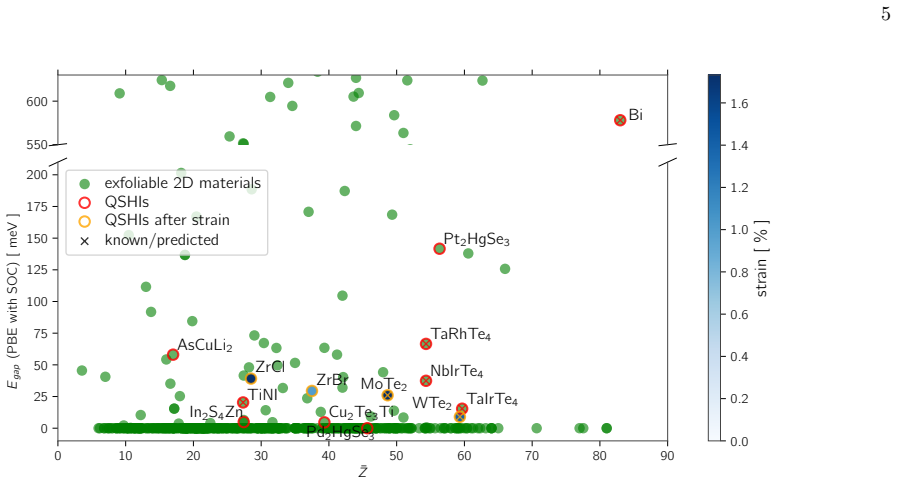
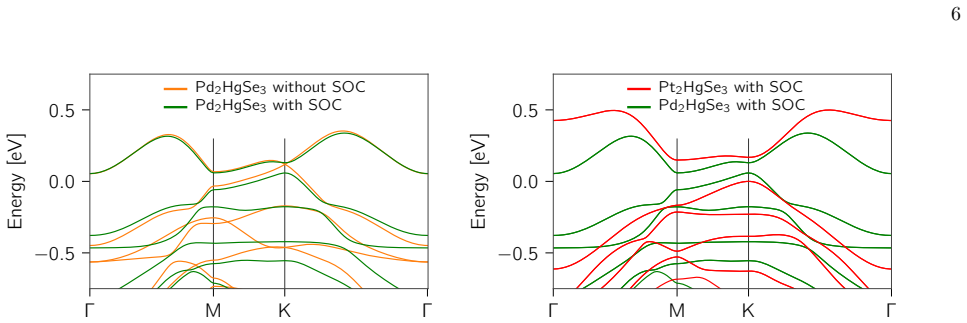
The paper's central claim is that $\mathbb{Z}_2$ topological order is not exotic within the pool of monolayer crystals that can be peeled from known layered compounds: of the 1,306 monolayers that survive the non-magnetic, structurally relaxed screening, a shortlist of 13 carries a non-trivial $\mathbb{Z}_2$ invariant, and Pd2HgSe3 is added as a second Kane-Mele QSHI, for a relative abundance of roughly 1%. The result is obtained through a funnel: structural relaxation starting from experimental parent crystals, a band-insulator or direct-gap-metal selection (with isotropic strain of 1–3% allowed for the metals), the $\mathbb{Z}_2$ invariant computed from hybrid Wannier charge centers, a magnetic-ground-state filter, and a phonon stability check. For five of the most interesting candidates the band inversion is recomputed at the G0W0 level with spin-orbit coupling; this confirms AsCuLi2 (inversion strength 169 meV) and Pd2HgSe3 (41 meV) as new QSHIs, while exposing TiNI as a PBE false positive that is trivial at G0W0 with a 0.7 eV direct gap. The authors read the 1% figure as the abundance of true two-dimensional bulk insulators whose entire occupied manifold is topologically nontrivial, as opposed to metals with well-defined interband gaps where non-trivial invariants coexist with gapless bulk.
Load-bearing premise
The load-bearing premise is that the PBE-with-spin-orbit $\mathbb{Z}_2$ assignments, which were checked at the G0W0 level for only five of the shortlisted materials, stay correct for the candidates that were not re-examined; the paper itself shows that this premise failed for TiNI.
Editorial extensions
If this is right
- Monolayer Pd2HgSe3 becomes a concrete experimental target: exfoliable, dynamically stable, and a Kane-Mele QSHI with a G0W0 inversion strength around 41 meV.
- AsCuLi2 offers a new crystal prototype for spin-Hall physics, with a clean band inversion at $\Gamma$ that strengthens at the G0W0 level (169 meV) compared with PBE (80 meV).
- Small isotropic strain of 1–3% turns several screened structures into true QSHI insulators, so substrate-induced strain can be used to realize the topological phase in otherwise gapless or weakly gapped monolayers.
- The 1% abundance estimate quantifies how likely a random exfoliable monolayer is to be a $\mathbb{Z}_2$ topological insulator, giving future computational searches a statistical benchmark.
- The TiNI case shows that PBE-level $\mathbb{Z}_2$ assignments are provisional: candidates not yet re-examined at the G0W0 level should be treated as predictions pending quasiparticle checks.
Reading between the lines
- The paper leaves the true abundance open: because only five of the shortlisted materials received G0W0 checks and one (TiNI) flipped to trivial, the 1% figure could creep below 1% if the unverified PBE-only candidates behave like TiNI.
- The finding that every candidate has fewer than 12 atoms per unit cell and a third share the same space group suggests that future screens could pre-filter on structural motifs and cell size, trading a small risk of missed candidates for a large gain in cost.
- For the strain-driven candidates (ZrBr, ZrCl, WTe2, MoTe2), a concrete testable route is to grow them on lattice-matched substrates that impose 1–3% isotropic strain and to measure the helical edge conductance predicted for the QSHI phase.
- The 1% abundance refers to exfoliable monolayers from known layered crystals; a screen over broader classes of two-dimensional materials might give a different fraction, so the number is a property of this materials pool, not a universal constant.
Signed reviews
Editorial analysis
A structured set of objections, weighed in public.
Referee Report
Summary. The paper reports a high-throughput first-principles screening of 1306 exfoliable monolayer materials for quantum spin Hall insulators (QSHIs). Using PBE-SOC band structures, Z2 invariants from Wannier charge centers, phonon stability checks via DFPT, strain engineering for direct-gap metals, and G0W0-with-SOC checks for five leading candidates, the authors identify a set of candidate QSHIs. The most notable new predictions are monolayer Pd2HgSe3, presented as a second Kane-Mele QSHI with a G0W0 inversion strength near 41 meV, and AsCuLi2, a new Bernevig-Hughes-Zhang-type prototype. The manuscript also reports that TiNI, previously proposed as a QSHI, is trivial at the G0W0 level, and it concludes that Z2 topological order has a relative abundance of around 1% among the screened exfoliable two-dimensional insulators.
Significance. If substantiated, this work would provide a valuable, systematically generated set of QSHI candidates and a useful methodological template for database-scale topological screening. Its strengths are the explicit first-principles computation of Z2 invariants (rather than descriptor-based proxies), the inclusion of phonon stability, the use of independent G0W0 quasiparticle corrections that are not fitted to the screening outcome, the honest reporting of a G0W0 false positive (TiNI), and the use of reproducible open-source codes and pseudopotential libraries. The two new material predictions, Pd2HgSe3 and AsCuLi2, are specific and falsifiable and are likely to be of interest to the experimental 2D-materials community. However, the headline candidate count and the associated abundance estimate are not currently supported in their stated form because the candidate table and text are internally inconsistent and because a large fraction of the candidates rest on PBE-level assignments that the paper itself shows can be reversed at G0W0.
major comments (3)
- [Results, Table I, and Abstract] The headline count of 13 QSHI candidates is internally inconsistent. The text states 'we find 13 QSHIs candidates... listed in Tab. I', but Table I lists 14 entries (Bi, Pt2HgSe3, Pd2HgSe3, TiNI, AsCuLi2, WTe2, MoTe2, TaIrTe4, TaRhTe4, NbIrTe4, Cu2Te3Ti, In2ZnS4, ZrBr, ZrCl). In addition, the Results paragraph on TiNI reports a G0W0 inversion strength of -705 meV and states explicitly that TiNI is a trivial insulator at G0W0, yet TiNI remains in the candidate table and in the count. This inconsistency directly affects the central claim and the 'around 1%' abundance estimate, and it must be corrected in a revised version.
- [Methods (G0W0 subsection) and Results (TiNI paragraph)] Only five candidates receive G0W0 validation, while seven entries in Table I (TaIrTe4, TaRhTe4, NbIrTe4, Cu2Te3Ti, In2ZnS4, ZrBr, ZrCl) have no G0W0 inversion strength. The TiNI case shows that a PBE-SOC inversion strength of 141 meV, well above the 20 meV screening cutoff, can nevertheless be reversed to a trivial assignment at G0W0. The PBE-only Z2 assignments should therefore be presented explicitly as tentative candidates, and the count of '13 QSHI candidates' and the deduced 1% abundance should be restricted to G0W0-validated cases or qualified with the number of PBE-only assignments.
- [Conclusions and Results (screening protocol)] The abundance statement 'relative abundance of Z2 topological order in two-dimensional insulators of around 1%' is not directly supported by the reported ratio. The denominator is the 1306 relaxed non-magnetic monolayers, which includes metals and direct-gap metals, not only band insulators. The numerator counts candidates that include strain-induced insulators and at least one G0W0-trivial material. To support the stated claim, the authors should either compute the fraction with respect to the number of band insulators (or an otherwise clearly defined denominator) or rephrase the claim to describe abundance among the full set of non-magnetic exfoliable monolayers.
minor comments (4)
- [Throughout] The manuscript contains several typographical errors, including 'unpertubed', 'abudance', 'miminum', 'perfom', and 'hermaphrodite Wannier charge centers' (presumably 'hybrid Wannier charge centers'). These should be corrected.
- [Results, TiNI paragraph and Table I] The TiNI paragraph gives a PBE inversion strength of 0.17 eV, while Table I lists 141 meV (0.141 eV) for the same quantity. Please reconcile this discrepancy.
- [Methods, Eq. (2) and footnote 20] The 20 meV inversion-strength cutoff and the 0.01 eV direct-gap-metal threshold are introduced without sensitivity analysis or justification. Since the abundance estimate depends on the candidate count, a brief statement on how the results change with these thresholds would strengthen the screening protocol.
- [Methods, Eq. (1)] The G0W0 inversion strengths obtained from the extrapolation in Eq. (1) are reported without uncertainty estimates; providing the fitted parameters or an error estimate would make the quoted values, especially the 41 meV result for Pd2HgSe3, more informative.
Circularity Check
No significant circularity: the screening's Z2 labels and G0W0 checks are independent first-principles computations, not fits or renamings of the input database.
full rationale
The paper's central claims — 13 candidate quantum spin Hall insulators and a ~1% abundance among exfoliable monolayers — are derived by an explicit high-throughput funnel: PBE-SOC band structures, hybrid Wannier charge-center Z2 invariants computed with Z2Pack, phonon stability via DFPT, and G0W0-with-SOC checks for the five most interesting candidates. None of these steps fits a parameter to the target result and then re-predicts it; the Z2 invariant is computed independently from the Wannier evolution, and the G0W0 inversion strengths are extrapolated from dense k-point grids using Eq. (1), which is a convergence extrapolation, not a fit to the PBE answer. The paper does rely on its own prior work: the exfoliable-monolayer database of Ref. [16] and the jacutingaite prediction of Ref. [33] are authored by overlapping groups, and the SSSP pseudopotential library (Ref. [57]) is also self-cited. However, these are input infrastructure and prior external predictions, not assumptions that already contain the 13-candidate list or the 1% abundance; the screening recomputes all properties from first principles rather than reading off the cited results. The TiNI case (PBE topological, G0W0 trivial) is presented as a cautionary result from the paper's own independent G0W0 calculation, and retaining TiNI in the candidate count is a correctness/consistency issue, not a circular-derivation issue. No equation in the paper reduces to its own input, and no fitted parameter is renamed as a prediction. The overall circularity score is therefore very low, 1 out of 10, reflecting only the presence of self-cited infrastructure that is not load-bearing for the central derivation.
Assumptions & free parameters
free parameters (4)
- Inversion-strength cutoff =
20 meV
- Direct-gap-metal threshold =
0.01 eV
- Strain steps =
+/-1, 2, 3%
- G0W0 inversion-strength extrapolation parameters =
a, b, c in IS(Nk) = a/Nk + b/sqrt(Nk) + c
assumptions (5)
- domain assumption PBE+SOC band structures are accurate enough for Z2 classification of the candidates not rechecked with G0W0.
- domain assumption Monolayers inherit parent bulk crystal symmetries and do not undergo structural transitions on exfoliation.
- domain assumption The non-magnetic ground-state assumption is valid for the screened candidates.
- domain assumption Exfoliability is captured by the vdW-DFT database of Ref. 16.
- standard math Z2 invariant from hybrid Wannier charge centers is correct for gapped time-reversal invariant systems.
Cite this review
Pith. "Pith review of Abundance of $\mathbb{Z}_2$ topological order in exfoliable two-dimensional insulators." pith.science (2026). https://pith.science/paper/D6HMHX5M
@misc{pith2026190808334,
  author       = {Pith},
  title        = {Pith review of: Abundance of $\mathbbZ_2$ topological order in exfoliable two-dimensional insulators},
  year         = {2026},
  howpublished = {\url{https://pith.science/paper/D6HMHX5M}},
  note         = {Machine review of arXiv:1908.08334}
}
abstract
Quantum spin Hall insulators are a class of two-dimensional materials with a finite electronic band gap in the bulk and gapless helical edge states. In the presence of time-reversal symmetry, $\mathbb{Z}_2$ topological order distinguishes the topological phase from the ordinary insulating one. Some of the phenomena that can be hosted in these materials, from one-dimensional low-dissipation electronic transport to spin filtering, could be very promising for many technological applications in the fields of electronics, spintronics and topological quantum computing. Nevertheless, the rarity of two-dimensional materials that can exhibit non-trivial $\mathbb{Z}_2$ topological order at room temperature hinders development. Here, we screen a comprehensive database we recently created of 1825 monolayers that can be exfoliated from experimentally known compounds, to search for novel quantum spin Hall insulators. Using density-functional and many-body perturbation theory simulations, we identify 13 monolayers that are candidates for quantum spin Hall insulators, including high-performing materials such as AsCuLi$_2$ and jacutingaite (Pt$_2$HgSe$_3$). We also identify monolayer Pd$_2$HgSe$_3$ as a novel Kane-Mele quantum spin Hall insulator, and compare it with jacutingaite. Such a handful of promising materials are mechanically stable and exhibit $\mathbb{Z}_2$ topological order, either unpertubed or driven by a small amount of strain. Such screening highlights a relative abundance of $\mathbb{Z}_2$ topological order of around 1%, and provides an optimal set of candidates for experimental efforts.
Figures

Figures from the paper (1 more)

Reference graph
Works this paper leans on
-
[1]
Molenkamp, Xiao-Liang Qi, and Shou-Cheng Zhang
Markus K¨ onig, Steffen Wiedmann, Christoph Br¨ une, An- dreas Roth, Hartmut Buhmann, Laurens W. Molenkamp, Xiao-Liang Qi, and Shou-Cheng Zhang. Quantum Spin Hall Insulator State in HgTe Quantum Wells. Science 2007, 318(5851):766–770
work page 2007
-
[2]
Topological states of condensed matter
Jing Wang and Shou-Cheng Zhang. Topological states of condensed matter. Nature Materials , 16(11):1062–1067 2017
work page 2017
-
[3]
C. L. Kane and E. J. Mele, Quantum Spin Hall Effect in Graphene, Phys. Rev. Lett. 2005, 95, 226801
work page 2005
-
[4]
C. L. Kane and E. J. Mele, Z2 Topological Order and the Quantum Spin Hall Effect, Phys. Rev. Lett. 2005, 95, 146802
work page 2005
-
[5]
B. A. Bernevig and S-C. Zhang, Quantum Spin Hall Ef- fect, Phys. Rev. Lett. 2006, 96, 106802
work page 2006
-
[6]
Liang Fu, C. L. Kane, and E. J. Mele. Topological In- sulators in Three Dimensions. Physical Review Letters 2007, 98(10):106803
work page 2007
-
[7]
M. Z. Hasan and C. L. Kane, Colloquium: Topological insulators, Rev. Mod. Phys. 2010, 82, 3045
work page 2010
-
[8]
Moore, Chan-Cuk Hwang, Choongyu Hwang, Zahid Hus- sain, Yulin Chen, Miguel M
Shujie Tang, Chaofan Zhang, Dillon Wong, Zahra Pe- dramrazi, Hsin-Zon Tsai, Chunjing Jia, Brian Moritz, Martin Claassen, Hyejin Ryu, Salman Kahn, Juan Jiang, Hao Yan, Makoto Hashimoto, Donghui Lu, Robert G. Moore, Chan-Cuk Hwang, Choongyu Hwang, Zahid Hus- sain, Yulin Chen, Miguel M. Ugeda, Zhi Liu, Xiaoming Xie, Thomas P. Devereaux, Michael F. Crommie, S...
work page 2017
Show all 72 references
-
[9]
Zaiyao Fei, Tauno Palomaki, Sanfeng Wu, Wenjin Zhao, Xinghan Cai, Bosong Sun, Paul Nguyen, Joseph Finney, Xiaodong Xu, and David H. Cobden. Edge conduction in monolayer WTe2. Nature Physics 2017, 13(7):677–682
2017
-
[10]
Gibson, Kenji Watanabe, Takashi Taniguchi, Robert J
Sanfeng Wu, Valla Fatemi, Quinn D. Gibson, Kenji Watanabe, Takashi Taniguchi, Robert J. Cava, and Pablo Jarillo-Herrero. Observation of the quantum spin Hall effect up to 100 kelvin in a monolayer crystal. Science 2018, 359(6371):76–79
2018
-
[11]
F. Reis, G. Li, L. Dudy, M. Bauernfeind, S. Glass, W. Hanke, R. Thomale, J. Sch¨ afer, and R. Claessen. Bismuthene on a SiC substrate: A candidate for a high- temperature quantum spin Hall material. Science 2017, 357(6348):287–290
2017
-
[12]
Andrei Bernevig and Taylor L
B. Andrei Bernevig and Taylor L. Hughes. Topological Insulators and Topological Superconductors . Princeton University Press 2013
2013
-
[13]
Quan- tum spin Hall effect in two-dimensional transition metal dichalcogenides
Xiaofeng Qian, Junwei Liu, Liang Fu, and Ju Li. Quan- tum spin Hall effect in two-dimensional transition metal dichalcogenides. Science 2014, 346(6215):1344–1347
2014
-
[14]
Gabriel Antonius and Steven G. Louie. Temperature- Induced Topological Phase Transitions: Promoted versus Suppressed Nontrivial Topology. Physical Review Letters 2016, 117(24):246401
2016
-
[15]
Tempera- ture Effects in the Band Structure of Topological Insula- tors
Bartomeu Monserrat and David Vanderbilt. Tempera- ture Effects in the Band Structure of Topological Insula- tors. Physical Review Letters 2016, 117(22):226801
2016
-
[16]
Two-dimensional materials from high-throughput computational exfolia- tion of experimentally known compounds
Nicolas Mounet, Marco Gibertini, Philippe Schwaller, Davide Campi, Andrius Merkys, Antimo Marrazzo, Thibault Sohier, Ivano Eligio Castelli, Andrea Cepellotti, Giovanni Pizzi, and Nicola Marzari. Two-dimensional materials from high-throughput computational exfolia- tion of expe...
2018
-
[17]
A search model for topological insulators with high- throughput robustness descriptors
Kesong Yang, Wahyu Setyawan, Shidong Wang, Marco Buongiorno Nardelli, and Stefano Curtarolo. A search model for topological insulators with high- throughput robustness descriptors. Nature Materials 2012, 11(7):614–619
2012
-
[18]
Garrity, and Francesca Tavazza
Kamal Choudhary, Kevin F. Garrity, and Francesca Tavazza. High-throughput discovery of topological ma- terials using spin-orbit spillage, Scientific Reports 2018, 9, 8534
2018
-
[19]
for 165 compounds standard non-magnetic structural op- timization did not succeed, mostly due either to the pres- ence of magnetic elements or to unstable structures
-
[20]
We further screen out compounds with band inversions (see later in the text) smaller than 20 meV
-
[21]
Electron localization in the insulating state: Application to crystalline semiconductors
Claudia Sgiarovello, Maria Peressi, and Raffaele Resta. Electron localization in the insulating state: Application to crystalline semiconductors. Physical Review B 2001, 64(11):115202
2001
-
[22]
Soluyanov and David Vanderbilt
Alexey A. Soluyanov and David Vanderbilt. Computing topological invariants without inversion symmetry.Phys- ical Review B 2011, 83(23):235401
2011
-
[23]
Yazyev, Matthias Troyer, David Vanderbilt, B
Dominik Gresch, Gabriel Aut` es, Oleg V. Yazyev, Matthias Troyer, David Vanderbilt, B. Andrei Bernevig, and Alexey A. Soluyanov. Z2Pack: Numerical implemen- tation of hybrid Wannier centers for identifying topolog- ical materials. Physical Review B 2017, 95(7):075146
2017
-
[24]
Phonons and related crystal prop- erties from density-functional perturbation theory
Stefano Baroni, Stefano de Gironcoli, Andrea Dal Corso, and Paolo Giannozzi. Phonons and related crystal prop- erties from density-functional perturbation theory. Re- views of Modern Physics 2001, 73(2):515–562
2001
-
[25]
Spin-orbit spillage as a measure of band inversion in insulators
Jianpeng Liu and David Vanderbilt. Spin-orbit spillage as a measure of band inversion in insulators. Physical Review B 2014, 90(12):125133
2014
-
[26]
Elcoro, Jennifer Cano, M
Barry Bradlyn, L. Elcoro, Jennifer Cano, M. G. Vergniory, Zhijun Wang, C. Felser, M. I. Aroyo, and B. Andrei Bernevig. Topological quantum chemistry.Na- ture 2017, 547(7663):298–305
2017
-
[27]
M. G. Vergniory, L. Elcoro, Claudia Felser, Nicolas Reg- nault, B. Andrei Bernevig, and Zhijun Wang. A complete catalogue of high-quality topological materials. Nature 2019, 566(7745):480. 10
2019
-
[28]
Comprehensive search for topologi- cal materials using symmetry indicators
Feng Tang, Hoi Chun Po, Ashvin Vishwanath, and Xiangang Wan. Comprehensive search for topologi- cal materials using symmetry indicators. Nature 2019, 566(7745):486
2019
-
[29]
Cat- alogue of topological electronic materials
Tiantian Zhang, Yi Jiang, Zhida Song, He Huang, Yuqing He, Zhong Fang, Hongming Weng, and Chen Fang. Cat- alogue of topological electronic materials. Nature 2019, 566(7745):475
2019
-
[30]
Beware of plausible predictions of fantasy materials
Alex Zunger. Beware of plausible predictions of fantasy materials. Nature 2019, 566(7745):447
2019
-
[31]
The quantized Hall effect
Klaus von Klitzing. The quantized Hall effect. Reviews of Modern Physics 1986, 58(3):519–531
1986
-
[32]
although quantitatively less accurately when SOC enters as a hopping term [33]. Crystal symmetries are crucial and most predicted QSHIs actually fall in very few structure prototypes, such as the honeycomb lattice [34] or the distorted 1T’ phase of transition-metal dichalcogen...
-
[33]
Prediction of a Large- Gap and Switchable Kane-Mele Quantum Spin Hall In- sulator
Antimo Marrazzo, Marco Gibertini, Davide Campi, Nico- las Mounet, and Nicola Marzari. Prediction of a Large- Gap and Switchable Kane-Mele Quantum Spin Hall In- sulator. Physical Review Letters 2018, 120(11):117701
2018
-
[34]
Johannsen, Andrea Pisoni, Ryo Mori, Wentao Zhang, Taisia G
Gabriel Aut` es, Anna Isaeva, Luca Moreschini, Jens C. Johannsen, Andrea Pisoni, Ryo Mori, Wentao Zhang, Taisia G. Filatova, Alexey N. Kuznetsov, L´ aszl´ o Forr´ o, Wouter Van den Broek, Yeongkwan Kim, Keun Su Kim, Alessandra Lanzara, Jonathan D. Denlinger, Eli Rotenberg, Aar...
2016
-
[35]
Van der Waals Stacking-Induced Topologi- cal Phase Transition in Layered Ternary Transition Metal Chalcogenides
Junwei Liu, Hua Wang, Chen Fang, Liang Fu, and Xi- aofeng Qian. Van der Waals Stacking-Induced Topologi- cal Phase Transition in Layered Ternary Transition Metal Chalcogenides. Nano Letters 2017, 17(1):467–475
2017
-
[36]
Buckled two-dimensional Xene sheets
Alessandro Molle, Joshua Goldberger, Michel Houssa, Yong Xu, Shou-Cheng Zhang, and Deji Akinwande. Buckled two-dimensional Xene sheets. Nature Materials 2017, 16(2):163–169
2017
-
[37]
Vidal, X
J. Vidal, X. Zhang, L. Yu, J.-W. Luo, and A. Zunger. False-positive and false-negative assignments of topolog- ical insulators in density functional theory and hybrids. Physical Review B 2011, 84(4):041109
2011
-
[38]
Phonon- assisted spin splitting in centrosymmetric crystals
Bartomeu Monserrat and David Vanderbilt. Phonon- assisted spin splitting in centrosymmetric crystals. arXiv:1711.06274 [cond-mat] 2017
2017 arXiv
-
[39]
Andrei Bernevig, Taylor L
B. Andrei Bernevig, Taylor L. Hughes, and Shou-Cheng Zhang. Quantum Spin Hall Effect and Topological Phase Transition in HgTe Quantum Wells. Science 2016, 314(5806):1757–1761
2016
-
[40]
Rafael Ram´ ıarez and Michael C. B¨ ohm. Simple geometric generation of special points in brillouin-zone integrations. Two-dimensional bravais lattices. International Journal of Quantum Chemistry 1986, 30(3):391–411
1986
-
[41]
Rasmussen, Per S
Filip A. Rasmussen, Per S. Schmidt, Kirsten T. Winther, and Kristian S. Thygesen. Efficient many-body calcula- tions for two-dimensional materials using exact limits for the screened potential: Band gaps of MoS 2,h-BN, and phosphorene. Physical Review B 2016, 94(15):155406
2016
-
[42]
Thyge- sen
Falco H¨ user, Thomas Olsen, and Kristian S. Thyge- sen. How dielectric screening in two-dimensional crys- tals affects the convergence of excited-state calculations: Monolayer MoS${}{2}$. Physical Review B 2013, 88(24):245309
2013
-
[43]
High throughput screening for two-dimensional topolog- ical insulators
Xinru Li, Zeying Zhang, Yugui Yao, and Hongbin Zhang. High throughput screening for two-dimensional topolog- ical insulators. 2D Materials 2018, 5(4):045023
2018
-
[44]
Band inversion and topological aspects in a TiNI monolayer
Aizhu Wang, Zhenhai Wang, Aijun Du, and Mingwen Zhao. Band inversion and topological aspects in a TiNI monolayer. Physical Chemistry Chemical Physics 2016, 18(32):22154–22159
2016
-
[45]
The system Hg–Pd–Se at 400 oC: phase relations involv- ing tischendorgite and other ternary phases
Milan Dr´ abek, Anna Vymazalov´ a, and Frantiˇ sek Laufek. The system Hg–Pd–Se at 400 oC: phase relations involv- ing tischendorgite and other ternary phases. The Cana- dian Mineralogist 2014, 52(4):763–768
2014
-
[46]
Laufek, A
F. Laufek, A. Vymazalov´ a, and M. Dr´ abek. Powder diffraction study of Pd2HgSe3. Powder Diffraction 2017, 32(4):244–248
2017
-
[47]
Drozdov, A
Ilya K. Drozdov, A. Alexandradinata, Sangjun Jeon, Stevan Nadj-Perge, Huiwen Ji, R. J. Cava, B. An- drei Bernevig, and Ali Yazdani. One-dimensional topo- logical edge states of bismuth bilayers. Nature Physics 2014, 10(9):664–669
2014
-
[48]
Quantum Spin Hall Effect and Enhanced Magnetic Response by Spin-Orbit Coupling
Shuichi Murakami. Quantum Spin Hall Effect and Enhanced Magnetic Response by Spin-Orbit Coupling. Physical Review Letters 2006, 97(23):236805
2006
-
[49]
Sabater, D
C. Sabater, D. Gos´ albez-Mart´ ınez, J. Fern´ andez-Rossier, J. G. Rodrigo, C. Untiedt, and J. J. Palacios. Topologi- cally Protected Quantum Transport in Locally Exfoliated Bismuth at Room Temperature. Phys. Rev. Lett. 2013, 110, 176802
2013
-
[50]
Visualizing topological edge states of single and dou- ble bilayer Bi supported on multibilayer Bi(111) films
Lang Peng, Jing-Jing Xian, Peizhe Tang, Angel Rubio, Shou-Cheng Zhang, Wenhao Zhang, and Ying-Shuang Fu. Visualizing topological edge states of single and dou- ble bilayer Bi supported on multibilayer Bi(111) films. Physical Review B 2018, 98(24):245108
2018
-
[51]
On the Quantum Spin Hall Gap of Monolayer 1T ′-WTe2
Feipeng Zheng, Chaoyi Cai, Shaofeng Ge, Xuefeng Zhang, Xin Liu, Hong Lu, Yudao Zhang, Jun Qiu, Takashi Taniguchi, Kenji Watanabe, Shuang Jia, Jing- shan Qi, Jian-Hao Chen, Dong Sun, and Ji Feng. On the Quantum Spin Hall Gap of Monolayer 1T ′-WTe2. Ad- vanced Materials 2016, 28...
2016
-
[52]
Quantum spin Hall insula- tor phase in monolayer WTe 2 by uniaxial strain
Hui Xiang, Bo Xu, Jinqiu Liu, Yidong Xia, Haiming Lu, Jiang Yin, and Zhiguo Liu. Quantum spin Hall insula- tor phase in monolayer WTe 2 by uniaxial strain. AIP Advances 2016, 6(9):095005
2016
-
[53]
Topological invariants are computed using Z2pack [22, 23]
and the revised Vydrov-Van Voorhis (rVV10) func- tional [62, 63]. Topological invariants are computed using Z2pack [22, 23]. Phonons dispersion have been obtained using DFPT [24] with the 2D Coulomb cutoff [64, 65], us- ing the SSSP precision library v1.0 and a q-points mesh at...
-
[54]
Murray, Lingzhu Kong, Bengt I
Kyuho Lee, ´Eamonn D. Murray, Lingzhu Kong, Bengt I. Lundqvist, and David C. Langreth. Higher-accuracy van der Waals density functional. Physical Review B 2010, 82(8):081101
2010
-
[55]
Valentino R. Cooper. Van der Waals density functional: An appropriate exchange functional. Physical Review B 2010, 81(16):161104
2010
-
[56]
Thygesen
Thomas Olsen, Erik Andersen, Takuya Okugawa, Daniele Torelli, Thorsten Deilmann, and Kristian S. Thygesen. Discovering two-dimensional topological in- sulators from high-throughput computations. Physical Review Materials 2019, 3(2):024005
2019
-
[57]
Paolo Giannozzi, Stefano Baroni, Nicola Bonini, Mat- teo Calandra, Roberto Car, Carlo Cavazzoni, Davide Ceresoli, Guido L. Chiarotti, Matteo Cococcioni, Ismaila Dabo, Andrea Dal Corso, Stefano de Gironcoli, Ste- fano Fabris, Guido Fratesi, Ralph Gebauer, Uwe Ger- stmann, Chris...
2009
-
[58]
Giannozzi, O
P. Giannozzi, O. Andreussi, T. Brumme, O. Bunau, M. Buongiorno Nardelli, M. Calandra, R. Car, C. Cavaz- zoni, D Ceresoli, M. Cococcioni, N. Colonna, I. Carn- imeo, A. Dal Corso, S. de Gironcoli, P. Delugas, R. A. DiStasio Jr, A Ferretti, A. Floris, G. Fratesi, G. Fu- gallo, R....
2017
-
[59]
Castelli, Nicolas Mounet, and Nicola Marzari, Precision and ef- ficiency in solid-state pseudopotential calculations, npj Computational Materials 2018, 4,72
Gianluca Prandini, Antimo Marrazzo, Ivano E. Castelli, Nicolas Mounet, and Nicola Marzari, Precision and ef- ficiency in solid-state pseudopotential calculations, npj Computational Materials 2018, 4,72
2018
-
[60]
D. R. Hamann. Optimized norm-conserving Van- derbilt pseudopotentials. Physical Review B 2013, 88(8):085117
2013
-
[61]
M. J. van Setten, M. Giantomassi, E. Bousquet, M. J. Verstraete, D. R. Hamann, X. Gonze, and G. M. Rig- nanese. The PseudoDojo: Training and grading a 85 el- ement optimized norm-conserving pseudopotential table. Computer Physics Communications 2018, 226:39–54
2018
-
[62]
Castelli, Stewart J
Kurt Lejaeghere, Gustav Bihlmayer, Torbj¨ orn Bj¨ orkman, Peter Blaha, Stefan Bl¨ ugel, Volker Blum, Damien Cal- iste, Ivano E. Castelli, Stewart J. Clark, Andrea Dal Corso, Stefano de Gironcoli, Thierry Deutsch, John Kay Dewhurst, Igor Di Marco, Claudia Draxl, Marcin Du lak, ...
2016
-
[63]
Nicola Marzari, David Vanderbilt, Alessandro De Vita, and M. C. Payne. Thermal Contraction and Disordering of the Al(110) Surface. Physical Review Letters 1999, 82(16):3296–3299
1999
-
[64]
Vydrov and Troy Van Voorhis
Oleg A. Vydrov and Troy Van Voorhis. Nonlocal van der Waals Density Functional Made Simple. Physical Review Letters 2009, 103(6):063004
2009
-
[65]
Nonlocal van der Waals density functional made simple and efficient
Riccardo Sabatini, Tommaso Gorni, and Stefano de Gironcoli. Nonlocal van der Waals density functional made simple and efficient. Physical Review B 2013, 87(4):041108
2013
-
[66]
Density functional perturbation theory for gated two- dimensional heterostructures: Theoretical developments and application to flexural phonons in graphene Phys
Thibault Sohier, Matteo Calandra, and Francesco Mauri. Density functional perturbation theory for gated two- dimensional heterostructures: Theoretical developments and application to flexural phonons in graphene Phys. Rev. B 2017, 96, 075448
2017
-
[67]
Thibault Sohier, Marco Gibertini, Matteo Calandra, Francesco Mauri, and Nicola Marzari, Breakdown of Op- tical Phonons’ Splitting in Two-Dimensional Materials, Nano Letters 2017, 17 (6), 3758-3763
2017
-
[68]
Yambo: An ab initio tool for excited state calculations
Andrea Marini, Conor Hogan, Myrta Gr¨ uning, and Daniele Varsano. Yambo: An ab initio tool for excited state calculations. Computer Physics Communications 2009, 180(8):1392–1403
2009
-
[69]
Sangalli, A
D. Sangalli, A. Ferretti, H. Miranda, C. Attaccalite, I. Marri, E. Cannuccia, P. Melo, M. Marsili, F. Paleari, A. Marrazzo, G. Prandini, P. Bonf` a, M. O. Atambo, F. Affinito, M. Palummo, A. Molina-S´ anchez, C. Hogan, M. Gr¨ uning, D. Varsano, and A. Marini, Many-body perturbat...
2019
-
[70]
R. W. Godby and R. J. Needs. Metal-insulator transition in Kohn-Sham theory and quasiparticle theory. Physical Review Letters 2019, 62(10):1169–1172
2019
-
[71]
Oschlies, R
A. Oschlies, R. W. Godby, and R. J. Needs. GW self-energy calculations of carrier-induced band-gap nar- rowing in n-type silicon. Physical Review B 1995, 51(3):1527–1535
1995
-
[72]
AiiDA: Auto- mated interactive infrastructure and database for compu- tational science
Giovanni Pizzi, Andrea Cepellotti, Riccardo Sabatini, Nicola Marzari, and Boris Kozinsky. AiiDA: Auto- mated interactive infrastructure and database for compu- tational science. Computational Materials Science 2016, 111:218–230
2016
Reviewed August 14, 2026 · model on record in the stance chip above.
Discussion (0). Continue with ORCID to comment.