REVIEW 4 major objections 5 minor 2 cited by
Tests of quantum contextuality in particle physics
T0 review · 4 major / 5 minor · reviewed 2026-08-16 · deepseek-v4-flash
Pith's one-line read Spin states measured in collider data violate non-contextuality inequalities with significance above 5 sigma for several mesons, baryons, and top-quark pairs.
desk verdict Careful and honest feasibility study, but the >5σ 'ruled out' claim outruns the data: the contexts are computed from tomography, not measured. read the letter →
The pith
A machine-rendered reading of the paper's core claim, the machinery that carries it, and where it could break.
The reading
Extended reading notes
Core claim
The polarization states of massive spin-1 particles produced at colliders (W+, J/psi, K*(892)0, phi) are contextual, and the spin states of bipartite spin-1/2 systems (Lambda, Sigma, top-quark pairs) are contextual, with significance exceeding 5 sigma (Abstract, Secs. 3 and 4). If true, non-contextual hidden-variable models are ruled out at high energies, extending low-energy contextuality tests to particle physics.
Load-bearing premise
The program relies on the premise, stated in Secs. 2.1 and 5, that a density matrix reconstructed by quantum state tomography from published angular distributions is sufficient to evaluate state-dependent non-contextuality inequalities, even though the incompatible contextual measurements were never performed and the sharpness and compatibility loopholes are declared closed by that tomography. If tomography does not close these loopholes, the reinterpretations are quantum-model-dependent estimates rather than direct tests of contextuality.
Signed reviews
Editorial analysis
A structured set of objections, weighed in public.
Referee Report
Summary. The paper tests quantum contextuality by evaluating KCBS-type (Eq. 2.8) and Peres-Mermin-type (Eq. 2.13) inequalities on density matrices reconstructed from published collider analyses. For spin-1 particles (W, J/ψ, K*, φ) and two-qubit systems (ΛΛbar, ΣΣbar, ttbar) it reports violations above 5σ; it also gives analytic and Monte Carlo feasibility studies for Z bosons, H→VV, and τ-lepton pairs. Results are presented partly as reinterpretations of ATLAS, LHCb, BESIII, Belle II, and CMS data and partly as prospective estimates. The paper is structured around explicit non-contextuality inequalities, with boxed results separating data reinterpretations from analytic/MC estimates.
Significance. If the tomographic route to contextuality were rigorously justified, the paper would be a valuable extension of low-energy contextuality tests to high-energy colliders and would connect contextuality with entanglement in particle systems. The paper is transparent about many assumptions, separates data reinterpretations from analytic/MC estimates, propagates experimental uncertainties by ensemble variation, and uses a broad set of recent experimental inputs. The central physics claim, however, is currently stated more strongly than the evidence supports.
major comments (4)
- [Secs. 2.1 and 5] The central claim that non-contextual hidden-variable models are ruled out at more than 5σ is not supported by the measurements as presented. In all data-based cases, the expectation values entering Eq. (2.8) or (2.13) are computed as Tr(ρΠ_i) from a density matrix obtained by quantum state tomography of angular distributions, rather than from measurements of the five or nine observables in their respective contexts. The sentence in Sec. 5 that the sharpness and compatibility loopholes "are closed by the full knowledge of the state ... obtained by quantum state tomography [29]" is an assertion, not a demonstrated argument: tomography presupposes the quantum-mechanical map from states to the unmeasured projectors' expectation values, and an NCHV model that reproduces the same angular moments could in principle assign different values to those projectors. The results are therefore quantum-model-dependent consistency estimates, and the abstract/outlook language about ruling out NCHV models should be softened accordingly unless a quantitative loophole analysis is added.
- [Sec. 3.1.1] The W-boson test is not a pure reinterpretation of measured helicity fractions. The density matrix used, Eq. (3.10), relies on the SM angular dependence (1±cosθ) and contains an off-diagonal element ρ0− that is not determined by the measured F0, F−, F+; the text first says unknown off-diagonal terms do not contribute and then displays a nonzero ρ0−. Since W is one of the four headline >5σ spin-1 cases, the quoted significance is conditional on these SM/modeling assumptions. Specify how ρ0− was treated (set to zero, fixed to SM, or marginalized), and state the same caveat in the abstract or in the boxed result.
- [Sec. 3.5] For χ1c→φφ, the result in Eq. (3.40) is obtained under the assumption of a vanishing relative strong phase and uses only statistical uncertainties for the amplitude ratios in Eq. (3.38). The quoted 5σ violation of CNTXT9 is therefore conditional on an unmeasured phase parameter and on the benchmark choice Θ=π/4. This should be stated wherever the φ meson is listed among the established >5σ cases.
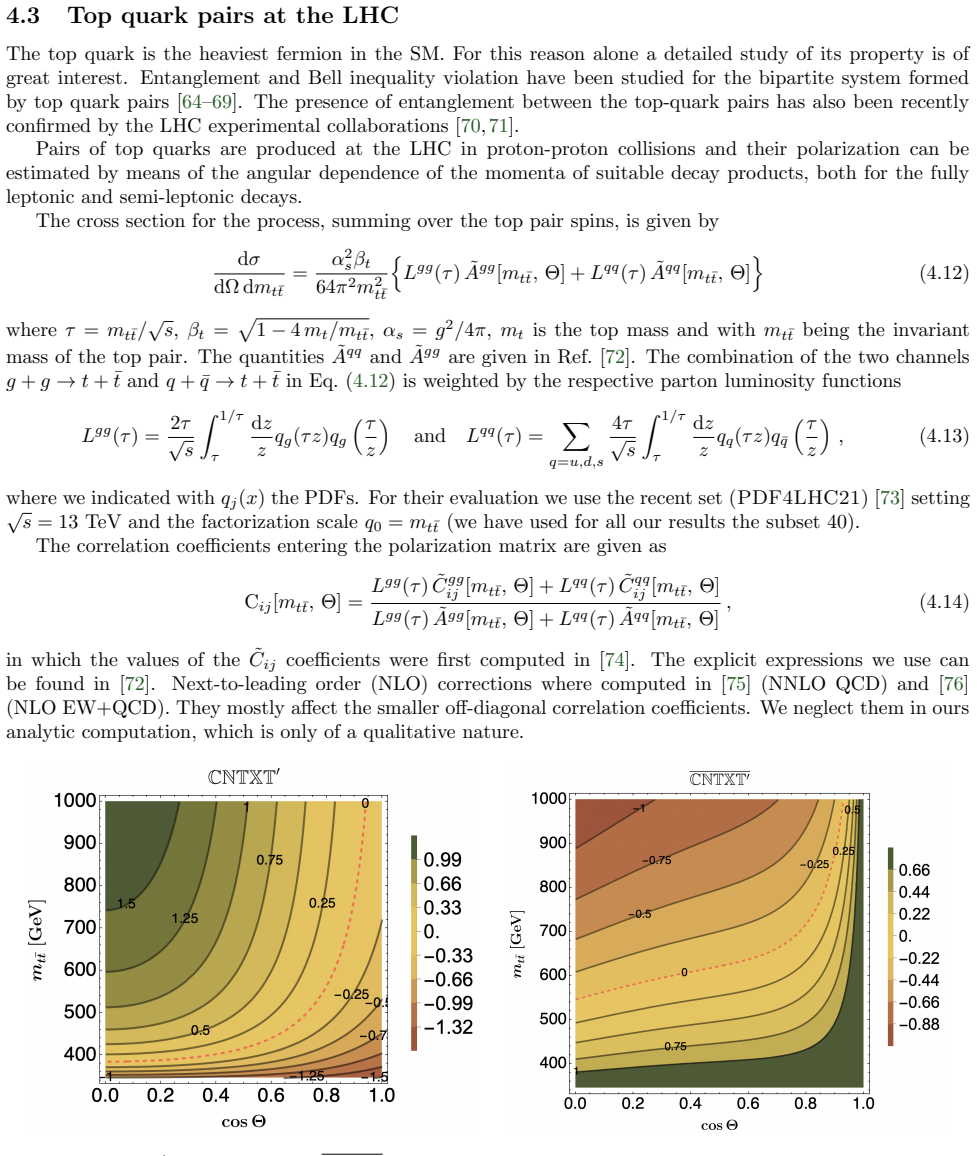
- [Sec. 4.3.1] The top-quark results in Eqs. (4.17)–(4.19) are quoted at >5σ while the text notes that error correlations are not included in the evaluation. In addition, the optimized observable (4.15) uses U and V chosen to maximize the violation in the same kinematic region, which introduces a selection bias that is not accounted for in the reported significance. A trials factor or a validation on an independent bin is needed before the top-quark case can be presented as an established contextuality test.
minor comments (5)
- [Sec. 2.1, Eq. (2.9)] Please clarify that V implements a maximization over the choice of projectors and that the non-contextuality bound c_N remains valid for the rotated set; the current wording 'implicitly defined' is ambiguous.
- [Table 4.1] The entry B−k = 0.003 ± 0.22 appears to contain a typo; the uncertainty is likely ±0.022. Please check the value against the CMS source.
- [Sec. 3.1.1] The phrase 'lower bounds for the non-contextuality of the involved particles' is potentially misleading: dropping or setting to zero an unknown off-diagonal element can shift the value of Tr(ρΠ) in either direction, so the quoted numbers are not guaranteed to be lower bounds.
- [Sec. 5] The fair-sampling assumption invoked for the detection loophole should be stated as an assumption about the selected event sample, not as a proven closure of the loophole; the current wording overstates what the experiments establish.
- [Fig. 4.4 caption] The caption says 'left-hand side' twice; the right panel should be labeled as showing CNTXT′.
Circularity Check
Self-cited loophole closure is load-bearing; the central contextuality scores are otherwise computed from external data rather than fitted.
-
self citation load bearing
[Sec. 5, Outlook (p. 24)]
"Of the three loopholes mentioned in the experimental tests of contextuality—lack of sharpness of the measurements, detection inefficiencies and incompatibility of the sequential measurements—only the one about detection efficiency is relevant in particle physics. The other two loopholes are closed by the full knowledge of the state used in the test, obtained by means of quantum state tomography [29]."
The claim that the sharpness and incompatibility loopholes are closed is the load-bearing step that converts tomographic reinterpretations into genuine contextuality tests. That assertion is supported only by ref. [29], an arXiv preprint by Fabbrichesi, Floreanini, and Marzola — three of the present authors — and is not machine-checked, code-reproduced, or independently validated in the present paper. No proof or quantitative bound is given for why knowing the state via tomography automatically closes the incompatibility loophole in these collider settings. Absent this self-cited assertion, the results reduce to state-dependent computations of Tr(ρΠ_i) rather than direct measurements of the incompatible projectors required by the KCBS and Peres-Mermin inequalities.
full rationale
The formal derivation chain is largely self-contained against external experimental inputs: ATLAS helicity fractions, LHCb/BESIII amplitudes, and CMS spin-correlation coefficients are taken as inputs, and the contextuality scores are computed from fixed inequalities without fitting a parameter to the target score. The J/ψ case, where the five-projector test does not violate the bound, shows that the computation is not tautological. However, Sec. 2.1 states that only state-dependent inequalities can be used because direct probing of the operator algebra is impossible at current colliders, and Sec. 5 then declares the sharpness and incompatibility loopholes closed by quantum state tomography, citing the authors' own preprint [29]. That self-citation is load-bearing for the paper's central claim that non-contextual hidden-variable models are ruled out at more than 5σ. The tomographic reconstruction also means the projectors were never measured in their incompatible contexts, so the computed violations depend on the quantum-mechanical model used to reconstruct the density matrices; this is a significant limitation bordering on circularity, but because the underlying measured moments and the inequalities are external to the present paper, I score it as partial self-citation-related circularity rather than a fully constructed equivalence.
Assumptions & free parameters
free parameters (4)
- Benchmark angle theta (W+ test) =
pi/4
- Benchmark scattering angle Theta (chi1c -> phi phi) =
pi/4
- Off-shell fraction f (H -> VV) =
0.1
- Optimizing rotations U, V (ttbar) =
Eq. (4.16)
assumptions (6)
- standard math Validity of non-contextuality inequality bounds c5=2, c9=3, c13=4 and their quantum upper limits.
- domain assumption Published angular distributions determine the full spin density matrix via quantum state tomography.
- domain assumption Fair sampling closes the detection loophole in the collider data.
- ad hoc to paper SM angular dependence (1 +/- cos theta) and zero off-diagonal terms for the W+ polarization matrix when combining measured helicity fractions with the SM structure.
- domain assumption Leading-order QCD production of ttbar with PDF4LHC21 PDFs and neglect of NLO corrections.
- domain assumption Helicity amplitude decompositions and symmetry constraints for chi_c -> phi phi and baryon-pair decays are correct.
Cite this review
Pith. "Pith review of Tests of quantum contextuality in particle physics." pith.science (2026). https://pith.science/paper/D6NCKDXU
@misc{pith2026250412382,
  author       = {Pith},
  title        = {Pith review of: Tests of quantum contextuality in particle physics},
  year         = {2026},
  howpublished = {\url{https://pith.science/paper/D6NCKDXU}},
  note         = {Machine review of arXiv:2504.12382}
}
abstract
Quantum contextuality refers to the impossibility of assigning a predefined, intrinsic value to a physical property of a system independently of the context in which the property is measured. It is, perhaps, the most fundamental feature of quantum mechanics. The many states with different spin that particle physics provides are the ideal setting for testing contextuality. We verify that the polarization states of single spin-1 massive particles produced at colliders are contextual. We test $W^{+}$ gauge bosons produced in top-quark decays, $J/\psi$ and $K^{*}(892)^0$ mesons in $B$-meson decays and $\phi$ mesons in $\chi^0_c$ and $\chi^1_c$ charmonium decays by reinterpreting the data and the analyses of the ATLAS, LHCb, Belle II and BESIII experimental collaborations, respectively. The polarization states of these four particles show contextuality with a significance larger than $5\sigma$. We also discuss the presence of quantum contextuality in spin states of bipartite systems formed by spin-1/2 particles. We test $\Lambda$ and $\Sigma$ baryons reinterpreting two BESIII data analyses, and pairs of top quarks utilizing a recent analysis of the CMS collaboration. Quantum contextuality is present with a significance exceeding $5\sigma$ also in these cases. In addition, we study the feasibility of testing quantum contextuality by means of $Z$ boson production in association with the Higgs boson, $Z$ and $W$ bosons pairs created in Higgs boson decays and with pairs of $\tau$ leptons. For the latter, we use Monte Carlo simulations that mimic the settings of SuperKEKB and of future lepton colliders. Experiments at high energies, though not designed for the purpose, perform surprisingly well in testing for quantum contextuality.
Figures


Figures from the paper (8 more)




Forward citations
Cited by 2 Pith papers
-
Experimental characterization of the hierarchy of quantum correlations in top quark pairs
LHC top-quark data show quantum discord at >5σ, first evidence for steering at >3σ, no Bell correlations, and nonzero magic.
-
Quantum tomography beyond the leading order
NLO corrections to angular distributions can be subtracted as a background, allowing quantum tomography of H to ZZ to four leptons to be performed with the well-defined leading-order spin interpretation.
Reference graph
Works this paper leans on
-
[29]
M. Fabbrichesi, R. Floreanini, and L. Marzola, About testing Bell locality at colliders , arXiv:2503.18535
-
[1]
A. J. Barr, M. Fabbrichesi, R. Floreanini, E. Gabrielli, and L. Marzola, Quantum entanglement and Bell inequality violation at colliders , Prog. Part. Nucl. Phys. 139 (2024) 104134, [ arXiv:2402.07972]
arXiv 2024
-
[2]
R. Horodecki, P. Horodecki, M. Horodecki, and K. Horodecki, Quantum entanglement, Rev. Mod. Phys. 81 (2009) 865–942, [ quant-ph/0702225]
arXiv 2009
-
[3]
Benatti, M
F. Benatti, M. Fannes, R. Floreanini, and D. Petritis, Quantum Information, Computation and Cryptography. Springer Berlin, Heidelberg, 2010
2010
-
[4]
M. A. Nielsen and I. L. Chuang, Quantum Computation and Quantum Information. Cambridge University Press, 6, 2012
2012
-
[5]
D. Bruss and G. Leuchs, Quantum Information: From Foundations to Quantum Technology Applications. Wiley, 2019
work page 2019
-
[6]
Bell, On the Einstein Podolsky Rosen paradox , Physics Physique Fizika 1 (1964) 195
J. Bell, On the Einstein Podolsky Rosen paradox , Physics Physique Fizika 1 (1964) 195
1964
-
[7]
V. Scarani, Bell Nonlocality. Oxford University Press, 2019
work page 2019
Show all 82 references
-
[8]
J. S. Bell, On the Problem of Hidden Variables in Quantum Mechanics, Rev. Mod. Phys. 38 (1966) 447–452
1966
-
[9]
Kochen and E
S. Kochen and E. Specker, The Problem of Hidden Variables in Quantum Mechanics , J. Math. Mech. 17 (1968) 59–87
1968
-
[10]
Michler, H
M. Michler, H. Weinfurter, and M. ˙Zukowski, Experiments towards falsification of noncontextual hidden variable theories , Phys. Rev. Lett. 84 (Jun,
-
[11]
Huang, C.-F
Y.-F. Huang, C.-F. Li, Y.-S. Zhang, J.-W. Pan, and G.-C. Guo, Experimental test of the Kochen-Specker theorem with single photons , Phys. Rev. Lett. 90 (Jun, 2003) 250401
2003
-
[12]
Amselem, M
E. Amselem, M. R˚ admark, M. Bourennane, and A. Cabello, State-independent quantum contextuality with single photons , Phys. Rev. Lett. 103 (Oct, 2009) 160405
2009
-
[13]
Lapkiewicz, P
R. Lapkiewicz, P. Li, C. Schaeff, N. K. Langford, S. Ramelow, M. Wie´ sniak, and A. Zeilinger, Experimental non-classicality of an indivisible quantum system, Nature 474 (2011), no. 7352 490–493
2011
-
[14]
Zu, Y.-X
C. Zu, Y.-X. Wang, D.-L. Deng, X.-Y. Chang, K. Liu, P.-Y. Hou, H.-X. Yang, and L.-M. Duan, State-independent experimental test of quantum contextuality in an indivisible system , Phys. Rev. Lett. 109 (Oct, 2012) 150401
2012
-
[15]
D’Ambrosio, I
V. D’Ambrosio, I. Herbauts, E. Amselem, E. Nagali, M. Bourennane, F. Sciarrino, and A. Cabello, Experimental implementation of a kochen-specker set of quantum tests , Phys. Rev. X 3 (Feb, 2013) 011012
2013
-
[16]
Ahrens, E
J. Ahrens, E. Amselem, A. Cabello, and M. Bourennane, Two fundamental experimental tests of nonclassicality with qutrits , Scientific Reports 3 (2013), no. 1 2170
2013
-
[17]
Hasegawa, R
Y. Hasegawa, R. Loidl, M. Baron, and H. Rauch, Violation of a bell-like inequality in single-neutron inteferometry, Nature 425 (2003) 45
2003
-
[18]
Bartosik, J
H. Bartosik, J. Klepp, C. Schmitzer, S. Sponar, A. Cabello, H. Rauch, and Y. Hasegawa, Experimental test of quantum contextuality in neutron interferometry, Phys. Rev. Lett. 103 (Jul,
-
[19]
Kirchmair, F
G. Kirchmair, F. Z¨ ahringer, R. Gerritsma, M. Kleinmann, O. G¨ uhne, A. Cabello, R. Blatt, and C. F. Roos, State-independent experimental test of quantum contextuality, Nature 460 (2009), no. 7254 494–497
2009
-
[20]
Zhang, M
X. Zhang, M. Um, J. Zhang, S. An, Y. Wang, D.-l. Deng, C. Shen, L.-M. Duan, and K. Kim, State-independent experimental test of quantum contextuality with a single trapped ion , Phys. Rev. Lett. 110 (Feb, 2013) 070401
2013
-
[21]
F. M. Leupold, M. Malinowski, C. Zhang, V. Negnevitsky, A. Cabello, J. Alonso, and J. P. Home, Sustained state-independent quantum contextual correlations from a single ion , Phys. Rev. Lett. 120 (May, 2018) 180401
2018
-
[22]
P. Wang, J. Zhang, C.-Y. Luan, M. Um, Y. Wang, M. Qiao, T. Xie, J.-N. Zhang, A. Cabello, and K. Kim, Significant loophole-free test of kochen-specker contextuality using two species of atomic ions, Science Advances 8 (2022), no. 6 eabk1660
2022
-
[23]
Moussa, C
O. Moussa, C. A. Ryan, D. G. Cory, and R. Laflamme, Testing contextuality on quantum ensembles with one clean qubit , Phys. Rev. Lett. 104 (Apr, 2010) 160501
2010
-
[24]
Jerger, Y
M. Jerger, Y. Reshitnyk, M. Oppliger, A. Potoˇ cnik, M. Mondal, A. Wallraff, K. Goodenough, S. Wehner, K. Juliusson, N. K. Langford, and A. Fedorov, Contextuality without nonlocality in a superconducting quantum system, Nature Communications 7 (2016), no. 1 12930
2016
-
[25]
S. B. van Dam, J. Cramer, T. H. Taminiau, and R. Hanson, Multipartite entanglement generation and contextuality tests using nondestructive three-qubit parity measurements, Phys. Rev. Lett. 123 (Jul,
-
[26]
Thompson, P
J. Thompson, P. Kurzy´ nski, S.-Y. Lee, A. Soeda, and D. Kaszlikowski, Recent advances in contextuality tests, Open Systems & Information Dynamics 23 (2016), no. 02 1650009
2016
-
[27]
Budroni, A
C. Budroni, A. Cabello, O. G¨ uhne, M. Kleinmann, and J.-r. Larsson, Kochen-Specker contextuality, Rev. Mod. Phys. 94 (2022), no. 4 045007, [arXiv:2102.13036]. 25
2022 arXiv
-
[28]
Genovese, Research on hidden variable theories: A review of recent progresses, Phys
M. Genovese, Research on hidden variable theories: A review of recent progresses, Phys. Rept. 413 (2005) 319–396, [quant-ph/0701071]
2005 arXiv
-
[30]
Cabello, S
A. Cabello, S. Severini, and A. Winter, Graph-theoretic approach to quantum correlations, Phys. Rev. Lett. 112 (Jan, 2014) 040401
2014
-
[31]
Cabello, M
A. Cabello, M. Kleinmann, and J. R. Portillo, Quantum state-independent contextuality requires 13 rays, Journal of Physics A: Mathematical and Theoretical 49 (aug, 2016) 38LT01
2016
-
[32]
A. A. Klyachko, M. A. Can, S. Binicioglu, and A. S. Shumovsky, Simple Test for Hidden Variables in Spin-1 Systems, Phys. Rev. Lett. 101 (2008) 020403, [arXiv:0706.0126]
2008 arXiv
-
[33]
Kurzy´ nski and D
P. Kurzy´ nski and D. Kaszlikowski,Contextuality of almost all qutrit states can be revealed with nine observables, Phys. Rev. A 86 (Oct, 2012) 042125
2012
-
[34]
Yu and C
S. Yu and C. H. Oh, State-Independent Proof of Kochen-Specker Theorem with 13 Rays, Phys. Rev. Lett. 108 (Jan, 2012) 030402
2012
-
[35]
Ahrens, E
J. Ahrens, E. Amselem, A. Cabello, and M. Bourennane, Two fundamental experimental tests of nonclassicality with qutrits , arXiv:1301.2887
-
[36]
Cabello, Experimentally testable state-independent quantum contextuality, Phys
A. Cabello, Experimentally testable state-independent quantum contextuality, Phys. Rev. Lett. 101 (Nov,
-
[37]
N. D. Mermin, Simple unified form for the major no-hidden-variables theorems, Phys. Rev. Lett. 65 (1990), no. 27 3373
1990
-
[38]
Peres, Incompatible results of quantum measurements, Phys
A. Peres, Incompatible results of quantum measurements, Phys. Lett. A 151 (1990) 107–108
1990
-
[39]
Peres, Two simple proofs of the Kochen-Specker theorem, J
A. Peres, Two simple proofs of the Kochen-Specker theorem, J. Phys. A 24 (1991), no. 4 L175
1991
-
[40]
Nambu, Proposed Experimental Test for Proving Quantum Contextuality with Non-entangled Photons , arXiv:0805.3398
Y. Nambu, Proposed Experimental Test for Proving Quantum Contextuality with Non-entangled Photons , arXiv:0805.3398
-
[41]
J. F. Clauser, M. A. Horne, A. Shimony, and R. A. Holt, Proposed experiment to test local hidden-variable theories, Phys. Rev. Lett. 23 (Oct,
-
[42]
Cabello, Converting contextuality into nonlocality , Phys
A. Cabello, Converting contextuality into nonlocality , Phys. Rev. Lett. 127 (Aug, 2021) 070401
2021
-
[43]
Abramsky and A
S. Abramsky and A. Brandenburger, The sheaf-theoretic structure of non-locality and contextuality, New Journal of Physics 13 (nov, 2011) 113036
2011
-
[44]
Fabbrichesi, R
M. Fabbrichesi, R. Floreanini, E. Gabrielli, and L. Marzola, Quantum contextuality of spin-1 massive particles, arXiv:2503.14587
-
[45]
J. A. Aguilar-Saavedra and J. Bernabeu, W polarisation beyond helicity fractions in top quark decays, Nucl. Phys. B 840 (2010) 349–378, [arXiv:1005.5382]
2010 arXiv
-
[46]
Aad et al., Measurement of the polarisation of W bosons produced in top-quark decays using dilepton events at s=13 TeV with the ATLAS experiment, Phys
A TLASCollaboration, G. Aad et al., Measurement of the polarisation of W bosons produced in top-quark decays using dilepton events at s=13 TeV with the ATLAS experiment, Phys. Lett. B 843 (2023) 137829, [arXiv:2209.14903]
2023 arXiv
-
[47]
Nakamura, Polarisations of the Z and W bosons in the processespp→ZH and pp→W±H, JHEP 08 (2017) 008, [ arXiv:1706.01816]
J. Nakamura, Polarisations of the Z and W bosons in the processespp→ZH and pp→W±H, JHEP 08 (2017) 008, [ arXiv:1706.01816]
2017 arXiv
-
[48]
K. Rao, S. D. Rindani, P. Sarmah, and B. Singh, Z polarization at an e+e− collider and properties of decay-lepton angular asymmetries, Proc. Indian Natl. Sci. Acad. 90 (2024), no. 3 664–677, [arXiv:2311.13473]
2024 arXiv
-
[49]
Fabbrichesi, R
M. Fabbrichesi, R. Floreanini, E. Gabrielli, and L. Marzola, Bell inequalities and quantum entanglement in weak gauge boson production at the LHC and future colliders , Eur. Phys. J. C 83 (2023), no. 9 823, [ arXiv:2302.00683]
2023 arXiv
-
[50]
J. A. Aguilar-Saavedra, A. Bernal, J. A. Casas, and J. M. Moreno, Testing entanglement and Bell inequalities in H →ZZ, Phys. Rev. D 107 (2023), no. 1 016012, [ arXiv:2209.13441]
2023 arXiv
-
[51]
Abulencia et al., Polarization of J/ψ and ψ2S Mesons Produced in p¯p Collisions at√s = 1.96-TeV, Phys
CDF Collaboration, A. Abulencia et al., Polarization of J/ψ and ψ2S Mesons Produced in p¯p Collisions at√s = 1.96-TeV, Phys. Rev. Lett. 99 (2007) 132001, [arXiv:0704.0638]
2007 arXiv
-
[52]
Aaij et al., Measurement of the polarization amplitudes in B0→J/ψK∗(892)0 decays, Phys
LHCb Collaboration, R. Aaij et al., Measurement of the polarization amplitudes in B0→J/ψK∗(892)0 decays, Phys. Rev. D 88 (2013) 052002, [arXiv:1307.2782]
2013 arXiv
-
[53]
Particle Data Group Collaboration, R. L. Workman et al., Review of Particle Physics , PTEP 2022 (2022) 083C01
2022
-
[54]
Fabbrichesi, R
M. Fabbrichesi, R. Floreanini, E. Gabrielli, and L. Marzola, Bell inequality is violated in B0→J/ψK∗0(892) decays, Phys. Rev. D 109 (2024), no. 3 L031104, [ arXiv:2305.04982]
2024 arXiv
-
[55]
Aaij et al., Measurement of CP asymmetries and polarisation fractions in B0 s→K∗0 ¯K∗0 decays, JHEP 07 (2015) 166, [arXiv:1503.05362]
LHCb Collaboration, R. Aaij et al., Measurement of CP asymmetries and polarisation fractions in B0 s→K∗0 ¯K∗0 decays, JHEP 07 (2015) 166, [arXiv:1503.05362]
2015 arXiv
-
[56]
Belle Collaboration, K. F. Chen et al., Measurement of polarization and triple-product correlations in B0→phiK∗decays, Phys. Rev. Lett. 94 (2005) 221804, [hep-ex/0503013]
2005 arXiv
-
[57]
Aaij et al., Measurement of polarization amplitudes and CP asymmetries in B0→ϕK∗(892)0, JHEP 05 (2014) 069, [arXiv:1403.2888]
LHCb Collaboration, R. Aaij et al., Measurement of polarization amplitudes and CP asymmetries in B0→ϕK∗(892)0, JHEP 05 (2014) 069, [arXiv:1403.2888]. 26
2014 arXiv
-
[58]
Ablikim et al., Helicity amplitude analysis of χJ c→ϕϕ, JHEP 05 (2023) 069, [arXiv:2301.12922]
BESIII Collaboration, M. Ablikim et al., Helicity amplitude analysis of χJ c→ϕϕ, JHEP 05 (2023) 069, [arXiv:2301.12922]
2023
-
[59]
Fabbrichesi, R
M. Fabbrichesi, R. Floreanini, E. Gabrielli, and L. Marzola, Bell inequality is violated in charmonium decays, Phys. Rev. D 110 (2024), no. 5 053008, [arXiv:2406.17772]
2024 arXiv
-
[60]
W. K. Wootters, Entanglement of formation of an arbitrary state of two qubits , Phys. Rev. Lett. 80 (Mar, 1998) 2245–2248
1998
-
[61]
Ablikim et al., Precise Measurements of Decay Parameters and CP Asymmetry with Entangled Λ-¯Λ Pairs, Phys
BESIII Collaboration, M. Ablikim et al., Precise Measurements of Decay Parameters and CP Asymmetry with Entangled Λ-¯Λ Pairs, Phys. Rev. Lett. 129 (2022), no. 13 131801, [ arXiv:2204.11058]
2022
-
[62]
Ablikim et al., Measurement of λ transverse polarization in e+-e− collisions at√s = 3.68-3.71 gev, JHEP 10 (2023) 081, [arXiv:2303.00271]
BESIII Collaboration, M. Ablikim et al., Measurement of λ transverse polarization in e+-e− collisions at√s = 3.68-3.71 gev, JHEP 10 (2023) 081, [arXiv:2303.00271]. [Erratum: JHEP 12, 080 (2023)]
2023
-
[63]
Ablikim et al., Σ + and ¯Σ− polarization in the J/ψ and ψ(3686) decays, Phys
BESIII Collaboration, M. Ablikim et al., Σ + and ¯Σ− polarization in the J/ψ and ψ(3686) decays, Phys. Rev. Lett. 125 (2020), no. 5 052004, [arXiv:2004.07701]
2020
-
[64]
Afik and J
Y. Afik and J. R. M. n. de Nova, Entanglement and quantum tomography with top quarks at the LHC , Eur. Phys. J. Plus 136 (2021), no. 9 907, [arXiv:2003.02280]
2021 arXiv
-
[65]
Fabbrichesi, R
M. Fabbrichesi, R. Floreanini, and G. Panizzo, Testing Bell Inequalities at the LHC with Top-Quark Pairs, Phys. Rev. Lett. 127 (2021), no. 16 161801, [arXiv:2102.11883]
2021 arXiv
-
[66]
Severi, C
C. Severi, C. D. E. Boschi, F. Maltoni, and M. Sioli, Quantum tops at the LHC: from entanglement to Bell inequalities, Eur. Phys. J. C 82 (2022), no. 4 285, [arXiv:2110.10112]
2022 arXiv
-
[67]
J. A. Aguilar-Saavedra and J. A. Casas, Improved tests of entanglement and Bell inequalities with LHC tops, Eur. Phys. J. C 82 (2022), no. 8 666, [arXiv:2205.00542]
2022 arXiv
-
[68]
Z. Dong, D. Gon¸ calves, K. Kong, and A. Navarro, Entanglement and Bell inequalities with boosted tt, Phys. Rev. D 109 (2024), no. 11 115023, [arXiv:2305.07075]
2024 arXiv
-
[69]
T. Han, M. Low, and T. A. Wu, Quantum Entanglement and Bell Inequality Violation in Semi-Leptonic Top Decays, arXiv:2310.17696
-
[70]
Aad et al., Observation of quantum entanglement with top quarks at the ATLAS detector, Nature 633 (2024), no
A TLASCollaboration, G. Aad et al., Observation of quantum entanglement with top quarks at the ATLAS detector, Nature 633 (2024), no. 8030 542–547, [arXiv:2311.07288]
2024 arXiv
-
[71]
CMS Collaboration, A. Hayrapetyan et al., Measurements of polarization and spin correlation and observation of entanglement in top quark pairs using lepton+jets events from proton-proton collisions at s=13 TeV, Phys. Rev. D 110 (2024), no. 11 112016, [arXiv:2409.11067]
2024 arXiv
-
[72]
Fabbrichesi, R
M. Fabbrichesi, R. Floreanini, and E. Gabrielli, Constraining new physics in entangled two-qubit systems: top-quark, tau-lepton and photon pairs , Eur. Phys. J. C 83 (2023), no. 2 162, [ arXiv:2208.11723]
2023 arXiv
-
[73]
PDF4LHC W orking Group Collaboration, R. D. Ball et al., The PDF4LHC21 combination of global PDF fits for the LHC Run III , J. Phys. G 49 (2022), no. 8 080501, [ arXiv:2203.05506]
2022 arXiv
-
[74]
Bernreuther and Z.-G
W. Bernreuther and Z.-G. Si, Distributions and correlations for top quark pair production and decay at the Tevatron and LHC , Nucl. Phys. B 837 (2010) 90–121, [arXiv:1003.3926]
2010 arXiv
-
[75]
Czakon, A
M. Czakon, A. Mitov, and R. Poncelet, NNLO QCD corrections to leptonic observables in top-quark pair production and decay, JHEP 05 (2021) 212, [arXiv:2008.11133]
2021 arXiv
-
[76]
Frederix, I
R. Frederix, I. Tsinikos, and T. Vitos, Probing the spin correlations of t¯t production at NLO QCD+EW , Eur. Phys. J. C 81 (2021), no. 9 817, [arXiv:2105.11478]
2021 arXiv
-
[77]
Ehat¨ aht, M
K. Ehat¨ aht, M. Fabbrichesi, L. Marzola, and C. Veelken, Probing entanglement and testing Bell inequality violation with e+e- →τ+τ- at Belle II , Phys. Rev. D 109 (2024), no. 3 032005, [arXiv:2311.17555]
2024 arXiv
-
[78]
Fabbrichesi and L
M. Fabbrichesi and L. Marzola, Dipole momenta and compositeness of the τ lepton at Belle II , Phys. Rev. D 109 (2024), no. 9 095026, [ arXiv:2401.04449]
2024 arXiv
-
[79]
Fabbrichesi and L
M. Fabbrichesi and L. Marzola, Quantum tomography with τ leptons at the FCC-ee: Entanglement, Bell inequality violation, sinθW, and anomalous couplings , Phys. Rev. D 110 (2024), no. 7 076004, [arXiv:2405.09201]
2024 arXiv
-
[80]
T. Han, M. Low, and Y. Su, Entanglement and Bell Nonlocality in τ+τ− at the BEPC , arXiv:2501.04801
-
[81]
Fabbrichesi, M
M. Fabbrichesi, M. Low, and L. Marzola, The trace distance between density matrices, a nifty tool in new-physics searches, arXiv:2501.03311
-
[82]
Zhang, B.-H
Y. Zhang, B.-H. Zhou, Q.-B. Liu, S. Li, S.-C. Hsu, T. Han, M. Low, and T. A. Wu, Entanglement and Bell Nonlocality in τ+τ− at the LHC using Machine Learning for Neutrino Reconstruction, arXiv:2504.01496. 27
Reviewed August 16, 2026 · model on record in the stance chip above.
Discussion (0). Continue with ORCID to comment.