LLM-Aided A* Search in Non-Geometric Network Graphs
Pith reviewed 2026-06-26 06:25 UTC · model grok-4.3
The pith
LLM-generated waypoints reduce A* node expansions by about 50% in non-geometric network graphs.
A machine-rendered reading of the paper's core claim, the machinery that carries it, and where it could break.
Core claim
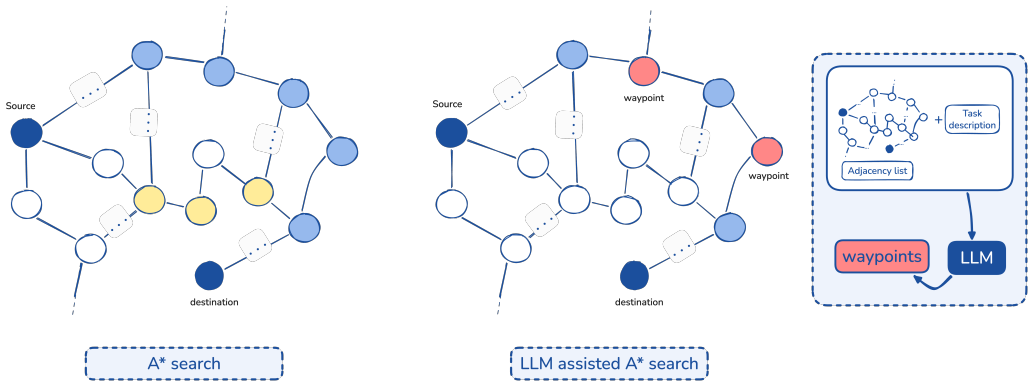
An LLM can generate waypoints from landmark distance features that guide A* expansions in non-geometric graphs, reducing the number of expanded nodes by around 50% while incurring only a marginal path cost increase compared to the optimal solution.
What carries the argument
Landmark distances, used both as an admissible ALT heuristic for A* and as structural features supplied to the LLM to generate guiding waypoints.
If this is right
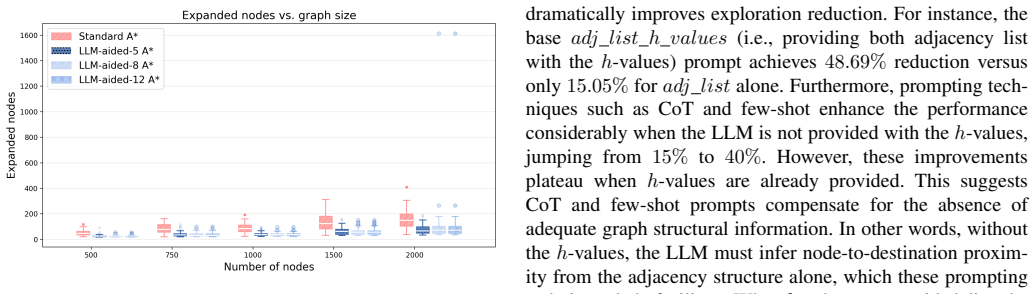
- LLM-generated waypoints reduce the number of expanded nodes by around 50%.
- The approach incurs only a marginal path cost increase compared to the optimal solution.
- Incorporating compact structural features such as heuristic estimates is more effective than advanced prompting techniques.
- The results hold on multiple graph topologies with up to 2,000 nodes.
Where Pith is reading between the lines
- The technique could be evaluated on graphs larger than 2,000 nodes or on real network topologies to test scaling behavior.
- Caching waypoint suggestions for repeated landmark patterns might offset the cost of LLM calls in repeated queries.
- Similar waypoint guidance could be explored for other informed search algorithms or for dynamic networks where edge costs change.
Load-bearing premise
Landmark distances supplied to the LLM will consistently produce waypoints that meaningfully reduce expansions without violating A* admissibility or introducing unacceptable computational overhead from LLM calls.
What would settle it
A counterexample would be a collection of test graphs where the LLM waypoints cause A* to expand more nodes than the baseline or produce paths whose cost exceeds the optimal cost by more than a small margin.
Figures



read the original abstract
Finding the shortest path in non-geometric network graphs, where edge weights encode arbitrary metrics such as latency or monetary cost rather than spatial distance, poses a challenge for informed search algorithms. Their efficiency depends on an informative heuristic, typically supplied in spatial domains by geometric distances that have no counterpart on non-geometric graphs. We propose a large language model (LLM)-aided A* algorithm in which an LLM generates intermediate waypoints that guide the A* expansion toward promising graph regions. At the core of the approach are landmark distances, which serve both as an admissible landmark-based (ALT) heuristic for the search and as a compact structural feature that, supplied to the LLM, restores the distance-to-destination signal it would otherwise lack on non-geometric graphs. Our comprehensive experiments on multiple graph topologies with up to 2,000 nodes demonstrate that LLM-generated waypoints reduce the number of expanded nodes by around 50% while incurring only a marginal path cost increase compared to the optimal solution. We further analyze the impact of prompt engineering and show that incorporating compact structural features, namely heuristic estimates, is more effective than advanced prompting techniques. These findings demonstrate the potential of combining LLM- based guidance with classical search algorithms for efficient network optimization.
Editorial analysis
A structured set of objections, weighed in public.
Referee Report
Summary. The paper proposes an LLM-aided A* search algorithm for shortest paths in non-geometric network graphs. Landmark distances serve dual roles as an admissible ALT heuristic and as compact structural features fed to an LLM to generate waypoints that guide expansion. Experiments on multiple topologies with up to 2,000 nodes are reported to show an approximately 50% reduction in expanded nodes with only marginal path-cost increase relative to optimal; prompt engineering is also analyzed, with the conclusion that heuristic features outperform advanced prompting techniques.
Significance. If the efficiency claims can be substantiated with complete experimental protocols and overhead measurements, the work would offer a concrete demonstration of hybrid LLM-classical search for domains lacking geometric structure, with potential relevance to network routing and optimization. The absence of runtime accounting and statistical validation currently prevents assessment of whether net gains are realized.
major comments (2)
- [Abstract / Experiments] Abstract and Experiments section: the central claim of ~50% reduction in expanded nodes with marginal cost increase is presented without any description of graph generation procedures, number of queries or trials per topology, choice of baselines (standard A*, pure ALT, etc.), error bars, or statistical significance tests. This directly undermines evaluation of the reported improvement.
- [Experiments] Experiments section: no quantification is given of LLM call frequency, prompt token counts (especially the landmark-distance vectors for 2,000-node graphs), or total wall-clock time including inference latency. Without these metrics the net efficiency gain cannot be established even if node expansions drop.
minor comments (1)
- [Method] Notation for landmark distances and waypoint selection could be formalized with a short pseudocode or equation block to clarify how the LLM output is integrated into the A* open set.
Simulated Author's Rebuttal
We thank the referee for the constructive feedback on our experimental presentation. We address each major comment below and will revise the manuscript accordingly to improve clarity and substantiation of results.
read point-by-point responses
-
Referee: [Abstract / Experiments] Abstract and Experiments section: the central claim of ~50% reduction in expanded nodes with marginal cost increase is presented without any description of graph generation procedures, number of queries or trials per topology, choice of baselines (standard A*, pure ALT, etc.), error bars, or statistical significance tests. This directly undermines evaluation of the reported improvement.
Authors: We agree that additional experimental details are needed for full reproducibility and evaluation. In the revised manuscript we will expand the Experiments section with: explicit graph generation procedures for each topology, the exact number of queries and independent trials per topology, a complete list of baselines (standard A*, pure ALT, and others), error bars on all reported metrics, and statistical significance tests (e.g., paired t-tests) supporting the ~50% node-expansion reduction. The abstract will remain unchanged as it accurately summarizes the findings once these details are provided. revision: yes
-
Referee: [Experiments] Experiments section: no quantification is given of LLM call frequency, prompt token counts (especially the landmark-distance vectors for 2,000-node graphs), or total wall-clock time including inference latency. Without these metrics the net efficiency gain cannot be established even if node expansions drop.
Authors: The referee is correct that overhead accounting is required to confirm net gains. We will add to the revised Experiments section a dedicated analysis quantifying LLM call frequency per search, average and maximum prompt token counts (noting that the landmark-distance vectors are compact and scale linearly), and total wall-clock runtime decomposed into classical search time and LLM inference latency. These measurements will allow readers to assess whether the reduction in node expansions translates to practical efficiency improvements. revision: yes
Circularity Check
No circularity; empirical results are independent measurements
full rationale
The paper reports experimental outcomes from running LLM-aided A* on graphs up to 2000 nodes, with the 50% reduction in expanded nodes measured directly from those runs rather than derived from any equation or fitted parameter. Landmark distances are supplied as an external admissible heuristic (ALT) and prompt feature; no self-definitional loop, fitted-input prediction, or self-citation chain is present in the provided text. The central claim rests on observable search behavior, not on any reduction to the paper's own inputs by construction.
Axiom & Free-Parameter Ledger
axioms (2)
- standard math A* with admissible heuristic returns optimal paths
- domain assumption Landmark distances yield admissible ALT heuristics
Reference graph
Works this paper leans on
-
[1]
AI reasoning for wireless communications and networking: A survey and perspectives,
H. Luo, Y . Yan, Y . Bian, W. Feng, R. Zhang, Y . Liu, J. Wang, G. Sun, D. Niyato, H. Yu, A. Jamalipour, and S. Mao, “AI reasoning for wireless communications and networking: A survey and perspectives,”CoRR, vol. abs/2509.09193, 2025
-
[2]
AI reasoning for wireless communications and networking: A survey and perspectives,
H. Luo, Y . Yan, Y . Bian, W. Feng, R. Zhang, Y . Liu, J. Wang, G. Sun, D. Niyato, H. Yuet al., “AI reasoning for wireless communications and networking: A survey and perspectives,”ACM Comput. Surveys, 2025
2025
-
[3]
Evaluating large language models on graphs: Perfor- mance insights and comparative analysis,
C. Liu and B. Wu, “Evaluating large language models on graphs: Perfor- mance insights and comparative analysis,”CoRR, vol. abs/2308.11224, 2023
-
[4]
A 1000 timesxfaster LLM- enhanced algorithm for path planning in large-scale grid maps,
J. Zeng, X. Zhang, X. Zhao, and Y . Pan, “A 1000 timesxfaster LLM- enhanced algorithm for path planning in large-scale grid maps,”CoRR, vol. abs/2510.02716, 2025
-
[5]
LLM-a*: Large language model enhanced incremental heuristic search on path planning,
S. Meng, Y . Wang, C.-F. Yang, N. Peng, and K.-W. Chang, “LLM-a*: Large language model enhanced incremental heuristic search on path planning,” inFindings ACL EMNLP, Nov. 2024, pp. 1087–1102
2024
-
[6]
Computing the shortest path: A search meets graph theory
A. V . Goldberg and C. Harrelson, “Computing the shortest path: A search meets graph theory.” inSODA, vol. 5, 2005, pp. 156–165
2005
-
[7]
Language is all a graph needs,
R. Ye, C. Zhang, R. Wang, S. Xu, and Y . Zhang, “Language is all a graph needs,” inin Findings ACL EACL, 2024, pp. 1955–1973
2024
-
[8]
Leveraging large language models for multi-objective and adaptive SFC deployment: Techniques, case study, and promising directions,
L. Zhu, J. Yu, X. Chen, Z. Jiang, X. Liu, J. Zhang, X. Yang, R. Zhang, D. Niyato, X. Yi, I. Khalil, D. Zhang, and C. Wu, “Leveraging large language models for multi-objective and adaptive SFC deployment: Techniques, case study, and promising directions,”IEEE Commun. Mag., vol. 64, no. 1, pp. 32–39, 2026
2026
-
[9]
Har- nessing explanations: Llm-to-lm interpreter for enhanced text-attributed graph representation learning,
X. He, X. Bresson, T. Laurent, A. Perold, Y . LeCun, and B. Hooi, “Har- nessing explanations: Llm-to-lm interpreter for enhanced text-attributed graph representation learning,” inProc. Int. Conf. Learn. Represent. (ICLR), 2024, pp. 5711–5732
2024
-
[10]
LLMAP: LLM- assisted multi-objective route planning with user preferences,
L. Yuan, D.-J. Han, C. Brinton, and S. Brunswicker, “LLMAP: LLM- assisted multi-objective route planning with user preferences,” inFind- ings ACL EMNLP, Nov. 2025, pp. 7866–7894
2025
-
[11]
Can large language models analyze graphs like professionals? a benchmark, datasets and models,
X. Li, W. Chen, Q. Chu, H. Li, Z. Sun, R. Li, C. Qian, Y . Wei, Z. Liu, C. Shi, M. Sun, and C. Yang, “Can large language models analyze graphs like professionals? a benchmark, datasets and models,” inAdv. Neural Inf. Process. Syst. (NeurIPS), vol. 37. Curran Associates, Inc., 2024
2024
-
[12]
Mathematical discoveries from program search with large language models,
B. Romera-Paredes, M. Barekatain, A. Novikov, M. Balog, M. Kumar, E. Dupont, F. Ruiz, J. Ellenberg, P. Wang, O. Fawzi, P. Kohli, and A. Fawzi, “Mathematical discoveries from program search with large language models,”Nature, vol. 625, 12 2023
2023
-
[13]
Eureka: Human-level reward design via coding large language models,
Y . J. Ma, W. Liang, G. Wang, D.-A. Huang, O. Bastani, D. Jayaraman, Y . Zhu, J. Fanet al., “Eureka: Human-level reward design via coding large language models,” inProc. Int. Conf. Learn. Represent. (ICLR), 2024, pp. 26 516–26 560
2024
-
[14]
Guiding pretraining in reinforcement learning with large language models,
Y . Du, O. Watkins, Z. Wang, C. Colas, T. Darrell, P. Abbeel, A. Gupta, and J. Andreas, “Guiding pretraining in reinforcement learning with large language models,” inInternational Conference on Machine Learn- ing. PMLR, 2023, pp. 8657–8677
2023
-
[15]
Snap: A general-purpose network analysis and graph-mining library,
J. Leskovec and R. Sosi ˇc, “Snap: A general-purpose network analysis and graph-mining library,”ACM Trans. Intell. Syst. Technol., vol. 8, no. 1, pp. 1–20, 2016
2016
-
[16]
GPT-4.1 model documentation,
OpenAI, “GPT-4.1 model documentation,” 2025, accessed: March 2026
2025
discussion (0)
Sign in with ORCID, Apple, or X to comment. Anyone can read and Pith papers without signing in.