REVIEW 4 major objections 4 minor 86 references
First-order phase transition from hypernuclear matter to deconfined quark matter obeying new constraints from compact star observations
T0 review · 4 major / 4 minor · reviewed 2026-08-14 · deepseek-v4-flash
Pith's one-line read The paper argues that a first-order transition to color-superconducting quark matter solves the hyperon puzzle and produces hybrid stars reaching 2.2 solar masses while meeting the new observational constraints.
desk verdict Worth engaging: a clear model-construction paper that makes a specific new prediction—the layered hypernuclear-quark star—but that layer sits in a chemical-potential window the authors themselves say their hadronic EoS should not be trusted in. read the letter →
The pith
A machine-rendered reading of the paper's core claim, the machinery that carries it, and where it could break.
The reading
What carries the argument
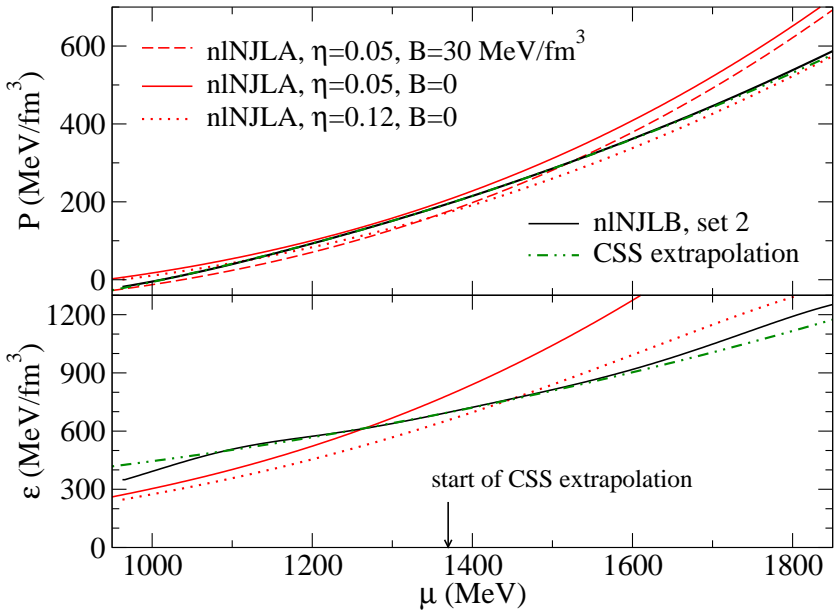
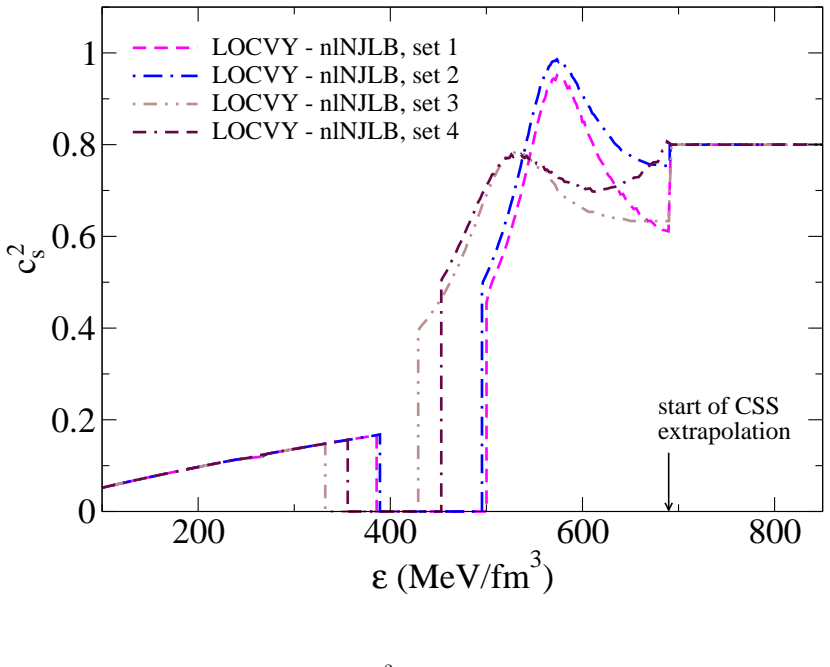
The argument is carried by a Maxwell construction between two equations of state, in which the phase with the higher pressure at a given baryon chemical potential is the stable one. The hadronic side is the LOCV hypernuclear equation of state, a lowest-order constrained variational calculation with realistic two- and three-body nuclear forces, and with Lambda and Sigma-minus hyperons added as noninteracting particles in beta equilibrium. The quark side is a nonlocal Nambu-Jona-Lasinio model with a color-superconducting diquark condensate; in the nlNJLB variant the bag pressure and vector coupling are made density-dependent by interpolating among three constant-parameter pressures, which confines quarks at low density and keeps the matter stiff at high density. A constant-speed-of-sound extrapolation extends the quark equation of state to the energy densities needed for the maximum mass. Together these pieces push the deconfinement crossing above the hyperon threshold, creating the intermediate hypernuclear phase.
What would settle it
Recompute the same Maxwell construction with a hadronic phase that includes interacting hyperons and check whether the hyperon-onset chemical potential moves above the quark-deconfinement chemical potential near 1090 to 1110 MeV; if it does, the claimed hypernuclear layer is gone. A radius measurement of a 1.4 to 1.6 solar-mass neutron star that rules out the predicted hybrid branch would also settle the question.
Extended reading notes
Core claim
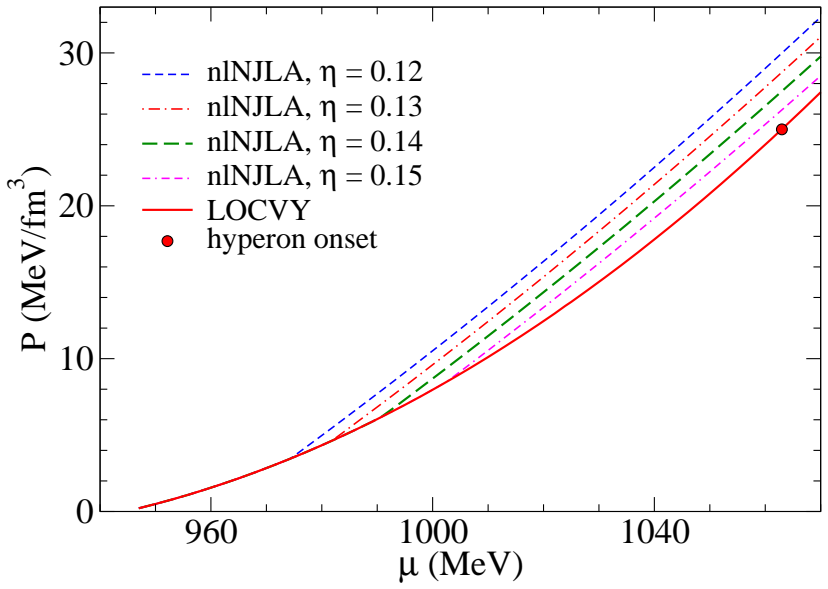
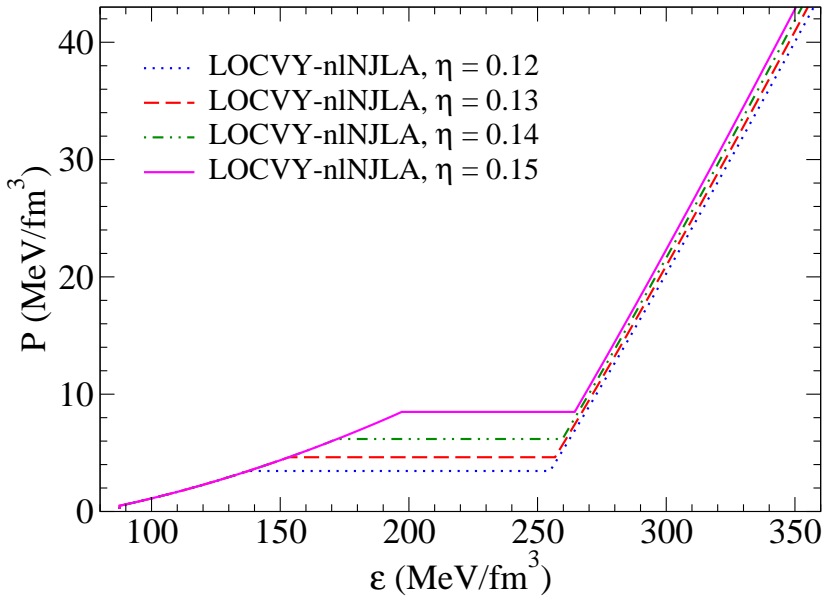
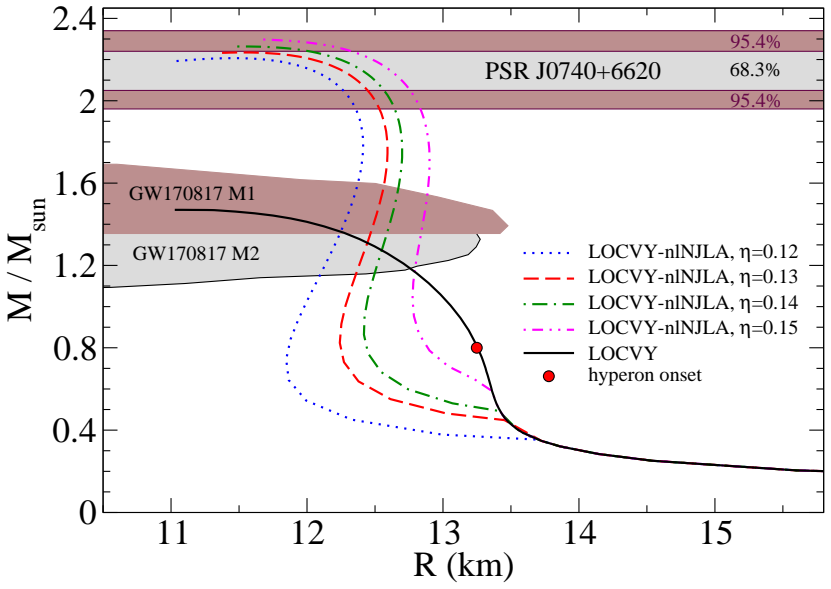
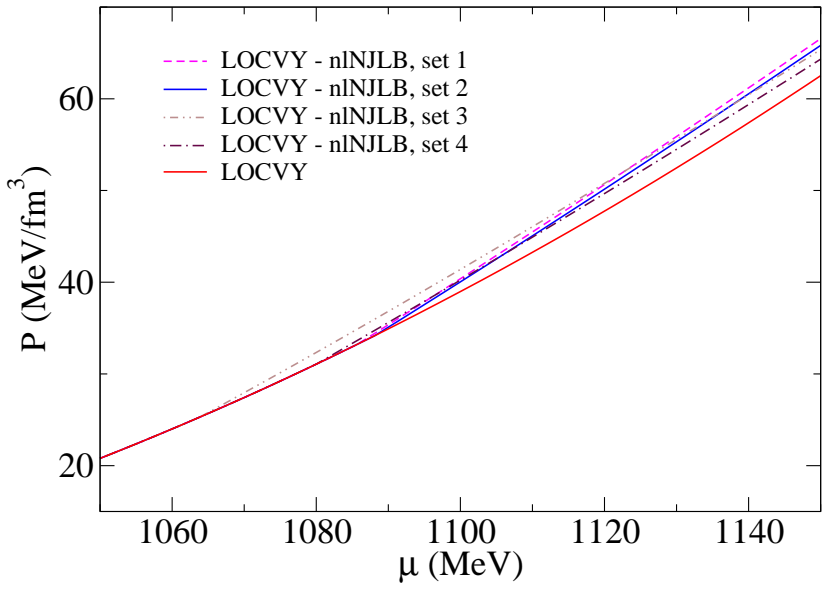
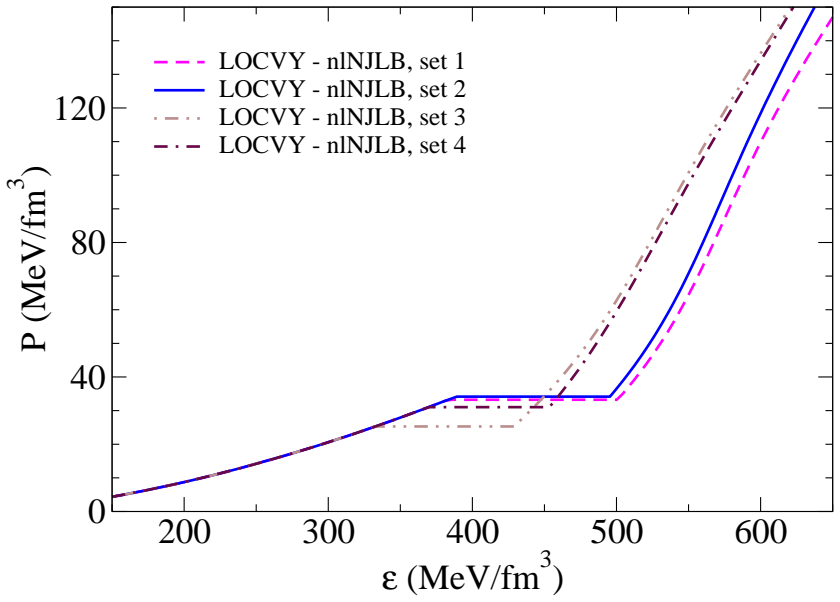
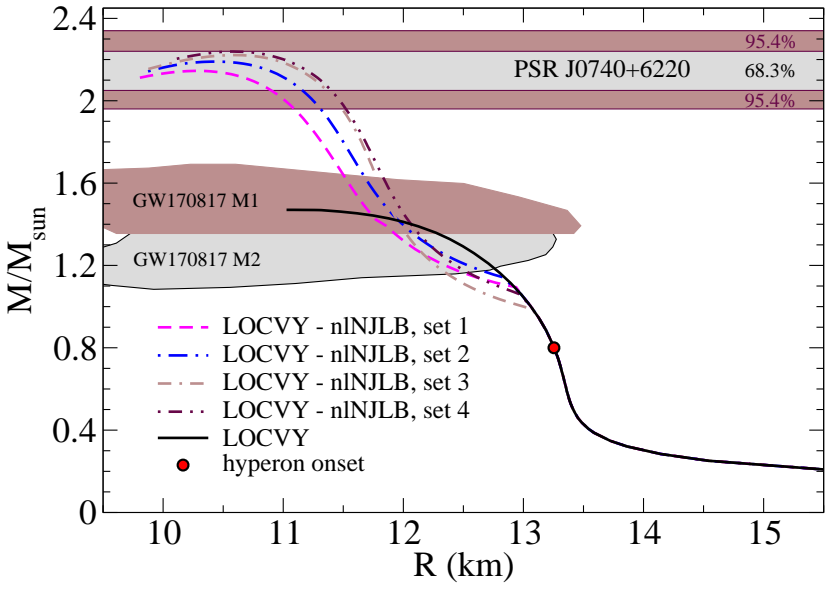
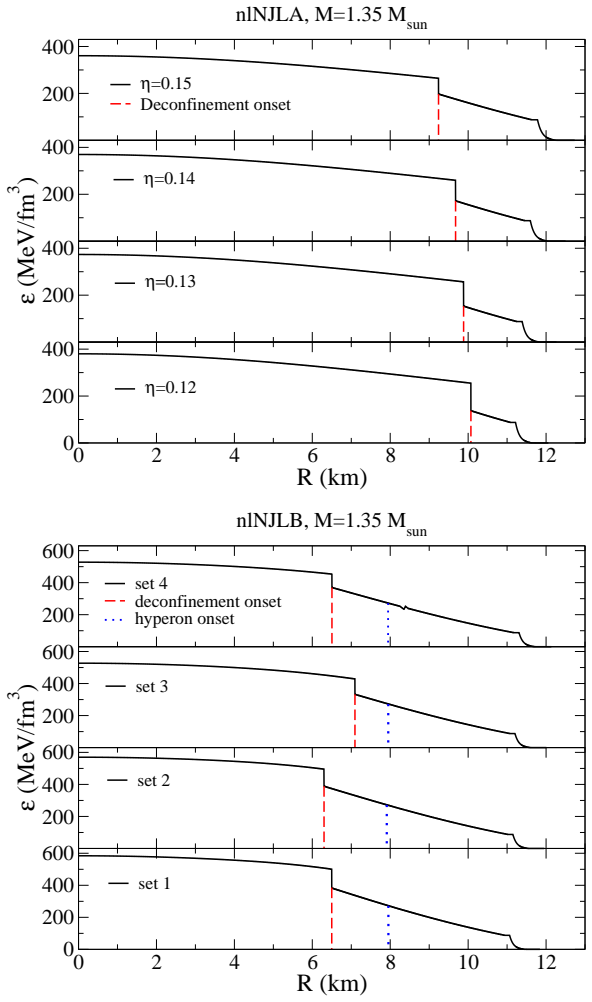
On the paper's own terms, the discovery is that the quark matter model determines whether deconfinement pre-empts strangeness or coexists with it. With the constant-coupling model nlNJLA, the hadron-quark pressure crossing lies below the hyperon threshold, so quark matter replaces nuclear matter directly. With the generalized model nlNJLB, whose bag pressure and vector coupling depend on density, the crossing shifts to roughly 1090 to 1110 MeV, above the hyperon onset at 1063 MeV; the result is a hybrid star equation of state with an intermediate hypernuclear phase between the nuclear outer core and the color-superconducting quark inner core. This equation of state reaches maximum masses up to 2.2 solar masses, above the one-sigma PSR J0740+6620 lower bound, while radii comply with the GW170817-derived constraints: a 1.6-solar-mass star must have radius above 10.7 km and a 1.4-solar-mass star below 13.6 km. All stars in the observed mass range from about 1.2 to 2.2 solar masses would then contain a hypernuclear shell around a quark core.
Load-bearing premise
The paper's new hypernuclear layer lives in a chemical-potential window between the hyperon onset near 1063 MeV and the deconfinement transition near 1090 to 1110 MeV, while Section II A itself says the hadronic equation of state should not be applied above about 1050 MeV. If that hadronic model is not reliable in this window, or if treating hyperons as noninteracting particles shifts the onset, the intermediate phase may disappear.
Editorial extensions
If this is right
- If the nlNJLB hybrid equation of state is right, the maximum mass of a compact star is about 2.2 solar masses, satisfying the PSR J0740+6620 lower limit.
- Neutron stars in the observed mass range, about 1.2 to 2.2 solar masses, would contain three matter layers: a nuclear outer core, a hypernuclear shell, and a color-superconducting quark inner core.
- Quark deconfinement would begin already at star masses between about 0.99 and 1.14 solar masses, so quark cores would be common rather than limited to the most massive stars.
- For isospin-symmetric matter, the model predicts a deconfinement onset between 2.2 and 2.7 times nuclear saturation density for all nlNJLB parameter sets, a target range for future heavy-ion collision experiments.
- Because the energy-density jump at the transition is not large enough, this class of models does not produce a disconnected third family of stable hybrid stars.
Reading between the lines
- The intermediate hypernuclear layer is the paper's most fragile outcome: it occupies the chemical-potential region where the hadronic model is stated to lose validity, so a hadronic treatment with interacting hyperons is the natural check that could erase it.
- If the layered structure is real, it should leave a distinctive mass-radius signature near 1.4 to 1.6 solar masses, where the hypernuclear shell softens the equation of state before the quark core stiffens it; current and future radius measurements can look for this nonmonotonic behavior.
- The density-dependent bag pressure acts as a phenomenological stand-in for confinement, and independent information about the quark matter speed of sound from gravitational-wave or radius data would test whether this mechanism is the right one.
- The predicted symmetric-matter onset of 2.2 to 2.7 times nuclear saturation density is a concrete target for collision experiments, but a fair comparison will require the finite-temperature extension that the paper says is still to be built.
Signed reviews
Editorial analysis
A structured set of objections, weighed in public.
Referee Report
Summary. The paper constructs hybrid compact-star equations of state by combining the LOCV hypernuclear hadronic EoS with a color-superconducting nonlocal NJL quark-matter EoS, using a Maxwell construction for the deconfinement transition. Two quark-model variants are considered: nlNJLA with constant couplings, and nlNJLB with density-dependent vector coupling and bag pressure, the latter matched to a constant-speed-of-sound extrapolation at high density. The authors find that nlNJLA deconfines before hyperon onset, whereas their four nlNJLB parameter sets produce deconfinement after hyperon onset, leading to stars with an intermediate hypernuclear shell and maximum masses up to about 2.2 Msun. They interpret this as a viable solution of the hyperon puzzle under the PSR J0740+6620 and GW170817 constraints, and additionally discuss the deconfinement transition in isospin-symmetric matter for heavy-ion applications.
Significance. If the central result is robust, the paper provides a concrete, observationally constrained scenario in which massive hybrid stars contain a layered structure of nuclear matter, hypernuclear matter, and color-superconducting quark matter, and it connects this scenario to measurable deconfinement transition densities in symmetric matter. The work is timely, clearly structured, and transparent about the model dependence through four parameter sets. Its main strength is the demonstration that a sufficiently stiff quark-matter EoS with a delayed first-order transition can satisfy the 2 Msun constraint even when hyperons soften the hadronic phase. However, the most novel claim, the existence of an intermediate hypernuclear phase, relies on the LOCVY EoS in a regime where the authors themselves caution against its use, and the quantitative maximum-mass value depends on a CSS extrapolation whose parameters are not systematically varied.
major comments (4)
- [Section II A and Fig. 8] The central new result, the intermediate hypernuclear phase in model nlNJLB, is obtained by applying the LOCVY hadronic EoS in the chemical-potential window from hyperon onset at mu = 1063 MeV to the deconfinement transition at roughly 1090-1110 MeV, yet the paper states in Section II A that the LOCVY EoS should not be applied when the chemical potential exceeds about 1050 MeV and that hyperons are treated as non-interacting particles. This is exactly the window in which the claimed new phase lives, so the existence of the hypernuclear shell is not established unless the authors demonstrate robustness against the identified limitations, for example by including repulsive hyperon mean fields or by varying the YN interaction and showing that the crossing point and the layer structure survive.
- [Section IV, Figs. 6 and 7] The quantitative statement that the maximum mass reaches about 2.2 Msun is obtained after replacing the nlNJLB EoS with a constant-speed-of-sound extrapolation above the matching point epsilon = 690 MeV/fm3, but the paper does not report the value of c_s^2 used in the extrapolation or the sensitivity of M_max to the matching point and to c_s^2. Since this extrapolated EoS determines the maximum mass, the authors should provide such a sensitivity analysis or explicitly state that the 2.2 Msun value is a consequence of the CSS assumption rather than a prediction of the underlying quark model.
- [Abstract and Introduction (Ref. [27])] The abstract claims that model nlNJLB provides 'for the first time' a hybrid star EoS with an intermediate hypernuclear matter phase between nuclear and color-superconducting quark matter, but the introduction itself describes Ref. [27] as having shown that a compact-star structure with a hypernuclear shell and a color-superconducting quark core is possible while fulfilling the 2 Msun constraint. The novelty claim therefore appears to conflict with the authors' own cited literature and needs to be clarified or qualified, for instance by specifying that the present work is the first to obtain this structure with the LOCVY and generalized nlNJL combination.
- [Section II B, Eqs. (21)-(24) and Table I] The appearance of the intermediate hypernuclear phase is controlled by the choice of the switching parameters mu_<, Gamma_<, mu_<<, Gamma_<< and the couplings eta_<, eta_> in the density-dependent nlNJLB model, with mu_< values near 1070-1090 MeV placed close to the hyperon onset. The paper should make explicit that the intermediate phase is a consequence of this parameter choice rather than an inevitable prediction of the model, and should show how the phase structure changes when mu_< is varied across the hyperon-onset window.
minor comments (4)
- [Section II A, Eq. (20)] The text states f_pi = 0.093 MeV for the pion decay constant, which appears to be a typo; the intended value is likely 0.093 GeV or 93 MeV, since the combination f_pi^2 M_pi^2 in the denominator would otherwise have incorrect dimensions.
- [Fig. 10 caption] The figure caption and axis label contain 'PSR J0740+6220', which should read PSR J0740+6620 as in the abstract and the rest of the paper.
- [Section IV, paragraph after Fig. 10] There is a typo in 'sufficiently large jump in the energy density tat the deconfinement transition'; 'tat' should be 'at'.
- [Section II B, paragraph after Eq. (8)] The word 'wich' in 'a covariant formfactor wich accounts' should be 'which'.
Circularity Check
No significant circularity: the intermediate hypernuclear phase is a computed model outcome; the flagged LOCVY validity and CSS matching issues are extrapolation risks, not circular reductions.
full rationale
The paper's derivation chain is a two-phase model study: it takes the LOCVY hadronic EoS (from the authors' prior variational calculations), the nlNJL quark EoS with density-dependent coefficients (introduced in Ref. [33] and calibrated to the density-functional quark matter approach of Ref. [42]), applies a Maxwell construction, and solves the TOV equations. The claimed new intermediate hypernuclear phase is a computed consequence of the chosen Table I parameters, not a quantity that was fitted to produce itself: no step in Eqs. (19)-(24) or in the TOV integration uses the existence of the intermediate hypernuclear phase as an input. The switching parameters µ< = 1070-1090 MeV are model inputs adopted from prior work, and they are indeed larger than the hyperon onset at 1063 MeV, which makes the appearance of an intermediate phase plausible; however, the actual deconfinement crossing is still determined by the pressure equality P_H = P_Q, and the paper explicitly contrasts model nlNJLA, where no such phase is realized, to display the model sensitivity. The self-citations to Refs. [33] and [42] supply an openly adopted phenomenological quark EoS, not a hidden theorem; the tanh-interpolation ansatz for η(µ) and B(µ) is stated explicitly in Eqs. (21)-(24). The manuscript also flags its own limitations: in Section II A it states that 'we should abstain from applying' the LOCVY EoS 'when the chemical potential exceeds about 1050 MeV', even though the intermediate phase resides in the 1063-1110 MeV window, and it notes that the CSS matching point is 'a matter of choice'. These are extrapolation and correctness risks, not circular reductions: they weaken the robustness of the central new claim but do not make it equivalent to its inputs. No quoted equation reduces to its own input by construction, and no fitted parameter is renamed as a prediction. Therefore the paper shows no significant circularity.
Assumptions & free parameters
free parameters (6)
- Vector coupling eta in model nlNJLA =
0.12, 0.13, 0.14, 0.15
- Bag pressure constant B in model nlNJLB =
20, 25, 30, 30 MeV/fm3 for sets 1-4
- Low-density vector coupling eta_< (nlNJLB) =
0.05 (sets 1, 2), 0.07 (sets 3, 4)
- High-density vector coupling eta_> (nlNJLB) =
0.09, 0.12, 0.12, 0.16 for sets 1-4
- Switching scales and widths (mu_<, Gamma_<, mu_<<, Gamma_<<) =
mu_< = 1070-1090 MeV, Gamma_< = 150-170 MeV, mu_<< = 1500-1600 MeV, Gamma_<< = 270-300 MeV
- CSS matching energy density epsilon_CSS =
690 MeV/fm3
assumptions (6)
- ad hoc to paper The LOCVY hadronic EoS is used in a chemical potential range where the paper itself declares it invalid (above about 1050 MeV).
- domain assumption Hyperons in the hadronic phase are treated as non-interacting particles.
- domain assumption After deconfinement, the hadronic EoS is no longer considered, so reconfinement crossings are ignored (no reconfinement paradigm).
- domain assumption The quark matter EoS is restricted to two flavors (u,d) and contains no strange quarks.
- domain assumption The nlNJL mean-field model with a diquark condensate adequately describes cold deconfined quark matter at neutron star densities.
- standard math Standard general relativity (TOV equations) and the chosen crust EoS describe the star's structure.
Cite this review
Pith. "Pith review of First-order phase transition from hypernuclear matter to deconfined quark matter obeying new constraints from compact star observations." pith.science (2026). https://pith.science/paper/D6XOQ7G5
@misc{pith2026190804740,
  author       = {Pith},
  title        = {Pith review of: First-order phase transition from hypernuclear matter to deconfined quark matter obeying new constraints from compact star observations},
  year         = {2026},
  howpublished = {\url{https://pith.science/paper/D6XOQ7G5}},
  note         = {Machine review of arXiv:1908.04740}
}
abstract
We reconsider the problem of the hyperon puzzle and its suggested solution by quark deconfinement within the two-phase approach to hybrid compact stars with recently obtained hadronic and quark matter equations of state. For the hadronic phase we employ the hypernuclear equation of state from the lowest order constrained variational method and the quark matter phase is described by a sufficiently stiff equation of state based on a color superconducting nonlocal Nambu-Jona-Lasinio model with constant (model nlNJLA) and with density-dependent (model nlNJLB) parameters. We study the model dependence of the phase transition obtained by a Maxwell construction. Our study confirms that also with the present set of equations of state quark deconfinement presents a viable solution of the hyperon puzzle even for the new constraint on the lower limit of the maximum mass from PSR J0740+6620. In this work we provide with model nlNJLB for the first time a hybrid star EoS with an intermediate hypernuclear matter phase between the nuclear and color superconducting quark matter phases, for which the maximum mass of the compact star reaches $2.2~M_\odot$, in accordance with most recent constraints. In model nlNJLA such a phase cannot be realised because the phase transition onset is at low densities, before the hyperon threshold density is passed. We discuss possible consequences of the hybrid equation of state for the deconfinement phase transition in symmetric matter as it will be probed in future heavy-ion collisions at FAIR, NICA and corresponding energy scan programs at the CERN and RHIC facilities.
Figures


Figures from the paper (11 more)



Reference graph
Works this paper leans on
-
[27]
A. Mukherjee, S. Schramm, J. Steinheimer and V. Dexheimer, Astron. Astrophys. 608 (2017) A110
work page 2017
-
[1]
a microscopic method in configuration space which is purely variational
-
[2]
simply generalizable to finite temperature
-
[3]
In fact, the two-body energy in LOCV method is a functional of correlation function
correlation functions for baryon-baryon interactions as well as structure functions which are important quantities of interest in scattering studies, are obtained directly 7 in our formulation. In fact, the two-body energy in LOCV method is a functional of correlation function. Thus, by a minimization of the energy with respect to the correlation function...
-
[4]
tensor correlation functions are employed
-
[5]
considering Eq.(4), the energy per baryon and correlation functions are state-dependent and can be obtained for each state which is defined by α ={J,L,S,T,T z,s}
-
[6]
Recently, we have extended the work of Goudarzi et al
numerical calculations are not a time consuming, so that they can be performed on standard desktop or laptop computers. Recently, we have extended the work of Goudarzi et al. [58] by including hyperons, and studied the composition and EoS of a charged neutral, equilibrated mixture of neutrons, protons, electrons, muons, free Σ− as well as Λ hyperons at ze...
-
[7]
Γfψ(x− z 2), (6) ja D(x) = ∫ d4z g(z) ¯ψC(x + z
Show all 86 references
-
[8]
(7) jµ V (x) = ∫ d4z g(z) ¯ψ(x + z
-
[9]
The function g(z) in Eqs
iγµ ψ(x− z 2), (8) whereψC(x) =γ2γ4 ¯ψT (x), Γf = (11,iγ 5⃗ τ) and ΓD =iγ5τ2λa, while⃗ τandλa, witha = 2, 5, 7, stand for Pauli and Gell-Mann matrices acting on flavor and color spaces, respectively. The function g(z) in Eqs. (8) is a covariant formfactor wich accounts for the ...
-
[10]
A. W. Steiner, J. M. Lattimer and E. F. Brown, Astrophys. J. 722 (2010) 33
2010
-
[11]
H. T. Cromartie et al. , Nature Astron. 3 (2019) 439; arXiv:1904.06759. 21
2019 arXiv
-
[12]
B. P. Abbott et al. [LIGO Scientific and Virgo Collaborations], Phys. Rev. Lett. 119 (2017) no.16, 161101
2017
-
[13]
Bauswein, O
A. Bauswein, O. Just, H. T. Janka and N. Stergioulas, Astrophys. J. 850 (2017) no.2, L34
2017
-
[14]
Annala, T
E. Annala, T. Gorda, A. Kurkela and A. Vuorinen, Phys. Rev. Lett. 120 (2018) no.17, 172703
2018
-
[15]
V. A. Ambartsumyan and G. S. Saakyan, Soviet Astronomy 4 (1960) no. 2, 187
1960
-
[16]
Baldo, G
M. Baldo, G. F. Burgio and H. J. Schulze, Phys. Rev. C 58 (1998) 3688
1998
-
[17]
Baldo, G
M. Baldo, G. F. Burgio and H. J. Schulze, Phys. Rev. C 61 (2000) 055801
2000
-
[18]
Shahrbaf and H
M. Shahrbaf and H. R. Moshfegh, Annals Phys. 402 (2019) 66
2019
-
[19]
Yamamoto, T
Y. Yamamoto, T. Furumoto, N. Yasutake and T. A. Rijken, Eur. Phys. J. A 52 (2016) no.2, 19
2016
-
[20]
E. N. E. van Dalen, G. Colucci and A. Sedrakian, Phys. Lett. B 734 (2014) 383
2014
-
[21]
K. A. Maslov, E. E. Kolomeitsev and D. N. Voskresensky, Phys. Lett. B 748 (2015) 369
2015
-
[22]
K. A. Maslov, E. E. Kolomeitsev and D. N. Voskresensky, Nucl. Phys. A 950 (2016) 64
2016
-
[23]
J. J. Li, A. Sedrakian and F. Weber, Phys. Lett. B 783 (2018) 234
2018
-
[24]
Provid´ encia, M
C. Provid´ encia, M. Fortin, H. Pais and A. Rabhi, Front. Astron. Space Sci. 6 (2019) 13
2019
-
[25]
Drago, A
A. Drago, A. Lavagno, G. Pagliara and D. Pigato, Phys. Rev. C 90 (2014) no.6, 065809
2014
-
[26]
Vida˜ na, M
I. Vida˜ na, M. Bashkanov, D. P. Watts and A. Pastore, Phys. Lett. B 781 (2018) 112
2018
-
[28]
Marczenko, D
M. Marczenko, D. Blaschke, K. Redlich and C. Sasaki, Phys. Rev. D 98 (2018) no.10, 103021
2018
-
[29]
Marczenko, D
M. Marczenko, D. Blaschke, K. Redlich and C. Sasaki, Universe 5 (2019) 180
2019
-
[30]
Weber, Prog
F. Weber, Prog. Part. Nucl. Phys. 54 (2005) 193
2005
-
[31]
G. F. Burgio, M. Baldo, P. K. Sahu and H. J. Schulze, Phys. Rev. C 66 (2002) 025802
2002
- [32]
-
[33]
Kl¨ ahn, D
T. Kl¨ ahn, D. Blaschke, F. Sandin, C. Fuchs, A. Faessler, H. Grigorian, G. R¨ opke and J. Tr¨ umper, Phys. Lett. B654 (2007) 170
2007
-
[34]
Blaschke, S
D. Blaschke, S. Fredriksson, H. Grigorian, A. M. Oztas and F. Sandin, Phys. Rev. D 72 (2005) 065020
2005
-
[35]
Typel, G
S. Typel, G. R¨ opke, T. Kl¨ ahn, D. Blaschke and H. H. Wolter, Phys. Rev. C81 (2010) 015803
2010
-
[36]
Lastowiecki, D
R. Lastowiecki, D. Blaschke, H. Grigorian and S. Typel, Acta Phys. Polon. Supp. 5 (2012) 535. 22
2012
-
[37]
Bonanno and A
L. Bonanno and A. Sedrakian, Astron. Astrophys. 539 (2012) A16
2012
-
[38]
G. A. Lalazissis, J. K¨ onig and P. Ring, Phys. Rev. C 55 (1997) 540
1997
-
[39]
G. A. Lalazissis, T. Niksic, D. Vretenar and P. Ring, Phys. Rev. C 71 (2005) 024312
2005
-
[40]
Colucci and A
G. Colucci and A. Sedrakian, Phys. Rev. C 87 (2013) 055806
2013
-
[41]
Shahrbaf, H
M. Shahrbaf, H. R. Moshfegh and M. Modarres, Phys. Rev. C 100, no. 4, 044314 (2019)
2019
-
[42]
D. E. Alvarez-Castillo, D. B. Blaschke, A. G. Grunfeld and V. P. Pagura, Phys. Rev. D 99 (2019) no.6, 063010
2019
-
[43]
Povh and J
B. Povh and J. H¨ ufner, Phys. Lett. B245, 653 (1990)
1990
-
[44]
G. E. Brown and M. Rho, Phys. Rev. Lett. 66, 2720 (1991)
1991
-
[45]
Jankowski, D
J. Jankowski, D. Blaschke and M. Spalinski, Phys. Rev. D 87, no. 10, 105018 (2013)
2013
-
[46]
Aarts, C
G. Aarts, C. Allton, D. De Boni, S. Hands, B. J¨ ager, C. Praki and J. I. Skullerud, JHEP 1706, 034 (2017)
2017
-
[47]
Marczenko, D
M. Marczenko, D. Blaschke, K. Redlich and C. Sasaki, Phys. Rev. D 98, no. 10, 103021 (2018)
2018
-
[48]
Ayriyan, D
A. Ayriyan, D. Alvarez-Castillo, D. Blaschke and H. Grigorian, Universe 5 (2019) no.2, 61
2019
-
[49]
Gomez Dumm, D
D. Gomez Dumm, D. B. Blaschke, A. G. Grunfeld and N. N. Scoccola, Phys. Rev. D 73 (2006) 114019
2006
-
[50]
D. B. Blaschke, D. Gomez Dumm, A. G. Grunfeld, T. Kl¨ ahn and N. N. Scoccola, Phys. Rev. C 75 (2007) 065804
2007
-
[51]
M. A. R. Kaltenborn, N. U. F. Bastian and D. B. Blaschke, Phys. Rev. D 96 (2017) no.5, 056024
2017
-
[52]
U. H. Gerlach, Phys. Rev. 172 (1968) 1325
1968
-
[53]
M. G. Alford, S. Han and M. Prakash, Phys. Rev. D 88 (2013) no.8, 083013
2013
-
[54]
N. K. Glendenning and C. Kettner, Astron. Astrophys. 353 (2000) L9
2000
-
[55]
Blaschke, D
D. Blaschke, D. E. Alvarez-Castillo and S. Benic, PoS CPOD 2013 (2013) 063
2013
-
[56]
Benic, D
S. Benic, D. Blaschke, D. E. Alvarez-Castillo, T. Fischer and S. Typel, Astron. Astrophys. 577 (2015) A40
2015
-
[57]
D. E. Alvarez-Castillo and D. B. Blaschke, Phys. Rev. C 96 (2017) no.4, 045809
2017
-
[58]
J. C. Owen, R. F. Bishop and J. M. Irvine, Nucl. Phys. A 277 (1977) 45
1977
-
[59]
Modarres and J
M. Modarres and J. M. Irvine, J. Phys. G 5 (1979) 511
1979
-
[60]
G. H. Bordbar and M. Modarres, Phys. Rev. C 57 (1998) 714
1998
-
[61]
Modarres and G
M. Modarres and G. H. Bordbar, Phys. Rev. C 58 (1998) 2781. 23
1998
-
[62]
Modarres and H
M. Modarres and H. R. Moshfegh, Phys. Rev. C 62 (2000) 044308
2000
-
[63]
H. R. Moshfegh and M. Modarres, Nucl. Phys. A 759 (2005) 79
2005
-
[64]
H. R. Moshfegh and M. Modarres, Nucl. Phys. A 792 (2007) 201
2007
-
[65]
Hiyama, Y
E. Hiyama, Y. Yamamoto, T. A. Rijken and T. Motoba, Phys. Rev. C 74 (2006) 054312
2006
-
[66]
Hiyama, M
E. Hiyama, M. Kamimura, T. Motoba, T. Yamada and Y. Yamamoto, Phys. Rev. C 66 (2002) 024007
2002
-
[67]
Goudarzi and H
S. Goudarzi and H. R. Moshfegh, Phys. Rev. C 91 (2015) no.5, 054320, Erratum: [Phys. Rev. C 96 (2017) no.4, 049902]
2015
-
[68]
Goudarzi and H
S. Goudarzi and H. R. Moshfegh, Nucl. Phys. A 985, (2019) 1
2019
-
[69]
Modarres and H
M. Modarres and H. R. Moshfegh, Physica A, 388 (2009) 3297
2009
-
[70]
Modarres, H
M. Modarres, H. R. Moshfegh, and A. Sepahvand, Eur. Phys. J. B, 31 (2003) 159
2003
-
[71]
Akmal, V
A. Akmal, V. R. Pandharipande and D. G. Ravenhall, Phys. Rev. C 58 (1998) 1804
1998
-
[72]
H. R. Moshfegh and S. Zaryouni, Eur. Phys. J. A 43 (2010) 283; 45 (2010) 69
2010
-
[73]
R. B. Wiringa, V. G. J. Stoks and R. Schiavilla, Phys. Rev. C 51 (1995) 38
1995
-
[74]
Masuda, T
K. Masuda, T. Hatsuda and T. Takatsuka, PTEP 2013 (2013) no.7, 073D01
2013
-
[75]
Asakawa and T
M. Asakawa and T. Hatsuda, Phys. Rev. D 55 (1997) 4488
1997
-
[76]
Blaschke, D
D. Blaschke, D. E. Alvarez Castillo, S. Benic, G. Contrera and R. Lastowiecki, PoS Confine- mentX (2012) 249
2012
-
[77]
J. L. Zdunik and P. Haensel, Astron. Astrophys. 551 (2013) A61
2013
-
[78]
M. G. Alford and S. Han, Eur. Phys. J. A 52 (2016) no.3, 62
2016
-
[79]
Paschalidis, K
V. Paschalidis, K. Yagi, D. Alvarez-Castillo, D. B. Blaschke and A. Sedrakian, Phys. Rev. D 97 (2018) no.8, 084038
2018
-
[80]
M. G. Alford and A. Sedrakian, Phys. Rev. Lett. 119 (2017) no.16, 161104
2017
-
[81]
R. C. Tolman, Phys. Rev. 55 (1939) 364
1939
-
[82]
J. R. Oppenheimer and G. M. Volkoff, Phys. Rev. 55 (1939) 374
1939
-
[83]
J. W. Negele and D. Vautherin, Nucl. Phys. A 207 (1973) 298
1973
-
[84]
B. K. Harrison, K. S. Thorne, M. Wakano, J. A. Wheeler, Gravitation Theory and Gravita- tional Collapse, University of Chicago Press, Chicago, 1965
1965
-
[85]
Bauswein, N
A. Bauswein, N. U. F. Bastian, D. B. Blaschke, K. Chatziioannou, J. A. Clark, T. Fischer and M. Oertel, Phys. Rev. Lett. 122 (2019) no.6, 061102
2019
-
[86]
Fischer et al
T. Fischer et al. , Nat. Astron. 2 (2018) no.12, 980. 24 950 1000 1050 1100 1150 1200 μ (MeV) 20 40 60 80 P (MeV/fm 3 ) upper limit for the chemical potential where a Maxwell construction between both phases makes sense for nlNJLA nlNJLA, η =0.05 nlNJLA, η =0.07 nlNJLA, η =0.0...
2018
Reviewed August 14, 2026 · model on record in the stance chip above.
Discussion (0). Continue with ORCID to comment.