REVIEW 3 major objections 5 minor 72 references
DetailMaster: Can Your Text-to-Image Model Handle Long Prompts?
T0 review · 3 major / 5 minor · reviewed 2026-08-07 · deepseek-v4-flash
Pith's one-line read DetailMaster: top image models fail half of long-prompt details.
desk verdict A genuinely useful long-prompt benchmark, but the headline accuracy numbers are not yet calibrated to human perception. read the letter →
The pith
A machine-rendered reading of the paper's core claim, the machinery that carries it, and where it could break.
The reading
What carries the argument
The central machinery is the DetailMaster benchmark itself. An automated pipeline takes human-annotated captions, identifies main characters, localizes them via an MLLM and an open-set detector, and converts bounding boxes into nine-region spatial descriptions. It then extracts character attributes, scene attributes, and entity relationships, and uses an LLM to fold all extracted features into polished long prompts. The evaluation protocol runs each prompt through a text-to-image model, detects the characters in the generated image, and asks an MLLM for binary yes/no judgments on every extracted attribute, location, scene property, and relationship, yielding four accuracy scores per model.
What would settle it
Take a random sample of DetailMaster images, ask human raters the same binary attribute, location, and relationship questions that the automated evaluator was asked, and compare the accuracy scores. If human scores for state-of-the-art models are substantially above 50% or the negative correlation with prompt length disappears, the paper's central quantitative claims are refuted.
Extended reading notes
Core claim
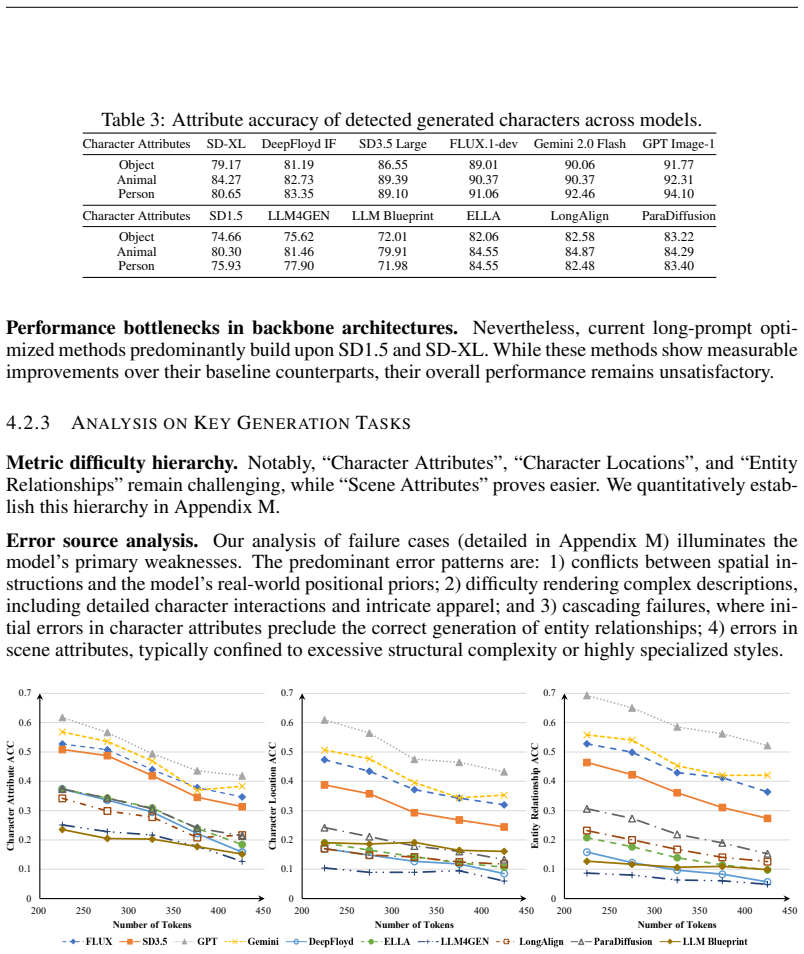
On its own terms, the paper establishes a capability gap: long-prompt text-to-image generation is a distinct skill that current models have not mastered. Evaluations across four dimensions—character attributes, structured character locations, multi-dimensional scene attributes, and spatial/interactive relationships—reveal a consistent difficulty hierarchy, with scene attributes rendered reliably while fine-grained character details, positions, and inter-entity relations hover near 50% accuracy even for proprietary state-of-the-art models. The benchmark's controlled comparisons show that while expanding the context window helps somewhat, the larger gains come from explicit long-prompt training and iterative decomposition, not from token capacity alone.
Load-bearing premise
The paper's quantitative conclusions hinge on the assumption that the automated vision-language evaluator's binary judgments correctly decide whether each attribute, location, and relationship is truly rendered in the generated image; the authors' own cross-check with a different evaluator shifts absolute scores by 10 to 20 points while preserving model rankings.
Editorial extensions
If this is right
- Models that train on long, detailed prompts gain more from that training than from simply admitting more tokens, so collecting and curating long-caption datasets becomes a direct path to better prompt adherence.
- The negative correlation between prompt length and adherence means that 'longer prompt, more failure' is a measurable property of current systems, not a user-perception artifact.
- The difficulty hierarchy—scene attributes easiest, character locations hardest—gives model developers a clear priority list of failure modes to fix.
- Because the benchmark ships with detection and evaluation code, models can be compared on identical long-prompt tasks, making improvements reproducible and attributable.
Reading between the lines
- If long-prompt training is the dominant lever, automatically scaling up curated long-caption datasets may improve prompt adherence faster than architectural innovations—a testable extension the paper's discussion gestures toward.
- The roughly 50% ceiling on attributes and relationships implies that for strict multi-object tasks, professional pipelines will need external verification or human-in-the-loop checks regardless of which model is chosen.
- A natural follow-up experiment is to check whether DetailMaster scores predict success on downstream tasks like visual storytelling or diagram generation, which would connect benchmark numbers to real-world utility.
- The paper's error analysis suggests spatial conflicts with real-world priors and cascading attribute errors are separate failure mechanisms; isolating them in controlled prompts could let researchers attribute a model's failures to one cause or the other.
Editorial analysis
A structured set of objections, weighed in public.
Referee Report
Summary. The paper proposes DetailMaster, a benchmark of 4,116 detail-rich prompts averaging 284.89 tokens, derived from human-annotated captions (DOCCI and Localized Narratives) and refined through an automated pipeline that extracts character attributes, structured character locations, scene attributes, and entity relationships. The evaluation protocol uses Qwen2.5-VL-7B as the primary MLLM judge, with auxiliary open-set detection and bounding-box validation. The authors evaluate 7 general-purpose and 5 long-prompt-optimized text-to-image models, report that even state-of-the-art models achieve only roughly 50% accuracy on character attributes, character locations, and entity relationships, observe a negative correlation between prompt length and adherence, and argue that long-prompt training is more important than expanded token capacity. The dataset, code, and a smaller mini-benchmark are released.
Significance. If the absolute accuracy numbers are properly calibrated, DetailMaster would be a valuable community resource: it is substantially larger and longer than existing long-prompt benchmarks (Table 1), its construction is grounded in human-annotated captions and auxiliary open-set detection, and the authors provide open-source code, a mini-benchmark, and a reproducible evaluation pipeline. The cross-evaluator analysis in Appendix I is a genuine strength: Kendall's tau values between 0.88 and 1.0 show that model rankings are stable under a different MLLM evaluator. The main open risk is that the headline absolute scores, including the '~50%' claim, rest on a single MLLM evaluator whose judgments have not been calibrated against human perception on generated images. The 'controlled ablation study' claim is also overstated, since the long-prompt-optimized model comparison is observational across different architectures and backbones rather than a controlled experiment.
major comments (3)
- [§3.2.3, §4.2.1, Appendix I (Table 9)] The absolute accuracy values, including the headline claim that SOTA models achieve only ~50% accuracy on character attributes, character locations, and entity relationships, are not calibrated against human judgments on generated images. Replacing Qwen2.5-VL-7B with InternVL3-9B changes FLUX.1-dev Character Attributes (Object) from 51.47 to 71.42 and GPT Image-1 Entity Relationships from 63.07 to 82.51, a 10–20 point shift. The high Kendall's tau values show that rankings are stable, but they do not determine which evaluator's absolute scale is correct. The human evaluation in Section 5.2 and Appendix G validates prompt/annotation fidelity to source images, not the binary judgments about generated images. The 50% figure and the magnitude of length-dependent degradation in Section 4.3 therefore rest on an unvalidated evaluator scale. Please add a human-validation study on a sample of generated images, or report accuracy ranges across evaluators rather than a single absolute scale.
- [Abstract, §4.2.2] The abstract's 'controlled ablation study' is not a controlled ablation. The comparison among LLM4GEN, ELLA, ParaDiffusion, LongAlign, and LLM Blueprint varies architecture, backbone (SD1.5 vs. SD-XL), text encoder, training data, and token limits simultaneously. For example, the ParaDiffusion-vs-DeepFloyd comparison changes both the encoder family and the training regime, so the claim that long-prompt training matters more than increasing token capacity is confounded. Please either reframe this as a comparative analysis with explicitly stated confounds, or run controlled experiments that vary token capacity and long-prompt training on the same architecture.
- [§4.2.2, §4.3, Appendix M] The causal mechanism claims—namely that 'weak encoders flatten syntactic dependencies' and 'diffusion models suffer from attribute leakage'—are not directly tested by the experiments. The authors acknowledge in the Discussion that direct causal validation remains open, which is appropriate, but the phrasing in the abstract and Section 4.3 ('reveals fundamental limitations in compositional reasoning... encoders flatten complex grammatical structures') overstates what the benchmark can establish. The comparisons show correlations and failure patterns, not mechanisms. Please soften these statements or add targeted analyses, such as comparing encoder representations or intervening on prompt structure while holding the model fixed.
minor comments (5)
- [§4.1] The experimental setup refers to 'GPT-4o' as the proprietary image generation model, but the rest of the paper consistently uses 'GPT Image-1'; please unify the naming.
- [§5.2] The text states that 50 samples are selected from each evaluation task, for a total of 400, but there are four evaluation tasks, which would give 200 samples. If additional subcategories (object/animal/person, background/light/style) are intended, please state that explicitly.
- [Table 1] The header contains a typo: 'Enitity Relationships' should be 'Entity Relationships'.
- [References] The GPT-4 technical report appears twice as entries 2023a and 2023b with identical author lists, and the HPS v2 paper appears twice as 2023b and 2023c; these duplicates should be removed.
- [§4.3, Figures 3 and 6] The negative-correlation claim would be stronger with per-model spread or statistical significance testing; the current figures appear to show only aggregate trend lines over binned token lengths.
Circularity Check
No significant circularity: the benchmark's evaluation targets are grounded in human-annotated captions and auxiliary detectors, and the performance findings are empirical measurements rather than consequences of the construction choices.
full rationale
The paper's central claims are empirical evaluations of T2I models on long prompts. The attribute lists, locations, scene attributes, and relationships used both as prompt content and as evaluation targets are extracted from source images and human-annotated captions (DOCCI, Localized Narratives) with auxiliary open-set detection, cropping, and human validation, so the benchmark is not defined in terms of the model outputs it predicts. The use of Qwen2.5-VL for both data curation and evaluation is a potential self-consistency risk, but the paper breaks the loop by grounding curation in non-LLM tools and by re-evaluating with InternVL3-9B (Appendix I), which preserves rankings (Kendall's tau 0.88-1.0); score inflation under a different evaluator is a calibration and validity limitation, not a circular reduction. The comparisons in Section 4.2.2 are cross-model comparisons rather than a true controlled ablation, but that is an overclaim about experimental control, not circularity. Self-citations (Data-Juicer in Section 3.1.1; Jiao et al. 2024 and Xu et al. 2025 in Appendix I) are incidental and not load-bearing for the benchmark conclusions.
Assumptions & free parameters
free parameters (5)
- Minimum character count filter =
>4 main characters
- IoU threshold for bounding box selection =
0.7
- BLIP matching score threshold =
0.4
- Spatial partition overlap coverage threshold =
75%
- Minimum character-level attributes filter =
4
assumptions (4)
- domain assumption Human-annotated captions from DOCCI and Localized Narratives provide accurate ground-truth descriptions of the source images.
- domain assumption Qwen2.5-VL-7B and YOLOE-11L provide reliable enough object detection and localization for annotation and evaluation.
- domain assumption MLLM binary judgments are a valid measure of text-image compositional fidelity.
- ad hoc to paper The nine-region spatial partition is a meaningful representation of spatial relationships for evaluation.
Cite this review
Pith. "Pith review of DetailMaster: Can Your Text-to-Image Model Handle Long Prompts?." pith.science (2026). https://pith.science/paper/DAFSZYOI
@misc{pith2026250516915,
  author       = {Pith},
  title        = {Pith review of: DetailMaster: Can Your Text-to-Image Model Handle Long Prompts?},
  year         = {2026},
  howpublished = {\url{https://pith.science/paper/DAFSZYOI}},
  note         = {Machine review of arXiv:2505.16915}
}
read the original abstract
While recent Text-to-Image (T2I) models show impressive capabilities in synthesizing images from brief descriptions, they struggle with the long, detailed prompts required for professional applications. We present DetailMaster, a comprehensive benchmark for evaluating T2I capabilities on long prompts with complex compositional requirements, accompanied by an automated data construction pipeline and an evaluation workflow. Comprising expert-validated prompts averaging 284.89 tokens, our benchmark introduces four critical evaluation dimensions: Character Attributes, Structured Character Locations, Multi-Dimensional Scene Attributes, and Spatial/Interactive Relationships. Evaluations on various general-purpose and long-prompt-optimized models reveal critical performance limitations, showing that weak encoders struggle to preserve syntactic dependencies within prompts and diffusion models suffer from attribute leakage under detail-intensive conditions. Through a controlled ablation study under varying constraints, we further show that high-fidelity generation requires a synergistic combination of expanded prompt limits and long-prompt training. We open-source our dataset and code to foster progress in long-prompt-driven T2I generation.
Figures


Figures from the paper (5 more)


Reference graph
Works this paper leans on
-
[1]
write newline
" write newline "" before.all 'output.state := FUNCTION n.dashify 't := "" t empty not t #1 #1 substring "-" = t #1 #2 substring "--" = not "--" * t #2 global.max substring 't := t #1 #1 substring "-" = "-" * t #2 global.max substring 't := while if t #1 #1 substring * t #2 global.max substring 't := if while FUNCTION format.date year duplicate empty "emp...
-
[3]
Josh Achiam, Steven Adler, Sandhini Agarwal, Lama Ahmad, Ilge Akkaya, Florencia Leoni Aleman, Diogo Almeida, Janko Altenschmidt, Sam Altman, Shyamal Anadkat, et al. Gpt-4 technical report. arXiv preprint arXiv:2303.08774, 2023 b
arXiv 2023
-
[4]
DeepFloyd Lab at StabilityAI. DeepFloyd IF : a novel state-of-the-art open-source text-to-image model with a high degree of photorealism and language understanding. https://www.deepfloyd.ai/deepfloyd-if, 2023. Retrieved on 2023-11-08
work page 2023
-
[5]
Hrs-bench: Holistic, reliable and scalable benchmark for text-to-image models
Eslam Mohamed Bakr, Pengzhan Sun, Xiaoqian Shen, Faizan Farooq Khan, Li Erran Li, and Mohamed Elhoseiny. Hrs-bench: Holistic, reliable and scalable benchmark for text-to-image models. In Proceedings of the IEEE/CVF International Conference on Computer Vision, pp.\ 20041--20053, 2023
work page 2023
-
[6]
Improving image generation with better captions
James Betker, Gabriel Goh, Li Jing, Tim Brooks, Jianfeng Wang, Linjie Li, Long Ouyang, Juntang Zhuang, Joyce Lee, Yufei Guo, et al. Improving image generation with better captions. Computer Science. https://cdn. openai. com/papers/dall-e-3. pdf, 2 0 (3): 0 8, 2023
2023
-
[7]
A survey of ai-generated content (aigc)
Yihan Cao, Siyu Li, Yixin Liu, Zhiling Yan, Yutong Dai, Philip Yu, and Lichao Sun. A survey of ai-generated content (aigc). ACM Computing Surveys, 57 0 (5): 0 1--38, 2025
work page 2025
-
[8]
Conceptual 12m: Pushing web-scale image-text pre-training to recognize long-tail visual concepts
Soravit Changpinyo, Piyush Sharma, Nan Ding, and Radu Soricut. Conceptual 12m: Pushing web-scale image-text pre-training to recognize long-tail visual concepts. In Proceedings of the IEEE/CVF conference on computer vision and pattern recognition, pp.\ 3558--3568, 2021
2021
-
[9]
Data-juicer 2.0: Cloud-scale adaptive data processing for and with foundation models
Daoyuan Chen, Yilun Huang, Xuchen Pan, Nana Jiang, Haibin Wang, Yilei Zhang, Ce Ge, Yushuo Chen, Wenhao Zhang, Zhijian Ma, Jun Huang, Wei Lin, Yaliang Li, Bolin Ding, and Jingren Zhou. Data-juicer 2.0: Cloud-scale adaptive data processing for and with foundation models. In NeurIPS, 2025 a
work page 2025
Show all 72 references
-
[10]
Data-juicer sandbox: A feedback-driven suite for multimodal data-model co-development
Daoyuan Chen, Haibin Wang, Yilun Huang, Ce Ge, Yaliang Li, Bolin Ding, and Jingren Zhou. Data-juicer sandbox: A feedback-driven suite for multimodal data-model co-development. In ICML, 2025 b
2025
-
[11]
Expanding performance boundaries of open-source multimodal models with model, data, and test-time scaling
Zhe Chen, Weiyun Wang, Yue Cao, Yangzhou Liu, Zhangwei Gao, Erfei Cui, Jinguo Zhu, Shenglong Ye, Hao Tian, Zhaoyang Liu, et al. Expanding performance boundaries of open-source multimodal models with model, data, and test-time scaling. arXiv preprint arXiv:2412.05271, 2024
2024 arXiv
-
[12]
Davidsonian scene graph: Improving reliability in fine-grained evaluation for text-to-image generation
Jaemin Cho, Yushi Hu, Roopal Garg, Peter Anderson, Ranjay Krishna, Jason Baldridge, Mohit Bansal, Jordi Pont-Tuset, and Su Wang. Davidsonian scene graph: Improving reliability in fine-grained evaluation for text-to-image generation. arXiv preprint arXiv:2310.18235, 2023
-
[13]
Gemini 2.5: Pushing the frontier with advanced reasoning, multimodality, long context, and next generation agentic capabilities
Gheorghe Comanici, Eric Bieber, Mike Schaekermann, Ice Pasupat, Noveen Sachdeva, Inderjit Dhillon, Marcel Blistein, Ori Ram, Dan Zhang, Evan Rosen, et al. Gemini 2.5: Pushing the frontier with advanced reasoning, multimodality, long context, and next generation agentic capabil...
2025 arXiv
-
[14]
Diffsynth: Latent in-iteration deflickering for realistic video synthesis
Zhongjie Duan, Lizhou You, Chengyu Wang, Cen Chen, Ziheng Wu, Weining Qian, and Jun Huang. Diffsynth: Latent in-iteration deflickering for realistic video synthesis. In Joint European Conference on Machine Learning and Knowledge Discovery in Databases, pp.\ 332--347. Springer, 2024
2024
-
[15]
Scaling rectified flow transformers for high-resolution image synthesis
Patrick Esser, Sumith Kulal, Andreas Blattmann, Rahim Entezari, Jonas M \"u ller, Harry Saini, Yam Levi, Dominik Lorenz, Axel Sauer, Frederic Boesel, et al. Scaling rectified flow transformers for high-resolution image synthesis. In Forty-first international conference on mach...
2024
-
[16]
nsfw-image-detection
Falcons.ai. nsfw-image-detection. https://huggingface.co/Falconsai/nsfw_image_detection, 2023
2023
-
[17]
Llm blueprint: Enabling text-to-image generation with complex and detailed prompts
Hanan Gani, Shariq Farooq Bhat, Muzammal Naseer, Salman Khan, and Peter Wonka. Llm blueprint: Enabling text-to-image generation with complex and detailed prompts. arXiv preprint arXiv:2310.10640, 2023
2023 arXiv
-
[18]
Generative adversarial nets
Ian J Goodfellow, Jean Pouget-Abadie, Mehdi Mirza, Bing Xu, David Warde-Farley, Sherjil Ozair, Aaron Courville, and Yoshua Bengio. Generative adversarial nets. Advances in neural information processing systems, 27, 2014
2014
-
[19]
Gemini 2.0 flash image generation
Google. Gemini 2.0 flash image generation. https://ai.google.dev/gemini-api/docs/image-generation#gemini, 2025
2025
-
[20]
Clipscore: A reference-free evaluation metric for image captioning
Jack Hessel, Ari Holtzman, Maxwell Forbes, Ronan Le Bras, and Yejin Choi. Clipscore: A reference-free evaluation metric for image captioning. arXiv preprint arXiv:2104.08718, 2021
2021 arXiv
-
[21]
Denoising diffusion probabilistic models
Jonathan Ho, Ajay Jain, and Pieter Abbeel. Denoising diffusion probabilistic models. Advances in neural information processing systems, 33: 0 6840--6851, 2020
2020
-
[22]
Ella: Equip diffusion models with llm for enhanced semantic alignment
Xiwei Hu, Rui Wang, Yixiao Fang, Bin Fu, Pei Cheng, and Gang Yu. Ella: Equip diffusion models with llm for enhanced semantic alignment. arXiv preprint arXiv:2403.05135, 2024
2024 arXiv
-
[23]
Tifa: Accurate and interpretable text-to-image faithfulness evaluation with question answering
Yushi Hu, Benlin Liu, Jungo Kasai, Yizhong Wang, Mari Ostendorf, Ranjay Krishna, and Noah A Smith. Tifa: Accurate and interpretable text-to-image faithfulness evaluation with question answering. In Proceedings of the IEEE/CVF International Conference on Computer Vision, pp.\ 2...
2023
-
[24]
T2i-compbench: A comprehensive benchmark for open-world compositional text-to-image generation
Kaiyi Huang, Kaiyue Sun, Enze Xie, Zhenguo Li, and Xihui Liu. T2i-compbench: A comprehensive benchmark for open-world compositional text-to-image generation. Advances in Neural Information Processing Systems, 36: 0 78723--78747, 2023
2023
-
[25]
Visual storytelling
Ting-Hao Huang, Francis Ferraro, Nasrin Mostafazadeh, Ishan Misra, Aishwarya Agrawal, Jacob Devlin, Ross Girshick, Xiaodong He, Pushmeet Kohli, Dhruv Batra, et al. Visual storytelling. In Proceedings of the 2016 conference of the North American chapter of the association for c...
2016
-
[26]
From training-free to adaptive: Empirical insights into mllms' understanding of detection information
Qirui Jiao, Daoyuan Chen, Yilun Huang, Yaliang Li, and Ying Shen. From training-free to adaptive: Empirical insights into mllms' understanding of detection information. arXiv preprint arXiv:2401.17981, 2024
2024 arXiv
-
[27]
Img-diff: Contrastive data synthesis for multimodal large language models
Qirui Jiao, Daoyuan Chen, Yilun Huang, Bolin Ding, Yaliang Li, and Ying Shen. Img-diff: Contrastive data synthesis for multimodal large language models. In Proceedings of the Computer Vision and Pattern Recognition Conference, pp.\ 9296--9307, 2025
2025
-
[28]
Jiayi Kuang, Yinghui Li, Chen Wang, Haohao Luo, Ying Shen, and Wenhao Jiang. Express what you see: Can multimodal llms decode visual ciphers with intuitive semiosis comprehension? In Findings of the Association for Computational Linguistics: ACL 2025, pp.\ 12743--12774, 2025 a
2025
-
[29]
Natural language understanding and inference with mllm in visual question answering: A survey
Jiayi Kuang, Ying Shen, Jingyou Xie, Haohao Luo, Zhe Xu, Ronghao Li, Yinghui Li, Xianfeng Cheng, Xika Lin, and Yu Han. Natural language understanding and inference with mllm in visual question answering: A survey. ACM Computing Surveys, 57 0 (8): 0 1--36, 2025 b
2025
-
[30]
Black Forest Labs. Flux. https://github.com/black-forest-labs/flux, 2024
2024
-
[31]
Genai-bench: A holistic benchmark for compositional text-to-visual generation
Baiqi Li, Zhiqiu Lin, Deepak Pathak, Jiayao Emily Li, Xide Xia, Graham Neubig, Pengchuan Zhang, and Deva Ramanan. Genai-bench: A holistic benchmark for compositional text-to-visual generation. In Synthetic Data for Computer Vision Workshop@ CVPR 2024, 2024 a
2024
-
[32]
Llava-onevision: Easy visual task transfer
Bo Li, Yuanhan Zhang, Dong Guo, Renrui Zhang, Feng Li, Hao Zhang, Kaichen Zhang, Peiyuan Zhang, Yanwei Li, Ziwei Liu, et al. Llava-onevision: Easy visual task transfer. arXiv preprint arXiv:2408.03326, 2024 b
2024 arXiv
-
[33]
mplug: Effective and efficient vision-language learning by cross-modal skip-connections
Chenliang Li, Haiyang Xu, Junfeng Tian, Wei Wang, Ming Yan, Bin Bi, Jiabo Ye, Hehong Chen, Guohai Xu, Zheng Cao, et al. mplug: Effective and efficient vision-language learning by cross-modal skip-connections. arXiv preprint arXiv:2205.12005, 2022 a
2022 arXiv
-
[34]
Blip: Bootstrapping language-image pre-training for unified vision-language understanding and generation
Junnan Li, Dongxu Li, Caiming Xiong, and Steven Hoi. Blip: Bootstrapping language-image pre-training for unified vision-language understanding and generation. In International conference on machine learning, pp.\ 12888--12900. PMLR, 2022 b
2022
-
[35]
Rich human feedback for text-to-image generation
Youwei Liang, Junfeng He, Gang Li, Peizhao Li, Arseniy Klimovskiy, Nicholas Carolan, Jiao Sun, Jordi Pont-Tuset, Sarah Young, Feng Yang, et al. Rich human feedback for text-to-image generation. In Proceedings of the IEEE/CVF Conference on Computer Vision and Pattern Recognitio...
2024
-
[36]
Microsoft coco: Common objects in context
Tsung-Yi Lin, Michael Maire, Serge Belongie, James Hays, Pietro Perona, Deva Ramanan, Piotr Doll \'a r, and C Lawrence Zitnick. Microsoft coco: Common objects in context. In Computer vision--ECCV 2014: 13th European conference, zurich, Switzerland, September 6-12, 2014, procee...
2014
-
[37]
Flow matching for generative modeling
Yaron Lipman, Ricky TQ Chen, Heli Ben-Hamu, Maximilian Nickel, and Matt Le. Flow matching for generative modeling. arXiv preprint arXiv:2210.02747, 2022
2022 arXiv
-
[38]
Improving long-text alignment for text-to-image diffusion models
Luping Liu, Chao Du, Tianyu Pang, Zehan Wang, Chongxuan Li, and Dong Xu. Improving long-text alignment for text-to-image diffusion models. arXiv preprint arXiv:2410.11817, 2024
2024 arXiv
-
[39]
Llm4gen: Leveraging semantic representation of llms for text-to-image generation
Mushui Liu, Yuhang Ma, Zhen Yang, Jun Dan, Yunlong Yu, Zeng Zhao, Zhipeng Hu, Bai Liu, and Changjie Fan. Llm4gen: Leveraging semantic representation of llms for text-to-image generation. In Proceedings of the AAAI Conference on Artificial Intelligence, volume 39, pp.\ 5523--5531, 2025
2025
-
[40]
Browsing like human: A multimodal web agent with experiential fast-and-slow thinking
Haohao Luo, Jiayi Kuang, Wei Liu, Ying Shen, Jian Luan, and Yang Deng. Browsing like human: A multimodal web agent with experiential fast-and-slow thinking. In Proceedings of the 63rd Annual Meeting of the Association for Computational Linguistics (Volume 1: Long Papers), pp.\...
2025
-
[41]
Automated flower classification over a large number of classes
Maria-Elena Nilsback and Andrew Zisserman. Automated flower classification over a large number of classes. In 2008 Sixth Indian conference on computer vision, graphics & image processing, pp.\ 722--729. IEEE, 2008
2008
-
[42]
Docci: Descriptions of connected and contrasting images
Yasumasa Onoe, Sunayana Rane, Zachary Berger, Yonatan Bitton, Jaemin Cho, Roopal Garg, Alexander Ku, Zarana Parekh, Jordi Pont-Tuset, Garrett Tanzer, et al. Docci: Descriptions of connected and contrasting images. In European Conference on Computer Vision, pp.\ 291--309. Sprin...
2024
-
[43]
Gpt image-1
OpenAI. Gpt image-1. https://openai.com/index/introducing-4o-image-generation/, 2025
2025
-
[44]
Sdxl: Improving latent diffusion models for high-resolution image synthesis
Dustin Podell, Zion English, Kyle Lacey, Andreas Blattmann, Tim Dockhorn, Jonas M \"u ller, Joe Penna, and Robin Rombach. Sdxl: Improving latent diffusion models for high-resolution image synthesis. arXiv preprint arXiv:2307.01952, 2023
2023 arXiv
-
[45]
Connecting vision and language with localized narratives
Jordi Pont-Tuset, Jasper Uijlings, Soravit Changpinyo, Radu Soricut, and Vittorio Ferrari. Connecting vision and language with localized narratives. In Computer Vision--ECCV 2020: 16th European Conference, Glasgow, UK, August 23--28, 2020, Proceedings, Part V 16, pp.\ 647--664...
2020
-
[46]
The synergy between data and multi-modal large language models: A survey from co-development perspective
Zhen Qin, Daoyuan Chen, Wenhao Zhang, Liuyi Yao, Yilun Huang, Bolin Ding, Yaliang Li, and Shuiguang Deng. The synergy between data and multi-modal large language models: A survey from co-development perspective. IEEE Transactions on Pattern Analysis and Machine Intelligence, 4...
2025
-
[47]
Learning transferable visual models from natural language supervision
Alec Radford, Jong Wook Kim, Chris Hallacy, Aditya Ramesh, Gabriel Goh, Sandhini Agarwal, Girish Sastry, Amanda Askell, Pamela Mishkin, Jack Clark, et al. Learning transferable visual models from natural language supervision. In International conference on machine learning, pp...
2021
-
[48]
Exploring the limits of transfer learning with a unified text-to-text transformer
Colin Raffel, Noam Shazeer, Adam Roberts, Katherine Lee, Sharan Narang, Michael Matena, Yanqi Zhou, Wei Li, and Peter J Liu. Exploring the limits of transfer learning with a unified text-to-text transformer. Journal of machine learning research, 21 0 (140): 0 1--67, 2020
2020
-
[49]
Zero-shot text-to-image generation
Aditya Ramesh, Mikhail Pavlov, Gabriel Goh, Scott Gray, Chelsea Voss, Alec Radford, Mark Chen, and Ilya Sutskever. Zero-shot text-to-image generation. In International conference on machine learning, pp.\ 8821--8831. Pmlr, 2021
2021
-
[50]
Hierarchical text-conditional image generation with clip latents
Aditya Ramesh, Prafulla Dhariwal, Alex Nichol, Casey Chu, and Mark Chen. Hierarchical text-conditional image generation with clip latents. arXiv preprint arXiv:2204.06125, 1 0 (2): 0 3, 2022
2022 arXiv
-
[51]
High-resolution image synthesis with latent diffusion models
Robin Rombach, Andreas Blattmann, Dominik Lorenz, Patrick Esser, and Bj \"o rn Ommer. High-resolution image synthesis with latent diffusion models. In Proceedings of the IEEE/CVF conference on computer vision and pattern recognition, pp.\ 10684--10695, 2022
2022
-
[52]
Photorealistic text-to-image diffusion models with deep language understanding
Chitwan Saharia, William Chan, Saurabh Saxena, Lala Li, Jay Whang, Emily L Denton, Kamyar Ghasemipour, Raphael Gontijo Lopes, Burcu Karagol Ayan, Tim Salimans, et al. Photorealistic text-to-image diffusion models with deep language understanding. Advances in neural information...
2022
-
[53]
Qwen2.5: A party of foundation models, September 2024
Qwen Team. Qwen2.5: A party of foundation models, September 2024. URL https://qwenlm.github.io/blog/qwen2.5/
2024
-
[54]
Qwen2.5-vl, January 2025
Qwen Team. Qwen2.5-vl, January 2025. URL https://qwenlm.github.io/blog/qwen2.5-vl/
2025
-
[55]
Llama 2: Open foundation and fine-tuned chat models
Hugo Touvron, Louis Martin, Kevin Stone, Peter Albert, Amjad Almahairi, Yasmine Babaei, Nikolay Bashlykov, Soumya Batra, Prajjwal Bhargava, Shruti Bhosale, et al. Llama 2: Open foundation and fine-tuned chat models. arXiv preprint arXiv:2307.09288, 2023
2023 arXiv
-
[56]
The caltech-ucsd birds-200-2011 dataset
Catherine Wah, Steve Branson, Peter Welinder, Pietro Perona, and Serge Belongie. The caltech-ucsd birds-200-2011 dataset. 2011
2011
-
[57]
Yoloe: Real-time seeing anything
Ao Wang, Lihao Liu, Hui Chen, Zijia Lin, Jungong Han, and Guiguang Ding. Yoloe: Real-time seeing anything. arXiv preprint arXiv:2503.07465, 2025
2025
-
[58]
Revisiting text-to-image evaluation with gecko: On metrics, prompts, and human ratings
Olivia Wiles, Chuhan Zhang, Isabela Albuquerque, Ivana Kaji \'c , Su Wang, Emanuele Bugliarello, Yasumasa Onoe, Pinelopi Papalampidi, Ira Ktena, Chris Knutsen, et al. Revisiting text-to-image evaluation with gecko: On metrics, prompts, and human ratings. arXiv preprint arXiv:2...
2024 arXiv
-
[59]
Integrating aigc with design: dependence, application, and evolution-a systematic literature review
Jianfeng Wu, Yuting Cai, Tingyu Sun, Keer Ma, and Chunfu Lu. Integrating aigc with design: dependence, application, and evolution-a systematic literature review. Journal of Engineering Design, pp.\ 1--39, 2024
2024
-
[60]
Paragraph-to-image generation with information-enriched diffusion model
Weijia Wu, Zhuang Li, Yefei He, Mike Zheng Shou, Chunhua Shen, Lele Cheng, Yan Li, Tingting Gao, Di Zhang, and Zhongyuan Wang. Paragraph-to-image generation with information-enriched diffusion model. arXiv preprint arXiv:2311.14284, 2023 a
2023 arXiv
-
[62]
Human preference score v2: A solid benchmark for evaluating human preferences of text-to-image synthesis
Xiaoshi Wu, Yiming Hao, Keqiang Sun, Yixiong Chen, Feng Zhu, Rui Zhao, and Hongsheng Li. Human preference score v2: A solid benchmark for evaluating human preferences of text-to-image synthesis. arXiv preprint arXiv:2306.09341, 2023 c
2023 arXiv
-
[63]
Ai-generated content for academic visualization and communication in maker education
Qingqing Xing, Chenghong Zheng, Nan Zhu, and David Yip. Ai-generated content for academic visualization and communication in maker education. In 2023 3rd International Conference on Educational Technology (ICET), pp.\ 52--56. IEEE, 2023
2023
-
[64]
Imagereward: Learning and evaluating human preferences for text-to-image generation
Jiazheng Xu, Xiao Liu, Yuchen Wu, Yuxuan Tong, Qinkai Li, Ming Ding, Jie Tang, and Yuxiao Dong. Imagereward: Learning and evaluating human preferences for text-to-image generation. Advances in Neural Information Processing Systems, 36: 0 15903--15935, 2023
2023
-
[65]
Mindgym: What matters in question synthesis for thinking-centric fine-tuning? In NeurIPS, 2025
Zhe Xu, Daoyuan Chen, Zhenqing Ling, Yaliang Li, and Ying Shen. Mindgym: What matters in question synthesis for thinking-centric fine-tuning? In NeurIPS, 2025
2025
-
[66]
From image descriptions to visual denotations: New similarity metrics for semantic inference over event descriptions
Peter Young, Alice Lai, Micah Hodosh, and Julia Hockenmaier. From image descriptions to visual denotations: New similarity metrics for semantic inference over event descriptions. Transactions of the association for computational linguistics, 2: 0 67--78, 2014
2014
-
[67]
Scaling autoregressive models for content-rich text-to-image generation
Jiahui Yu, Yuanzhong Xu, Jing Yu Koh, Thang Luong, Gunjan Baid, Zirui Wang, Vijay Vasudevan, Alexander Ku, Yinfei Yang, Burcu Karagol Ayan, et al. Scaling autoregressive models for content-rich text-to-image generation. arXiv preprint arXiv:2206.10789, 2 0 (3): 0 5, 2022
2022 arXiv
-
[68]
Learning multi-dimensional human preference for text-to-image generation
Sixian Zhang, Bohan Wang, Junqiang Wu, Yan Li, Tingting Gao, Di Zhang, and Zhongyuan Wang. Learning multi-dimensional human preference for text-to-image generation. In Proceedings of the IEEE/CVF Conference on Computer Vision and Pattern Recognition, pp.\ 8018--8027, 2024
2024
-
[69]
Humanvbench: Exploring human-centric video understanding capabilities of mllms with synthetic benchmark data
Ting Zhou, Daoyuan Chen, Qirui Jiao, Bolin Ding, Yaliang Li, and Ying Shen. Humanvbench: Exploring human-centric video understanding capabilities of mllms with synthetic benchmark data. arXiv preprint arXiv:2412.17574, 2024
2024 arXiv
-
[70]
Minigpt-4: Enhancing vision-language understanding with advanced large language models
Deyao Zhu, Jun Chen, Xiaoqian Shen, Xiang Li, and Mohamed Elhoseiny. Minigpt-4: Enhancing vision-language understanding with advanced large language models. arXiv preprint arXiv:2304.10592, 2023
2023 arXiv
-
[71]
Internvl3: Exploring advanced training and test-time recipes for open-source multimodal models
Jinguo Zhu, Weiyun Wang, Zhe Chen, Zhaoyang Liu, Shenglong Ye, Lixin Gu, Hao Tian, Yuchen Duan, Weijie Su, Jie Shao, et al. Internvl3: Exploring advanced training and test-time recipes for open-source multimodal models. arXiv preprint arXiv:2504.10479, 2025
2025 arXiv
-
[72]
@esa (Ref
\@ifxundefined[1] #1\@undefined \@firstoftwo \@secondoftwo \@ifnum[1] #1 \@firstoftwo \@secondoftwo \@ifx[1] #1 \@firstoftwo \@secondoftwo [2] @ #1 \@temptokena #2 #1 @ \@temptokena \@ifclassloaded agu2001 natbib The agu2001 class already includes natbib coding, so you should ...
-
[73]
\@lbibitem[] @bibitem@first@sw\@secondoftwo \@lbibitem[#1]#2 \@extra@b@citeb \@ifundefined br@#2\@extra@b@citeb \@namedef br@#2 \@nameuse br@#2\@extra@b@citeb \@ifundefined b@#2\@extra@b@citeb @num @parse #2 @tmp #1 NAT@b@open@#2 NAT@b@shut@#2 \@ifnum @merge>\@ne @bibitem@firs...
-
[74]
@open @close @open @close and [1] URL: #1 \@ifundefined chapter * \@mkboth \@ifxundefined @sectionbib * \@mkboth * \@mkboth\@gobbletwo \@ifclassloaded amsart * \@ifclassloaded amsbook * \@ifxundefined @heading @heading NAT@ctr thebibliography [1] @ \@biblabel @NAT@ctr \@bibset...
Reviewed August 7, 2026 · model on record in the stance chip above.
Discussion (0). Continue with ORCID to comment.