REVIEW 2 major objections 74 references
Reviewed by Pith at T0; open to challenge.
T0 means a machine referee read the full paper against a public rubric. The mark states how deep the mechanical check went, never who wrote it. the ladder, T0–T4 →
T0 review · grok-4.3
MidSurfNet learns to pair faces in CAD models and represents mid-surfaces as the interference of two signed distance functions for flexible abstraction.
2026-06-28 12:05 UTC pith:DAJSZZ4Z
load-bearing objection MidSurfNet pairs a learned face-pairing network with an interference implicit field to handle multi-wall and self-matching CAD cases that break rule-based mid-surface tools, but the results sit on an internal 1500-model set with no external validation shown. the 2 major comments →
MidSurfNet: Learnable Face Pairing and Interference Implicit Fields for Generalized Mid-surface Abstraction
The pith
A machine-rendered reading of the paper's core claim, the machinery that carries it, and where it could break.
Core claim
MidSurfNet replaces rule-based face pairing with a learned module that scores candidate pairs from geometric and topological features, and it encodes each mid-surface as the interference region of two signed distance functions so that arbitrary offsets can be controlled without recomputing the entire abstraction.
What carries the argument
Neural face pairing module that outputs pair confidence scores, together with the interference implicit field that defines the mid-surface location.
Load-bearing premise
The 1,500 manually annotated CAD models capture enough variety of real industrial thin-walled geometries that the trained network will work on unseen multi-wall and self-matching configurations.
What would settle it
Run the trained model on a fresh set of 200 industrial CAD models containing previously unseen multi-wall-thickness and self-matching face patterns, then check whether face-pairing accuracy falls below 70 percent or completion rates for the hard cases drop below 40 percent.
If this is right
- MidSurfNet produces mid-surfaces in multi-wall-thickness regions at 61.90 percent completion where prior methods reach zero.
- It completes self-matching face cases at 52.94 percent where earlier approaches fail entirely.
- The framework supplies arbitrary offset distances rather than forcing center surfaces only.
- Overall face-pairing accuracy reaches 87.32 percent on the test set.
Where Pith is reading between the lines
- The same learned pairing plus interference representation could be adapted to other offset-surface tasks such as shell meshing or mold design.
- Once the implicit field is available, downstream CAE tools could query arbitrary offset surfaces without regenerating the abstraction.
- Replacing heuristic pairing with a learned scorer may reduce the need for manual cleanup steps that currently precede finite-element analysis of complex assemblies.
Editorial analysis
A structured set of objections, weighed in public.
Referee Report
Summary. The paper presents MidSurfNet, a learning-augmented framework for mid-surface abstraction of thin-walled CAD models. It introduces a neural face pairing module to predict face pair confidence from geometric and topological features and an interference implicit field to represent mid-surfaces as the interference of two signed distance functions for flexible offset control. The authors create a dataset of over 1,500 manually annotated CAD models and report 87.32% face pairing accuracy, with 61.90% completion on multi-wall-thickness and 52.94% on self-matching scenarios, claiming superiority over rule-based methods in complex cases.
Significance. If the generalization claims hold under rigorous evaluation, the work could advance automated mid-surface extraction for FEA/CAE applications by addressing failure modes of heuristic methods in multi-wall and self-matching configurations. The construction of the 1,500-model annotated dataset and the two novel components (learnable face pairing and interference implicit fields) are constructive contributions.
major comments (2)
- [Abstract] Abstract: The headline metrics (87.32% face pairing accuracy, 61.90% multi-wall completion, 52.94% self-matching completion) are reported without any description of train/test splits, the frequency of multi-wall or self-matching examples within the 1,500-model dataset, baseline implementations, error bars, or statistical significance tests. This directly undermines the central claim that the learned module generalizes to arbitrary industrial geometries beyond the annotated training distribution.
- [Experiments] Experimental evaluation: All quantitative results appear to be obtained by training and testing on the authors' own manually annotated 1,500-model collection with no external benchmarks or held-out industrial data described, creating a circularity risk where reported success may reflect interpolation within the training distribution rather than robustness to unseen configurations.
Simulated Author's Rebuttal
We thank the referee for the constructive feedback. We address each major comment below with clarifications from the manuscript and proposed revisions.
read point-by-point responses
-
Referee: [Abstract] Abstract: The headline metrics (87.32% face pairing accuracy, 61.90% multi-wall completion, 52.94% self-matching completion) are reported without any description of train/test splits, the frequency of multi-wall or self-matching examples within the 1,500-model dataset, baseline implementations, error bars, or statistical significance tests. This directly undermines the central claim that the learned module generalizes to arbitrary industrial geometries beyond the annotated training distribution.
Authors: The abstract is concise by design and omits these details, which are provided in the manuscript body (dataset construction and splits in Section 3, baseline comparisons and quantitative results in Section 4). We agree this should be more explicit in the abstract and will revise it to include a brief statement on the evaluation protocol, split, and dataset composition. Error bars and significance tests were not computed originally; we will add them to the experiments section in revision. revision: yes
-
Referee: [Experiments] Experimental evaluation: All quantitative results appear to be obtained by training and testing on the authors' own manually annotated 1,500-model collection with no external benchmarks or held-out industrial data described, creating a circularity risk where reported success may reflect interpolation within the training distribution rather than robustness to unseen configurations.
Authors: The 1,500-model dataset is a core contribution of the work, as no public annotated benchmarks exist for generalized mid-surface abstraction including multi-wall and self-matching cases. An internal train/test split was performed on this collection to assess performance. We will revise the manuscript to explicitly report the split ratios, the frequency of multi-wall and self-matching examples, and further details on model diversity to strengthen the generalization discussion. revision: yes
Circularity Check
No significant circularity; standard supervised learning evaluation on annotated dataset.
full rationale
The paper introduces a neural face-pairing module and interference implicit field trained on a manually annotated dataset of 1,500 CAD models, then reports accuracy and completion metrics from experiments. No self-definitional equations, fitted inputs renamed as predictions, load-bearing self-citations, uniqueness theorems, or ansatz smuggling are present in the abstract or described method. The evaluation follows conventional train/test practices on the authors' data without reducing any claimed result to its inputs by construction. This is self-contained against the stated benchmarks and receives the default non-circularity finding.
Axiom & Free-Parameter Ledger
read the original abstract
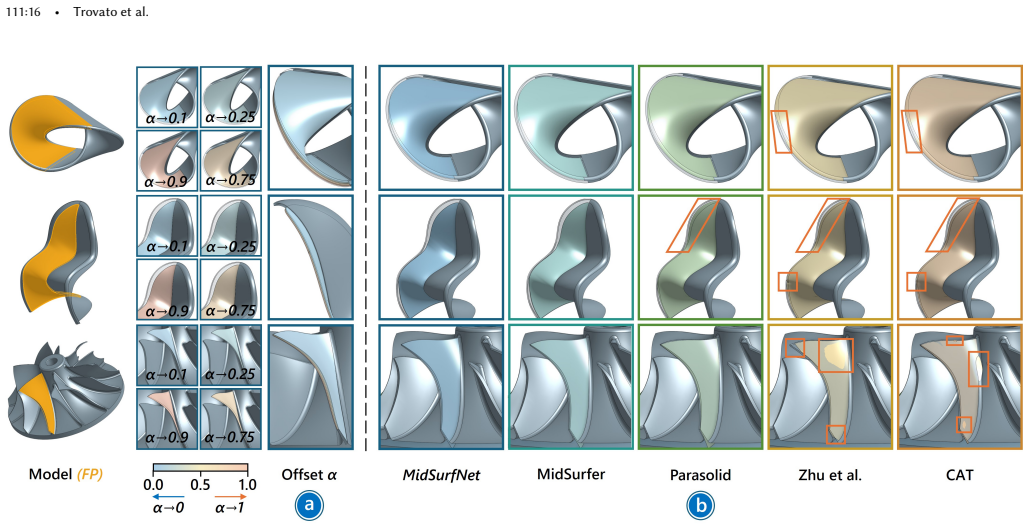
Mid-surface abstraction is essential for finite element analysis of thin-walled CAD models. Existing face pairing-based methods rely on handcrafted geometric heuristics, yet real-world industrial models frequently exhibit multi-wall-thickness regions, self-matching face configurations, and demand for non-center offset surfaces--scenarios where rule-based approaches consistently fail. We present MidSurfNet, a learning-augmented framework that addresses these limitations through two novel components: (1) a neural face pairing module that learns to predict face pair confidence from geometric and topological features, handling complex pairing scenarios beyond rule-based methods; and (2) an interference implicit field that represents mid-surfaces as the interference of two signed distance functions, enabling generalized offset control for flexible positioning in downstream CAE/FEA-oriented workflows. We construct a large-scale mid-surface dataset containing over 1,500 manually annotated CAD models. Experiments demonstrate that MidSurfNet achieves 87.32% face pairing accuracy and successfully handles multi-wall-thickness (61.90% completion) and self-matching (52.94% completion) scenarios that confound all existing methods. Furthermore, MidSurfNet provides a learning-based approach to generalized mid-surface abstraction with arbitrary offset control for CAE-oriented applications.
Figures



Reference graph
Works this paper leans on
-
[1]
Michael Downes and Barbara Beeton , organization =. The
-
[2]
Cristophe Fiorio , year = 2015, month = oct, note =
2015
-
[3]
The algorithms bundle , author =
-
[4]
The Listings Package , author =
-
[5]
Publication quality tables in
Simon Fear , year = 2005, month = apr, note =. Publication quality tables in
2005
-
[6]
The subcaption package , author =
-
[7]
A package to create a nomenclature , author =
-
[8]
User Manual for glossaries.sty v4.44 , author =
-
[9]
David Carlisle , month = oct, year = 2004, note =. The
2004
-
[10]
Models for the perception of speech and visual form , volume=
A transformation for extracting new descriptors of shape , author=. Models for the perception of speech and visual form , volume=. 1967 , publisher=
1967
-
[11]
An algorithm for the medial axis transform of 3
Sherbrooke, Evan C and Patrikalakis, Nicholas M and Brisson, Erik , journal=. An algorithm for the medial axis transform of 3. 1996 , publisher=
1996
-
[12]
CNLS Newsletter , volume=
Morphological analysis of shapes , author=. CNLS Newsletter , volume=
-
[13]
Skeleton-based computational method for the generation of a 3
Quadros, William Roshan and Shimada, Kenji and Owen, Steven J , booktitle=. Skeleton-based computational method for the generation of a 3. 2002 , publisher=
2002
-
[14]
Midsurface abstraction from 3
Rezayat, Mansour , journal=. Midsurface abstraction from 3. 1996 , publisher=
1996
-
[15]
Computer-Aided Design , volume=
Transformation of a thin-walled solid model into a surface model via solid deflation , author=. Computer-Aided Design , volume=. 2010 , publisher=
2010
-
[16]
Computer-Aided Design , volume=
A divide-and-conquer approach to constructing midsurfaces , author=. Computer-Aided Design , volume=. 2014 , publisher=
2014
-
[17]
2026 , publisher=
Ye, Li and Zhou, Xinhang and Fan, Peng and Tong, Ruofeng and Li, Hailong and Du, Peng and Tang, Min , journal=. 2026 , publisher=
2026
-
[18]
Ye, Li and Zhou, Xinhang and Fan, Peng and Tong, Ruofeng and Tang, Min , journal=
-
[19]
Lambourne, Joseph G and Willis, Karl DD and Jayaraman, Pradeep Kumar and Sanghi, Aditya and Meltzer, Peter and Shayani, Hooman , booktitle=
-
[20]
Jayaraman, Pradeep Kumar and Sanghi, Aditya and Lambourne, Joseph G and Willis, Karl DD and Davies, Thomas and Shayani, Hooman and Morris, Nigel , booktitle=
-
[21]
Fusion 360 gallery: A dataset and environment for programmatic
Willis, Karl DD and Pu, Yewen and Luo, Jieliang and Chu, Hang and Du, Tao and Lambourne, Joseph G and Solar-Lezama, Armando and Matusik, Wojciech , booktitle=. Fusion 360 gallery: A dataset and environment for programmatic. 2021 , publisher=
2021
-
[22]
Qi, Charles R and Su, Hao and Mo, Kaichun and Guibas, Leonidas J , booktitle=
-
[23]
Qi, Charles Ruizhongtai and Yi, Li and Su, Hao and Guibas, Leonidas J , booktitle=
-
[24]
Dynamic graph
Wang, Yue and Sun, Yongbin and Liu, Ziwei and Sarma, Sanjay E and Bronstein, Michael M and Solomon, Justin M , journal=. Dynamic graph. 2019 , publisher=
2019
-
[25]
International Conference on Learning Representations (ICLR) , year=
Semi-supervised classification with graph convolutional networks , author=. International Conference on Learning Representations (ICLR) , year=
-
[26]
International Conference on Learning Representations (ICLR) , year=
Graph attention networks , author=. International Conference on Learning Representations (ICLR) , year=
-
[27]
Advances in Neural Information Processing Systems (NeurIPS) , volume=
Inductive representation learning on large graphs , author=. Advances in Neural Information Processing Systems (NeurIPS) , volume=
-
[28]
Sarlin, Paul-Edouard and DeTone, Daniel and Malisiewicz, Tomasz and Rabinovich, Andrew , booktitle=
-
[29]
Sun, Jiaming and Shen, Zehong and Wang, Yuang and Bao, Hujun and Zhou, Xiaowei , booktitle=
-
[30]
Park, Jeong Joon and Florence, Peter and Straub, Julian and Newcombe, Richard and Lovegrove, Steven , booktitle=
-
[31]
Occupancy networks: Learning 3
Mescheder, Lars and Oechsle, Michael and Niemeyer, Michael and Nowozin, Sebastian and Geiger, Andreas , booktitle=. Occupancy networks: Learning 3
-
[32]
Advances in Neural Information Processing Systems (NeurIPS) , volume=
Implicit neural representations with periodic activation functions , author=. Advances in Neural Information Processing Systems (NeurIPS) , volume=
-
[33]
Proceedings of the IEEE Conference on Computer Vision and Pattern Recognition (CVPR) , pages=
Deep ordinal regression network for monocular depth estimation , author=. Proceedings of the IEEE Conference on Computer Vision and Pattern Recognition (CVPR) , pages=
-
[34]
Ordinal regression with multiple output
Niu, Zhenxing and Zhou, Mo and Wang, Le and Gao, Xinbo and Hua, Gang , booktitle=. Ordinal regression with multiple output
-
[35]
Proceedings of the IEEE International Conference on Computer Vision (ICCV) , pages=
Focal loss for dense object detection , author=. Proceedings of the IEEE International Conference on Computer Vision (ICCV) , pages=
-
[36]
Bringing Attention to CAD: Boundary Representation Learning via Transformer , journal =
Qiang Zou and Lizhen Zhu , keywords =. Bringing Attention to CAD: Boundary Representation Learning via Transformer , journal =. 2025 , issn =. doi:https://doi.org/10.1016/j.cad.2025.103940 , url =
-
[37]
Advances in neural information processing systems , volume=
Do transformers really perform badly for graph representation? , author=. Advances in neural information processing systems , volume=
-
[38]
Advances in Neural Information Processing Systems , volume=
Big bird: Transformers for longer sequences , author=. Advances in Neural Information Processing Systems , volume=
-
[39]
International Conference on Machine Learning , pages=
Exphormer: Sparse transformers for graphs , author=. International Conference on Machine Learning , pages=. 2023 , organization=
2023
-
[40]
2012 , publisher=
Hamdi, Mounir and Aifaoui, Nizar and Benamara, Abdelmajid , journal=. 2012 , publisher=
2012
-
[41]
Computer-Aided Design , volume=
Model simplification for meshing using face clustering , author=. Computer-Aided Design , volume=. 2001 , publisher=
2001
-
[42]
Small blend suppression from
Lai, Jing-Yong and Wong, Chun-Hong and Huynh, Trong-Thai , journal=. Small blend suppression from. 2016 , publisher=
2016
-
[43]
and Malyshev, Alexander S
Slyadnev, Sergey E. and Malyshev, Alexander S. and Turlapov, Vadim E. , journal=. Simplification of. 2020 , publisher=
2020
-
[44]
Advances in Neural Information Processing Systems , volume=
Deep sets , author=. Advances in Neural Information Processing Systems , volume=
-
[45]
International Conference on Machine Learning , pages=
Set transformer: A framework for attention-based permutation-invariant neural networks , author=. International Conference on Machine Learning , pages=. 2019 , organization=
2019
-
[46]
and Armstrong, Cecil G
Sun, Liang and Tierney, Christopher M. and Armstrong, Cecil G. and Robinson, Trevor T. , journal=. Decomposing complex thin-walled. 2018 , publisher=
2018
-
[47]
Computer-Aided Design , volume=
Using virtual topology operations to generate analysis topology , author=. Computer-Aided Design , volume=. 2019 , publisher=
2019
-
[48]
Computational Geometry , volume=
The power crust, unions of balls, and the medial axis transform , author=. Computational Geometry , volume=. 2001 , publisher=
2001
-
[49]
and Woo, Hyuckje and Zhao, Wulue , booktitle=
Dey, Tamal K. and Woo, Hyuckje and Zhao, Wulue , booktitle=. Approximate medial axis for. 2003 , organization=
2003
-
[50]
ACM Transactions on Graphics , volume=
Computing medial axis transform with feature preservation via restricted power diagram , author=. ACM Transactions on Graphics , volume=. 2022 , publisher=
2022
-
[51]
Longformer: The Long-Document Transformer
Longformer: The long-document transformer , author=. arXiv preprint arXiv:2004.05150 , year=
work page internal anchor Pith review Pith/arXiv arXiv 2004
-
[52]
Advances in Neural Information Processing Systems , volume=
Recipe for a general, powerful, scalable graph transformer , author=. Advances in Neural Information Processing Systems , volume=
-
[53]
International Conference on Learning Representations , year=
Janossy pooling: Learning deep permutation-invariant functions for variable-size inputs , author=. International Conference on Learning Representations , year=
-
[54]
and Armstrong, Cecil G
Sun, Liang and Tierney, Christopher M. and Armstrong, Cecil G. and Robinson, Trevor T. , journal=. Automatic decomposition of complex thin walled. 2016 , publisher=
2016
-
[55]
International Conference on Machine Learning , pages=
Set norm and equivariant skip connections: Putting the deep in deep sets , author=. International Conference on Machine Learning , pages=. 2022 , organization=
2022
-
[56]
Kong, Jiayi and Zong, Chen and Luo, Jun and Xin, Shiqing and Hou, Fei and Jiang, Hanqing and Qian, Chen and He, Ying , title =. ACM Trans. Graph. , month = feb, keywords =. 2026 , publisher =. doi:10.1145/3795772 , note =
-
[57]
Proceedings of the AAAI conference on artificial intelligence , volume=
Film: Visual reasoning with a general conditioning layer , author=. Proceedings of the AAAI conference on artificial intelligence , volume=
-
[58]
International conference on machine learning , pages=
On layer normalization in the transformer architecture , author=. International conference on machine learning , pages=. 2020 , organization=
2020
-
[59]
International conference on machine learning , pages=
Transformers are rnns: Fast autoregressive transformers with linear attention , author=. International conference on machine learning , pages=. 2020 , organization=
2020
-
[60]
2016 fourth international conference on 3D vision (3DV) , pages=
V-net: Fully convolutional neural networks for volumetric medical image segmentation , author=. 2016 fourth international conference on 3D vision (3DV) , pages=. 2016 , organization=
2016
-
[61]
Decoupled Weight Decay Regularization
Decoupled weight decay regularization , author=. arXiv preprint arXiv:1711.05101 , year=
work page internal anchor Pith review Pith/arXiv arXiv
-
[62]
SGDR: Stochastic Gradient Descent with Warm Restarts
Sgdr: Stochastic gradient descent with warm restarts , author=. arXiv preprint arXiv:1608.03983 , year=
work page internal anchor Pith review Pith/arXiv arXiv
-
[63]
Scientific reports , volume=
Adaptive recognition of machining features in sheet metal parts based on a graph class-incremental learning strategy , author=. Scientific reports , volume=. 2024 , publisher=
2024
-
[64]
Sign and Basis Invariant Networks for Spectral Graph Representation Learning
Sign and basis invariant networks for spectral graph representation learning , author=. arXiv preprint arXiv:2202.13013 , year=
-
[65]
, author=
Hex-Layer: Layered All-Hex Mesh Generation on Thin Section Solids via Chordal Surface Transformation. , author=. IMR , pages=
-
[66]
International Journal of Computer Integrated Manufacturing , volume=
Mid-surface abstraction for complex thin-wall models based on virtual decomposition , author=. International Journal of Computer Integrated Manufacturing , volume=. 2016 , publisher=
2016
-
[67]
Parasolid , author =
-
[68]
Journal of Open Source Software , volume=
PyVista: 3D Plotting and Mesh Analysis through a Streamlined Interface for the Visualization Toolkit (VTK) , author=. Journal of Open Source Software , volume=
-
[69]
2021 , url =
Jayaraman, Pradeep Kumar and Lambourne, Joseph , title =. 2021 , url =
2021
-
[70]
Proceedings of the 2016 4th International Conference on 3D Vision (3DV) , pages =
V-Net: Fully Convolutional Neural Networks for Volumetric Medical Image Segmentation , author =. Proceedings of the 2016 4th International Conference on 3D Vision (3DV) , pages =. 2016 , publisher =
2016
-
[71]
Abaqus Analysis User's Guide , year=
-
[72]
International Journal of Solids and Structures , volume=
Subsurface initiated rolling contact fatigue of railway wheels as generated by rail corrugation , author=. International Journal of Solids and Structures , volume=. 2007 , publisher=
2007
-
[73]
International Journal of Fatigue , volume=
Investigation of the crack initiation of subsurface rolling contact fatigue in railway wheels , author=. International Journal of Fatigue , volume=. 2020 , publisher=
2020
-
[74]
Facta Universitatis
Models for intralaminar damage and failure of fiber composites-A review , author=. Facta Universitatis. Series Mechanical Engineering , volume=
discussion (0)
Sign in with ORCID, Apple, or X to comment. Anyone can read and Pith papers without signing in.