REVIEW 5 major objections 7 minor 1 cited by
Spec-TOD: A Specialized Instruction-Tuned LLM Framework for Efficient Task-Oriented Dialogue Systems
T0 review · 5 major / 7 minor · reviewed 2026-08-06 · deepseek-v4-flash
Pith's one-line read Spec-TOD claims that fine-tuning an 8-billion-parameter LLM with role-decomposed function-calling instructions makes end-to-end task-oriented dialogue work with one-tenth of the usual labeled data.
desk verdict Useful integration of known TOD components, but the central data-efficiency claim is undercut by a missing ablation that would isolate the role-instruction mechanism. read the letter →
The pith
A machine-rendered reading of the paper's core claim, the machinery that carries it, and where it could break.
The reading
What carries the argument
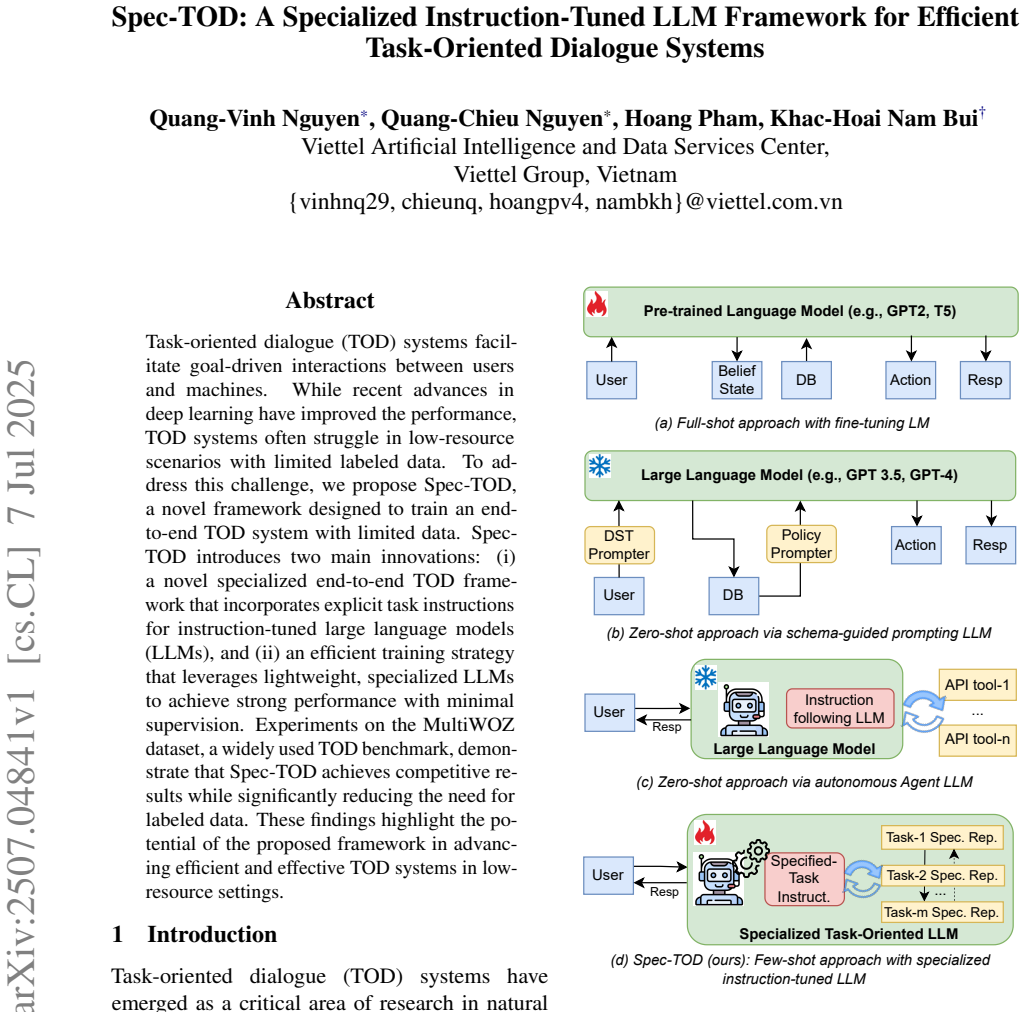
The mechanism that carries the argument is the specified-task instruction template combined with role-masked loss. Each dialogue turn is expanded into the roles System, User, Domain, Function, Observation, and Assistant; the domain role carries the selected domain, the function role carries the JSON function call with belief-state arguments, and the assistant role carries the action and response. The model is trained to predict only the tokens of the role associated with each task, so domain selection, dialogue state tracking, and response generation each receive an isolated gradient signal, and the total loss is the sum of the three task-specific losses.
What would settle it
Fine-tune LLaMA-3-8B on 10% of MultiWOZ 2.2 with plain dialogue-state-to-response text formatting, with no domain/function/observation roles and no per-task instructions, and evaluate with the same metrics; if it matches Spec-TOD's roughly 77% Success and 87% Inform, the specialized instruction and role decomposition is not what causes the result.
Extended reading notes
Core claim
The central claim is that an end-to-end TOD system can be built by reformulating the task as a set of instruction-specified function calls and fine-tuning a compact LLM with per-role losses. Spec-TOD maps each domain to a function, treats belief-state tracking as filling that function's JSON arguments, and generates responses conditioned on a database observation; six roles (system, user, domain, function, observation, assistant) carry the dialogue context, and the loss is the sum of task-specific losses for the domain, function, and assistant roles. On MultiWOZ 2.2, 10% of the training data yields 77.1% Success and 87.2% Inform, matching or exceeding full-shot GALAXY (75.7% Success, 85.4% Inform), with a Combined score of 92.6 versus GALAXY's 100.2. The paper presents this as evidence that strong TOD can be trained from minimal labeled data, and that 50% and 100% data produce nearly identical results.
Load-bearing premise
The paper does not compare against fine-tuning the same 8-billion-parameter model on the same data with a flat, non-role-decomposed text-to-text format, so it assumes the instruction and role decomposition, not the backbone or the function-call format itself, is what delivers the data efficiency.
Editorial extensions
If this is right
- On MultiWOZ 2.0 with 10% data, Spec-TOD reaches 75.5% Success and 86.0% Inform, well above the few-shot baselines reported (Mars-G reaches 55.3% and 69.4%).
- Even at 1% of MultiWOZ 2.0, the model obtains 63.2% Success and 73.0% Inform, roughly matching the zero-shot AutoTOD-Llama-2-70B (69.8% and 73.3%).
- The DST component trained on 10% data outperforms GPT-3.5 and GPT-4 used zero-shot across restaurant, taxi, hotel, attraction, train, and average JGA.
- Training beyond 10% saturates: 50% and 100% of MultiWOZ 2.2 give almost identical Success and Inform scores around 83.5/90.5 and 83.4/90.3.
- The lower BLEU score is offset by higher GPT-score semantics, suggesting the method trades n-gram overlap for meaning preservation.
Reading between the lines
- A direct ablation the paper does not run: fine-tune the same LLaMA-3-8B on 10% of MultiWOZ with a flat context-to-belief-state, action, and response format; if that baseline matches Spec-TOD, the six-role instruction decomposition is not the active ingredient, and if it falls short, the decomposition is validated.
- The function-call encoding suggests a natural path to schema generalization: because domains are described in the prompt rather than hard-coded, the same recipe could be tested on unseen domains or on other schema-guided dialogue benchmarks, which the paper does not evaluate.
- The saturation of performance between 50% and 100% data may indicate that MultiWOZ's schema coverage is nearly complete at 50%; a useful extension would be to measure how performance scales as the number of new slots and domains grows, rather than as dialogue turns grow.
Editorial analysis
A structured set of objections, weighed in public.
Referee Report
Summary. The paper proposes Spec-TOD, a framework that reformulates end-to-end task-oriented dialogue (TOD) into four specified tasks—domain selection, dialogue state tracking, policy instruction, and response generation—using task-specific instructions, a six-role prompt structure, and role-specific loss masking, then fine-tunes a lightweight LLM (LLaMA-3-8B) with LoRA on only 10% of the MultiWOZ training data. The authors claim that with 10% of the data, Spec-TOD matches full-shot baselines on Success and Inform metrics, outperforms prior few-shot TOD models, and surpasses zero-shot large-LLM prompting, while also presenting ablations over backbones and LoRA hyperparameters and a GPT-4o-based semantic evaluation. Experiments are reported on MultiWOZ 2.0, 2.1, and 2.2.
Significance. If the central claims were fully supported, the paper would make a useful practical contribution: demonstrating that a lightweight instruction-tuned LLM can achieve strong TOD performance with very limited labeled data, while releasing code and evaluating on multiple MultiWOZ versions. The paper also tests extreme low-data settings (1% and 5%) and includes ablations over backbones and LoRA configurations, which are useful. However, the headline claim of matching full-shot models is only partially true: on the standard Combined metric, Spec-TOD at 10% data (92.6) is below full-shot GALAXY (100.2) and UBAR (94.4/105.1). More importantly, the absence of a same-backbone flat fine-tuning control means the contribution of the proposed instruction/role decomposition over simply fine-tuning LLaMA-3-8B is not established. The significance of the work therefore rests on experiments that are currently missing or insufficiently controlled.
major comments (5)
- [Section 4.3.3, Table 5] The claim that 'with only 10% of the training data, our model matches the performance of prior approaches that utilized the entire dataset' is not supported by the standard Combined metric. On MultiWOZ 2.2, Spec-TOD (10%) achieves Combined 92.6, while full-shot GALAXY is 100.2 and UBAR is 94.4; on MultiWOZ 2.0, full-shot UBAR reaches 105.1 versus Spec-TOD's 91.2. The claim holds only for Success and Inform scores, not for the Combined metric that is customary in this literature. Please either restrict the claim to the specific metrics where it holds, or provide a detailed analysis of why the Combined shortfall (driven largely by BLEU) does not undermine the data-efficiency conclusion.
- [Section 4.2, Table 1] The statement in the Table 1 caption, 'The difference in mean is statistically significant (p < 0.01)', is unsupported by any reported statistics. The paper reports single runs without standard deviations, number of seeds, or the specific statistical test used. Since the claim of statistical significance underpins the comparison against baselines, please provide means and standard deviations over at least 3–5 seeds (or an equivalent resampling procedure) and specify the test and the exact comparisons being tested, or remove the significance claim.
- [Section 4 (experimental design)] No ablation isolates the proposed six-role instruction decomposition. Every experiment in Section 4 trains with the Spec-TOD prompt format and role-specific loss masking, so the observed gains at 10% data could be attributed primarily to the strong pretrained backbone (LLaMA-3-8B) and LoRA tuning rather than the framework's contribution. Please add a control that fine-tunes the same LLaMA-3-8B on the same MultiWOZ data with a flat text-to-text format—no role labels, no per-task instructions, no domain/function JSON—and compare all metrics. Without this baseline, the core novelty claim of Sections 3.2–3.3 cannot be validated.
- [Section 4.2, Table 2 (GPT-score)] The GPT-4o-based evaluation lacks essential details needed to support the claim that GPT-score 'reflects better semantic accuracy': the number of evaluated dialogues, the exact judge prompt, the sampling temperature, and any human-agreement or reproducibility analysis are not given. Please provide these details and a reliability analysis (e.g., correlation with human judgments or agreement across judge runs), otherwise this evaluation is not reproducible and the claim is not substantiated.
- [Section 4.2, Table 1 and Section 4.3.3] The comparisons are confounded by backbone, model scale, and pretraining. The full-shot baselines (GALAXY, UBAR, Mars) use older, smaller pretrained models, and the few-shot baselines (MinTL, PPTOD, Mars-G) are not LLMs at all. The data-efficiency argument would be much stronger if the paper compared against the same LLaMA-3-8B backbone fine-tuned on the full dataset (with the same LoRA setup) and against a flat-format control. Please add such comparisons or explicitly discuss how this confound affects the stated conclusions.
minor comments (7)
- [Section 3.2.4, Eq. (10)] The spelled item 'NoOfFfer' appears to be a typo for 'NoOffer'; the bullet list below it uses the correct spelling.
- [Appendix A.2, Figure 7] The example JSON contains a malformed string: 'description': "hotel reservations and vacation stays. " is missing a closing quote before the period; please correct the JSON formatting.
- [Section 3.2.3] The Policy Instruction component is described only as deriving an observation and is not a learned task, but the appendix lists prompt templates only for Domain Selection, DST, and Response Generation. Please clarify whether this component is rule-based or prompt-only and include its instruction template in the appendix for reproducibility.
- [Section 4.1 and Table 1] The capitalization of the backbone model is inconsistent: 'LLama-3-8B' appears in Table 1 while 'LLaMA-3-8B' is used elsewhere; please unify.
- [Section 4.3.4, Figure 5] No details are given about the zero-shot GPT-3.5 and GPT-4 prompts used for the DST comparison; without these, the comparison is not reproducible.
- [Section 1 and Abstract] The claim of being 'the first LLM-based framework explicitly designed for trainable end-to-end TOD systems' is very strong and should be softened unless a comprehensive related-work search demonstrates novelty; prior instruction-tuned TOD approaches exist.
- [Section 4.3.2, Table 4] The conclusion that 'the proposed method does not benefit from a high number of fine-tuned parameters' is not clearly supported by the table: rank 64/alpha 128 yields Combined 91.64, close to the best rank 32/alpha 16 value of 92.56, and no variance is reported. Please add a more nuanced interpretation or additional configurations to support the claim.
Circularity Check
No circular derivation: Spec-TOD's central claims are empirical comparisons and standard fine-tuning results, not identities between model inputs and predicted outputs.
full rationale
The paper's load-bearing claims are empirical: Section 4 reports Inform, Success, BLEU, Combined, and JGA numbers after LoRA fine-tuning LLaMA-3-8B on MultiWOZ subsets. Section 3 defines the task decomposition and loss function as L = L_DS + L_DST + L_RG, but this is a training objective, not a quantity that is later 'predicted' from itself. The 10%-data efficiency claim in Section 4.3.3 is a comparison to published baselines, not a fitted parameter disguised as a prediction. LoRA rank/alpha are tuned on dev data, which is standard practice and does not make the reported test-set numbers circular. The only self-citation (Chieu et al. 2024) appears in related work and is not used to justify the framework's validity. The absence of a flat fine-tuning control is a real attribution weakness, but a missing ablation is not circular reasoning: it does not show that any claimed result reduces to its own input by construction. Accordingly, the appropriate circularity score is 0.
Assumptions & free parameters
free parameters (5)
- LoRA rank =
32
- LoRA alpha =
16
- learning rate =
3e-4
- training epochs =
4
- action description grouping =
six action types compressed from MultiWOZ schema
assumptions (4)
- standard math Cross-entropy losses for domain selection, function calling, and response generation are independent and can be summed (Eq. 11).
- domain assumption MultiWOZ annotations across versions are consistent enough that a model trained on 10% of one version transfers to evaluation on another.
- domain assumption The database observation (number of matching entities) is accurate and available at inference time in the low-resource deployment scenario.
- ad hoc to paper The six-role prompt structure is a suitable inductive bias for learning all TOD tasks simultaneously.
Cite this review
Pith. "Pith review of Spec-TOD: A Specialized Instruction-Tuned LLM Framework for Efficient Task-Oriented Dialogue Systems." pith.science (2026). https://pith.science/paper/DB633IRL
@misc{pith2026250704841,
  author       = {Pith},
  title        = {Pith review of: Spec-TOD: A Specialized Instruction-Tuned LLM Framework for Efficient Task-Oriented Dialogue Systems},
  year         = {2026},
  howpublished = {\url{https://pith.science/paper/DB633IRL}},
  note         = {Machine review of arXiv:2507.04841}
}
read the original abstract
Task-oriented dialogue (TOD) systems facilitate goal-driven interactions between users and machines. While recent advances in deep learning have improved the performance, TOD systems often struggle in low-resource scenarios with limited labeled data. To address this challenge, we propose Spec-TOD, a novel framework designed to train an end-to-end TOD system with limited data. Spec-TOD introduces two main innovations: (i) a novel specialized end-to-end TOD framework that incorporates explicit task instructions for instruction-tuned large language models (LLMs), and (ii) an efficient training strategy that leverages lightweight, specialized LLMs to achieve strong performance with minimal supervision. Experiments on the MultiWOZ dataset, a widely used TOD benchmark, demonstrate that Spec-TOD achieves competitive results while significantly reducing the need for labeled data. These findings highlight the potential of the proposed framework in advancing efficient and effective TOD systems in low-resource settings.
Figures


Figures from the paper (5 more)


Forward citations
Cited by 1 Pith paper
-
MemGuide: Intent-Driven Memory Selection for Goal-Oriented Multi-Session LLM Agents
MemGuide retrieves and filters past dialogue memories by intent and missing slots, and on its new synthetic benchmark MS-TOD it improves task success by 11 points and shortens dialogues by 2.84 turns.
Reference graph
Works this paper leans on
-
[1]
name: inform description: provide information about an entity (if multiple matched results exist, choose one) in the form of [value_xxx] if requested by the user (required)
-
[2]
name: request description: inform the number of available offers ([value_choice]) and ask the user for more preference on the requested entity to narrow down the search results (optional)
-
[3]
name: nooffer description: inform the user that no suitable offer could be found ... <Function_Specification> { "name": "hotel", "description": "hotel reservations and vacation stays", "arguments": [ { "name": "pricerange", "type": "string", "description": "price budget of the hotel", "possible_values": [ "expensive", "cheap", "moderate" ] }, { "name": "a...
-
[6]
Zero and few-shot localization of task-oriented dialogue agents with a distilled representation. In Proceedings of the 17th Conference of the European Chapter of the Association for Computational Lin- guistics, EACL 2023, Dubrovnik, Croatia, May 2-6, 2023, pages 886–901. Association for Computational Linguistics. Jinjie Ni, Tom Young, Vlad Pandelea, Fuzha...
arXiv 2023
-
[9]
MultiWOZ 2.2 : A dialogue dataset with additional annotation corrections and state tracking baselines. In Proceedings of the 2nd Workshop on Natural Language Processing for Conversational AI, pages 109–117, Online. Association for Computa- tional Linguistics. Xiaoying Zhang, Baolin Peng, Kun Li, Jingyan Zhou, and Helen Meng. 2023. SGP-TOD: building task b...
work page 2023
-
[1303]
Association for Computational Linguistics. Zekun Li, Zhiyu Chen, Mike Ross, Patrick Huber, Se- ungwhan Moon, Zhaojiang Lin, Xin Dong, Adithya Sagar, Xifeng Yan, and Paul A. Crook. 2024. Large language models as zero-shot dialogue state tracker through function calling. In Proceedings of the 62nd Annual Meeting of the Association for Computational Linguist...
work page 2024
-
[2020]
Multiwoz 2.1: A consolidated multi-domain dialogue dataset with state corrections and state track- ing baselines. In Proceedings of The 12th Language Resources and Evaluation Conference, LREC 2020, Marseille, France, May 11-16, 2020, pages 422–428. European Language Resources Association. Yujie Feng, Zexin Lu, Bo Liu, Liming Zhan, and Xiao- Ming Wu. 2023....
arXiv 2020
-
[2022]
MultiWOZ 2.4: A multi-domain task-oriented dialogue dataset with essential annotation corrections to improve state tracking evaluation. In Proceedings of the 23rd Annual Meeting of the Special Interest Group on Discourse and Dialogue, pages 351–360, Edinburgh, UK. Association for Computational Lin- guistics. Xiaoxue Zang, Abhinav Rastogi, Srinivas Sunkara...
Show all 12 references
-
[2023]
In Findings of the As- sociation for Computational Linguistics: ACL 2023, Toronto, Canada, July 9-14, 2023, pages 7355–7369
Task-optimized adapters for an end-to-end task-oriented dialogue system. In Findings of the As- sociation for Computational Linguistics: ACL 2023, Toronto, Canada, July 9-14, 2023, pages 7355–7369. Association for Computational Linguistics. Jianzhu Bao, Rui Wang, Yasheng Wang,...
2023
-
[2763]
Association for Computational Linguistics. An Yang, Baosong Yang, Binyuan Hui, Bo Zheng, Bowen Yu, Chang Zhou, Chengpeng Li, Chengyuan Li, Dayiheng Liu, Fei Huang, Guanting Dong, Hao- ran Wei, Huan Lin, Jialong Tang, Jialin Wang, Jian Yang, Jianhong Tu, Jianwei Zhang, Jianxin ...
2024 arXiv
-
[3405]
Fei Mi, Yasheng Wang, and Yitong Li
Association for Computational Linguistics. Fei Mi, Yasheng Wang, and Yitong Li. 2022. CINS: comprehensive instruction for few-shot learning in task-oriented dialog systems. In Thirty-Sixth AAAI Conference on Artificial Intelligence, AAAI 2022, Thirty-Fourth Conference on Innov...
2022
-
[8704]
Zhaojiang Lin, Andrea Madotto, Genta Indra Winata, and Pascale Fung
Association for Computational Linguistics. Zhaojiang Lin, Andrea Madotto, Genta Indra Winata, and Pascale Fung. 2020. Mintl: Minimalist trans- fer learning for task-oriented dialogue systems. In Proceedings of the 2020 Conference on Empirical Methods in Natural Language Proces...
2020
Reviewed August 6, 2026 · model on record in the stance chip above.
Discussion (0). Continue with ORCID to comment.