REVIEW 3 major objections 4 minor 1 cited by
This paper claims that one worldsheet action reproduces Mandelstam's generalized Veneziano amplitudes and generates new higher-point open and closed-string amplitudes with partial crossing symmetry.
Reviewed by Pith at T0; open to challenge. T0 means a machine referee read the full paper against a public rubric. the ladder, T0–T4 →
T0 review · deepseek-v4-flash
2026-08-03 21:12 UTC pith:DBLKUVEF
load-bearing objection First worldsheet realization of Mandelstam's generalized Veneziano family, with a plausible dictionary but a load-bearing analytic-continuation step that needs a branch prescription. the 3 major comments →
Worldsheet for Generalized Veneziano Amplitudes
The pith
A machine-rendered reading of the paper's core claim, the machinery that carries it, and where it could break.
Core claim
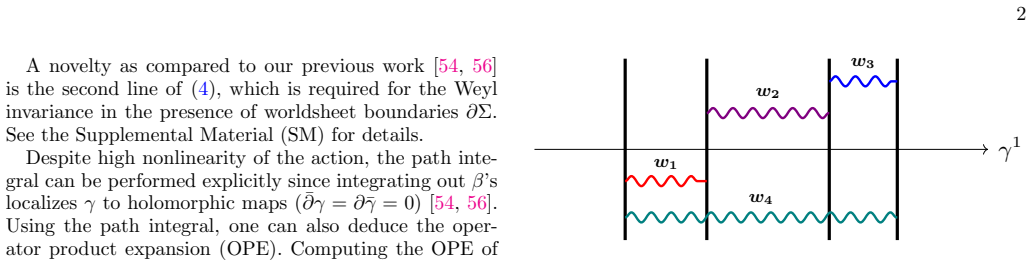
The central claim is that the worldsheet action (4), with the D0-brane boundary conditions (7) and vertex operators (11), reproduces the generalized Veneziano amplitude (1) for generic parameters. The path integral over the γ-field localizes to the Mandelstam map ρ(z)=∑ w_k log(z−x_k), and evaluating the chiral composite dilaton action on this map yields a four-point integrand which, after tuning w1=w3 and dressing two vertex operators by a free boson, matches Mandelstam's formula with δ=q/2, b=1−q−p², λ=1/(1+r)². The same construction produces higher-point open-string amplitudes and a four-point closed-string amplitude, both of which are partially crossing-symmetric but not fully so.
What carries the argument
The central object is the chiral composite linear dilaton (CLD) action, a βγ-system with a specific background-charge term and a newly added geodesic-curvature boundary term that restores Weyl invariance on worldsheets with boundaries. Combined with D0-brane boundary conditions on the γ-field and vertex operators carrying winding numbers {w_k}, the path integral localizes γ to the Mandelstam map, whose interaction points Z_I control the discriminant ∆(P_n) that enters the amplitude. The boundary term and the winding-number dictionary are what carry the argument: they turn a previously known CFT into a source of generalized Veneziano amplitudes.
Load-bearing premise
The load-bearing premise is that the worldsheet path integral, evaluated for real interaction points, can be analytically continued in the winding numbers without crossing branch ambiguities; if that continuation is not branch-safe for the complex branch points that appear when q/2 is not an integer, the four-point integrand is not Mandelstam's.
What would settle it
Numerically evaluate the four-point worldsheet integral (17) for a non-integer q/2, say q=1/2 with r=1 (so a±=1/2 ± i√3/2), using a fixed branch convention, and compare with the Mandelstam integrand (1) for δ=1/4, b=1/2, λ=1/4; any difference at generic s,t shows the analytic continuation is not the branch-preserving one needed for the dictionary.
If this is right
- The generalized Veneziano amplitudes now have a worldsheet origin, so questions about their unitarity, factorization, and Regge behavior can be addressed with worldsheet techniques.
- The construction yields n-point open-string amplitudes (e.g., five-point formula (29)) that are new and can be studied systematically.
- The closed-string analog (33) is a new partially crossing-symmetric amplitude whose KLT-like factorization expresses it as a sum of products of Appell hypergeometric functions.
- Partial crossing symmetry is traced to winding-number conservation, explaining why full crossing symmetry is incompatible with the present worldsheet realization.
- The dictionary δ=q/2, b=1−q−p², λ=1/(1+r)² makes clear how to engineer the parameters of the generalized Veneziano family at will.
Where Pith is reading between the lines
- The analytic continuation in winding numbers, asserted in the supplemental material, is the step that lets the four-point integrand (17) be identified with Mandelstam's formula for non-integer q/2; a branch-prescription check would be needed to fully settle the match.
- If the worldsheet description is robust, it suggests a route to construct worldsheet actions for other generalized amplitudes (e.g., hypergeometric amplitudes) by suitably modifying the CLD action or its boundary conditions.
- The winding-conservation obstruction to full crossing symmetry may point to a general no-go: any worldsheet theory whose vertex operators carry conserved winding numbers will produce only partially crossing-symmetric amplitudes, unless the localization mechanism is changed.
- Testing the higher-point amplitudes numerically for small n could reveal whether they satisfy the expected duality properties (channel factorization) that the four-point case inherits from Mandelstam's formula.
Editorial analysis
A structured set of objections, weighed in public.
Referee Report
Summary. The manuscript proposes a bosonic worldsheet action that is claimed to reproduce Mandelstam's three-parameter generalization of the Veneziano amplitude. The construction uses the chiral composite linear dilaton (CLD) beta-gamma system with a new boundary term, D0-brane boundary conditions, and vertex operators carrying fractional winding. After localization to the Mandelstam map, the four-point amplitude is matched to the target formula with the dictionary delta = q/2, b = 1 - q - p^2, lambda = 1/(1+r)^2. The same action is then used to compute n-point open-string amplitudes and a four-point closed-string amplitude with partial crossing symmetry. The supplemental material contains the Weyl-invariance check of the boundary term and the detailed evaluation of the localized CLD action.
Significance. If the central derivation is completed, this is a significant step: it would be the first worldsheet description of generalized Veneziano amplitudes beyond the standard Veneziano case, and it provides explicit higher-point and closed-string predictions. The paper's strengths include a detailed Weyl-anomaly computation for the new boundary term, a careful treatment of the Mandelstam map and its PSL(2,R) transformation, and explicit degenerate cross-ratio checks of the identities a_+ + a_- = 1 and lambda = 1/(1+r)^2. The target amplitude is an external benchmark, so the construction is not circular in the sense of input-equals-output. The main obstacle is not the final matching formula itself, but the analytic continuation used to obtain it from the path integral.
major comments (3)
- [SM B.1; Eqs. (B15), (17), (19)] The evaluation is performed for real interaction points Z_I and yields e^{-Gamma_ren} = |Delta(P_n) prod w_k|^{q/2} prod |x_i-x_j|^{-q}. This modulus is not analytic in w_k, so the statement in SM B1 that the result is analytic in {w_k} and can therefore be analytically continued is not valid as written. Eq. (17) contains (x-a_+)^{q/2}(x-a_-)^{q/2} with complex a_+ and a_- for the tuned four-point case and generically non-integer q/2, so a branch prescription is required. Without specifying the branch selected by the OPE/contour of the path integral, Eq. (17) is not established as the amplitude of action (4), and the dictionary (18)-(20)/(24) is not established. Please supply an explicit branch prescription and show that it follows from the localization, or alternatively prove that the relevant combination is branch-independent in the physical region.
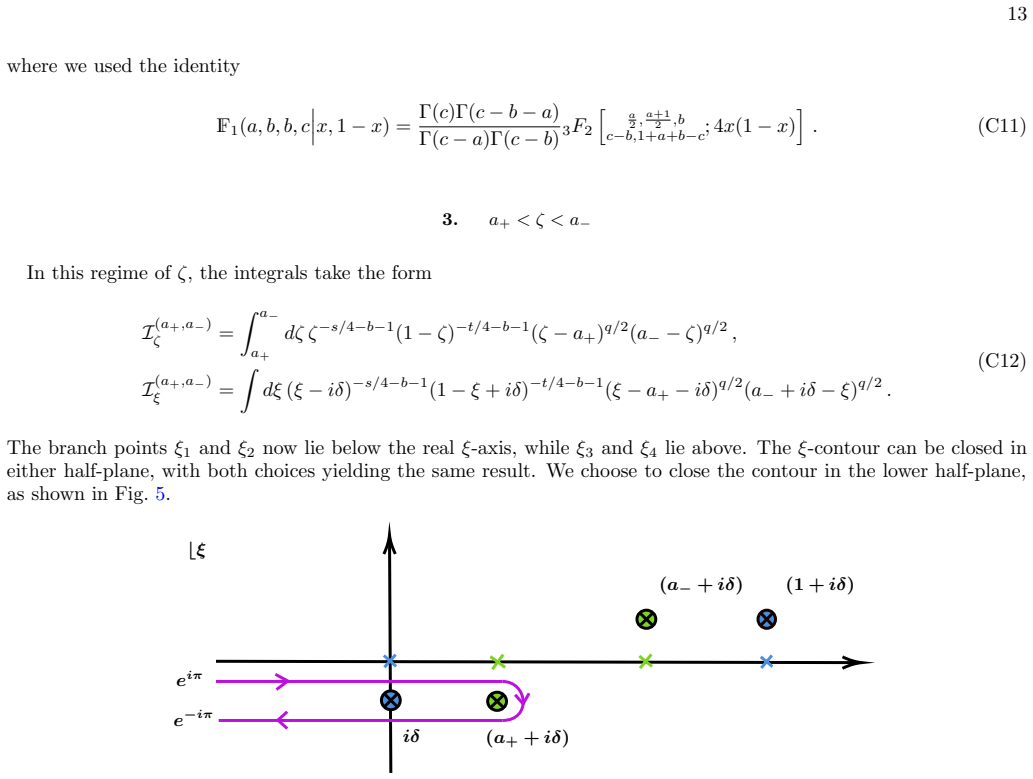
- [SM C; Eqs. (C1)-(C18), (33)] The closed-string computation explicitly assumes a_+ and a_- are real and uses the ordering 0 < a_+ < a_- < 1. However, the s-t symmetric choice w_1 = w_3 used in the main text gives complex a_+ and a_- for generic r (Eq. (19)). The Appell-function expression (C18) is therefore derived only for real a_+; its analytic continuation to the complex case is not described. Since Eq. (33) is presented for a_+ and a_- given by (16), the closed-string prediction has the same branch gap as the open-string case. The higher-point open-string result (29) inherits the same issue through |Delta(Q_5)|^{q/2} in Eq. (25).
- [Sec. II, Eqs. (18), (24), (6)] The statement that the construction reproduces '(1) with general parameters' is stronger than what is established. The dictionary gives delta = q/2, b = 1 - q - p^2, and q = 1 - (d+c_chi)/24. For a real dressing momentum p^2 >= 0, this imposes b <= 1 - 2 delta. The allowed region of the Mandelstam parameters (b, delta, lambda) covered by the worldsheet construction should be stated explicitly, including any reality conditions on r. This does not invalidate the construction, but it qualifies the generality claim.
minor comments (4)
- [SM C, heading] Typo: 'Kawai-Lwewllen-Tye' should be 'Kawai-Lewellen-Tye'.
- [Sec. IV] Typo: 'connectons' should be 'connections'.
- [Eqs. (15), (25)] Eq. (15) writes the factor without absolute values, while Eq. (25) has |...|^{q/2}. This notational inconsistency should be resolved, especially because the absolute value is central to the analytic-continuation question.
- [Ref. [56]] Reference [56] is cited as 'to appear'. Since the present construction relies on the CLD framework developed there, an arXiv number or a more complete citation would help the reader verify the background.
Circularity Check
No circularity: Mandelstam amplitude is an external benchmark; the worldsheet matching is parameter identification, not input-equals-output.
full rationale
The claimed derivation chain is: action (4) with the new boundary term and D0-brane boundary conditions (7), vertex operators (11), path-integral localization to the Mandelstam map (14), evaluation of the matter correlator as (15)/(17), and finally comparison with Mandelstam's generalized Veneziano amplitude (1). None of these steps reduces to its own input. Mandelstam's amplitude is an external 1968 target, not a quantity defined by the worldsheet action. The dictionary (delta=q/2, b=1-q-p^2, lambda=1/(1+r)^2) is obtained by explicit algebra after setting w1=w3, so that (x-a+)(x-a-) is proportional to (1-4 lambda x(1-x)); this is parameter identification, not a fitted parameter renamed as a prediction. The paper does not claim to predict the Mandelstam parameters from first principles without tuning; it claims to reproduce the family of generalized Veneziano amplitudes, and the path-integral computation is the nontrivial content. The self-citations to [54,56] provide the CLD machinery and localization technique, but the present derivation of the boundary term, the higher-point integrands, and the closed-string amplitude is carried out here and tested against an external benchmark, so the argument does not collapse into a self-citation chain. The flagged weakness in SM B1 (analytic continuation from real interaction points Z_I to complex a+ and a-; Eq. (B15) contains absolute values and is not literally analytic in {w_k}) is a potential gap in the derivation of Eq. (17), not a circular equivalence. If the continuation is invalid, the worldsheet match fails, but it does not fail because the output was inserted as an input. Therefore the circularity score is 0.
Axiom & Free-Parameter Ledger
free parameters (4)
- q (CLD background charge, set by d and c_χ) =
δ = q/2 (target δ)
- p (momentum of the dressing boson y) =
p² = 1 − q − b (target b)
- r = w2/w1 (winding ratio, with w1 = w3, Σw = 0) =
λ = 1/(1+r)² (target λ)
- Internal CFT central charge c_χ (equivalently spacetime dimension d) =
c_χ = 24(1−q) − d
axioms (4)
- domain assumption The CLD βγ path integral localizes to holomorphic maps (∂̄γ = ∂γ̄ = 0), with the renormalized on-shell action given by (B13)/(B15).
- ad hoc to paper The analytic continuation of the Mandelstam-map evaluation from real interaction points Z_I to complex w_k is valid and branch-safe for the non-integer powers q/2.
- domain assumption Weyl invariance of the action with the new boundary term (second line of (4)); the SM A variation computation yielding the CLD central charge c = 24q is the correct boundary treatment.
- domain assumption The vertex operators (11) have conformal weights k²+q, the on-shell condition is M² = q − 1 (13), and winding conservation Σw = 0 is exactly enforced (δ in (15)).
invented entities (3)
-
Chiral composite linear dilaton (CLD) βγ-system with the new boundary term
no independent evidence
-
D0-branes localized in γ1 and extended in γ2, with fractional winding numbers w_a
no independent evidence
-
Dressing free boson y in the internal CFT
no independent evidence
read the original abstract
We present a worldsheet action that reproduces a class of dual resonance amplitudes discussed in the literature, which generalize the Veneziano amplitude for open strings. Our proposal builds on the chiral composite linear dilaton introduced recently. We further compute higher-point extensions and closed-string analogs, which exhibit partial crossing symmetry.
Figures




Forward citations
Cited by 1 Pith paper
-
Meromorphic amplitudes from 3-dimensional supersymmetry
Coon amplitude equals 3d N=2 half-index of XYZ model with boundary conditions; IR flow gives Veneziano amplitude, and elliptic completion of q^ST yields a meromorphic positive version.
Reference graph
Works this paper leans on
-
[1]
(17) is nots, t-crossing symmetric in general be- cause of the extra factor (x−a +) q 2 (x−a −) q 2
-
[2]
Witten-type
The parametersbandδare both fixed byqand are not independent in (17): δ= q 2 , b= 1−q .(18) The first issue can be resolved by tuningw a’s. A par- ticularly convenient choice isw 1 =w 3, under whicha ± satisfya + = 1−a − and are given by a± = 1 2 ± i 2 p r(2 +r),(19) withr=w 2/w1. With this choice, the parameterλin (1) is given by λ= 1 (1 +r) 2 .(20) Gene...
-
[3]
Veneziano, Nuovo Cim
G. Veneziano, Nuovo Cim. A57, 190 (1968)
1968
-
[4]
Mandelstam, Phys
S. Mandelstam, Phys. Rev. Lett.21, 1724 (1968)
1968
-
[5]
Bardakci and H
K. Bardakci and H. Ruegg, Phys. Lett. B28, 342 (1968)
1968
-
[6]
D. D. Coon, Phys. Lett. B29, 669 (1969)
1969
-
[7]
Matsuda,MODEL FOR INFINITE VENEZIANO SE- RIES, Report UCRL-19266 (Lawrence Radiation Labora- 5 tory, University of California, Berkeley, California, 1969)
S. Matsuda,MODEL FOR INFINITE VENEZIANO SE- RIES, Report UCRL-19266 (Lawrence Radiation Labora- 5 tory, University of California, Berkeley, California, 1969)
1969
-
[8]
Chan and S
H.-M. Chan and S. T. Tsou, Phys. Lett. B28, 485 (1969)
1969
-
[9]
M. A. Virasoro, Phys. Rev.177, 2309 (1969)
1969
-
[10]
D. J. Gross, Nucl. Phys. B13, 467 (1969)
1969
-
[11]
J. A. Shapiro, Phys. Lett. B33, 361 (1970)
1970
-
[12]
L. J. Romans, Conf. Proc. C8903131, 57 (1989)
1989
-
[13]
D. B. Fairlie and J. Nuyts, Nucl. Phys. B433, 26 (1995), arXiv:hep-th/9406043
Pith/arXiv arXiv 1995
-
[14]
Y.-t. Huang, J.-Y. Liu, L. Rodina, and Y. Wang, JHEP 04, 195 (2021), arXiv:2008.02293 [hep-th]
Pith/arXiv arXiv 2021
-
[15]
I. Ridkokasha, Mod. Phys. Lett. A36, 2150031 (2021), arXiv:2008.11418 [hep-ph]
Pith/arXiv arXiv 2021
-
[16]
Maity, JHEP04, 064 (2022), arXiv:2110.01578 [hep- th]
P. Maity, JHEP04, 064 (2022), arXiv:2110.01578 [hep- th]
Pith/arXiv arXiv 2022
-
[17]
N. Arkani-Hamed, L. Eberhardt, Y.-t. Huang, and S. Mizera, JHEP02, 197 (2022), arXiv:2201.11575 [hep- th]
Pith/arXiv arXiv 2022
-
[18]
F. Figueroa and P. Tourkine, Phys. Rev. Lett.129, 121602 (2022), arXiv:2201.12331 [hep-th]
Pith/arXiv arXiv 2022
-
[19]
Y.-t. Huang and G. N. Remmen, Phys. Rev. D106, L021902 (2022), arXiv:2203.00696 [hep-th]
Pith/arXiv arXiv 2022
-
[20]
N. Geiser and L. W. Lindwasser, JHEP12, 112 (2022), arXiv:2207.08855 [hep-th]
Pith/arXiv arXiv 2022
-
[21]
J. Chakravarty, P. Maity, and A. Mishra, JHEP10, 043 (2022), arXiv:2208.02735 [hep-th]
Pith/arXiv arXiv 2022
-
[22]
N. Geiser and L. W. Lindwasser, JHEP04, 031 (2023), arXiv:2210.14920 [hep-th]
Pith/arXiv arXiv 2023
-
[23]
R. Bhardwaj, S. De, M. Spradlin, and A. Volovich, JHEP 08, 082 (2023), arXiv:2212.00764 [hep-th]
Pith/arXiv arXiv 2023
-
[24]
A. S.-K. Chen, H. Elvang, and A. Herderschee, Phys. Rev. Lett.133, 091601 (2024), arXiv:2212.13998 [hep- th]
Pith/arXiv arXiv 2024
-
[25]
C. Cheung and G. N. Remmen, Phys. Rev. D108, 026011 (2023), arXiv:2302.12263 [hep-th]
Pith/arXiv arXiv 2023
-
[26]
A. S.-K. Chen, H. Elvang, and A. Herderschee, Phys. Rev. Lett.131, 031602 (2023), arXiv:2302.04895 [hep- th]
Pith/arXiv arXiv 2023
-
[27]
C. B. Jepsen, JHEP06, 114 (2023), arXiv:2303.02149 [hep-th]
Pith/arXiv arXiv 2023
-
[28]
C. Cheung and G. N. Remmen, Phys. Rev. D108, 086009 (2023), arXiv:2308.03833 [hep-th]
Pith/arXiv arXiv 2023
-
[29]
L.-Y. Chiang, Y.-t. Huang, and H.-C. Weng, JHEP05, 289 (2024), arXiv:2310.10710 [hep-th]
Pith/arXiv arXiv 2024
-
[30]
K. H¨ aring and A. Zhiboedov, JHEP10, 075 (2024), arXiv:2311.13631 [hep-th]
Pith/arXiv arXiv 2024
- [31]
-
[32]
K. C. Rigatos, Phys. Rev. D109, 086008 (2024), arXiv:2310.12207 [hep-th]
Pith/arXiv arXiv 2024
-
[33]
J. Berman, H. Elvang, and A. Herderschee, JHEP03, 021 (2024), arXiv:2310.10729 [hep-th]
Pith/arXiv arXiv 2024
-
[34]
Geiser, JHEP10, 010 (2024), arXiv:2311.04130 [hep- th]
N. Geiser, JHEP10, 010 (2024), arXiv:2311.04130 [hep- th]
Pith/arXiv arXiv 2024
-
[35]
C. Eckner, F. Figueroa, and P. Tourkine, Phys. Rev. D 111, 126005 (2025), arXiv:2401.08736 [hep-th]
Pith/arXiv arXiv 2025
-
[36]
K. C. Rigatos and B. Wang, Phys. Rev. D110, 126024 (2024), arXiv:2401.13031 [hep-th]
Pith/arXiv arXiv 2024
-
[37]
C. Eckner, F. Figueroa, and P. Tourkine, JHEP02, 103 (2025), arXiv:2405.21057 [hep-th]
Pith/arXiv arXiv 2025
-
[38]
Wang, JHEP04, 143 (2024), arXiv:2403.00906 [hep- th]
B. Wang, JHEP04, 143 (2024), arXiv:2403.00906 [hep- th]
Pith/arXiv arXiv 2024
-
[39]
J. Berman and H. Elvang, JHEP09, 076 (2024), arXiv:2406.03543 [hep-th]
Pith/arXiv arXiv 2024
-
[40]
N. Arkani-Hamed, C. Figueiredo, and G. N. Remmen, JHEP04, 039 (2025), arXiv:2412.20639 [hep-th]
Pith/arXiv arXiv 2025
-
[41]
R. Bhardwaj, M. Spradlin, A. Volovich, and H.-C. Weng, Phys. Rev. D110, 106016 (2024), arXiv:2406.04410 [hep- th]
Pith/arXiv arXiv 2024
-
[42]
G. Mansfield and M. Spradlin, JHEP02, 145 (2025), arXiv:2409.09561 [hep-th]
Pith/arXiv arXiv 2025
- [43]
-
[44]
S. Caron-Huot, Z. Komargodski, A. Sever, and A. Zhi- boedov, JHEP10, 026 (2017), arXiv:1607.04253 [hep-th]
Pith/arXiv arXiv 2017
-
[45]
C. Cheung and G. N. Remmen, JHEP01, 122 (2023), arXiv:2210.12163 [hep-th]
Pith/arXiv arXiv 2023
-
[46]
N. Arkani-Hamed, C. Cheung, C. Figueiredo, and G. N. Remmen, Phys. Rev. Lett.132, 091601 (2024), arXiv:2312.07652 [hep-th]
Pith/arXiv arXiv 2024
-
[47]
J. Albert, W. Knop, and L. Rastelli, JHEP02, 157 (2025), arXiv:2406.12959 [hep-th]
Pith/arXiv arXiv 2025
-
[48]
C. Cheung, A. Hillman, and G. N. Remmen, Phys. Rev. Lett.133, 251601 (2024), arXiv:2406.02665 [hep-th]
Pith/arXiv arXiv 2024
-
[49]
C. Cheung, A. Hillman, and G. N. Remmen, Phys. Rev. D111, 086034 (2025), arXiv:2408.03362 [hep-th]
Pith/arXiv arXiv 2025
-
[50]
C. Cheung, G. N. Remmen, F. Sciotti, and M. Tarquini, (2025), arXiv:2508.09246 [hep-th]
Pith/arXiv arXiv 2025
-
[51]
J. Albert and L. Rastelli, JHEP08, 151 (2022), arXiv:2203.11950 [hep-th]
Pith/arXiv arXiv 2022
-
[52]
J. Albert and L. Rastelli, JHEP09, 039 (2024), arXiv:2307.01246 [hep-th]
Pith/arXiv arXiv 2024
-
[53]
C. Fernandez, A. Pomarol, F. Riva, and F. Sciotti, JHEP 06, 094 (2023), arXiv:2211.12488 [hep-th]
Pith/arXiv arXiv 2023
-
[54]
J. Albert, J. Henriksson, L. Rastelli, and A. Vichi, JHEP 09, 172 (2024), arXiv:2312.15013 [hep-th]
Pith/arXiv arXiv 2024
-
[55]
We also introduced a new parameterλfollowing [28]
We set the parameterain [2] to 1 by rescalingsandt. We also introduced a new parameterλfollowing [28]
- [56]
-
[57]
Throughout this letter, we setα ′ = 1
-
[58]
Komatsu and P
S. Komatsu and P. Maity, to appear (2025)
2025
-
[59]
Mandelstam, inWorkshop on Unified String Theories (1985)
S. Mandelstam, inWorkshop on Unified String Theories (1985)
1985
-
[60]
Kawai, D
H. Kawai, D. C. Lewellen, and S. H. H. Tye, Nucl. Phys. B269, 1 (1986)
1986
-
[61]
Witten, Nucl
E. Witten, Nucl. Phys. B268, 253 (1986)
1986
-
[62]
L. Rastelli and B. Zwiebach, JHEP01, 018 (2008), arXiv:0708.2591 [hep-th]. 6 Supplemental Material Appendix A: Conformal invariance of our worldsheet action In this appendix, we find how our CLD worldsheet action with the boundary term (4) transforms under the Weyl transformation of the worldsheet metric: gab →g ′ ab =e 2w(τ,σ) gab .(A1) We first write do...
Pith/arXiv arXiv 2008
-
[63]
In what follows, we will work in a parameter regime of{w k}n k=1 in which the interaction pointsZ I , I= 1,· · ·, n−2 are real
Derivation of the Mandelstam formula. In what follows, we will work in a parameter regime of{w k}n k=1 in which the interaction pointsZ I , I= 1,· · ·, n−2 are real. The final result thus obtained is analytic in{w k}, and therefore can be analytically continued to arbitrary parameter regimes. Note that Γ[ρ,¯ρ] can be viewed as the Liouville action associa...
-
[64]
Conformal property We now study howe −Γren[ρ] transforms under the PSL(2,R) transformationz→(az+b)/(cz+d) withad−bc= 1. For this purpose, it is useful to recall that (x 1 −x 2) transforms under the PSL(2,R),x 1,2 →(ax 1,2 +b)/(cx 1,2 +d), as (x1 −x 2)→ x1 −x 2 (cx1 +d)(cx 2 +d) .(B17) Another useful equality is nX j=1 wjxj =w k Q j(̸=k) (xk −x j) Q I (xk ...
-
[65]
7: Branch points of theξ-integrand for 1< ζ <∞and our choice of theξ-contour where the explicit forms ofI ζ andI ξ in each integration domain are given in Eqs
F ull answer The resulting expression for the four-point closed-string amplitude (33) takes the form Aclosed 4 / ˜N closed 4 =i h I (0,a+) ζ I (0,a+) ξ +I (a+,a−) ζ I (a+,a−) ξ +I (a−,1) ζ I (a−,1) ξ i (C18) 15 iδ (a+ +iδ) (a− +iδ) (1 +iδ) ⌊ξ FIG. 7: Branch points of theξ-integrand for 1< ζ <∞and our choice of theξ-contour where the explicit forms ofI ζ a...
discussion (0)
Sign in with ORCID, Apple, or X to comment. Anyone can read and Pith papers without signing in.