REVIEW 3 major objections 5 minor 101 references
A subgrid model can follow massive black hole triplets all the way to coalescence inside live galaxy simulations, and encounter geometry alone can decide which pair merges and when.
Reviewed by Pith at T0; open to challenge. T0 means a machine referee read the full paper against a public rubric. the ladder, T0–T4 →
RAMCOAL now evolves subgrid massive black hole triplets to coalescence inside live hydrodynamical simulations by mapping chaotic encounters onto Bonetti three-body outcomes.
T0 review reviewed 2026-07-11 challenge →
load-bearing objection Solid methods extension that really does run a live-hydro triplet to a Bonetti-drawn coalescence; the stress-test is right that the resonant phase itself is a library lookup, not integrated dynamics. the 3 major comments →
Set them free: extending RAMCOAL to model massive black hole triplets in hydrodynamical simulations of galaxies
The pith
A machine-rendered reading of the paper's core claim, the machinery that carries it, and where it could break.
The reading
Core claim
The authors establish that RAMCOAL can now follow subgrid massive black hole triplets self-consistently inside live hydrodynamical galaxy simulations, and they demonstrate for the first time a complete dynamical evolution of such a triplet from three resolved black holes through chaotic three-body interaction all the way to coalescence, with the surviving configuration, accretion, and spin updated on the fly.
What carries the argument
The RAMCOAL triplet extension: a three-stage subgrid treatment (resolved sinks, dynamical-friction pairs, bound binaries) that, when a hierarchical triplet becomes unstable, maps the encounter onto a weighted library of three-body outcomes and updates the surviving system, accretion, spins, and recoils while remaining coupled to the live host galaxy.
Load-bearing premise
When a hierarchical triplet becomes chaotic, the full resonant three-body dance can be replaced by one weighted draw from a fixed scattering library that depends only on primary mass and two mass ratios, with a short fixed interaction timer and an escape-speed ejection velocity.
What would settle it
Run matched live-galaxy simulations in which the chaotic phase is integrated with a direct few-body or regularized N-body method instead of the library draw, and check whether the identity of the coalescing pair, the merger delay, and the residual eccentricity systematically disagree with the library-based outcomes.
Editorial analysis
A structured set of objections, weighed in public.
Referee Report
Summary. The paper extends the RAMCOAL subgrid framework in RAMSES to treat massive black hole triplets. MBHs evolve as sinks through resolved dynamical friction (stage 0), subgrid DF (stage 1), and bound hardening by stellar scattering, circumbinary torques, and GWs (stage 2). Hierarchical triplets that meet a Mylläri-type instability criterion are mapped onto the Bonetti et al. (2018) scattering library via a weighted draw on (M_pri, q_in, q_out), with a fixed 10^3 yr chaotic timer; remnant spin and recoil follow Rezzolla and Lousto–Zlochower fits. Three isolated-galaxy tests show geometry-dependent partner selection (A vs B) and an exchange merger in a compact active triplet (C), with post-processed GW tracks. The authors claim the first end-to-end triplet evolution to coalescence inside a live hydrodynamical simulation and a route to environmentally linked GW merger catalogues.
Significance. If the framework holds under cosmological application, it would fill a genuine gap between pure post-processing delay models and expensive regularized N-body treatments (e.g. KETJU), enabling PTA/LISA/TianQin catalogues that retain live gas, accretion, spin, and recoil history. Strengths include an explicit seven-state classification, on-the-fly coupling of accretion/spin/feedback to the subgrid orbit outside the chaotic interval, validation of the Bonetti selector for one cell (N_seed=100), and a transparent demonstration that encounter geometry alone can change which pair merges. The work is timely given PTA backgrounds and LISA adoption. The main caveat is that the resonant three-body phase itself is not dynamically integrated in the live run, so the strongest wording of the end-to-end claim needs careful qualification.
major comments (3)
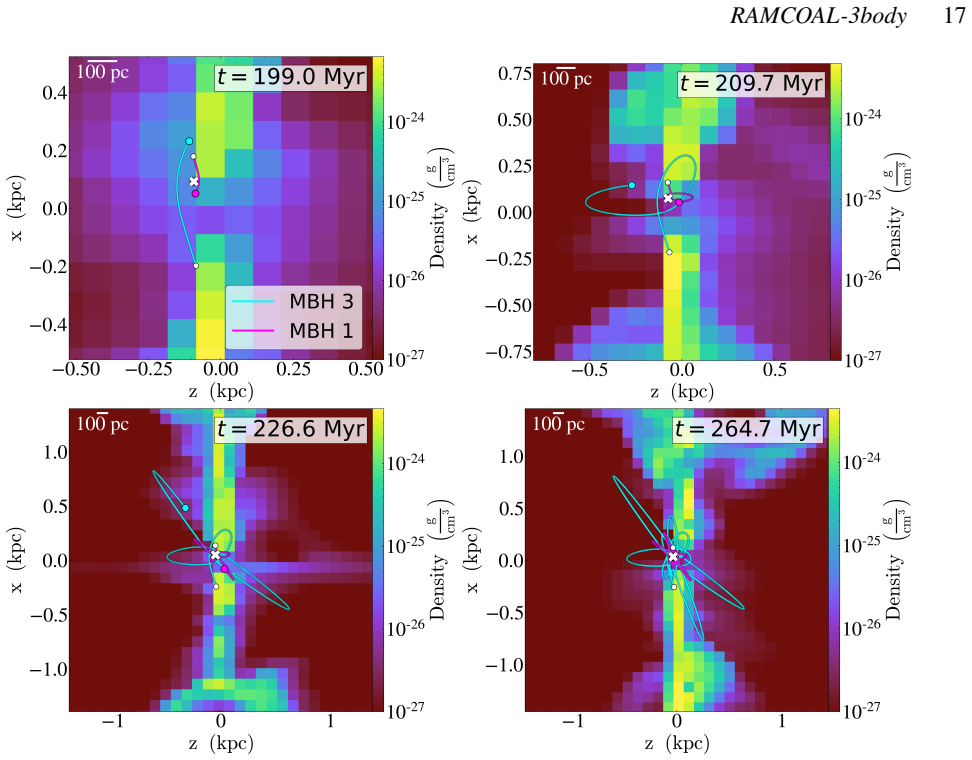
- [Abstract; §5.2; §6.4; Conclusions] Abstract, §6.4, and Conclusions claim the first triplet evolution “all the way to coalescence inside a live hydrodynamical simulation.” In case C the chaotic phase is not integrated: once Eqs. (16)–(19) are satisfied, a single Bonetti draw is taken and coalescence is assumed after a fixed 10^3 yr timer (§5.2); the GW track is reconstructed only in post-processing (Fig. 22). Live gas/stars/feedback therefore never act during the resonant interaction that decides partner and timing. The capability is real for pre- and post-chaotic stages, but the wording overstates what is demonstrated. Soften the claim and state explicitly that the resonant phase is a library lookup plus timer.
- [§5.2] §5.2 sets the chaotic interaction timer to a fixed 10^3 yr (called tunable) and sets ejection velocity to the local escape speed from the resolution sphere rather than drawing from the Bonetti N-body distributions. Both choices are load-bearing for merger delays and the wandering/offset population that the paper advertises for dual-AGN and multimessenger science. Either justify the numerical values against the Bonetti completion-time and velocity distributions, or present a short sensitivity test (e.g. timer ×10 and ÷10) so that the reported coalescence times in cases A–C can be interpreted.
- [§5.2; §7.3] The Bonetti grid assumes M_out < M_pri + M_sec (q_out ≤ 1); the opposite case is deferred (§5.2). In hierarchical assembly the intruder can be more massive. The manuscript should quantify how often this configuration is expected in the intended cosmological application and state how such systems will be handled (reject, force merge, or flag) so that the catalogue claim is not silently incomplete.
minor comments (5)
- [§5.4, Eq. (34)] Eq. (34) lists the Rezzolla coefficients as empty placeholders (“s4 =, s5 =, t0 =…”). Insert the numerical values from Rezzolla et al. (2008).
- [Table 3; §6.4] Table 3 and the text give slightly inconsistent initial separations/velocities for case C; reconcile the numbers and state whether the resolution sphere is 2Δx or 4Δx for that run.
- [Fig. 6] Fig. 6 caption and text note that the plotted quantity switches from instantaneous separation to semi-major axis at the stage 1–2 boundary; make this change of variable explicit in the figure legend itself to avoid an apparent jump.
- [§6.3 and passim] Several typos: “RMACOAL” (§6.3), “set them free” title is fine but “set them free” vs body consistency, and occasional missing spaces around units (e.g. 0.39 kpc).
- [§5.3] The CBD preferential-accretion coefficients p0, p1, p2 (Eqs. 22–23) and η_s2 = 0.01 are free parameters; a one-sentence statement of their provenance (or that they are held fixed from Duffell et al.) would help reproducibility.
Circularity Check
No significant circularity: external libraries and staged prescriptions are applied, not fitted to the paper's own outputs; the end-to-end claim is overstated but not circular.
specific steps
-
self citation load bearing
[§3 (opening); abstract; conclusions]
"Before introducing the triplet extension, we summarize the RAMCOAL model for MBHBs as presented in paper I (Li et al. 2025). ... We demonstrate the first triplet MBH dynamical evolution all the way to coalescence inside a live hydrodynamical simulation."
The binary stages (DF, stellar hardening, CBD torques, GW) are taken wholesale from the authors' own prior paper rather than re-derived. This is ordinary sequential self-citation and is not load-bearing for the new triplet claim (the Bonetti mapping and test-case C demonstration stand independently), so it contributes only a minor score increment.
full rationale
The paper's derivation chain is a staged subgrid model that imports independent external results (Bonetti et al. 2018 scattering probabilities, Lousto & Zlochower 2013 recoils, Rezzolla et al. 2008 remnant spins, Duffell et al. 2020 preferential accretion) and applies them on the fly inside RAMSES. It does not fit those libraries to its own simulation outputs, nor does it redefine a target observable in terms of a fitted parameter and then call the result a prediction. Self-citations to paper I (Li et al. 2025) and prior RAMSES spin/accretion work supply the binary baseline; the new triplet machinery (Mylläri-type instability criterion, 49-combination reduction, Bonetti weighted draw) is an independent extension demonstrated in controlled isolated-galaxy tests. The strongest claim—that a triplet is followed "all the way to coalescence inside a live hydrodynamical simulation"—is weaker than advertised because the chaotic resonant phase is replaced by a library lookup plus a fixed 10^3 yr timer rather than integrated live, but that is an overstatement of capability, not a circular reduction of a prediction to its inputs. Score 1 for ordinary self-citation of the binary baseline that is not load-bearing for the new triplet results.
Axiom & Free-Parameter Ledger
free parameters (4)
- chaotic interaction timer =
10^3 yr
- η_s2 mini-disc suppression threshold =
0.01
- preferential-accretion polynomial coefficients p0,p1,p2 =
0.8054, 0.9840, 0.3818
- resolution-sphere multiplier (4Δx or 2Δx) =
4Δx (fiducial); 2Δx (case C)
axioms (5)
- domain assumption A hierarchical triplet becomes chaotic once the Mylläri et al. (2018) instability proxy Q_st < Q_st,0, after which secular evolution is no longer valid.
- domain assumption Chaotic three-body outcomes are fully captured by the seven-channel Bonetti et al. (2018) probability tables binned only on (M_pri, q_in, q_out) with q_out ≤ 1.
- ad hoc to paper Ejection velocity may be set to the local escape speed from the resolution sphere rather than drawn from N-body scattering data.
- domain assumption A bound MBHB is always embedded in a circumbinary disc whose torques follow the adopted viscous-drag prescription, independent of local gas geometry.
- standard math Standard Peters GW, Quinlan stellar hardening, and Lousto–Zlochower recoil formulae remain valid once the subgrid binary is formed.
invented entities (2)
-
Seven-state subgrid classification (single, stage-1 pair, bound binary, three stage-1, hierarchical triplet, active triplet, pending ejection)
no independent evidence
-
Two-channel CBD reservoir (mini-disc supply vs gap/clump reservoir) with feedback-regulated mini-disc suppression
no independent evidence
Cite this review
Pith. "Pith review of Set them free: extending RAMCOAL to model massive black hole triplets in hydrodynamical simulations of galaxies." pith.science (2026). https://pith.science/paper/DC5BZSEY
@misc{pith2026260704121,
  author       = {Pith},
  title        = {Pith review of: Set them free: extending RAMCOAL to model massive black hole triplets in hydrodynamical simulations of galaxies},
  year         = {2026},
  howpublished = {\url{https://pith.science/paper/DC5BZSEY}},
  note         = {Machine review of arXiv:2607.04121}
}
read the original abstract
Massive black hole binaries (MBHBs), and the higher-order multiples produced by repeated galaxy mergers, spend part of their lives in dynamical regimes that cosmological simulations cannot resolve, even though these regimes set their merger delays, spins, recoils, and host-galaxy context. We extend the RAMCOAL framework to follow such subgrid massive black hole triplets directly within hydrodynamical galaxy simulations. As in the original staged binary model, the black holes start as sink particles, pass through a dynamical-friction phase, and settle into bound binaries that harden through stellar scattering, gas torques, circumbinary-disc coupling, and gravitational-wave emission. When a hierarchical triplet becomes chaotic, RAMCOAL maps the encounter onto a library of three-body outcomes from direct N-body experiments and updates the surviving system, following the resulting mergers, exchanges, and ejections together with the accretion and spin evolution of each black hole. Using isolated-galaxy tests with contrasting geometries, we show that the encounter geometry alone can change which pair finally merges, and after how long. We demonstrate the first triplet MBH dynamical evolution all the way to coalescence inside a live hydrodynamical simulation. This establishes an end-to-end capability to predict triplet-driven MBH coalescences self-consistently coupled to the evolving host galaxy. Because each MBHB coalescence carries its environmental history through the subgrid phase, RAMCOAL offers a route toward merger catalogues that link the gravitational-wave signatures of coalescing black holes to the galaxies in which they form.
Figures




Reference graph
Works this paper leans on
-
[1]
Agazie G., et al., 2023, ApJL, 951, L8
2023
-
[2]
Agazie G., et al., 2023b, ApJL, 952, L37
-
[3]
Agazie G., et al., 2023c, ApJL, 951, L50
-
[4]
Amaro-Seoane P., et al., 2017, arXiv e-prints, arXiv:1702.00786
Pith/arXiv arXiv 2017
-
[5]
Antonini F., Merritt D., 2012, ApJ, 745, 83
2012
-
[6]
M., et al., 2022, MNRAS, 516, 167
Bah\'e Y. M., et al., 2022, MNRAS, 516, 167
2022
-
[7]
Barausse E., 2012, MNRAS, 423, 2533
2012
-
[8]
Barausse E., Dvorkin I., Tremmel M., Volonteri M., Bonetti M., 2020, ApJ, 904, 16
2020
-
[9]
M., 1970, Nature, 226, 64
Bardeen J. M., 1970, Nature, 226, 64
1970
-
[10]
M., Petterson J
Bardeen J. M., Petterson J. A., 1975, ApJL, 195, L65
1975
-
[11]
S., Dubois Y., Volonteri M., Dong-Paez C
Beckmann R. S., Dubois Y., Volonteri M., Dong-Paez C. A., Peirani S., Piotrowska J. M., Martin G., Kraljic K., Devriendt J., Pichon C., 2025, MNRAS, 536, 1838
2025
-
[12]
C., Blandford R
Begelman M. C., Blandford R. D., Rees M. J., 1980, Nature, 287, 307
1980
-
[13]
H., Socrates A., 2002, ApJ, 578, 775
Blaes O., Lee M. H., Socrates A., 2002, ApJ, 578, 775
2002
-
[14]
Bondi H., 1952, MNRAS, 112, 195
1952
-
[15]
Bonetti M., Haardt F., Sesana A., Barausse E., 2018, MNRAS, 477, 3910
2018
-
[16]
Bonetti M., Sesana A., Haardt F., Barausse E., Colpi M., 2019, MNRAS, 486, 4044
2019
-
[17]
B., Mewes V., Campanelli M., Noble S
Bowen D. B., Mewes V., Campanelli M., Noble S. C., Krolik J. H., Zilh\ ao M., 2018, ApJL, 853, L17
2018
-
[18]
Chapon D., Mayer L., Teyssier R., 2013, MNRAS, 429, 3114
2013
-
[19]
Chen N., Ni Y., Tremmel M., Di Matteo T., Bird S., DeGraf C., Feng Y., 2022, MNRAS, 510, 531
2022
-
[20]
Damiano A., et al., 2025, A&A, 704, A83
2025
-
[21]
De Rosa A., et al., 2020, New Astronomy Reviews, 86, 101525
2020
-
[22]
Dong-P\'aez C. A., Beckmann R. S., Volonteri M., Dubois Y., Trebitsch M., 2023, arXiv e-prints, arXiv:2303.00766
Pith/arXiv arXiv 2023
-
[23]
J., Duffell P
D'Orazio D. J., Duffell P. C., 2021, ApJL, 914, L21
2021
-
[24]
Dosopoulou F., Antonini F., 2017, ApJ, 840, 31
2017
-
[25]
Dotti M., Colpi M., Pallini S., Perego A., 2013, ApJ, 762, 68
2013
-
[26]
Dubois Y., Devriendt J., Teyssier R., Slyz A., 2012, MNRAS, 420, 2662
2012
-
[27]
Dubois Y., Volonteri M., Silk J., 2014b, MNRAS, 440, 2333
-
[28]
Dubois Y., et al., 2021, A&A, 650, A133
2021
-
[29]
C., D'Orazio D
Duffell P. C., D'Orazio D. J., Derdzinski A., Haiman Z., MacFadyen A. I., Rosen A. L., Zrake J., 2020, ApJ, 901, 25
2020
-
[30]
EPTA Collaboration, InPTA Collaboration, 2023, A&A, 678, A50
2023
-
[31]
European Space Agency, 2024, ESA Press Release N ^ 4--2024, Venus voyager and gravitational wave surfer get green light
2024
-
[32]
D., Duffell P., MacFadyen A
Farris B. D., Duffell P., MacFadyen A. I., Haiman Z., 2014, ApJ, 783, 134
2014
-
[33]
Genina A., Springel V., Rantala A., 2024, MNRAS, 534, 957
2024
-
[34]
P., 2015, MNRAS, 451, 3941
Gerosa D., Veronesi B., Lodato G., Rosotti G. P., 2015, MNRAS, 451, 3941
2015
-
[35]
I., 2022, MNRAS, 511, 4753
Gualandris A., Dehnen W., Read J. I., 2022, MNRAS, 511, 4753
2022
-
[36]
Hernquist L., 1990, ApJ, 356, 359
1990
-
[37]
Hoffman L., Loeb A., 2007, MNRAS, 377, 957
2007
-
[38]
A., 1939, Mathematical Proceedings of the Cambridge Philosophical Society, 35, 405
Hoyle F., Lyttleton R. A., 1939, Mathematical Proceedings of the Cambridge Philosophical Society, 35, 405
1939
-
[39]
Hu W.-R., Wu Y.-L., 2017, National Science Review, 4, 685
2017
-
[40]
Izquierdo-Villalba D., Colpi M., Volonteri M., Spinoso D., Bonoli S., Sesana A., 2023, A&A, 677, A123
2023
-
[41]
Izquierdo-Villalba D., et al., 2026, arXiv e-prints, arXiv:2605.00092
Pith/arXiv arXiv 2026
-
[42]
Ji X., et al., 2025, MNRAS, 544, 3900
2025
-
[43]
Juod z balis I., Marconcini C., D'Eugenio F., et al., 2026, Nature, 653, 1017
2026
-
[44]
Z., Blecha L., Hernquist L., 2017, MNRAS, 464, 3131
Kelley L. Z., Blecha L., Hernquist L., 2017, MNRAS, 464, 3131
2017
-
[45]
Kim H., Kim W.-T., 2007, ApJ, 665, 432
2007
-
[46]
R., Lubow S
King A. R., Lubow S. H., Ogilvie G. I., Pringle J. E., 2005, MNRAS, 363, 49
2005
-
[47]
Klein A., Barausse E., Sesana A., Petiteau A., Berti E., Babak S., Gair J., Aoudia S., Hinder I., Ohme F., Wardell B., 2016, Phys. Rev. D, 93, 024003
2016
-
[48]
Koehn H., Just A., Berczik P., Tremmel M., 2023, A&A, 678, A11
2023
-
[49]
S., Volonteri M., 2023, A&A, 674, A217
Lescaudron S., Dubois Y., Beckmann R. S., Volonteri M., 2023, A&A, 674, A217
2023
-
[50]
R., Bonetti M., 2022, ApJ, 933, 104
Li K., Bogdanovi\'c T., Ballantyne D. R., Bonetti M., 2022, ApJ, 933, 104
2022
-
[51]
R., Bonetti M., 2023, ApJ, 959, 3
Li K., Bogdanovi\'c T., Ballantyne D. R., Bonetti M., 2023, ApJ, 959, 3
2023
-
[52]
S., Trebitsch M., 2025, A&A, 701, A232
Li K., Volonteri M., Dubois Y., Beckmann R. S., Trebitsch M., 2025, A&A, 701, A232
2025
-
[53]
O., Zlochower Y., 2013, Phys
Lousto C. O., Zlochower Y., 2013, Phys. Rev. D, 87, 084027
2013
-
[54]
Luo J., Chen L.-S., Duan H.-Z., Gong Y.-G., Hu S., Ji J., Long J.-D., Luo S., Mei J., Milyukov V., et al., 2016, Classical and Quantum Gravity, 33, 035010
2016
-
[55]
Madau P., Haardt F., Dotti M., 2014, ApJL, 784, L38
2014
-
[56]
Maiolino R., et al., 2024, A&A, 691, A145
2024
-
[57]
H., Rantala A., Naab T., Liao S., 2021, ApJ, 912, L20
Mannerkoski M., Johansson P. H., Rantala A., Naab T., Liao S., 2021, ApJ, 912, L20
2021
-
[58]
H., Naab T., Rantala A., Springel V., Irodotou D., Liao S., 2023, MNRAS, 524, 4062
Mannerkoski M., Rawlings A., Johansson P. H., Naab T., Rantala A., Springel V., Irodotou D., Liao S., 2023, MNRAS, 524, 4062
2023
-
[59]
S., 2023a, A&A, 669, A143
Massonneau W., Dubois Y., Volonteri M., Beckmann R. S., 2023a, A&A, 669, A143
-
[60]
S., 2023b, A&A, 670, A180
Massonneau W., Volonteri M., Dubois Y., Beckmann R. S., 2023b, A&A, 670, A180
-
[61]
C., Tchekhovskoy A., Blandford R
McKinney J. C., Tchekhovskoy A., Blandford R. D., 2012, MNRAS, 423, 3083
2012
-
[62]
C., Krolik J
Miller M. C., Krolik J. H., 2013, ApJ, 774, 43
2013
-
[63]
Proc., 686, 201
Milosavljevi\'c M., Merritt D., 2003, AIP Conf. Proc., 686, 201
2003
-
[64]
Myll\"ari A., Valtonen M., Pasechnik A., Mikkola S., 2018, MNRAS, 476, 830
2018
-
[65]
F., Frenk C
Navarro J. F., Frenk C. S., White S. D. M., 1997, ApJ, 490, 493
1997
-
[66]
Ni Y., et al., 2022, MNRAS, 513, 670
2022
-
[67]
C., 1999, ApJ, 513, 252
Ostriker E. C., 1999, ApJ, 513, 252
1999
-
[68]
Padmanabhan H., Loeb A., 2024, A&A, 684, L15
2024
-
[69]
Perego A., Dotti M., Colpi M., Volonteri M., 2009, MNRAS, 399, 2249
2009
-
[70]
Perna M., et al., 2025, A&A, 696, A59
2025
-
[71]
C., 1964, Phys
Peters P. C., 1964, Phys. Rev., 136, B1224
1964
-
[72]
Pfister H., Volonteri M., Dubois Y., Dotti M., Colpi M., 2019, MNRAS, 486, 101
2019
-
[73]
Quelquejay Leclere H., 2026, arXiv e-prints, arXiv:2604.20975
Pith/arXiv arXiv 2026
-
[74]
D., 1996, New Astron., 1, 35
Quinlan G. D., 1996, New Astron., 1, 35
1996
-
[75]
J., et al., 2023, ApJL, 951, L6
Reardon D. J., et al., 2023, ApJL, 951, L6
2023
-
[76]
N., Pollney D., Reisswig C., Seiler J., Husa S., 2008, Phys
Rezzolla L., Barausse E., Dorband E. N., Pollney D., Reisswig C., Seiler J., Husa S., 2008, Phys. Rev. D, 78, 044002
2008
-
[77]
Ruan W.-H., Liu C., Guo Z.-K., Wu Y.-L., Cai R.-G., 2021, Research, 2021, 6014164
2021
-
[78]
A., Narayan R., 2016, MNRAS, 456, 3915
S a dowski A., Lasota J.-P., Abramowicz M. A., Narayan R., 2016, MNRAS, 456, 3915
2016
-
[79]
R., Mayer L., 2024, ApJ, 975, 265
Saeedzadeh V., Babul A., Mukherjee S., Tremmel M., Quinn T. R., Mayer L., 2024, ApJ, 975, 265
2024
-
[80]
Z., 2024, MNRAS, 527, 7424
Sayeb M., Blecha L., Kelley L. Z., 2024, MNRAS, 527, 7424
2024
This paper was first reviewed by grok-4.5 on July 11, 2026.
discussion (0)
Sign in with ORCID, Apple, or X to comment. Anyone can read and Pith papers without signing in.