REVIEW 3 major objections 4 minor 1 cited by
What do people expect from Artificial Intelligence? Public opinion on alignment in AI moderation from Germany and the United States
T0 review · 3 major / 4 minor · reviewed 2026-08-16 · deepseek-v4-flash
Pith's one-line read Public support for AI moderation is strongest for accuracy and safety, weakest for aspirational goals.
desk verdict Solid two-country survey with a robust descriptive core (accuracy/safety rank highest), but the abstract overstates cross-national support by including aspirational imaginaries, and the country comparisons rest on untested measurement invariance. read the letter →
The pith
A machine-rendered reading of the paper's core claim, the machinery that carries it, and where it could break.
The reading
What carries the argument
The central machinery is a four-part typology of AI moderation goals, namely accuracy and reliability, safety, bias mitigation, and aspirational imaginaries, each captured by a single survey item, paired with an involvement model that locates influences at the individual, group, and country levels. The country comparison is the load-bearing device: the paper treats the United States as a high-involvement society and Germany as a low-involvement society, and uses country interaction terms to show that individual-level predictors lose explanatory power in the high-involvement context. This design is what lets the authors argue that exposure to AI consolidates expectations rather than merely shifting their level.
What would settle it
Administer the same four items with anchoring vignettes or a multi-group confirmatory factor model: if the US–Germany gaps in accuracy, safety, and bias support disappear once response styles or scalar non-invariance are modeled, the country-comparison claim fails. A simpler check would be to re-run the survey with concrete moderation examples instead of abstract descriptions and see whether the rank order of the four goals changes.
Extended reading notes
Core claim
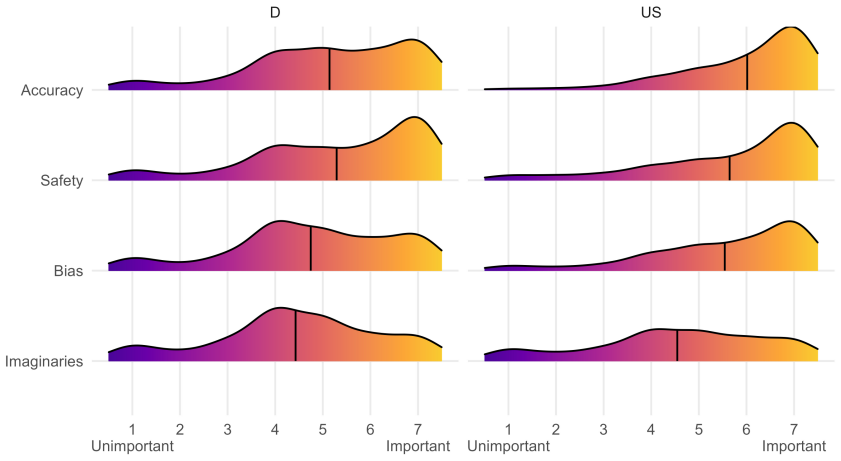
The paper's central claim is that public expectations for AI alignment are not monolithic: people evaluate moderation goals by their normative rationale, supporting interventions that prevent factual error or harm far more readily than interventions meant to correct bias or actively shape society. In both countries support ranks accuracy and reliability first, safety second, bias mitigation third, and aspirational imaginaries last, with the United States showing significantly higher support for the first three but no reliable country difference for aspirational goals. The paper further claims that individual-level factors, such as personal AI use, free speech attitudes, ideology, partisanship, and gender, shape these preferences but with country-specific strength: AI use and free speech matter more in Germany, while ideology matters more for aspirational support in the United States. This is presented as evidence that societal-level involvement with AI consolidates public attitudes, so that in high-involvement contexts individual differences recede.
Load-bearing premise
The results assume that the four single-item importance questions measure the same concepts in the same way in German and English, so that the observed country differences are real opinion differences rather than translation or response-style artifacts.
Editorial extensions
If this is right
- Accuracy and safety enjoy broad, cross-national support, so AI developers and regulators can treat these as a shared baseline of public expectation.
- Support falls off for bias mitigation and aspirational goals, so governance measures aimed at fairness or social vision will likely face more public contestation.
- U.S. respondents support accuracy, safety, and bias mitigation more strongly than Germans, but the two countries do not differ reliably on aspirational goals, suggesting that value-driven moderation is decoupled from technological involvement.
- Free speech support is positively, not negatively, associated with AI moderation support, which implies that the public treats AI-generated output as different from human speech.
- In low-involvement contexts like Germany, individual AI experience and free speech attitudes do more work, while in high-involvement contexts views are more uniform.
Reading between the lines
- If exposure to AI consolidates expectations, then as German AI use rises the country gap in support for accuracy, safety, and bias mitigation should narrow; this is directly testable in later waves of the same survey.
- The free speech finding suggests a boundary condition for the broader content moderation literature: the dynamics documented for human speech may not transfer to machine-generated text.
- Anchoring vignettes or multi-group measurement invariance models could check whether the single-item country differences reflect true opinion gaps or different response styles between German and U.S. samples.
- A factorial survey varying the stated rationale of a moderation rule could test whether the observed rank ordering survives concrete, contextualized decisions rather than abstract importance ratings.
Signed reviews
Editorial analysis
A structured set of objections, weighed in public.
Referee Report
Summary. This paper presents survey evidence from Germany (n = 1800) and the United States (n = 1756) on public support for four goals of AI content moderation: accuracy/reliability, safety, bias mitigation, and promotion of aspirational imaginaries. The authors measure each construct with a single 7-point importance item, compare countries and individual predictors using OLS regressions with country interaction terms, and support the analysis with a specification-curve robustness check. They report that accuracy and safety are strongly supported in both countries, that U.S. respondents are more supportive than German respondents, and that individual-level predictors (AI use, free speech attitudes) are more strongly associated with preferences in Germany than in the U.S.
Significance. The study is a useful, transparent empirical contribution to the emerging literature on public preferences for AI governance, and the specification-curve analysis is a genuine strength. If the country differences are real, the paper offers one of the first systematic comparative baselines for debates about AI alignment outside expert circles. However, because the headline cross-national claim partly depends on single-item measures whose equivalence across English and German is untested, the significance of the country-level conclusions is currently uncertain.
major comments (3)
- [Abstract and Results, RQ4] The abstract and the introductory summary state that U.S. respondents show 'consistently greater support for all alignment features' and 'consistently stronger support across all categories,' but the regression for aspirational imaginaries (Table 9, country beta = -0.06, p = 0.358, 95% CI [-0.18, 0.07]; interaction model Table 13, country beta = -0.13, p = 0.216) shows no significant country difference for this outcome. The RQ4 text itself correctly notes the null result, so the claim in the abstract and introduction should be revised to 'three of the four features' or otherwise qualified.
- [Appendix Tables 4-5 and Results RQ4] The cross-national comparisons in RQ4 rest on four single-item dependent variables (Appendix Tables 4-5) that are assumed to be understood equivalently in English and German. With one indicator per construct, metric and scalar measurement invariance cannot be established from these data, and the paper reports no auxiliary tests (e.g., anchoring vignettes, response-style indices). Different interpretations of phrases such as 'aspirational view of society' or 'fairness and equity,' or different use of the 7-point scale, could produce or inflate the observed country coefficients (Tables 6-9) and the interaction terms (Tables 10-13). The limitations section does not mention translation or response styles; this should be acknowledged and the country-effect claims softened accordingly.
- [System-level involvement: Country and RQ4] The paper interprets the U.S.-Germany difference as reflecting 'higher societal involvement with AI,' but country is a composite variable that also captures political culture, regulatory discourse, and technology-market structure. The measured AI-use differences (Table 1) are consistent with the proposed mechanism, yet the country indicator cannot isolate societal involvement from other country-level confounds. I recommend tempering the causal-sounding language and explicitly noting that the country effect is consistent with, but not a direct test of, the societal-involvement account.
minor comments (4)
- [Results RQ2] The text contains two instances of 'p < .001 0' (for AI use and aspirational portrayals); the stray '0' should be removed.
- [Methods] The description of the U.S. sample as 'representative' for sex, age, and political affiliation is stronger than warranted for a quota-sampled online panel; 'quota-matched' would be more precise.
- [Figure 1] Adding numeric labels or a small table with means and standard deviations alongside Figure 1 would make the distributional comparison easier to read.
- [Appendix Table 9] The table heading says 'aspirational version of the world,' while the item wording and the text use 'aspirational view of society' and 'aspirational imaginaries'; align the wording for consistency.
Circularity Check
No circular reasoning found: the survey measures preferences directly and does not derive its conclusions from its own assumptions.
full rationale
This paper reports an empirical survey study and does not present a formal derivation chain that could collapse into its own inputs. The four outcome variables (importance of accuracy, safety, bias mitigation, and aspirational imaginaries) are directly measured with single survey items; the predictors (AI use, free speech support, political orientation, partisanship, gender, education, age, and country) are independently measured. No parameter is fitted to a subset of the outcome data and then used to 'predict' that same outcome; country differences, individual-level associations, and interaction terms are estimated directly from the survey responses. The theoretical expectations are drawn from prior literature, including some work by the authors, but those citations are contextual rather than load-bearing: the empirical claims would stand or fall on the survey data themselves, and the paper reports specification curve analyses as robustness checks. The identified concern about untested measurement equivalence across the German and U.S. samples is a validity or measurement limitation, not a circularity: it questions whether the items capture the same construct across languages, but it does not show that the paper's argument assumes what it claims to demonstrate. Similarly, the inconsistency between the abstract's claim of 'consistently greater support for all alignment features' and the non-significant country coefficient for aspirational imaginaries (Table 9) is an internal-consistency or reporting issue, not a circular derivation. Accordingly, the paper is self-contained as an empirical contribution, and no circular step can be quoted or exhibited.
Assumptions & free parameters
assumptions (4)
- domain assumption Self-reported survey responses are valid indicators of public preferences.
- domain assumption The US and German samples are comparable for cross-national inference.
- domain assumption The four single-item measures capture the intended alignment constructs.
- standard math OLS regression assumptions (linearity, independence) hold for the pooled data.
Cite this review
Pith. "Pith review of What do people expect from Artificial Intelligence? Public opinion on alignment in AI moderation from Germany and the United States." pith.science (2026). https://pith.science/paper/DCBONPI6
@misc{pith2026250412476,
  author       = {Pith},
  title        = {Pith review of: What do people expect from Artificial Intelligence? Public opinion on alignment in AI moderation from Germany and the United States},
  year         = {2026},
  howpublished = {\url{https://pith.science/paper/DCBONPI6}},
  note         = {Machine review of arXiv:2504.12476}
}
read the original abstract
Recent advances in generative Artificial Intelligence have raised public awareness, shaping expectations and concerns about their societal implications. Central to these debates is the question of AI alignment -- how well AI systems meet public expectations regarding safety, fairness, and social values. However, little is known about what people expect from AI-enabled systems and how these expectations differ across national contexts. We present evidence from two surveys of public preferences for key functional features of AI-enabled systems in Germany (n = 1800) and the United States (n = 1756). We examine support for four types of alignment in AI moderation: accuracy and reliability, safety, bias mitigation, and the promotion of aspirational imaginaries. U.S. respondents report significantly higher AI use and consistently greater support for all alignment features, reflecting broader technological openness and higher societal involvement with AI. In both countries, accuracy and safety enjoy the strongest support, while more normatively charged goals -- like fairness and aspirational imaginaries -- receive more cautious backing, particularly in Germany. We also explore how individual experience with AI, attitudes toward free speech, political ideology, partisan affiliation, and gender shape these preferences. AI use and free speech support explain more variation in Germany. In contrast, U.S. responses show greater attitudinal uniformity, suggesting that higher exposure to AI may consolidate public expectations. These findings contribute to debates on AI governance and cross-national variation in public preferences. More broadly, our study demonstrates the value of empirically grounding AI alignment debates in public attitudes and of explicitly developing normatively grounded expectations into theoretical and policy discussions on the governance of AI-generated content.
Figures


Figures from the paper (2 more)


Forward citations
Cited by 1 Pith paper
-
Artificial Intelligence in Government: Why People Feel They Lose Control
When government AI is framed as efficient, trust rises but perceived control falls; when it is framed as opaque, irreversible, or uncontestable, both trust and perceived control drop sharply.
Reference graph
Works this paper leans on
-
[1332]
https://doi.org/10.1007/s13347-021-00459-2 Dewey, J. (1916). Democracy and Education. An Introduction to the Philosophy of Education. Macmillan. Dewey, J. (1934).Art as Experience. Minton, Balch & Co. Ding, J. (2024).Technology and the rise of great powers: How diffusion shapes economic competi- tion. Princeton University Press. Douglas, M., & Wildavsky, ...
-
[2023]
https://doi.org/10.48550/arXiv.2306.06135 Hendrycks, D., Carlini, N., Schulman, J., & Steinhardt, J. (2022).Unsolved Problems in ML Safety. arXiv. https://doi.org/10.48550/arXiv.2109.13916 Hofmann, V., Kalluri, P. R., Jurafsky, D., & King, S. (2024). AI generates covertly racist decisions about people based on their dialect.Nature, 633(8028), 147–154. htt...
Reviewed August 16, 2026 · model on record in the stance chip above.
Discussion (0). Continue with ORCID to comment.