REVIEW 3 major objections 6 minor 37 references
Network Sampling: An Overview and Comparative Analysis
T0 review · 3 major / 6 minor · reviewed 2026-08-16 · deepseek-v4-flash
Pith's one-line read The paper claims that no network sampling method consistently beats the others, with advanced methods doing better on static networks and simple methods on temporal ones, so method choice must adapt to network type and target metric.
desk verdict A decent but unoriginal static-network comparison is undermined by an over-generalized temporal claim resting on two methods, one dataset, and no statistical tests. read the letter →
The pith
A machine-rendered reading of the paper's core claim, the machinery that carries it, and where it could break.
The reading
What carries the argument
The central object is the sampled subgraph $G_s=(V_s,E_s)$ generated from $G=(V,E)$ by each method, and the evaluation protocol that surrounds it. For the static network the protocol draws 100 independent samples at fixed node counts and compares six metrics — average degree, clustering coefficient, largest component ratio, average shortest path, density, and the s-metric — against the full network's values. For the temporal network the protocol samples at time $t=0$ and keeps the same node set across later 40-day snapshots, which separates the method's sampling bias from the network's temporal decay.
What would settle it
Repeat the temporal experiment on a second temporal network, such as an email or phone-call dataset with snapshots, and compare uniform node sampling with PageRank sampling on the same metrics. If PageRank sampling matches or beats uniform node sampling on structural metrics in that network, the claimed temporal inversion fails. A second check is to compute the degree heterogeneity of CollegeMsg over time: the paper's suggestion that the temporal network has uniformly random features predicts low heterogeneity, so a strongly scale-free temporal degree distribution would undermine the explanation.
Extended reading notes
Core claim
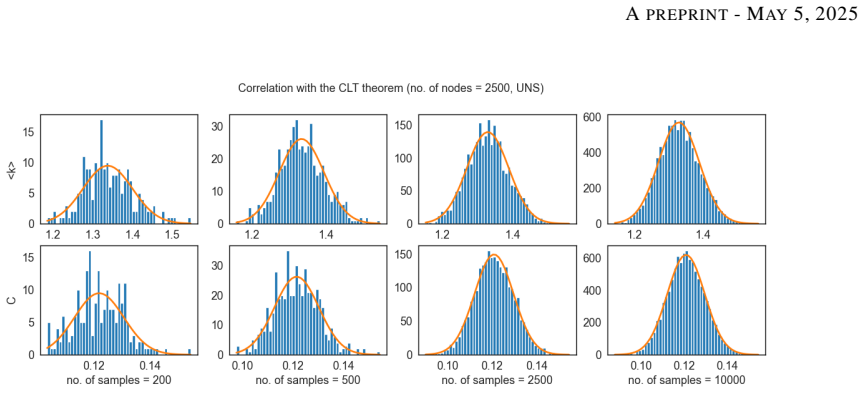
The central claim is that sampling-method performance is context-dependent and the direction of the effect can invert with network type. On the static CA-HepTh collaboration network, exploration-based methods are superior: random walk sampling and snowball sampling preserve clustering, degree, and the largest component, while uniform node and edge sampling fragment the graph. On the temporal CollegeMsg network, the ordering flips: uniform node sampling estimates node and edge structure well but approximates connectivity poorly, while PageRank node sampling does the reverse. The paper also reports that uniform node sampling produces metric estimates whose distributions converge to normal as the number of samples grows, consistent with the Central Limit Theorem despite the network's power-law degree distribution.
Load-bearing premise
The temporal half of the conclusion — that simpler methods can outperform advanced ones on temporal networks — rests on comparing only two methods, uniform node sampling and PageRank sampling, on a single temporal dataset, CollegeMsg; if that two-method, one-dataset comparison is atypical, the temporal claim does not generalize.
Editorial extensions
If this is right
- On static networks, exploration-based methods such as random walk and snowball sampling are the safer default when connectivity and clustering matter.
- On temporal networks, centrality-biased sampling can distort structural metrics, so uniform node sampling deserves a place as a baseline rather than being dismissed as naive.
- Benchmarking sampling methods should be decomposed by network type and by metric, since overall rankings hide opposite orderings.
- Uniform node sampling can yield statistically reliable global estimates even when the sample destroys local structure, which supports using sample-mean confidence intervals for network metrics.
- A single early sampling time can capture later temporal dynamics when the sampled node set is held fixed, at least on the CollegeMsg network.
Reading between the lines
- If the temporal inversion holds beyond CollegeMsg, a practical decision rule emerges: measure activity concentration or degree heterogeneity first, then choose a sampling bias direction — toward hubs for static structure, away from hubs for temporal structure.
- The Central Limit Theorem observation could be developed into a formal error-bar method for arbitrary network metrics, a step the paper does not take.
- The paper's suggestion that the temporal network has uniformly random features is testable against a temporal null model that reshuffles messages in time while preserving the aggregate degree sequence.
- The fixed-node-set temporal design points toward an adaptive streaming sampler: sample once, track the same nodes, and re-sample only when metric drift exceeds a threshold.
Signed reviews
Editorial analysis
A structured set of objections, weighed in public.
Referee Report
Summary. This manuscript presents an empirical comparison of network sampling methods on two real-world datasets: a static scientific collaboration network (CA-HepTh/HEP-TH) and a temporal message-sending network (CollegeMsg). The authors organize sampling methods into node-based, edge-based, and exploration-based categories and compare their ability to preserve metrics such as average degree, clustering coefficient, largest component size, average shortest path, edge percentage, and s-metric. Static experiments use 100 independent samples fixed at 1,000 nodes; temporal experiments fix the sampled node set at 30 nodes drawn from the initial snapshot and track the induced subnetworks over time. The paper reports that no single method consistently outperforms others, that exploration-based methods perform well on static networks, and that simpler methods such as uniform node sampling can be more effective on temporal networks. It also reports a Central Limit Theorem check for uniform node sampling and concludes that sampling strategy should be tailored to network type and target metric.
Significance. If the static/temporal contrast were firmly established, the paper would offer practically useful guidance for practitioners choosing sampling methods, and the explicit taxonomy of node-, edge-, and exploration-based methods is a clear organizing framework. The static experiment design, with 100 replications at a sample size of 1,000 nodes, is a reasonable empirical setup, and the authors are transparent about using public datasets and about some limitations of the study. However, the paper's most distinctive claim, that advanced methods underperform simpler ones on temporal networks, rests on very thin evidence: two methods, one temporal dataset, and no inferential statistics. The static 'most robust method' conclusion is also presented without quantitative uncertainty measures. These gaps make the current claims broader than the evidence supports.
major comments (3)
- [§2.3, Fig. 7, §4] The central claim that 'simpler techniques can be more effective' on temporal networks is not established by the evidence presented. The temporal experiment compares only Uniform Node Sampling and PageRank Sampling on a single dataset (CollegeMsg), with the sample fixed at 30 nodes taken from G(t=0). Table 2 shows that later snapshots are very small: at t=4 there are only 69 edges and an average degree of 1.19, so induced 30-node subnetworks can be extremely sparse and high-variance. The paper reports no confidence intervals, bootstrap errors, effect sizes, or statistical tests for any temporal metric, and Fig. 7 is purely qualitative. The observed reversal could be an artifact of the choice of PageRank as the only 'advanced' method, of the un-described selection of 116 persistent users, or of the fixed small sample size, rather than a general property of temporal networks. Section 4's limitation list acknowledges only the two-dataset and fixed-metric limitations and does not mention that the temporal conclusion rests on a two-method comparison. The authors should either substantially expand the temporal evaluation (more methods, more datasets, inferential statistics) or materially restrict the claims in the abstract and conclusion.
- [§3, Fig. 5] The static conclusion that RWS and SS are 'the most robust' methods is based on visual inspection of boxplots. The manuscript does not report error measures, confidence intervals, or pairwise comparisons across the 100 samples; statements such as 'consistently approximated' and 'significant deviations' are not quantified. Given the visible separation in Fig. 5, this is likely fixable by reporting summary statistics such as mean absolute error or root mean square error with associated uncertainties, but as written the ranking of methods is not quantitatively established.
- [§2.2, Fig. 4, Fig. 5, §4, §5] The manuscript is internally inconsistent about the number of methods used in the static experiment. Section 2.2 says 'we compare six methods' but then lists eight methods (UNS, WNS, UES, IES, RWS, MHRWS, SS, BFS). Figure 4's caption says six methods, Fig. 5 says eight methods, while Sections 4 and 5 say six. The reader cannot determine which methods were actually included in each figure. Please reconcile the method lists, figure captions, and text, and state explicitly which methods are included in each experimental setting.
minor comments (6)
- [§2.2, Table 1] The dataset name is inconsistent across the manuscript: 'CA-HepTH' in the abstract/introduction, 'Arxiv HEP-TH' in Section 2.2, and 'CA-HepTh' in Table 1. Please use one consistent name.
- [Eq. (1)] The formula for average degree is missing the normalization by the number of nodes: it should be ⟨k⟩ = (1/n) Σ_i k_i. The numerical values in Table 2 are consistent with this normalized definition, so this appears to be a typographical error, but it should be corrected.
- [§2.3] PageRank Sampling is not fully specified: the manuscript does not state on which graph PageRank is computed (the t=0 snapshot or the full temporal aggregate), what damping factor is used, or how many nodes are selected. This is needed for reproducibility.
- [§3, Fig. 6] The text says the distributions approach normality 'as the number of samples increases,' but the experimental design uses a fixed number of 100 samples and varies the sample size (number of nodes). Please correct the wording to refer to increasing sample size.
- [Throughout] There are several typographical errors: 'Methematics' and 'Unites States' in the author affiliation, 'egdes' in Table 2, and an incomplete word in Eq. (5) ('connecte'). These should be corrected.
- [§7] The data availability statement names the Stanford Network Analysis Project but does not give dataset versions, access dates, or any code. Releasing the analysis code would substantially improve reproducibility.
Circularity Check
No significant circularity: empirical benchmark with conclusions read directly from measurements.
full rationale
This paper is a purely empirical comparative study. It runs six (static) or two (temporal) sampling methods on two real-world datasets and compares observed metrics against the original networks; there are no fitted parameters, no model-derived predictions, and no quantity is defined in terms of the quantity it is claimed to predict. The central claims, such as 'no single sampling method consistently outperforms the others' and 'simpler techniques can be more effective' on temporal networks, are direct readings of the plotted results rather than derivations from any assumed input. No self-citations appear, and the cited external works are used only to define standard sampling methods and datasets, so no load-bearing argument reduces to a self-citation chain. The limited temporal evidence (two methods, one dataset) is a robustness and generalizability concern, not a circularity concern, and the paper explicitly acknowledges its two-dataset limitation in the Discussion. The derivation chain, such as it is, is self-contained: definitions of metrics and methods are standard, and the outputs are measurements, not conclusions forced by construction.
Assumptions & free parameters
free parameters (4)
- static sample size =
1000 nodes
- static sample count =
100
- temporal sample size =
30 nodes
- temporal bin width =
40 days
assumptions (4)
- domain assumption Both directed networks are treated as undirected and unweighted
- domain assumption The 40-day temporal binning is appropriate for the CollegeMsg data
- domain assumption The two datasets are representative of static and temporal networks generally
- domain assumption The chosen metrics capture the relevant performance dimensions
Cite this review
Pith. "Pith review of Network Sampling: An Overview and Comparative Analysis." pith.science (2026). https://pith.science/paper/DCMRB4YI
@misc{pith2026250417701,
  author       = {Pith},
  title        = {Pith review of: Network Sampling: An Overview and Comparative Analysis},
  year         = {2026},
  howpublished = {\url{https://pith.science/paper/DCMRB4YI}},
  note         = {Machine review of arXiv:2504.17701}
}
read the original abstract
Network sampling is a crucial technique for analyzing large or partially observable networks. However, the effectiveness of different sampling methods can vary significantly depending on the context. In this study, we empirically compare representative methods from three main categories: node-based, edge-based, and exploration-based sampling. We used two real-world datasets for our analysis: a scientific collaboration network and a temporal message-sending network. Our results indicate that no single sampling method consistently outperforms the others in both datasets. Although advanced methods tend to provide better accuracy on static networks, they often perform poorly on temporal networks, where simpler techniques can be more effective. These findings suggest that the best sampling strategy depends not only on the structural characteristics of the network but also on the specific metrics that need to be preserved or analyzed. Our work offers practical insights for researchers in choosing sampling approaches that are tailored to different types of networks and analytical objectives.
Figures


Figures from the paper (4 more)



Reference graph
Works this paper leans on
-
[24]
Neli Blagus, Lovro Šubelj, and Marko Bajec. Empirical comparison of network sampling: How to choose the most appropriate method? Physica A: Statistical Mechanics and its Applications, 477:136–148, 2017
work page 2017
-
[1]
Ted Mouw and Ashton M. Verdery. Network sampling with memory: A proposal for more efficient sampling from social networks. Sociological Methodology, 42(1):206–256, 2012. PMID: 24159246
work page 2012
-
[2]
Airoldi, Xue Bai, and Kathleen M
Edoardo M. Airoldi, Xue Bai, and Kathleen M. Carley. Network sampling and classification: An investigation of network model representations. Decision Support Systems, 51(3):506–518, 2011
work page 2011
-
[3]
M Ko, Jaromír Ková ˇrík, and Trevon Logan
Chih-Sheng Hsieh, Stanley I. M Ko, Jaromír Ková ˇrík, and Trevon Logan. Non-randomly sampled networks: Biases and corrections. Working Paper 25270, National Bureau of Economic Research, November 2018
work page 2018
-
[4]
Giovanni Briganti, Marco Scutari, Sacha Epskamp, Denny Borsboom, Ria H. A. Hoekstra, Hudson Fernandes Golino, Alexander P. Christensen, Yannick Morvan, Omid V . Ebrahimi, Giulio Costantini, Alexandre Heeren, Jill de Ron, Laura F. Bringmann, Karoline Huth, Jonas M. B. Haslbeck, Adela-Maria Isvoranu, Maarten Marsman, Tessa Blanken, Allison Gilbert, Teague R...
work page 2024
-
[5]
Advanced network sampling with heterogeneous multiple chains
Jaekoo Lee, MyungKeun Yoon, and Song Noh. Advanced network sampling with heterogeneous multiple chains. Sensors, 21(5), 2021
work page 2021
-
[6]
Network sampling via edge-based node selection with graph induction
Nesreen Ahmed, Jennifer Neville, and Ramana Rao Kompella. Network sampling via edge-based node selection with graph induction. 2011
work page 2011
-
[7]
Sampling multiple nodes in large networks: Beyond random walks
Omri Ben-Eliezer, Talya Eden, Joel Oren, and Dimitris Fotakis. Sampling multiple nodes in large networks: Beyond random walks. In Proceedings of the Fifteenth ACM International Conference on Web Search and Data Mining, WSDM ’22, page 37–47, New York, NY , USA, 2022. Association for Computing Machinery
work page 2022
Show all 37 references
-
[8]
Exploring sampling techniques in large graphs and networks
Anna Myakushina and Alex Iosevich. Exploring sampling techniques in large graphs and networks. 2023
2023
-
[9]
Michael P. H. Stumpf, Carsten Wiuf, and Robert M. May. Subnets of scale-free networks are not scale-free: Sampling properties of networks. Proceedings of the National Academy of Sciences, 102(12):4221–4224, 2005
2005
-
[10]
Adamic, Rajan M
Lada A. Adamic, Rajan M. Lukose, Amit R. Puniyani, and Bernardo A. Huberman. Search in power-law networks. Phys. Rev. E, 64:046135, Sep 2001
2001
-
[11]
Sampling from large graphs
Jure Leskovec and Christos Faloutsos. Sampling from large graphs. In Proceedings of the 12th ACM SIGKDD International Conference on Knowledge Discovery and Data Mining, KDD ’06, page 631–636, New York, NY , USA, 2006. Association for Computing Machinery. 9 A PREPRINT - M AY 5, 2025
2006
-
[12]
Can M. Le. Edge sampling using local network information. Journal of Machine Learning Research, 22(88):1–29, 2021
2021
-
[13]
Un- derstanding graph sampling algorithms for social network analysis
Tianyi Wang, Yang Chen, Zengbin Zhang, Tianyin Xu, Long Jin, Pan Hui, Beixing Deng, and Xing Li. Un- derstanding graph sampling algorithms for social network analysis. In 2011 31st International Conference on Distributed Computing Systems Workshops, pages 123–128, 2011
2011
-
[14]
Hes: Edge sampling for heterogeneous graphs
Le Fang and Chuan Wu. Hes: Edge sampling for heterogeneous graphs. In 2023 International Joint Conference on Neural Networks (IJCNN), pages 1–8, 2023
2023
-
[15]
Sampling unknown large networks restricted by low sampling rates
Bo Jiao. Sampling unknown large networks restricted by low sampling rates. Scientific Reports, 14(1):13340, Jun 2024
2024
-
[16]
Krishnamurthy, M
V . Krishnamurthy, M. Faloutsos, M. Chrobak, L. Lao, J. H. Cui, and A. G. Percus. Reducing large internet topologies for faster simulations. In NETWORKING 2005. Networking Technologies, Services, and Protocols; Performance of Computer and Communication Networks; Mobile and Wir...
2005
-
[17]
Ahmed, Jennifer Neville, and Ramana Kompella
Nesreen K. Ahmed, Jennifer Neville, and Ramana Kompella. Network sampling: From static to streaming graphs. ACM Trans. Knowl. Discov. Data, 8(2), June 2013
2013
-
[18]
Butts, and Athina Markopoulou
Minas Gjoka, Maciej Kurant, Carter T. Butts, and Athina Markopoulou. Walking in facebook: A case study of unbiased sampling of osns. In 2010 Proceedings IEEE INFOCOM, pages 1–9, 2010
2010
-
[19]
Metropolis algorithms for representative subgraph sampling
Christian Hübler, Hans-Peter Kriegel, Karsten Borgwardt, and Zoubin Ghahramani. Metropolis algorithms for representative subgraph sampling. In 2008 Eighth IEEE International Conference on Data Mining, pages 283–292, 2008
2008
-
[20]
Gregory F. Lawler. Loop-Erased Random Walk, pages 197–217. Birkhäuser Boston, Boston, MA, 1999
1999
-
[21]
Leo A. Goodman. Snowball Sampling. The Annals of Mathematical Statistics, 32(1):148 – 170, 1961
1961
-
[22]
Estimating and sampling graphs with multidimensional random walks
Bruno Ribeiro and Don Towsley. Estimating and sampling graphs with multidimensional random walks. In Proceedings of the 10th ACM SIGCOMM Conference on Internet Measurement, IMC ’10, page 390–403, New York, NY , USA, 2010. Association for Computing Machinery
2010
-
[23]
Active exploration: simultaneous sampling and labeling for large graphs
Meng Fang, Jie Yin, and Xingquan Zhu. Active exploration: simultaneous sampling and labeling for large graphs. In Proceedings of the 22nd ACM International Conference on Information & Knowledge Management, CIKM ’13, page 829–834, New York, NY , USA, 2013. Association for Compu...
2013
-
[25]
Learning the mechanisms of network growth
Lourens Touwen, Doina Bucur, Remco van der Hofstad, Alessandro Garavaglia, and Nelly Litvak. Learning the mechanisms of network growth. Scientific Reports, 14(1):11866, May 2024
2024
-
[26]
Ángeles Serrano
Muhua Zheng, Guillermo García-Pérez, Marián Boguñá, and M. Ángeles Serrano. Scaling up real networks by geometric branching growth. Proceedings of the National Academy of Sciences, 118(21):e2018994118, 2021
2021
-
[27]
Network expansion for practical training acceleration
Ning Ding, Yehui Tang, Kai Han, Chao Xu, and Yunhe Wang. Network expansion for practical training acceleration. In 2023 IEEE/CVF Conference on Computer Vision and Pattern Recognition (CVPR), pages 20269–20279, 2023
2023
-
[28]
Freund and Philippe J
Alexander J. Freund and Philippe J. Giabbanelli. An experimental study on the scalability of recent node centrality metrics in sparse complex networks. Frontiers in Big Data, V olume 5 - 2022, 2022
2022
-
[29]
Kanai, B
R. Kanai, B. Bahrami, R. Roylance, and G. Rees. Online social network size is reflected in human brain structure. Proceedings of the Royal Society B: Biological Sciences, 279(1732):1327–1334, 2012
2012
-
[30]
Statistical properties of sampled networks
Sang Hoon Lee, Pan-Jun Kim, and Hawoong Jeong. Statistical properties of sampled networks. Phys. Rev. E, 73:016102, Jan 2006
2006
-
[31]
Network sampling designs for relational classification
Nesreen Ahmed, Jennifer Neville, and Ramana Kompella. Network sampling designs for relational classification. Proceedings of the International AAAI Conference on Web and Social Media, 6(1):383–386, Aug. 2021
2021
-
[32]
Leroux, Dominique Gravel, Cindy Chu, Alyssa R
Anne McLeod, Shawn J. Leroux, Dominique Gravel, Cindy Chu, Alyssa R. Cirtwill, Marie-Josée Fortin, Núria Galiana, Timothée Poisot, and Spencer A. Wood. Sampling and asymptotic network properties of spatial multi-trophic networks. Oikos, 130(12):2250–2259, 2021
2021
-
[33]
Smith and James Moody
Jeffrey A. Smith and James Moody. Structural effects of network sampling coverage i: Nodes missing at random. Social Networks, 35(4):652–668, Oct 2013
2013
-
[34]
Optimization of multiple sampling for solving network boundary specification problem.Scientific Reports, 15(1):4221, Feb 2025
Ruochen Zhang. Optimization of multiple sampling for solving network boundary specification problem.Scientific Reports, 15(1):4221, Feb 2025. 10 A PREPRINT - M AY 5, 2025
2025
-
[35]
Graph evolution: Densification and shrinking diameters
Jure Leskovec, Jon Kleinberg, and Christos Faloutsos. Graph evolution: Densification and shrinking diameters. ACM Trans. Knowl. Discov. Data, 1(1):2–es, March 2007
2007
-
[36]
Pietro Panzarasa, Tore Opsahl, and Kathleen M. Carley. Patterns and dynamics of users’ behavior and interaction: Network analysis of an online community. J. Am. Soc. Inf. Sci. Technol., 60(5):911–932, May 2009
2009
-
[37]
Doyle, and Walter Willinger
Lun Li, David Alderson, Reiko Tanaka, John C. Doyle, and Walter Willinger. Towards a theory of scale-free graphs: Definition, properties, and implications (extended version), 2005. 11
2005
Reviewed August 16, 2026 · model on record in the stance chip above.
Discussion (0). Continue with ORCID to comment.