REVIEW 4 major objections 5 minor 59 references
Online Curvature-Aware Replay: Leveraging $\mathbf{2^{nd}}$ Order Information for Online Continual Learning
T0 review · 4 major / 5 minor · reviewed 2026-08-09 · deepseek-v4-flash
Pith's one-line read Replay-based online continual learning can be reframed as second-order optimization with a KL-divergence stability constraint, and the resulting OCAR optimizer beats prior state-of-the-art on continual metrics in three benchmarks.
desk verdict OCAR is a serious, well-engineered OCL method with strong anytime-accuracy results, but the paper's central claim that second-order curvature drives the gains needs an ablation that isolates K-FAC from the Tikhonov schedule. read the letter →
The pith
A machine-rendered reading of the paper's core claim, the machinery that carries it, and where it could break.
The reading
What carries the argument
The central object is the preconditioned update rule $\delta^*_t = -\alpha(F_{N_t} + (1+\lambda)F_{B_t} + \tau I)^{-1}(\nabla_{N_t} + \nabla_{B_t})$, which unifies the paper's three ingredients: the replay gradients, the Fisher Information Matrix (FIM) as a stability constraint, and Tikhonov damping as a plasticity regulator. The FIM is the Hessian of the KL divergence between pre- and post-update predictive distributions on buffer data, so the constraint 'do not change predictions on old data' becomes the quadratic form $\delta^T F \delta \le \rho$; by the Fisher/Generalized-Gauss-Newton equivalence the same FIM replaces the Hessians of the two loss terms, so one curvature quantity plays three roles at once: metric of the parameter manifold, stabilizer for old tasks, and accelerator for new ones. Tractability comes from K-FAC: the FIM is approximated block-diagonally as per-layer Kronecker products of activation and gradient factors, updated by exponential moving average, and inverted cheaply through $(A \otimes B)^{-1} = A^{-1} \otimes B^{-1}$. Three practical mechanisms carry the method in non-iid streams: the EMA factors, with a reset of only the classifier factor when its shape changes at a class-incremental boundary; the $\lambda$ schedule, which strengthens the stability constraint as the buffer accumulates more classes; and the $\tau$ schedule, which grows damping each step because a fixed small $\tau$ dangerously amplifies low-curvature directions when new classes appear.
What would settle it
Run OCAR on Split-CIFAR100 twice: once with the default exponential-moving-average Fisher, and once with all K-FAC factors reset at every task boundary, and record the accuracy on previously seen tasks in the steps immediately after each boundary. If the EMA-carryover version does not show a consistently smaller drop than the reset version, and than plain experience replay with matched hyperparameters, then the assumption that averaged curvature stays valid across tasks is what carries the result, not the second-order update itself.
Extended reading notes
Core claim
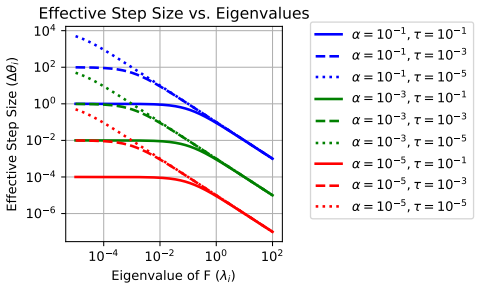
The paper's central claim is that the instability of replay-based online continual learning is a first-order optimization artifact, and that a second-order formulation removes most of it. OCAR solves, at every step, a constrained joint optimization over new and replayed data: minimize the KL divergence of the model on both batches while requiring the KL divergence between the pre-update and post-update predictive distributions on buffer data to stay below a threshold $\rho$. A Taylor expansion turns this into a preconditioned update $\delta^* = -\alpha(F_{N_t} + (1+\lambda)F_{B_t} + \tau I)^{-1}(\nabla_{N_t} + \nabla_{B_t})$, where $F$ is the Fisher Information Matrix on current and buffer data, $\lambda$ is the Lagrange multiplier of the stability constraint, $\tau$ is Tikhonov damping, and $\alpha$ is the learning rate. The Fisher is the 'true' Fisher, an expectation over the model's predictive distribution rather than over observed labels, and it is made tractable with a block-diagonal K-FAC approximation whose Kronecker factors are updated by exponential moving average; at class-incremental boundaries the classifier factor is reset when its shape grows, and $\tau$ grows each step. On this basis the paper reports state-of-the-art continual metrics, average anytime accuracy and worst-case accuracy, on Split-CIFAR100 (20 tasks), Split-TinyImageNet (20 tasks), and Online CLEAR (10 tasks), with the OCAR-ACE combination best overall on the class-incremental benchmarks. The paper also identifies the ratio $\alpha/\tau$, rather than $\alpha$ or $\tau$ alone, as the control knob of the stability-plasticity tradeoff: $\tau$ caps the maximum acceleration in low-curvature directions, while $\alpha$ scales all directions uniformly.
Load-bearing premise
The load-bearing premise is that the exponential-moving-average estimate of the Fisher matrix stays trustworthy when the data distribution shifts: if the averaged curvature mixes old and new tasks in the wrong proportions, the preconditioner can amplify exactly the wrong directions and OCAR loses its stability advantage over plain replay.
Editorial extensions
If this is right
- OCAR achieves the best average anytime accuracy and worst-case accuracy among all compared methods on Split-CIFAR100 and Split-TinyImageNet, and the largest gains on Online CLEAR (75.3 vs LPR's 65.2 final accuracy), indicating that the stability gap is not an inevitable property of replay methods.
- Because OCAR is an optimizer rather than a new loss or architecture, it can be stacked with other replay methods: OCAR-ACE sets the best Acc, AAA, and WC-Acc overall, while OCAR-DER++ fails on TinyImageNet, which the authors attribute to DER's entropy regularization breaking the KL assumption behind the Fisher.
- The $\alpha/\tau$ ratio, rather than the learning rate alone, controls the effective step size in low-curvature directions, so tuning the growth of $\tau$ on a short validation stream generalizes better to longer streams than tuning a fixed damping value.
- OCAR improves linear probing accuracy on both main benchmarks, suggesting that curvature-aware updates produce better feature representations over the stream, not merely a better final classifier.
- The method's runtime is about three times that of plain experience replay but below several prior sophisticated methods (MIR, SCR, LPR), so the stability gain does not come at extreme computational cost.
Reading between the lines
- If the optimizer-level story is right, a corollary the paper leaves implicit is that the stability gap should be treatable in other nonstationary settings, such as reinforcement learning or fine-tuning on drifting data, with the same damped-Fisher preconditioning even without a replay buffer.
- The reported OCAR-DER++ failure suggests a testable boundary on the method: any replay loss whose gradients are not approximately the gradient of a KL-type objective will not inherit the stability guarantee, and one could quantify this by measuring how far the DER loss's Hessian deviates from the Fisher on buffer data.
- The $\tau$-scheduling result hints that the FIM's conditioning degrades as the stream lengthens, so a natural extension is adapting $\tau$ online from the eigenvalue spectrum of the K-FAC factors instead of a fixed additive schedule.
- The reset policy assumes most boundary instability lives in the classifier, yet the strong Online CLEAR results, a domain-incremental setting with a shared classifier, suggest the reset is not the main source of gains; ablating the reset there would isolate its actual contribution.
Editorial analysis
A structured set of objections, weighed in public.
Referee Report
Summary. The paper formalizes replay-based online continual learning (OCL) as a sequence of second-order optimization problems with a KL-divergence stability constraint on buffer data, and proposes OCAR, which uses a K-FAC approximation of the Fisher Information Matrix to precondition the replay gradient. A Tikhonov regularization term with a time-increasing schedule is introduced to control the stability-plasticity tradeoff. The method is evaluated on Split-CIFAR100, Split-TinyImageNet, and Online CLEAR, reporting improvements on continual metrics (AAA, WC-Acc) over strong baselines, as well as combinations with ER-ACE and DER++. The authors provide code and follow the evaluation protocol of prior OCL surveys.
Significance. If the claimed effects are real, OCAR is a valuable contribution: it brings second-order optimization, previously used mainly in stationary or task-boundary settings, to the online continual setting and reports large gains on the metrics that measure the stability gap. The paper is also careful to use established benchmarks, a shared evaluation protocol, and public code, and it does not fit constants to test data. The main weakness is causal attribution: the algorithm confounds the K-FAC preconditioner with a first-order learning-rate annealing schedule, and no ablation isolates the second-order contribution. The theoretical framing also overstates the role of the explicit KL constraint, since the implemented λ schedule is heuristic and no ρ is enforced. These issues are fixable with additional experiments and a revised derivation, and therefore a major revision is appropriate.
major comments (4)
- [Algorithm 1, line 10; Section 5] The central claim that second-order curvature information drives the stability-plasticity improvement is not supported by an isolation experiment. In Algorithm 1, τ is initialized to α and incremented by Δτ at every gradient step, while the update is δ = -α(F + τI)^{-1}∇L; in the low-curvature directions the effective step size is α/(σ_i + τ) ≈ α/τ, which decays over time. This is a first-order learning-rate annealing mechanism that exists independently of the K-FAC preconditioner. Since no ablation keeps the τ and λ schedules fixed while removing the curvature term (e.g., F=0) and no ER baseline is run with the same effective step decay, the empirical AAA/WC-Acc gains on Split-CIFAR100 and Split-TinyImageNet do not yet establish that the second-order information is the causal mechanism. Please add such an ablation and report the continual metrics.
- [Section 4.1, Eq. (2); Algorithm 1, lines 11-16] The optimization problem in Eq. (2) is posed with a hard KL constraint δ^T F_B δ ≤ 2ρ, but the implemented algorithm never chooses λ to satisfy that constraint: Algorithm 1 increases λ heuristically with the number of observed classes or with time, and no value of ρ is set or measured. As a result, the 'explicit KL-divergence constraints' described in the abstract and introduction are not actually enforced by the method used in the experiments. The authors should either derive the λ schedule from the KKT conditions of Eq. (2) and verify that the constraint is active, or reframe the method as a Tikhonov-weighted replay optimizer and provide an ablation showing what the constraint term contributes.
- [Section 4.1, Eq. (1)-(2)] The second-order Taylor expansion of the KL divergence is written without the standard factor 1/2 in the quadratic term: the text gives ∇^T δ + δ^T H δ instead of ∇^T δ + (1/2)δ^T H δ. The derivation then jumps from Eq. (2) to the closed-form update δ* = -(H_N + H_B + λ F_B + τI)^{-1}(∇_N + ∇_B) without writing the Lagrangian or the stationary condition. The missing 1/2 factor changes the stationary condition under a strict reading of Eq. (2), and the factor is not tracked when the Hessians are later replaced by FIMs. Please write out the expansion and the KKT system explicitly, and state which factors are exact, approximated, or absorbed into hyperparameters.
- [Section 4.2, Section 4.3] The replacement of both Hessians by Fisher Information Matrices is justified by the FIM/GGN equivalence only under model-and-data conditions that are not checked in the nonstationary OCL setting; the text itself notes the model is far from the optimum in OCL, which is exactly where the equivalence is weakest. In addition, the boundary reset policy in Section 4.3 reinitializes only the classifier factor G while retaining the activation factor A, relying on an unstated assumption that representations are consistent across tasks. Since the optimizer's behavior is driven by this approximated curvature, I ask for a targeted check, for example comparing the K-FAC preconditioner against an exact FIM or Hessian-vector-product preconditioner on a small-scale variant, and for an ablation of the reset policy on a setting where representations change substantially.
minor comments (5)
- [Section 4.1, paragraph beginning 'Stability constraint:'] There is a typo in the phrase 'Stability constraint:s approach' that should be corrected to 'Stability constraint:' or 'Stability constraint approach:'. Minor: please proofread the paragraph.
- [Algorithm 1 and Section 4.3] The hyperparameter Δτ is described as the 'increase of τ' but the units are ambiguous: Algorithm 1 increments τ inside the inner loop over gradient steps, so it should be stated explicitly whether Δτ is per gradient step, per batch, or per task, and how the value was selected in the grid search.
- [Tables 1 and 2; Appendix B] Baseline numbers in Table 1 are taken from prior papers with different numbers of seeds (LPR used 10 seeds, the other methods 5) and possibly different hyperparameter-selection procedures. A sentence in the main text acknowledging this asymmetry and its likely direction of bias, rather than only in Appendix B, would improve the fairness assessment.
- [Figure 2 and Appendix Figure 11] The grid-search plots over α and α/τ appear to report a single run without confidence intervals; since Section 5 uses them to support claims (1)-(4) about the stability-plasticity tradeoff, the number of seeds and any variance should be reported.
- [Appendix C, 'Last Layer FIM'] For one-hot categorical targets, the derivation uses y_i^2 = y_i without stating this identity; adding a short note makes the algebra in the diagonal FIM computation transparent.
Circularity Check
No significant circularity: OCAR's derivation is a self-contained constrained-optimization construction, and its empirical claims are evaluated against external baselines; self-citations are present but not load-bearing.
full rationale
The derivation chain is not circular. Section 4.1 starts from a replay objective, takes a second-order Taylor expansion, and solves the KKT system of the constrained problem to obtain the damped preconditioned update δ*_t = −α(F_N + (1+λ)F_B + τI)^{-1}(∇_N+∇_B). The FIM appears both as the Hessian of the KL stability constraint and as the curvature preconditioner; that is the method's defining construction rather than a hidden reuse of the conclusion. The Hessians are approximated by FIM/GGN following Martens and Kunstner, and the Fisher is computed from the model's predictive distribution, which is standard for natural-gradient methods and does not presuppose the empirical results. The experimental comparisons use external baselines (ER, DER++, ER-ACE, MIR, RAR, SCR, LPR, etc.), with numbers taken from the shared OCL survey code and the ICML24 LPR paper; the author's co-authorship of the survey and Avalanche is a self-citation, but it is not load-bearing because the baseline numbers are independent, externally published results rather than OCAR outputs. Hyperparameters are selected on a validation prefix (first four experiences) and all reported metrics are computed on the held-out test stream, so no fitted parameter is relabeled as a prediction. The lack of an ablation that removes the K-FAC curvature term while keeping the τ/λ schedules is a real attribution/confound concern for the causal claim that second-order information drives the gains, but a missing ablation is a correctness risk, not a circular reduction; no quoted equation reduces by construction to its inputs.
Assumptions & free parameters
free parameters (4)
- Learning rate alpha
- Tikhonov increase Delta_tau per step
- EMA coefficient alpha_EMA
- Buffer-class weighting factor n/k
assumptions (5)
- domain assumption The FIM is equivalent to the Hessian of the KL divergence when the model is at the optimum, and this equivalence is assumed to hold approximately near optima and in nonstationary settings.
- domain assumption Cross-entropy loss is treated as a KL divergence, so the gradient of the loss is the same as the gradient of the KL; losses deviating from KL break the method (as observed with DER++).
- domain assumption The K-FAC block-diagonal approximation and the EMA of its Kronecker factors provide a sufficient estimate of the FIM for gradient preconditioning in online continual learning.
- ad hoc to paper The model representations are consistent across tasks, so resetting only the classifier K-FAC factor when its shape changes preserves the validity of the other factor.
- standard math Standard properties of the Kronecker product allow efficient inversion of block-diagonal curvature matrices.
Cite this review
Pith. "Pith review of Online Curvature-Aware Replay: Leveraging $\mathbf{2^{nd}}$ Order Information for Online Continual Learning." pith.science (2026). https://pith.science/paper/DDHSJGMQ
@misc{pith2026250201866,
  author       = {Pith},
  title        = {Pith review of: Online Curvature-Aware Replay: Leveraging $\mathbf2^nd$ Order Information for Online Continual Learning},
  year         = {2026},
  howpublished = {\url{https://pith.science/paper/DDHSJGMQ}},
  note         = {Machine review of arXiv:2502.01866}
}
read the original abstract
Online Continual Learning (OCL) models continuously adapt to nonstationary data streams, usually without task information. These settings are complex and many traditional CL methods fail, while online methods (mainly replay-based) suffer from instabilities after the task shift. To address this issue, we formalize replay-based OCL as a second-order online joint optimization with explicit KL-divergence constraints on replay data. We propose Online Curvature-Aware Replay (OCAR) to solve the problem: a method that leverages second-order information of the loss using a K-FAC approximation of the Fisher Information Matrix (FIM) to precondition the gradient. The FIM acts as a stabilizer to prevent forgetting while also accelerating the optimization in non-interfering directions. We show how to adapt the estimation of the FIM to a continual setting stabilizing second-order optimization for non-iid data, uncovering the role of the Tikhonov regularization in the stability-plasticity tradeoff. Empirical results show that OCAR outperforms state-of-the-art methods in continual metrics achieving higher average accuracy throughout the training process in three different benchmarks.
Figures


Figures from the paper (8 more)




Reference graph
Works this paper leans on
-
[1]
write newline
" write newline "" before.all 'output.state := FUNCTION n.dashify 't := "" t empty not t #1 #1 substring "-" = t #1 #2 substring "--" = not "--" * t #2 global.max substring 't := t #1 #1 substring "-" = "-" * t #2 global.max substring 't := while if t #1 #1 substring * t #2 global.max substring 't := if while FUNCTION format.date year duplicate empty "emp...
-
[2]
Online continual learning with maximal interfered retrieval
Aljundi, R., Belilovsky, E., Tuytelaars, T., Charlin, L., Caccia, M., Lin, M., and Page-Caccia, L. Online continual learning with maximal interfered retrieval. Advances in neural information processing systems, 32, 2019 a
2019
-
[3]
Aljundi, R., Kelchtermans, K., and Tuytelaars, T. Task-free continual learning. In Proceedings of the IEEE/CVF conference on computer vision and pattern recognition, pp.\ 11254--11263, 2019 b
work page 2019
-
[4]
Natural gradient works efficiently in learning
Amari, S.-I. Natural gradient works efficiently in learning. Neural computation, 10 0 (2): 0 251--276, 1998
1998
-
[5]
Information geometry and its applications, volume 194
Amari, S.-i. Information geometry and its applications, volume 194. Springer, 2016
2016
-
[6]
Gradient descent on neurons and its link to approximate second-order optimization
Benzing, F. Gradient descent on neurons and its link to approximate second-order optimization. In Chaudhuri, K., Jegelka, S., Song, L., Szepesv \' a ri, C., Niu, G., and Sabato, S. (eds.), International Conference on Machine Learning, ICML 2022, 17-23 July 2022, Baltimore, Maryland, USA , volume 162 of Proceedings of Machine Learning Research, pp.\ 1817--...
work page 2022
-
[7]
Gradient descent on neurons and its link to approximate second-order optimization
Benzing, F. Gradient descent on neurons and its link to approximate second-order optimization. In International Conference on Machine Learning, pp.\ 1817--1853. PMLR, 2022 b
work page 2022
-
[8]
Dark experience for general continual learning: a strong, simple baseline
Buzzega, P., Boschini, M., Porrello, A., Abati, D., and Calderara, S. Dark experience for general continual learning: a strong, simple baseline. Advances in neural information processing systems, 33: 0 15920--15930, 2020
work page 2020
Show all 59 references
-
[9]
New insights on reducing abrupt representation change in online continual learning
Caccia, L., Aljundi, R., Asadi, N., Tuytelaars, T., Pineau, J., and Belilovsky, E. New insights on reducing abrupt representation change in online continual learning. In The Tenth International Conference on Learning Representations, ICLR 2022, Virtual Event, April 25-29, 2022...
2022
-
[10]
Avalanche: A pytorch library for deep continual learning
Carta, A., Pellegrini, L., Cossu, A., Hemati, H., and Lomonaco, V. Avalanche: A pytorch library for deep continual learning. Journal of Machine Learning Research, 24 0 (363): 0 1--6, 2023
2023
-
[11]
K., Ajanthan, T., and Torr, P
Chaudhry, A., Dokania, P. K., Ajanthan, T., and Torr, P. H. Riemannian walk for incremental learning: Understanding forgetting and intransigence. In Proceedings of the European conference on computer vision (ECCV), pp.\ 532--547, 2018 a
2018
-
[12]
K., Ajanthan, T., and Torr, P
Chaudhry, A., Dokania, P. K., Ajanthan, T., and Torr, P. H. S. Riemannian walk for incremental learning: Understanding forgetting and intransigence. In Ferrari, V., Hebert, M., Sminchisescu, C., and Weiss, Y. (eds.), Computer Vision - ECCV 2018 - 15th European Conference, Muni...
2018 doi
-
[13]
Efficient lifelong learning with A-GEM
Chaudhry, A., Ranzato, M., Rohrbach, M., and Elhoseiny, M. Efficient lifelong learning with A-GEM . In 7th International Conference on Learning Representations, ICLR 2019, New Orleans, LA, USA, May 6-9, 2019 . OpenReview.net, 2019 a . URL https://openreview.net/forum?id=Hkf2\_sC5FX
2019
-
[14]
Continual learning with tiny episodic memories
Chaudhry, A., Rohrbach, M., Elhoseiny, M., Ajanthan, T., Dokania, P., Torr, P., and Ranzato, M. Continual learning with tiny episodic memories. In Workshop on Multi-Task and Lifelong Reinforcement Learning, 2019 b
2019
-
[15]
Probing representation forgetting in supervised and unsupervised continual learning
Davari, M., Asadi, N., Mudur, S., Aljundi, R., and Belilovsky, E. Probing representation forgetting in supervised and unsupervised continual learning. In Proceedings of the IEEE/CVF Conference on Computer Vision and Pattern Recognition, pp.\ 16712--16721, 2022
2022
-
[16]
E., Hern \'a ndez-Lobato, J
Daxberger, E., Swaroop, S., Osawa, K., Yokota, R., Turner, R. E., Hern \'a ndez-Lobato, J. M., and Khan, M. E. Improving continual learning by accurate gradient reconstructions of the past. Transactions on Machine Learning Research, 2023
2023
-
[17]
Continual evaluation for lifelong learning: Identifying the stability gap, 2023
De Lange, M., van de Ven, G., and Tuytelaars, T. Continual evaluation for lifelong learning: Identifying the stability gap, 2023
2023
-
[18]
F., Lan, Q., Rahman, P., Mahmood, A
Dohare, S., Hernandez - Garcia, J. F., Lan, Q., Rahman, P., Mahmood, A. R., and Sutton, R. S. Loss of plasticity in deep continual learning. Nat., 632 0 (8026): 0 768--774, 2024. doi:10.1038/S41586-024-07711-7. URL https://doi.org/10.1038/s41586-024-07711-7
2024 doi
-
[19]
and Koopman, S
Durbin, J. and Koopman, S. J. Time series analysis by state space methods, volume 38. OUP Oxford, 2012
2012
-
[20]
Orthogonal gradient descent for continual learning
Farajtabar, M., Azizan, N., Mott, A., and Li, A. Orthogonal gradient descent for continual learning. In Chiappa, S. and Calandra, R. (eds.), The 23rd International Conference on Artificial Intelligence and Statistics, AISTATS 2020, 26-28 August 2020, Online [Palermo, Sicily, I...
2020
-
[21]
French, R. M. Catastrophic forgetting in connectionist networks. Trends in cognitive sciences, 3 0 (4): 0 128--135, 1999
1999
-
[22]
NNGeometry: Easy and Fast Fisher Information Matrices and Neural Tangent Kernels in PyTorch , February 2021
George, T. NNGeometry: Easy and Fast Fisher Information Matrices and Neural Tangent Kernels in PyTorch , February 2021. URL https://doi.org/10.5281/zenodo.4532597
2021 doi
-
[23]
Fast approximate natural gradient descent in a kronecker factored eigenbasis
George, T., Laurent, C., Bouthillier, X., Ballas, N., and Vincent, P. Fast approximate natural gradient descent in a kronecker factored eigenbasis. In Bengio, S., Wallach, H. M., Larochelle, H., Grauman, K., Cesa - Bianchi, N., and Garnett, R. (eds.), Advances in Neural Inform...
2018
-
[24]
Fast approximate natural gradient descent in a kronecker factored eigenbasis
George, T., Laurent, C., Bouthillier, X., Ballas, N., and Vincent, P. Fast approximate natural gradient descent in a kronecker factored eigenbasis. Advances in Neural Information Processing Systems, 31, 2018 b
2018
-
[25]
Online continual learning through mutual information maximization
Guo, Y., Liu, B., and Zhao, D. Online continual learning through mutual information maximization. In International conference on machine learning, pp.\ 8109--8126. PMLR, 2022
2022
- [26]
-
[27]
On quadratic penalties in elastic weight consolidation
Husz \' a r, F. On quadratic penalties in elastic weight consolidation. CoRR, abs/1712.03847, 2017. URL http://arxiv.org/abs/1712.03847
2017 arXiv
-
[28]
The expanding scope of the stability gap: Unveiling its presence in joint incremental learning of homogeneous tasks
Kamath, S., Soutif - Cormerais, A., van de Weijer, J., and Raducanu, B. The expanding scope of the stability gap: Unveiling its presence in joint incremental learning of homogeneous tasks. CoRR, abs/2406.05114, 2024. doi:10.48550/ARXIV.2406.05114. URL https://doi.org/10.48550/...
-
[29]
T., van de Ven, G., Bernacchia, A., and Hennequin, G
Kao, T., Jensen, K. T., van de Ven, G., Bernacchia, A., and Hennequin, G. Natural continual learning: success is a journey, not (just) a destination. In Ranzato, M., Beygelzimer, A., Dauphin, Y. N., Liang, P., and Vaughan, J. W. (eds.), Advances in Neural Information Processin...
2021
-
[31]
Kingma, D. P. and Ba, J. Adam: A method for stochastic optimization. In Bengio, Y. and LeCun, Y. (eds.), 3rd International Conference on Learning Representations, ICLR 2015, San Diego, CA, USA, May 7-9, 2015, Conference Track Proceedings , 2015. URL http://arxiv.org/abs/1412.6980
2015 arXiv
-
[32]
A., Milan, K., Quan, J., Ramalho, T., Grabska-Barwinska, A., et al
Kirkpatrick, J., Pascanu, R., Rabinowitz, N., Veness, J., Desjardins, G., Rusu, A. A., Milan, K., Quan, J., Ramalho, T., Grabska-Barwinska, A., et al. Overcoming catastrophic forgetting in neural networks. Proceedings of the national academy of sciences, 114 0 (13): 0 3521--3526, 2017
2017
-
[33]
Kumari, L., Wang, S., Zhou, T., and Bilmes, J. A. Retrospective adversarial replay for continual learning. Advances in neural information processing systems, 35: 0 28530--28544, 2022
2022
-
[34]
Limitations of the empirical fisher approximation for natural gradient descent
Kunstner, F., Hennig, P., and Balles, L. Limitations of the empirical fisher approximation for natural gradient descent. Advances in neural information processing systems, 32, 2019
2019
-
[35]
D., Aljundi, R., Masana, M., Parisot, S., Jia, X., Leonardis, A., Slabaugh, G
Lange, M. D., Aljundi, R., Masana, M., Parisot, S., Jia, X., Leonardis, A., Slabaugh, G. G., and Tuytelaars, T. A continual learning survey: Defying forgetting in classification tasks. IEEE Trans. Pattern Anal. Mach. Intell. , 44 0 (7): 0 3366--3385, 2022. doi:10.1109/TPAMI.20...
2022
-
[36]
D., van de Ven, G
Lange, M. D., van de Ven, G. M., and Tuytelaars, T. Continual evaluation for lifelong learning: Identifying the stability gap. In The Eleventh International Conference on Learning Representations, ICLR 2023, Kigali, Rwanda, May 1-5, 2023 . OpenReview.net, 2023. URL https://ope...
2023
-
[37]
Deep learning
LeCun, Y., Bengio, Y., and Hinton, G. Deep learning. nature, 521 0 (7553): 0 436--444, 2015
2015
-
[38]
and Hoiem, D
Li, Z. and Hoiem, D. Learning without forgetting. IEEE transactions on pattern analysis and machine intelligence, 40 0 (12): 0 2935--2947, 2017
2017
-
[39]
The clear benchmark: Continual learning on real-world imagery
Lin, Z., Shi, J., Pathak, D., and Ramanan, D. The clear benchmark: Continual learning on real-world imagery. In Thirty-fifth conference on neural information processing systems datasets and benchmarks track (round 2), 2021
2021
-
[40]
M., and Bagdanov, A
Liu, X., Masana, M., Herranz, L., Van de Weijer, J., Lopez, A. M., and Bagdanov, A. D. Rotate your networks: Better weight consolidation and less catastrophic forgetting. In 2018 24th International Conference on Pattern Recognition (ICPR), pp.\ 2262--2268. IEEE, 2018
2018
-
[41]
and Ranzato, M
Lopez - Paz, D. and Ranzato, M. Gradient episodic memory for continual learning. In Guyon, I., von Luxburg, U., Bengio, S., Wallach, H. M., Fergus, R., Vishwanathan, S. V. N., and Garnett, R. (eds.), Advances in Neural Information Processing Systems 30: Annual Conference on Ne...
2017
-
[42]
Magistri, S., Trinci, T., Soutif - Cormerais, A., van de Weijer, J., and Bagdanov, A. D. Elastic feature consolidation for cold start exemplar-free incremental learning. In The Twelfth International Conference on Learning Representations, ICLR 2024, Vienna, Austria, May 7-11, ...
2024
-
[43]
Supervised contrastive replay: Revisiting the nearest class mean classifier in online class-incremental continual learning
Mai, Z., Li, R., Kim, H., and Sanner, S. Supervised contrastive replay: Revisiting the nearest class mean classifier in online class-incremental continual learning. In Proceedings of the IEEE/CVF conference on computer vision and pattern recognition, pp.\ 3589--3599, 2021
2021
-
[44]
Online continual learning in image classification: An empirical survey
Mai, Z., Li, R., Jeong, J., Quispe, D., Kim, H., and Sanner, S. Online continual learning in image classification: An empirical survey. Neurocomputing, 469: 0 28--51, 2022 a . doi:10.1016/J.NEUCOM.2021.10.021. URL https://doi.org/10.1016/j.neucom.2021.10.021
2022 doi
-
[45]
Online continual learning in image classification: An empirical survey
Mai, Z., Li, R., Jeong, J., Quispe, D., Kim, H., and Sanner, S. Online continual learning in image classification: An empirical survey. Neurocomputing, 469: 0 28--51, 2022 b
2022
-
[46]
New insights and perspectives on the natural gradient method
Martens, J. New insights and perspectives on the natural gradient method. Journal of Machine Learning Research, 21 0 (146): 0 1--76, 2020
2020
-
[47]
and Grosse, R
Martens, J. and Grosse, R. Optimizing neural networks with kronecker-factored approximate curvature. In International conference on machine learning, pp.\ 2408--2417. PMLR, 2015
2015
-
[48]
and Sutskever, I
Martens, J. and Sutskever, I. Training deep and recurrent networks with hessian-free optimization. In Neural Networks: Tricks of the Trade: Second Edition, pp.\ 479--535. Springer, 2012
2012
-
[49]
D., and van de Weijer, J
Masana, M., Liu, X., Twardowski, B., Menta, M., Bagdanov, A. D., and van de Weijer, J. Class-incremental learning: Survey and performance evaluation on image classification. IEEE Trans. Pattern Anal. Mach. Intell. , 45 0 (5): 0 5513--5533, 2023. doi:10.1109/TPAMI.2022.3213473....
2023
-
[50]
Understanding the role of training regimes in continual learning
Mirzadeh, S., Farajtabar, M., Pascanu, R., and Ghasemzadeh, H. Understanding the role of training regimes in continual learning. In Larochelle, H., Ranzato, M., Hadsell, R., Balcan, M., and Lin, H. (eds.), Advances in Neural Information Processing Systems 33: Annual Conference...
2020
-
[51]
Linear mode connectivity in multitask and continual learning
Mirzadeh, S., Farajtabar, M., G \" o r \" u r, D., Pascanu, R., and Ghasemzadeh, H. Linear mode connectivity in multitask and continual learning. In 9th International Conference on Learning Representations, ICLR 2021, Virtual Event, Austria, May 3-7, 2021 . OpenReview.net, 202...
2021
-
[52]
Information-geometric optimization algorithms: A unifying picture via invariance principles
Ollivier, Y., Arnold, L., Auger, A., and Hansen, N. Information-geometric optimization algorithms: A unifying picture via invariance principles. Journal of Machine Learning Research, 18 0 (18): 0 1--65, 2017
2017
-
[53]
Pan, P., Swaroop, S., Immer, A., Eschenhagen, R., Turner, R., and Khan, M. E. E. Continual deep learning by functional regularisation of memorable past. Advances in neural information processing systems, 33: 0 4453--4464, 2020
2020
-
[54]
H., and Dokania, P
Prabhu, A., Torr, P. H., and Dokania, P. K. Gdumb: A simple approach that questions our progress in continual learning. In Computer Vision--ECCV 2020: 16th European Conference, Glasgow, UK, August 23--28, 2020, Proceedings, Part II 16, pp.\ 524--540. Springer, 2020
2020
-
[55]
Gradient projection memory for continual learning
Saha, G., Garg, I., and Roy, K. Gradient projection memory for continual learning. In 9th International Conference on Learning Representations, ICLR 2021, Virtual Event, Austria, May 3-7, 2021 . OpenReview.net, 2021. URL https://openreview.net/forum?id=3AOj0RCNC2
2021
-
[56]
A comprehensive empirical evaluation on online continual learning
Soutif - Cormerais, A., Carta, A., Cossu, A., Hurtado, J., Lomonaco, V., van de Weijer, J., and Hemati, H. A comprehensive empirical evaluation on online continual learning. In IEEE/CVF International Conference on Computer Vision, ICCV 2023 - Workshops, Paris, France, October ...
2023
-
[57]
and Joy, A
Thomas, M. and Joy, A. T. Elements of information theory. Wiley-Interscience, 2006
2006
-
[58]
van de Ven, G. M. and Tolias, A. S. Three scenarios for continual learning. CoRR, abs/1904.07734, 2019. URL http://arxiv.org/abs/1904.07734
1904 arXiv
-
[59]
Online prototype learning for online continual learning
Wei, Y., Ye, J., Huang, Z., Zhang, J., and Shan, H. Online prototype learning for online continual learning. In Proceedings of the IEEE/CVF International Conference on Computer Vision, pp.\ 18764--18774, 2023
2023
-
[60]
Layerwise proximal replay: A proximal point method for online continual learning
Yoo, J., Liu, Y., Wood, F., and Pleiss, G. Layerwise proximal replay: A proximal point method for online continual learning. arXiv preprint arXiv:2402.09542, 2024
2024 arXiv
Reviewed August 9, 2026 · model on record in the stance chip above.
Discussion (0). Continue with ORCID to comment.