REVIEW 2 major objections 5 minor 1 cited by
R3Det: Refined Single-Stage Detector with Feature Refinement for Rotating Object
T0 review · 2 major / 5 minor · reviewed 2026-08-14 · deepseek-v4-flash
Pith's one-line read Feature-aligned single-stage rotation detector hits 73.79 mAP on DOTA.
desk verdict Useful, reproducible rotation detector with a genuinely clean feature-refinement idea, but the headline 'FRM alone' attribution is confounded in the tables and the approximate SkewIoU loss is oversold as a gradient approximation. read the letter →
The pith
A machine-rendered reading of the paper's core claim, the machinery that carries it, and where it could break.
The reading
What carries the argument
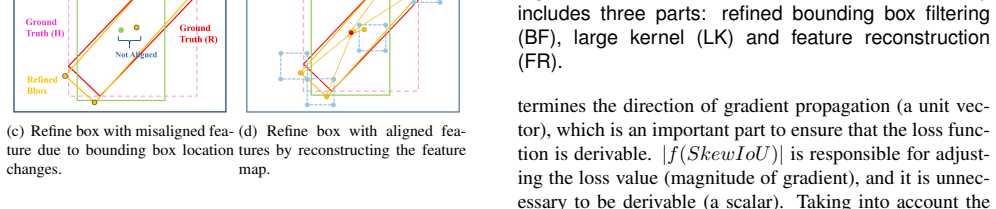
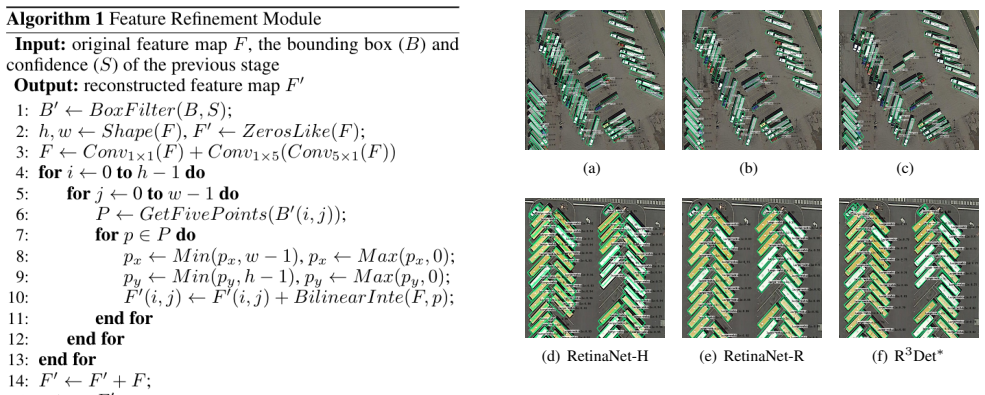
The load-bearing mechanism is the Feature Refinement Module (FRM), which re-encodes the position of the current refined bounding box onto the feature map. For every feature point, five points on the refined box (center plus four corners) are projected onto the feature map; bilinear interpolation extracts a feature vector for each, the five vectors are summed, and this replaces the original feature point, reconstructing a whole aligned feature map that is added to the input. A box-filtering step keeps only the highest-scoring box per feature point so each location maps to one refined box, and a large-kernel convolution broadens context before reconstruction. The complementary mechanism is the approximate SkewIoU loss, which multiplies the magnitude of a SkewIoU-derived term by the unit vector of a smooth-L1-plus-horizontal-IoU regression loss, so the gradient direction comes from a differentiable proxy while the loss magnitude tracks actual rotated overlap. The progressive regression scheme (horizontal anchors first, rotated anchors in later stages) is what makes refinement affordable while keeping recall high.
What would settle it
Take pairs of rotated boxes with aspect ratio 5:1 and small angle differences, compute the cosine similarity between the gradient of L_reg (Eq. 3) and the numerically computed gradient of SkewIoU; if the similarity is close to zero or negative across the early-training distribution, the loss is not steering toward higher overlap and the central mechanism fails.
Extended reading notes
Core claim
The central claim is that feature misalignment, not the number of regression stages, is what limits refined single-stage rotation detectors. Existing refined detectors reuse the same feature map for later stages even though the predicted box has moved, so classification and regression see stale features. The paper's fix, the Feature Refinement Module (FRM), samples five feature points per map location—the center and four corners of the current refined box—interpolates them bilinearly, reconstructs the entire feature map, and adds it back. This is a pure computation, not a learned offset, which keeps the detector fully convolutional. For the angle, the paper replaces smooth-L1 regression with an approximate SkewIoU loss: the magnitude of a SkewIoU-based term scales the loss, while gradient direction comes from a unit vector based on smooth-L1 angle plus horizontal IoU, making the loss differentiable. The paper's ablation attributes a 2.79-point DOTA gain to FRM (63.52 to 66.31 mAP, Table 1) and reports state-of-the-art results on four rotation-sensitive benchmarks.
Load-bearing premise
Everything rests on the assumption that the gradient direction of L_reg — smooth-L1 on angle plus horizontal IoU — points the same way as the true SkewIoU gradient; the SkewIoU magnitude is detached from backpropagation, so if that direction misleads, the loss cannot deliver the claimed rotation accuracy.
Editorial extensions
If this is right
- Feature alignment in single-stage detectors does not require RoI pooling or learned deformable offsets; a fixed interpolation scheme can realign features while preserving a fully convolutional network.
- Because the network uses horizontal anchors at the first stage, it needs far fewer anchors than a fully rotated-anchor detector; the speed advantage grows with the number of categories since anchor count scales as (5 + C) per location.
- Approximate SkewIoU loss stabilizes training relative to smooth-L1 and improves angle accuracy for high-aspect-ratio objects; the training-loss curve in the paper shows lower variance.
- Beyond two refinement stages, additional stages add little mAP on DOTA; three stages is the practical ceiling for this architecture.
- The same detector transfers to scene text: on ICDAR2015 it reaches 84.96% Hmean at 13.5 fps without extra training data.
Reading between the lines
- Because FRM is a fixed geometric operation rather than a learned module, it could be plugged into any refined detector architecture; the cost is minimal sampling and the benefit should scale with aspect ratio.
- The paper never measures how well the gradient direction of L_reg matches the true SkewIoU gradient; comparing against a fully differentiable SkewIoU (e.g., by numerical differentiation) would settle whether the direction or the magnitude is responsible for the gain.
- The interpolation weights being location-sensitive (random permutation of weights destroys accuracy) suggests FRM is doing real geometric alignment, not just adding nonlinearity; a similar sensitivity test on other pixel-wise reconstruction methods could generalize this conclusion.
- The speed comparison on HRSC2016 is single-class; on multi-class datasets, the anchor-count argument predicts R3Det's speed edge over rotated-anchor baselines widens, which is testable with the released code.
Editorial analysis
A structured set of objections, weighed in public.
Referee Report
Summary. The paper proposes R3Det, a refined single-stage rotation detector that combines three components: a progressive coarse-to-fine regression scheme that starts from horizontal anchors and refines with rotating anchors; a feature refinement module (FRM) that reconstructs the feature map by bilinear interpolation of five feature points (center and four corners) per refined box; and an approximate SkewIoU loss that uses the SkewIoU value as a detached magnitude scaling a smooth-L1-plus-horizontal-IoU gradient term. Experiments on DOTA, HRSC2016, UCAS-AOD, and ICDAR2015 report state-of-the-art accuracy among single-stage methods, and the authors release TensorFlow and PyTorch implementations.
Significance. The empirical results are strong: R3Det achieves 73.79% mAP on DOTA without multi-scale training, outperforming prior single-stage rotation detectors, and the public code supports reproducibility. The FRM idea—reconstructing the whole feature map from refined box positions rather than cropping instance-level features—is a useful contribution, and the ablation in Table 3 showing sensitivity to the interpolation formula gives credible evidence that feature alignment matters. However, the two central technical claims have important gaps: the approximate SkewIoU loss is not a differentiable surrogate for SkewIoU in gradient direction, since the SkewIoU term is detached from backpropagation and the gradient comes entirely from L_reg; and the key FRM ablation in Table 1 is confounded with a change in the regression loss. These issues affect the paper's contribution claims even though the overall detector works well in practice.
major comments (2)
- [Section 3.1, Eq. (2)-(3)] The proposed approximate SkewIoU loss does not provide gradients that approximate the gradient of SkewIoU. In Eq. (2), the term |f(SkewIoU)| is explicitly detached from backpropagation (as stated in the text: "|.| is used to obtain the modulus of the vector and is not involved in gradient back propagation"), so the gradient direction is entirely determined by L_reg, which is smooth-L1 on the angle plus horizontal IoU. The paper's claim that "L_reg/|L_reg| determines the direction of gradient propagation" is misleading because this quotient is a scalar ±1; the parameter-space direction is ∇L_reg. Thus the loss is a sample-reweighted smooth-L1 loss, not an approximation of the SkewIoU loss. No analysis or experiment is provided showing that ∇L_reg is a good proxy for the true SkewIoU gradient direction. Table 5 only varies the detached magnitude function f, so it cannot validate the claimed "more accurate rotation estimation" through gradient alignment. The paper should either re-scope the contribution as a heuristic reweighting scheme or provide direct evidence of direction alignment.
- [Section 4.3, Table 1 and Table 2] The ablation attributed to the feature refinement module (FRM) is confounded. In Table 1, the comparison that Section 4.3 uses to claim FRM increases performance by 2.79% is between R3Det* (mAP 63.52) and R3Det (mAP 66.31). According to Section 4.2, R3Det* is the refined detector without feature refinement; its single checkmark in Table 1 corresponds to the approximate SkewIoU loss column, while R3Det has checkmarks for BF&FR and LK but no checkmark for the approximate loss. Therefore the two rows differ in both FRM and the regression loss, and the +2.79 mAP cannot be attributed to FRM alone. A controlled comparison with and without FRM under the same loss is not reported. The same confounding appears in Table 2, where R3Det* and R3Det differ in both the loss (Table 1) and the FRM components. Since the paper's central component claim is that "FRM alone" gives a large gain, this needs to be re-established with a properly controlled ablation, e.g., R3Det with vs. without FRM while keeping the approximate SkewIoU loss fixed, and vice versa.
minor comments (5)
- [General] There are several typos: "Refined Rotation Singe-Stage Detector" in the contributions list, "ReitnaNet-H" in Section 4.2, "shell" for "shall" in Section 7, and "comparsion" in the Supplementary Material.
- [Table 1] The checkmark layout of Table 1 is ambiguous in the manuscript text. Please clarify which checkmarks correspond to BF&FR, LK, and approximate SkewIoU loss in each row, as the current formatting makes the ablation difficult to interpret.
- [Section 3.2] The reference to "Algorithm 3.2" appears to point to a numbered algorithm that is not present in the manuscript text. Please include the pseudo-code with a proper caption or remove the cross-reference.
- [Eq. (2)] The function f in Eq. (2) is not defined in the main text; the reader must infer from Table 5 that f can be 1−SkewIoU or exp(1−SkewIoU)−1. Please define f explicitly in Section 3.1.
- [Section 6.3] The supplementary text states that FRM does not work well for horizontal detection on COCO, but no experimental result is shown. Either include the COCO experiment or weaken the claim.
Circularity Check
No circularity found; the central components are empirically validated, with a confounded FRM ablation as a validity concern rather than a circular step.
full rationale
The paper's derivation chain is not circular. The approximate SkewIoU loss (Eqs. 2-3) uses the smooth-L1/horizontal-IoU direction as the backpropagated gradient and only a detached SkewIoU magnitude for scaling; using SkewIoU in training while also reporting SkewIoU-based mAP is objective alignment, not hidden reuse of the evaluation target. The claimed gains are supported by held-out benchmark comparisons against external methods and by controlled ablations of the loss function form (Table 5) and of the feature-interpolation weights (Table 3). The feature refinement module is a constructive mechanism with position-sensitive evidence, not a renamed existing result. The only notable weakness is that the headline FRM attribution compares R3Det* (with approximate loss, without FRM) to R3Det (with FRM, without approximate loss), so the 2.79-point gap in Table 1 is not a controlled FRM-only ablation; this is an experimental confound, not a reduction of the result to its inputs. The SCRDet self-citation for the loss is acknowledged inspiration, and the exact equations are given in the paper, so no load-bearing claim rests on an unverified self-citation. The paper's own limitation note in Sec. 6.3, saying FRM is unsatisfactory on horizontal COCO detection, is an honest scope limitation and does not indicate circularity.
Assumptions & free parameters
free parameters (5)
- IoU thresholds per refinement stage =
0.5/0.4, 0.6/0.5, 0.7/0.6
- Loss weights lambda_1, lambda_2, alpha_i =
1
- SkewIoU magnitude function f =
exp(1 - SkewIoU) - 1
- Anchor configuration =
7 aspect ratios, 3 scales, 6 angles
- Number of refinement stages =
2 (R3Det-dagger), 1 (R3Det)
assumptions (4)
- domain assumption The five-parameter oriented box representation with theta in [-pi/2, 0) fully describes the rotated objects in the target datasets.
- domain assumption Bilinear interpolation at the center and four corners of the refined box provides features that are better aligned than features from the original anchor position.
- ad hoc to paper The gradient direction of L_reg is a sufficient proxy for increasing SkewIoU.
- domain assumption Keeping only the highest-scoring box per feature point during refinement does not lose essential candidates.
Cite this review
Pith. "Pith review of R3Det: Refined Single-Stage Detector with Feature Refinement for Rotating Object." pith.science (2026). https://pith.science/paper/DEFZ3GCU
@misc{pith2026190805612,
  author       = {Pith},
  title        = {Pith review of: R3Det: Refined Single-Stage Detector with Feature Refinement for Rotating Object},
  year         = {2026},
  howpublished = {\url{https://pith.science/paper/DEFZ3GCU}},
  note         = {Machine review of arXiv:1908.05612}
}
read the original abstract
Rotation detection is a challenging task due to the difficulties of locating the multi-angle objects and separating them effectively from the background. Though considerable progress has been made, for practical settings, there still exist challenges for rotating objects with large aspect ratio, dense distribution and category extremely imbalance. In this paper, we propose an end-to-end refined single-stage rotation detector for fast and accurate object detection by using a progressive regression approach from coarse to fine granularity. Considering the shortcoming of feature misalignment in existing refined single-stage detector, we design a feature refinement module to improve detection performance by getting more accurate features. The key idea of feature refinement module is to re-encode the position information of the current refined bounding box to the corresponding feature points through pixel-wise feature interpolation to realize feature reconstruction and alignment. For more accurate rotation estimation, an approximate SkewIoU loss is proposed to solve the problem that the calculation of SkewIoU is not derivable. Experiments on three popular remote sensing public datasets DOTA, HRSC2016, UCAS-AOD as well as one scene text dataset ICDAR2015 show the effectiveness of our approach. Tensorflow and Pytorch version codes are available at https://github.com/Thinklab-SJTU/R3Det_Tensorflow and https://github.com/SJTU-Thinklab-Det/r3det-on-mmdetection, and R3Det is also integrated in our open source rotation detection benchmark: https://github.com/yangxue0827/RotationDetection.
Figures


Figures from the paper (7 more)


Forward citations
Cited by 1 Pith paper
-
Oriented Tiny Object Detection: A Dataset, Benchmark, and Dynamic Unbiased Learning
A new benchmark for oriented tiny object detection with the smallest object sizes to date, plus a dynamic coarse-to-fine training scheme that improves accuracy across eight datasets.
Reference graph
Works this paper leans on
-
[1]
Towards multi-class object de- tection in unconstrained remote sensing imagery
Seyed Majid Azimi, Eleonora Vig, Reza Bahmanyar, Marco K¨orner, and Peter Reinartz. Towards multi-class object de- tection in unconstrained remote sensing imagery. In Asian Conference on Computer Vision , pages 150–165. Springer,
-
[2]
Songze Bao, Xing Zhong, Ruifei Zhu, Xiaonan Zhang, Zhuqiang Li, and Mengyang Li. Single shot anchor refine- ment network for oriented object detection in optical remote sensing imagery. IEEE Access, 7:87150–87161, 2019. 8
work page 2019
-
[3]
Cascade r-cnn: Delv- ing into high quality object detection
Zhaowei Cai and Nuno Vasconcelos. Cascade r-cnn: Delv- ing into high quality object detection. In Proceedings of the IEEE Conference on Computer Vision and Pattern Recogni- tion, pages 6154–6162, 2018. 3
work page 2018
-
[4]
Hybrid task cascade for instance seg- mentation
Kai Chen, Jiangmiao Pang, Jiaqi Wang, Yu Xiong, Xiaox- iao Li, Shuyang Sun, Wansen Feng, Ziwei Liu, Jianping Shi, Wanli Ouyang, et al. Hybrid task cascade for instance seg- mentation. In Proceedings of the IEEE Conference on Com- puter Vision and Pattern Recognition , pages 4974–4983,
-
[5]
Joint Anchor-Feature Refinement for Real-Time Accurate Object Detection in Images and Videos
Xingyu Chen, Junzhi Yu, Shihan Kong, Zhengxing Wu, and Li Wen. Dual refinement networks for accurate and fast object detection in real-world scenes. arXiv preprint arXiv:1807.08638, 2018. 2, 3
work page Pith review arXiv 2018
-
[6]
Piou loss: Towards accurate ori- ented object detection in complex environments
Zhiming Chen, Kean Chen, Weiyao Lin, John See, Hui Yu, Yan Ke, and Cong Yang. Piou loss: Towards accurate ori- ented object detection in complex environments. Proceed- ings of the European Conference on Computer Vision, 2020. 2, 3, 8
work page 2020
-
[7]
Selective refinement network for high performance face detection
Cheng Chi, Shifeng Zhang, Junliang Xing, Zhen Lei, Stan Z Li, and Xudong Zou. Selective refinement network for high performance face detection. In Proceedings of the AAAI Conference on Artificial Intelligence, volume 33, pages 8231–8238, 2019. 2
work page 2019
-
[8]
R-fcn: Object detection via region-based fully convolutional networks
Jifeng Dai, Yi Li, Kaiming He, and Jian Sun. R-fcn: Object detection via region-based fully convolutional networks. In Advances in Neural Information Processing Systems , pages 379–387, 2016. 1, 2
work page 2016
Show all 65 references
-
[9]
Jifeng Dai, Haozhi Qi, Yuwen Xiong, Yi Li, Guodong Zhang, Han Hu, and Yichen Wei. Deformable convolutional 10 (a) BC and TC (b) SBF, GTF, TC and SP (c) HA (d) HA and SH (e) SP (f) RA and SV (g) ST (h) BD and RA (i) SV and LV (j) PL and HC (k) BR Figure 12: Detection results on...
2017
-
[10]
Learning roi transformer for oriented object detection in aerial images
Jian Ding, Nan Xue, Yang Long, Gui-Song Xia, and Qikai Lu. Learning roi transformer for oriented object detection in aerial images. In Proceedings of the IEEE Conference on Computer Vision and Pattern Recognition , pages 2849– 2858, 2019. 3, 8
2019
-
[11]
Rotation-aware and multi-scale convolutional neural network for object detection in remote sensing images
Kun Fu, Zhonghan Chang, Yue Zhang, Guangluan Xu, Keshu Zhang, and Xian Sun. Rotation-aware and multi-scale convolutional neural network for object detection in remote sensing images. ISPRS Journal of Photogrammetry and Re- mote Sensing, 161:294–308, 2020. 8
2020
-
[12]
A ship rotation detection model in remote sensing images based on feature fusion pyramid net- work and deep reinforcement learning
Kun Fu, Yang Li, Hao Sun, Xue Yang, Guangluan Xu, Yut- ing Li, and Xian Sun. A ship rotation detection model in remote sensing images based on feature fusion pyramid net- work and deep reinforcement learning. Remote Sensing , 11 10(12):1922, 2018. 2
1922
-
[13]
Fast r-cnn
Ross Girshick. Fast r-cnn. In Proceedings of the IEEE Inter- national Conference on Computer Vision, pages 1440–1448,
-
[14]
Rich feature hierarchies for accurate object detection and semantic segmentation
Ross Girshick, Jeff Donahue, Trevor Darrell, and Jitendra Malik. Rich feature hierarchies for accurate object detection and semantic segmentation. InProceedings of the IEEE Con- ference on Computer Vision and Pattern Recognition, pages 580–587, 2014. 1
2014
-
[15]
Mask r-cnn
Kaiming He, Georgia Gkioxari, Piotr Doll ´ar, and Ross Gir- shick. Mask r-cnn. In Proceedings of the IEEE International Conference on Computer Vision, pages 2961–2969, 2017. 3
2017
-
[16]
Deep residual learning for image recognition
Kaiming He, Xiangyu Zhang, Shaoqing Ren, and Jian Sun. Deep residual learning for image recognition. In Proceed- ings of the IEEE Conference on Computer Vision and Pattern Recognition, pages 770–778, 2016. 6
2016
-
[17]
Deep direct regression for multi-oriented scene text detec- tion
Wenhao He, Xu-Yao Zhang, Fei Yin, and Cheng-Lin Liu. Deep direct regression for multi-oriented scene text detec- tion. In Proceedings of the IEEE International Conference on Computer Vision, pages 745–753, 2017. 9
2017
-
[18]
Cascade detector with feature fusion for arbitrary-oriented objects in remote sensing images
Liping Hou, Ke Lu, Jian Xue, and Li Hao. Cascade detector with feature fusion for arbitrary-oriented objects in remote sensing images. In 2020 IEEE International Conference on Multimedia and Expo, pages 1–6. IEEE, 2020. 8
2020
-
[19]
Propose-and-attend single shot detector
Ho-Deok Jang, Sanghyun Woo, Philipp Benz, Jinsun Park, and In So Kweon. Propose-and-attend single shot detector. arXiv preprint arXiv:1907.12736, 2019. 2, 3
1907 arXiv
-
[20]
R2cnn: rota- tional region cnn for orientation robust scene text detection
Yingying Jiang, Xiangyu Zhu, Xiaobing Wang, Shuli Yang, Wei Li, Hua Wang, Pei Fu, and Zhenbo Luo. R2cnn: rota- tional region cnn for orientation robust scene text detection. arXiv preprint arXiv:1706.09579, 2017. 3, 8, 9
2017 arXiv
-
[21]
Icdar 2015 competition on ro- bust reading
Dimosthenis Karatzas, Lluis Gomez-Bigorda, Anguelos Nicolaou, Suman Ghosh, Andrew Bagdanov, Masakazu Iwa- mura, Jiri Matas, Lukas Neumann, Vijay Ramaseshan Chan- drasekhar, Shijian Lu, et al. Icdar 2015 competition on ro- bust reading. In 2015 13th International Conference on ...
2015
-
[22]
Rethinking clas- sification and localization for cascade r-cnn
Ang Li, Xue Yang, and Chongyang Zhang. Rethinking clas- sification and localization for cascade r-cnn. arXiv preprint arXiv:1907.11914, 2019. 3
1907 arXiv
-
[23]
Feature-attentioned object detection in remote sensing imagery
Chengzheng Li, Chunyan Xu, Zhen Cui, Dan Wang, Tong Zhang, and Jian Yang. Feature-attentioned object detection in remote sensing imagery. In2019 IEEE International Con- ference on Image Processing, pages 3886–3890. IEEE, 2019. 8
2019
-
[24]
Radet: Refine feature pyramid network and multi-layer attention network for arbitrary-oriented ob- ject detection of remote sensing images
Yangyang Li, Qin Huang, Xuan Pei, Licheng Jiao, and Ronghua Shang. Radet: Refine feature pyramid network and multi-layer attention network for arbitrary-oriented ob- ject detection of remote sensing images. Remote Sensing, 12(3):389, 2020. 8
2020
-
[25]
Textboxes++: A single-shot oriented scene text detector
Minghui Liao, Baoguang Shi, and Xiang Bai. Textboxes++: A single-shot oriented scene text detector. IEEE Transac- tions on Image Processing, 27(8):3676–3690, 2018. 3
2018
-
[26]
Rotation-sensitive regression for oriented scene text detection
Minghui Liao, Zhen Zhu, Baoguang Shi, Gui-song Xia, and Xiang Bai. Rotation-sensitive regression for oriented scene text detection. In Proceedings of the IEEE Conference on Computer Vision and Pattern Recognition , pages 5909– 5918, 2018. 8
2018
-
[27]
Feature pyramid networks for object detection
Tsung-Yi Lin, Piotr Doll ´ar, Ross Girshick, Kaiming He, Bharath Hariharan, and Serge Belongie. Feature pyramid networks for object detection. In Proceedings of the IEEE Conference on Computer Vision and Pattern Recognition , pages 2117–2125, 2017. 1, 2
2017
-
[28]
Focal loss for dense object detection
Tsung-Yi Lin, Priya Goyal, Ross Girshick, Kaiming He, and Piotr Doll´ar. Focal loss for dense object detection. In Pro- ceedings of the IEEE International Conference on Computer Vision, pages 2980–2988, 2017. 1, 2, 3, 4
2017
-
[29]
Ienet: Interacting embranchment one stage anchor free detec- tor for orientation aerial object detection
Youtian Lin, Pengming Feng, and Jian Guan. Ienet: Interacting embranchment one stage anchor free detec- tor for orientation aerial object detection. arXiv preprint arXiv:1912.00969, 2019. 8
1912 arXiv
-
[30]
Learning a rotation in- variant detector with rotatable bounding box
Lei Liu, Zongxu Pan, and Bin Lei. Learning a rotation in- variant detector with rotatable bounding box. arXiv preprint arXiv:1711.09405, 2017. 8
2017 arXiv
-
[31]
Ssd: Single shot multibox detector
Wei Liu, Dragomir Anguelov, Dumitru Erhan, Christian Szegedy, Scott Reed, Cheng-Yang Fu, and Alexander C Berg. Ssd: Single shot multibox detector. In Proceedings of the European Conference on Computer Vision, pages 21–
-
[32]
Fots: Fast oriented text spotting with a unified network
Xuebo Liu, Ding Liang, Shi Yan, Dagui Chen, Yu Qiao, and Junjie Yan. Fots: Fast oriented text spotting with a unified network. In Proceedings of the IEEE Conference on Computer Vision and Pattern Recognition , pages 5676– 5685, 2018. 3, 9
2018
-
[33]
Omnidirectional scene text detec- tion with sequential-free box discretization
Yuliang Liu, Sheng Zhang, Lianwen Jin, Lele Xie, Yaqiang Wu, and Zhepeng Wang. Omnidirectional scene text detec- tion with sequential-free box discretization. arXiv preprint arXiv:1906.02371, 2019. 8
1906 arXiv
-
[34]
A high resolution optical satellite image dataset for ship recognition and some new baselines
Zikun Liu, Liu Yuan, Lubin Weng, and Yiping Yang. A high resolution optical satellite image dataset for ship recognition and some new baselines. In Proceedings of the International Conference on Pattern Recognition Applications and Meth- ods, volume 2, pages 324–331, 2017. 6, 8, 9
2017
-
[35]
Arbitrary-oriented scene text detection via rotation proposals
Jianqi Ma, Weiyuan Shao, Hao Ye, Li Wang, Hong Wang, Yingbin Zheng, and Xiangyang Xue. Arbitrary-oriented scene text detection via rotation proposals. IEEE Transac- tions on Multimedia, 2018. 2, 3, 8, 9
2018
-
[36]
Icdar2017 ro- bust reading challenge on multi-lingual scene text detection and script identification-rrc-mlt
Nibal Nayef, Fei Yin, Imen Bizid, Hyunsoo Choi, Yuan Feng, Dimosthenis Karatzas, Zhenbo Luo, Umapada Pal, Christophe Rigaud, Joseph Chazalon, et al. Icdar2017 ro- bust reading challenge on multi-lingual scene text detection and script identification-rrc-mlt. In 2017 14th IAPR I...
2017
-
[37]
Springer, 2016. 1, 2
2016
-
[38]
You only look once: Unified, real-time object de- tection
Joseph Redmon, Santosh Divvala, Ross Girshick, and Ali Farhadi. You only look once: Unified, real-time object de- tection. In Proceedings of the IEEE Conference on Computer Vision and Pattern Recognition, pages 779–788, 2016. 1, 2 12
2016
-
[39]
Dynamic refinement network for oriented and densely packed object detection
Xingjia Pan, Yuqiang Ren, Kekai Sheng, Weiming Dong, Haolei Yuan, Xiaowei Guo, Chongyang Ma, and Chang- sheng Xu. Dynamic refinement network for oriented and densely packed object detection. In Proceedings of the IEEE Conference on Computer Vision and Pattern Recognition , page...
2020
-
[40]
Faster r-cnn: Towards real-time object detection with region proposal networks
Shaoqing Ren, Kaiming He, Ross Girshick, and Jian Sun. Faster r-cnn: Towards real-time object detection with region proposal networks. In Advances in Neural Information Pro- cessing Systems, pages 91–99, 2015. 1, 2
2015
-
[41]
Yolo9000: better, faster, stronger
Joseph Redmon and Ali Farhadi. Yolo9000: better, faster, stronger. In Proceedings of the IEEE Conference on Com- puter Vision and Pattern Recognition , pages 7263–7271,
-
[42]
Mobilenetv2: Inverted residuals and linear bottlenecks
Mark Sandler, Andrew Howard, Menglong Zhu, Andrey Zh- moginov, and Liang-Chieh Chen. Mobilenetv2: Inverted residuals and linear bottlenecks. In Proceedings of the IEEE Conference on Computer Vision and Pattern Recognition , pages 4510–4520, 2018. 8
2018
-
[43]
Generalized in- tersection over union: A metric and a loss for bounding box regression
Hamid Rezatofighi, Nathan Tsoi, JunYoung Gwak, Amir Sadeghian, Ian Reid, and Silvio Savarese. Generalized in- tersection over union: A metric and a loss for bounding box regression. In Proceedings of the IEEE Conference on Com- puter Vision and Pattern Recognition, pages 658–66...
2019
-
[44]
Detecting oriented text in natural images by linking segments
Baoguang Shi, Xiang Bai, and Serge Belongie. Detecting oriented text in natural images by linking segments. In Pro- ceedings of the IEEE Conference on Computer Vision and Pattern Recognition, pages 2550–2558, 2017. 9
2017
-
[45]
Overfeat: Integrated recognition, localization and detection using convolutional networks
Pierre Sermanet, David Eigen, Xiang Zhang, Micha ¨el Math- ieu, Rob Fergus, and Yann LeCun. Overfeat: Integrated recognition, localization and detection using convolutional networks. arXiv preprint arXiv:1312.6229, 2013. 2
2013 arXiv
-
[46]
Mask obb: A semantic attention- based mask oriented bounding box representation for multi- category object detection in aerial images
Jinwang Wang, Jian Ding, Haowen Guo, Wensheng Cheng, Ting Pan, and Wen Yang. Mask obb: A semantic attention- based mask oriented bounding box representation for multi- category object detection in aerial images. Remote Sensing, 11(24):2930, 2019. 8
2019
-
[47]
Detecting text in natural image with connectionist text pro- posal network
Zhi Tian, Weilin Huang, Tong He, Pan He, and Yu Qiao. Detecting text in natural image with connectionist text pro- posal network. In Proceedings of the European Conference on Computer Vision, pages 56–72. Springer, 2016. 9
2016
-
[48]
Oriented objects as pairs of middle lines
Haoran Wei, Lin Zhou, Yue Zhang, Hao Li, Rongxin Guo, and Hongqi Wang. Oriented objects as pairs of middle lines. arXiv preprint arXiv:1912.10694, 2019. 8
1912 arXiv
-
[49]
Learning center probability map for de- tecting objects in aerial images
Jinwang Wang, Wen Yang, Heng-Chao Li, Haijian Zhang, and Gui-Song Xia. Learning center probability map for de- tecting objects in aerial images. IEEE Transactions on Geo- science and Remote Sensing, 2020. 8
2020
-
[50]
Gliding vertex on the horizontal bounding box for multi-oriented object detec- tion
Yongchao Xu, Mingtao Fu, Qimeng Wang, Yukang Wang, Kai Chen, Gui-Song Xia, and Xiang Bai. Gliding vertex on the horizontal bounding box for multi-oriented object detec- tion. IEEE Transactions on Pattern Analysis and Machine Intelligence, 2020. 3, 8
2020
-
[51]
Dota: A large-scale dataset for object detection in aerial images
Gui-Song Xia, Xiang Bai, Jian Ding, Zhen Zhu, Serge Be- longie, Jiebo Luo, Mihai Datcu, Marcello Pelillo, and Liang- pei Zhang. Dota: A large-scale dataset for object detection in aerial images. In Proceedings of the IEEE Conference on Computer Vision and Pattern Recognition ,...
2018
-
[52]
Object detection with head di- rection in remote sensing images based on rotational region cnn
Xue Yang, Kun Fu, Hao Sun, Xian Sun, Menglong Yan, Wenhui Diao, and Zhi Guo. Object detection with head di- rection in remote sensing images based on rotational region cnn. In IGARSS 2018-2018 IEEE International Geoscience and Remote Sensing Symposium , pages 2507–2510. IEEE,
2018
-
[53]
Building detection in high spatial resolution remote sensing imagery with the u-rotation detection network
Jirui Yang, Luyan Ji, Xiurui Geng, Xue Yang, and Yongchao Zhao. Building detection in high spatial resolution remote sensing imagery with the u-rotation detection network. In- ternational Journal of Remote Sensing , 40(15):6036–6058,
-
[54]
Scrdet: Towards more robust detection for small, cluttered and rotated ob- jects
Xue Yang, Jirui Yang, Junchi Yan, Yue Zhang, Tengfei Zhang, Zhi Guo, Xian Sun, and Kun Fu. Scrdet: Towards more robust detection for small, cluttered and rotated ob- jects. In Proceedings of the IEEE International Conference on Computer Vision, pages 8232–8241, 2019. 3, 8
2019
-
[55]
Automatic ship detection in remote sensing images from google earth of complex scenes based on multiscale rotation dense feature pyramid networks
Xue Yang, Hao Sun, Kun Fu, Jirui Yang, Xian Sun, Meng- long Yan, and Zhi Guo. Automatic ship detection in remote sensing images from google earth of complex scenes based on multiscale rotation dense feature pyramid networks. Re- mote Sensing, 10(1):132, 2018. 2, 8
2018
-
[56]
Cascade retinanet: Maintaining con- sistency for single-stage object detection
Hongkai Zhang, Hong Chang, Bingpeng Ma, Shiguang Shan, and Xilin Chen. Cascade retinanet: Maintaining con- sistency for single-stage object detection. arXiv preprint arXiv:1907.06881, 2019. 2, 3
1907 arXiv
-
[57]
Cad-net: A context-aware detection network for objects in remote sens- ing imagery
Gongjie Zhang, Shijian Lu, and Wei Zhang. Cad-net: A context-aware detection network for objects in remote sens- ing imagery. IEEE Transactions on Geoscience and Remote Sensing, 57(12):10015–10024, 2019. 8
2019
-
[58]
Toward arbitrary-oriented ship detection with ro- tated region proposal and discrimination networks
Zenghui Zhang, Weiwei Guo, Shengnan Zhu, and Wenx- ian Yu. Toward arbitrary-oriented ship detection with ro- tated region proposal and discrimination networks. IEEE Geoscience and Remote Sensing Letters, 15(11):1745–1749,
-
[59]
Shifeng Zhang, Longyin Wen, Xiao Bian, Zhen Lei, and Stan Z. Li. Single-shot refinement neural network for object detection. 2018. 2, 3
2018
-
[60]
Objects detection for remote sens- ing images based on polar coordinates
Lin Zhou, Haoran Wei, Hao Li, Yue Zhang, Xian Sun, and Wenzhe Zhao. Objects detection for remote sens- ing images based on polar coordinates. arXiv preprint arXiv:2001.02988, 2020. 8
2001 arXiv
-
[61]
Distance-iou loss: Faster and bet- ter learning for bounding box regression
Zhaohui Zheng, Ping Wang, Wei Liu, Jinze Li, Rongguang Ye, and Dongwei Ren. Distance-iou loss: Faster and bet- ter learning for bounding box regression. In Proceedings of the AAAI Conference on Artificial Intelligence, pages 12993– 13000, 2020. 3
2020
-
[62]
Orientation robust object detection in aerial images using deep convolutional neural network
Haigang Zhu, Xiaogang Chen, Weiqun Dai, Kun Fu, Qixiang Ye, and Jianbin Jiao. Orientation robust object detection in aerial images using deep convolutional neural network. In 2015 IEEE International Conference on Image Processing , pages 3735–3739. IEEE, 2015. 6
2015
-
[63]
East: An efficient and accurate scene text detector
Xinyu Zhou, Cong Yao, He Wen, Yuzhi Wang, Shuchang Zhou, Weiran He, and Jiajun Liang. East: An efficient and accurate scene text detector. In Proceedings of the IEEE Conference on Computer Vision and Pattern Recognition ,
-
[65]
Adaptive period embedding for representing oriented objects in aerial im- ages
Yixing Zhu, Jun Du, and Xueqing Wu. Adaptive period embedding for representing oriented objects in aerial im- ages. IEEE Transactions on Geoscience and Remote Sens- ing, 2020. 8 13
2020
-
[2018]
The red and green bounding box indi- cate the ground truth and prediction box, respectively
3, 6, 8 (a) (b) (c) (d) Figure 11: Ship detection results on the HRSC2016 benchmarks. The red and green bounding box indi- cate the ground truth and prediction box, respectively
Reviewed August 14, 2026 · model on record in the stance chip above.
Discussion (0). Continue with ORCID to comment.