REVIEW 3 major objections 4 minor 48 references
Non-stationary Statistics and Formation Jitter in Transient Photon Condensation
T0 review · 3 major / 4 minor · reviewed 2026-08-14 · deepseek-v4-flash
Pith's one-line read Transient phase transitions exhibit a distinct divergent fluctuation: jitter in the time the ordered phase forms, witnessed by two-time non-stationary correlations.
desk verdict A careful experiment-theory paper that introduces a genuinely useful two-time g(2) tool for transient photon condensation, with a plausible jitter mechanism that the universality claim outruns. read the letter →
The pith
A machine-rendered reading of the paper's core claim, the machinery that carries it, and where it could break.
The reading
What carries the argument
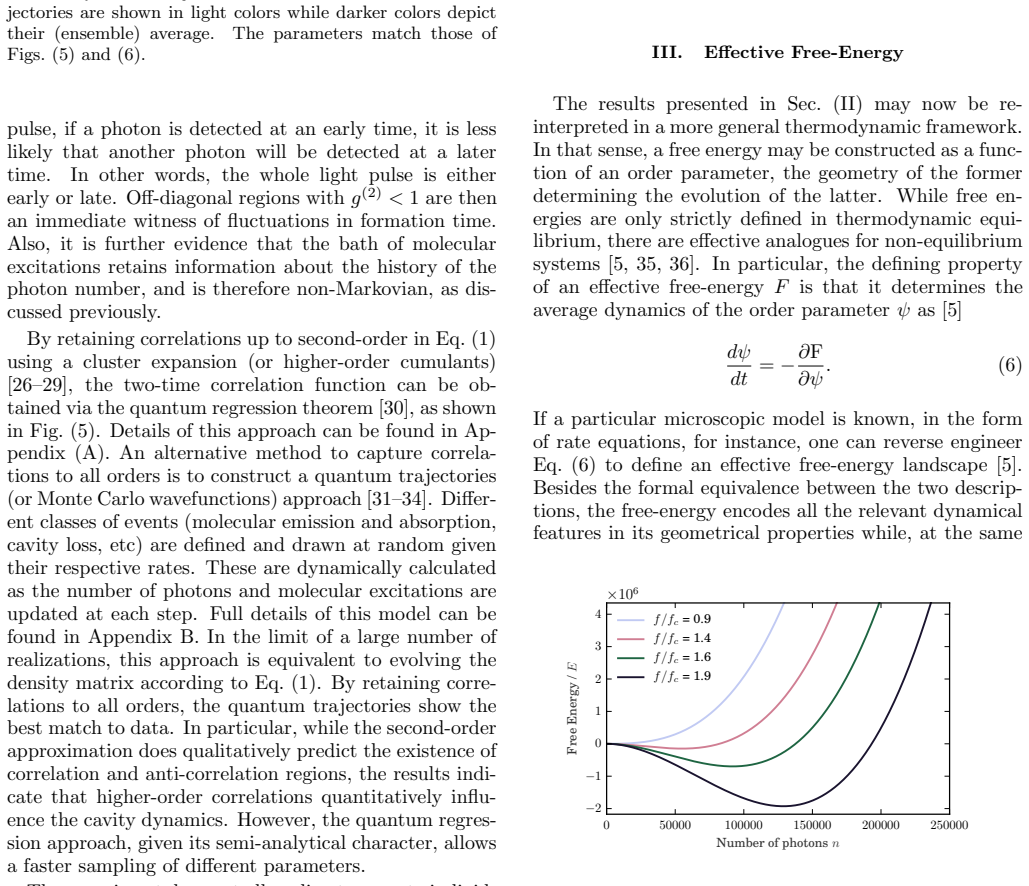
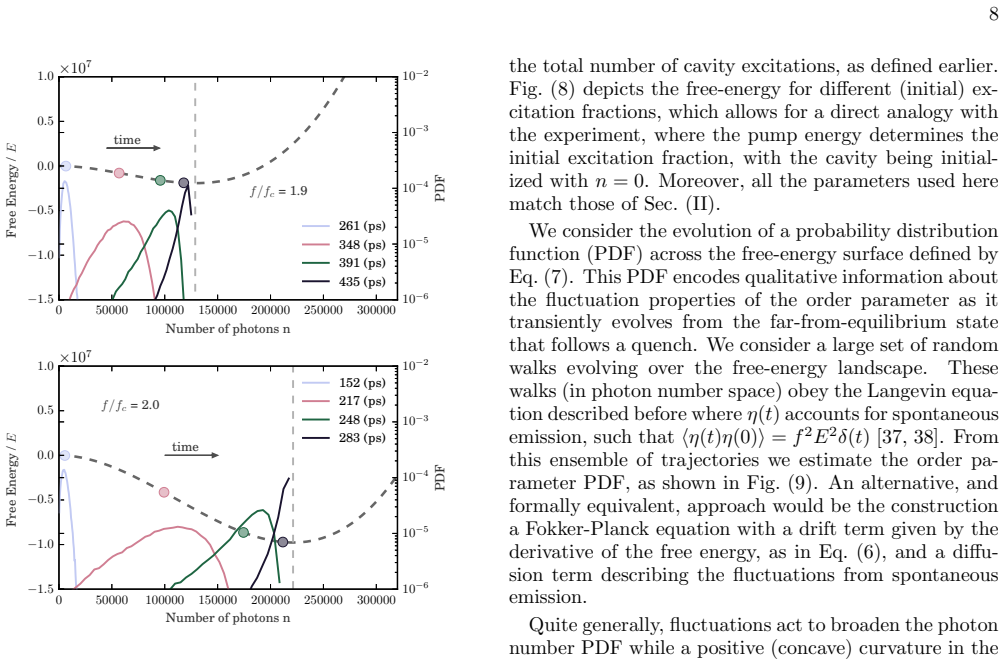
The central objects are the two-time non-stationary second-order correlation function $g^{(2)}(t_1,t_2)$, defined as the normalized joint photon-detection probability, and the effective free-energy landscape $F(n)=-\int_0^n \dot n'\,dn'$ for the photon number $n$ as order parameter. The correlation function carries the measurement: because the transient system lacks time-translation symmetry, the single-time $g^{(2)}(\tau)$ is insufficient, and the full two-time map separates diagonal number fluctuations from off-diagonal timing-jitter correlations. The free-energy landscape carries the generalization: the relation $d\psi/dt=-\partial F/\partial\psi$ turns the microscopic rate equations into a geometry problem, and a Langevin walk over this landscape shows that a probability distribution passing through the convex, negative-curvature part of $F$ is briefly but strongly broadened by spontaneous-emission noise, which is the microscopic origin of the jitter. The landscape is coupled to the photon-number history through cavity loss, producing the early-pulse-decays-early correlations that appear as anti-correlation lobes.
What would settle it
Measure $g^{(2)}(t_1,t_2)$ in the same cavity after increasing the molecular fluorescence rate $\Gamma_\downarrow$ relative to the cavity emission rate $E$ so that $\Gamma_\downarrow \gg E$, pushing the bath toward Markovian behaviour; the model predicts that the off-diagonal anti-correlation lobes disappear and the near-threshold pulse broadening is strongly reduced, even though a delayed pulse remains.
Extended reading notes
Core claim
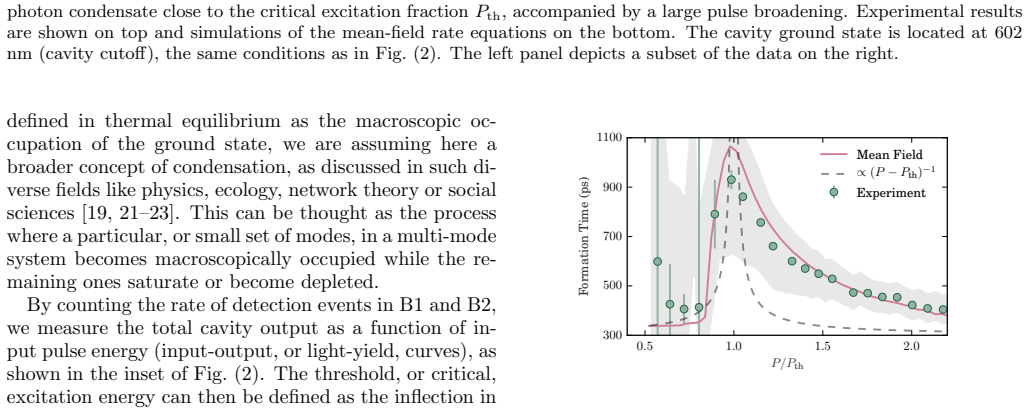
The paper's central claim is that a quench through a photon-condensation threshold is characterized not only by growing number fluctuations but by a qualitatively different divergent fluctuation: timing jitter in the growth of the order parameter. On each realization the condensed pulse is seeded by spontaneous emission, so the instant of condensate formation fluctuates from shot to shot; near threshold these timing fluctuations grow and the ensemble-averaged pulse broadens even though individual pulses remain sharp. The authors show that this jitter is directly witnessed by the two-time non-stationary second-order correlation function $g^{(2)}(t_1,t_2)$: strong diagonal correlations at the inflection of the mean pulse and off-diagonal anti-correlations because an early pulse makes late detections less likely. They observe this signature experimentally in a dye microcavity, reproduce it with quantum trajectories that keep correlations to all orders, and reinterpret it through the geometry of an effective free-energy landscape, concluding that formation jitter is a general feature of transient second-order phase transitions in systems whose excitation reservoirs retain memory.
Load-bearing premise
The result depends on the molecular excitation bath being in the fitted non-Markovian regime, where stimulated emission de-excites molecules faster than ordinary fluorescence; the paper states that in the Markovian limit both critical slowing down and timing jitter vanish.
Editorial extensions
If this is right
- Any quench through a second-order phase transition in a system whose excitation reservoir keeps memory of the photons should show the same qualitative signature: pulse broadening from formation jitter and anti-correlation lobes in $g^{(2)}(t_1,t_2)$.
- The two-time correlation function becomes a practical diagnostic for transient critical phenomena, letting experimenters separate number fluctuations from formation-time fluctuations in a single measurement.
- Micro- and nano-laser turn-on experiments, previously analyzed with single-time correlations, should be re-examined with two-time statistics to isolate formation jitter.
- Colloidal nanoparticle growth, described by nucleation on a free-energy landscape, is predicted to exhibit an analogous formation-time jitter.
Reading between the lines
- If the universality claim holds, the depth of the off-diagonal anti-correlation dip could be used to extract the curvature of the effective free energy near the threshold without knowing the microscopic rates.
- The same two-time diagnostic could be applied to quenches in atomic Bose-Einstein condensates or spin systems where the order parameter is not directly measurable, testing whether formation jitter is generic beyond photonic systems.
- A dedicated analysis separating pulse-shape effects from timing variance could yield a scaling exponent for the jitter, since the paper notes that the two competing effects hide a clean divergence in the raw $g^{(2)}$ maps.
Signed reviews
Editorial analysis
A structured set of objections, weighed in public.
Referee Report
Summary. The paper reports an experimental and theoretical study of transient photon condensation in a dye-filled microcavity after pulsed excitation. The authors measure the time-resolved cavity output for a range of pump energies and introduce a two-time, non-stationary second-order correlation function g(2)(t1,t2) as a probe of the transient relaxation dynamics. They observe delayed condensate formation near threshold, interpreted as a transient analogue of critical slowing down, and diagonal correlations together with off-diagonal anti-correlations in g(2), interpreted as shot-to-shot timing jitter in the condensate formation seeded by spontaneous emission. The experimental results are compared with mean-field rate equations, a quantum regression approach, and quantum trajectory simulations using parameters fitted to the averaged pulse shapes. The authors then construct an effective free-energy landscape and argue that formation jitter is a universal feature of quenches through second-order phase transitions.
Significance. If substantiated, the paper introduces a genuinely useful experimental tool, the non-stationary two-time correlation function, and identifies a distinct fluctuation phenomenon in transient phase transitions, namely timing jitter in order-parameter formation. A notable strength is that the two-time data are compared with a quantum-trajectories model whose parameters were fitted to independent one-time intensity data, providing a partially independent test of the model. The free-energy argument connects the observations to a broader class of systems. However, the central interpretation and the universality claim rest on the identification of a specific non-Markovian reservoir regime, and the manuscript currently does not provide the statistical evidence needed to establish that regime. The paper is therefore significant but requires further quantitative support before the claims can be fully accepted.
major comments (3)
- [Sec. II D and Sec. III (final paragraph)] The classification of the system as non-Markovian rests entirely on the fitted values kappa=10^10 s^-1 and Gamma_down=0.998 Gamma_0, yet no uncertainties, goodness-of-fit measures, or model-selection tests are reported. Because the final paragraph of Sec. III states that in the Markovian regime both critical slowing down and timing jitter vanish, the central claim depends on this fitted regime being statistically distinguishable from the Markovian limit. The authors should provide confidence intervals for (kappa, Gamma_down, alpha) and a quantitative comparison, such as a profile likelihood or an information criterion, against the Markovian alternative.
- [Sec. III, Eq. (7)] The effective free-energy landscape in Eq. (7) is derived after setting kappa=Gamma_down=Gamma_up=0, whereas the fitted experimental regime has kappa >> Gamma_down (kappa approximately 40 times Gamma_0). The paper acknowledges that the fixed-Nex approximation is only valid in the non-Markovian regime, but it does not quantify how the finite-loss dynamics modify the free-energy geometry or the predicted jitter. To support the universality claim, the authors should show that the Langevin dynamics on Eq. (7) reproduces the same qualitative g(2) features as the full quantum-trajectory model with the actual lossy parameters, or provide a controlled expansion in the loss-to-stimulated-emission ratio.
- [Figs. 5 and 6] The experimental g(2)(t1,t2) maps are presented without error bars or confidence intervals. Since the off-diagonal anti-correlation lobes are the central witness of formation jitter, the reader cannot assess whether the deviations from g(2)=1 are statistically significant, particularly at P/Pth=1.07 where the count rate is low (Fig. 6, bottom left). The authors should include uncertainty estimates derived from finite detection counts and perform a statistical comparison between the experimental maps and the quantum-trajectory predictions.
minor comments (4)
- [Appendix B, Eq. (B3)] The jump rate for the free-space spontaneous emission process sqrt(Gamma_down) sigma_- is written as R2=Gamma_down n, but it should be proportional to the number of excited molecules m, i.e., R2=Gamma_down m. This appears to be a typo that should be corrected.
- [Sec. II E, Fig. 6] The statement that the slight deviation of the quantum-trajectory result from the off-diagonal experimental data 'may be attributed to the error that propagates from determining the peak time t0' is not quantified. Please propagate the uncertainty in t0 into the theoretical curve or otherwise justify that the deviation is within the expected error.
- [Fig. 5 caption] The caption states that the cavity cutoff is set to lambda0=595 nm and notes a difference from Sec. II D, but the main text does not specify the cutoff used for the data in Fig. 3. Please clarify which cutoff applies to which figure and whether this affects the parameter fits.
- [Eq. (5)] The validity conditions for the approximation in Eq. (5) are stated as '[a^dag(t1),a(t2)] approx 0 or <a^dag(t)a(t)> >> 1'. For t1=t2 the commutator is not small, so the large-photon-number condition is the operative one on the diagonal; stating this explicitly would avoid confusion.
Circularity Check
No significant circularity: the two-time correlation prediction is independent of the one-time fit, and the effective free-energy is an acknowledged re-parameterization rather than an independent derivation.
full rationale
The paper fits κ, Γ↓, and α to the zero-time light-yield curve and the one-time average pulse shapes, then uses the same parameters in quantum trajectories and quantum regression calculations to predict the two-time non-stationary correlation function g(2)(t1,t2). Because the two-time coincidence data were not used in the fit, the agreement between theory and the measured g(2) maps in Figs. 5 and 6 is a genuine, independent confirmation of the jitter interpretation rather than a forced reproduction of the inputs. The effective free-energy in Eq. (7) is explicitly constructed by integrating the mean-field rate equation, F(n) = −∫ ṅ dn′, so any dynamics described by that landscape is a re-statement of the same microscopic model; the paper acknowledges this formal equivalence and does not present the free-energy as a first-principles derivation. The universality claim is an extrapolation from the generic geometry of the landscape, not a result derived solely from the fitted parameters. Self-citations in the paper (Refs. 16, 19, 24, 25) are not load-bearing: Ref. 24 supplies spectral data for the non-fitted rates, Ref. 25 reproduces a scaling law also derived in the text, and the others are contextual. The paper itself flags the limitation that timing jitter vanishes in the Markovian regime (Sec. III, final paragraph), but the measured off-diagonal anti-correlations provide independent evidence for the non-Markovian regime; the lack of error bars on the fitted parameters is a model-validity or correctness concern rather than a circularity. No step in the derivation reduces, by construction or by self-citation, to its own input.
Assumptions & free parameters
free parameters (3)
- Cavity loss rate kappa =
10^10 s^-1
- Free-space spontaneous emission rate Gamma_down =
0.998 Gamma_0 (Gamma_0 = 1/tau_0, tau_0 approximately 4 ns)
- Spontaneous emission background fraction alpha =
0.13
assumptions (7)
- domain assumption The single-mode master equation (1) with Lindblad dissipators for cavity loss, molecular pumping, and incoherent emission/absorption describes the cavity dynamics.
- domain assumption All light-matter processes in the dye are incoherent due to fast collisional dephasing.
- standard math The quantum regression theorem and the second-order cumulant truncation (Eqs. A5-A9) give a valid approximation to g(2)(t1,t2).
- standard math Ensemble-averaged quantum trajectories reproduce the master-equation evolution.
- domain assumption An effective free energy F defined by d-psi/dt = -dF/d-psi exists for the transient dynamics, and a Langevin walk on F with noise correlator f^2 E^2 delta(t) describes fluctuations.
- domain assumption Ignoring losses and pumping (kappa = Gamma_down = Gamma_up = 0) in the free-energy construction is a valid description of the experimental non-Markovian regime.
- ad hoc to paper Any transient second-order phase transition with a convex effective free-energy region and spontaneous-emission-like seeding exhibits formation jitter.
Cite this review
Pith. "Pith review of Non-stationary Statistics and Formation Jitter in Transient Photon Condensation." pith.science (2026). https://pith.science/paper/DEYAPFYN
@misc{pith2026190805568,
  author       = {Pith},
  title        = {Pith review of: Non-stationary Statistics and Formation Jitter in Transient Photon Condensation},
  year         = {2026},
  howpublished = {\url{https://pith.science/paper/DEYAPFYN}},
  note         = {Machine review of arXiv:1908.05568}
}
read the original abstract
While equilibrium phase transitions are well described by a free-energy landscape, there are few tools to describe general features of their non-equilibrium counterparts. On the other hand, near-equilibrium free-energies are easily accessible but their full geometry is only explored in non-equilibrium, e.g. after a quench. In the particular case of a non-stationary system, however, the concepts of an order parameter and free energy become ill-defined, and a comprehensive understanding of non-stationary (transient) phase transitions is still lacking. Here, we probe transient non-equilibrium dynamics of an optically pumped, dye-filled microcavity which exhibits near-equilibrium Bose-Einstein condensation under steady-state conditions. By rapidly exciting a large number of dye molecules, we quench the system to a far-from-equilibrium state and, close to a critical excitation energy, find delayed condensation, interpreted as a transient equivalent of critical slowing down. We introduce the two-time, non-stationary, second-order correlation function as a powerful experimental tool for probing the statistical properties of the transient relaxation dynamics. In addition to number fluctuations near the critical excitation energy, we show that transient phase transitions exhibit a different form of diverging fluctuations, namely timing jitter in the growth of the order parameter. This jitter is seeded by the randomness associated with spontaneous emission, with its effect being amplified near the critical point. The general character of our results are then discussed based on the geometry of effective free-energy landscapes. We thus identify universal features, such as the formation timing jitter, for a larger set of systems undergoing transient phase transitions. Our results carry immediate implications to diverse systems, including micro- and nano-lasers and growth of colloidal nanoparticles.
Figures


Figures from the paper (5 more)


Reference graph
Works this paper leans on
-
[1]
J. W. Gibbs, Transactions of Connecticut Academy of Arts and Sciences 382 (1873)
-
[2]
Jaynes, Frontiers of Nonequilibrium Statistical Physics (Springer, New York, 1986), pp
E. Jaynes, Frontiers of Nonequilibrium Statistical Physics (Springer, New York, 1986), pp. 33–55
work page 1986
-
[3]
We also thank Julian Schmitt for helpful discussions
number 820392. We also thank Julian Schmitt for helpful discussions. The data related to this paper may be requested from the authors or via dataenquiryEXSS@ imperial.ac.uk. 10 V. Appendix A. Second-order rate equations and the quantum regression theorem From the non-equilibrium model introduced in Eq. (1), one can derive rate equations for the ensemble-a...
-
[4]
E. T. Jaynes, Physical review 106, 620 (1957)
1957
-
[5]
C. Chipot and A. Pohorille, Free energy calculations (Springer, Berlin, 2007)
work page 2007
-
[6]
DeGiorgio and M
V. DeGiorgio and M. O. Scully, Phys. Rev. A 2, 1170 (1970)
1970
-
[7]
Greiner, O
M. Greiner, O. Mandel, T. Esslinger, T. W. H¨ ansch, and I. Bloch, Nature 415, 39 (2002)
2002
-
[8]
D. Chen, M. White, C. Borries, and B. DeMarco, Phys. Rev. Lett. 106, 235304 (2011)
2011
Show all 48 references
-
[9]
Guardado-Sanchez, P
E. Guardado-Sanchez, P. T. Brown, D. Mitra, T. De- vakul, D. A. Huse, P. Schauß, and W. S. Bakr, Phys. Rev. X 8, 021069 (2018)
2018
-
[10]
Navon, A
N. Navon, A. L. Gaunt, R. P. Smith, and Z. Hadzibabic, Science 347, 167 (2015)
2015
-
[11]
C. N. Weiler, T. W. Neely, D. R. Scherer, A. S. Bradley, M. J. Davis, and B. P. Anderson, Nature 455, 948 EP (2008)
2008
-
[12]
Kirton and J
P. Kirton and J. Keeling, Phys. Rev. Lett. 111, 100404 (2013)
2013
-
[13]
Kirton and J
P. Kirton and J. Keeling, Phys. Rev. A 91, 033826 (2015)
2015
-
[14]
F. E. Ozturk, T. Lappe, G. Hellmann, J. Schmitt, J. Klaers, F. Vewinger, J. Kroha, and M. Weitz, Fluctua- tion dynamics of an open dye microcavity photon Bose- Einstein condensate, 2019
2019
-
[15]
Schmitt, T
J. Schmitt, T. Damm, D. Dung, F. Vewinger, J. Klaers, and M. Weitz, Physical Review A 92, 011602 (2015)
2015
-
[16]
Keeling and P
J. Keeling and P. Kirton, Phys. Rev. A 93, 013829 (2016)
2016
-
[17]
H. J. Hesten, R. A. Nyman, and F. Mintert, Phys. Rev. Lett. 120, 040601 (2018)
2018
-
[18]
Klaers, J
J. Klaers, J. Schmitt, F. Vewinger, and M. Weitz, Nature 468, 545 (2010)
2010
-
[19]
Marelic and R
J. Marelic and R. A. Nyman, Phys. Rev. A 91, 033813 (2015)
2015
-
[20]
Marelic, L
J. Marelic, L. F. Zajiczek, H. J. Hesten, K. H. Leung, E. Y. X. Ong, F. Mintert, and R. A. Nyman, New J. Phys. 18, 103012 (2016)
2016
-
[21]
Greveling, K
S. Greveling, K. L. Perrier, and D. van Oosten, Phys. Rev. A 98, 013810 (2018)
2018
-
[22]
P. L. Krapivsky, S. Redner, and F. Leyvraz, Phys. Rev. Lett. 85, 4629 (2000)
2000
-
[23]
Chowdhury, L
D. Chowdhury, L. Santen, and A. Schadschneider, Physics Reports 329, 199 (2000)
2000
-
[24]
Knebel, M
J. Knebel, M. F. Weber, T. Kr¨ uger, and E. Frey, Nature Communications 6, 6977 EP (2015)
2015
-
[25]
R. A. Nyman, Absorption and Fluorescence spectra of Rhodamine 6G, 2017
2017
-
[26]
H. J. Hesten, B. T. Walker, R. A. Nyman, and F. Mintert, Non-critical slowing down of photonic conden- 12 sation, 2018
2018
-
[27]
Fricke, Annals of Physics 252, 479 (1996)
J. Fricke, Annals of Physics 252, 479 (1996)
1996
-
[28]
C. Gies, J. Wiersig, M. Lorke, and F. Jahnke, Phys. Rev. A 75, 013803 (2007)
2007
-
[29]
Kubo, Journal of the Physical Society of Japan 17, 1100 (1962)
R. Kubo, Journal of the Physical Society of Japan 17, 1100 (1962)
1962
-
[30]
M. Zens, D. O. Krimer, and S. Rotter, Phys. Rev. A 100, 013856 (2019)
2019
-
[31]
Gardiner and P
C. Gardiner and P. Zoller, Quantum Noise (Springer- Verlag, Berlin, 2004)
2004
-
[32]
H. J. Carmichael, An Open Systems Approach to Quantum Optics (Springer, Berlin, 1993)
1993
-
[33]
Dalibard, Y
J. Dalibard, Y. Castin, and K. Mølmer, Phys. Rev. Lett. 68, 580 (1992)
1992
-
[34]
R. Dum, P. Zoller, and H. Ritsch, Phys. Rev. A 45, 4879 (1992)
1992
-
[35]
Mølmer, Y
K. Mølmer, Y. Castin, and J. Dalibard, J. Opt. Soc. Am. B 10, 524 (1993)
1993
-
[36]
A. E. Allahverdyan and N. Martirosyan, EPL (Euro- physics Letters) 117, 50004 (2017)
2017
-
[37]
Agarwal and S
G. Agarwal and S. Dattagupta, Physical Review A 26, 880 (1982)
1982
-
[38]
N. J. van Druten, Y. Lien, C. Serrat, S. S. R. Oem- rawsingh, M. P. van Exter, and J. P. Woerdman, Phys. Rev. A 62, 053808 (2000)
2000
-
[39]
Mork and G
J. Mork and G. L. Lippi, Applied Physics Letters 112, 141103 (2018)
2018
-
[40]
S. M. Ulrich, C. Gies, S. Ates, J. Wiersig, S. Reitzenstein, C. Hofmann, A. L¨ offler, A. Forchel, F. Jahnke, and P. Michler, Phys. Rev. Lett. 98, 043906 (2007)
2007
-
[41]
Aßmann, F
M. Aßmann, F. Veit, M. Bayer, M. van der Poel, and J. M. Hvam, Science 325, 297 (2009)
2009
-
[42]
Wiersig, C
J. Wiersig, C. Gies, F. Jahnke, M. Aßmann, T. Berster- mann, M. Bayer, C. Kistner, S. Reitzenstein, C. Schnei- der, S. H¨ ofling, A. Forchel, C. Kruse, J. Kalden, and D. Hommel, Nature 460, 245 EP (2009)
2009
-
[43]
Aßmann, F
M. Aßmann, F. Veit, M. Bayer, C. Gies, F. Jahnke, S. Reitzenstein, S. H¨ ofling, L. Worschech, and A. Forchel, Phys. Rev. B 81, 165314 (2010)
2010
-
[44]
Lebreton, I
A. Lebreton, I. Abram, R. Braive, I. Sagnes, I. Robert- Philip, and A. Beveratos, Phys. Rev. Lett. 110, 163603 (2013)
2013
-
[45]
Lebreton, I
A. Lebreton, I. Abram, R. Braive, N. Belabas, I. Sagnes, F. Marsili, V. B. Verma, S. W. Nam, T. Gerrits, I. Robert-Philip, M. J. Stevens, and A. Beveratos, Applied Physics Letters 106, 031108 (2015)
2015
-
[46]
Moody, M
G. Moody, M. Segnon, I. Sagnes, R. Braive, A. Beveratos, I. Robert-Philip, N. Belabas, F. Jahnke, K. L. Silverman, R. P. Mirin, M. J. Stevens, and C. Gies, Optica 5, 395 (2018)
2018
-
[47]
Polte, CrystEngComm 17, 6809 (2015)
J. Polte, CrystEngComm 17, 6809 (2015)
2015
-
[48]
N. T. K. Thanh, N. Maclean, and S. Mahiddine, Chemi- cal Reviews 114, 7610 (2014)
2014
Reviewed August 14, 2026 · model on record in the stance chip above.
Discussion (0). Continue with ORCID to comment.