REVIEW 2 major objections 6 minor 29 references
The new NA62 K+→π+νν̄ result constrains new physics in B decays under modified-Z and third-generation-dominance assumptions, and predicts a distinctive KL/K+ pattern.
Reviewed by Pith at T0; open to challenge. T0 means a machine referee read the full paper against a public rubric. the ladder, T0–T4 →
T0 review · grok-4.5
2026-07-31 13:13 UTC pith:DFFGQ2M6
load-bearing objection Solid incremental update of the U(2)^5 programme with the new NA62 number; the KL/K+ ~1.5 ratio is real arithmetic but only on the BSM-maximising lobe the authors choose to highlight. the 2 major comments →
Implications of Ktoπνbarν for new physics in B decays
The pith
A machine-rendered reading of the paper's core claim, the machinery that carries it, and where it could break.
Core claim
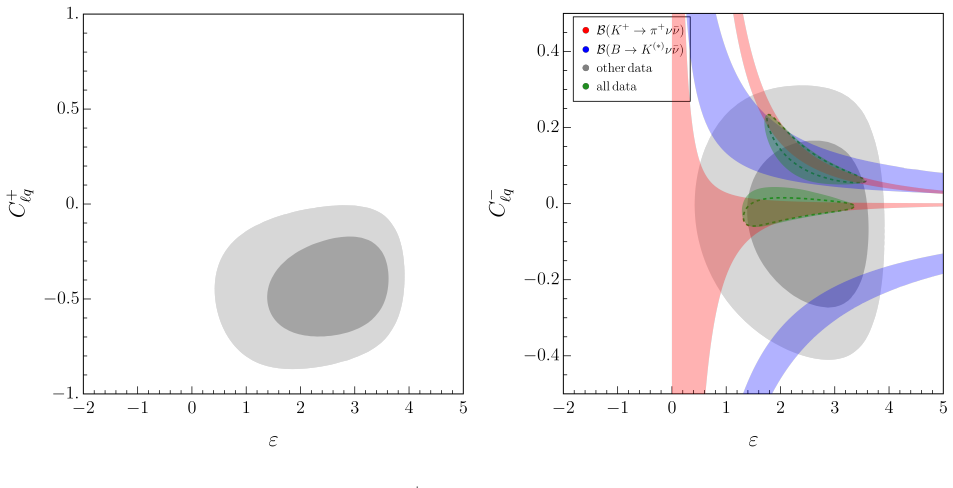
With the new NA62 branching fraction, modified-Z scenarios (MFV or Partial Compositeness) and a minimal U(2)^5 third-generation-dominance fit to semileptonic operators are both tightly constrained by the combination of kaon, B, electroweak and high-pT data; the latter scenario yields the concrete prediction that the ratio of normalised KL to K+ dineutrino rates is about 1.5 inside the preferred 68% region.
What carries the argument
Two effective setups carry the argument: flavour-violating shifts δgL,R in Z–down-quark couplings, scaled by MFV or Partial Compositeness; and SMEFT semileptonic operators Q±ℓq, QS controlled by a single real spurion Ṽ=−ε(Vtd,Vts) and Wilson coefficients C±ℓq that fix all light-generation insertions relative to the third generation.
Load-bearing premise
The clean, testable KL-to-K+ correlation assumes that one universal spurion and one real Wilson coefficient control every light-generation insertion, with no independent coefficients or misalignment.
What would settle it
A KOTO-II measurement of KL→π0νν̄ that finds the ratio of normalised branching fractions far from ∼1.5 while K+ stays near the Standard Model, or a Belle-II B→Kνν̄ rate lying outside the correlation bands predicted under either flavour hypothesis.
If this is right
- Under MFV modified-Z couplings, Bs→μμ remains the strongest FCNC bound and both kaon modes stay largely Standard-Model-like.
- Under Partial Compositeness, K+→π+νν̄ resolves a double solution for right-handed couplings; B→Kνν̄ pulls toward the Standard-Model-like branch.
- In the preferred U(2) lobe, K+ stays near the Standard Model by cancellation while larger effects remain allowed in B→Kνν̄ and a relative KL enhancement of ∼1.5 is predicted.
- Projected NA62 (15%), KOTO-II (25%) and Belle-II (8% on B→Kνν̄) precision can challenge the U(2) scenario if present central values hold.
- The implied effective scales are ≳8 TeV for modified-Z scenarios and ≳1.8 TeV for the semileptonic U(2) case.
Where Pith is reading between the lines
- A confirmed KL enhancement near the predicted factor would favour third-generation-dominated operators over pure modified-Z explanations that keep both kaon modes Standard-Model-like.
- The present Belle-II B→Kνν̄ central value lying above both scenarios’ preferred bands suggests either underestimated systematics or the need for non-minimal spurion misalignment.
- Because the U(2) effective scale sits near 2 TeV, high-pT mono-tau and di-tau tails at the HL-LHC remain directly complementary probes.
- Independent or complex spurion components would generically erase the fixed KL/K+ ratio, so a null result on that ratio would still leave less predictive variants viable.
Editorial analysis
A structured set of objections, weighed in public.
Referee Report
Summary. The authors reassess correlations between K→πνν̄ and B-physics FCNC observables in light of the new NA62 K+→π+νν̄ measurement, under two heavy-NP scenarios: (i) modified Z couplings to down-type quarks with MFV or Partial Compositeness flavour assumptions, and (ii) dimension-six semileptonic SMEFT operators with a U(2)^5 third-generation-dominance hypothesis, updating the global fit of Ref. [10] with the new NA62 result and an updated short-distance treatment of b→sμμ. For the Z scenario they present fits in the δg_L–δg_R plane including Z→bb̄, B_s→μμ, K→πνν̄ and B→Kνν̄, finding MFV is B_s-dominated while PC shows a double solution that B→Kνν̄ helps resolve. For the semileptonic scenario they derive explicit K+ and KL branching-ratio formulae (Eq. 4.3) and advertise a correlated enhancement of KL→π⁰νν̄ relative to K+→π+νν̄ by a factor ~1.5 in the preferred fit region, within the Grossman–Nir bound.
Significance. This is a timely and competent analysis of an important new experimental input. Strengths: the observable formulae as functions of the modified Z couplings are given explicitly in Appendix A, making the FCNC part reproducible; the semileptonic fit is built on the published, documented framework of [10] with the two updated inputs clearly identified; the KL→π⁰νν̄ implications are derived rather than postulated (Eq. 4.3), checked against the Grossman–Nir bound, and tied to concrete future sensitivities (NA62 15%, KOTO-II 25%, Belle II 8%), giving the scenarios genuinely falsifiable correlators. If the results hold, the paper usefully quantifies how the flavour hypothesis (MFV vs PC vs U(2)^5) changes which mode is the leading constraint, and provides the sharpest current statement of the K+/KL correlation in the third-generation-dominance framework. The impact is primarily as a precision-update and correlation study rather than a new framework, but that is appropriate for the scope.
major comments (2)
- [§3.2 and §4, Fig. 3.1 right panel, Eq. (4.4)] The advertised ratio ~1.5 is a property of only the upper lobe of the fit. The paper itself states (§3.2) that 'the two green lobes are equally allowed' at 68% C.L., and the lower lobe (ε∼0 or C−_ℓq∼0) predicts both kaon modes SM-like, i.e. ratio ~1. Selecting the upper lobe because it 'maximises the possible BSM effects' is a discretionary choice, and no Δχ² or likelihood ratio between the two branches is quoted. This matters for the central falsifiability claim: a SM-like KL→π⁰νν̄ measurement would not exclude the framework — it would select the lower branch — yet the conclusions call the KL rate 'a genuine prediction of the framework' and the three-mode combination 'a powerful test'. Please (i) quantify the relative likelihood of the two lobes (e.g. Δχ² between their best-fit points), (ii) state explicitly in §4, the abstract and the conclusions that the ~1.5 enhancement is conditiona
- [§3.1, Eq. (3.4); §4, Eq. (4.3)] The fixed KL/K+ correlation in Eq. (4.3) (coefficients 2.91 and 3.82) rests entirely on the minimal ansatz q³_L → q³_L + Ṽ_i q^i_L with a single universal real spurion and one coefficient C−_ℓq controlling all light-generation insertions. As the text itself notes (§3.1), generic U(2)_q breaking assigns an independent Wilson coefficient to each insertion, and a complex or misaligned Ṽ would break the correlation. The qualitative remark at the end of §4 (non-minimal breaking 'could be leveraged') does not quantify this. Please add a short statement of which features of Fig. 4.1 survive when the one- and two-insertion coefficients are allowed to differ within the fit bounds — for instance, the resulting range of the ratio in Eq. (4.4) — or point precisely to where this is established in Ref. [10]. This determines how much of the advertised signature is a prediction of U(2)^5 versus of the m
minor comments (6)
- [Appendix A.2, Eq. (A.15)] The experimental value B(K+→π+νν̄)_exp = 9.6^{+1.9}_{−1.8}×10⁻⁹ must be ×10⁻¹¹; as written it exceeds the SM prediction by two orders of magnitude and contradicts the statement in §1 that the result agrees with the SM.
- [§4, Eqs. (4.1)–(4.2)] The effective scales Λ^Z_eff ≳ 8 TeV and Λ^{U(2)}_eff ≳ 1.8 TeV are quoted without specifying the matching convention or which coefficient value at the fit boundary they correspond to. One sentence or an explicit formula (e.g. Λ_eff = v/√(δg or C·v²)) would make these numbers reproducible.
- [Fig. 4.1 caption vs. §4 text] Left-panel caption says the rates are shown 'as a function of the Wilson coefficient C−_lq', while the text correctly says the relevant combination is ε²C−_ℓq; the subscript also appears as both 'lq' and 'ℓq' in §4. Please align.
- [Figs. 2.2 and 2.3 captions] Captions say the regions are 'obtained by varying δg_L and δg_R around their best-fit values' without stating the confidence level or profiling procedure; please specify (e.g. 68% C.L. from the fit).
- [§4, paragraph on modified-Z KL predictions] 'we refrain from making any assumption about their size, and assume these couplings to be real' is internally contradictory phrasing; presumably the intended meaning is that Im δg²¹ is set to zero for the KL discussion while noting present constraints are weak.
- [Acknowledgments] Typo: 'suggesting this projects' → 'this project'.
Circularity Check
No load-bearing circularity: the KL/K+ ~1.5 correlation is a genuine model forecast from distinct coefficients, not a fit renamed as a prediction.
specific steps
-
self citation load bearing
[Sec. 3.1, framework paragraph; also ‘for the EFT expansion… we refer to Ref. [10]’]
"We now turn to the second scenario, closely following the analysis in Ref. [10]. … For all other inputs, as well as for the EFT expansion of the observables included in the fit, we refer to Ref. [10]."
The global-fit setup, operator basis, and low-energy expansions are imported wholesale from the authors’ own prior paper rather than re-derived. This is ordinary incremental work and is not used to forbid alternatives or to force the KL/K+ ratio; the new NA62 input and the distinct KL coefficients still supply independent content. Minor, non-load-bearing self-citation only.
full rationale
The paper’s two scenarios are standard EFT/flavour analyses. Modified-Z (MFV/PC) bounds are read off independent observables (Z→bb, Bs→μμ, K→πνν, B→Kνν) with explicit flavour scalings; nothing is defined in terms of its own output. In the U(2)^5 semileptonic fit the authors adopt an explicit minimal spurion ansatz (q3→q3+Ṽi qi) and fit C±ℓq, CS, ε to a broad dataset that includes the new NA62 K+ rate; they then evaluate the unmeasured KL mode. Equations (4.3) give different numerical coefficients for the two kaon modes (−2.91 vs −3.82 and the 2/3+1/3 CP structure), so the ratio ~1.5 inside the upper lobe is a nontrivial correlation of the model, not fixed by construction from the K+ input. Selecting the BSM-maximizing lobe is a discretionary phenomenological choice the text states openly; it is not a definitional reduction. Routine citation of the authors’ prior fit paper [10] for the EFT expansion and observable list is incremental, not a uniqueness theorem or self-justifying premise. Score 1 only for that minor self-citation of framework machinery; central claims remain independently constrained by external data.
Axiom & Free-Parameter Ledger
free parameters (4)
- δg_L, δg_R (MFV and PC normalisations) =
Best-fit regions shown in Fig. 2.1; no single central value quoted
- C^+_ℓq, C^−_ℓq (TeV^−2) =
Preferred regions in Fig. 3.1; CS consistent with zero
- ε (spurion magnitude) =
O(1); contours in Fig. 3.1
- C_S =
≈0
axioms (7)
- domain assumption NP effects in FCNCs can be parametrised by flavour-violating shifts δg^{ij}_{L,R} of the Z couplings to down quarks only, with lepton couplings fixed to SM values.
- domain assumption MFV scaling: δg^{ij}_L ∝ V*_{ti}V_{tj}, δg^{ij}_R ∝ (m_i m_j/m_b²)V*_{ti}V_{tj}.
- domain assumption Partial-Compositeness scaling: δg^{ij}_L ∝ |V_{ti}||V_{tj}|, δg^{ij}_R ∝ (m_i m_j/m_b²)/(|V_{ti}||V_{tj}|).
- domain assumption U(2)^5 flavour symmetry with NP couplings only to third-generation fields, broken solely by the quark spurion Ṽ=−ε(V_td,V_ts)^T.
- ad hoc to paper Minimal ansatz: every third-generation quark bilinear is replaced by the single combination q3+Ṽ_i q_i, so one Wilson coefficient controls all light-generation insertions.
- domain assumption All Wilson coefficients C^±_ℓq, C_S are real; down-aligned left-handed quark basis.
- ad hoc to paper Imaginary parts of δg^{21}_{L,R} are set to zero when discussing KL in the Z scenario.
read the original abstract
The new measurement of the $K^+\to\pi^+\nu\bar\nu$ branching ratio by the NA62 collaboration represents an important milestone in precision flavour physics. Under different flavour assumptions on beyond the standard model physics, this decay mode can be related to many other observables with underlying flavour-changing currents, such as $B\to K\nu\bar\nu$ or $B_s\to\mu\mu$, effectively providing an additional handle in our exploration of flavour-violating new physics effects. We study the impact of this new result, under the hypotheses that deviations from the standard model arise from modified $Z$ couplings, or from effects in semileptonic interactions. Finally, we review the implications of our scenarios for the yet to be measured partner mode $K_L\to\pi^0\nu\bar\nu$.
Figures



Reference graph
Works this paper leans on
-
[4]
Rare b decays meet high-mass Drell-Yan,
A. Greljo, J. Salko, A. Smolkoviˇ c, and P. Stangl, “Rare b decays meet high-mass Drell-Yan,”JHEP05(2023) 087,arXiv:2212.10497 [hep-ph]. [5]Belle-IICollaboration, I. Adachiet al., “Evidence for B+→K+νν¯decays,”Phys. Rev. D109no. 11, (2024) 112006,arXiv:2311.14647 [hep-ex]. [6]NA62Collaboration, S. Alibocuset al., “Measurement of the branching ratio of the...
Pith/arXiv arXiv 2023
-
[7]
Challenging Majorana neutrino effects inB→K (∗)ννandK→πννdecays,
A. Abada, C. Chevallier, L. P. S. Leal, A. Llaurad´ o, O. Sumensari, and R. Z. Funchal, “Challenging Majorana neutrino effects inB→K (∗)ννandK→πννdecays,” arXiv:2607.13142 [hep-ph]
-
[8]
Correlatedb→sands→dRare Semileptonic Transitions in the Standard Model Effective Field Theory,
N. Das, R. Mandal, and P. S. Patil, “Correlatedb→sands→dRare Semileptonic Transitions in the Standard Model Effective Field Theory,”arXiv:2605.23759 [hep-ph]
-
[9]
Discriminating tauphilic leptoquark explanations of the B anomalies via K→πνν¯and B→Kνν¯,
A. Crivellin, S. Iguro, and T. Kitahara, “Discriminating tauphilic leptoquark explanations of the B anomalies via K→πνν¯and B→Kνν¯,”Phys. Rev. D112no. 9, (2025) 095016,arXiv:2505.05552 [hep-ph]
arXiv 2025
-
[10]
Probing third-generation New Physics withK→πν¯νandB→K (∗)ν¯ν,
L. Allwicher, M. Bordone, G. Isidori, G. Piazza, and A. Stanzione, “Probing third-generation New Physics withK→πν¯νandB→K (∗)ν¯ν,”Phys. Lett. B861 (2025) 139295,arXiv:2410.21444 [hep-ph]
Pith/arXiv arXiv 2025
-
[11]
Disentangling new physics inK→πν νand B→K(K ∗)ν νobservables,
A. J. Buras, J. Harz, and M. A. Mojahed, “Disentangling new physics inK→πν νand B→K(K ∗)ν νobservables,”JHEP10(2024) 087,arXiv:2405.06742 [hep-ph]. 14
Pith/arXiv arXiv 2024
-
[12]
Implications ofB→Kν¯ν under rank-one flavor violation hypothesis,
D. Marzocca, M. Nardecchia, A. Stanzione, and C. Toni, “Implications ofB→Kν¯ν under rank-one flavor violation hypothesis,”Eur. Phys. J. C84no. 11, (2024) 1217, arXiv:2404.06533 [hep-ph]
Pith/arXiv arXiv 2024
-
[13]
From B-meson anomalies to Kaon physics with scalar leptoquarks,
D. Marzocca, S. Trifinopoulos, and E. Venturini, “From B-meson anomalies to Kaon physics with scalar leptoquarks,”Eur. Phys. J. C82no. 4, (2022) 320, arXiv:2106.15630 [hep-ph]
Pith/arXiv arXiv 2022
-
[14]
Minimal flavor violation: An Effective field theory approach,
G. D’Ambrosio, G. F. Giudice, G. Isidori, and A. Strumia, “Minimal flavor violation: An Effective field theory approach,”Nucl. Phys. B645(2002) 155–187, arXiv:hep-ph/0207036
Pith/arXiv arXiv 2002
-
[15]
Bulk fields and supersymmetry in a slice of AdS,
T. Gherghetta and A. Pomarol, “Bulk fields and supersymmetry in a slice of AdS,”Nucl. Phys. B586(2000) 141–162,arXiv:hep-ph/0003129
Pith/arXiv arXiv 2000
-
[16]
Flavor structure of warped extra dimension models,
K. Agashe, G. Perez, and A. Soni, “Flavor structure of warped extra dimension models,” Phys. Rev. D71(2005) 016002,arXiv:hep-ph/0408134
Pith/arXiv arXiv 2005
-
[17]
Warped/composite phenomenology simplified,
R. Contino, T. Kramer, M. Son, and R. Sundrum, “Warped/composite phenomenology simplified,”JHEP05(2007) 074,arXiv:hep-ph/0612180
Pith/arXiv arXiv 2007
-
[18]
Solving the flavour problem with hierarchical fermion wave functions,
S. Davidson, G. Isidori, and S. Uhlig, “Solving the flavour problem with hierarchical fermion wave functions,”Phys. Lett. B663(2008) 73–79,arXiv:0711.3376 [hep-ph]
Pith/arXiv arXiv 2008
-
[19]
On Partial Compositeness and the CP asymmetry in charm decays,
B. Keren-Zur, P. Lodone, M. Nardecchia, D. Pappadopulo, R. Rattazzi, and L. Vecchi, “On Partial Compositeness and the CP asymmetry in charm decays,”Nucl. Phys. B867 (2013) 394–428,arXiv:1205.5803 [hep-ph]
Pith/arXiv arXiv 2013
-
[20]
U(2) and Minimal Flavour Violation in Supersymmetry,
R. Barbieri, G. Isidori, J. Jones-Perez, P. Lodone, and D. M. Straub, “U(2) and Minimal Flavour Violation in Supersymmetry,”Eur. Phys. J. C71(2011) 1725, arXiv:1105.2296 [hep-ph]
Pith/arXiv arXiv 2011
-
[21]
Flavor non-universal vector leptoquark imprints in K→πνν¯and ∆F=2 transitions,
`O. L. Crosas, G. Isidori, J. M. Lizana, N. Selimovic, and B. A. Stefanek, “Flavor non-universal vector leptoquark imprints in K→πνν¯and ∆F=2 transitions,”Phys. Lett. B835(2022) 137525,arXiv:2207.00018 [hep-ph]
Pith/arXiv arXiv 2022
-
[22]
B(B s →µ +µ−) as an electroweak precision test,
D. Guadagnoli and G. Isidori, “B(B s →µ +µ−) as an electroweak precision test,”Phys. Lett. B724(2013) 63–67,arXiv:1302.3909 [hep-ph]. [23]ATLAS, Belle-II, CMS, LHCbCollaboration, “Projections for Key Measurements in Heavy Flavour Physics,”arXiv:2503.24346 [hep-ex]
Pith/arXiv arXiv 2013
-
[24]
Dimension-Six Terms in the Standard Model Lagrangian,
B. Grzadkowski, M. Iskrzynski, M. Misiak, and J. Rosiek, “Dimension-Six Terms in the Standard Model Lagrangian,”JHEP10(2010) 085,arXiv:1008.4884 [hep-ph]
Pith/arXiv arXiv 2010
-
[25]
HighPT: A tool for high-p T Drell-Yan tails beyond the standard model,
L. Allwicher, D. A. Faroughy, F. Jaffredo, O. Sumensari, and F. Wilsch, “HighPT: A tool for high-p T Drell-Yan tails beyond the standard model,”Comput. Phys. Commun. 289(2023) 108749,arXiv:2207.10756 [hep-ph]. [26]Heavy Flavor Averaging Group (HFLA V)Collaboration, S. Banerjeeet al., “Averages ofb-hadron,c-hadron, andτ-lepton properties as of 2023,”Phys. ...
Pith/arXiv arXiv 2023
-
[28]
J. Aebischer, M. Fael, C. Greub, and J. Virto, “B physics Beyond the Standard Model at One Loop: Complete Renormalization Group Evolution below the Electroweak Scale,” JHEP09(2017) 158,arXiv:1704.06639 [hep-ph]
Pith/arXiv arXiv 2017
-
[29]
A. Crivellin, C. Greub, D. M¨ uller, and F. Saturnino, “Importance of Loop Effects in Explaining the Accumulated Evidence for New Physics in B Decays with a Vector Leptoquark,”Phys. Rev. Lett.122no. 1, (2019) 011805,arXiv:1807.02068 [hep-ph]
Pith/arXiv arXiv 2019
-
[30]
Confronting the vector leptoquark hypothesis with new low- and high-energy data,
J. Aebischer, G. Isidori, M. Pesut, B. A. Stefanek, and F. Wilsch, “Confronting the vector leptoquark hypothesis with new low- and high-energy data,”Eur. Phys. J. C83 no. 2, (2023) 153,arXiv:2210.13422 [hep-ph]
Pith/arXiv arXiv 2023
-
[31]
Disentangling short- vs. long-distance dynamics inB→K ∗µ+µ−,
M. Bordone, G. Isidori, and A. Tinari, “Disentangling short- vs. long-distance dynamics inB→K ∗µ+µ−,”arXiv:2607.09458 [hep-ph]
-
[32]
L. G¨ artner, N. Hartmann, L. Heinrich, M. Horstmann, T. Kuhr, M. Reboud, S. Stefkova, and D. van Dyk, “Constructing model-agnostic likelihoods, a method for the reinterpretation of particle physics results,”Eur. Phys. J. C84no. 7, (2024) 693, arXiv:2402.08417 [hep-ph]
Pith/arXiv arXiv 2024
-
[33]
Constraints on lepton-flavor mixing with third-generation new physics,
S. Covone, P. Morell, and A. Tinari, “Constraints on lepton-flavor mixing with third-generation new physics,”Phys. Lett. B879(2026) 140582,arXiv:2511.15800 [hep-ph]
Pith/arXiv arXiv 2026
-
[34]
K(L) —>pi0 neutrino anti-neutrino beyond the standard model,
Y. Grossman and Y. Nir, “K(L) —>pi0 neutrino anti-neutrino beyond the standard model,”Phys. Lett. B398(1997) 163–168,arXiv:hep-ph/9701313. [35]KOTOCollaboration, J. K. Ahnet al., “Search for the KL→π0νν¯Decay at the J-PARC KOTO Experiment,”Phys. Rev. Lett.134no. 8, (2025) 081802, arXiv:2411.11237 [hep-ex]
Pith/arXiv arXiv 1997
-
[36]
Enhanced electromagnetic correction to the rare B-meson decayB s,d →µ +µ−,
M. Beneke, C. Bobeth, and R. Szafron, “Enhanced electromagnetic correction to the rare B-meson decayB s,d →µ +µ−,”Phys. Rev. Lett.120no. 1, (2018) 011801, arXiv:1708.09152 [hep-ph]
Pith/arXiv arXiv 2018
-
[37]
Power-enhanced leading-logarithmic QED corrections toB q →µ +µ−,
M. Beneke, C. Bobeth, and R. Szafron, “Power-enhanced leading-logarithmic QED corrections toB q →µ +µ−,”JHEP10(2019) 232,arXiv:1908.07011 [hep-ph]. [Erratum: JHEP 11, 099 (2022)]
Pith/arXiv arXiv 2019
-
[38]
RevisitingB→K (∗)ν¯νdecays in the Standard Model and beyond,
D. Beˇ cirevi´ c, G. Piazza, and O. Sumensari, “RevisitingB→K (∗)ν¯νdecays in the Standard Model and beyond,”Eur. Phys. J. C83no. 3, (2023) 252,arXiv:2301.06990 [hep-ph]. 16
Pith/arXiv arXiv 2023
discussion (0)
Sign in with ORCID, Apple, or X to comment. Anyone can read and Pith papers without signing in.