REVIEW 4 major objections 5 minor 19 references
Evaluation of Headway Threshold-based Coordinated Platooning over a Cascade of Highway Junctions
T0 review · 4 major / 5 minor · reviewed 2026-08-14 · deepseek-v4-flash
Pith's one-line read This paper claims that threshold-based coordinated platooning over a cascade of highway junctions cuts total fuel consumption only when the downstream cruising distance is long enough, and that the optimal headway threshold is often an…
desk verdict A plausible system-level SUMO evaluation of threshold-based platooning on a real I-210 corridor, but the predicted fuel savings hinge on an unverified assumption that platoons form instantly and persist after each merge. read the letter →
The pith
A machine-rendered reading of the paper's core claim, the machinery that carries it, and where it could break.
The reading
What carries the argument
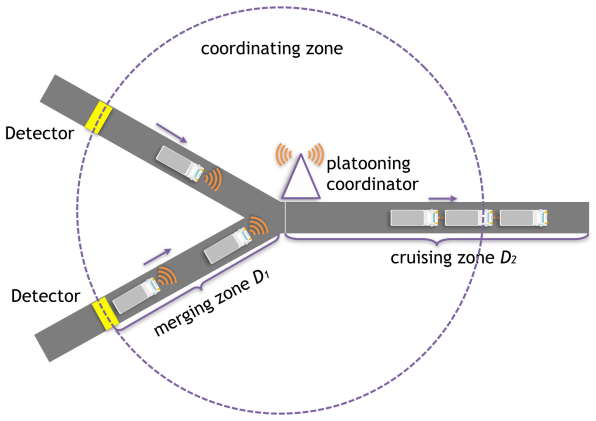
The load-bearing object is the incremental-fuel equation (Eq. (6)): $\Delta TC^k = \Delta F_1^k + \Delta F_2^k$, where $\Delta F_1^k$ is the extra fuel consumed when the follower traverses the coordination zone of length $D_1$ at catch-up speed $V_f = D_1/(D_1/V_0 - (t_f^0 - t_l^0))$ instead of the nominal speed $V_0$, and $\Delta F_2^k = -\eta\theta D_2$ is a drag-saving credit proportional to downstream cruise distance, with saving fraction $\eta$ and fuel efficiency $\theta$. The upper-level rule is a headway threshold: if the estimated arrival-time gap between leader and follower is below $r$, the follower is instructed to arrive at the junction at the leader's time. The equation makes the trade-off explicit because the acceleration penalty is convex in the required speed-up and independent of what happens after the junction, while the benefit accumulates linearly with $D_2$. This additive form is what lets the paper attribute the shape of the fuel-versus-threshold curves to the $D_2/D_1$ balance.
What would settle it
Run the same two-junction simulation with $D_2 = 1000$ m after the downstream junction and sweep thresholds from 5 s to 25 s: if the fuel curve is monotone rather than U-shaped, the claimed interior optimum is absent. Alternatively, instrument actual merges to measure the drag-saving fraction as a function of the achieved inter-vehicle gap; if the saving does not grow linearly with $D_2$, the linear credit term in Eq. (6) fails.
Extended reading notes
Core claim
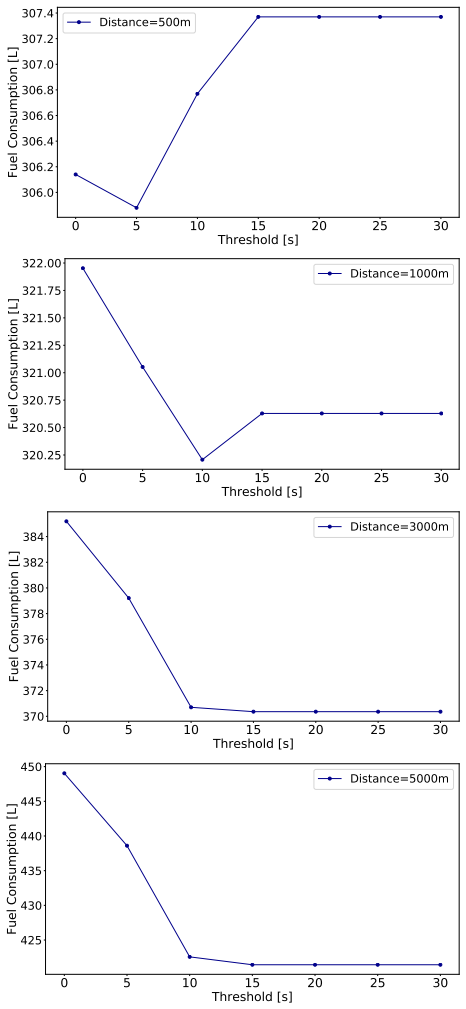
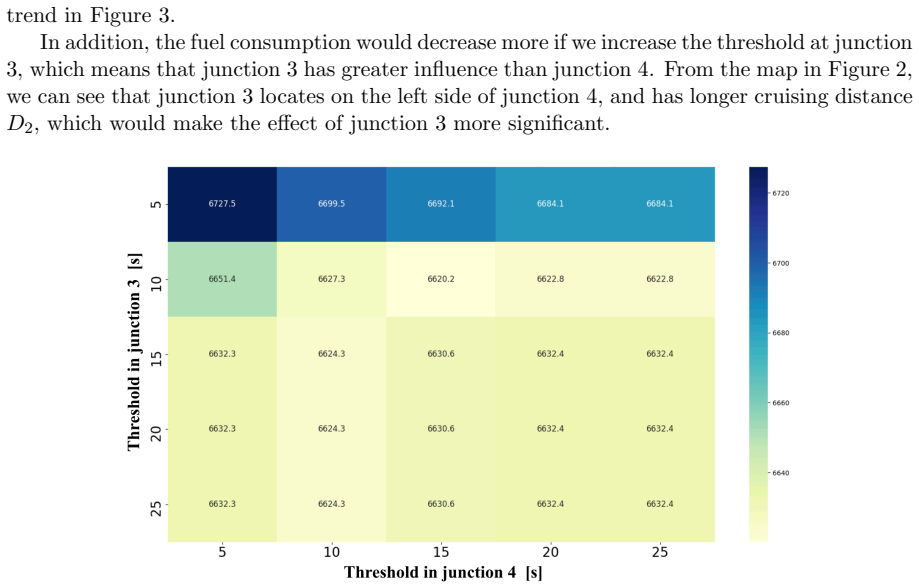
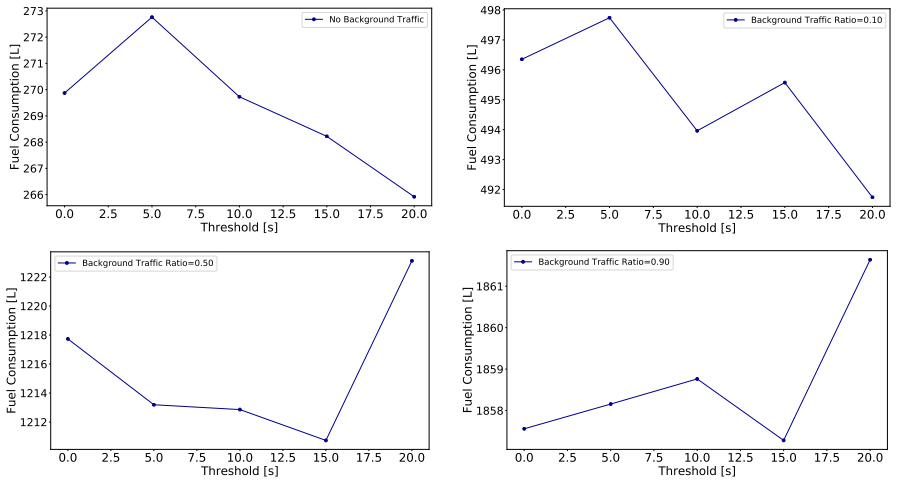
On its own terms, the paper establishes that a simple threshold-based coordination policy for platooning over a cascade of highway junctions has a system-level fuel trade-off governed by the ratio of coordination distance to cruising distance. The incremental fuel cost of one coordinated merge is the extra fuel burned while the follower traverses the coordination zone $D_1$ at the catch-up speed needed to meet the leader, minus $\eta \theta D_2$, the fuel saved by cruising in the platoon's wake over the downstream distance $D_2$. Total fuel consumption therefore falls with the headway threshold only when $D_2$ is large enough for drag savings to dominate; at an intermediate $D_2$ the fuel-versus-threshold curve is U-shaped with a finite optimal threshold; and in a two-junction cascade the system-wide minimum occurs at 10 s at one junction and 15 s at the other, not at the largest threshold. The paper also reports that lengthening the detector distance $D_1$, raising the connected-vehicle share, and coordinating over longer downstream cruises all improve fuel outcome, while heavy background traffic can turn the benefit into a loss.
Load-bearing premise
The fuel savings over $D_2$ assume that after each junction the merging vehicles actually form and maintain a close-formation platoon with a fixed drag-saving fraction (eta) for the entire post-junction distance, and the paper states that the lower-level merging process is not studied in detail.
Editorial extensions
If this is right
- For short post-junction cruises (for instance $D_2 = 500$ m), any positive platooning threshold increases total fuel, so the coordination system should disable platooning or use a very small threshold there.
- At an intermediate cruise distance ($D_2 = 1000$ m), the fuel-versus-threshold curve is U-shaped, so an aggressive 'larger threshold is always better' policy is suboptimal and a finite optimal threshold exists.
- Increasing the detector distance $D_1$ from 500 m to 1500 m reduces total fuel, meaning earlier coordination is worth the extra communication and control effort.
- Raising the connected-vehicle share from 5% to 20% reduces per-vehicle fuel consumption, quantifying the system-level benefit of higher CAV penetration.
- In a multi-junction network, upstream junctions with longer downstream cruising distances dominate the fuel outcome, so heterogeneous thresholds tuned per junction can beat a single aggressive setting.
Reading between the lines
- Extending the paper's logic, the optimal threshold should be re-tuned as the origin-destination demand pattern shifts by time of day, because the effective downstream cruise distance at each junction changes with where vehicles exit.
- The fixed drag-saving fraction $\eta$ is the main simplification; measuring how $\eta$ varies with achieved platoon spacing would show whether the interior optimum shifts or disappears under realistic merging.
- The two-junction minimum suggests a network-level optimization problem in which the best threshold at an upstream junction depends on downstream demand; a decentralized rule may need upstream demand information.
- Equation (6) could be turned into a closed-form per-junction optimal-threshold rule by balancing the marginal acceleration cost against $\eta\theta$ per unit of $D_2$, replacing simulation sweeps with an analytic design formula.
Signed reviews
Editorial analysis
A structured set of objections, weighed in public.
Referee Report
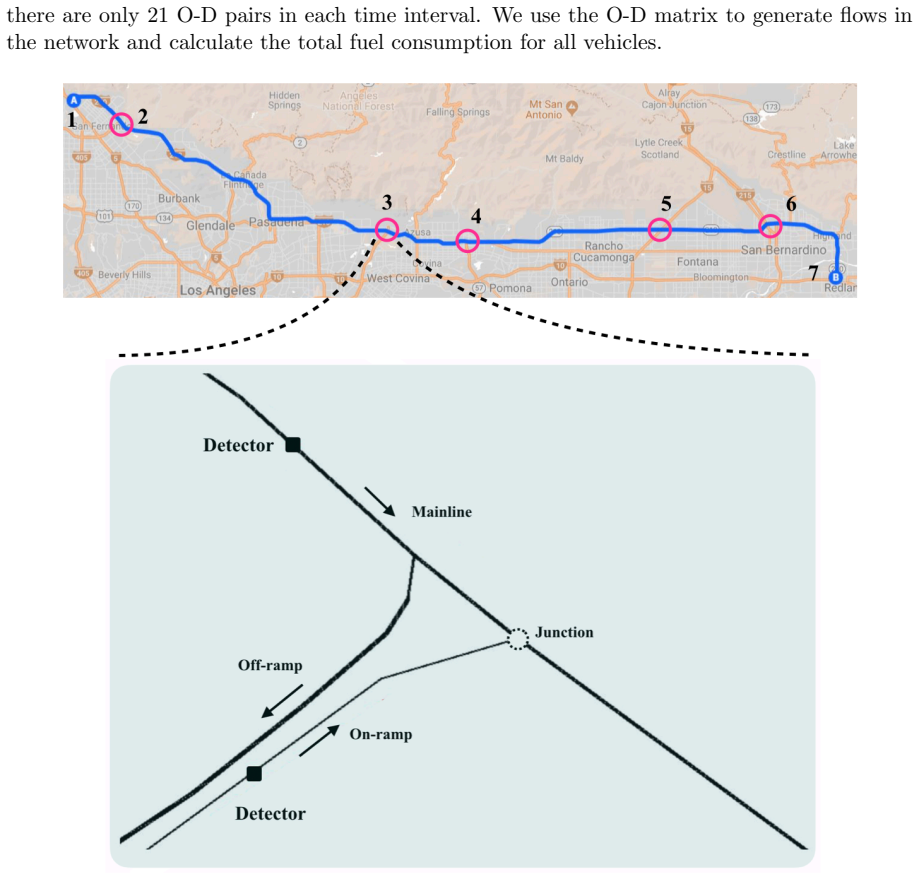
Summary. The paper proposes a two-layer hierarchical control framework for coordinated platooning at highway junctions: an upper layer decides, from detector headways, whether a following vehicle should accelerate to meet a leading vehicle at a junction, and a lower layer handles the actual merging and platooning. The upper-layer decision is threshold-based, and the authors evaluate it in SUMO using a five-junction network calibrated with PeMS data from I-210. The reported results are: at a single junction, a larger threshold increases fuel consumption for short post-junction cruising distances and decreases it for long distances, with an interior optimum near D2 = 1000 m; in a five-junction network, larger thresholds reduce fuel and longer coordination distances D1 reduce fuel; heterogeneous thresholds at two junctions yield a minimum at intermediate thresholds (10 s and 15 s), not at the largest thresholds; and background traffic changes these trends. The paper attributes the trade-off to an acceleration penalty in the coordination zone versus a drag-reduction saving over the cruising distance, summarized analytically in Eq. (6).
Significance. If the qualitative conclusions hold, the paper provides a useful system-level insight: threshold-based platooning coordination can be fuel-positive only when the post-junction cruising distance is sufficiently long, and interactions between multiple junctions can create interior optima in the threshold choice. The main strengths are the use of real PeMS demand data, an independent SUMO testbed rather than a purely analytic model, and systematic parameter sweeps over D1, D2, threshold, connected-vehicle ratio, and background-traffic ratio. The fuel curves are not produced by fitting the model parameters, so there is no circularity in that sense. However, the analytical support in Eq. (6) is incomplete, the optimal-threshold statement is not backed by a documented calculation, and the platoon-formation assumption underlying the savings term is not validated, so the quantitative conclusions should be treated as preliminary.
major comments (4)
- [§2.3, Eq. (6)] Equation (6), which is used to explain the trade-off between coordination and cruising, drops the acceleration-dependent terms c1 v a + c2 v a^2 from the SUMO fuel model in Eq. (5) on the ground that acceleration is small, even though the maneuver being modeled is precisely an acceleration from V0 to Vf. Moreover, the constant term c0 is also dropped, and it does not cancel because the traverse times s_kf and s_k0 differ. As written, Eq. (6) is not the fuel penalty of a catch-up maneuver and cannot support the statement that ΔF1 increases fuel due to acceleration. The simulation results may still be correct, but the analytic model needs to be corrected or the analytic claim restricted.
- [§3.2, paragraph after Figure 3] The sentence 'The optimal threshold can be calculated using the function in Equation 6' is not supported by any calculation in the paper. Since the threshold r acts as a selection rule over a stochastic set of arrival-time differences, an optimization requires a model of the arrival process and a definition of the objective over all vehicles; neither is given. Please either provide the derivation, state the numerical value of the optimal threshold, or remove/soften the claim.
- [§2.2–§2.3] The savings term −ηθD2 in Eq. (6) is credited from the junction onward for every vehicle selected by the threshold, but the paper explicitly states that the lower-level merging layer is not studied in detail. If close-formation platooning is not established immediately at the junction (finite merge distance d_m), is not established at all (e.g., because the speed limit in Eq. (4) prevents catch-up), or is broken by downstream traffic, the effective saving is ηθ(D2−d_m) or pηθD2 with p<1. For D2=500 m and 1000 m, the cases used to exhibit an interior optimum, even a small merge distance or failure probability can reverse the sign. A sensitivity analysis on η, merge success probability, and spacing dynamics is needed, or the qualitative conclusions should be restricted to an idealized setting.
- [Figures 3–6] All fuel-consumption curves are reported as single traces without error bars, confidence intervals, or a statement about the number of simulation replications. Several qualitative claims, including the existence of an interior minimum in the D2=1000 m panel of Figure 3 and the 'unstable' trend in Figure 6 (background ratio 0.10), are based on changes of less than 1% on the vertical axis. Please report multiple random seeds or explain why the simulation is deterministic, and quantify the uncertainty before drawing conclusions about optimal thresholds.
minor comments (5)
- [§2.3] The quantity θ is defined as 'fuel efficiency (a ratio of distance traveled per unit of fuel consumed, L/km)', but L/km is fuel consumption per distance, not efficiency; please fix the units and sign convention.
- [§1 and §2.1] 'Longitude and latitude control' should be 'longitudinal and lateral control'.
- [§3.3, Figure 4(b) and surrounding text] The explanation that 'we multiply the total fuel consumption by the ratio' is unclear; specify whether the plotted quantity is per-CAV fuel consumption, total normalized fuel, or something else.
- [§4] Reducing the simulation time from 3 hours to 1000 s for the background-traffic cases may make the plotted totals not comparable across figures; state the modeled time horizon in each figure and any warm-up period.
- [Throughout] There are several typographical errors, including 'hetergeneous' in the Section 3 heading, 'curing distance' in §3.2, and inconsistent use of 'off-ramp' and 'off-ramp'; a careful proofread is needed.
Circularity Check
No load-bearing circularity: Eq. (6) is an explicit model assumption with externally sourced parameters, and the SUMO simulation is an independent testbed; only a minor self-citation in the framing remains.
full rationale
The derivation chain is self-contained. Section 2.3 obtains Eq. (6) by combining SUMO's fuel-rate function (Eq. 5), the kinematics of the threshold coordination rule (Eqs. 1-4), and the externally sourced drag-saving fraction eta from Larson et al. [7]; the acceleration penalty and the cruising saving are not fitted to the fuel curves they explain. The simulation in Section 3 uses PeMS O-D counts as exogenous demand and sweeps the threshold r, so the qualitative behavior in Figs. 3-5 is an evaluation of the model rather than a restatement of a fitted parameter. The only low-signal item is the paper's contribution (iii), which says it validates 'the theoretical results in a related work [8]' where [8] is an earlier paper by two of the same authors; however, no theorem or parameter from [8] is used to construct Eq. (6) or the SUMO testbed, so this self-citation is framing rather than load-bearing. The caveat that lower-level merging is not explicitly modeled affects the realism of the D2 savings, but it is a modeling assumption, not a circular reduction.
Assumptions & free parameters
free parameters (4)
- eta (drag-saving fraction) =
0.05 to 0.15
- V0 (average coordination-zone speed) =
Not specified numerically
- Heavy-duty vehicle demand fraction =
0.1
- Catch-up speed limit =
40 mph
assumptions (6)
- domain assumption Average speed V0 is constant, so junction arrival time is detector time plus D1/V0.
- domain assumption Acceleration during coordination is small, so fuel terms proportional to acceleration are dropped.
- domain assumption Once formed, a platoon saves a fixed fraction eta of fuel over the whole cruising distance D2.
- domain assumption Platoon formation at a junction is determined solely by the headway threshold, with no merge safety or capacity constraints.
- domain assumption The O-D demand matrix can be reconstructed from link counts by assuming off-ramp exit fractions apply to all origins.
- domain assumption SUMO micro-simulation faithfully represents traffic dynamics and fuel consumption.
Cite this review
Pith. "Pith review of Evaluation of Headway Threshold-based Coordinated Platooning over a Cascade of Highway Junctions." pith.science (2026). https://pith.science/paper/DFW72JAL
@misc{pith2026190802405,
  author       = {Pith},
  title        = {Pith review of: Evaluation of Headway Threshold-based Coordinated Platooning over a Cascade of Highway Junctions},
  year         = {2026},
  howpublished = {\url{https://pith.science/paper/DFW72JAL}},
  note         = {Machine review of arXiv:1908.02405}
}
read the original abstract
Platooning of vehicles with coordinated adaptive cruise control (CACC) capabilities is a promising technology with a strong potential for fuel savings and congestion mitigation. Although some researchers have studied the vehicle-level fuel savings of platooning, few have considered the system-level benefits. This paper evaluates vehicle platooning as a fuel-reduction method and propose a hierarchical control system. We particularly focus on the impact of platooning coordination algorithm on system-wide benefits. The main task of platooning coordination is to regulate the times at which multiple vehicles arrive at a particular junction: these vehicles can platoon only if they meet (i.e. arrive within a common time interval) at the junction. We use a micro-simulation model to evaluate a class of threshold-based coordination strategies and derive insights about the trade-off between the fuel savings due to air drag reduction in platoons and the extra fuel consumption due to the coordination (i.e. acceleration of some vehicles to catch up with the leading ones). The model is calibrated using real traffic data of a section of Interstate 210 in the Los Angeles metropolitan area. We study the relation between key decision variables, including the platooning threshold and the coordination radius, and key performance metric, fuel consumption.
Figures
Figures from the paper (3 more)

Reference graph
Works this paper leans on
-
[1]
Control design of an automated highway system,
R. Horowitz and P. Varaiya, “Control design of an automated highway system,”Proceedings of the IEEE , vol. 88, no. 7, pp. 913–925, 2000
work page 2000
-
[2]
Cyber-physical control of road freight transport,
B. Besselink, V. Turri, S. van de Hoef, K.-Y. Liang, A. Alam, J. M˚ artensson, and K. H. Johansson, “Cyber-physical control of road freight transport,” Proceedings of IEEE , vol. 104, no. 5, pp. 1128–1141, 2016. 13
work page 2016
-
[3]
Influence of connected and autonomous vehicles on traffic flow stability and throughput,
A. Talebpour and H. S. Mahmassani, “Influence of connected and autonomous vehicles on traffic flow stability and throughput,” Transportation Research Part C: Emerging Technolo- gies, vol. 71, pp. 143–163, 2016
work page 2016
-
[4]
A review of truck platooning projects for energy savings,
S. Tsugawa, S. Jeschke, and S. E. Shladover, “A review of truck platooning projects for energy savings,” IEEE Transactions on Intelligent Vehicles , vol. 1, no. 1, pp. 68–77, 2016
work page 2016
-
[5]
Litman, Autonomous vehicle implementation predictions
T. Litman, Autonomous vehicle implementation predictions . Victoria Transport Policy Institute Victoria, Canada, 2017
2017
-
[6]
Smart cars on smart roads: Problems of control,
P. Varaiya, “Smart cars on smart roads: Problems of control,” IEEE Transactions on Automatic Control, vol. 38, no. 2, pp. 195–207, 1993
work page 1993
-
[7]
A distributed framework for coordinated heavy-duty vehicle platooning
J. Larson, K.-Y. Liang, and K. H. Johansson, “A distributed framework for coordinated heavy-duty vehicle platooning.” IEEE Trans. Intelligent Transportation Systems , vol. 16, no. 1, pp. 419–429, 2015
work page 2015
-
[8]
Analysis of a Stochastic Model for Coordinated Platooning of Heavy-duty Vehicles
X. Xiong, E. Xiao, and L. Jin, “Analysis of a stochastic model for coordinated platooning of heavy-duty vehicles,” arXiv preprint arXiv:1903.06741 , 2019
work page Pith review arXiv 1903
Show all 19 references
-
[9]
String-stable CACC design and experimental validation: A frequency-domain approach,
G. J. L. Naus, R. P. A. Vugts, J. Ploeg, M. J. G. van de Molengraft, and M. Steinbuch, “String-stable CACC design and experimental validation: A frequency-domain approach,” IEEE Transactions on Vehicular Technology , vol. 59, no. 9, pp. 4268–4279, 2010
2010
-
[10]
A dissipativity approach to safety verification for interconnected systems,
S. Coogan and M. Arcak, “A dissipativity approach to safety verification for interconnected systems,” IEEE Transactions on Automatic Control , vol. 60, no. 6, pp. 1722–1727, 2015
2015
-
[11]
Data-driven adaptive optimal control of connected vehicles,
W. Gao, Z.-P. Jiang, and K. Ozbay, “Data-driven adaptive optimal control of connected vehicles,” IEEE Transactions on Intelligent Transportation Systems , vol. 18, no. 5, pp. 1122–1133, 2017
2017
-
[12]
String stability and a delay-based spacing policy for vehicle platoons subject to disturbances,
B. Besselink and K. H. Johansson, “String stability and a delay-based spacing policy for vehicle platoons subject to disturbances,” IEEE Transactions on Automatic Control, vol. 62, no. 9, pp. 4376–4391, 2017
2017
-
[13]
Plug and play distributed model predictive control for heavy duty vehicle platooning and interaction with passenger vehicles,
H. Hu, Y. Pu, M. Chen, and C. J. Tomlin, “Plug and play distributed model predictive control for heavy duty vehicle platooning and interaction with passenger vehicles,” in 2018 IEEE Conference on Decision and Control (CDC) . IEEE, 2018, pp. 2803–2809
2018
-
[14]
Fuel-efficient en route formation of truck platoons,
S. van de Hoef, K. H. Johansson, and D. V. Dimarogonas, “Fuel-efficient en route formation of truck platoons,” IEEE Transactions on Intelligent Transportation Systems , vol. 19, no. 1, pp. 102–112, 2018
2018
-
[15]
Modeling the impact of vehicle platooning on highway congestion: A fluid queuing approach,
L. Jin, M. ˇCiˇ ciˇ c, S. Amin, and K. H. Johansson, “Modeling the impact of vehicle platooning on highway congestion: A fluid queuing approach,” in Proceedings of the 21st International Conference on Hybrid Systems: Computation and Control (part of CPS Week) . ACM, 2018, pp. 237–246
2018
-
[16]
Stop-and-go wave dissipation using accumulated controlled moving bottlenecks in multi-class ctm framework,
M. ˇCiˇ ci´ c and K. H. Johansson, “Stop-and-go wave dissipation using accumulated controlled moving bottlenecks in multi-class ctm framework,” in Control and Decision Conference (ECC), Nice, France, 2019. 14
2019
-
[17]
Coordinating vehicle platoons for highway bottle- neck decongestion and throughput improvement,
M. ˇCiˇ ci´ c, L. Jin, and K. H. Johansson, “Coordinating vehicle platoons for highway bottle- neck decongestion and throughput improvement,” arXiv preprint arXiv:1907.13049 , 2019
1907 arXiv
-
[18]
Sumo (simulation of urban mobility)-an open-source traffic simulation,
D. Krajzewicz, G. Hertkorn, C. R¨ ossel, and P. Wagner, “Sumo (simulation of urban mobility)-an open-source traffic simulation,” in Proceedings of the 4th middle East Sym- posium on Simulation and Modelling (MESM20002) , 2002, pp. 183–187
2002
-
[19]
Freeway performance measurement system (pems), pems 7.0,
P. P. Varaiya, “Freeway performance measurement system (pems), pems 7.0,” Tech. Rep., 2007. 15
2007
Reviewed August 14, 2026 · model on record in the stance chip above.
Discussion (0). Continue with ORCID to comment.