REVIEW 4 major objections 5 minor 23 references
Repetitive Reprediction Deep Decipher for Semi-Supervised Learning
T0 review · 4 major / 5 minor · reviewed 2026-08-14 · deepseek-v4-flash
Pith's one-line read The paper proves that, in its deep decipher framework, pseudo-labels converge to an exponential function of network predictions, and shows that repetitive reprediction built on this result reaches 41.55% top-1 error on ImageNet with only…
desk verdict Strong ImageNet numbers and a clean end-to-end pseudo-label framework, but the paper's core exponential-link theorem is unproven and inconsistent with its own pseudo-label update; let the empirical result stand on its own. read the letter →
The pith
A machine-rendered reading of the paper's core claim, the machinery that carries it, and where it could break.
The reading
What carries the argument
The exponential link function of Theorem 1, $\tilde{p}_n \to \exp(-\mathcal{L}/\alpha)(\hat{p}_n)^{(1-\beta)/\alpha}$, is the load-bearing identity. It is obtained by differentiating the D2 loss with respect to the last-layer weight $\mathbf{w}_n$, requiring the gradient to vanish at convergence, and solving for $\tilde{p}_n$; the softmax structure of $\hat{p}$ and the nonzero-feature assumption make the division by $\hat{p}_n$ legal. This identity carries the argument because it both justifies prediction-based pseudo-labels and, through the inequality in Theorem 2, predicts the flattening problem that R2 fixes.
What would settle it
Train the base D2 variant on CIFAR-10 with 4000 labeled images, stop at the end of the second stage, and for each unlabeled sample plot $\log \tilde{p}_n$ against $\log \hat{p}_n$; if the points do not lie on a line with slope $(1-\beta)/\alpha$ and intercept $-\mathcal{L}/\alpha$, the claimed exponential link is not what the optimization produces.
Extended reading notes
Core claim
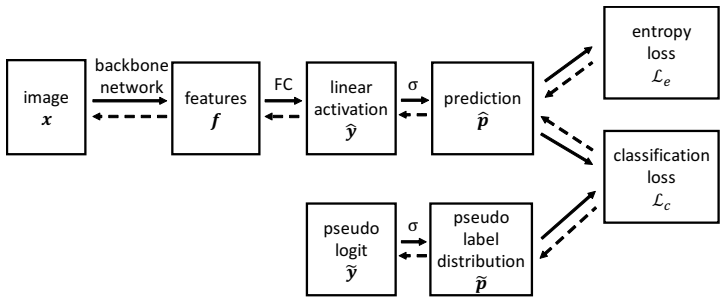
Within the D2 framework, pseudo-labels are not hand-designed targets but trainable variables: each unlabeled image carries a pseudo-logit $\tilde{y}$, converted to a pseudo-label distribution $\tilde{p} = \sigma(\tilde{y})$ by softmax, and updated by gradient descent on $\mathcal{L} = \alpha\,\mathrm{KL}(\hat{p}\,\|\,\tilde{p}) + \beta\,H(\hat{p})$, where $\hat{p}$ is the network's softmax prediction. Theorem 1 states that after SGD converges, the pseudo-label value for the class $n$ with the largest prediction satisfies $\tilde{p}_n \to \exp(-\mathcal{L}/\alpha)(\hat{p}_n)^{(1-\beta)/\alpha}$. The paper interprets this as the theoretical justification for using predictions as pseudo-labels. Theorem 2 then shows that under this relation $\tilde{p}_n \le \hat{p}_n$, so D2-trained pseudo-labels are flatter than the network's own predictions, and the paper further shows that $\sum_i \tilde{y}_i$ is invariant under the update, creating a bias. Repetitive reprediction re-initializes $\tilde{y}$ from the current prediction every 75 epochs and reduces the learning rate, and the ablated comparisons attribute the resulting gains to these two corrections.
Load-bearing premise
The proof requires that training reaches a true stopping point where the network's last-layer weights stop changing, and that the most confident prediction for each image never drops to zero; if either fails, the exponential link between pseudo-label and prediction is not guaranteed.
Editorial extensions
If this is right
- Because pseudo-labels under D2 are exponentially linked to predictions, the longstanding practice of using network predictions as pseudo-labels becomes a derived consequence rather than an ad-hoc choice.
- Theorem 2 implies pseudo-labels trained with the D2 loss are systematically flatter than the network's predictions, so periodic re-initialization (R2) is not a heuristic ornament but a corrective for a proven bias.
- The invariance of the sum of pseudo-logits identifies a concrete equality-constraint bias; any variant of D2 must either break this invariance or periodically reset pseudo-logits.
- R2-D2's 41.55% top-1 error on ImageNet is about 5 points below dual-view deep co-training and about 7.5 points below mean teacher, closing about half the gap between the 10%-labeled baseline (52.23%) and full supervision (30.43%).
- Several previous SSL methods, including temporal ensembling, mean teacher, and deep co-training, can be viewed in certain aspects as special cases of D2's update rule, giving a common theoretical frame for comparing them.
Reading between the lines
- A direct test of the theory is to check the same exponential relation at intermediate layers of the backbone, since Theorem 1 is derived only for the last-layer weights; if the link holds there, pseudo-labels could be generated and ensembled at multiple depths.
- The exponent $(1-\beta)/\alpha$ controls how much sharper pseudo-labels are than predictions, so $\alpha$ and $\beta$ can be read as a pseudo-label confidence dial, not merely as loss weights; this suggests a calibration procedure that picks them from a labeled validation set.
- The equality-constraint bias points to a simple monitoring diagnostic: track $\sum_i \tilde{y}_i$ during D2 training; if it drifts from its initial value, the training dynamics are no longer the ones the theorem analyzes.
Signed reviews
Editorial analysis
A structured set of objections, weighed in public.
Referee Report
Summary. This paper proposes D2, an end-to-end semi-supervised learning framework in which pseudo-labels are represented as softmax probabilities of learnable pseudo-logits and are optimized by back-propagation together with the network. The loss is α KL(hat p || tilde p) + β entropy(hat p). The authors claim Theorem 1, an 'exponential link' tilde p_n → exp(−L/α) hat p_n^{(1−β)/α} at convergence, as theoretical support for using network predictions as pseudo-labels. They further claim Theorem 2, that pseudo-labels become flatter than predictions, and propose repetitive reprediction (R2) with learning-rate decay to mitigate this. Extensive experiments on ImageNet, CIFAR-100, CIFAR-10, and SVHN report state-of-the-art or competitive results, most notably a 41.55% Top-1 error on ImageNet with 10% labels.
Significance. The empirical part of the paper is strong: the method is simple, uses fixed hyperparameters (α=0.1, β=0.03, λ=4000) across datasets, reports multiple random splits, and obtains a large improvement over Deep Co-Training on ImageNet. If the experimental results are reliable, R2-D2 is a practically valuable SSL method. However, the advertised theoretical contribution—the proof of the exponential link—is the stated justification for the method and for the paper's central claim, and it is not sound. The paper therefore cannot be accepted on the strength of its theory, and the current manuscript does not establish its main claimed contribution.
major comments (4)
- [Theorem 1, Eq. (5)] The proof of Theorem 1 is invalid because it treats the gradient of the total loss with respect to a shared last-layer weight as a per-example condition. In Eq. (5), the derivative ∂L/∂w_n is computed for a single example and the proof then sets this derivative to zero at convergence. However, w_n is shared across all examples, and SGD convergence only implies Σ_i ∂L_i/∂w_n = 0; the per-example bracket [(α−β) log hat p_n − α log tilde p_n − L] need not vanish. The conclusion tilde p_n → exp(−L/α) hat p_n^{(1−β)/α} therefore does not follow from the stated assumptions.
- [Eq. (6) and Theorem 1] The exponential link is inconsistent with the optimization over pseudo-logits. Eq. (6) gives ∂L/∂tilde y_n = α(tilde p_n − hat p_n), so at any joint stationary point tilde p_n = hat p_n for every class n. Substituting tilde p = hat p into Theorem 1 and using L = βH(hat p) at that point gives (α+β−1) log hat p_n = −βH(hat p), which is not satisfied by a generic confident prediction. Thus the theorem contradicts the pseudo-label stationarity condition implied by the paper's own update rule in Eq. (7).
- [Theorem 1 proof assumptions] Even apart from the shared-weight issue, the proof of Theorem 1 relies on unstated and nontrivial assumptions: SGD reaches a stationary point, the feature vector f is nonzero, and the largest softmax value hat p_n does not tend to zero. None of these is established for the training procedure described, and the last assumption is especially delicate for the 1000-class ImageNet setting.
- [Theorem 2 and R2 motivation] Theorem 2 and the claimed flatness of pseudo-labels depend directly on Theorem 1, so the theoretical motivation for the R2 strategy is unsupported once Theorem 1 fails. Moreover, the inference from tilde p_n ≤ hat p_n to 'tilde p is flatter than hat p' is only a statement about the largest component; it does not by itself imply higher entropy of the full distribution.
minor comments (5)
- [Abstract / Table 8] The abstract's claim of outperforming state-of-the-art methods is too broad; on SVHN, R2-D2 (3.64±0.20) is behind DCT with 8 Views (3.29±0.03) and VAdD(KL)+VAT (3.55±0.05). Please qualify the claim to the datasets where it holds.
- [The R2-D2 Method] The pseudo-logit scale K=10 for labeled examples is introduced but not analyzed; a brief justification or ablation would clarify whether performance depends on this choice.
- [Proof of Theorem 2] The first inequality in the proof of Theorem 2 uses the nonnegativity of KL(hat p || tilde p), but this is not stated; please add the justification.
- [Figure 1] In the version I reviewed, the text inside Figure 1 and its caption appears as unreadable glyph sequences; please ensure the figure is legible in the final PDF.
- [Throughout] There are several typographical errors, including 'samll-scale' in Related Works, 'obtaines' in the contributions list, and an incomplete word in the sentence about validation accuracy; these should be corrected.
Circularity Check
Theorem 1's exponential link is a restatement of the authors' own consistency loss, not an independent justification for using predictions as pseudo-labels.
-
self definitional
[Section 'Deep decipher', Eq. (2), Theorem 1, Eq. (6)-(7)]
"L = αLc + βLe = α ∑_{j=1}^N ˆp_j [log(ˆp_j)− log(˜p_j)] − β ∑_{j=1}^N ˆp_j log(ˆp_j) ... Theorem 1 ... we have ˜p_n → exp(−L/α) (ˆp_n)^{(1−β)/α}."
The loss is defined with Lc = KL(ˆp||˜p), explicitly minimizing divergence between predictions and pseudo-labels. Eq. (6) gives ∂L/∂˜y_n = −α σ(ˆy)_n + α σ(˜y)_n = α(˜p_n − ˆp_n), so gradient descent (Eq. 7) directly pulls pseudo-labels toward predictions. Theorem 1 then rearranges the per-example stationarity condition ∂L/∂w_n = 0 of this same objective to obtain an 'exponential link.' Thus the link is not an independent explanation of why predictions are good pseudo-labels; it is the stationarity condition of a loss the authors constructed to make predictions and pseudo-labels consistent. Moreover, joint stationarity of Eq. (6) forces ˜p = ˆp, which is not the exponential formula in general, so the claimed support is both tautological and internally inconsistent.
full rationale
The experimental results are self-contained and externally benchmarked against prior methods, so the empirical parts do not reduce to the loss definition. The central theoretical claim, however, is circular: Theorem 1's exponential link is derived from the same KL(ˆp||˜p) objective that was designed to couple predictions and pseudo-labels, and Eq. (6) literally implements gradient descent that moves pseudo-labels toward predictions. Calling the fixed point of that pull a 'deciphered' relationship presents the objective's assumption as its conclusion. The Yi and Wu self-citation is an acknowledged inspiration rather than a load-bearing justification, so no separate self-citation circularity is scored. Because the central theoretical support reduces by construction while the empirical evaluation remains independent, the score is 6.
Assumptions & free parameters
free parameters (4)
- alpha =
0.1
- beta =
0.03
- lambda (pseudo-label learning rate) =
4000
- K (pseudo-logit scale for labeled examples) =
10
assumptions (2)
- domain assumption The loss function L = alpha KL(hat p || tilde p) + beta entropy (Eq. 2) is a well-posed SSL objective.
- domain assumption SGD converges to a stationary point with ∂L/∂w_n tending to 0, f is nonzero, and the largest softmax value hat p_n is bounded away from zero.
Cite this review
Pith. "Pith review of Repetitive Reprediction Deep Decipher for Semi-Supervised Learning." pith.science (2026). https://pith.science/paper/DG3F6NYC
@misc{pith2026190804345,
  author       = {Pith},
  title        = {Pith review of: Repetitive Reprediction Deep Decipher for Semi-Supervised Learning},
  year         = {2026},
  howpublished = {\url{https://pith.science/paper/DG3F6NYC}},
  note         = {Machine review of arXiv:1908.04345}
}
read the original abstract
Most recent semi-supervised deep learning (deep SSL) methods used a similar paradigm: use network predictions to update pseudo-labels and use pseudo-labels to update network parameters iteratively. However, they lack theoretical support and cannot explain why predictions are good candidates for pseudo-labels. In this paper, we propose a principled end-to-end framework named deep decipher (D2) for SSL. Within the D2 framework, we prove that pseudo-labels are related to network predictions by an exponential link function, which gives a theoretical support for using predictions as pseudo-labels. Furthermore, we demonstrate that updating pseudo-labels by network predictions will make them uncertain. To mitigate this problem, we propose a training strategy called repetitive reprediction (R2). Finally, the proposed R2-D2 method is tested on the large-scale ImageNet dataset and outperforms state-of-the-art methods by 5 percentage points.
Figures

Reference graph
Works this paper leans on
-
[1]
write newline
" write newline "" before.all 'output.state := FUNCTION fin.entry add.period write newline FUNCTION new.block output.state before.all = 'skip after.block 'output.state := if FUNCTION new.sentence output.state after.block = 'skip output.state before.all = 'skip after.sentence 'output.state := if if FUNCTION not #0 #1 if FUNCTION and 'skip pop #0 if FUNCTIO...
-
[2]
Gao, B.-B.; Xing, C.; Xie, C.-W.; Wu, J.; and Geng, X. 2017. Deep label distribution learning with label ambiguity. IEEE Transactions on Image Processing 26(6):2825--2838
work page 2017
-
[3]
Gastaldi, X. 2017. Shake-shake regularization. arXiv preprint arXiv:1705.07485
arXiv 2017
-
[4]
He, K.; Zhang, X.; Ren, S.; and Sun, J. 2016. Deep residual learning for image recognition. In The IEEE Conference on Computer Vision and Pattern Recognition (CVPR) , 770--778
work page 2016
-
[5]
Iscen, A.; Tolias, G.; Avrithis, Y.; and Chum, O. 2019. Label propagation for deep semi-supervised learning. In The IEEE Conference on Computer Vision and Pattern Recognition (CVPR) , 5070--5079
work page 2019
-
[6]
Krizhevsky, A., and Hinton, G. 2009. Learning multiple layers of features from tiny images. Technical report, University of Toronto
work page 2009
-
[7]
Laine, S., and Aila, T. 2017. Temporal ensembling for semi-supervised learning. In The International Conference on Learning Representations (ICLR) , 1--13
work page 2017
-
[8]
LeCun, Y.; Bottou, L.; Bengio, Y.; and Haffner, P. 1998. Gradient-based learning applied to document recognition. Proceedings of the IEEE 86(11):2278--2324
1998
Show all 23 references
-
[9]
Lee, D.-H. 2013. Pseudo-label: The simple and efficient semi-supervised learning method for deep neural networks. In Workshop on Challenges in Representation Learning, ICML , volume 3, 2
2013
-
[10]
Liu, Y.; Song, G.; Shao, J.; Jin, X.; and Wang, X. 2018. Transductive centroid projection for semi-supervised large-scale recognition. In The European Conference on Computer Vision (ECCV) , volume 11209 of LNCS . Springer. 72--89
2018
-
[11]
Miyato, T.; Maeda, S.-i.; Ishii, S.; and Koyama, M. 2018. Virtual adversarial training: a regularization method for supervised and semi-supervised learning. IEEE Transactions on Pattern Analysis and Machine Intelligence 1979--1993
2018
-
[12]
Netzer, Y.; Wang, T.; Coates, A.; Bissacco, A.; Wu, B.; and Ng, A. Y. 2011. Reading digits in natural images with unsupervised feature learning. In NIPS Workshop on Deep Learning and Unsupervised Feature Learning
2011
-
[13]
Park, S.; Park, J.; Shin, S.-J.; and Moon, I.-C. 2018. Adversarial dropout for supervised and semi-supervised learning. In Thirty-Second AAAI Conference on Artificial Intelligence , 3917--3924
2018
-
[14]
Pu, Y.; Gan, Z.; Henao, R.; Yuan, X.; Li, C.; Stevens, A.; and Carin, L. 2016. Variational autoencoder for deep learning of images, labels and captions. In Advances in Neural Information Processing Systems 29 , 2352--2360
2016
-
[15]
Qiao, S.; Shen, W.; Zhang, Z.; Wang, B.; and Yuille, A. 2018. Deep co-training for semi-supervised image recognition. In The European Conference on Computer Vision (ECCV) , volume 11219 of LNCS . Springer. 142--159
2018
-
[16]
Robert, T.; Thome, N.; and Cord, M. 2018. HybridNet : Classification and reconstruction cooperation for semi-supervised learning. In The European Conference on Computer Vision (ECCV) , volume 11211 of LNCS . Springer. 158--175
2018
-
[17]
C.; and Fei-Fei, L
Russakovsky, O.; Deng, J.; Su, H.; Krause, J.; Satheesh, S.; Ma, S.; Huang, Z.; Karpathy, A.; Khosla, A.; Bernstein, M.; Berg, A. C.; and Fei-Fei, L. 2015. ImageNet large scale visual recognition challenge. International Journal of Computer Vision 115(3):211--252
2015
-
[18]
Sajjadi, M.; Javanmardi, M.; and Tasdizen, T. 2016. Regularization with stochastic transformations and perturbations for deep semi-supervised learning. In Advances in Neural Information Processing Systems 29 , 1163--1171
2016
-
[19]
Tanaka, D.; Ikami, D.; Yamasaki, T.; and Aizawa, K. 2018. Joint optimization framework for learning with noisy labels. In The IEEE Conference on Computer Vision and Pattern Recognition (CVPR) , 5552--5560
2018
-
[20]
Tarvainen, A., and Valpola, H. 2017. Mean teachers are better role models: Weight-averaged consistency targets improve semi-supervised deep learning results. In Advances in Neural Information Processing Systems 30 , 1195--1204
2017
-
[21]
Weston, J.; Ratle, F.; Mobahi, H.; and Collobert, R. 2012. Deep learning via semi-supervised embedding. In Montavon, G.; Orr, G. B.; and M \"u ller, K.-R., eds., Neural Networks: Tricks of the Trade: Second Edition . Springer. 639--655
2012
-
[22]
Yi, K., and Wu, J. 2019. Probabilistic end-to-end noise correction for learning with noisy labels. In The IEEE Conference on Computer Vision and Pattern Recognition (CVPR) , 7017--7025
2019
-
[23]
Zhu, X., and Ghahramani, Z. 2002. Learning from labeled and unlabeled data with label propagation. Technical Report CMU-CALD-02-107, Carnegie Mellon University
2002
Reviewed August 14, 2026 · model on record in the stance chip above.
Discussion (0). Continue with ORCID to comment.