Blind Symmetry Matching in Quantum States with Application to Shot-Count Reduction
Pith reviewed 2026-06-26 20:42 UTC · model grok-4.3
The pith
A controlled twirl followed by SWAP test discovers unknown symmetries carried by quantum states and selects an adapted measurement basis that reduces required shots.
A machine-rendered reading of the paper's core claim, the machinery that carries it, and where it could break.
Core claim
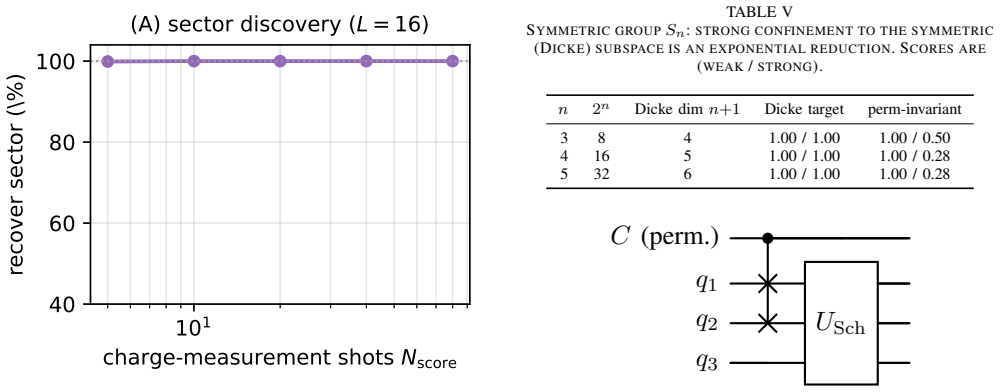
The central claim is that a single circuit consisting of a controlled twirl followed by a SWAP test discovers both weak and strong symmetry conditions by scoring finite-group candidates, selects the largest passing group as an unbiased measurement basis, and thereby reduces the number of shots needed; the framework applies over any finite group, with the strong condition yielding confinement to the symmetric subspace and an exponential reduction in shots, as shown in seeded examples for momentum readout and two-system targets.
What carries the argument
The symmetry test circuit consisting of a controlled twirl followed by a SWAP test, which discovers weak commutation by discarding the group register and strong confinement by post-selecting it.
If this is right
- Weak matching on momentum readout reduces shots by factors that widen from ten to several thousand as the state size grows.
- Strong matching on a two-system target reduces shots by an additional factor equal to the subsystem size.
- The same circuit and selection rule apply to cyclic groups via Fourier analysis, dihedral groups, and symmetric groups via Schur-Weyl duality.
- Strong confinement to the symmetric or Dicke subspace produces an exponential reduction in the number of shots.
- Seeded demonstrations show that the net shot count after the discovery loop is lower than without adaptation.
Where Pith is reading between the lines
- The discovery loop could be used to flag symmetry-breaking events as error signatures without a pre-specified symmetry.
- The unbiased selection rule might be combined with existing compression techniques to adaptively choose readout bases in unknown states.
- Further tests on hardware with realistic noise could measure how sample size affects the reliability of the largest-passing-group choice.
- The method provides a concrete primitive that could be inserted into larger protocols for certifying conserved charges when the sector is not known beforehand.
Load-bearing premise
The symmetry test can accurately score candidate groups from finite data samples such that the largest passing group is a reliable and unbiased choice for the measurement basis even when the symmetry is unknown in advance.
What would settle it
Run the discovery loop on a state known to be invariant only under a specific group G but not under larger candidate groups, and check whether the selected group from finite samples is consistently G rather than a non-symmetry or a smaller subgroup.
Figures




read the original abstract
Measuring a quantum computation in a basis adapted to a symmetry it carries reduces the repeated measurements, commonly referred to as ``shots'', needed to read a statistical answer. Detecting the symmetry a quantum state carries has many uses: certifying a claimed symmetry, identifying a conserved-charge sector, flagging symmetry-breaking as an error signature, and selecting a compression or readout basis; shot-count reduction is developed here as one exemplary case. Existing methods assume the symmetry is known in advance; we remove that assumption. When it is unknown, the carried symmetry is discovered from the data by a symmetry test that scores candidate groups, and the largest passing group is exploited as the measurement basis. We state the pipeline precisely, prove the selection rule is unbiased, and charge discovery in full. Two conditions are treated, both detected by the same score with a different projection: a weak condition, commutation with the representation, and a strong condition, confinement to a single charge sector, the distinction drawn in the quantum-reference-frame literature. A single circuit, a controlled twirl followed by a SWAP test, discovers both: discarding the group register tests the weak condition, post-selecting it the strong one. The framework is general over finite groups, with cyclic (Fourier), dihedral, and symmetric-group (Schur-Weyl) examples; strong confinement to the symmetric, or Dicke, subspace is an exponential reduction. Seeded demonstrations show the loop wins net of discovery: weak matching on momentum readout reduces shots by a factor widening from ten to several thousand, and strong matching on a two-system target by a further factor of the subsystem size. Blind symmetry matching is a practical primitive for the common case where the matched basis cannot be written down in advance.
Editorial analysis
A structured set of objections, weighed in public.
Referee Report
Summary. The paper claims a pipeline for blind discovery of unknown symmetries carried by a quantum state via a single circuit (controlled twirl + SWAP test) that scores candidate groups from a finite group; the largest passing group is selected as an adapted measurement basis. The selection rule is proved unbiased for the exact score. Both weak (commutation with the representation) and strong (confinement to one charge sector) conditions are detected by the same circuit with different post-processing. The framework is instantiated for cyclic, dihedral, and symmetric groups; strong confinement yields exponential shot reduction. Seeded demonstrations report net shot savings after discovery cost, e.g., factors of 10–thousands for weak momentum matching and an extra subsystem-size factor for strong matching.
Significance. If the central claims hold, the work supplies a practical primitive for symmetry discovery and exploitation when the symmetry cannot be written down in advance. The single-circuit treatment of both weak and strong conditions, the general finite-group setting, and the explicit shot-reduction application are useful. The seeded demonstrations provide concrete evidence that discovery overhead can be amortized.
major comments (2)
- [Proof of the selection rule (exact-score case)] The unbiasedness proof is stated for the exact SWAP-test probability, yet the pipeline executes on finite-shot estimates. No quantitative bound is supplied on the probability that sampling noise flips the argmax selection when several candidate groups lie near the decision threshold; because the selected basis is then used for all subsequent measurements, this directly affects the claimed net shot reduction.
- [Pipeline description and demonstrations] The finite-shot analysis is absent: the manuscript does not derive or simulate how variance in the estimated scores scales with shot count, group order, or number of candidate groups, leaving the practical reliability of the blind step unanchored.
minor comments (2)
- [Circuit description] The circuit diagram and accompanying text should explicitly label the group register versus the system register and state the dimension of each register for the Schur-Weyl example.
- [Demonstrations] Table or figure reporting the seeded shot counts should include the exact number of shots used for the discovery step itself so that the net-gain calculation can be reproduced.
Simulated Author's Rebuttal
We thank the referee for the positive assessment of the work's significance and for the constructive comments on finite-shot effects. We agree these require explicit treatment to support the practical claims and will revise accordingly.
read point-by-point responses
-
Referee: [Proof of the selection rule (exact-score case)] The unbiasedness proof is stated for the exact SWAP-test probability, yet the pipeline executes on finite-shot estimates. No quantitative bound is supplied on the probability that sampling noise flips the argmax selection when several candidate groups lie near the decision threshold; because the selected basis is then used for all subsequent measurements, this directly affects the claimed net shot reduction.
Authors: We acknowledge the distinction: the unbiasedness result holds for the exact probability, while implementation uses finite-shot estimates. In revision we will add a bound on the probability of argmax flip using Hoeffding's inequality applied to the binomial variance of each SWAP-test estimator. The bound will be expressed in terms of shot count per candidate, group order, and score separation; we will also include Monte-Carlo simulations of the full discovery-plus-measurement pipeline for the seeded demonstrations, confirming that net shot savings remain positive with high probability even when mis-selection is possible. revision: yes
-
Referee: [Pipeline description and demonstrations] The finite-shot analysis is absent: the manuscript does not derive or simulate how variance in the estimated scores scales with shot count, group order, or number of candidate groups, leaving the practical reliability of the blind step unanchored.
Authors: The referee is correct that no such scaling analysis or simulation appears in the current text. We will insert a new subsection deriving the variance of the controlled-twirl + SWAP-test estimator (accounting for the average over |G| group elements and the post-selection for the strong condition) and showing its dependence on shot count, |G|, and the number of candidates. Numerical experiments will be added for the cyclic, dihedral, and symmetric-group cases to illustrate the shot budget needed for reliable selection. revision: yes
Circularity Check
No circularity; derivation self-contained
full rationale
The abstract states the pipeline, proves the selection rule unbiased, and charges discovery in full using a controlled twirl + SWAP test circuit, with weak/strong conditions distinguished by projection. No equations, fitted parameters, or self-citations are exhibited that reduce any claimed result to its own inputs by construction. The central claims rest on an explicit proof of unbiasedness rather than renaming, ansatz smuggling, or load-bearing self-reference, making the derivation independent of the patterns that trigger circularity flags.
Axiom & Free-Parameter Ledger
Reference graph
Works this paper leans on
-
[1]
Measurement optimiza- tion in the variational quantum eigensolver using a minimum clique cover,
V . Verteletskyi, T.-C. Yen, and A. F. Izmaylov, “Measurement optimiza- tion in the variational quantum eigensolver using a minimum clique cover,”The Journal of Chemical Physics, vol. 152, no. 12, p. 124114, 2020
2020
-
[2]
Measuring all compat- ible operators in one series of single-qubit measurements using unitary transformations,
T.-C. Yen, V . Verteletskyi, and A. F. Izmaylov, “Measuring all compat- ible operators in one series of single-qubit measurements using unitary transformations,”Journal of Chemical Theory and Computation, vol. 16, no. 4, pp. 2400–2409, 2020
2020
-
[3]
Efficient quantum measurement of Pauli operators in the presence of finite sampling error,
O. Crawford, B. van Straaten, D. Wang, T. Parks, E. Campbell, and S. Brierley, “Efficient quantum measurement of Pauli operators in the presence of finite sampling error,”Quantum, vol. 5, p. 385, 2021
2021
-
[4]
Minimizing state preparations in vari- ational quantum eigensolver by partitioning into commuting families,
P. Gokhale, O. Angiuli, Y . Ding, K. Gui, T. Tomesh, M. Suchara, M. Martonosi, and F. T. Chong, “Minimizing state preparations in vari- ational quantum eigensolver by partitioning into commuting families,” arXiv preprint, 2019
2019
-
[5]
Group-theoretic error mitigation enabled by classical shadows and symmetries,
A. Zhao and N. C. Rubin, “Group-theoretic error mitigation enabled by classical shadows and symmetries,”npj Quantum Information, 2024
2024
-
[6]
Classical shadows with symmetries,
F. Sauvage and M. Larocca, “Classical shadows with symmetries,” 2024
2024
-
[7]
Quantum Algebraic Diversity: Single-Copy Density Matrix Estimation via Group-Structured Measurements
M. A. Thornton, “Quantum algebraic diversity: Single-copy density matrix estimation via group-structured measurements,” 2026. [Online]. Available: https://arxiv.org/abs/2604.03725
work page internal anchor Pith review Pith/arXiv arXiv 2026
-
[8]
Testing sym- metry on quantum computers,
M. L. LaBorde, S. Rethinasamy, and M. M. Wilde, “Testing sym- metry on quantum computers,”Quantum, vol. 7, p. 1120, 2023, arXiv:2105.12758
-
[9]
Quantum algorithms for testing hamiltonian symmetry,
M. L. LaBorde and M. M. Wilde, “Quantum algorithms for testing hamiltonian symmetry,”Phys. Rev. Lett., vol. 129, no. 16, p. 160503, 2022, arXiv:2203.10017
-
[10]
Predicting symmetries of quantum dynamics with optimal samples,
M. Hayashi, Y .-A. Chen, C. Zhu, and X. Wang, “Predicting symmetries of quantum dynamics with optimal samples,”arXiv preprint, 2025, arXiv:2502.01464
-
[11]
G. Doat and A. Vanrietvelde, “What can we do in a symmetry- constrained perspective? the importance of the total charge’s sta- tus in quantum reference frame frameworks,”Quantum, 2026, arXiv:2510.13607
work page internal anchor Pith review Pith/arXiv arXiv 2026
-
[12]
Algebraic Diversity: Group-Theoretic Spectral Estimation from Single Observations
M. A. Thornton, “Algebraic diversity: Group-theoretic spectral estimation from single observations,” 2026. [Online]. Available: https://arxiv.org/abs/2604.03634
work page internal anchor Pith review Pith/arXiv arXiv 2026
-
[13]
Algebraic Diversity: Principles of a Group-Theoretic Approach to Signal Processing
——, “Algebraic diversity: Principles of a group-theoretic approach to signal processing,” 2026. [Online]. Available: https://arxiv.org/abs/ 2604.19983
work page internal anchor Pith review Pith/arXiv arXiv 2026
-
[14]
and Schatzki, Louis and Coles, Patrick J
M. Ragone, P. Braccia, Q. T. Nguyen, L. Schatzki, P. J. Coles, F. Sauvage, M. Larocca, and M. Cerezo, “Representation theory for geometric quantum machine learning,”arXiv preprint, 2022, arXiv:2210.07980
-
[15]
Group-invariant quantum machine learning,
M. Larocca, F. Sauvage, F. M. Sbahi, G. Verdon, P. J. Coles, and M. Cerezo, “Group-invariant quantum machine learning,”PRX Quan- tum, vol. 3, no. 3, p. 030341, 2022
2022
-
[16]
Quantum amplitude amplification and estimation,
G. Brassard, P. Høyer, M. Mosca, and A. Tapp, “Quantum amplitude amplification and estimation,” inQuantum Computation and Informa- tion, ser. Contemporary Mathematics. American Mathematical Society, 2002, vol. 305, pp. 53–74
2002
-
[17]
Serre,Linear Representations of Finite Groups, ser
J.-P. Serre,Linear Representations of Finite Groups, ser. Graduate Texts in Mathematics. Springer, 1977, vol. 42
1977
-
[18]
Fulton and J
W. Fulton and J. Harris,Representation Theory: A First Course, ser. Graduate Texts in Mathematics. Springer, 1991, vol. 129
1991
-
[19]
Quantum states with Einstein-Podolsky-Rosen correla- tions admitting a hidden-variable model,
R. F. Werner, “Quantum states with Einstein-Podolsky-Rosen correla- tions admitting a hidden-variable model,”Phys. Rev. A, vol. 40, pp. 4277–4281, 1989
1989
-
[20]
Mixed-state entanglement and quantum error correction,
C. H. Bennett, D. P. DiVincenzo, J. A. Smolin, and W. K. Wootters, “Mixed-state entanglement and quantum error correction,”Physical Review A, vol. 54, no. 5, pp. 3824–3851, 1996
1996
-
[21]
Efficient quantum circuits for Schur and Clebsch-Gordan transforms,
D. Bacon, I. L. Chuang, and A. W. Harrow, “Efficient quantum circuits for Schur and Clebsch-Gordan transforms,”Phys. Rev. Lett., vol. 97, p. 170502, 2006
2006
-
[22]
The Church of the Symmetric Subspace
A. W. Harrow, “The church of the symmetric subspace,”arXiv preprint arXiv:1308.6595, 2013
work page internal anchor Pith review Pith/arXiv arXiv 2013
-
[23]
Coherence in spontaneous radiation processes,
R. H. Dicke, “Coherence in spontaneous radiation processes,”Physical Review, vol. 93, no. 1, pp. 99–110, 1954
1954
-
[24]
Efficient quantum tomography,
R. O’Donnell and J. Wright, “Efficient quantum tomography,” inProc. 48th ACM Symp. Theory of Computing (STOC), 2016, pp. 899–912
2016
-
[25]
Estimating the spectrum of a density operator,
M. Keyl and R. F. Werner, “Estimating the spectrum of a density operator,”Phys. Rev. A, vol. 64, p. 052311, 2001
2001
-
[26]
On the power of quantum computation,
D. R. Simon, “On the power of quantum computation,”SIAM Journal on Computing, vol. 26, no. 5, pp. 1474–1483, 1997
1997
-
[27]
Quantum algorithms for algebraic problems,
A. M. Childs and W. van Dam, “Quantum algorithms for algebraic problems,”Reviews of Modern Physics, vol. 82, no. 1, pp. 1–52, 2010
2010
discussion (0)
Sign in with ORCID, Apple, or X to comment. Anyone can read and Pith papers without signing in.