REVIEW 4 major objections 6 minor 63 references
3D-GIMP shows that a single generative inpainting of a reference view, propagated across all views with a 3D-aware PatchMatch, is enough to match multi-view diffusion object removal in quality while being far cheaper and more view-consisten
Reviewed by Pith at T0; open to challenge. T0 means a machine referee read the full paper against a public rubric. the ladder, T0–T4 →
2026-08-01 09:23 UTC pith:DGTCTZJA
load-bearing objection Single-reference diffusion plus PatchMatch propagation is a sensible speed play, but the view-consistency claim rides on a depth prior that is neither named nor shown to be robust. the 4 major comments →
3D-GIMP: When 3D Gaussian Inpainting Meets PatchMatch
The pith
A machine-rendered reading of the paper's core claim, the machinery that carries it, and where it could break.
Core claim
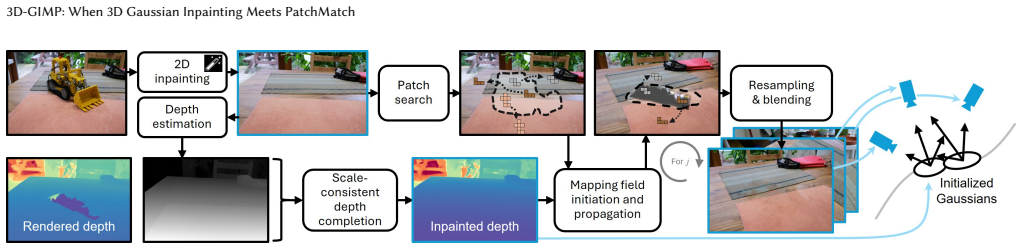
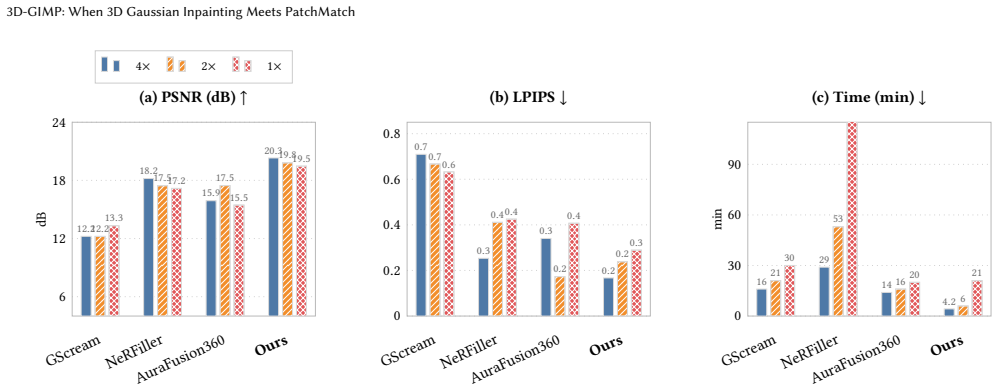
The central claim is that high-fidelity, view-consistent object removal in 3D Gaussian Splatting does not require per-view generative inpainting. Instead, the paper builds a patch mapping field in the inpainted reference view and reprojects it through a scale-consistent depth map, so every target view is filled by sampling and blending local patches that already agree with the scene's geometry and photometry. The paper argues this 'reconstructive consistency' avoids hallucination drift and preserves high-frequency details at arbitrary resolution, and supports it with experiments where the proposed pipeline reaches 19.09 PSNR / 0.248 LPIPS / 53.11 FID on the IMFine dataset in 6 minutes, compa
What carries the argument
The load-bearing mechanism is a 3D-aware PatchMatch mapping field: a nearest-neighbour field f that explains each inpainted pixel in the reference view by a similar patch elsewhere in the same image, with a visibility score biasing the search toward patches that stay visible in many views. This field is propagated to other cameras by reprojecting matched pairs through a depth map that is completed inside the removal region by a discrete Poisson equation, whose gradient guidance comes from a scaled monocular disparity prior and whose boundary values come from the 2DGS rasterizer. The mapping field lets the method resample local patches in each target view, then blends them via splatting and d
Load-bearing premise
The weakest link is the Poisson-completed depth map inside the removed region: if the scaled monocular prior (with the fixed sf=0.1) does not reconstruct the true geometry, the patch reprojections misalign and the cross-view consistency that the method's claim rests on degrades, as the paper itself acknowledges for 'extreme cases'.
What would settle it
Run the pipeline on a scene with a known wrong monocular depth prior inside the ROI (e.g., a mirror, a transparent object, or a strongly concave surface), and measure PSNR of propagated inpainted views: if the patch-reprojected patches are visibly misaligned and the view-consistency advantage over per-view diffusion disappears, the central claim fails on such geometry. A cheaper check: vary sf around 0.1 on the 'rocks' scene and observe whether the reported FID/PSNR gap closes—if a single fixed sf cannot serve varied shapes, the claim of scale-consistent propagation is conditional, not general
If this is right
- Per-view diffusion inpainting for 3DGS object removal can be replaced by one generative pass plus geometric propagation, cutting inpainting cost by about 90% on the tested scenes.
- Because propagation is geometric and patch-based, the method keeps high-frequency details and view-dependent effects (such as specular reflections) that simple image warping loses, and it scales to higher resolutions without additional generative passes.
- The patch mapping field acts as a structural prior: feeding it to a diffusion refiner (as in the paper's Ours+LeftRefill ablation) reduces hallucinations and yields the best reported PSNR and LPIPS, at higher runtime.
- Better multi-view consistency translates directly to cleaner novel-view synthesis, since the inpainted Gaussian primitives are back-projected from views that already agree.
Where Pith is reading between the lines
- The 'generate once, propagate through geometry' recipe generalizes beyond object removal: the same single-reference edit plus PatchMatch propagation could handle object insertion, texture replacement, or reflection editing in 3DGS, since the mechanism only requires an edited reference and a completed depth map.
- The scene-specific scale factor sf is the obvious knob to automate: a search that maximizes photometric consistency of propagated patches across neighboring views would remove the manual tuning and likely improve robustness on hard geometry.
- The explicit mapping field could be replaced or refined by a learned correspondence network, potentially making the propagation differentiable and end-to-end trainable while keeping the geometric grounding.
- The visibility-score weighting suggests a principled reference-view selection criterion: pick the camera whose view of the removed region is most visible across the training set, which the paper notes would reduce sampling gaps and stretching artifacts.
Editorial analysis
A structured set of objections, weighed in public.
Referee Report
Summary. 3D-GIMP proposes a hybrid object-removal pipeline for 3D Gaussian Splatting. Instead of running a diffusion inpainting model on every training view, it performs a single generative inpainting on one reference view, constructs a PatchMatch mapping field from the inpainted reference, completes the reference depth map inside the removal region with a Poisson equation guided by scaled monocular disparity, and then propagates the mapping to all other views via 3D warping. The resulting per-view inpainted images are used to re-initialize and finetune the Gaussian primitives. The paper reports about a 10x speedup over per-view diffusion baselines on IMFine (6 min vs 1 h) and claims competitive quality with better view consistency. The method is evaluated on IMFine, 360-USID, and Mip-NeRF 360 scenes, including an ablation and a comparison with a video-diffusion baseline.
Significance. If the central claims hold, the single-reference + PatchMatch propagation design is a meaningful efficiency contribution to 3D Gaussian object removal: it reduces the dependence on stochastic multi-view diffusion and achieves a large practical speedup. The reported FID gains on IMFine and 360-USID, and the hybrid 'Ours + LeftRefill' variant that improves LPIPS, are encouraging. However, the paper's strongest conceptual claim — multi-view consistency — is never directly measured, and the entire propagation chain rests on a depth-completion step whose monocular prior is left unidentified and whose scale parameter is tuned per test scene. The significance of the results is therefore conditional on additional validation of the depth propagation and a direct consistency metric.
major comments (4)
- [Section 3.3, Eqs. (4)-(6); Section 5; Supp. A.4] The depth-completion step that drives the propagation is load-bearing, but its core components are not specified or validated. The monocular disparity prior d_m is never identified (no model name, source, or license), and the scale factor s_f is set to 0.1 as 'the most consistent quality across all test scenes' (Supp. A.4) while Section 5 admits it is 'currently scene-specific' and that when the solver fails, 'the precision of subsequent patch-warping steps is significantly degraded.' Since Algorithm 1 warps both p0 and q0 through w_j(·) using D(p0), any depth error directly misplaces the copied patches and undermines the asserted multi-view consistency. Please identify the monocular depth model, report sensitivity of the final metrics to s_f across all scenes (not just 'rocks'), and provide a quantitative check of completed depth, e.g., against ground-truth depth or by correlating depth
- [Abstract and Section 4.3 (Table 1)] The paper repeatedly claims that 3D-GIMP 'outperforms ... in view consistency' (Abstract, Section 1, Section 4.3), but no quantitative sanity metric for multi-view agreement is reported anywhere in Tables 1-4. The only consistency-adjacent number is SSIM in the GEN3C comparison (Table 3), which is computed on a single view's object mask, not across views. This is a central, load-bearing claim; it should be tested directly, e.g., by measuring pixel variance or pairwise PSNR/SSIM between overlapping inpainted views, or by rendering novel views and comparing them to ground truth when available. Without such a metric, the claimed advantage over multi-view diffusion methods is not demonstrated.
- [Table 1] The quality claims are only partially supported by the numbers. On IMFine, Ours (2DGS) has a worse LPIPS than AuraFusion360 (0.248 vs 0.173); on 360-USID, Ours (2DGS) has a worse PSNR (15.02 vs 16.22). The abstract says 'competitive inpainting quality', which is defensible when FID and runtime are considered, but the text in Section 4.3 should qualify the claim rather than implying global superiority. Moreover, the results are averaged over 8 scenes (IMFine) and 7 scenes (360-USID) with a scene-tuned s_f; per-scene results with standard deviations are needed to assess whether the averages are driven by a few favorable scenes. Please provide the per-scene tables with significance information.
- [Section 4.2, Supp. A.3] The evaluation protocol for the reference view is ambiguous and potentially unfair. The paper states 'we use the first ground truth frame from the testing set as the reference view' and Supp. A.3 says 'we use the same view as the ground truth for comparison.' If the reference view is a clean ground-truth background image, then the diffusion pass on the reference is not actually exercised, and methods that do not receive such a reference (e.g., SPInNeRF, NeRFiller, GScream) are at a disadvantage. Please clarify whether the 'ground truth frame' still contains the object to be removed, how the reference is used by each baseline, and what exactly is meant by 'same view as the ground truth.' If a clean reference is used, justify this protocol or adopt a common protocol with and without a reference.
minor comments (6)
- [Section 4.4] Typos: 'ketchen' should be 'kitchen' (twice in Section 4.4 and in the Table 2 caption).
- [Section 3.3, Eq. (7)] The visibility score is defined as v(p) in the text but Eq. (7) writes v(q); the notation is inconsistent and should be aligned.
- [Algorithm 1] ReTargeting, PixelSampling, SortingAndBlending, and UpdateCameraState are not defined in the main text or the supplement. Please add pseudocode or a precise citation for each.
- [Section 3.3] The sentence 'Ideally, we wish to construct the patch mapping field f only once in the reference view and reuse these assignments in all reference views I_j' uses 'reference views' where it should be 'target views'.
- [Supp. A.4, Figure 11] The axis annotation '0.0137 / 0.1655 Disp.' is unclear. Please specify the units and what the two numbers denote.
- [Section 4.4] The sentence 'While the core of our method serves as a highly efficient standalone solution, establishes a new state-of-the-art.' is incomplete and grammatically broken; it also overstates the evidence given the mixed results in Table 1.
Circularity Check
No circularity found: the PatchMatch propagation and Poisson depth completion are an empirical construction benchmarked externally; the scene-specific scale factor is a robustness limitation, not a definitional loop.
full rationale
The paper's derivations do not define any predicted quantity in terms of its own inputs. The patch mapping field f is computed on the inpainted reference view and propagated via reprojection w_j(p), using the completed depth map D from Eqs. (4)-(6). That depth map is filled from a monocular disparity prior scaled by s_f with rasterizer boundary conditions; it is not fitted to the PSNR/LPIPS/FID targets. No uniqueness theorem or load-bearing self-citation is invoked: the only self-references (InpaintFusion [Mori et al. 2020], Good Keyframes [Mori et al. 2022]) are motivational or about reference-view selection, not used to force the algorithm. The central claim is validated against external baselines (AuraFusion360, IMFine, GEN3C, etc.) on held-out ground-truth views, so the reported numbers are not equivalent to the method's definitions. I do flag the admitted limitation in Sec. 5 and Supp. A.4: the depth-completion scale s_f=0.1 was chosen as 'most consistent quality across all test scenes,' and the paper states that when the Poisson solver fails, 'the precision of subsequent patch-warping steps is significantly degraded.' That is a genuine robustness and possible test-set-tuning concern, but it is not circularity: the parameter is not disguised as a prediction, and the propagation pipeline remains a constructive recipe whose success depends on the unknown monocular depth model. For the same reason, the use of the first ground-truth frame as reference view is a data-protocol question, not a reduction of the output to the input.
Axiom & Free-Parameter Ledger
free parameters (6)
- sf (scale of monocular disparity guidance) =
0.1
- s (guard-band enlargement) =
1.2
- lambda_s (spatial smoothness weight) =
0.001
- lambda_v (visibility weight) =
not reported
- sigma_0 (SH outlier weight strictness) =
not reported
- Reference camera selection =
first test-frame camera
axioms (6)
- domain assumption 2D Gaussian Splatting ray-splat intersection produces accurate, scale-consistent depth and normal maps for the visible scene.
- domain assumption Surface patches in the reference view remain photometrically similar in neighboring views, so a mapping field computed once can be reprojected and reused.
- domain assumption The disoccluded content in the reference view can be represented as copies of visible patches from an unoccluded source region.
- standard math Poisson equation with Dirichlet boundary conditions and scaled monocular guidance yields scale-consistent completed depth.
- domain assumption The monocular depth prior d_m is locally correct up to latent scale.
- domain assumption A diffusion-based reference inpainter (Nano Banana Pro / Gemini 2.5) provides a trustworthy appearance prior.
Cite this review
Pith. "Pith review of 3D-GIMP: When 3D Gaussian Inpainting Meets PatchMatch." pith.science (2026). https://pith.science/paper/DGTCTZJA
@misc{pith2026260720789,
  author       = {Pith},
  title        = {Pith review of: 3D-GIMP: When 3D Gaussian Inpainting Meets PatchMatch},
  year         = {2026},
  howpublished = {\url{https://pith.science/paper/DGTCTZJA}},
  note         = {Machine review of arXiv:2607.20789}
}
read the original abstract
Recent advances in 3D scene editing have leveraged iterative diffusion models to update input views. However, this process is computationally expensive and struggles to produce sharp details. Meanwhile, ``hallucination drift'' frequently introduces multi-view inconsistencies, leading to structural artifacts when rendering novel viewpoints. To address this problem, we present 3D-GIMP (3D Gaussian Inpainting Meets Patch Matching), a novel hybrid paradigm designed for high-fidelity object removal in 3D Gaussian Splatting. Instead of diffusing every view, 3D-GIMP performs a single generative inpainting on a key reference view, which serves as an appearance prior. We then introduce a 3D-aware PatchMatch algorithm to propagate these reference textures across all remaining views via correspondence matching, effectively bypassing the stochastic nature of frame-by-frame diffusion. By prioritizing reconstructive consistency over iterative generation, 3D-GIMP maintains high-frequency details across arbitrary resolutions while ensuring a mathematically consistent 3D reconstruction. Our experiments demonstrate that 3D-GIMP not only achieves competitive inpainting quality as previous methods using diffusion in multiple views, but also outperforms these methods in rendering speed and view consistency.
Figures





Reference graph
Works this paper leans on
-
[1]
Structured Variational Inference Procedures and their Realizations (as incol)
Dan Geiger and Christopher Meek. Structured Variational Inference Procedures and their Realizations (as incol). Proceedings of Tenth International Workshop on Artificial Intelligence and Statistics, The Barbados
-
[2]
Stan W. Smith. An experiment in bibliographic mark-up: Parsing metadata for XML export. Proceedings of the 3rd. annual workshop on Librarians and Computers. 2010
2010
-
[3]
Derpanis and Jonathan Kelly and Marcus A
Ashkan Mirzaei and Tristan Aumentado-Armstrong and Konstantinos G. Derpanis and Jonathan Kelly and Marcus A. Brubaker and Igor Gilitschenski and Alex Levinshtein , year=
-
[4]
2025 , pages =
Wu, Chung-Ho and Chen, Yang-Jung and Chen, Ying-Huan and Lee, Jie-Ying and Ke, Bo-Hsu and Mu, Chun-Wei Tuan and Huang, Yi-Chuan and Lin, Chin-Yang and Chen, Min-Hung and Lin, Yen-Yu and Liu, Yu-Lun , title =. 2025 , pages =
2025
-
[5]
GScream: Learning 3D Geometry and Feature Consistent Gaussian Splatting for Object Removal , author=
-
[6]
arXiv preprint arXiv:2404.11613 , year=
InFusion: Inpainting 3D Gaussians via Learning Depth Completion from Diffusion Prior , author=. arXiv preprint arXiv:2404.11613 , year=
-
[7]
NeRFiller: Completing Scenes via Generative 3D Inpainting , author =
-
[8]
2025 , eprint=
Perspective-aware 3D Gaussian Inpainting with Multi-view Consistency , author=. 2025 , eprint=
2025
-
[9]
2025 , eprint=
IMFine: 3D Inpainting via Geometry-guided Multi-view Refinement , author=. 2025 , eprint=
2025
-
[10]
Inpaint360GS: Efficient Object-Aware 3D Inpainting via Gaussian Splatting for 360
Shaoxiang Wang and Shihong Zhang and Christen Millerdurai and Rüdiger Westermann and Didier Stricker and Alain Pagani , year=. Inpaint360GS: Efficient Object-Aware 3D Inpainting via Gaussian Splatting for 360. 2511.06457 , archivePrefix=
-
[11]
InstaInpaint: Instant 3D-Scene Inpainting with Masked Large Reconstruction Model , author=
-
[12]
arXiv preprint arXiv:2408.00714 , year=
SAM 2: Segment Anything in Images and Videos , author=. arXiv preprint arXiv:2408.00714 , year=
- [13]
-
[14]
3D Gaussian Splatting for Real-Time Radiance Field Rendering , journal = TOG, number =
Kerbl, Bernhard and Kopanas, Georgios and Leimk. 3D Gaussian Splatting for Real-Time Radiance Field Rendering , journal = TOG, number =
-
[15]
PixMix: A real-time approach to high-quality Diminished Reality , year=
Herling, Jan and Broll, Wolfgang , booktitle=. PixMix: A real-time approach to high-quality Diminished Reality , year=
-
[16]
2009 , volume =
Barnes, Connelly and Shechtman, Eli and Finkelstein, Adam and Goldman, Dan B , title =. 2009 , volume =
2009
-
[17]
2025 , eprint=
GSFix3D: Diffusion-Guided Repair of Novel Views in Gaussian Splatting , author=. 2025 , eprint=
2025
-
[18]
3d gaussian inpainting with depth-guided cross-view consistency , author=
-
[19]
and Perez, P
Criminisi, A. and Perez, P. and Toyama, K. , booktitle=CVPR, title=. 2003 , volume=
2003
-
[20]
2024 , isbn =
Ye, Mingqiao and Danelljan, Martin and Yu, Fisher and Ke, Lei , title =. 2024 , isbn =
2024
-
[21]
On the uncertainty of self-supervised monocular depth estimation , author =
-
[22]
NeRF: Representing Scenes as Neural Radiance Fields for View Synthesis , author=
-
[23]
Gaussianeditor: Swift and controllable 3d editing with gaussian splatting , author=
-
[24]
Reference-guided Controllable Inpainting of Neural Radiance Fields , author=
-
[25]
MVIP-NeRF: Multi-view 3D Inpainting on NeRF Scenes via Diffusion Prior , author=
-
[26]
2D Gaussian Splatting for Geometrically Accurate Radiance Fields , author=
-
[27]
InpaintFusion: Incremental RGB-D Inpainting for 3D Scenes , volume=
Mori, Shohei and Erat, Okan and Broll, Wolfgang and Saito, Hideo and Schmalstieg, Dieter and Kalkofen, Denis , journal=. InpaintFusion: Incremental RGB-D Inpainting for 3D Scenes , volume=
-
[28]
2015 , volume=
Ružić, Tijana and Pižurica, Aleksandra , journal=TIP, title=. 2015 , volume=
2015
-
[29]
Patch-Based Image Inpainting via Two-Stage Low Rank Approximation , year=
Guo, Qiang and Gao, Shanshan and Zhang, Xiaofeng and Yin, Yilong and Zhang, Caiming , journal=. Patch-Based Image Inpainting via Two-Stage Low Rank Approximation , year=
-
[30]
Multimedia Tools Appl
Lu, Hongyang and Liu, Qiegen and Zhang, Minghui and Wang, Yuhao and Deng, Xiaohua , title =. Multimedia Tools Appl. , month = mar, pages =. 2018 , publisher =
2018
-
[31]
2014 , volume=
Lu, Si and Ren, Xiaofeng and Liu, Feng , booktitle=CVPR, title=. 2014 , volume=
2014
-
[32]
Atapour Abarghouei, Amir and Breckon, Toby , year =
-
[33]
and Firman, Michael and Vicente, Sara , title =
Weder, Silvan and Garcia-Hernando, Guillermo and Monszpart, \'Aron and Pollefeys, Marc and Brostow, Gabriel J. and Firman, Michael and Vicente, Sara , title =. 2023 , pages =
2023
-
[34]
arXiv preprint arXiv:2109.07161 , year=
Resolution-robust Large Mask Inpainting with Fourier Convolutions , author=. arXiv preprint arXiv:2109.07161 , year=
-
[35]
Towards An End-to-End Framework for Flow-Guided Video Inpainting , author=
-
[36]
DVI: Depth Guided Video Inpainting for Autonomous Driving , author=
-
[37]
2024 , volume=
Corneanu, Ciprian and Gadde, Raghudeep and Martinez, Aleix M , booktitle=WACV, title=. 2024 , volume=
2024
-
[38]
2025 , eprint=
Efficient Zero-Shot Inpainting with Decoupled Diffusion Guidance , author=. 2025 , eprint=
2025
-
[39]
2024 , eprint=
ObjectDrop: Bootstrapping Counterfactuals for Photorealistic Object Removal and Insertion , author=. 2024 , eprint=
2024
-
[40]
2021 , eprint=
High-Resolution Image Synthesis with Latent Diffusion Models , author=. 2021 , eprint=
2021
-
[41]
Gaussian Grouping: Segment and Edit Anything in 3D Scenes , author=
-
[42]
arXiv preprint arXiv:2212.03245 , year=
Differentiable Point-Based Radiance Fields for Efficient View Synthesis , author=. arXiv preprint arXiv:2212.03245 , year=
-
[43]
Srinivasan and Peter Hedman and Ricardo Martin-Brualla and Jonathan T
Ben Mildenhall and Dor Verbin and Pratul P. Srinivasan and Peter Hedman and Ricardo Martin-Brualla and Jonathan T. Barron , year=
-
[44]
2025 , eprint =
Gemma 3 Technical Report , author =. 2025 , eprint =
2025
-
[45]
Nano Banana Pro: Gemini 3 Pro Image Generation , year =
-
[46]
2024 , eprint=
From Noise to Nuance: Advances in Deep Generative Image Models , author=. 2024 , eprint=
2024
-
[47]
2018 , eprint=
The Unreasonable Effectiveness of Deep Features as a Perceptual Metric , author=. 2018 , eprint=
2018
-
[48]
Heusel, Martin and Ramsauer, Hubert and Unterthiner, Thomas and Nessler, Bernhard and Hochreiter, Sepp , title =. Proc. NeurIPS , pages =. 2017 , publisher =
2017
-
[49]
Mip-NeRF 360: Unbounded Anti-Aliased Neural Radiance Fields , author=
-
[50]
Poisson image editing , year =
P\'. Poisson image editing , year =
-
[51]
2024 , pages=
Yang, Lihe and Kang, Bingyi and Huang, Zilong and Xu, Xiaogang and Feng, Jiashi and Zhao, Hengshuang , booktitle=CVPR, title=. 2024 , pages=
2024
-
[52]
Mori, Shohei and Schmalstieg, Dieter and Kalkofen, Denis , journal=TVCG, title=
-
[53]
Scaffold-gs: Structured 3d gaussians for view-adaptive rendering , author=
-
[54]
2024 , eprint=
Text-to-3D using Gaussian Splatting , author=. 2024 , eprint=
2024
-
[55]
Haque, Ayaan and Tancik, Matthew and Efros, Alexei and Holynski, Aleksander and Kanazawa, Angjoo , title =
-
[56]
IPSJ Transactions on Computer Vision and Applications , author =
A survey of diminished reality:. IPSJ Transactions on Computer Vision and Applications , author =
-
[57]
and Tancik, Matthew and Barron, Jonathan T
Mildenhall, Ben and Srinivasan, Pratul P. and Tancik, Matthew and Barron, Jonathan T. and Ramamoorthi, Ravi and Ng, Ren , title =. Commun. ACM , month = dec, pages =. 2021 , volume =
2021
-
[58]
Look Outside the Room: Synthesizing A Consistent Long-Term 3D Scene Video from A Single Image , author=
-
[59]
2023 , eprint=
Zero-1-to-3: Zero-shot One Image to 3D Object , author=. 2023 , eprint=
2023
-
[60]
2023 , eprint=
Zero123++: a Single Image to Consistent Multi-view Diffusion Base Model , author=. 2023 , eprint=
2023
-
[61]
Generative Camera Dolly: Extreme Monocular Dynamic Novel View Synthesis , author=
-
[62]
GEN3C: 3D-Informed World-Consistent Video Generation with Precise Camera Control , author=
-
[63]
LeftRefill: Filling Right Canvas based on Left Reference through Generalized Text-to-Image Diffusion Model , author=
This paper was first reviewed by deepseek-v4-flash on August 1, 2026.
discussion (0)
Sign in with ORCID, Apple, or X to comment. Anyone can read and Pith papers without signing in.