Dissipative Spectral Form Factor of the Complex Elliptic Ginibre Ensemble across Various Non-Hermiticity Regimes
Pith reviewed 2026-06-29 09:54 UTC · model grok-4.3
The pith
The dissipative spectral form factor of the elliptic Ginibre ensemble shows a dip-ramp-plateau whose ramp shape depends on the joint scaling of time and non-Hermiticity in the large-N limit.
A machine-rendered reading of the paper's core claim, the machinery that carries it, and where it could break.
Core claim
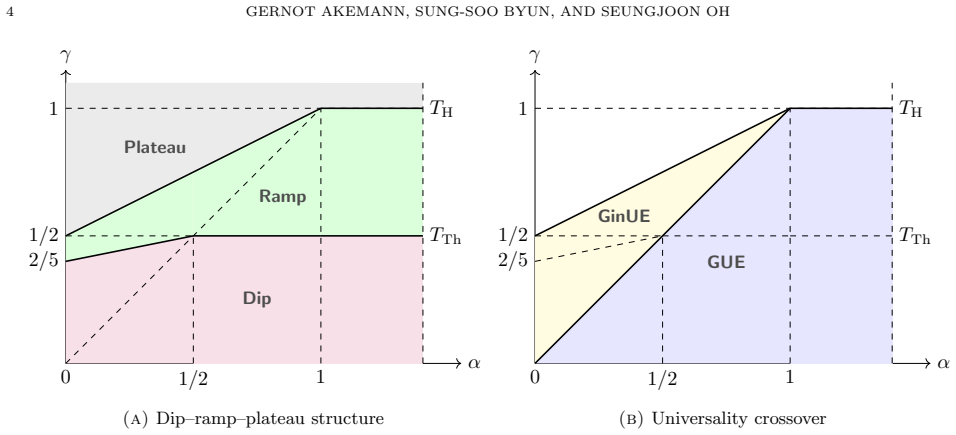
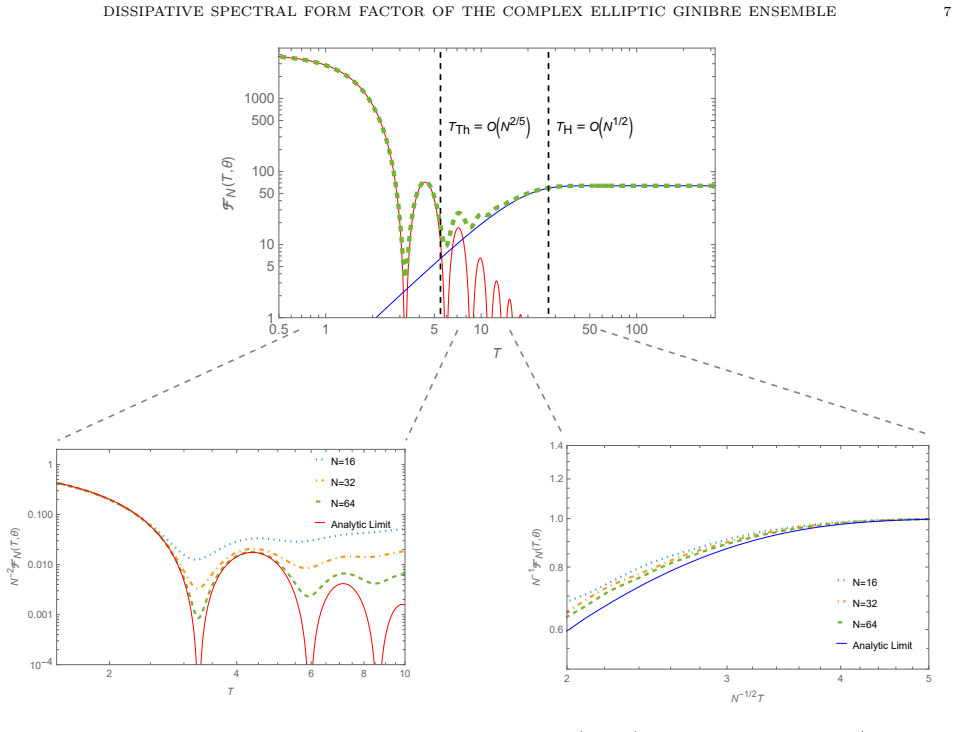
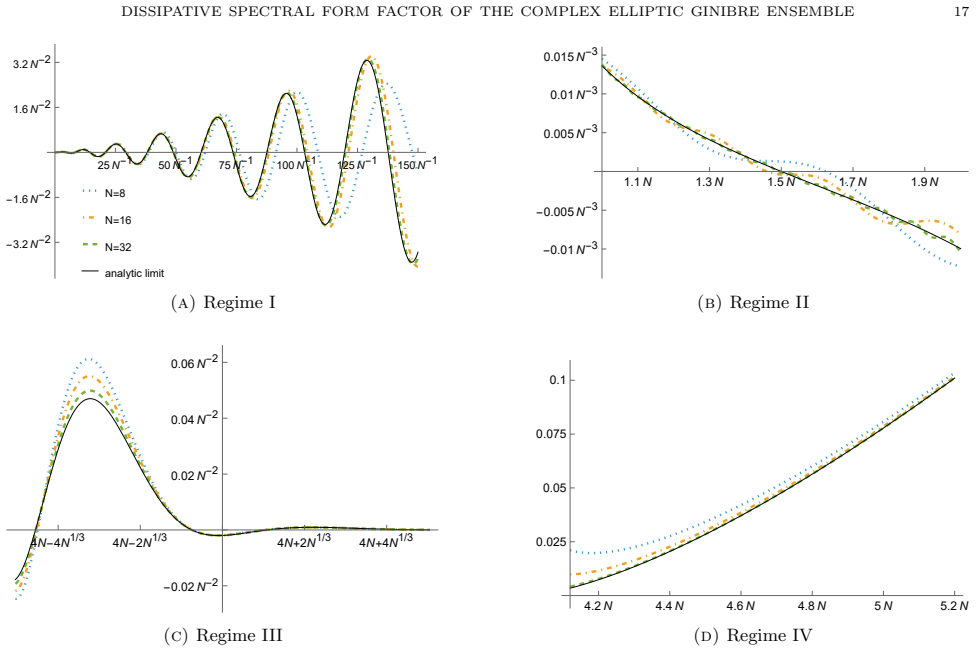
As N tends to infinity under the scalings T = O(N^γ) and 1-τ = O(N^{-α}) for all γ ≥ 0 and α ≥ 0, both the disconnected and connected components of the DSFF admit precise asymptotic expansions that fully characterize the dip-ramp-plateau structure together with its dip time and Heisenberg time; the mesoscopic window α ∈ (0,1) produces an interpolation between the DSFF of non-Hermitian matrices and the ordinary spectral form factor of Hermitian ensembles, while the ramp itself takes quadratic, linear, or intermediate form according to the values of the scaling exponents.
What carries the argument
The dissipative spectral form factor (DSFF) at complex time Te^{iθ} for the elliptic Ginibre ensemble with non-Hermiticity parameter τ, analyzed under joint power-law scalings of time and 1-τ.
If this is right
- The dip time and Heisenberg time receive explicit characterizations in every regime.
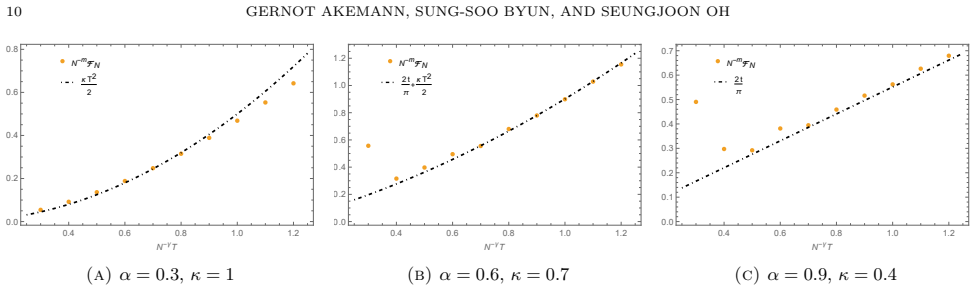
- The ramp of the DSFF takes quadratic, linear, or intermediate shape depending on the pair of scaling exponents.
- The mesoscopic regime α ∈ (0,1) produces a continuous interpolation between fully non-Hermitian and Hermitian spectral statistics.
- Both the disconnected and connected parts of the DSFF receive complete asymptotic descriptions.
Where Pith is reading between the lines
- The same scaling approach may uncover analogous crossover regimes in other non-Hermitian ensembles.
- Open quantum systems with tunable dissipation strength could exhibit the predicted change in ramp shape when their spectral statistics are measured.
- The phase diagram supplies concrete transition lines that finite-N simulations can test directly.
Load-bearing premise
The chosen power-law scalings for time and the deviation from Hermiticity are the ones that exhaust all relevant asymptotic regimes of the DSFF.
What would settle it
A numerical computation of the DSFF for the elliptic Ginibre ensemble at large but finite N, performed inside one of the scaling regimes, that deviates from the predicted leading asymptotic expression.
Figures
read the original abstract
We study the dissipative spectral form factor (DSFF) at complex time $T e^{i\theta}$ for the complex elliptic Ginibre ensemble with non-Hermiticity parameter $\tau \in [0,1)$. As the matrix dimension $N \to \infty$, we consider the natural scalings in both the time variable and the non-Hermiticity parameter, namely $T = O(N^\gamma)$ and $1 - \tau = O(N^{-\alpha})$. For all regimes $\gamma \ge 0$ and $\alpha \ge 0$, we derive the precise asymptotic behaviour of both the disconnected and connected components of the DSFF. In particular, we explicitly characterise the dip--ramp--plateau structure, including the dip time and the Heisenberg time. In addition, we identify the mesoscopic regime $\alpha \in (0,1)$, which interpolates between the behaviour of the DSFF of non-Hermitian random matrices and the spectral form factor (SFF) of Hermitian ensembles. We further provide an explicit description of the phase diagram, in which the ramp exhibits quadratic, linear, or intermediate behaviour depending on the scaling parameters.
Editorial analysis
A structured set of objections, weighed in public.
Referee Report
Summary. The manuscript derives the precise large-N asymptotic behavior of both the disconnected and connected components of the dissipative spectral form factor (DSFF) for the complex elliptic Ginibre ensemble at complex time T e^{iθ}. It considers the scalings T = O(N^γ) and 1−τ = O(N^{-α}) for all γ ≥ 0 and α ≥ 0, explicitly characterizing the dip–ramp–plateau structure (including dip time and Heisenberg time), identifying the mesoscopic regime α ∈ (0,1) that interpolates between non-Hermitian DSFF and Hermitian SFF, and providing a phase diagram in which the ramp is quadratic, linear, or intermediate depending on the parameters.
Significance. If the derivations are correct, the work supplies a complete phase diagram for DSFF across non-Hermiticity regimes, including an explicit interpolation to the Hermitian limit. This is a substantive contribution to random-matrix theory for open quantum systems, particularly for understanding spectral correlations at complex times.
major comments (1)
- [Abstract] Abstract: the claim that the scalings T = O(N^γ) and 1−τ = O(N^{-α}) exhaust all relevant asymptotic regimes for the DSFF (both disconnected and connected) rests on the unstated assumption that the argument θ of the complex time does not introduce an independent N-dependent scale. No justification is given that crossovers arising from Im(log T) ~ N^β are either absent or already covered by the existing (γ,α) plane; if such scales exist, the phase diagram and the interpolation for α ∈ (0,1) would be incomplete.
Simulated Author's Rebuttal
We thank the referee for the careful reading and the constructive comment regarding the abstract. We address the point below and will revise the manuscript accordingly.
read point-by-point responses
-
Referee: [Abstract] Abstract: the claim that the scalings T = O(N^γ) and 1−τ = O(N^{-α}) exhaust all relevant asymptotic regimes for the DSFF (both disconnected and connected) rests on the unstated assumption that the argument θ of the complex time does not introduce an independent N-dependent scale. No justification is given that crossovers arising from Im(log T) ~ N^β are either absent or already covered by the existing (γ,α) plane; if such scales exist, the phase diagram and the interpolation for α ∈ (0,1) would be incomplete.
Authors: We agree that an N-dependent scaling of the phase θ could in principle define additional regimes. In the present work θ is held fixed (O(1)), independent of N; this is the conventional choice when studying DSFF at complex times T e^{iθ}. With θ fixed, the leading large-N asymptotics of both the disconnected and connected DSFF are controlled by the magnitude T ~ N^γ and the non-Hermiticity parameter 1−τ ~ N^{-α}, and the phase factors arising from θ do not generate new crossover scales. If θ were allowed to scale as N^β, a separate scaling analysis would indeed be required, but that lies outside the scope of the regimes we consider. We will add an explicit statement in the abstract and introduction clarifying that θ is fixed and independent of N, thereby justifying completeness of the (γ,α) phase diagram for the fixed-θ case. revision: yes
Circularity Check
No circularity: derivation uses standard large-N analysis on independent ensemble properties
full rationale
The abstract states that the authors derive the DSFF asymptotics for the given scalings of T and τ directly from the complex elliptic Ginibre ensemble. No quoted steps reduce the claimed results to fitted parameters renamed as predictions, self-definitional loops, or load-bearing self-citations whose content is itself unverified. The phase diagram and dip-ramp-plateau characterization are presented as outputs of the large-N limit applied to the ensemble's spectral statistics, which are external to the DSFF expressions themselves. The choice of scalings is labeled 'natural' but does not enter the derivation as a fitted input that forces the output by construction. This is the expected non-circular case for a mathematical physics derivation grounded in explicit asymptotic analysis.
Axiom & Free-Parameter Ledger
axioms (1)
- domain assumption The large-N limit with the stated scalings T = O(N^γ) and 1-τ = O(N^{-α}) exists and yields well-defined asymptotics for the DSFF.
Reference graph
Works this paper leans on
-
[1]
Akemann, M
G. Akemann, M. Cikovic and M. Venker,Universality at weak and strong non-Hermiticity beyond the elliptic Ginibre en- semble, Comm. Math. Phys.362(2018), 1111–1141
2018
-
[2]
G. Akemann, M. Duits and L. D. Molag,Fluctuations in various regimes of non-Hermiticity and a holographic principle, Ann. Henri Poincar´ e (to appear), arXiv:2412.15854
-
[3]
Ameur and S.-S
Y. Ameur and S.-S. Byun,Almost-Hermitian random matrices and bandlimited point processes, Anal. Math. Phys.13(2023), 52
2023
-
[4]
Y. Y. Atas, E. Bogomolny, O. Giraud and G. Roux,Distribution of the ratio of consecutive level spacings in random matrix ensembles, Phys. Rev. Lett.110(2013), 084101
2013
-
[5]
Bender,Edge scaling limits for a family of non-Hermitian random matrix ensembles, Probab
M. Bender,Edge scaling limits for a family of non-Hermitian random matrix ensembles, Probab. Theory Relat. Fields147 (2010), 241–271
2010
-
[6]
Br´ ezin and S
E. Br´ ezin and S. Hikami,Spectral form factor in a random matrix theory, Phys. Rev. E55(1997), 4067–4083
1997
-
[7]
Buijsman,Average weighted ratio of consecutive level spacings for infinite-dimensional orthogonal random matrices, Phys
W. Buijsman,Average weighted ratio of consecutive level spacings for infinite-dimensional orthogonal random matrices, Phys. Rev. E113(2026), 014111
2026
-
[8]
Byun and P
S.-S. Byun and P. J. Forrester,Progress on the study of the Ginibre ensembles, Springer Singapore, KIAS Springer Series in Mathematics (2025)
2025
-
[9]
Can,Random Lindblad dynamics, J
T. Can,Random Lindblad dynamics, J. Phys. A.52(2019), 485302
2019
-
[10]
Cipolloni, L
G. Cipolloni, L. Erd˝ os and D. Schr¨ oder,On the spectral form factor for random matrices, Comm. Math. Phys.8(2023), 1–36
2023
-
[11]
Cipolloni and N
G. Cipolloni and N. Grometto,The dissipative spectral form factor for iid matrices, J. Stat. Phys.191(2024), 21
2024
-
[12]
F. D. Cunden, F. Mezzadri, N. O’Connell and N. Simm,Moments of random matrices and hypergeometric orthogonal polynomials, Comm. Math. Phys.369(2019), 1091–1145
2019
-
[13]
Di Francesco, M
P. Di Francesco, M. Gaudin, C. Itzykson and F. Lesage,Laughlin’s wave functions, Coulomb gases and expansions of the discriminant, Int. J. Mod. Phys. A9(1994), 4257–4351
1994
-
[14]
S. J. L. van Eijndhoven and J. L. H. Meyers,New orthogonality relations for the Hermite polynomials and related Hilbert spaces, J. Math. Anal. Appl.146(1990), 89–98
1990
-
[15]
P. J. Forrester,Log-gases and random matrices, Princeton University Press, Princeton, NJ, 2010
2010
-
[16]
P. J. Forrester,Differential identities for the structure function of some random matrix ensembles, J. Stat. Phys.183(2021), 33
2021
-
[17]
P. J. Forrester,Quantifying dip-ramp-plateau for the Laguerre unitary ensemble structure function, Comm. Math. Phys.387 (2021), 215–235
2021
-
[18]
P. J. Forrester, M. Kieburg, S.-H. Li and J. Zhang,Dip-ramp-plateau for Dyson Brownian motion from the identity onU(N), Prob. Math. Phys.5(2024), 321–355
2024
-
[19]
P. J. Forrester and A. K. Trinh,Finite-size corrections at the hard edge for the Laguerreβensemble, Stud. Appl. Math.143 (2019), 315-–336
2019
-
[20]
Y. V. Fyodorov, B. A. Khoruzhenko and H.-J. Sommers,Almost Hermitian random matrices: Crossover from Wigner-Dyson to Ginibre eigenvalue statistics, Phys. Rev. Lett.79(1997), 557–560
1997
-
[21]
T. M. Garoni, P. J. Forrester and N. E. Frankel,Asymptotic corrections to the eigenvalue density of the GUE and LUE, J. Math. Phys.46(2005), 103301
2005
-
[22]
Y. V. Fyodorov, B. A. Khoruzhenko and H.-J. Sommers,Almost-Hermitian random matrices: eigenvalue density in the complex plane, Phys. Lett. A226(1997), 46—52
1997
-
[23]
Y. V. Fyodorov, B. A. Khoruzhenko and H.-J. Sommers,Universality in the random matrix spectra in the regime of weak non-Hermiticity, Ann. Inst. H. Poincar´ e Phys. Th´ eor.68(1998), 449–489
1998
-
[24]
C. L. Frenzen and R. Wong,Uniform asymptotic expansions of Laguerre polynomials, SIAM J. Math. Anal.19(1988), 1232–1248
1988
-
[25]
A. M. Garc´ ıa-Garc´ ıa, S. M. Nishigaki and J. J. Verbaarschot,Critical statistics for non-Hermitian matrices, Phys. Rev. E 66(2002), 016132
2002
-
[26]
Ginibre,Statistical ensembles of complex, quaternion, and real matrices, J
J. Ginibre,Statistical ensembles of complex, quaternion, and real matrices, J. Math. Phys.6(1965), 440–449
1965
-
[27]
V. L. Girko,The elliptic law, Theory Probab. Appl.30(1986), 677–690
1986
-
[28]
Grobe, F
R. Grobe, F. Haake and H.-J. Sommers,Quantum distinction of regular and chaotic dissipative motion, Phys. Rev. Lett.61 (1988), 1899–1902
1988
-
[29]
Haake,Quantum Signatures of Chaos, 3rd ed., Springer-Verlag Berlin, Heidelberg, 2010
F. Haake,Quantum Signatures of Chaos, 3rd ed., Springer-Verlag Berlin, Heidelberg, 2010
2010
-
[30]
Leviandier, M
L. Leviandier, M. Lombardi, R. Jost and J. P. Pique,Fourier transform: a tool to measure statistical level properties in very complex spectra, Phys. Rev. Lett.56(1986), 2449–2452
1986
-
[31]
J. Li, T. Prosen and A. Chan,Spectral statistics of non-Hermitian matrices and dissipative quantum chaos, Phys. Rev. Lett. 127(2021), 170602
2021
- [32]
-
[33]
Moments at the hard edge and Rayleigh functions
A. Maltsev and N. Simm,Moments at the hard edge and Rayleigh functions, arXiv:2604.18113
work page internal anchor Pith review Pith/arXiv arXiv
-
[34]
A. S. Matsoukas-Roubeas, F. Roccati, J. Cornelius, Z. Xu, A. Chenu and A. del Campo,Non-Hermitian Hamiltonian deformations in quantum mechanics, JHEP2023(2023), 1-–31
2023
-
[35]
M. L. Mehta,Random Matrices, 3rd ed., Academic Press, 2004. DISSIPATIVE SPECTRAL FORM F ACTOR OF THE COMPLEX ELLIPTIC GINIBRE ENSEMBLE 29
2004
-
[36]
S. M. Nishigaki,Distributions of consecutive level spacings of Gaussian unitary ensemble and their ratio: ab initio derivation, Prog. Theor. Exp. Phys.2024(2024), 081A01
2024
-
[37]
Oganesyan and D
V. Oganesyan and D. A. Huse,Localization of interacting fermions at high temperature, Phys. Rev. B75(2007), 155111
2007
-
[38]
Okuyama,Spectral form factor and semi-circle law in the time direction, JHEP2019(2019), 161
K. Okuyama,Spectral form factor and semi-circle law in the time direction, JHEP2019(2019), 161
2019
-
[39]
F. W. J. Olver, D. W. Lozier, R. F. Boisvert and C. W. Clark, eds.NIST Handbook of Mathematical Functions, Cambridge: Cambridge University Press, 2010
2010
-
[40]
L. S´ a, P. Ribeiro and T. Prosen,Complex Spacing Ratios: A Signature of Dissipative Quantum ChaosPhys. Rev. X10 (2020), 021019
2020
- [41]
-
[42]
Sommers, A
H.-J. Sommers, A. Crisanti, H. Sompolinsky and Y. Stein,Spectrum of large random asymmetric matrices, Phys. Rev. Lett. 60(1988), 1895–1898. F aculty of Physics, Bielefeld University, P.O. Box 100131, 33501 Bielefeld, Germany Email address:akemann@physik.uni-bielefeld.de Department of Mathematical Sciences and Research Institute of Mathematics, Seoul Natio...
1988
discussion (0)
Sign in with ORCID, Apple, or X to comment. Anyone can read and Pith papers without signing in.