REVIEW 3 major objections 4 minor 43 references
Parametric effects in circuit quantum electrodynamics
T0 review · 3 major / 4 minor · reviewed 2026-08-14 · deepseek-v4-flash
Pith's one-line read Parametric effects in flux-pumped superconducting cavities reduce to one Bogoliubov input-output law.
desk verdict A solid, self-referential review that consolidates the authors' own theory of parametric effects in c-QED; the four-mode squeezing claims rest on a model the authors themselves call artificial, so treat those with caution. read the letter →
The pith
A machine-rendered reading of the paper's core claim, the machinery that carries it, and where it could break.
The reading
What carries the argument
The central object is the resonance-approximated quantum Langevin equation: after rotating-wave averaging, a flux-modulated SQUID cavity is mapped to a few-mode Hamiltonian in which a pump at $\Omega = \omega_n + \omega_m + 2\delta$ couples the selected modes through the two-photon term $-\hbar\epsilon_{nm}(a_n a_m + a_n^\dagger a_m^\dagger)$, while self- and cross-Kerr terms provide amplitude-dependent frequency shifts. The identity that carries the argument is the Bogoliubov input-output relation, $c_n(\Delta) = u_n(\Delta) b_n(\Delta) + v_n(\Delta) b_m^\dagger(-\Delta)$, with $|u_n|^2 - |v_n|^2 = 1$. All observable predictions—gain, squeezing parameter $r$, entanglement entropy, effective temperature, SNR—are read off these coefficients; in the nonlinear regime the same structure survives with detuning and pump strength renormalized by the strong intracavity field, and in the four-mode regime the transformation becomes a matrix that the balanced-mode model diagonalizes into two supermode squeezers.
What would settle it
Drive a flux-pumped SQUID cavity with pump detuning or pump strength pushed toward the spacing between the chosen modes and look for extra idler lines or deviations from the two-mode input-output relation (21)–(23); separately, measure the four-mode squeezed output in a device whose two modes have clearly unequal damping and Kerr coefficients to test the balanced-mode supermode prediction.
Extended reading notes
Core claim
The paper's central claim is that the resonance approximation applied to the quantum Langevin equation (5) is the correct zero-order description of a flux-driven SQUID-terminated cavity. In the rotating frame this reduces the dynamics to the effective Hamiltonians (9) and (15), with a parametric coupling $\epsilon_{nm}$, self- and cross-Kerr coefficients $\alpha_j$ and $\alpha_{nm}$, damping $\Gamma_j$, and detuning $\delta$. Linearizing around the classical steady state converts the input-output relation into the Bogoliubov transformation (21)–(23), whose coefficients satisfy $|u_n(\Delta)|^2 - |v_n(\Delta)|^2 = 1$ and therefore preserve bosonic commutation relations. Every quantity the review discusses—signal and idler gains, quadrature squeezing, two- and four-mode entanglement, effective noise temperature, parametric oscillation threshold and amplitude, and signal-to-noise ratio—is expressed through this same pair of coefficients, with the Kerr nonlinearity supplying the intensity-dependent frequency shift that stabilizes the system above threshold. For the four-mode case, the balanced-mode model diagonalizes the Bogoliubov matrix into two independent degenerate-type squeezers, the supermodes.
Load-bearing premise
The whole framework rests on the assumption that the pump strength, detuning, nonlinear frequency shifts, and damping are all small compared with the spacing between cavity modes, so only the selected pair of modes responds; the analytical four-mode squeezing results further assume the two modes have equal damping and nonlinearity, which the authors call artificial.
Editorial extensions
If this is right
- In the linear non-degenerate regime, every input tone generates a conjugated idler, and the gain identities $G_{nn} = 1 + G_{nm}$ and $G_{mm}(\Delta) = G_{nn}(-\Delta)$ hold; the output noise is phase-insensitive and the signal-to-noise ratio is approximately half the input value, while phase-sensitive degenerate amplification reaches the input SNR with no added noise.
- The degenerate parametric oscillator has two discrete phase-degenerate states, whereas the non-degenerate oscillator has a continuous phase degeneracy with the sum of the phases fixed by $\sin\Theta = \sqrt{\Gamma_n\Gamma_m}/\epsilon_{nm}$; this leads to phase diffusion that can be suppressed by injection locking.
- Close to threshold the Kerr effect stabilizes the divergent linear response, the maximum nonlinear gain diverges as $|B_n|^{-2/3}$ with vanishing input power, and the maximum entanglement entropy scales as $\max E[\rho_n] \approx (2/3)\ln(\Gamma_n/\alpha_n)$.
- A strong intracavity field acts as an additional parametric pump, producing four-mode amplification with three idlers under non-degenerate resonance; in the balanced-mode model the four-mode squeezed vacuum factorizes into two supermode squeezers.
- Pumping at a difference frequency realizes a unitary beam-splitter-type frequency converter, with full conversion when $\epsilon_{nm}^2 = \Gamma_n\Gamma_m(1 + 4\delta^2/(\Gamma_n-\Gamma_m)^2)$, and the two-pump interference effect depends on the parity of the coupled modes.
Reading between the lines
- If the framework is correct, the same Bogoliubov structure should organize parametric effects in other driven nonlinear platforms with non-equidistant mode spectra, such as optomechanical or acoustic resonators, where the review's concluding remarks suggest analogous mechanisms.
- The balanced-mode assumption is the most fragile part of the four-mode analytical predictions; a natural test is to deliberately fabricate a device with strongly unequal mode dampings and Kerr coefficients and compare the measured four-mode squeezing with the supermode formulas to see where the prediction breaks.
- The predicted nonlinear SNR enhancement (about a factor of 9 for the degenerate case and about 15 relative to the input in the non-degenerate case) suggests operating parametric amplifiers in the Kerr-dominated regime rather than the linear regime, a practical direction the review leaves for future experiments.
- Because the four-mode squeezed vacuum contains pairwise photon correlations between all pairs chosen from four modes, it is a natural resource for continuous-variable multipartite entanglement if the two-pump phase difference can be controlled; this is an extension beyond the paper's explicit claims.
Signed reviews
Editorial analysis
A structured set of objections, weighed in public.
Referee Report
Summary. The paper reviews parametric effects in SQUID-terminated superconducting cavities, presenting a unified theoretical framework built from a circuit Lagrangian, a quantum Langevin equation, and a resonance approximation that yields an effective two-mode Kerr-nonlinear parametric Hamiltonian. From this Hamiltonian the authors derive Bogoliubov input-output relations and use them to discuss linear and nonlinear amplification, frequency conversion, parametric and subharmonic oscillations, squeezing, entanglement, and signal-to-noise ratios. The review is structured as a tutorial account of the authors' own framework and includes experimental data from several cited works, with explicit statements where theory and experiment disagree.
Significance. If accepted as a review, the paper provides a useful self-contained map of parametric c-QED. Its main strengths are the transparent derivation from the Lagrangian to the effective Hamiltonian and input-output relations, the explicit statement of the resonance-approximation condition (Eq. 14), and the honest acknowledgment of experimental discrepancies, such as the negative-detuning crossover in Sec. IVA1 and the first-order-transition behavior in the period-tripling regime. The most distinctive quantitative predictions, however—four-mode squeezing and the roughly 30-fold SNR enhancement—are derived only within the balanced-mode model and are imported from the authors' prior papers rather than independently validated in this manuscript. The derivations shown are not circular, but the headline numbers should be presented as conditional theoretical predictions.
major comments (3)
- [Sec. IIID3 and Sec. V] The four-mode squeezing results and the SNR enhancement quoted in Eq. (87) are derived only within the balanced-mode model (α_n = α_m, Γ_n = Γ_m), which the authors themselves call 'rather artificial' in Sec. IIID3. The manuscript does not test the robustness of these predictions against realistic frequency-dependent α_j and Γ_j, nor does it check that the dressed parameters ζ_j and ϵ̃_nm of Eq. (39) remain small compared with the nearest unmodeled mode spacing as required by the resonance approximation, Eq. (14). Since these predictions are the most distinctive quantitative claims of the review, the paper should either supply such a validation or clearly frame them as conditional in the abstract, the main text, and the conclusion.
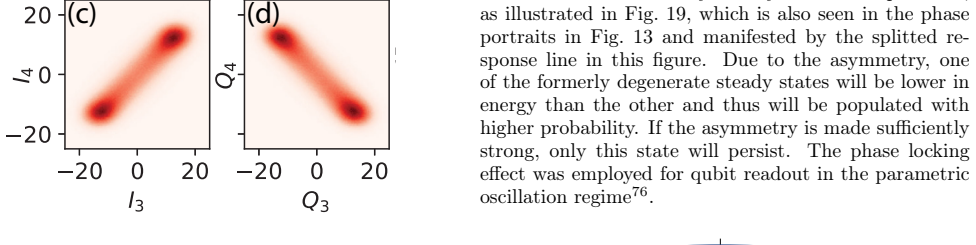
- [Sec. VB2, Eq. (87)] The 'about 30 times' SNR enhancement relative to the linear-amplifier result is carried over from the authors' Ref. 46 and is not independently derived or experimentally confirmed in this manuscript. For a review that aims to provide a quantitative map of parametric effects, this number should be explicitly labeled as a theoretical prediction of the balanced-mode model, with the parameter values (|B_n|² = 0.1 Γ, ε = Γ, α_n = Γ/100) stated in the main text next to Eq. (87) rather than only in the figure caption.
- [Sec. IVA1 and IVC] The experimental crossover at negative detuning shown in Fig. 14 and the discrepancy in the lower boundary of the period-tripling oscillations discussed in Sec. IVC are acknowledged but not analyzed. Given the review's claim of a comprehensive quantitative description, a short discussion of whether these discrepancies indicate a breakdown of the quasiclassical resonance approximation or the need to include noise-activated transitions would strengthen the paper.
minor comments (4)
- [Sec. IVA1 and figure insets] Several passages are reproduced verbatim from other publications without editorial integration, for example the paragraph beginning 'It is fair to ask whether we can interpret these results...' in Sec. IVA1 and the figure insets in Figs. 14, 15, 17, 18, 22, and 23. These should be rewritten in the authors' own voice or clearly set as quotations.
- [References] The reference numbering is inconsistent: Sec. IIIE cites Ref. 85 for a characterization measurement, while Ref. 85 is also cited in Sec. IVC for period-tripling, and some copied text contains internal citations such as '[13]' and '[21]' from the source papers. The bibliography needs renumbering and deduplication.
- [Sec. IVA2, Eq. (51)] Equation (51) factorizes the Hamiltonian only at the special point δ = −α_n/2, yet the connection to the quasiclassical amplitudes in Eqs. (49)-(50) is stated without spelling out the needed limit α_n ≪ ε_n and Γ_n → 0; adding this condition would prevent confusion.
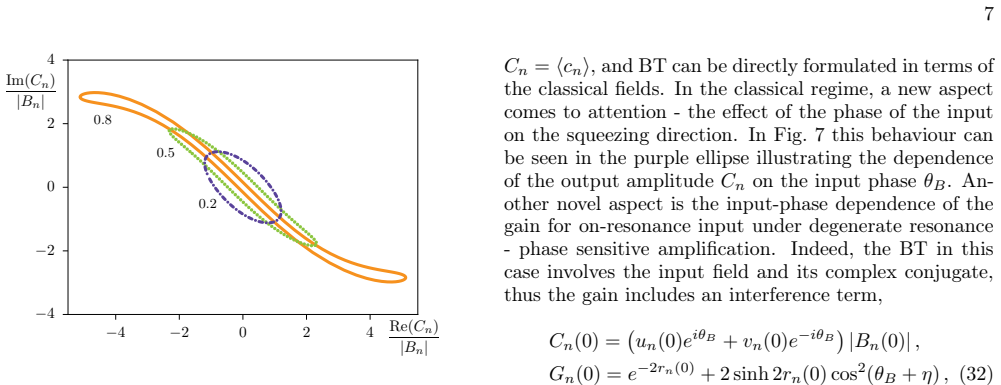
- [Fig. 7 caption] The caption refers to the 'purple curve' for the linear regime, and the text lists colors in a different order; please check the color correspondence so that the legend matches the plotted data.
Circularity Check
No circular step found: the core Langevin-to-Bogoliubov derivation is self-contained, while the four-mode squeezing and SNR results are explicitly delegated to the authors' own prior paper under an acknowledged artificial balanced-mode assumption.
full rationale
The paper's main derivation chain is explicit and self-contained: the cavity-SQUID Lagrangian gives the Hamiltonian (Eqs. 3-4), the quantum Langevin equation is written down (Eq. 5), and the rotating-wave/resonance approximation yields the effective two-mode Hamiltonian (Eq. 9) and the Langevin equations (Eq. 13). The linear input-output relations (Eqs. 21-23) are then solved algebraically, and the Bogoliubov identities (Eq. 24) follow from those coefficients. This central content does not reduce to its own inputs by construction and does not depend on any fitted parameter. The nonlinear extensions (Eqs. 33-36 and 37-39) are derived in the text by linearizing around strong intracavity fields. The four-mode squeezing and SNR enhancement (Eqs. 71 and 87) are presented as results of the balanced-mode model, which the paper itself states 'is rather artificial since real cavity parameters are strongly frequency dependent' (Sec. IIID3). That is a candid limitation, not a circular step: the calculation is attributed to the authors' earlier Ref. 46, but the input-output structure appears in the text, and the target quantity is not used to define the model. The experimental comparisons in Sec. IV partly use data from the authors' collaboration, and the Fig. 17 excerpt explicitly fits Kerr coefficients from the same data before comparing theory curves; this weakens independent confirmation but does not make the derivation circular. The paper also openly notes that quantum versus classical initiation of oscillations cannot be distinguished from steady-state data and that experimental testing of the nonlinear SNR enhancement is still pending. Overall, no equation reduces to its own input by definition, and no load-bearing uniqueness claim is imported solely from the authors' prior work.
Assumptions & free parameters
free parameters (3)
- Kerr coefficients alpha_3 and alpha_4 =
alpha_3/2pi = 71 kHz, alpha_4/2pi = 178 kHz
- Pump-to-fluxline calibration (epsilon vs applied signal) =
Not stated explicitly; established by scaling in Ref. 67
- Damping rates Gamma_n and Gamma_m =
Device-dependent; e.g., Gamma_n = 4/3 Gamma_m0 in Fig. 10
assumptions (5)
- domain assumption Resonance/rotating-wave approximation: delta, alpha_j, Gamma_j, epsilon_nm << omega_n - omega_m ~ omega_j.
- domain assumption Small flux modulation delta f(t) << 1 and small phase phi(d,t) << 1 so that cos(phi) and cos(f/2) can be expanded to low order.
- domain assumption Markovian input-output theory with white noise operators [b(t), b^dagger(t')] = delta(t-t') and constant loss rates Gamma_n.
- domain assumption Zero-temperature environment for the quantum fluctuation analysis.
- ad hoc to paper Balanced mode model: alpha_n = alpha_m and Gamma_n = Gamma_m.
Cite this review
Pith. "Pith review of Parametric effects in circuit quantum electrodynamics." pith.science (2026). https://pith.science/paper/DIJKVIAF
@misc{pith2026190805516,
  author       = {Pith},
  title        = {Pith review of: Parametric effects in circuit quantum electrodynamics},
  year         = {2026},
  howpublished = {\url{https://pith.science/paper/DIJKVIAF}},
  note         = {Machine review of arXiv:1908.05516}
}
read the original abstract
We review recent advances in the research on quantum parametric phenomena in superconducting circuits with Josephson junctions. We discuss physical processes in parametrically driven tunable cavity and outline theoretical foundations for their description. Amplification and frequency conversion are discussed in detail for degenerate and non-degenerate parametric resonance, including quantum noise squeezing and photon entanglement. Experimental advances in this area played decisive role in successful development of quantum limited parametric amplifiers for superconducting quantum information technology. We also discuss nonlinear down-conversion processes and experiments on self-sustained parametric and subharmonic oscillations.
Figures


Figures from the paper (22 more)








Reference graph
Works this paper leans on
-
[1]
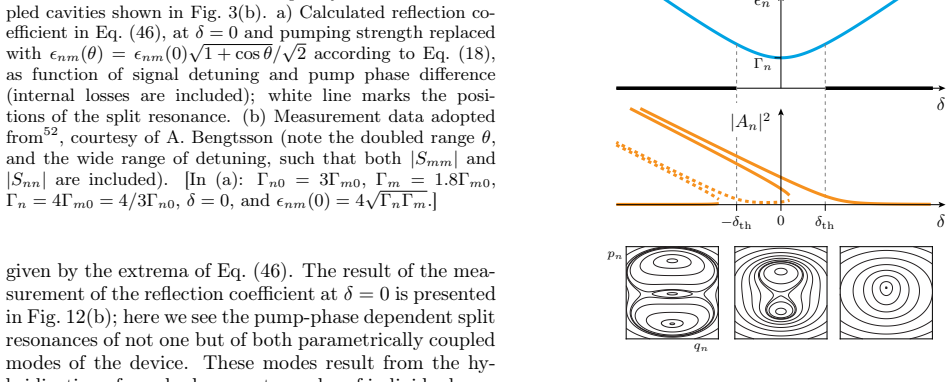
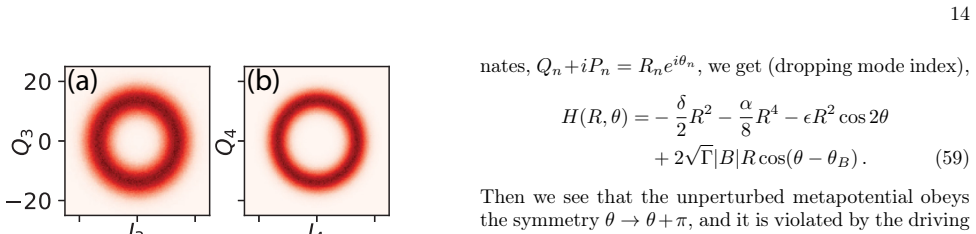
Quasiclassical description δ ǫn Γn δ0−δth δth |An|2 qn pn FIG. 13. Degenerate parametric oscillation. Upper panel: blue line indicates threshold of instability,ϵn(δ); bold black line indicate stability region of the ground state. Middle panel: stationary response to applied on-resonance signal vs detuning, intensity of the response indicates the one of th...
-
[2]
Bouwmeester et al., Nature (London) 390, 575 (1997)
D. Bouwmeester et al., Nature (London) 390, 575 (1997)
work page 1997
-
[3]
Balanced mode model In this model one assumes equal Kerr coefficients and damping rates for both modes,αn =αm, Γn = Γm. One has to admit that this model is rather artificial since real cavity parameters are strongly frequency dependent. As shown in46 diagonalization of the BT (40) within the bal- anced mode model is achieved with unitary transforma- tion, U ...
- [4]
- [5]
- [6]
- [7]
- [8]
Show all 43 references
-
[9]
Braggio et al
C. Braggio et al. , Europhys. Lett. 70, 754 (2005)
2005
-
[10]
W. Kim, J. Brownell, and R. Onofrio, Phys. Rev. Lett. 96, 200402 (2006)
2006
-
[11]
Y ablonovitch, Phys
E. Y ablonovitch, Phys. Rev. Lett. 62, 1742 (1989)
1989
-
[12]
Lozovik, V
Y u. Lozovik, V . Tsvetus, and E. Vinogradov, JETP Lett. 61, 723 (1995)
1995
-
[13]
Dodonov, A
V . Dodonov, A. Klimov, and D. Nikonov, Phys. Rev. A 47, 4422 (1993)
1993
-
[14]
J. R. Johansson et al. , Phys. Rev. A 82, 052509 (2010)
2010
-
[15]
Johansson et al
J. Johansson et al. , Phys. Rev. Lett. 103, 147003 (2009)
2009
-
[16]
Gu ¨ nter et al
G. Gu ¨ nter et al. , Nature (London) 458, 178 (2009)
2009
-
[17]
DeLiberato, C
S. DeLiberato, C. Ciuti, and I. Carusotto, Phys. Rev. Lett. 98, 103602 (2007)
2007
-
[18]
Milburn and C
G. Milburn and C. Holmes, Phys. Rev. A 44, 4704 (1991)
1991
-
[19]
M. I. Dykman et al. , Phys. Rev. E 57, 5202 (1998)
1998
-
[20]
Dodonov, Phys
V . Dodonov, Phys. Lett. A 207, 126 (1995)
1995
-
[21]
Marthaler and M
M. Marthaler and M. I. Dykman, Phys. Rev. A 73, 042108 (2006)
2006
-
[22]
Y urke et al
B. Y urke et al. , Phys. Rev. Lett. 60, 764 (1988)
1988
-
[23]
E. A. Tholen et al. , Appl. Phys. Lett. 90, 253509 (2007)
2007
-
[24]
M. A. Castellanos-Beltran et al. , Nature Phys. 4, 929 (2008)
2008
-
[25]
Abdo et al
B. Abdo et al. , Europhys. Lett. 85, 68 001 (2009)
2009
-
[26]
Sandberg et al
M. Sandberg et al. , Appl. Phys. Lett. 92, 203501 (2008)
2008
-
[27]
Palacios-Laloy et al
A. Palacios-Laloy et al. , J. Low Temp. Phys. 151, 1034 (2008)
2008
-
[28]
Y amamoto et al
T. Y amamoto et al. , Appl. Phys. Lett. 93, 042510 (2008)
2008
-
[29]
Wallquist, V
M. Wallquist, V . S. Shumeiko, and G. Wendin, Phys. Rev. B 74, 224506 (2006)
2006
-
[30]
Dodonov and V
A. Dodonov and V . Dodonov, Phys. Lett. A 289, 291 (2001)
2001
-
[31]
Schutzhold, G
R. Schutzhold, G. Plunien, and G. Soff, Phys. Rev. A 57, 2311 (1998)
1998
-
[32]
Serban and F
I. Serban and F. K. Wilhelm, Phys. Rev. Lett. 99, 137001 (2007). -20 -10 0 10 20 Quadrature Voltage -20 -10 0 10 20 In-Phase Voltage -20 -10 0 10 20 In-Phase Voltage -20 -10 0 10 20 In-Phase Voltage (a) )c()b( FIG. 3 (color online). Exploring the metapotential. 2D histograms o...
2007
-
[33]
Let us revisit the Hamiltonian for the degenerate resonance, Eq
Quantum cat states In spite of cumbersome form of the density matrix of parametric oscillator68–70and complex physics of quan- tum interstate transitions71–73, the question about the nature of the quantum ground state in the parametric oscillator has a surprisingly simple answ...
-
[34]
The peak appearing in the centre of the blue trace arises mainly from qubit relaxation before and during the read-out
Application to qubit readout The existence of parametric oscillation within a well defined interval of detuning can be employed for qubit 13 fidelity. The peak appearing in the centre of the blue trace arises mainly from qubit relaxation before and during the read-out. We analys...
2018
-
[35]
(2), |A3|2 = 2/Gamma14(δth(ϵ) − δ) α3/Gamma14 + α4/Gamma13 + 2α(/Gamma13 + /Gamma14), (7) |A4|2 = /Gamma13 /Gamma14 |A3|2
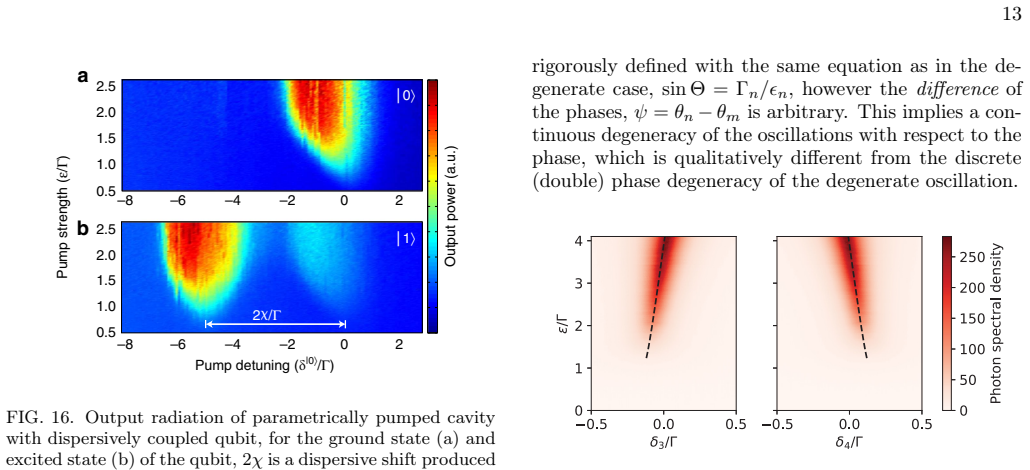
Output intensities A quantitative analysis of the intensity of the oscillations is performed by solving Eq. (2), |A3|2 = 2/Gamma14(δth(ϵ) − δ) α3/Gamma14 + α4/Gamma13 + 2α(/Gamma13 + /Gamma14), (7) |A4|2 = /Gamma13 /Gamma14 |A3|2. (8) The output intensity is given by the relat...
-
[36]
To this end, we choose the point in 144502-3 FIG
Phase dynamics We further investigate the phase properties of the para- metric oscillations. To this end, we choose the point in 144502-3 FIG. 17. Nondegenerate parametric oscillations of modes n = 3 and n = 4 observed experimentally67 emerge at finite detuning from the resonan...
2018
-
[37]
The output noise should also be influenced by the strong fluctuations of the oscillation phases discussed above
This process of four-mode amplifi- cation should result in four-mode quantum noise squeezing. The output noise should also be influenced by the strong fluctuations of the oscillation phases discussed above. In this section, we present data that corroborate the presence of the thr...
-
[38]
This effect is explained by a violation of the symmetry of the phase degeneracy by external driving
Injection locking It is generally known that in self-sustained oscillators possessing phase degeneracy, large phase fluctuations can be suppressed by injecting a small, but frequency stable, signal in resonance with the oscillator [ 37]. This effect is explained by a violation ...
-
[39]
processed
Phase locking Continuous phase degeneracy of non-degenerate para- metric oscillations and related phase diffusion leads to considerable broadening of the output linewidth. This effect is known in lasers and microwave generators, where it is eliminated, in particular, by injectin...
2017
-
[40]
Two-mode entanglement In the linear amplification regime, the output noise consists of coupled signal and idler modes, Eq. (21). In the quantum regime the photons of these modes are strongly correlated. The quantum properties of output noise are fully described with the quantum...
-
[41]
It is because now four modes be- come coupled
Four-mode entanglement The results of the previous section do not directly ap- ply to the noise in presence of a strong signal under non- degenerate resonance. It is because now four modes be- come coupled. To find the form of the squeezing operator in this case we resort to th...
-
[42]
The output signal here is,Cn = un(0)Bn, hence Pθ 0 = 8 πGn(0)|Bn|2 cos2(θ− θB − argu(0))
Linear amplification Consider now the the linear amplification under non- degenerate resonance. The output signal here is,Cn = un(0)Bn, hence Pθ 0 = 8 πGn(0)|Bn|2 cos2(θ− θB − argu(0)). The spectral density of the output noise is phase insensitive, Sθ n(∆) = (|un(∆)|2 +|vn(−∆)|2...
-
[43]
The magni- tude of the Kerr frequency shifts are however different for signal and noise (compare Eq
Nonlinear amplification In the nonlinear amplification regime the gains and optimal squeezing directions change for both the signal and the noise because of the Kerr effect. The magni- tude of the Kerr frequency shifts are however different for signal and noise (compare Eq. (33), ...
2014 arXiv
Reviewed August 14, 2026 · model on record in the stance chip above.
Discussion (0). Continue with ORCID to comment.