REVIEW 5 major objections 5 minor 13 references
Unsupervised Learning for Class Distribution Mismatch
T0 review · 5 major / 5 minor · reviewed 2026-08-15 · deepseek-v4-flash
Pith's one-line read A pretrained diffusion model can generate the positive and negative training pairs needed to solve class distribution mismatch without any labeled data.
desk verdict A genuinely new unsupervised CDM recipe with strong open-set gains, but the proofs have algebraic slips and the diffusion add/erase reliability is unaudited. read the letter →
The pith
A machine-rendered reading of the paper's core claim, the machinery that carries it, and where it could break.
The reading
What carries the argument
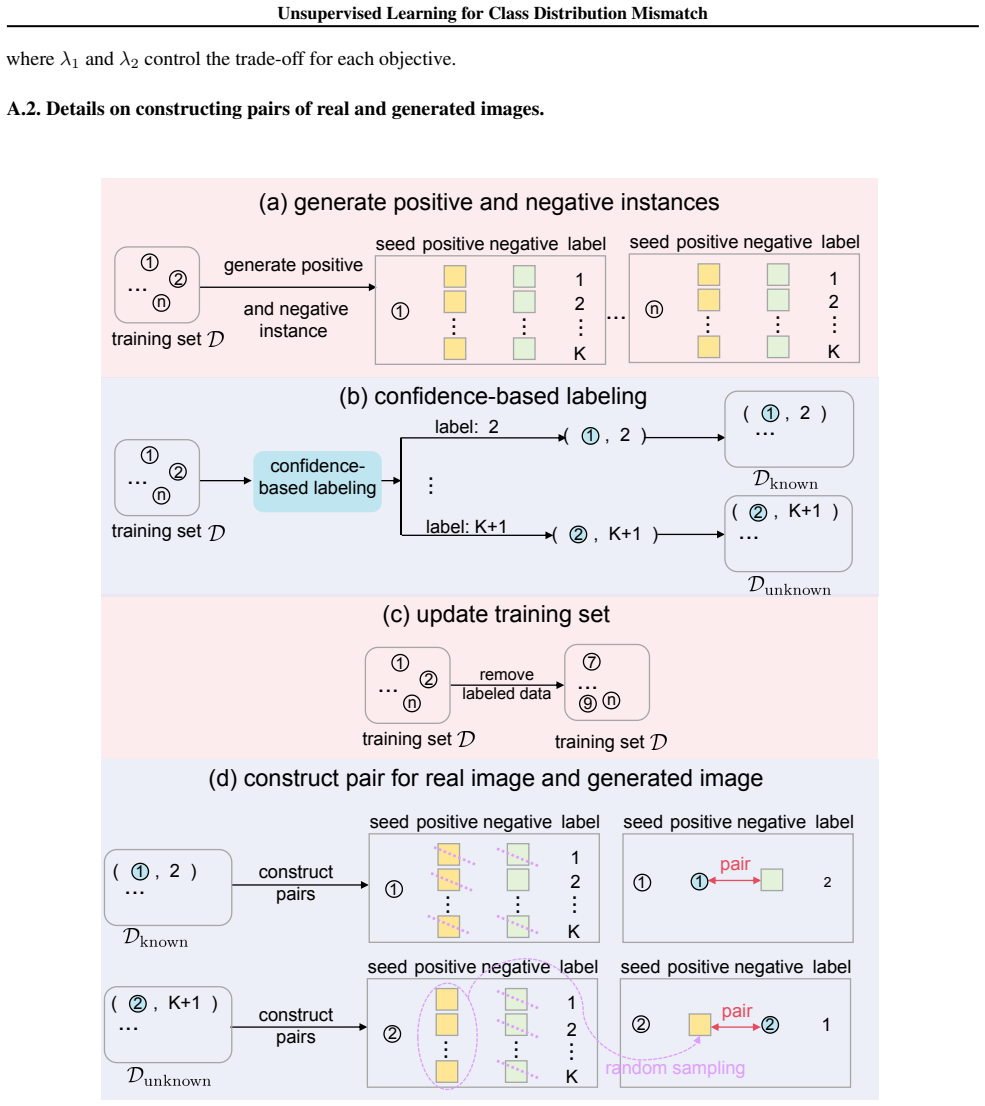
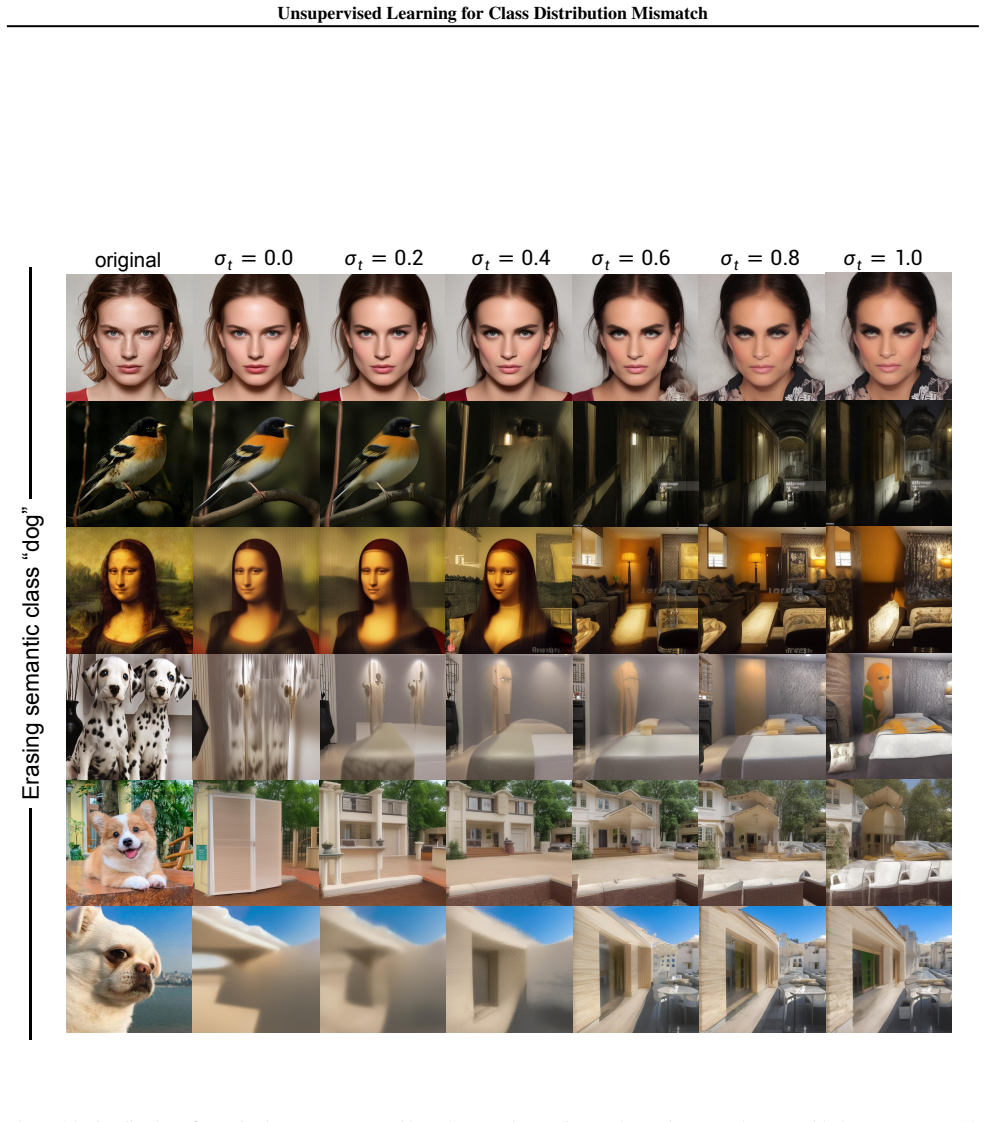
The central machinery is the diffusion-driven pair generator. It uses the score-based view of diffusion models, in which the conditional noise estimator points along the gradient of the conditional log-likelihood, so conditioning on class y creates the class and replacing the conditional estimator with the unconditional one erases it. Negative instances are produced by conditional DDIM inversion, which walks the noise vector in the direction that reduces the class likelihood, followed by unconditional DDIM reverse to recover the original image minus that class; positive instances are produced by adding noise to a seed and conditionally reversing with random noise strength \sigma_t = 1 for diversity. The second machinery is the confidence-based labeling rule: two (K+1)-way distributions, q and \tilde{q}, are formed by combining the binary open-set probabilities with the closed-set probabilities, and a real image receives a pseudo-label only when both distributions agree on the top class above a high threshold (\delta = 0.98). These labeled real images are then paired with generated negatives for known classes or generated positives for the 'other' class, converting an unlabeled dataset into a training signal without human annotation.
What would settle it
Take one known class at a time from Tiny-ImageNet, run the positive and negative generation pipelines on held-out images of that class, and measure with a human or a robust semantic-scoring model how often positives still lack the class or negatives still show it; if mislabeled pairs occur at a substantial rate for any class, the classifier is being trained on wrong labels even when aggregate accuracy looks high.
Extended reading notes
Core claim
The central claim is that semantic add-and-erase operations by a diffusion model provide enough weak supervision to train the whole class-distribution-mismatch pipeline, so the classifier can be learned from unlabeled images plus a list of known class names. Given a seed image, the pipeline constructs positives by noising the image and conditionally reversing toward a prompt such as 'A photo of a [CLASS].' It constructs negatives by conditional DDIM inversion to erase the class, followed by unconditional DDIM reverse to restore visual structure. The paper proves two supporting theorems: conditional inversion moves the noise vector along the negative gradient of the class-conditional log-likelihood, and unconditional reverse approximately removes only the class-specific semantic term while preserving the original image's visual characteristics. Each binary known-class classifier is trained to accept positives and reject negatives, the closed-set head is trained on positives, and iterative confidence-based labeling assigns pseudo-labels to real images whose two complementary open-set probability estimates agree at high confidence. On CIFAR-10, CIFAR-100, and Tiny-ImageNet, the method reports the highest balance scores across the mismatch proportions tested, including settings where several baselines collapse to near-zero unknown and new class accuracy.
Load-bearing premise
The whole pair-construction pipeline assumes that the pretrained Stable Diffusion model, prompted with 'A photo of [CLASS],' can reliably add or erase the semantic class of every known class on arbitrary seed images; the paper's own Figure 12 shows a failure case where the prompt 'papillon' turns a dog into a butterfly.
Editorial extensions
If this is right
- At 60% mismatch on Tiny-ImageNet, UCDM reports known, unknown, and new class accuracies of 15.8%, 94.9%, and 95.4%, against OpenMatch's 10.8%, 3.5%, and 5.9% with 40 labels per class.
- UCDM's closed-set accuracy improves or stays stable as the mismatch proportion increases, for example from 95.2% at 20% to 96.7% at 75% on CIFAR-10, suggesting negative instances become more useful as the unlabeled pool gets noisier.
- The same framework works at 0% mismatch, reporting high known-class accuracy and high rejection of unseen categories on CIFAR-10, so the negative-generation signal is not specific to heavily mismatched training sets.
- The confidence-based labeling step materially improves known-class accuracy: the ablation shows that adding real images paired with generated negatives or positives outperforms training on generated pairs alone.
- Raising the pseudo-label confidence threshold above 0.95 stabilizes open-set performance, which the paper attributes to fewer incorrect pseudo-labels entering training.
Reading between the lines
- A natural extension the paper does not test is to use multiple or per-instance prompts, or an LLM to expand the prompt set, to handle polysemous class names like 'papillon'; the paper's own Figure 12 shows exactly the failure mode this would address.
- If diffusion erasure is reliable, the same positive-negative construction could supply open-set training signal to neighbouring tasks where labels are the bottleneck but class names are known, such as out-of-distribution detection, active learning, or domain adaptation.
- The reported trade suggests the main cost shifts from human annotation to compute, since each seed image requires one diffusion forward pass per known class; whether that trade is worthwhile depends on how diffusion costs compare with a few manual labels per class.
- A direct stress test implied by the method is to swap the pretrained text-to-image model for a different one and check whether the gains survive, since the paper's claim is about diffusion-based semantic add and erase in general, not about a single checkpoint.
Signed reviews
Editorial analysis
A structured set of objections, weighed in public.
Referee Report
Summary. The paper proposes UCDM, an unsupervised method for class distribution mismatch (CDM) in which no ground-truth labels are used during training and only the names of the known classes are provided. UCDM samples seed images from the unlabeled training set and uses a pretrained Stable Diffusion model to generate positive instances (by adding the semantic class specified by a known-class prompt) and negative instances (by erasing the semantic class via conditional DDIM inversion followed by unconditional DDIM reverse). A confidence-based pseudo-labeling mechanism selects real images with high prediction confidence and incorporates them into training. The classifier is trained with a combination of open-set multi-binary losses and a closed-set loss. Experiments are reported on CIFAR-10, CIFAR-100, and Tiny-ImageNet across mismatch proportions of 20% to 75%, comparing against SCDMCT and SCDM baselines, with the claim that UCDM outperforms semi-supervised methods without using labels. Two theorems are provided to theoretically support the negative-instance generation pipeline.
Significance. If the empirical claims are correct, this would be a meaningful contribution: it removes the labeled-data requirement for CDM and shows that a frozen text-to-image diffusion model can generate effective training pairs for both closed-set and open-set classification. The study is broad (three datasets, four mismatch proportions, seven baselines), includes a held-out evaluation, provides a code link, and contains an ablation study of the loss components and generation pipelines. However, the central assumption that the pretrained diffusion model can reliably add and erase the semantic class of every known class from arbitrary seed images is not audited, the theoretical proofs contain algebraic inconsistencies, and several reported numbers and dataset configurations are internally inconsistent. These issues do not necessarily invalidate the framework, but they prevent the current version from being fully convincing.
major comments (5)
- [Appendix A.5, Eqs. (17)-(18), and Appendix A.7, Eq. (27)] The method's core assumption is that the pretrained Stable Diffusion model can, for every known class, (i) render that class into an arbitrary seed image and (ii) erase the class from a seed image while preserving other visual content. The paper provides only a handful of visualizations (Figures 12-20) and a CIFAR-10 ablation (Table 5) as evidence; it does not audit per-class success on the 20 known classes of Tiny-ImageNet, which include fine-grained or ambiguous names such as 'tailed frog', 'brain coral', 'southern black widow', and 'spiny lobster'. Figure 12 itself documents a polysemy failure ('papillon' being rendered as a butterfly when sampling from noise), and although the authors argue that starting from the seed image's latent avoids this, no systematic evaluation is presented. Since Eq. (13) optimizes against the labels y assigned to generated positives and negatives, any class for which generation fails introduces systematic label noise into the training data. The authors should provide a per-class audit for all known classes in every dataset, for example by measuring oracle classification accuracy of generated positives, human evaluation of erase fidelity, or an image-text consistency metric.
- [Abstract and Table 4] The theoretical derivations contain algebraic slips that, as written, break the proofs of Theorems 3.1 and 3.2. In Eq. (17), the coefficient of delta_{i+1} is sqrt(alpha_t) * (sqrt(1/alpha_{i+1}-1) - sqrt(1/alpha_i-1)); after defining s_i with the factor sqrt(alpha_t (1 - alpha_bar_{i+1})), this coefficient becomes s_i / sqrt(1 - alpha_bar_{i+1}), but Eq. (18) writes s_i / (1 - sqrt(alpha_bar_{i+1})). The same incorrect denominator is carried into Eq. (20). In Appendix A.7, Eq. (27), the double-sum coefficient s_i / sqrt(alpha_t (1 - alpha_bar_{j+1})) differs from what follows from Eq. (24) by a misplaced or missing 1/sqrt(alpha_t) factor. Because these theorems are invoked in Section 3.4 as theoretical support for the negative-instance pipeline, the authors should either correct the derivations or restate the theorems with valid hypotheses.
- [Section 4.2 and Appendix C.1, Tables 11, 14, 15] The abstract states that on Tiny-ImageNet with a 60% mismatch proportion, UCDM surpasses OpenMatch by 35.1%, 63.7%, and 72.5% in classifying known, unknown, and new classes. Table 4 reports absolute differences of 5.0, 91.4, and 89.5 percentage points for these three metrics at 60% mismatch; the values 35.1, 63.7, and 72.5 instead match CIFAR-100 at 60% mismatch in Table 3. The abstract thus misstates the main result, and the introduction's own numbers (5.0%, 91.4%, 89.5%) are inconsistent with the abstract. The abstract should be corrected to match the tables.
- [Tables 3 and 4] The dataset configurations are internally inconsistent. Section 4.2 states that CIFAR-10 includes 2 known, 6 unknown, and 2 new classes, but Table 11 lists 2 known, 5 unknown, and 3 new classes. The training-set counts in Table 14 (30,000 unknown images at 75% mismatch) are consistent with 6 unknown classes, not 5. Additionally, Table 15 reports 2,000 test images for each of the known, unknown, and new categories, which is impossible for CIFAR-10 with the stated class splits (2,000/5,000/3,000 test images for 2/5/3 classes) and its 10,000-image test set. These inconsistencies undermine the reproducibility of the experimental setup and should be corrected.
- [Tables 3 and 4] The baseline behavior in several reported settings appears degenerate and is not discussed. On CIFAR-100 and Tiny-ImageNet, IOMatch reports identical known/unknown/new accuracies of 0.0/100.0/100.0 across all mismatch proportions (Tables 3 and 4), which indicates the evaluated IOMatch collapses to predicting only the 'other' class. This makes IOMatch a vacuous comparator in those settings. The authors should clarify whether this behavior is expected under their evaluation protocol or whether the baseline implementation is problematic, and should discuss how it affects the comparison.
minor comments (5)
- [Section 2.1 and Table 1] The baseline is referred to as 'MTCF' in Section 2.1 but as 'MCTF' in Tables 1-4; the spelling should be made consistent.
- [Table 14] The entry '3,0000' for the 75% unknown-class count in CIFAR-10 should be '30,000', and the table header has duplicate 'kno. unkno.' labels that should be cleaned up.
- [Appendix A.3, Algorithm 2] The pseudo-code condition 'if epoch = ec then' does not match the text in Section 4.3, which describes an interval of 40 epochs and 10 labeling rounds; the algorithm should state the actual triggering condition, such as 'if epoch mod 40 == 0'.
- [Appendix B.8, Figure 12 caption] The caption reads 'original UCDM random', but each row contains six images; the caption should explain the layout, for example by labeling which columns correspond to 'original', 'UCDM', and 'random'.
- [Appendix B.7] The acronym 'UCMD' appears instead of 'UCDM' in the first sentence of Section B.7; this typo should be fixed.
Circularity Check
The erasure theorem restates the conditional-score construction, but the central CDM accuracy claims rest on held-out real images and are not circular.
-
self definitional
[Section 3.4, Theorem 3.1 (Eqs. 5-6) and Appendix A.5]
"The essence of erasing a semantic class lies in minimizing the likelihood of instance belonging to the positive instance’s class y. Inspired by Eq. (4), we propose conditional DDIM inversion, which employs a conditional DPM ... As demonstrated in Theorem 3.1, this process approximately moves x0 in the negative gradient direction of Pt−1 i=0 [∇xi logpθ(xi)si +∇xi logpθ(y|xi)si]."
The theorem's conclusion is the construction's input. Conditional DDIM inversion is defined by running the DDIM recurrence with the class-conditioned score ϵθ(xt,t,Cy), which by Eq. (4) equals −√(1−ᾱt)∇xt log pθ(xt|Cy), i.e. −√(1−ᾱt)[∇xt log pθ(xt) + ∇xt log pθ(y|xt)]. Substituting that same score into Eq. (2) with γ=1, σ=0 yields Theorem 3.1's Eq. (5)/(20) verbatim; the −∇ log pθ(y|xi) term is put in by construction, not discovered. Calling this a proof that the pipeline 'erases' class y also identifies the diffusion model's likelihood with the true semantic class, an unverified assumption (cf. the 'papillon' case in Fig. 12). This does not compromise the held-out empirical comparison, but it makes the theoretical support self-definitional.
full rationale
The paper's main result is an empirical comparison on real test sets (Tables 2-4); those numbers cannot be produced by construction from the training loss because test labels are never used in training. The confidence-based self-training loop reuses the model's own predictions as pseudo-labels, but the paper evaluates on held-out known/unknown/new classes and reports pseudo-label reliability (Appendix B.7), so this is standard self-training rather than a fitted-input-called-prediction scheme. The cited works with overlapping authors (Du et al. 2022; Zhang et al. 2023b) are background and are not load-bearing. The only circular element is the theoretical claim in Sec. 3.4: Theorem 3.1 'proves' that conditional DDIM inversion moves away from class y by expanding the very conditional score that defines the inversion; it is an algebraic restatement, and the jump from 'lower pθ(y|x)' to 'the image no longer contains the semantic class' is assumed rather than shown. Theorem 3.2 is a similar algebra of the same definitions. The approximation that δt is negligible is checked with the same diffusion model (Appendix A.4), which is an internal consistency check, not independent validation. Because the central claim is externally tested on held-out data, the circularity is limited to the theoretical support; score 2.
Assumptions & free parameters
free parameters (6)
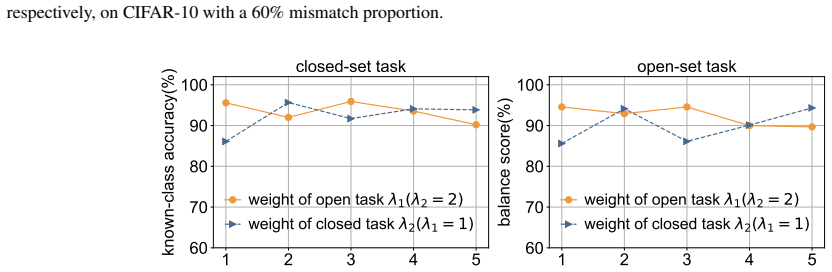
- lambda_2 loss weight =
2 (CIFAR-10), 5 (CIFAR-100), 20 (Tiny-ImageNet)
- Confidence threshold delta =
0.98
- sigma_t (positive generation) =
1.0
- sigma_t (negative generation) =
0.2
- DDIM steps =
20
- text guidance strength =
7.5
assumptions (4)
- domain assumption The pretrained Stable Diffusion 2.0 model provides accurate conditional and unconditional score estimates for the data distribution of the three evaluation datasets.
- domain assumption delta_t and tilde_delta_t are negligible for 20 DDIM steps.
- ad hoc to paper The approximation epsilon_theta(x_t,t,C) approx -sqrt(1-alpha_bar_t) grad log p_theta(x_{t-1}|C) + delta_t is valid.
- standard math Bayes rule and DDIM inversion formulas from Song et al. (2020a) are correct.
Cite this review
Pith. "Pith review of Unsupervised Learning for Class Distribution Mismatch." pith.science (2026). https://pith.science/paper/DISSGOSD
@misc{pith2026250506948,
  author       = {Pith},
  title        = {Pith review of: Unsupervised Learning for Class Distribution Mismatch},
  year         = {2026},
  howpublished = {\url{https://pith.science/paper/DISSGOSD}},
  note         = {Machine review of arXiv:2505.06948}
}
read the original abstract
Class distribution mismatch (CDM) refers to the discrepancy between class distributions in training data and target tasks. Previous methods address this by designing classifiers to categorize classes known during training, while grouping unknown or new classes into an "other" category. However, they focus on semi-supervised scenarios and heavily rely on labeled data, limiting their applicability and performance. To address this, we propose Unsupervised Learning for Class Distribution Mismatch (UCDM), which constructs positive-negative pairs from unlabeled data for classifier training. Our approach randomly samples images and uses a diffusion model to add or erase semantic classes, synthesizing diverse training pairs. Additionally, we introduce a confidence-based labeling mechanism that iteratively assigns pseudo-labels to valuable real-world data and incorporates them into the training process. Extensive experiments on three datasets demonstrate UCDM's superiority over previous semi-supervised methods. Specifically, with a 60% mismatch proportion on Tiny-ImageNet dataset, our approach, without relying on labeled data, surpasses OpenMatch (with 40 labels per class) by 35.1%, 63.7%, and 72.5% in classifying known, unknown, and new classes.
Figures


Figures from the paper (18 more)








Reference graph
Works this paper leans on
-
[1]
Azizi, S., Kornblith, S., Saharia, C., Norouzi, M., and Fleet, D. J. Synthetic data from diffusion models improves imagenet classification. arXiv preprint arXiv:2304.08466,
-
[4]
Unsupervised rep- resentation learning by predicting image rotations
Gidaris, S., Singh, P., and Komodakis, N. Unsupervised rep- resentation learning by predicting image rotations. arXiv preprint arXiv:1803.07728,
-
[6]
Ho, J. and Salimans, T. Classifier-free diffusion guidance. arXiv preprint arXiv:2207.12598,
-
[7]
Understanding diffusion models: A unified perspec- tive
Luo, C. Understanding diffusion models: A unified perspec- tive. arXiv preprint arXiv:2208.11970,
-
[8]
Denoising diffusion im- plicit models
Song, J., Meng, C., and Ermon, S. Denoising diffusion im- plicit models. arXiv preprint arXiv:2010.02502, 2020a. Song, Y ., Sohl-Dickstein, J., Kingma, D. P., Kumar, A., Er- mon, S., and Poole, B. Score-based generative modeling through stochastic differential equations. arXiv preprint arXiv:2011.13456, 2020b. Tack, J., Mo, S., Jeong, J., and Shin, J. Csi...
arXiv 2010
-
[9]
Loss weight configurations. and classification tasks. B.6. Evaluation of the Impact of the Batch Normalization Layer on Model Training Several studies (Oliver et al., 2018; Zhao et al., 2020
work page 2018
-
[11]
How out-of- distribution data hurts semi-supervised learning
Zhao, X., Krishnateja, K., Iyer, R., and Chen, F. How out-of- distribution data hurts semi-supervised learning. In 2022 IEEE International Conference on Data Mining (ICDM), pp. 763–772. IEEE,
work page 2022
-
[21]
Generated hard training pairs where positive and negative instances are highly similar. Negative instances are created by guiding the generation process with a carefully designed prompt, such as “erase hole from button.” This approach removes crucial features from seed samples and shifts the original semantics. 34 Unsupervised Learning for Class Distribut...
work page 2009
Show all 13 references
-
[2016]
Class relationship em- bedded learning for source-free unsupervised domain adaptation
Zhang, Y ., Wang, Z., and He, W. Class relationship em- bedded learning for source-free unsupervised domain adaptation. In Proceedings of the IEEE/CVF Conference on Computer Vision and Pattern Recognition (CVPR), pp. 7619–7629, June 2023a. Zhang, Y ., Zhou, D., Hooi, B., Wang,...
2010 arXiv
-
[2020]
Is synthetic data from generative models ready for image recognition? arXiv preprint arXiv:2210.07574,
He, R., Sun, S., Yu, X., Xue, C., Zhang, W., Torr, P., Bai, S., and Qi, X. Is synthetic data from generative models ready for image recognition? arXiv preprint arXiv:2210.07574,
-
[2022]
Dunlap, L., Umino, A., Zhang, H., Yang, J., Gonzalez, J
doi: 10.1109/ TPAMI.2022.3188807. Dunlap, L., Umino, A., Zhang, H., Yang, J., Gonzalez, J. E., and Darrell, T. Diversify your vision datasets with automatic diffusion-based augmentation. Advances in neural information processing systems, 36:79024–79034,
2022
-
[2023]
Imagenet: A large-scale hierarchical image database
Deng, J., Dong, W., Socher, R., Li, L.-J., Li, K., and Fei-Fei, L. Imagenet: A large-scale hierarchical image database. In 2009 IEEE conference on computer vision and pattern recognition, pp. 248–255. Ieee,
2009
-
[2024]
Multi-task cur- riculum framework for open-set semi-supervised learning
Yu, Q., Ikami, D., Irie, G., and Aizawa, K. Multi-task cur- riculum framework for open-set semi-supervised learning. In Computer Vision–ECCV 2020: 16th European Con- ference, Glasgow, UK, August 23–28, 2020, Proceedings, Part XII 16, pp. 438–454. Springer,
2020
Reviewed August 15, 2026 · model on record in the stance chip above.
Discussion (0). Continue with ORCID to comment.