REVIEW 3 major objections 4 minor 149 references
This proof-of-concept shows that stacking the predicted lines of all singly 13C-substituted isotopologues of a PAH can recover a single aggregate signal from TMC-1 data, and that existing observations would separate a locally formed aromati
Reviewed by Pith at T0; open to challenge. T0 means a machine referee read the full paper against a public rubric. the ladder, T0–T4 →
Spectral-line stacking can recover aggregate 13C-isotopologue emission without false positives, and existing TMC-1 observations could distinguish a local from an enriched carbon-isotope ratio in PAHs if the needed lab spectra existed.
T0 review reviewed 2026-08-01 challenge →
load-bearing objection Clean stress-test of stacking methods, but the PAH sensitivity forecast rests on unvalidated line lists — conditional proof-of-concept, not a result. the 3 major comments →
Exploring the Limits of Spectral Line Stacking in Spectral Line Data and Application Toward the Detection of Bulk $^{13}$C Enrichment of Aromatics in TMC-1
The pith
A machine-rendered reading of the paper's core claim, the machinery that carries it, and where it could break.
The reading
Core claim
The central claim is a conditional sensitivity forecast: if laboratory rotational spectra of all singly 13C-substituted isotopologues of the cyanonaphthalene and cyanopyrene isomers were available, the GOTHAM observations of TMC-1 would already be sensitive enough to discriminate, at a 5σ matched-filter threshold, between a local, bulk 12C/13C ratio of about 69 and an enhanced 13C abundance with a ratio at or below about 30. The paper also establishes, through synthetic line-confusion stress tests, that stacking many predicted lines into one matched filter cannot be fooled into a false positive by hidden sub-noise lines—the recovered significance instead collapses toward 1σ as line density a
What carries the argument
Spectral line stacking and matched filtering: relevant rotational transitions of a molecule (or of all isotopologues summed into one aggregate spectrum) are extracted from a broadband survey, re-gridded into velocity space with line centers aligned, and SNR-weighted; the stacked simulated spectrum then serves as a matched filter cross-correlated with the stacked data. The load-bearing statistic is the apparent SNR, SNR_app = (S + N_c)/(N_w + N_c), which in the limit of strong line confusion approaches unity, so buried lines can suppress but never manufacture a 5σ detection. The 5σ impulse-response threshold is the adopted detection criterion.
Load-bearing premise
The forecast depends on the assumption that the rotationally scaled quantum-chemical spectra predict the true 13C isotopologue line frequencies and intensities closely enough that real lines fall inside the matched filter's passband—if the predicted positions or relative strengths are off, the simulated 5σ discrimination thresholds do not transfer to actual observations.
What would settle it
Measure the laboratory rotational spectrum of a single singly 13C-substituted isotopologue of 1-cyanonaphthalene, shift it to TMC-1's velocity, and run it through the paper's stacking-and-filtering pipeline in place of the predicted spectrum; if the recovered impulse response drops below the simulated 5σ threshold at 12C/13C ≈ 30, the central forecast fails.
If this is right
- If the forecast holds, a >5σ aggregate detection of 13C-cyanonaphthalene or 13C-cyanopyrene at the local bulk ratio would argue for (though not prove) a circumstellar, top-down inheritance origin, since in-situ formation in TMC-1 would be expected to dilute rather than enrich 13C.
- A non-detection would weigh against an enhanced-13C inheritance scenario, because simulations show that at 12C/13C ≤ ~30 a robust detection should be obtained regardless of the noise realization.
- The demonstrated recovery of aggregate 13C signal from HC9N shows the technique already works on real observations and can yield preliminary, loose isotope-ratio constraints in advance of detailed MCMC fitting.
- The line-confusion stress tests establish that stacking results cannot be artificially inflated by hidden lines, so previously reported stacked detections are not vulnerable to this particular false-positive pathway.
- The sensitivity curves can be used to prioritize which isotopologue laboratory spectra to measure: molecules with strong predicted aggregate signal are the ones where laboratory effort is most likely to result in a detection or a meaningful limit.
Where Pith is reading between the lines
- The test is asymmetric in a way the authors note but do not emphasize: an enriched-13C detection cleanly supports inheritance, but a bulk-ratio detection does not cleanly rule it out, because circumstellar PAHs need not always be 13C-enriched; the useful null result is the non-detection at the enrichment threshold.
- The forecast's weakest link—the accuracy of the scaled quantum-chemical spectra—can be tested incrementally: measuring even one 13C isotopologue in the laboratory and checking that its strongest lines fall inside the matched-filter passband would validate or invalidate the entire sensitivity argument before large observational effort is spent.
- The same aggregate-stacking logic should transfer to other isotopic substitutions (15N, D) and to families of related molecules, potentially turning isotopic stacking into a general provenance tool for interstellar complex molecules.
- The paper's own caution about the hidden-line power-law extrapolation (Appendix A: 'no compelling physical reason') implies that the 5σ thresholds carry an unquantified systematic uncertainty; a direct line-count comparison with the higher-frequency QUIJOTE survey at frequencies where cyanopyrene lines cluster would test the hidden-line model.
Editorial analysis
A structured set of objections, weighed in public.
Referee Report
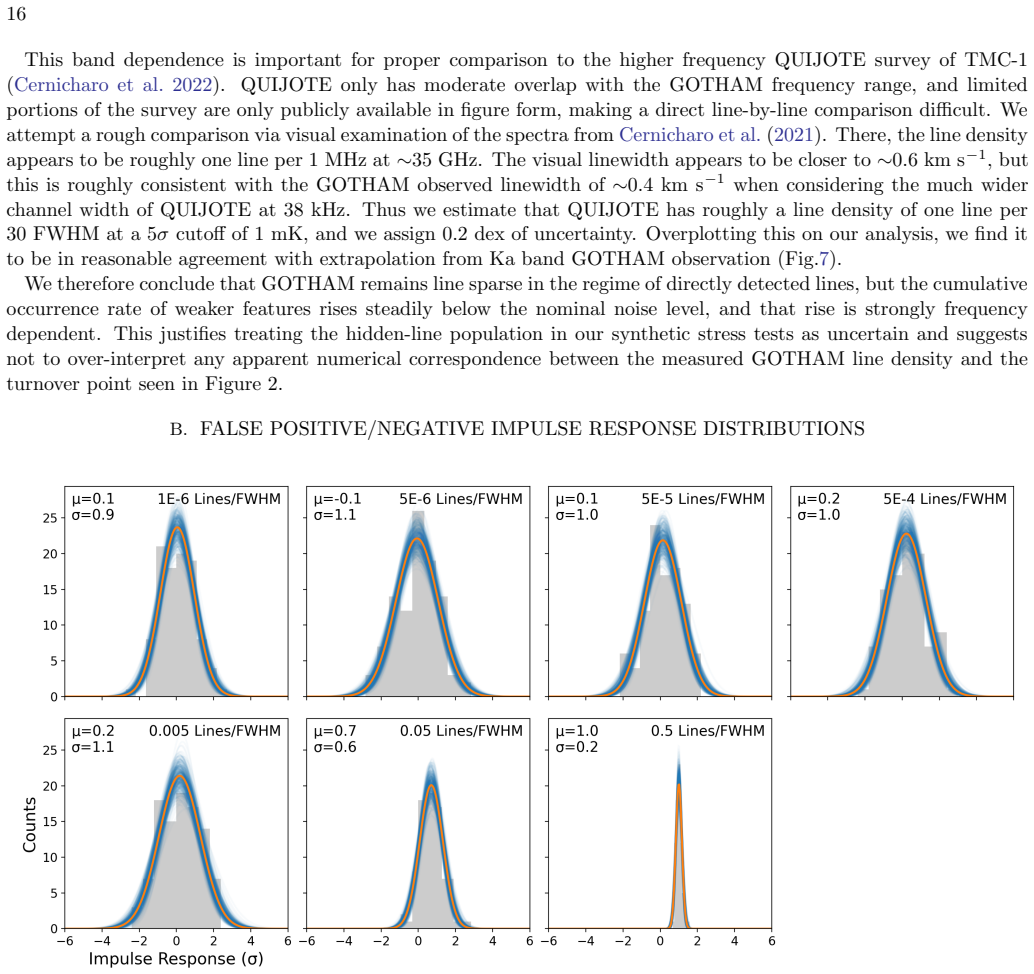
Summary. The paper develops and stress-tests a spectral line stacking / matched-filtering method for recovering aggregate emission from many singly substituted 13C isotopologues in the GOTHAM TMC-1 survey. Synthetic injection-recovery experiments with n=100 trials per line density show that the matched-filter response is centered near 0σ for absent signals and degrades to ~1σ under complete line confusion, implying that buried lines cannot inflate false positives above the adopted 5σ threshold (§3.1, Eqs. 1–2). The method is demonstrated on HC9N isotopologues in real GOTHAM data, giving a 14.5σ aggregate stack, with a rough 12C/13C ratio of 130 (§3.2). The main forecast is for cyanonaphthalene and cyanopyrene: using quantum-chemically predicted 13C spectra, the authors simulate that at 12C/13C≲30 current observations would yield >5σ aggregate detections, whereas at the local bulk ratio ~69 they would not, potentially distinguishing in-situ from inherited PAH formation (§3.3).
Significance. If the forecast is correct, the paper provides a clear observational route to discriminating in-situ from inherited PAH formation and justifies costly laboratory measurements. Its strengths are the controlled injection-recovery design with known ground truth, the large number of Monte Carlo trials, the explicit false-positive/false-negative analysis, and the candid discussion of caveats (power-law extrapolation, need for laboratory spectra). However, the headline discrimination claim is only as strong as the unvalidated quantum-chemical 13C line lists and the circular HC9N calibration; these are load-bearing and need further work or qualification.
major comments (3)
- [§3.3, §2.3.1] The central PAH forecast is a self-consistency test: the same quantum-chemically predicted 13C line lists (M06-2X/6-31+G(d), parent-constant scaling, unchanged centrifugal/hyperfine constants; §2.3.1) are used both to inject and to recover signal in §3.3. No validation against experimental 13C spectra is provided. The text itself concedes that 'laboratory accuracy will still be required.' How large a frequency error is tolerable? A 1 MHz offset at 10 GHz is ~30 km/s, two orders of magnitude larger than the 0.4 km/s line width; even 0.1 MHz offsets would materially degrade the matched-filter response. Because the same line list appears on both sides, the simulated >5σ thresholds at 12C/13C≈30 cannot establish that real laboratory spectra would produce a detection. Please add a sensitivity analysis over plausible scaling errors, or a validation against measured 13C spectra of a known molec
- [§3.2, Conclusions] The HC9N application is partly circular. The aggregate simulation's 12C/13C ratio is 'empirically scaled ... to a value of 130 to match the spectral stack intensity by eye' (§3.2), and the Conclusions then state 'the lower limit of the carbon isotope ratio for HC9N estimated from our presented analysis is consistent with previous estimates.' A value adjusted to fit the stack cannot be independently validated with that same stack, and no uncertainty is quoted. As a proof of aggregate recovery the section is convincing; as an isotopic constraint it is not. Either remove the interpreting sentence and present the 130 as a calibration parameter, or incorporate the forthcoming MCMC fit (Burkhardt 2026) with quoted uncertainties.
- [§3.1.3, Appendix A] The paper is admirably explicit that the hidden-line density estimate is 'highly speculative' and that the power-law extrapolation has 'no compelling physical reason.' This caveat matters because vertical line A in Fig. 2 and the claim that GOTHAM's SNR is 'slightly depressed' depend on that extrapolation. The controlled injection-recovery experiments (n=100) stand on their own, but the application to GOTHAM's actual line-confusion regime is model-dependent. The text should mark the GOTHAM-specific depression claim as an illustration under an assumed line density, not a measurement.
minor comments (4)
- [§3.3.2] The text refers to 'all four isomers' of cyanopyrene but enumerates three (1-, 2-, and 4-cyanopyrene) and the counts 17+17+11=45. Please correct 'four' to 'three'.
- [Eq. (1)] The symbols S, N_c, N_w are defined in the sentence after the equation; moving these definitions before the equation would improve readability.
- [Appendix A] The expression 'n σσ local,i' appears to contain a typographical duplication of σ; it should likely be nσ × σ_local,i.
- [Figure 2 caption] The caption describes the pink dataset as 'showing false negative detection rates' but does not explicitly say that the orange dataset shows false positives; consider making this explicit for clarity.
Circularity Check
HC9N 12C/13C 'lower limit' is the eye-fitted input presented as an output; the PAH forecast is self-consistent and not circular.
specific steps
-
fitted input called prediction
[§3.2 (HC9N demonstration) and §5 (Conclusions)]
"Because we did not perform detailed MCMC fitting to the individual species, we empirically scaled the bulk 12C/13C ratio to a value of 130 to match the spectral stack intensity by eye. This ratio should be viewed as a loose estimate; a more rigorous analysis will be presented later in Burkhardt (2026). ... The lower limit of the carbon isotope ratio for HC9N estimated from our presented analysis is consistent with previous estimates of cyanopolyynes in TMC-1 that are thought to be formed in situ in the cloud itself."
The 12C/13C value of 130 was not derived from an independent fitting procedure; it was chosen as the scaling that makes the simulated stack match the observed stack 'by eye.' The Conclusions then report a 'lower limit ... estimated from our presented analysis,' turning the tuned input into a measured constraint. No separate recovery-curve inversion is performed for HC9N, so the 'constraint' is the input parameter itself. The claimed consistency with previous cyanopolyyne ratios therefore reflects the tuning choice, not an independently estimated limit from the stack.
full rationale
The central PAH forecast is a conditional, self-contained simulation: synthetic signals from calculated 13C-isotopologue spectra are injected into synthetic noise with GOTHAM-like properties and then recovered with the same matched-filter procedure. This tests statistical sensitivity under the stated assumption that the calculated spectra are representative; the paper explicitly defers to future laboratory spectra, so this is an unvalidated assumption rather than a circular reduction. The false-positive/false-negative tests and the line-density analysis are also self-contained synthetic experiments. The one genuine circular step is the HC9N demonstration: the bulk 12C/13C ratio is fitted by eye to match the observed stack amplitude, and then the Conclusions present the resulting value as a 'lower limit ... estimated from our presented analysis.' That is a fitted input renamed as a derived constraint. The paper's own caveats ('loose estimate', 'no compelling physical reason' for the line-density power law) partially mitigate the overstatement, but the circular move in the Conclusions remains. No load-bearing self-citation or uniqueness-importation chain was found.
Axiom & Free-Parameter Ledger
free parameters (2)
- HC9N 12C/13C ratio used in aggregate simulation =
130
- Injected interfering line intensity =
1σ local RMS
axioms (5)
- domain assumption The 13C isotopologue rotational spectra used for PAH forecasts can be accurately approximated by scaling parent rotational constants and assuming identical centrifugal distortion and 14N hyperfine constants.
- domain assumption The hidden line population below the GOTHAM noise level is adequately represented by synthetic asymmetric-rotor catalogs with lines injected at 1σ local RMS.
- domain assumption All isotopologues share a single velocity component, excitation temperature, linewidth, and (for HC9N) equal column density.
- standard math A 5σ matched-filter response yields 0.00003% false-alarm probability under Gaussian white noise and no competing signals.
- ad hoc to paper Power-law extrapolation of line density below the noise is a valid estimate of hidden-line density.
Cite this review
Pith. "Pith review of Exploring the Limits of Spectral Line Stacking in Spectral Line Data and Application Toward the Detection of Bulk $^{13}$C Enrichment of Aromatics in TMC-1." pith.science (2026). https://pith.science/paper/DJ52NJM5
@misc{pith2026260727382,
  author       = {Pith},
  title        = {Pith review of: Exploring the Limits of Spectral Line Stacking in Spectral Line Data and Application Toward the Detection of Bulk $^13$C Enrichment of Aromatics in TMC-1},
  year         = {2026},
  howpublished = {\url{https://pith.science/paper/DJ52NJM5}},
  note         = {Machine review of arXiv:2607.27382}
}
abstract
The formation history of polycyclic aromatic hydrocarbons (PAHs) in the interstellar medium remains a topic of active debate, with proposed mechanisms ranging from high-temperature stellar ejecta processes to low-temperature chemistry within molecular clouds. Recently, the identification of small PAHs in the cold, dark cloud TMC-1 has provided some circumstantial evidence of the latter. If these are formed in situ, their isotopic ratios, particularly $^{12}$C/$^{13}$C, should reflect the local, bulk material of the molecular cloud; in contrast, PAHs formed in the circumstellar envelopes of evolved stars may show enhanced $^{13}$C abundances. The expected radio signals of these $^{13}$C substituted species will be faint, and thus we conducted a detailed proof-of-concept analysis examining whether spectral line stacking and matched filtering techniques can robustly retrieve signal from multiple singly substituted $^{13}$C isotopologues in aggregate. We find that while retrieved signal decreases in the limit of spectral line confusion, false-positive detections are exceedingly improbable at the adopted 5$\sigma$ matched filter response detection threshold. We then demonstrate the technique on actual observational data of isotopologues of HC$_9$N toward TMC-1. Finally, we show using synthetic data that if laboratory rotational spectra of all singly substituted $^{13}$C isotopologues of cyanonaphthalene and cyanopyrene isomers existed, current observations of TMC-1 would be sensitive enough to discriminate between a local, bulk $^{12}$C/$^{13}$C ratio and one with an enhanced $^{13}$C abundance suggestive of inheritance.
Figures


Reference graph
Works this paper leans on
-
[1]
Astronomy & Astrophysics , author =
Discovery of. Astronomy & Astrophysics , author =. 2021 , pages =. doi:10.1051/0004-6361/202142634 , urldate =
-
[2]
and Frenklach, Michael , month = dec, year =
Feigelson, Eric D. and Frenklach, Michael , month = dec, year =
-
[3]
Reports on Progress in Physics , author =
Isotopes in the interstellar medium and circumstellar envelopes , volume =. Reports on Progress in Physics , author =. 1999 , pages =. doi:10.1088/0034-4885/62/2/002 , number =
-
[4]
Wenzel, Gabi and Holdren, Martin S. and Stewart, D. Archie and Toru Shay, Hannah and Byrne, Alex N. and Xue, Ci and McGuire, Brett A. , month = may, year =. Laboratory. The Journal of Physical Chemistry A , publisher =. doi:10.1021/acs.jpca.5c00980 , abstract =
-
[5]
Bryan and Holdren, Martin S
Wenzel, Gabi and Gong, Siyuan and Xue, Ci and Changala, P. Bryan and Holdren, Martin S. and Speak, Thomas H. and Stewart, D. Archie and Fried, Zachary T. P. and Willis, Reace H. J. and Bergin, Edwin A. and Burkhardt, Andrew M. and Byrne, Alex N. and Charnley, Steven B. and Lipnicky, Andrew and Loomis, Ryan A. and Shingledecker, Christopher N. and Cooke, I...
2041
-
[6]
The Astrophysical Journal , author =
Detection of five. The Astrophysical Journal , author =. 1990 , pages =. doi:10.1086/185816 , language =
-
[7]
Stockett, Mark H. and Bull, James N. and Cederquist, Henrik and Indrajith, Suvasthika and Ji, MingChao and Navarro Navarrete, José E. and Schmidt, Henning T. and Zettergren, Henning and Zhu, Boxing , month = jan, year =. Efficient stabilization of cyanonaphthalene by fast radiative cooling and implications for the resilience of small. Nature Communication...
-
[8]
First direct detection of large polycyclic aromatic hydrocarbons on asteroid (162173). Natural Sciences , author =. 2024 , note =. doi:10.1002/ntls.20240010 , abstract =
-
[9]
Astronomy & Astrophysics , author =
Formation and destruction of polycyclic aromatic hydrocarbon clusters in the interstellar medium , volume =. Astronomy & Astrophysics , author =. 2006 , pages =. doi:10.1051/0004-6361:20065412 , number =
-
[10]
Proceedings of the IEEE , author =
An. Proceedings of the IEEE , author =. 1963 , keywords =. doi:10.1109/PROC.1963.2383 , abstract =
arXiv 1963
-
[11]
Montillaud, J. and Joblin, C. and Toublanc, D. , month = apr, year =. Evolution of polycyclic aromatic hydrocarbons in photodissociation regions -. Astronomy & Astrophysics , publisher =. doi:10.1051/0004-6361/201220757 , abstract =
-
[12]
Milam, S. N. and Woolf, N. J. and Ziurys, L. M. , month = dec, year =. The Astrophysical Journal , publisher =. doi:10.1088/0004-637X/690/1/837 , abstract =
-
[13]
Micelotta, E. R. and Jones, A. P. and Tielens, A. G. G. M. , month = feb, year =. Polycyclic aromatic hydrocarbon processing by cosmic rays , volume =. Astronomy & Astrophysics , publisher =. doi:10.1051/0004-6361/201015741 , abstract =
-
[14]
Laboratory rotational spectroscopy of cyano substituted polycyclic aromatic hydrocarbons , volume =
McNaughton, Don and Jahn, Michaela K and Travers, Michael J and Wachsmuth, Dennis and Godfrey, Peter D and Grabow, Jens-Uwe , month = jun, year =. Laboratory rotational spectroscopy of cyano substituted polycyclic aromatic hydrocarbons , volume =. Monthly Notices of the Royal Astronomical Society , publisher =. doi:10.1093/mnras/sty557 , abstract =
-
[15]
McCarthy, M.C. and Levine, E.S. and Apponi, A.J. and Thaddeus, P. , month = sep, year =. Experimental. Journal of Molecular Spectroscopy , publisher =. doi:10.1006/jmsp.2000.8149 , language =
arXiv 2000
-
[16]
Science (New York, N.Y.) , author =
Detection of two interstellar polycyclic aromatic hydrocarbons via spectral matched filtering , volume =. Science (New York, N.Y.) , author =. 2021 , pages =. doi:10.1126/science.abb7535 , abstract =
-
[17]
Loomis, Ryan A. and Öberg, Karin I. and Andrews, Sean M. and Walsh, Catherine and Czekala, Ian and Huang, Jane and Rosenfeld, Katherine A. , month = apr, year =. Detecting. The Astronomical Journal , publisher =. doi:10.3847/1538-3881/aab604 , abstract =
-
[18]
Loomis, Ryan A. and Burkhardt, Andrew M. and Shingledecker, Christopher N. and Charnley, Steven B. and Cordiner, Martin A. and Herbst, Eric and Kalenskii, Sergei and Lee, Kin Long Kelvin and Willis, Eric R. and Xue, Ci and Remijan, Anthony J. and McCarthy, Michael C. and McGuire, Brett A. , month = feb, year =. An investigation of spectral line stacking t...
-
[19]
Lee, Kin Long Kelvin and McCarthy, Michael , month = feb, year =. Bayesian. The Journal of Physical Chemistry A , publisher =. doi:10.1021/acs.jpca.9b09982 , abstract =
-
[20]
Langston, G. and Turner, B. , month = mar, year =. Detection of. The Astrophysical Journal , publisher =. doi:10.1086/511332 , abstract =
-
[21]
doi:10.1051/978-2-7598-2482-3 , abstract =
Joblin, Christine and Tielens, Alexander Godfried Gerardus Maria , month = nov, year =. doi:10.1051/978-2-7598-2482-3 , abstract =
-
[22]
and Simonsson, Ansgar and Denifl, Stephan and Cederquist, Henrik and Schmidt, Henning T
Gatchell, Michael and Ameixa, João and Ji, MingChao and Stockett, Mark H. and Simonsson, Ansgar and Denifl, Stephan and Cederquist, Henrik and Schmidt, Henning T. and Zettergren, Henning , month = nov, year =. Survival of polycyclic aromatic hydrocarbon knockout fragments in the interstellar medium , volume =. Nature Communications , publisher =. doi:10.1...
-
[23]
The Astrophysical Journal , publisher =
Furuya, Kenji and Aikawa, Yuri and Sakai, Nami and Yamamoto, Satoshi , month = mar, year =. The Astrophysical Journal , publisher =. doi:10.1088/0004-637X/731/1/38 , abstract =
-
[24]
The Astrophysical Journal , author =
Formation of polycyclic aromatic hydrocarbons in circumstellar envelopes , volume =. The Astrophysical Journal , author =. 1989 , pages =. doi:10.1086/167501 , abstract =
doi:10.1086/167501 1989
-
[25]
Astronomy & Astrophysics , author =
Carbon isotopic fractionation in molecular clouds , volume =. Astronomy & Astrophysics , author =. 2020 , note =. doi:10.1051/0004-6361/202038251 , abstract =
-
[26]
Polycyclic aromatic hydrocarbons and the unidentified infrared emission bands: auto exhaust along the milky way. , volume =. The Astrophysical Journal , author =. 1985 , pages =. doi:10.1086/184435 , abstract =
doi:10.1086/184435 1985
-
[27]
The Astrophysical Journal , author =
Low-temperature. The Astrophysical Journal , author =. 2020 , pages =. doi:10.3847/1538-4357/ab62b7 , abstract =
-
[28]
The Journal of Physical Chemistry A , author =. 2022 , pages =. doi:10.1021/acs.jpca.1c08310 , language =
-
[29]
Nature Communications , author =
Polycyclic aromatic hydrocarbon formation chemistry in a plasma jet revealed by. Nature Communications , author =. 2020 , pages =. doi:10.1038/s41467-019-14092-3 , abstract =
-
[30]
and Domínguez, Inma and Straniero, Oscar , year =
Abia, Carlos and Hedrosa, Rubén P. and Domínguez, Inma and Straniero, Oscar , year =. The puzzle of the. doi:10.48550/ARXIV.1611.06400 , abstract =
-
[31]
Burkhardt, A M , year =
-
[32]
EPJ Web of Conferences , author =
The. EPJ Web of Conferences , author =. 2022 , pages =. doi:10.1051/epjconf/202226500041 , abstract =
arXiv 2022
-
[33]
ACS Earth and Space Chemistry , author =
Aromatic. ACS Earth and Space Chemistry , author =. 2026 , pages =. doi:10.1021/acsearthspacechem.5c00385 , language =
-
[34]
Astronomy and Astrophysics , author =
Abundance anomaly of the ^. Astronomy and Astrophysics , author =. 2010 , pages =. doi:10.1051/0004-6361/200913098 , urldate =
-
[35]
Prevalence of non-aromatic carbonaceous molecules in the inner regions of circumstellar envelopes , volume =. Nature Astronomy , author =. 2019 , pages =. doi:10.1038/s41550-019-0899-4 , language =
-
[36]
Biochemical and Biophysical Research Communications , author =
Effect of chloroquine on cultured fibroblasts: release of lysosomal hydrolases and inhibition of their uptake , volume =. Biochemical and Biophysical Research Communications , author =. 1975 , keywords =. doi:10.1016/0006-291x(75)90506-9 , language =
-
[37]
Cherchneff, Isabelle and Barker, John R. and Tielens, Alexander G. G. M. , month = dec, year =. Polycyclic. The Astrophysical Journal , publisher =. doi:10.1086/172059 , abstract =
-
[38]
EAS Publications Series , author =
The formation of polycyclic aromatic hydrocarbons in evolved circumstellar environments , volume =. EAS Publications Series , author =. 2011 , note =. doi:10.1051/eas/1146019 , abstract =
arXiv 2011
-
[39]
Formation and growth mechanisms of polycyclic aromatic hydrocarbons:. Chemosphere , author =. 2022 , pages =. doi:10.1016/j.chemosphere.2021.132793 , language =
arXiv 2022
-
[40]
The Molecular Inventory of TMC-1 with GOTHAM Observations
Xue, Ci and Byrne, Alex N. and Morgan, Larry and Wenzel, Gabi and Changala, P. Bryan and Fried, Zachary T. P. and Loomis, Ryan A. and Remijan, Anthony and Bergin, Edwin A. and Cooke, Ilsa R. and Frayer, David and Burkhardt, Andrew M. and Charnley, Steven B. and Cordiner, Martin A. and Lipnicky, Andrew and McCarthy, Michael C. and McGuire, Brett A. , month...
work page internal anchor Pith review Pith/arXiv arXiv doi:10.48550/arxiv.2509.06256
-
[41]
Astrophysics and Space Science , author =
Carbon-chain chemistry in the interstellar medium , volume =. Astrophysics and Space Science , author =. 2024 , pages =. doi:10.1007/s10509-024-04292-9 , abstract =
-
[42]
Ubiquitous Aromatic Carbon Chemistry at the Earliest Stages of Star Formation
Burkhardt, Andrew M. and Loomis, Ryan A. and Shingledecker, Christopher N. and Lee, Kin Long Kelvin and Remijan, Anthony J. and McCarthy, Michael C. and McGuire, Brett A. , month = sep, year =. Ubiquitous. doi:10.48550/arXiv.2009.13548 , abstract =
work page internal anchor Pith review Pith/arXiv arXiv doi:10.48550/arxiv.2009.13548 2009
-
[43]
Astronomy & Astrophysics , author =
Aromatic cycles are widespread in cold clouds , volume =. Astronomy & Astrophysics , author =. 2023 , pages =. doi:10.1051/0004-6361/202347524 , abstract =
-
[44]
Monthly Notices of the Royal Astronomical Society , author =
Non-. Monthly Notices of the Royal Astronomical Society , author =. 2016 , note =. doi:10.1093/mnras/stw2302 , abstract =
-
[45]
Astronomy & Astrophysics , author =
Molecular abundances in carbon-rich circumstellar envelopes , volume =. Astronomy & Astrophysics , author =. 2003 , pages =. doi:10.1051/0004-6361:20030190 , number =
-
[46]
The Astrophysical Journal Supplement Series , author =
The. The Astrophysical Journal Supplement Series , author =. 2025 , pages =. doi:10.3847/1538-4365/ae04e5 , abstract =
-
[47]
Astronomy & Astrophysics , author =
Discovery of. Astronomy & Astrophysics , author =. 2020 , pages =. doi:10.1051/0004-6361/202039274 , abstract =
-
[48]
Astronomy & Astrophysics , author =
Study of the. Astronomy & Astrophysics , author =. 2024 , pages =. doi:10.1051/0004-6361/202348822 , abstract =
-
[49]
Astronomy & Astrophysics , author =
Detection of six isotopologues of. Astronomy & Astrophysics , author =. 2025 , pages =. doi:10.1051/0004-6361/202557754 , abstract =
-
[50]
Astronomy & Astrophysics , author =
Gas-phase formation and photochemistry of large cyano-containing polycyclic aromatic hydrocarbon clusters , volume =. Astronomy & Astrophysics , author =. 2025 , pages =. doi:10.1051/0004-6361/202555079 , abstract =
-
[51]
1997 , keywords =
åp , author =. 1997 , keywords =
1997
-
[52]
Ichimura, Ryota and Nomura, Hideko and Furuya, Kenji and Hama, Tetsuya and Millar, T. J. , month = dec, year =. Isotopomer-. doi:10.1021/acsearthspacechem.5c00180 , journal =
-
[53]
Monthly Notices of the Royal Astronomical Society , author =
Gas-grain model of carbon fractionation in dense molecular clouds , volume =. Monthly Notices of the Royal Astronomical Society , author =. 2020 , pages =. doi:10.1093/mnras/staa2700 , abstract =
-
[54]
The Astrophysical Journal , author =
Measurement and significance of the equilibrium reaction. The Astrophysical Journal , author =. 1976 , pages =. doi:10.1086/182115 , language =
-
[55]
and Morgan, Larry and Wenzel, Gabi and Changala, P
Xue, Ci and Byrne, Alex N. and Morgan, Larry and Wenzel, Gabi and Changala, P. Bryan and Fried, Zachary T. P. and Loomis, Ryan A. and Remijan, Anthony and Bergin, Edwin A. and Cooke, Ilsa R. and Frayer, David and Burkhardt, Andrew M. and Charnley, Steven B. and Cordiner, Martin A. and Lipnicky, Andrew and McCarthy, Michael C. and McGuire, Brett A. , year =. The
-
[56]
Journal of Molecular Spectroscopy , author =
The fitting and prediction of vibration-rotation spectra with spin interactions , volume =. Journal of Molecular Spectroscopy , author =. 1991 , pages =. doi:10.1016/0022-2852(91)90393-O , language =
-
[57]
Frisch, M. J. and Trucks, G. W. and Schlegel, H. B. and Scuseria, G. E. and Robb, M. A. and Cheeseman, J. R. and Scalmani, G. and Barone, V. and Petersson, G. A. and Nakatsuji, H. and Li, X. and Caricato, M. and Marenich, A. V. and Bloino, J. and Janesko, B. G. and Gomperts, R. and Mennucci, B. and Hratchian, H. P. and Ortiz, J. V. and Izmaylov, A. F. and...
-
[58]
EAS Publications Series , author =
Astronomical observations of the. EAS Publications Series , author =. 2011 , pages =. doi:10.1051/eas/1146002 , urldate =
arXiv 2011
-
[59]
The Astrophysical Journal , author =
Growth and. The Astrophysical Journal , author =. 2017 , pages =. doi:10.3847/1538-4357/836/1/32 , abstract =
-
[60]
Astronomy & Astrophysics , author =
Discovery of interstellar phenalene (. Astronomy & Astrophysics , author =. 2025 , pages =. doi:10.1051/0004-6361/202556687 , abstract =
-
[61]
Egorov, Oleg V. and Leroy, Adam K. and Sandstrom, Karin and Kreckel, Kathryn and Baron, Dalya and Belfiore, Francesco and Chown, Ryan and Sutter, Jessica and Boquien, Médéric and Saguer, Mar Canal i and Congiu, Enrico and Dale, Daniel A. and Egorova, Evgeniya and Huber, Michael and Li, Jing and Williams, Thomas G. and Chastenet, Jérémy and Chiang, I-Da an...
-
[62]
Chemical evolution imprints in the rare isotopes of nearby
González Picos, Darío and Snellen, Ignas and de Regt, Sam , month = aug, year =. Chemical evolution imprints in the rare isotopes of nearby. Nature Astronomy , publisher =. doi:10.1038/s41550-025-02641-4 , abstract =
-
[63]
Proceedings of the National Academy of Sciences , author =
Carbon and oxygen isotope evidence for a protoplanetary disk origin of organic solids in meteorites , volume =. Proceedings of the National Academy of Sciences , author =. 2025 , pages =. doi:10.1073/pnas.2423345122 , abstract =
-
[64]
Stable. Elements , author =. 2011 , pages =. doi:10.2113/gselements.7.1.23 , abstract =
-
[65]
Astronomy and Astrophysics , author =
Carbon isotopic abundance ratios in. Astronomy and Astrophysics , author =. 2011 , pages =. doi:10.1051/0004-6361/201015280 , abstract =
-
[66]
Annual Review of Astronomy and Astrophysics , author =
Organic. Annual Review of Astronomy and Astrophysics , author =. 2000 , pages =. doi:10.1146/annurev.astro.38.1.427 , abstract =
-
[67]
Proceedings of the National Academy of Sciences , author =
Multiple generations of grain aggregation in different environments preceded solar system body formation , volume =. Proceedings of the National Academy of Sciences , author =. 2018 , pages =. doi:10.1073/pnas.1720167115 , abstract =
-
[68]
Following the. Astrobiology , author =. 2016 , pages =. doi:10.1089/ast.2016.1484 , language =
arXiv 2016
-
[69]
An interstellar dust component rich in. Nature , author =. 1988 , pages =. doi:10.1038/336228a0 , language =
-
[70]
The nucleosynthetic fingerprint of the outermost protoplanetary disk and early
-
[71]
D/. Philosophical transactions. Series A, Mathematical, physical, and engineering sciences , author =. 2017 , pages =. doi:10.1098/rsta.2015.0390 , abstract =
arXiv 2017
-
[72]
The Astrophysical Journal , author =
On the. The Astrophysical Journal , author =. 2017 , pages =. doi:10.3847/1538-4357/aa96b2 , abstract =
-
[73]
Astronomy & Astrophysics , author =
Deuterium fractionation along the. Astronomy & Astrophysics , author =. 2001 , pages =. doi:10.1051/0004-6361:20011022 , abstract =
-
[74]
Dumas, Dylan and Guérin, Charles-Antoine , month = jun, year =. New. Journal of Atmospheric and Oceanic Technology , publisher =. doi:10.1175/JTECH-D-22-0064.1 , abstract =
-
[75]
A cyclic learning approach for improving pre-stack seismic processing , volume =
Borges Oliveira, Dario Augusto and Szwarcman, Daniela and da Silva Ferreira, Rodrigo and Zaytsev, Semen and Semin, Daniil , month = apr, year =. A cyclic learning approach for improving pre-stack seismic processing , volume =. Scientific Reports , publisher =. doi:10.1038/s41598-021-87794-8 , abstract =
-
[76]
Steber, A. L. and Janeiro, J. and Cabezas, C. and Agundez, M. and Pereira-Santaella, M. and Perez, C. and Perez, D. and Heras, D. and Lesarri, A. and Garcia-Bernete, I. and Goicoechea, J. R. and Cernicharo, J. , month = jul, year =. Low. doi:10.48550/arXiv.2507.16552 , abstract =
work page internal anchor Pith review Pith/arXiv arXiv doi:10.48550/arxiv.2507.16552
-
[77]
Sita, Madelyn L. and Changala, P. Bryan and Xue, Ci and Burkhardt, Andrew M. and Shingledecker, Christopher N. and Lee, Kin Long Kelvin and Loomis, Ryan A. and Momjian, Emmanuel and Siebert, Mark A. and Gupta, Divita and Herbst, Eric and Remijan, Anthony J. and McCarthy, Michael C. and Cooke, Ilsa R. and McGuire, Brett A. , month = oct, year =. Discovery ...
-
[78]
Remijan, Anthony and Scolati, Haley N. and Burkhardt, Andrew M. and Changala, P. Bryan and Charnley, Steven B. and Cooke, Ilsa R. and Cordiner, Martin A. and Gupta, Harshal and Herbst, Eric and Lee, Kin Long Kelvin and Loomis, Ryan A. and Shingledecker, Christopher N. and Siebert, Mark A. and Xue, Ci and McCarthy, Michael C. and McGuire, Brett A. , month ...
-
[79]
Byrne, Alex N. and Xue, Ci and Cooke, Ilsa R. and McCarthy, Michael C. and McGuire, Brett A. , month = nov, year =. Astrochemical. The Astrophysical Journal , publisher =. doi:10.3847/1538-4357/acf863 , abstract =
-
[80]
and Oba, Yasuhiro and Hamase, Kenji and Furusho, Aogu and Ogawa, Nanako O
Naraoka, Hiroshi and Takano, Yoshinori and Dworkin, Jason P. and Oba, Yasuhiro and Hamase, Kenji and Furusho, Aogu and Ogawa, Nanako O. and Hashiguchi, Minako and Fukushima, Kazuhiko and Aoki, Dan and Schmitt-Kopplin, Philippe and Aponte, José C. and Parker, Eric T. and Glavin, Daniel P. and McLain, Hannah L. and Elsila, Jamie E. and Graham, Heather V. an...
This paper was first reviewed by deepseek-v4-flash on August 1, 2026.
discussion (0)
Sign in with ORCID, Apple, or X to comment. Anyone can read and Pith papers without signing in.