REVIEW 4 major objections 5 minor 2 cited by
PatchWorld: Gradient-Free Optimization of Executable World Models for Agent Environments
T0 review · 4 major / 5 minor · reviewed 2026-08-02 · deepseek-v4-flash
Pith's one-line read This paper claims that offline agent trajectories can be compiled, through counterexample-guided code repair, into executable Python world models that predict next observations and support planning at zero LLM inference cost, matching or ex
desk verdict Solid, honest paper; fidelity results and code-vs-code planning gains are credible, but the 'matching LLM lookahead' claim is fragile and should be softened. read the letter →
The pith
A machine-rendered reading of the paper's core claim, the machinery that carries it, and where it could break.
The reading
What carries the argument
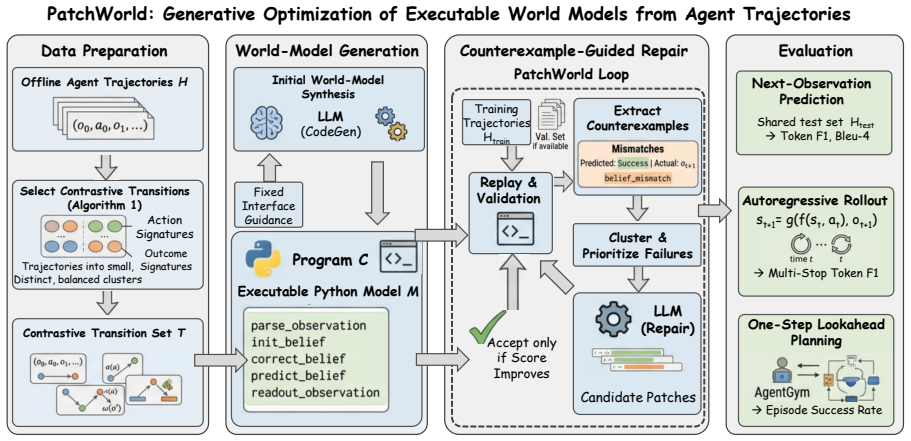
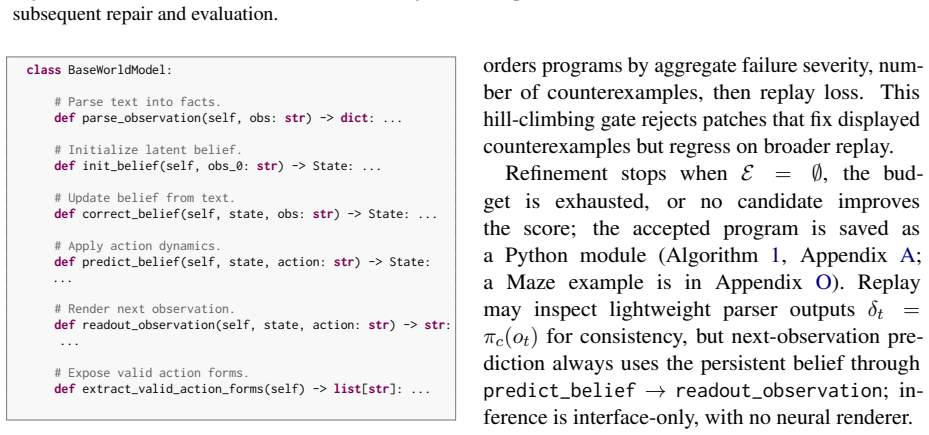
The central object is the executable belief-state program c, which separates parsing, belief correction, dynamics, and readout through the functions parse_observation, init_belief, correct_belief, predict_belief, readout_observation, and extract_valid_action_forms. The predict-and-correct cycle is: ŝ0 = gc(⊥, o0); ŝt+1 = fc(ŝt, at); ôt+1 = ρc(ŝt+1, at); ŝt+1 = gc(ŝt+1, ot+1). Induction is a counterexample-guided loop: replay the program against logged trajectories, cluster and prioritize typed failures (load errors, parser exceptions, belief-update mismatches, readout mismatches), prompt an LLM to emit complete replacement programs, and accept a patch only when its severity-weighted replay s
What would settle it
Run the same one-step lookahead planning protocol with the world-model predictor replaced by a constant predictor that returns the same generic string for every candidate action, keeping the candidate generator and reranker fixed. If macro episode success stays near 76.4% or within a few points of the no-lookahead baseline, the reported gain is not attributable to the world model's action-conditioned predictions. A complementary check would corrupt the lookahead predictions only for the action that the planner ultimately selects and measure the success drop.
Extended reading notes
Core claim
Under partial observability, finite trajectories underdetermine the environment's latent structure, yet PatchWorld shows that an LLM acting as a symbolic optimizer can search the space of executable belief-state programs and converge to models that both predict next observations and support action selection. The induced program implements a predict-and-correct cycle: parse the observation into a belief state, predict the next belief from an action, render a predicted observation, then correct the belief when the true observation arrives. Repair is driven by typed counterexamples from full-trajectory replay, and a candidate patch is accepted only if it improves a severity-weighted replay scor
Load-bearing premise
The headline planning result assumes that the shared reranker genuinely uses the world model's predicted next-observation text to decide between candidate actions; if the reranker mostly falls back to the default action or ignores the lookahead predictions, the 76.4% success rate measures the selector, not the world model.
Editorial extensions
If this is right
- Executable world models induced from offline logs can be used at inference time with zero LLM calls inside the prediction module, cutting lookahead prediction cost from tens of thousands of tokens per task to zero while roughly matching LLM-based planning accuracy.
- The same induced program supports both next-observation prediction and action selection, so a single inspectable artifact can serve simulation, diagnosis, and planning without retraining.
- The fidelity–utility divergence means that next-token metrics like Token F1 and BLEU-4 can mis-rank world models for decision making; planning-oriented evaluation needs an action-contrastive axis.
- Counterexample-guided repair with a validation gate is an effective inductive bias: it reduces replay errors by 12–79% depending on environment and backbone, and the strongest single component in the ablation is contrastive transition selection, not the repair loop itself.
- A human-specified residual-memory bias improves surface fidelity but can weaken planning utility, showing that world-model design involves a deliberate tradeoff rather than a single optimum.
Reading between the lines
- A natural testable extension is to use PatchWorld's induced programs as disagreement generators: the points where a program's predictions diverge from the logged environment could be mined to bootstrap better neural predictors or to flag environment instances where the code model is unreliable.
- The fidelity–utility frontier suggests that benchmark suites for text agents should report both a reconstruction score and a decision-utility score for every world model, since a model that excels at one axis can be worse on the other, as shown by the residual variant's opposite ordering on the two metrics.
- If the cost of induction continues to fall, offline logs from deployed agents could become a renewable source of inspectable simulators for sandboxing, safety auditing, and counterfactual 'what if' analysis — uses that a black-box neural world model supports less directly.
- The repair loop's validation gate suggests that similar acceptance rules could stabilize other LLM self-improvement schemes: allowing a proposed change only when it improves a formal, replay-grounding score may prevent the regression failures seen in unconstrained self-correction.
Signed reviews
Editorial analysis
A structured set of objections, weighed in public.
Referee Report
Summary. PatchWorld induces executable Python belief-state world models from offline trajectories in text-agent environments. It uses an LLM to synthesize an initial program, then performs counterexample-guided repair by replaying trajectories, extracting typed counterexamples, asking the LLM for candidate patches, and accepting only patches that lower a severity-weighted replay score. It evaluates two variants: PatchWorld-Simple (pure symbolic) and PatchWorld-Residual (with a train-only exact-key residual memory). Across seven AgentGym environments, it reports PatchWorld-Residual as the best code-based next-observation predictor (macro Token F1 0.69) and PatchWorld-Simple as the best code-based planner (76.4% macro episode success in one-step lookahead with zero LLM calls at prediction), and claims a fidelity–utility Pareto frontier. The paper includes per-environment tables, a five-seed variance study, a component ablation, a coverage diagnostic, and complete induced programs.
Significance. If the planning claim were robust, the paper would make a valuable contribution: a gradient-free, inspectable, executable alternative to neural next-observation predictors, with evidence on multiple environments and backbones, careful instance-level splits, five-seed variance, and released code. The fidelity result (PatchWorld-Residual 0.69 macro Token F1, with 0.019 seed std) appears solid. However, the headline planning result is not robustly supported: the Wordle component is an artifact, Maze has six test instances, and the macro difference over ReAct/LLM-Direct is within noise. Thus the significance as a planning method is currently unproven, though the framework and fidelity contribution remain interesting.
major comments (4)
- [Table 11; Appendix P] The Wordle row is invalid as evidence and inflates the headline. Figure 11's init_belief hard-codes target_word='frame'; readout_observation always returns feedback for 'frame', and correct_belief never updates the target. For any held-out episode with a different target, predictions are wrong, yet Table 11 reports 100% PatchWorld-Simple success identical to ReAct, which the gated fallback (Appendix H) can produce regardless of the predictor. Combined with Maze's 6-instance test split (Table 6), these two environments carry the macro result: excluding Maze and Wordle, PatchWorld-Simple's macro success over the remaining five environments is 66.9%, below ReAct (67.5%) and essentially tied with LLM-Direct (66.0%). The abstract's 'matching or exceeding LLM-based lookahead' and 'useful for action selection' are not supported. Please re-analyze on the robust subset and report per-environment
- [Appendix H] The planning protocol does not isolate the world model. A shared Qwen3-Coder-480B selector overrides the ReAct default only when it finds 'usable contrast', otherwise falls back. This gating machinery is identical across all predictors and is never ablated. A predictor that is wrong on most episodes (Wordle) can still yield ceiling success via fallback, so the 76.4% macro number may measure the selector rather than the world model. Please add a no-lookahead control with the same selector, and an ablation that replaces the selector with a fixed rule or random ranking, to demonstrate that predicted next-observation differences change action selection.
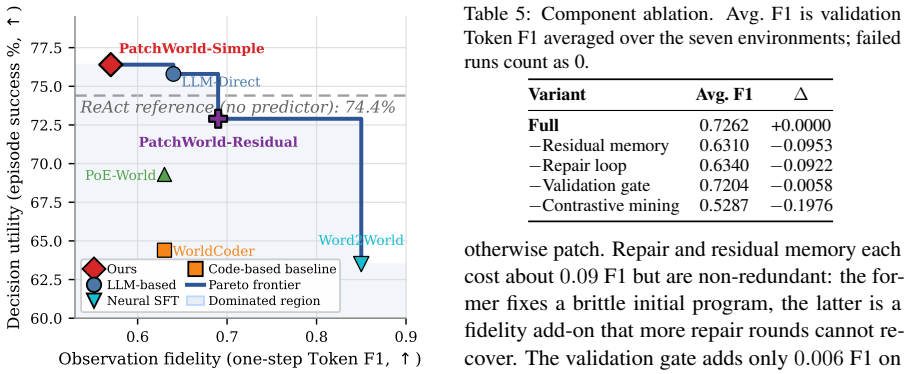
- [§5.4; Table 12; Figure 3] The fidelity–utility tradeoff is not robustly established. PatchWorld-Residual's lower macro success (72.9 vs 76.4) is driven by Maze (83.3 vs 100, n=6) and Wordle (tied); on the other five environments the per-environment signs are mixed, and excluding Maze and Wordle the residual's macro is 65.4 vs 66.9 for Simple, within run-to-run variation. No significance test is reported. Appendix K only rules out identical-string collapse; it does not show that residual memory causally weakens action-discriminative contrast. Please report per-environment confidence intervals and a formal test, or temper the tradeoff claim.
- [§5.5; Table 15] The reported replay-error reduction is tautological. Candidate patches are accepted only if Score(c;B) improves, so the final validation error is lower by construction. Table 5's '-Repair loop' also reports validation F1, not held-out test F1. To support the repair-loop contribution, report a held-out test ablation (full pipeline vs R=0) or explicitly label Table 15 as an optimization diagnostic rather than evidence of generalization.
minor comments (5)
- [Abstract vs Appendix J] The abstract says 'matching or exceeding LLM-based lookahead' while Appendix J explicitly says 'parity' with LLM-Direct. Please align the wording with the statistical evidence.
- [Table 5] The caption should state that Avg. F1 is validation Token F1, not held-out test F1, to avoid implying test-set ablation.
- [Figure 3] The 'Pareto frontier' is drawn through only two points; since many points are not on a convex hull, clarify that it is a schematic frontier rather than a fitted Pareto surface.
- [Appendix H, step 4] The 'usable contrast' criterion for overriding the ReAct default is not specified. Please define it or provide the exact threshold used, since it controls the fallback behavior that drives the headline numbers.
- [Figure 11] The code comment 'Fixed target for consistent testing' should not appear in a paper claiming generalization. At minimum, disclose this limitation in the main text and exclude Wordle from the planning claim unless the model is repaired.
Circularity Check
Auxiliary replay-error reduction is tautological and residual fidelity is partly memorization; held-out core claims remain independent.
-
self definitional
[Section 4.3 (Algorithm 1), Section 5.5, Appendix M (Table 15)]
"if some retained candidate has ˜qj < q or (˜qj = q and |˜Ej| < |E|) then c,E,q←best improving candidate ... validation and repair average 17–28 LLM calls per environment, reducing replay error by 12–79% (Appendix M)."
The repair loop accepts a patch only when it strictly lowers the validation replay score (or error count) on the same replay set. Therefore any accepted sequence of patches necessarily reduces the reported validation error; Table 15 records the algorithm's own acceptance criterion rather than an independent evaluation. The held-out test results are not affected, but the 'repair reduces replay error' claim is true by construction.
-
fitted input called prediction
[Section 4.4 and Appendix F]
"Prediction returns RetrieveK(q(ot, at)) on a cache hit and ˆosym t+1 otherwise ... retrieval-only predictor reaches 0.32 macro Token F1 when uncovered transitions count as zero."
The residual memory is built from training transitions keyed by exact normalized observation-action pairs; on a hit it returns the memorized majority next observation. Thus the fidelity gained from cache hits is retrieval, not prediction from the induced symbolic dynamics. The paper discloses this with a retrieval-only diagnostic, and test keys are held out, so this is a partial, transparent circularity rather than a hidden one.
full rationale
The central results—held-out next-observation prediction (Tables 2 and 3) and live one-step lookahead planning under a shared selector/fallback (Table 11)—do not have target labels in the induction loop: train/validation/test are split by instance, residual memory is train-only, and the planning comparisons use external baselines. The value-equivalence argument is cited from external work (Grimm et al. 2020), and self-citations (Bai et al. 2023/2024; Zheng et al. 2026a; Li et al. 2026) are background, not load-bearing. The circularity is limited to two in-sample or by-construction effects. First, the repair loop accepts only patches that improve the validation replay score, so Table 15's 'replay-error reduction' is the algorithm's own acceptance objective, not an independent finding. Second, PatchWorld-Residual's residual memory is a train-key lookup table that returns memorized training observations on exact matches; its fidelity contribution is a fitted-input result, though the paper transparently reports a retrieval-only diagnostic. Neither effect defines the main held-out conclusions, which is why the score is 3 rather than higher. Separately, the planning metric's sensitivity to the shared Qwen reranker/ReAct fallback, the Wordle model's hard-coded target ('frame') yielding ceiling success, and Maze's six test instances are robustness/validity concerns, not circular derivation.
Assumptions & free parameters
free parameters (4)
- contrastive mining caps k, m =
k=5, m=60
- residual confidence threshold tau =
tau=1
- repair budget R, candidates C, beam b =
R=15; C and b not fully specified in text
- validator severity ranks sigma(e) =
execution/interface > latent support > readout > uncategorized
assumptions (5)
- domain assumption Each target environment is a POMDP whose latent state and transition kernel are hidden from the agent (Section 3).
- domain assumption LLM synthesis prior plus contrastive examples biases search toward compact latent programs rather than lookup tables (Section 3, Feasibility and identification).
- ad hoc to paper Replay score Eq. (6) with fixed severity ranks sigma(e) is a monotone proxy for model quality.
- domain assumption Value-equivalence principle (Grimm et al., 2020) transfers to text-observation POMDPs where fidelity and action-contrastive utility can diverge (Section 3).
- domain assumption Train/validation/test splits by instance and train-only residual construction prevent test leakage; test distribution matches train (Section 5.1, Appendix C).
Cite this review
Pith. "Pith review of PatchWorld: Gradient-Free Optimization of Executable World Models for Agent Environments." pith.science (2026). https://pith.science/paper/DJM62QHS
@misc{pith2026260530880,
  author       = {Pith},
  title        = {Pith review of: PatchWorld: Gradient-Free Optimization of Executable World Models for Agent Environments},
  year         = {2026},
  howpublished = {\url{https://pith.science/paper/DJM62QHS}},
  note         = {Machine review of arXiv:2605.30880}
}
read the original abstract
World models for interactive text agents must typically be learned from observation-action trajectories alone. Specifically, the environment returns text observations after each action, but does not expose a ground-truth latent state nor an inspectable transition model.A research gap remains in how to induce executable code as a world model in this black-box setting for prediction and agent decision making. We introduce PatchWorld, a gradient-free framework that turns offline trajectories into executable Python world models through counterexample-guided code repair.Instead of predicting the next observation with a black-box model, PatchWorld induces symbolic belief-state programs whose action updates can be inspected, replayed, and locally patched. Across seven AgentGym environments, PatchWorld-Simple achieves the highest code-based decision-making score among evaluated methods (76.4% macro success in live one-step lookahead), matching or exceeding LLM-based lookahead while invoking no LLM calls inside the world-model prediction module itself. We further find that a human-specified residual-memory bias improves surface observation fidelity but weakens agent decision-making utility. This reveals a tradeoff in executable world models, since improving observation fidelity can come at the expense of action-discriminative dynamics, and vice versa. Code is available at https://github.com/HKBU-KnowComp/PatchWorld.
Figures
Forward citations
Cited by 2 Pith papers
-
Scaling GUI Agents with Visual State Transitions
A joint inverse-forward pretraining stage on visual screen transitions improves GUI-agent fine-tuning by 0.6–6.2 percentage points across three benchmarks.
-
VisualPatchWorld: Code World Models as Latent Structured Representations for Planning
A two-level induction procedure—active-probe sketch selection plus multi-step rollout fitting—recovers executable code world models that improve CEM planning over prior code baselines on four LeWM tasks.
Reference graph
Works this paper leans on
-
[1]
For PatchWorld, this calls correct_belief; for WorldCoder/PoE- World, the program’s transition; for LLM- Direct, an ICL prompt that conditions on the lastk=3transitions
Belief update.On observation ot, the world model ingests (ot−1, at−1, ot) and updates its internal state. For PatchWorld, this calls correct_belief; for WorldCoder/PoE- World, the program’s transition; for LLM- Direct, an ICL prompt that conditions on the lastk=3transitions
-
[2]
Up to four ad- ditional diverse candidates are drawn from the environment’s exposed action API (dedu- plicated and capped at eight total candidates, including the default)
Candidate generation.A ReAct policy pro- poses a default action adefault. Up to four ad- ditional diverse candidates are drawn from the environment’s exposed action API (dedu- plicated and capped at eight total candidates, including the default)
-
[3]
No multi-step rollout is used in this study; the lookahead depth is exactly one
Lookahead rollout.For each candidate a(i), the world model predicts ˆo(i) t+1. No multi-step rollout is used in this study; the lookahead depth is exactly one
-
[4]
Gated reranking.A shared Qwen3-Coder- 480B selector scores (ot, a(i),ˆo(i) t+1) tuples. The planner overrides adefault only when the world-model predictions provide a usable con- trast and the selected action has clear positive evidence relative to the default (or avoids an explicitly bad predicted outcome). Otherwise it falls back to adefault. This avoid...
-
[5]
Code world models for general game playing. Preprint, arXiv:2510.04542. 10 Yixia Li, Hongru Wang, Peng Lai, Zhiwen Ruan, He Zhu, Youxin Zhu, Ganlong Zhao, Minda Hu, Yun Chen, Sibei Yang, Peng Li, Jeff Z. Pan, Jia Pan, Guanhua Chen, Yang Liu, and Guanbin Li. 2026. Bridging the agent-world gap: Text world models for llm-based agents.Preprint, arXiv:2606.090...
arXiv 2026
-
[6]
Armando Solar-Lezama, Liviu Tancau, Rastislav Bodik, Sanjit Seshia, and Vijay Saraswat
OpenReview.net. Armando Solar-Lezama, Liviu Tancau, Rastislav Bodik, Sanjit Seshia, and Vijay Saraswat. 2006. Combinato- rial sketching for finite programs. InProceedings of the 12th International Conference on Architectural Support for Programming Languages and Operating Systems, ASPLOS XII, page 404–415, New York, NY , USA. Association for Computing Mac...
arXiv 2006
-
[11]
Identical
Termination.Episodes terminate on envi- ronment success, environment failure, or a 30-step cap, whichever comes first. Each en- vironment uses up to 200 held-out instances. The selector, candidate cap, and step cap are identical across all rows in Figure 3 and Table 11. I Per-Task Planning Results Table 11: Episode success rate (%) per environment under t...
-
[2017]
Program synthesis.Found. Trends Program. Lang., 4(1–2):1–119. David Ha and Jürgen Schmidhuber. 2018. World mod- els.CoRR, abs/1803.10122. Danijar Hafner, T. Lillicrap, Jimmy Ba, and Moham- mad Norouzi. 2019. Dream to control: Learning behaviors by latent imagination. Mengkang Hu, Tianxing Chen, Yude Zou, Yuheng Lei, Qiguang Chen, Ming Li, Yao Mu, Hongyuan...
arXiv 2018
Show all 11 references
-
[2021]
In Proceedings of the 42nd acm sigplan international conference on programming language design and implementation, pages 835–850
Dreamcoder: Bootstrapping inductive pro- gram synthesis with wake-sleep library learning. In Proceedings of the 42nd acm sigplan international conference on programming language design and implementation, pages 835–850. Tianqing Fang, Hongming Zhang, Zhisong Zhang, Kaixin Ma, ...
-
[2024]
Maxime Chevalier-Boisvert, Dzmitry Bahdanau, Salem Lahlou, Lucas Willems, Chitwan Saharia, Thien Huu Nguyen, and Yoshua Bengio
Genie: Generative interactive environments. Maxime Chevalier-Boisvert, Dzmitry Bahdanau, Salem Lahlou, Lucas Willems, Chitwan Saharia, Thien Huu Nguyen, and Yoshua Bengio. 2019. BabyAI: First steps towards grounded language learning with a hu- man in the loop. InInternational ...
2019
-
[2025]
InPro- ceedings of the 2025 Conference on Empirical Meth- ods in Natural Language Processing, pages 8959– 8975, Suzhou, China
WebEvolver: Enhancing web agent self- improvement with co-evolving world model. InPro- ceedings of the 2025 Conference on Empirical Meth- ods in Natural Language Processing, pages 8959– 8975, Suzhou, China. Association for Computational Linguistics. Christopher Grimm, André Ba...
2025
Reviewed August 2, 2026 · model on record in the stance chip above.
Discussion (0). Continue with ORCID to comment.