JL1-CC&QA: Extending the JL1-CD Benchmark with Change Captioning and Question Answering
Pith reviewed 2026-07-01 05:23 UTC · model grok-4.3
The pith
JL1-CC&QA extends JL1-CD with 17,021 change captions and 20,060 QA pairs to add semantic description to remote sensing change detection.
A machine-rendered reading of the paper's core claim, the machinery that carries it, and where it could break.
Core claim
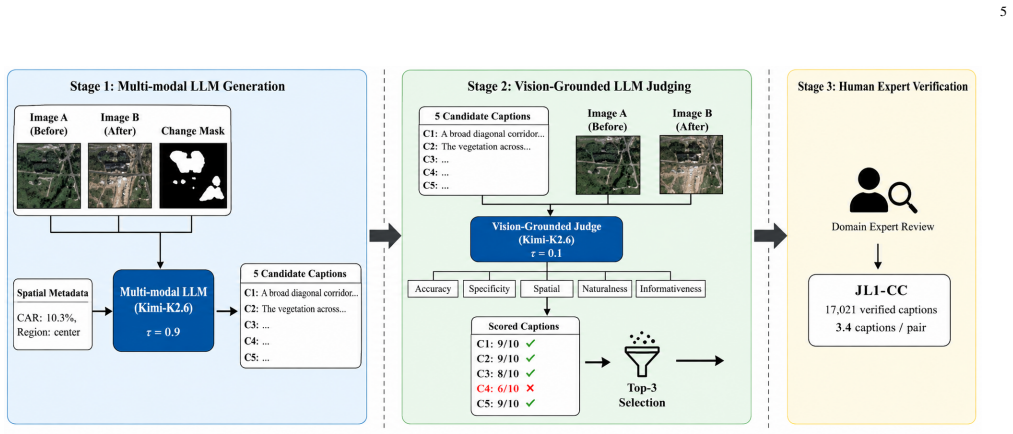
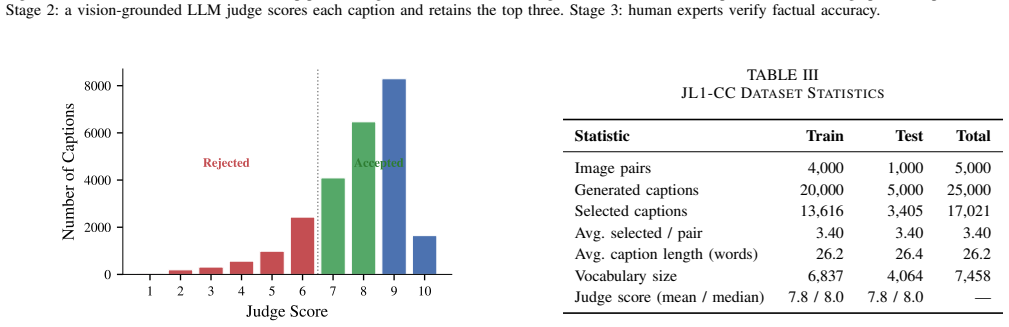
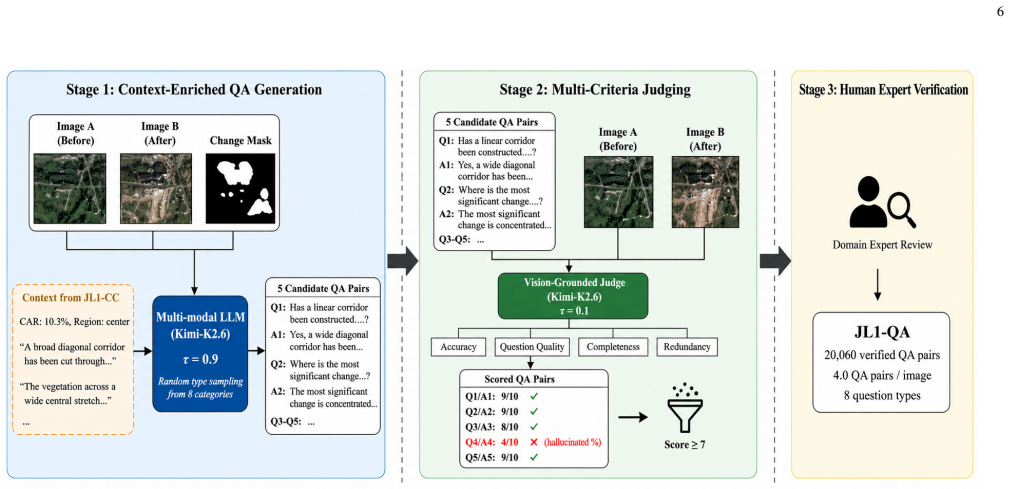
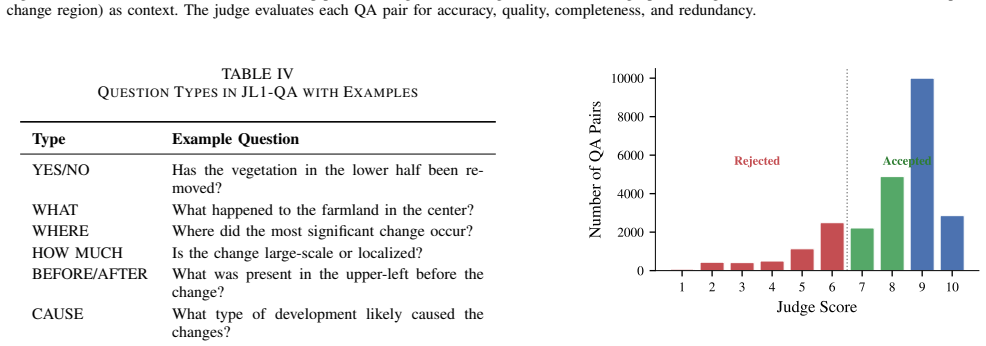
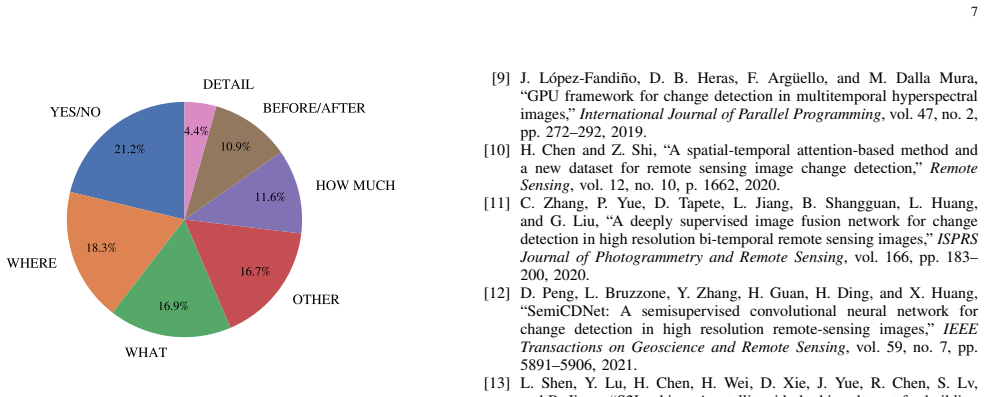
JL1-CC&QA extends the JL1-CD dataset with two annotation layers: change captioning that supplies 17,021 quality-verified captions of land-cover transformations and change question answering that supplies 20,060 pairs across eight question types, all generated from the same 5,000 bi-temporal Jilin-1 image pairs via a three-stage pipeline of multi-modal LLM generation, vision-grounded LLM judging, and human expert verification.
What carries the argument
The three-stage annotation pipeline of multi-modal large language model generation, vision-grounded LLM judging, and human expert verification that produces the captions and QA pairs.
If this is right
- The same image pairs now support training on binary masks, natural language captions, and question answering at once.
- Eight question types enable fine-grained interrogation of surface changes such as type, extent, or timing.
- Diverse land-cover transformations are described in the captions for broader coverage of real-world changes.
- The unified benchmark can drive research on multi-task models that combine detection with semantic understanding.
Where Pith is reading between the lines
- Models trained on this data could generate natural language reports for applications like disaster response or urban monitoring.
- The LLM-based pipeline may scale to annotate larger collections of satellite imagery with less manual effort.
- Connecting the QA pairs to visual grounding could test how well language models align with actual image evidence.
- Future work might combine this benchmark with other remote sensing tasks to build systems that both detect and explain changes.
Load-bearing premise
The three-stage pipeline of LLM generation, LLM judging, and human verification produces reliable high-quality annotations without substantial errors or biases.
What would settle it
A random sample audit that finds factual inaccuracies or image inconsistencies in more than a small percentage of the captions or QA pairs would show the annotations are not as reliable as claimed.
Figures
read the original abstract
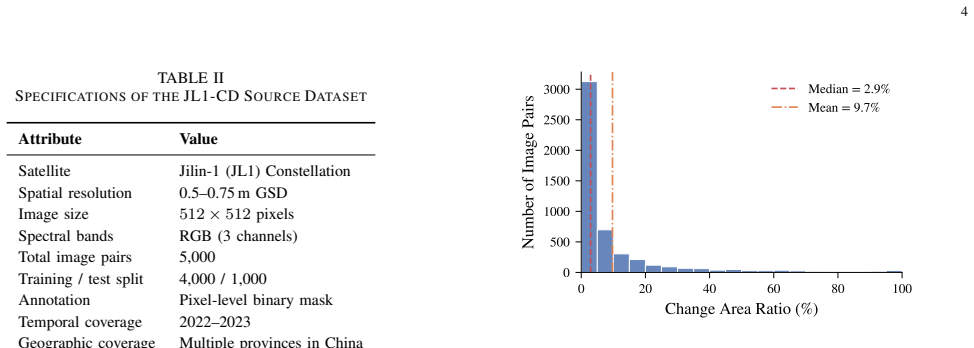
Remote sensing change detection (CD) traditionally focuses on pixel-level binary segmentation, which identifies where changes occur but neither what nor why. To bridge this semantic gap, we introduce JL1-CC&QA, a multi-task benchmark that extends the JL1-CD dataset with two complementary annotation layers: change captioning (CC) and change question answering (QA). Built upon 5,000 bi-temporal image pairs acquired by the Jilin-1 satellite at 0.5-0.75m ground sample distance, the benchmark comprises: (i) JL1-CC, providing 17,021 quality-verified captions that describe diverse land-cover transformations; and (ii) JL1-QA, offering 20,060 question-answer pairs across eight question types, enabling fine-grained, interactive interrogation of surface changes. All annotations are produced via a three-stage pipeline consisting of multi-modal large language model (LLM) generation, vision-grounded LLM judging, and human expert verification. We hope that JL1-CC&QA, as a benchmark unifying binary change masks, change captions, and change-oriented QA over the same image set, will serve as a valuable resource for the community to advance multi-task change understanding in remote sensing. The dataset is available at https://github.com/circleLZY/JL1-CD.
Editorial analysis
A structured set of objections, weighed in public.
Referee Report
Summary. The paper introduces JL1-CC&QA as a multi-task benchmark extending the JL1-CD dataset with change captioning (JL1-CC: 17,021 quality-verified captions) and change question answering (JL1-QA: 20,060 QA pairs across eight types) annotations over 5,000 bi-temporal Jilin-1 satellite image pairs at 0.5-0.75m GSD. All annotations are produced via a three-stage pipeline of multi-modal LLM generation, vision-grounded LLM judging, and human expert verification. The contribution is positioned as a resource unifying binary change masks, captions, and QA to advance semantic change understanding in remote sensing, with the dataset released at a GitHub link.
Significance. If the annotations are demonstrated to be reliable, the benchmark would be a useful community resource for multi-task remote sensing change analysis, enabling work on semantic description and interactive interrogation of land-cover transformations alongside pixel-level detection. The open release of a dataset constructed on an existing CD benchmark is a concrete strength.
major comments (1)
- [Abstract] Abstract: the claim that the annotations are 'quality-verified' rests on the three-stage pipeline (LLM generation, vision-grounded judging, human verification) but supplies no quantitative quality metrics, inter-annotator agreement scores, error rates from the human stage, or agreement statistics between LLM judging and human experts. This leaves the central claim of reliable, high-quality annotations weakly supported.
Simulated Author's Rebuttal
We thank the referee for the detailed and constructive review. The single major comment identifies a genuine gap in the current manuscript: the abstract asserts 'quality-verified' annotations without accompanying quantitative evidence. We will address this directly in revision.
read point-by-point responses
-
Referee: [Abstract] Abstract: the claim that the annotations are 'quality-verified' rests on the three-stage pipeline (LLM generation, vision-grounded judging, human verification) but supplies no quantitative quality metrics, inter-annotator agreement scores, error rates from the human stage, or agreement statistics between LLM judging and human experts. This leaves the central claim of reliable, high-quality annotations weakly supported.
Authors: We agree that the current manuscript does not supply the requested quantitative metrics and that this weakens the central quality claim. In the revised version we will add a dedicated 'Annotation Quality Analysis' subsection (placed after the pipeline description) that reports: (1) inter-annotator agreement (Cohen's kappa and percentage agreement) computed on a held-out subset of captions and QA pairs verified by multiple human experts; (2) error rates and rejection rates observed during the final human verification stage; and (3) agreement statistics (accuracy, precision, recall) between the vision-grounded LLM judge and the human experts on the same verification subset. These statistics will be derived from the existing annotation logs and will be presented with confidence intervals. The abstract will be updated to reference these new results rather than simply stating 'quality-verified'. revision: yes
Circularity Check
No significant circularity: dataset release with no derivations
full rationale
The paper is a resource contribution that extends an existing dataset (JL1-CD) with new CC and QA annotations produced by a described three-stage pipeline (LLM generation, vision-grounded judging, human verification). No equations, fitted parameters, predictions, self-citations as load-bearing premises, or modeling derivations appear in the abstract or described content. The central claim reduces only to the factual release of annotations, with no internal reduction to inputs by construction. This is the expected non-finding for a pure benchmark paper.
Axiom & Free-Parameter Ledger
Reference graph
Works this paper leans on
-
[1]
Land cover change detection techniques: Very-high-resolution optical images: A review,
Z. Lv, T. Liu, J. A. Benediktsson, and N. Falco, “Land cover change detection techniques: Very-high-resolution optical images: A review,” IEEE Geoscience and Remote Sensing Magazine, vol. 10, no. 1, pp. 44–63, 2022
2022
-
[2]
Deep learning for change detection in remote sensing: A review,
T. Bai, L. Wang, D. Yin, K. Sun, Y . Chen, and W. Li, “Deep learning for change detection in remote sensing: A review,”Geo-spatial Information Science, vol. 26, no. 3, pp. 262–288, 2023
2023
-
[3]
Change detection in optical aerial images by a multilayer conditional mixed Markov model,
C. Benedek and T. Szir ´anyi, “Change detection in optical aerial images by a multilayer conditional mixed Markov model,”IEEE Transactions on Geoscience and Remote Sensing, vol. 47, no. 10, pp. 3416–3430, 2009
2009
-
[4]
Constrained optical flow for aerial image change detection,
N. Bourdis, D. Marraud, and H. Sahbi, “Constrained optical flow for aerial image change detection,” in2011 IEEE International Geoscience and Remote Sensing Symposium. Vancouver, BC, Canada: IEEE, 2011, pp. 4176–4179
2011
-
[5]
Urban change detection for multispectral earth observation using convolutional neural networks,
R. C. Daudt, B. Le Saux, A. Boulch, and Y . Gousseau, “Urban change detection for multispectral earth observation using convolutional neural networks,” inIGARSS 2018 – 2018 IEEE International Geoscience and Remote Sensing Symposium. Valencia, Spain: IEEE, 2018, pp. 2115– 2118
2018
-
[6]
Change detection in remote sensing images using conditional adversarial networks,
M. A. Lebedev, Y . V . Vizilter, O. V . Vygolov, V . A. Knyaz, and A. Y . Rubis, “Change detection in remote sensing images using conditional adversarial networks,”The International Archives of the Photogrammetry, Remote Sensing and Spatial Information Sciences, vol. XLII-2, pp. 565–571, 2018
2018
-
[7]
Fully convolutional networks for multisource building extraction from an open aerial and satellite imagery data set,
S. Ji, S. Wei, and M. Lu, “Fully convolutional networks for multisource building extraction from an open aerial and satellite imagery data set,” IEEE Transactions on Geoscience and Remote Sensing, vol. 57, no. 1, pp. 574–586, 2019
2019
-
[8]
GETNET: A general end-to-end 2-D CNN framework for hyperspectral image change detection,
Q. Wang, Z. Yuan, Q. Du, and X. Li, “GETNET: A general end-to-end 2-D CNN framework for hyperspectral image change detection,”IEEE Transactions on Geoscience and Remote Sensing, vol. 57, no. 1, pp. 3–13, 2019
2019
-
[9]
GPU framework for change detection in multitemporal hyperspectral images,
J. L ´opez-Fandi˜no, D. B. Heras, F. Arg ¨uello, and M. Dalla Mura, “GPU framework for change detection in multitemporal hyperspectral images,”International Journal of Parallel Programming, vol. 47, no. 2, pp. 272–292, 2019
2019
-
[10]
A spatial-temporal attention-based method and a new dataset for remote sensing image change detection,
H. Chen and Z. Shi, “A spatial-temporal attention-based method and a new dataset for remote sensing image change detection,”Remote Sensing, vol. 12, no. 10, p. 1662, 2020
2020
-
[11]
A deeply supervised image fusion network for change detection in high resolution bi-temporal remote sensing images,
C. Zhang, P. Yue, D. Tapete, L. Jiang, B. Shangguan, L. Huang, and G. Liu, “A deeply supervised image fusion network for change detection in high resolution bi-temporal remote sensing images,”ISPRS Journal of Photogrammetry and Remote Sensing, vol. 166, pp. 183– 200, 2020
2020
-
[12]
SemiCDNet: A semisupervised convolutional neural network for change detection in high resolution remote-sensing images,
D. Peng, L. Bruzzone, Y . Zhang, H. Guan, H. Ding, and X. Huang, “SemiCDNet: A semisupervised convolutional neural network for change detection in high resolution remote-sensing images,”IEEE Transactions on Geoscience and Remote Sensing, vol. 59, no. 7, pp. 5891–5906, 2021
2021
-
[13]
S2Looking: A satellite side-looking dataset for building change detection,
L. Shen, Y . Lu, H. Chen, H. Wei, D. Xie, J. Yue, R. Chen, S. Lv, and B. Jiang, “S2Looking: A satellite side-looking dataset for building change detection,”Remote Sensing, vol. 13, no. 24, p. 5094, 2021
2021
-
[14]
SUNet: Change detection for heterogeneous remote sensing images from satellite and UA V using a dual-channel fully convolution network,
R. Shao, C. Du, H. Chen, and J. Li, “SUNet: Change detection for heterogeneous remote sensing images from satellite and UA V using a dual-channel fully convolution network,”Remote Sensing, vol. 13, no. 18, p. 3750, 2021
2021
-
[15]
A deeply supervised attention metric-based network and an open aerial image dataset for remote sensing change detection,
Q. Shi, M. Liu, S. Li, X. Liu, F. Wang, and L. Zhang, “A deeply supervised attention metric-based network and an open aerial image dataset for remote sensing change detection,”IEEE Transactions on Geoscience and Remote Sensing, vol. 60, pp. 1–16, 2022
2022
-
[16]
A CNN-Transformer network with multiscale context aggregation for fine-grained cropland change detection,
M. Liu, Z. Chai, H. Deng, and R. Liu, “A CNN-Transformer network with multiscale context aggregation for fine-grained cropland change detection,”IEEE Journal of Selected Topics in Applied Earth Obser- vations and Remote Sensing, vol. 15, pp. 4297–4306, 2022
2022
-
[17]
MSCDUNet: A deep learning framework for built-up area change detection integrating multispectral, SAR, and VHR data,
H. Li, F. Zhu, X. Zheng, M. Liu, and G. Chen, “MSCDUNet: A deep learning framework for built-up area change detection integrating multispectral, SAR, and VHR data,”IEEE Journal of Selected Topics in Applied Earth Observations and Remote Sensing, vol. 15, pp. 5163– 5176, 2022
2022
-
[18]
AFDE-Net: Building change detection using attention-based feature differential enhancement for satellite imagery,
S. Holail, T. Saleh, X. Xiao, and D. Li, “AFDE-Net: Building change detection using attention-based feature differential enhancement for satellite imagery,”IEEE Geoscience and Remote Sensing Letters, vol. 20, pp. 1–5, 2023
2023
-
[19]
Z. Liu, R. Zhu, L. Gao, Y . Zhou, J. Ma, and Y . Gu, “JL1-CD: A new benchmark for remote sensing change detection and a ro- bust multi-teacher knowledge distillation framework,” arXiv preprint arXiv:2502.13407, 2025
-
[20]
Fully convolutional siamese networks for change detection,
R. C. Daudt, B. Le Saux, and A. Boulch, “Fully convolutional siamese networks for change detection,” in2018 25th IEEE International Conference on Image Processing (ICIP). Athens, Greece: IEEE, 2018, pp. 4063–4067
2018
-
[21]
SNUNet-CD: A densely con- nected siamese network for change detection of VHR images,
S. Fang, K. Li, J. Shao, and Z. Li, “SNUNet-CD: A densely con- nected siamese network for change detection of VHR images,”IEEE Geoscience and Remote Sensing Letters, vol. 19, pp. 1–5, 2022
2022
-
[22]
Remote sensing image change detection with transformers,
H. Chen, Z. Qi, and Z. Shi, “Remote sensing image change detection with transformers,”IEEE Transactions on Geoscience and Remote Sensing, vol. 60, pp. 1–14, 2022
2022
-
[23]
A transformer-based siamese net- work for change detection,
W. G. C. Bandara and V . M. Patel, “A transformer-based siamese net- work for change detection,” inIGARSS 2022 – 2022 IEEE International Geoscience and Remote Sensing Symposium. Fort Worth, TX, USA: IEEE, 2022, pp. 207–210
2022
-
[24]
ChangeMamba: Re- mote sensing change detection with spatiotemporal state space model,
H. Chen, J. Song, C. Han, J. Xia, and N. Yokoya, “ChangeMamba: Re- mote sensing change detection with spatiotemporal state space model,” IEEE Transactions on Geoscience and Remote Sensing, vol. 62, pp. 1– 20, 2024
2024
-
[25]
Change is everywhere: Single-temporal supervised object change detection in remote sensing imagery,
Z. Zheng, A. Ma, L. Zhang, and Y . Zhong, “Change is everywhere: Single-temporal supervised object change detection in remote sensing imagery,” inIEEE/CVF International Conference on Computer Vision (ICCV). Montreal, QC, Canada: IEEE, 2021, pp. 15 193–15 202
2021
-
[26]
Exchange means change: An unsupervised single-temporal change detection framework based on intra- and inter-image patch exchange,
H. Chen, J. Song, C. Wu, B. Du, and N. Yokoya, “Exchange means change: An unsupervised single-temporal change detection framework based on intra- and inter-image patch exchange,”ISPRS Journal of Photogrammetry and Remote Sensing, vol. 206, pp. 87–105, 2023
2023
-
[27]
STMNet: Single- temporal mask-based network for self-supervised hyperspectral change detection,
T. Zhou, F. Luo, C. Fu, T. Guo, X. Wang, and B. Du, “STMNet: Single- temporal mask-based network for self-supervised hyperspectral change detection,”IEEE Transactions on Geoscience and Remote Sensing, vol. 63, pp. 1–12, 2024
2024
-
[28]
DynamicEarthNet: Daily multi-spectral satellite dataset 8 for semantic change segmentation,
A. Toker, L. Kondmann, M. Weber, M. Eisenberger, A. Camero, and J. Hu, “DynamicEarthNet: Daily multi-spectral satellite dataset 8 for semantic change segmentation,” inProceedings of the IEEE/CVF Conference on Computer Vision and Pattern Recognition (CVPR), New Orleans, LA, USA, 2022, pp. 21 126–21 135
2022
-
[29]
The multi-temporal urban development SpaceNet dataset,
A. Van Etten, D. Hogan, J. M. Manso, J. Shermeyer, N. Weir, and R. Lewis, “The multi-temporal urban development SpaceNet dataset,” inProceedings of the IEEE/CVF Conference on Computer Vision and Pattern Recognition (CVPR), Nashville, TN, USA, 2021, pp. 6394– 6403
2021
-
[30]
Multi-temporal urban semantic understanding based on GF-2 remote sensing imagery: From tri-temporal datasets to multi-task mapping,
S. Shi, Y . Zhong, Y . Liu, J. Wang, Y . Wan, J. Zhao, P. Lv, L. Zhang, and D. Li, “Multi-temporal urban semantic understanding based on GF-2 remote sensing imagery: From tri-temporal datasets to multi-task mapping,”International Journal of Digital Earth, vol. 16, no. 1, pp. 3321–3347, 2023
2023
-
[31]
COUD: Con- tinual urbanization detector for time series building change detection,
Y . Zhao, H.-C. Li, S. Lei, N. Liu, J. Pan, and T. Celik, “COUD: Con- tinual urbanization detector for time series building change detection,” IEEE Journal of Selected Topics in Applied Earth Observations and Remote Sensing, vol. 17, pp. 19 601–19 615, 2024
2024
-
[32]
Damage detection from aerial images via convolutional neural networks,
A. Fujita, K. Sakurada, T. Imaizumi, R. Ito, S. Hikosaka, and R. Naka- mura, “Damage detection from aerial images via convolutional neural networks,” in2017 Fifteenth IAPR International Conference on Ma- chine Vision Applications (MVA). Nagoya, Japan: IEEE, 2017, pp. 5–8
2017
-
[33]
Kernel slow feature analysis for scene change detection,
C. Wu, L. Zhang, and B. Du, “Kernel slow feature analysis for scene change detection,”IEEE Transactions on Geoscience and Remote Sensing, vol. 55, no. 4, pp. 2367–2384, 2017
2017
-
[34]
Multitask learning for large-scale semantic change detection,
R. C. Daudt, B. Le Saux, A. Boulch, and Y . Gousseau, “Multitask learning for large-scale semantic change detection,”Computer Vision and Image Understanding, vol. 187, p. 102783, 2019
2019
-
[35]
Creating xBD: A dataset for assessing building damage from satellite imagery,
R. Gupta, B. Goodman, N. Patel, R. Hosfelt, S. Sajeev, E. Heim, J. Doshi, K. Lucas, H. Choset, and M. Gaston, “Creating xBD: A dataset for assessing building damage from satellite imagery,” in Proceedings of the IEEE/CVF Conference on Computer Vision and Pattern Recognition Workshops (CVPRW), 2019, pp. 10–17
2019
-
[36]
Self-supervised multisensor change detection,
S. Saha, P. Ebel, and X. X. Zhu, “Self-supervised multisensor change detection,”IEEE Transactions on Geoscience and Remote Sensing, vol. 60, pp. 1–10, 2022
2022
-
[37]
Asymmetric siamese networks for semantic change detection in aerial images,
K. Yang, G.-S. Xia, Z. Liu, B. Du, Y . Wen, and M. Pelillo, “Asymmetric siamese networks for semantic change detection in aerial images,” IEEE Transactions on Geoscience and Remote Sensing, vol. 60, pp. 1–18, 2022
2022
-
[38]
Building damage assessment for rapid disaster response with a deep object-based semantic change detection framework: From natural disasters to man- made disasters,
Z. Zheng, Y . Zhong, J. Wang, A. Ma, and L. Zhang, “Building damage assessment for rapid disaster response with a deep object-based semantic change detection framework: From natural disasters to man- made disasters,”Remote Sensing of Environment, vol. 265, p. 112636, 2021
2021
-
[39]
Hyperspectral anomaly change detection based on autoencoder,
M. Hu, C. Wu, L. Zhang, and B. Du, “Hyperspectral anomaly change detection based on autoencoder,”IEEE Journal of Selected Topics in Applied Earth Observations and Remote Sensing, vol. 14, pp. 3750– 3762, 2021
2021
-
[40]
MCANet: A joint semantic segmentation framework of optical and SAR images for land use classification,
X. Li, G. Zhang, H. Cui, S. Hou, S. Wang, X. Li, Y . Chen, Z. Li, and L. Zhang, “MCANet: A joint semantic segmentation framework of optical and SAR images for land use classification,”International Journal of Applied Earth Observation and Geoinformation, vol. 106, p. 102638, 2022
2022
-
[41]
Large-scale deep learning based binary and semantic change detection in ultra high resolution remote sensing imagery: From benchmark datasets to urban application,
S. Tian, A. Ma, Z. Zheng, Y . Zhong, X. Tan, and L. Zhang, “Large-scale deep learning based binary and semantic change detection in ultra high resolution remote sensing imagery: From benchmark datasets to urban application,”ISPRS Journal of Photogrammetry and Remote Sensing, vol. 193, pp. 164–186, 2022
2022
-
[42]
A transformer-based siamese network and an open optical dataset for semantic change detection of remote sensing images,
P. Yuan, Q. Zhao, X. Zhao, X. Wang, X. Long, and Y . Zheng, “A transformer-based siamese network and an open optical dataset for semantic change detection of remote sensing images,”International Journal of Digital Earth, vol. 15, no. 1, pp. 1506–1525, 2022
2022
-
[43]
Detecting building changes with off-nadir aerial images,
C. Pang, J. Wu, J. Ding, C. Song, and G.-S. Xia, “Detecting building changes with off-nadir aerial images,”Science China Information Sciences, vol. 66, no. 4, p. 140306, 2023
2023
-
[44]
Inferring 3D change detection from bitemporal optical images,
V . Marsocci, V . Coletta, R. Ravanelli, S. Scardapane, and M. Crespi, “Inferring 3D change detection from bitemporal optical images,”ISPRS Journal of Photogrammetry and Remote Sensing, vol. 196, pp. 325– 339, 2023
2023
-
[45]
Cross-modal change detection flood extraction based on convolutional neural network,
X. He, S. Zhang, B. Xue, T. Zhao, and T. Wu, “Cross-modal change detection flood extraction based on convolutional neural network,”In- ternational Journal of Applied Earth Observation and Geoinformation, vol. 117, p. 103197, 2023
2023
-
[46]
RescueNet: A high resolution UA V semantic segmentation dataset for natural disaster damage assessment,
M. Rahnemoonfar, T. Chowdhury, and R. Murphy, “RescueNet: A high resolution UA V semantic segmentation dataset for natural disaster damage assessment,”Scientific Data, vol. 10, no. 1, p. 913, 2023
2023
-
[47]
A memory-guided network and a novel dataset for cropland semantic change detection,
M. Liu, S. Lin, Y . Zhong, Q. Shi, and J. Li, “A memory-guided network and a novel dataset for cropland semantic change detection,”IEEE Transactions on Geoscience and Remote Sensing, vol. 62, pp. 1–13, 2024
2024
-
[48]
The ClearSCD model: Comprehensively leveraging semantics and change relationships for semantic change detection in high spatial resolution remote sensing imagery,
K. Tang, F. Xu, X. Chen, Q. Dong, Y . Yuan, and J. Chen, “The ClearSCD model: Comprehensively leveraging semantics and change relationships for semantic change detection in high spatial resolution remote sensing imagery,”ISPRS Journal of Photogrammetry and Remote Sensing, vol. 211, pp. 299–317, 2024
2024
-
[49]
QuickQuakeBuildings: Post- earthquake SAR-optical dataset for quick damaged-building detection,
Y . Sun, Y . Wang, and M. Eineder, “QuickQuakeBuildings: Post- earthquake SAR-optical dataset for quick damaged-building detection,” IEEE Geoscience and Remote Sensing Letters, vol. 21, pp. 1–5, 2024
2024
-
[50]
Rethinking semantic change detection from a semantic alignment perspective,
S. Fang, W. Li, Y . Song, Z. Li, and J. Zhao, “Rethinking semantic change detection from a semantic alignment perspective,” Authorea Preprints, 2025
2025
-
[51]
TripleS: Mitigating multi-task learning conflicts for semantic change detection in high-resolution remote sensing imagery,
X. Tan, G. Chen, X. Zhang, T. Wang, J. Wang, K. Wang, and T. Miao, “TripleS: Mitigating multi-task learning conflicts for semantic change detection in high-resolution remote sensing imagery,”ISPRS Journal of Photogrammetry and Remote Sensing, vol. 230, pp. 374–401, 2025
2025
-
[52]
BRIGHT: A globally distributed multimodal building damage as- sessment dataset with very-high-resolution for all-weather disaster response,
H. Chen, J. Song, O. Dietrich, C. Broni-Bediako, W. Xuan, J. Wang, X. Shao, Y . Wei, J. Xia, C. Lan, K. Schindler, and N. Yokoya, “BRIGHT: A globally distributed multimodal building damage as- sessment dataset with very-high-resolution for all-weather disaster response,”Earth System Science Data Discussions, pp. 1–51, 2025
2025
-
[53]
Cross-scenario damaged build- ing extraction network: Methodology, application, and efficiency using single-temporal HRRS imagery,
H. Wang, W. He, Z. Li, and N. Yokoya, “Cross-scenario damaged build- ing extraction network: Methodology, application, and efficiency using single-temporal HRRS imagery,”ISPRS Journal of Photogrammetry and Remote Sensing, vol. 228, pp. 228–248, 2025
2025
-
[54]
Spectral-spatial-temporal transformers for hyperspectral image change detection,
Y . Wang, D. Hong, J. Sha, L. Gao, L. Liu, Y . Zhang, and X. Rong, “Spectral-spatial-temporal transformers for hyperspectral image change detection,”IEEE Transactions on Geoscience and Remote Sensing, vol. 60, pp. 1–14, 2022
2022
-
[55]
Decentralized federated GAN for hyper- spectral change detection in edge computing,
W. Xie, X. Xu, and Y . Li, “Decentralized federated GAN for hyper- spectral change detection in edge computing,”IEEE Journal of Selected Topics in Applied Earth Observations and Remote Sensing, vol. 17, pp. 8863–8874, 2024
2024
-
[56]
Cycle translation- based collaborative training for hyperspectral-RGB multimodal change detection,
W. Dong, J. Ren, S. Xiao, L. Fang, J. Qu, and Y . Li, “Cycle translation- based collaborative training for hyperspectral-RGB multimodal change detection,”IEEE Transactions on Image Processing, vol. 34, pp. 6347– 6360, 2025
2025
-
[57]
A deep translation (GAN) based change detection network for optical and SAR remote sensing images,
X. Li, Z. Du, Y . Huang, and Z. Tan, “A deep translation (GAN) based change detection network for optical and SAR remote sensing images,” ISPRS Journal of Photogrammetry and Remote Sensing, vol. 179, pp. 14–34, 2021
2021
-
[58]
Improved difference images for change detection classifiers in SAR imagery using deep learning,
J. Alatalo, T. Sipola, and M. Rantonen, “Improved difference images for change detection classifiers in SAR imagery using deep learning,” IEEE Transactions on Geoscience and Remote Sensing, vol. 61, pp. 1–14, 2023
2023
-
[59]
M2CD: A unified multimodal framework for optical-SAR change detection with mixture of experts and self-distillation,
Z. Liu, J. Zhang, W. Wang, and Y . Gu, “M2CD: A unified multimodal framework for optical-SAR change detection with mixture of experts and self-distillation,”IEEE Geoscience and Remote Sensing Letters, vol. 22, pp. 1–5, 2025
2025
-
[60]
SD-Mamba: A lightweight synthetic-decompression network for cross-modal flood change de- tection,
Y . Shen, S. Yao, Z. Qiang, and G. Pei, “SD-Mamba: A lightweight synthetic-decompression network for cross-modal flood change de- tection,”International Journal of Applied Earth Observation and Geoinformation, vol. 136, p. 104409, 2025
2025
-
[61]
Bi- temporal semantic reasoning for the semantic change detection in HR remote sensing images,
L. Ding, H. Guo, S. Liu, L. Mou, J. Zhang, and L. Bruzzone, “Bi- temporal semantic reasoning for the semantic change detection in HR remote sensing images,”IEEE Transactions on Geoscience and Remote Sensing, vol. 60, pp. 1–14, 2022
2022
-
[62]
Learning to describe differences between pairs of similar images,
H. Jhamtani and T. Berg-Kirkpatrick, “Learning to describe differences between pairs of similar images,” inProceedings of the 2018 Confer- ence on Empirical Methods in Natural Language Processing (EMNLP), 2018, pp. 4024–4034
2018
-
[63]
Robust change captioning,
D. H. Park, T. Darrell, and A. Rohrbach, “Robust change captioning,” in Proceedings of the IEEE/CVF International Conference on Computer Vision (ICCV), 2019, pp. 4624–4633
2019
-
[64]
Change captioning: A new paradigm for multitemporal remote sensing image analysis,
G. Hoxha, S. Chouaf, F. Melgani, and Y . Smara, “Change captioning: A new paradigm for multitemporal remote sensing image analysis,” IEEE Transactions on Geoscience and Remote Sensing, vol. 60, pp. 1–14, 2022
2022
-
[65]
Remote sensing image change captioning with dual-branch transformers: A new method and a large scale dataset,
C. Liu, R. Zhao, H. Chen, Z. Zou, and Z. Shi, “Remote sensing image change captioning with dual-branch transformers: A new method and a large scale dataset,”IEEE Transactions on Geoscience and Remote Sensing, vol. 60, pp. 1–20, 2022. 9
2022
-
[66]
Change detec- tion as visual question answering,
C. Liu, K. Chen, B. Zhang, Z. Qi, Z. Zou, and Z. Shi, “Change detec- tion as visual question answering,”IEEE Transactions on Geoscience and Remote Sensing, vol. 62, pp. 1–18, 2024
2024
-
[67]
SECOND-CC: A large-scale change captioning dataset with real-world challenges,
X. Liet al., “SECOND-CC: A large-scale change captioning dataset with real-world challenges,” arXiv preprint arXiv:2501.10075, 2025
-
[68]
arXiv preprint arXiv:2411.11360 (2024)
Z. Chenet al., “CCExpert: Advancing RSCC via an expert-level large vision-language model,” arXiv preprint arXiv:2411.11360, 2024
-
[69]
Towards real-world change captioning: A large-scale disaster-focused dataset,
Z. Liet al., “Towards real-world change captioning: A large-scale disaster-focused dataset,” inAdvances in Neural Information Process- ing Systems (NeurIPS), 2025
2025
-
[70]
Multispectral remote sensing image change caption- ing with Sentinel-2,
U. T ¨urkeret al., “Multispectral remote sensing image change caption- ing with Sentinel-2,”IEEE Journal of Selected Topics in Applied Earth Observations and Remote Sensing, vol. 18, pp. 25 410–25 423, 2025
2025
-
[71]
Change detection meets visual question answering,
Z. Yuan, L. Mou, Y . Hua, and X. X. Zhu, “Change detection meets visual question answering,”IEEE Transactions on Geoscience and Remote Sensing, vol. 60, pp. 1–13, 2022
2022
-
[72]
K. Li, F. Dong, D. Wang, S. Li, Q. Wang, X. Gao, and T.-S. Chua, “Show me what and where has changed? question answering and grounding for remote sensing change detection,” arXiv preprint arXiv:2410.23828, 2024
-
[73]
ChangeChat: An interactive model for remote sensing change analysis via multimodal instruction tuning,
P. Wuet al., “ChangeChat: An interactive model for remote sensing change analysis via multimodal instruction tuning,” inIEEE Inter- national Conference on Acoustics, Speech and Signal Processing (ICASSP), 2025
2025
-
[74]
TEOChat: A large vision-language assistant for temporal earth observation data,
J. Irvin, A. Grucaet al., “TEOChat: A large vision-language assistant for temporal earth observation data,” inInternational Conference on Learning Representations (ICLR), 2025
2025
-
[75]
DisasterM3: A remote sensing vision-language dataset for disaster damage assessment and response,
J. Wang, W. Xuan, H. Qi, Z. Liu, K. Liu, Y . Wu, H. Chen, J. Song, J. Xia, Z. Zheng, and N. Yokoya, “DisasterM3: A remote sensing vision-language dataset for disaster damage assessment and response,” arXiv preprint arXiv:2505.21089, 2025
-
[76]
FCCDN: Feature constraint network for VHR image change detection,
P. Chen, B. Zhang, D. Hong, Z. Chen, X. Yang, and B. Li, “FCCDN: Feature constraint network for VHR image change detection,”ISPRS Journal of Photogrammetry and Remote Sensing, vol. 187, pp. 101– 119, 2022
2022
-
[77]
RDP-Net: Region detail preserv- ing network for change detection,
H. Chen, F. Pu, R. Yang, and X. Xu, “RDP-Net: Region detail preserv- ing network for change detection,”IEEE Transactions on Geoscience and Remote Sensing, vol. 60, pp. 1–10, 2022
2022
-
[78]
Semantic-aware dense repre- sentation learning for remote sensing image change detection,
H. Chen, W. Li, S. Chen, and Z. Shi, “Semantic-aware dense repre- sentation learning for remote sensing image change detection,”IEEE Transactions on Geoscience and Remote Sensing, vol. 60, pp. 1–18, 2022
2022
-
[79]
Adversarial instance augmentation for building change detection in remote sensing images,
H. Chen, W. Li, and Z. Shi, “Adversarial instance augmentation for building change detection in remote sensing images,”IEEE Transac- tions on Geoscience and Remote Sensing, vol. 60, pp. 1–16, 2021
2021
-
[80]
Lightweight remote sensing change detection with progressive feature aggregation and supervised attention,
Z. Li, C. Tang, X. Liu, W. Zhang, J. Dou, and L. Wang, “Lightweight remote sensing change detection with progressive feature aggregation and supervised attention,”IEEE Transactions on Geoscience and Remote Sensing, vol. 61, pp. 1–12, 2023
2023
discussion (0)
Sign in with ORCID, Apple, or X to comment. Anyone can read and Pith papers without signing in.