REVIEW 3 major objections 5 minor 44 references
Boosted GAN with Semantically Interpretable Information for Image Inpainting
T0 review · 3 major / 5 minor · reviewed 2026-08-14 · deepseek-v4-flash
Pith's one-line read Mixing attributes and segmentation into a GAN generator keeps inpainted images semantically consistent with the original.
desk verdict Plausible semantic-guidance idea for GAN inpainting, but the headline claim of significant gains rests on single-run numbers and same-set hyperparameter tuning. read the letter →
The pith
A machine-rendered reading of the paper's core claim, the machinery that carries it, and where it could break.
The reading
What carries the argument
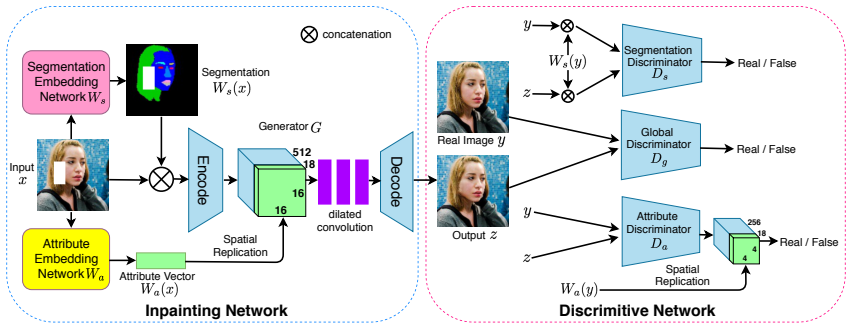
The load-bearing object is the pair of pretrained embedding networks: an attribute embedding network $W_a$, a multi-label image classifier that outputs an attribute vector, and a segmentation embedding network $W_s$, a semantic segmentation model that outputs a segmentation map. The corrupted image $x$ is concatenated with $W_s(x)$ and fed into the encoder; the attribute vector $W_a(x)$ is spatially replicated and concatenated to the intermediate feature map before dilated convolution and decoding. Three discriminators—global, attribute, and segmentation—then enforce overall realness, attribute-level match, and segmentation-structure match, using pairs of real images with their predicted semantic labels as positive examples and mismatched or restored pairs as negative examples.
What would settle it
Run the model on a test set where the mask covers the semantic cue itself—for instance, mask an eye in face images or the central object in scene images—and compare the restored output's attribute vector and segmentation map against the ground-truth labels. If the output follows the predicted wrong vector instead of the true labels, and if feeding the true labels instead raises quality, then the guidance mechanism is injecting error rather than removing ambiguity.
Extended reading notes
Core claim
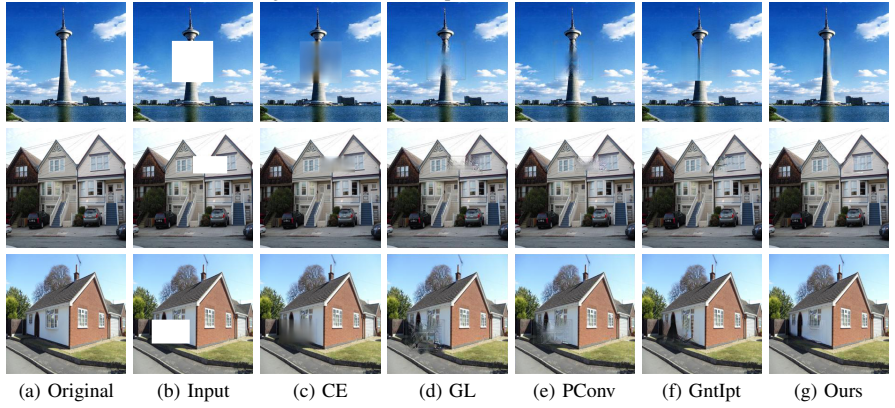
On the paper's own terms, the discovery is that explicit semantic supervision extracted from masked inputs can steer an inpainting GAN toward a more correct restoration. The generator produces $z = G(x, W_s(x), W_a(x))$, where $W_a(x)$ is the predicted attribute vector and $W_s(x)$ is the predicted segmentation map, and the discriminative network adds an attribute discriminator and a segmentation discriminator on top of the global discriminator. The authors claim this preserves consistency at both attribute and segmentation levels, and that the two regularizations complement each other: attribute guidance sharpens details, while segmentation guidance aligns region boundaries. Their experiments report consistent improvements over Context Encoder, Globally and Locally Consistent image completion, Partial Convolutions, and Generative Image Inpainting with Contextual Attention, on both a face dataset and a scene dataset, as well as on the proposed semantic retrieval metric.
Load-bearing premise
The load-bearing premise is that the pretrained attribute and segmentation networks return accurate-enough semantic predictions for corrupted inputs; if they misread the masked image, the guidance pushes the generator toward the wrong attributes and region boundaries rather than the true ones.
Editorial extensions
If this is right
- If the claim holds, inpainting systems that ignore mid-level semantics leave a measurable quality gap on the table; adding attribute and segmentation discriminators closes part of it.
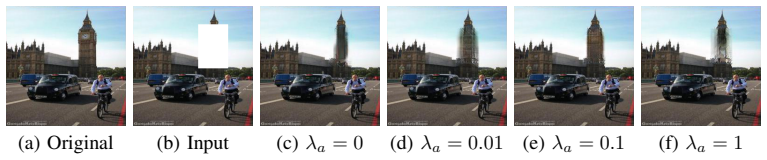
- The two semantic regularizations are complementary, so combining them is better than either alone, and the reported ablation points to trade-off parameters around $\lambda_a = 0.1$ and $\lambda_s = 0.1$ as a good operating point.
- The retrieval-based mAP evaluation offers a semantic-level yardstick for inpainting that does not require manual labels on the inpainting test set, since retrieved results of the original query images serve as ground truth.
- Because the inpainting training data itself need not be labeled, the method can be applied to any image collection that shares content categories with an auxiliary attribute or segmentation dataset.
- Consistent gains on both face and scene datasets suggest the mechanism transfers beyond faces to structured outdoor scenes.
Reading between the lines
- An implicit ceiling test would feed the generator the ground-truth attribute vector and segmentation map instead of the predicted ones; the gap between that upper bound and the full model would measure how much of the reported gain depends on prediction accuracy.
- The same dual-guidance design could be extended to other mid-level scene structure, such as depth maps or surface normals, whenever a pretrained estimator of that structure exists.
- The retrieval metric could serve as a general semantic-fidelity score for inpainting, complementing PSNR and SSIM, and could be applied to any downstream task whose performance depends on semantic content.
- If the embedding networks mispredict on heavily masked inputs, the guidance may reinforce the wrong semantics; an adaptive or jointly fine-tuned embedding could reduce that risk.
Signed reviews
Editorial analysis
A structured set of objections, weighed in public.
Referee Report
Summary. The paper proposes a GAN-based image inpainting model that injects explicit semantic guidance at two levels. An attribute embedding network Wa and a segmentation embedding network Ws, pretrained on auxiliary datasets, predict attribute vectors and segmentation maps from the corrupted input; these predictions are concatenated into the generator (Eq. (1)). A multi-level discriminative network adds an attribute discriminator and a segmentation discriminator, using matching-based training with predicted attribute and segmentation information of real images as references (Eqs. (4)-(5)). The total inpainting loss combines l2 reconstruction with global, attribute, and segmentation adversarial terms (Eq. (6)). Experiments compare with CE, GL, PConv, and GntIpt on CelebA-HQ and Places2 (Table I), provide an ablation on Places2 (Section IV-C, Table II), and introduce a retrieval-based mAP semantic metric evaluated on Paris, Oxford, and Caltech256 (Table III). The paper claims the model 'significantly outperforms' existing methods and preserves attribute and segmentation consistency.
Significance. If the empirical claims held, the paper would make a useful contribution: it addresses a genuine limitation of reconstruction-plus-adversarial losses by introducing mid-level semantic regularizers, and the three-discriminator design is a clean and sensible way to incorporate attribute and segmentation consistency. The ablation study gives qualitative and quantitative support for the complementary effect of the two regularizations, and the retrieval-based mAP metric is a reasonable step beyond PSNR/SSIM for semantic evaluation. The proposed formulation is clearly presented and the loss definitions are coherent. However, the current evidence is not sufficient for the headline claim: the quantitative gains are small, unreplicated, and selected on the same dataset used for final evaluation.
major comments (3)
- [§IV-B, Table I] The abstract's claim that the model 'significantly outperforms the state-of-the-art models' rests entirely on Table I, which reports a single training run per method with no standard deviations, confidence intervals, or significance tests. The margins are small (CelebA-HQ SSIM 0.943 vs 0.940 for GntIpt and PSNR 19.11 vs 18.80; Places2 SSIM 0.845 vs 0.839 and PSNR 22.32 vs 21.79), so the reported differences may be within run-to-run stochasticity. Table III has the same limitation. Please report multiple seeds with error bars and, if appropriate, paired significance tests over the same test images.
- [§IV-B and §IV-C, Tables I and II] The final Places2 numbers are not an independent evaluation. The hyperparameters λa=0.1 and λs=0.1 are selected from the ablation study in Section IV-C, which is conducted on Places2, and the same dataset is then used for the Places2 rows of Table I. In fact, the chosen configuration appears in Table II with PSNR 22.32 and SSIM 0.846, identical to the Places2 row in Table I. As written, the test set serves as a model-selection set, which can inflate the apparent improvement. The hyperparameters should be chosen on a validation split and the test numbers reported on a disjoint split, or the evaluation should be done by cross-validation.
- [§III-A1, §III-B, Eq. (1), Eq. (6); Conclusion] The semantic supervisory signal is not verified. Eq. (1) feeds Wa(x) and Ws(x), both computed on the corrupted input, into the generator, and the attribute and segmentation discriminators use Wa(y) and Ws(y) predicted from the real image as positive references (Eqs. (4)-(6)). The paper does not measure how accurate these predictions are on masked inputs; the Conclusion explicitly concedes that 'attribute vectors and segmentation maps might not be accurately predicted for input images, and this might result in an inaccurate supervision for inpainting.' If Wa and Ws are unreliable on masked images, the guidance injects noise rather than useful structure, and any gains may come from the extra discriminators rather than from interpretable semantic information. Please report the accuracy of Wa and Ws on masked inputs against human-labeled attributes and segmentations, or add an ablation that replaces the corrupted-input predictions with ground-truth semantic maps.
minor comments (5)
- [§III-A1, 'Segmentation Embedding Network' paragraph] The sentence 'We use the state-of-the-art semantic segmentation model [27] as our attribute embedding network' should read 'as our segmentation embedding network.'
- [§III-B, Eqs. (4) and (5)] The same symbol W_a(y_i) is used for the matched attribute vector and for the mismatched attribute vector; using a distinct symbol (e.g., W_a'(y_i)) would prevent confusion.
- [Figure 2] The label 'Discrimitive Network' in Figure 2 should be 'Discriminative Network.'
- [§IV-D] Please specify the retrieval protocol in full: number of query images, whether the inpainting models are retrained or fine-tuned on the retrieval datasets, and how many retrieved images define the pseudo-ground-truth set; without these details the proposed mAP metric is difficult to reproduce.
- [References] Reference [38] appears to duplicate reference [19] for the Helen Face dataset; the citation should be consolidated or relabeled to avoid ambiguity.
Circularity Check
No significant circularity: the semantic guidance networks are pretrained on external labeled data and the headline comparisons use independent pixel and retrieval metrics.
full rationale
The paper's derivation chain is self-contained with respect to its central claim. The generator is conditioned on attribute and segmentation embeddings Wa(x) and Ws(x) (Eq. 1), and the discriminators use Wa(y) and Ws(y) of the real image as positive references (Eqs. 4–6). This is not circular because Wa and Ws are fixed networks pretrained on external labeled datasets (CelebA, Helen, SUN, ADE20k) that are independent of the inpainting training data and of the proposed model's parameters. The consistency target is therefore an externally learned semantic representation, not a quantity produced by the inpainting model itself. The quantitative support for 'significantly outperforms' is Table I (mean l1, mean l2, PSNR, SSIM) and Table III (retrieval-based mAP using a fixed VGG-16 retrieval method); both are independent of the attribute/segmentation embeddings used in training, so the main evaluation is not defined in terms of the model's own inputs. The paper explicitly concedes a limitation: 'attribute vectors and segmentation maps might not be accurately predicted for input images, and this might result in an inaccurate supervision for inpainting' (Conclusion). This is a robustness concern about the external predictors, not a circular step. The only self-citation in the paper ([7], a GAN background reference) is not load-bearing. The choice of lambda_a = 0.1 and lambda_s = 0.1 from the Places2 ablation and then reporting Places2 results in Table I is a statistical evaluation-design concern (possible selection on the evaluation set), but it does not make the derivation circular. No equation reduces to its own input, and no fitted parameter is renamed as a prediction.
Assumptions & free parameters
free parameters (2)
- lambda_a =
0.1
- lambda_s =
0.1
assumptions (4)
- domain assumption The pretrained attribute and segmentation embedding networks produce accurate enough predictions on corrupted input images to guide inpainting.
- domain assumption The matching-based discriminator design from text-to-image synthesis (Reed et al.) transfers to image inpainting with predicted semantic features.
- domain assumption Auxiliary datasets need only be category-similar, not identical, to the inpainting training set.
- domain assumption The generator architecture of Iizuka et al. with dilated convolutions is a capable base for inpainting.
Cite this review
Pith. "Pith review of Boosted GAN with Semantically Interpretable Information for Image Inpainting." pith.science (2026). https://pith.science/paper/DKC6ZB6M
@misc{pith2026190804503,
  author       = {Pith},
  title        = {Pith review of: Boosted GAN with Semantically Interpretable Information for Image Inpainting},
  year         = {2026},
  howpublished = {\url{https://pith.science/paper/DKC6ZB6M}},
  note         = {Machine review of arXiv:1908.04503}
}
read the original abstract
Image inpainting aims at restoring missing region of corrupted images, which has many applications such as image restoration and object removal. However, current GAN-based inpainting models fail to explicitly consider the semantic consistency between restored images and original images. Forexample, given a male image with image region of one eye missing, current models may restore it with a female eye. This is due to the ambiguity of GAN-based inpainting models: these models can generate many possible restorations given a missing region. To address this limitation, our key insight is that semantically interpretable information (such as attribute and segmentation information) of input images (with missing regions) can provide essential guidance for the inpainting process. Based on this insight, we propose a boosted GAN with semantically interpretable information for image inpainting that consists of an inpainting network and a discriminative network. The inpainting network utilizes two auxiliary pretrained networks to discover the attribute and segmentation information of input images and incorporates them into the inpainting process to provide explicit semantic-level guidance. The discriminative network adopts a multi-level design that can enforce regularizations not only on overall realness but also on attribute and segmentation consistency with the original images. Experimental results show that our proposed model can preserve consistency on both attribute and segmentation level, and significantly outperforms the state-of-the-art models.
Figures


Figures from the paper (2 more)
Reference graph
Works this paper leans on
-
[1]
Generative image inpainting with contextual attention,
J. Yu, Z. Lin, J. Yang, X. Shen, X. Lu, and T. S. Huang, “Generative image inpainting with contextual attention,” CVPR 2018
work page 2018
-
[2]
M. V . Afonso, J. M. Bioucas-Dias, and M. A. Figueiredo, “An aug- mented lagrangian approach to the constrained optimization formulation of imaging inverse problems,” IEEE Transactions on Image Processing, vol. 20, no. 3, pp. 681–695, 2011
work page 2011
-
[3]
Patch- match: A randomized correspondence algorithm for structural image editing,
C. Barnes, E. Shechtman, A. Finkelstein, and D. B. Goldman, “Patch- match: A randomized correspondence algorithm for structural image editing,” ACM Transactions on Graphics, vol. 28, no. 3, pp. 24–1, 2009
work page 2009
-
[4]
Texture synthesis by non-parametric sampling,
A. A. Efros and T. K. Leung, “Texture synthesis by non-parametric sampling,” in ICCV 1999
work page 1999
-
[5]
I. J. Goodfellow, J. Pouget-Abadie, M. Mirza, B. Xu, D. Warde-Farley, S. Ozair, A. Courville, and Y . Bengio, “Generative adversarial nets,” in NIPS 2014
work page 2014
-
[6]
Unsupervised representation learning with deep convolutional generative adversarial networks,
A. Radford, L. Metz, and S. Chintala, “Unsupervised representation learning with deep convolutional generative adversarial networks,” ICLR 2016
work page 2016
-
[7]
Kdgan: Knowledge distillation with generative adversarial networks,
X. Wang, R. Zhang, Y . Sun, and J. Qi, “Kdgan: Knowledge distillation with generative adversarial networks,” in NIPS 2018
work page 2018
-
[8]
Globally and locally consistent image completion,
S. Iizuka, E. Simo-Serra, and H. Ishikawa, “Globally and locally consistent image completion,” ACM Transactions on Graphics (TOG) , vol. 36, no. 4, p. 107, 2017
work page 2017
Show all 44 references
-
[9]
Context encoders: Feature learning by inpainting,
D. Pathak, P. Krahenbuhl, J. Donahue, T. Darrell, and A. A. Efros, “Context encoders: Feature learning by inpainting,” in CVPR 2016
2016
-
[10]
High- resolution image inpainting using multi-scale neural patch synthesis,
C. Yang, X. Lu, Z. Lin, E. Shechtman, O. Wang, and H. Li, “High- resolution image inpainting using multi-scale neural patch synthesis,” in CVPR 2017
2017
-
[11]
Semantic image inpainting with deep generative models,
R. A. Yeh, C. Chen, T. Y . Lim, A. G. Schwing, M. Hasegawa-Johnson, and M. N. Do, “Semantic image inpainting with deep generative models,” in CVPR 2017
2017
-
[12]
Generative adversarial text to image synthesis,
S. Reed, Z. Akata, X. Yan, L. Logeswaran, B. Schiele, and H. Lee, “Generative adversarial text to image synthesis,” in ICML 2016
2016
-
[13]
Stackgan: Text to photo-realistic image synthesis with stacked generative adversarial networks,
H. Zhang, T. Xu, and H. Li, “Stackgan: Text to photo-realistic image synthesis with stacked generative adversarial networks,” in ICCV 2017
2017
-
[14]
Image-to-image translation with conditional adversarial networks,
P. Isola, J.-Y . Zhu, T. Zhou, and A. A. Efros, “Image-to-image translation with conditional adversarial networks,” in CVPR 2017
2017
-
[15]
High-resolution image synthesis and semantic manipulation with con- ditional gans,
T.-C. Wang, M.-Y . Liu, J.-Y . Zhu, A. Tao, J. Kautz, and B. Catanzaro, “High-resolution image synthesis and semantic manipulation with con- ditional gans,” in CVPR 2018
2018
-
[16]
Deep learning face attributes in the wild,
Z. Liu, P. Luo, X. Wang, and X. Tang, “Deep learning face attributes in the wild,” in ICCV 2015
2015
-
[17]
Places: A 10 million image database for scene recognition,
B. Zhou, A. Lapedriza, A. Khosla, A. Oliva, and A. Torralba, “Places: A 10 million image database for scene recognition,” IEEE transactions on pattern analysis and machine intelligence , 2017
2017
-
[18]
Scene parsing through ade20k dataset,
B. Zhou, H. Zhao, X. Puig, S. Fidler, A. Barriuso, and A. Torralba, “Scene parsing through ade20k dataset,” in CVPR 2017
2017
-
[19]
Interactive facial feature localization,
V . Le, J. Brandt, Z. Lin, L. Bourdev, and T. S. Huang, “Interactive facial feature localization,” in ECCV 2012
2012
-
[20]
Annotation order matters: Recurrent image annotator for arbitrary length image tagging,
J. Jin and H. Nakayama, “Annotation order matters: Recurrent image annotator for arbitrary length image tagging,” in ICPR 2016
2016
-
[21]
Semantic regularisation for recurrent image annotation,
F. Liu, T. Xiang, T. M. Hospedales, W. Yang, and C. Sun, “Semantic regularisation for recurrent image annotation,” CVPR 2017
2017
-
[22]
Cnn-rnn: A unified framework for multi-label image classification,
J. Wang, Y . Yang, J. Mao, Z. Huang, C. Huang, and W. Xu, “Cnn-rnn: A unified framework for multi-label image classification,” in CVPR 2016
2016
-
[23]
Hcp: A flexible cnn framework for multi-label image classification,
Y . Wei, W. Xia, M. Lin, J. Huang, B. Ni, J. Dong, Y . Zhao, and S. Yan, “Hcp: A flexible cnn framework for multi-label image classification,” IEEE transactions on pattern analysis and machine intelligence, vol. 38, no. 9, pp. 1901–1907, 2016
1901
-
[24]
Exploit bounding box annotations for multi-label object recognition,
H. Yang, J. Tianyi Zhou, Y . Zhang, B.-B. Gao, J. Wu, and J. Cai, “Exploit bounding box annotations for multi-label object recognition,” in CVPR 2016
2016
-
[25]
Deeplab: Semantic image segmentation with deep convolutional nets, atrous convolution, and fully connected crfs,
L.-C. Chen, G. Papandreou, I. Kokkinos, K. Murphy, and A. L. Yuille, “Deeplab: Semantic image segmentation with deep convolutional nets, atrous convolution, and fully connected crfs,” IEEE Transactions on Pattern Analysis and Machine Intelligence , vol. 40, no. 4, pp. 834–848, 2018
2018
-
[26]
Rethinking atrous convolution for semantic image segmentation,
L.-C. Chen, G. Papandreou, F. Schroff, and H. Adam, “Rethinking atrous convolution for semantic image segmentation,” arXiv preprint arXiv:1706.05587, 2017
2017 arXiv
-
[27]
Encoder- decoder with atrous separable convolution for semantic image segmen- tation,
L.-C. Chen, Y . Zhu, G. Papandreou, F. Schroff, and H. Adam, “Encoder- decoder with atrous separable convolution for semantic image segmen- tation,” arXiv preprint arXiv:1802.02611
-
[28]
Fully convolutional networks for semantic segmentation,
J. Long, E. Shelhamer, and T. Darrell, “Fully convolutional networks for semantic segmentation,” in CVPR 2015
2015
-
[29]
Pyramid scene parsing network,
H. Zhao, J. Shi, X. Qi, X. Wang, and J. Jia, “Pyramid scene parsing network,” in CVPR 2017
2017
-
[30]
Conditional generative adversarial nets,
M. Mirza and S. Osindero, “Conditional generative adversarial nets,” arXiv preprint arXiv:1411.1784 , 2014
2014 arXiv
-
[31]
Simultaneous structure and texture image inpainting,
M. Bertalmio, L. Vese, G. Sapiro, and S. Osher, “Simultaneous structure and texture image inpainting,” IEEE Transactions on Image Processing, vol. 12, no. 8, pp. 882–889, 2003
2003
-
[32]
Image quilting for texture synthesis and transfer,
A. A. Efros and W. T. Freeman, “Image quilting for texture synthesis and transfer,” in SIGGRAPH 2001
2001
-
[33]
Image inpainting for irregular holes using partial convolutions,
G. Liu, F. A. Reda, K. J. Shih, T.-C. Wang, A. Tao, and B. Catanzaro, “Image inpainting for irregular holes using partial convolutions,” ECCV 2018
2018
-
[34]
Semantic image inpainting with progressive generative networks,
H. Zhang, Z. Hu, C. Luo, W. Zuo, and M. Wang, “Semantic image inpainting with progressive generative networks,” in ACMMM 2018
2018
-
[35]
Attribute2image: Conditional image generation from visual attributes,
X. Yan, J. Yang, K. Sohn, and H. Lee, “Attribute2image: Conditional image generation from visual attributes,” in ECCV 2016
2016
-
[36]
Multi-label image recognition by recurrently discovering attentional regions,
Z. Wang, T. Chen, G. Li, R. Xu, and L. Lin, “Multi-label image recognition by recurrently discovering attentional regions,” in ICCV 2017
2017
-
[37]
Progressive growing of gans for improved quality, stability, and variation,
T. Karras, T. Aila, S. Laine, and J. Lehtinen, “Progressive growing of gans for improved quality, stability, and variation,” ICLR 2018
2018
-
[38]
Exemplar-based face parsing,
B. M. Smith, L. Zhang, J. Brandt, Z. Lin, and J. Yang, “Exemplar-based face parsing,” in CVPR 2013
2013
-
[39]
Sun database: Large-scale scene recognition from abbey to zoo,
J. Xiao, J. Hays, K. A. Ehinger, A. Oliva, and A. Torralba, “Sun database: Large-scale scene recognition from abbey to zoo,” in CVPR 2010
2010
-
[40]
Object retrieval with large vocabularies and fast spatial matching,
J. Philbin, O. Chum, M. Isard, J. Sivic, and A. Zisserman, “Object retrieval with large vocabularies and fast spatial matching,” in CVPR 2007
2007
-
[41]
Lost in quantization: Improving particular object retrieval in large scale image databases,
J. Philbin, O. Chum, M. Isard, J. Sivic, and A. Zisserman, “Lost in quantization: Improving particular object retrieval in large scale image databases,” in CVPR 2008
2008
-
[42]
Caltech256 image dataset,
G. Griffin, A. Holub, and P. Perona, “Caltech256 image dataset,” 2006
2006
-
[43]
Deep learning for content-based image retrieval: A comprehensive study,
J. Wan, D. Wang, S. C. H. Hoi, P. Wu, J. Zhu, Y . Zhang, and J. Li, “Deep learning for content-based image retrieval: A comprehensive study,” in ACMMM, 2014
2014
-
[44]
Very deep convolutional networks for large-scale image recognition,
K. Simonyan and A. Zisserman, “Very deep convolutional networks for large-scale image recognition,” Computer Science, 2014
2014
Reviewed August 14, 2026 · model on record in the stance chip above.
Discussion (0). Continue with ORCID to comment.