REVIEW 3 major objections 4 minor 86 references
Interacting Agegraphic Dark Energy Model in DGP Braneworld Cosmology: Dynamical System Approach
T0 review · 3 major / 4 minor · reviewed 2026-08-14 · deepseek-v4-flash
Pith's one-line read Interaction can stabilize the dark-energy era in an agegraphic DGP braneworld model and prevent the big rip.
desk verdict The central stability claim does not survive contact with the paper's own equations: z is a dynamical variable, and the reported eigenvalues do not match the Jacobian. read the letter →
The pith
A machine-rendered reading of the paper's core claim, the machinery that carries it, and where it could break.
The reading
What carries the argument
The central machinery is the two-dimensional autonomous system in the normalized energy-density variables $x = \sqrt{\rho_m / (3M_p^2 (H^2 + H/r_c))}$ and $y = \sqrt{\rho_{DE} / (3M_p^2 (H^2 + H/r_c))}$, subject to the Friedmann constraint $x^2 + y^2 = 1$. The parameter $z = \sqrt{1 + 1/(H r_c)}$ is treated as constant; with that, Eqs. (16)-(17) close into an autonomous planar system. Stability is read off from the eigenvalues of the linearized system at the two fixed points, and the dark-energy point's second eigenvalue gives the threshold $\beta = 1 - 2/(3n)$. This eigenvalue criterion is what carries the paper's main conclusion.
What would settle it
Evaluate the derivative of $z = \sqrt{1 + 1/(H r_c)}$ at the claimed fixed point $(x,y) = (0,1)$; one finds $z' = z^2(z^2-1)/(n(z^2+1))$, which is nonzero for $z>1$, so the full three-variable dynamics has no equilibrium there.
Extended reading notes
Core claim
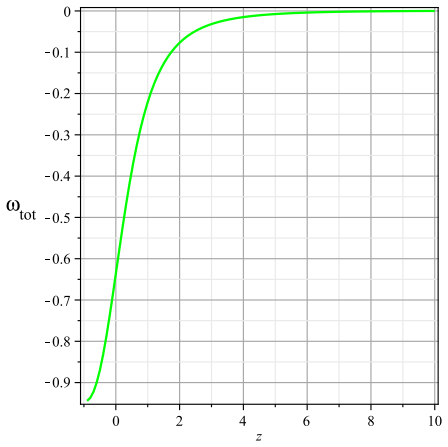
The central claim is that adding an interaction between agegraphic dark energy and dark matter changes the fate of the dark-energy-dominated phase in a normal DGP braneworld. In the non-interacting case this epoch is a saddle point, but here the fixed point $(x,y) = (0,1)$ has eigenvalues $(2-3n)/n$ and $(3\beta n - 3n + 2)/(2n)$; the second eigenvalue is negative when $\beta < 1 - 2/(3n)$, making the point stable, whereas for $\beta > 1 - 2/(3n)$ it is a saddle. With best-fit parameters $n=14$ and $\beta=0.18$ from CMB+BAO+OHD data, the inequality holds, so the universe is claimed to end in a stable, dark-energy-dominated state. The total equation of state $w_{\rm tot}$ evaluated at both fixed points and along the best-fit trajectory remains greater than $-1$, which the authors take as evidence that the model avoids the big rip.
Load-bearing premise
The entire fixed-point analysis depends on freezing the auxiliary quantity $z = \sqrt{1 + 1/(H r_c)}$ as a constant while $H$ is still evolving; if $z$ is treated as a genuine dynamical variable, the claimed stable point need not exist.
Editorial extensions
If this is right
- If the central claim holds, the future universe in this model approaches a stable dark-energy-dominated configuration rather than passing through a transient one, making the coincidence problem less severe.
- The stability condition $\beta < 1 - 2/(3n)$ means only sufficiently weak interactions (relative to $n$) allow a stable dark-energy era; stronger interactions make that era a saddle point.
- The model predicts no big rip: the total equation of state stays above $-1$ at both critical points and along the fitted evolution.
- The matter-dominated fixed point remains unstable for all parameter values, consistent with a universe that evolves from matter domination toward dark-energy domination.
Reading between the lines
- A natural next step is to promote $z$ to a dynamical variable; because $z$ varies with $H$, the stability results could change, and checking that would settle whether the claimed attractor is real.
- The same dynamical-system treatment could be rerun for other interaction forms, such as $Q \propto \rho_{DE}$ or $Q \propto \rho_m$, to see whether the stability threshold survives or moves.
- If future data constrain $n$ and $\beta$ independently, the inequality $\beta < 1 - 2/(3n)$ becomes a falsifiable prediction linking the agegraphic parameter to the dark-sector coupling.
Signed reviews
Editorial analysis
A structured set of objections, weighed in public.
Referee Report
Summary. The manuscript studies an interacting agegraphic dark energy model in the normal DGP braneworld using the dynamical system approach. It introduces normalized variables x and y, derives the evolution equations (16) and (17), fits the model parameters to CMB+BAO+OHD data, and identifies two fixed points. The central claim is that the dark-energy-dominated point B=(0,1) is stable when beta < 1 - 2/(3n), so that interaction can stabilize the future DE-dominated era and avoid a big rip singularity. The paper further argues that the total equation of state stays above -1 and therefore the model is free of phantom singularities.
Significance. If the stability claim were correct, the paper would provide a notable result: interaction would change the DE-dominated fixed point from a saddle to an attractor in an agegraphic DGP setup, while keeping the total equation of state above -1. The paper also supplies observational constraints on the model parameters. However, the central result is not supported by the presented equations: the system is not closed as a two-dimensional autonomous system, and the reported eigenvalues do not follow from the Jacobian of Eqs. (16)-(17). These are load-bearing problems, not presentation issues.
major comments (3)
- [Section III, Eqs. (16)-(17)] The system is declared autonomous, but z = sqrt(1 + 1/(H r_c)) depends on H and therefore on ln a, so z is a dynamical variable. No evolution equation for z is supplied. Differentiating z gives z' = 3 z (z^2 - 1)(x^2 + (2/(3n)) y^3 z - beta x^2 y^2) / (2(z^2 + 1)), which at the claimed fixed point (0,1) equals z^2 (z^2 - 1)/(n(z^2 + 1)) and is nonzero for every z > 1. Hence the phase space is at least three-dimensional and (0,1) is not an equilibrium of the full dynamics. The two-dimensional stability analysis is therefore incomplete and cannot justify the classification of point B.
- [Table II, point B] The eigenvalues listed for B=(0,1) do not match the Jacobian of Eqs. (16)-(17) even with z held fixed. Linearizing at (0,1) gives the eigenvalues lambda_1 = -3/2 + 3 beta/2 + z/n and lambda_2 = 2 z/n, neither of which equals the reported (2 - 3n)/n or (3 beta n - 3n + 2)/(2n). The paper's threshold beta < 1 - 2/(3n) corresponds to lambda_1 < 0 with z = 1, but the paper itself states that at B, Omega_DE = z^2 and z >= 1, so z = 1 is not the relevant value. The stability classification of the DE-dominated era is therefore unsupported.
- [Section IV, big rip discussion] The conclusion that the model avoids a big rip relies on evaluating the total equation of state at the claimed fixed point B and treating it as the future attractor. Since B is not a fixed point of the full dynamics, the attractor statement is not established, and the big-rip avoidance claim loses its dynamical basis. Additionally, at B one has Omega_DE = z^2 > 1 on the normal DGP branch, so the physical relevance of this point requires further discussion that is not present.
minor comments (4)
- [Section III, after Eq. (14)] The phrase 'advert to Eq. (6)' is nonstandard; it should be 'refer to Eq. (6)' or 'appeal to Eq. (6)'.
- [Section III, Table I and fitting procedure] The description of the observational constraints is too sparse: no data sets, likelihood functions, priors, or chi-squared values are given, and no uncertainties on the best-fit parameters are reported. This makes the best-fit values difficult to evaluate.
- [Figure 1] The caption mentions 'the blue curve' but the text does not explain what this curve represents or how it was obtained.
- [Throughout] There are several grammatical slips, e.g., 'there is not the big rip singularity' in the conclusion, and inconsistent use of 'first' / 'firstly' in the abstract and introduction. A careful language edit is needed.
Circularity Check
No significant circularity: the stability criterion is derived in-place from the model equations, and the fitted parameters are applied only after that derivation.
full rationale
The paper's central stability claim for the DE-dominated point B is derived internally: the dimensionless phase-space system (16)-(17) is written down, fixed points are obtained by setting x' = y' = 0, and the eigenvalues in Table II are reported in terms of the model parameters n and beta. The stability condition beta < 1 - 2/(3n) follows from requiring the eigenvalues to be negative, and the best-fit values from Table I are used only afterward to check whether the inequality holds for the observationally preferred parameters. No fitted quantity is inserted back into the derivation of the inequality itself, and no data-derived output is renamed as an independent prediction. The self-citation [64] is used only as motivational contrast about the non-interacting case; the stabilizing effect of interaction is argued from the explicitly computed eigenvalues in this paper, so that citation is not load-bearing. Concerns about z being treated as constant when it actually varies with H, or about the reported eigenvalues not matching the Jacobian of the two-dimensional reduction, are correctness and consistency issues rather than circularity: they do not show that an output was assumed in the inputs or that a fitted parameter was renamed as a prediction. The derivation chain from the model equations to the stability condition is self-contained, so no circular step is exhibited.
Assumptions & free parameters
free parameters (5)
- n =
14
- beta =
0.18
- Omega_rc =
0.0099
- H0 =
67 km/s/Mpc
- Omega_DE0 =
0.82
assumptions (4)
- domain assumption Agegraphic dark energy density rho_DE = 3 n^2 M_p^2 / T^2, where T is the age of the universe.
- domain assumption Normal DGP brane Friedmann equation H^2 + H/r_c = (rho_m + rho_DE)/(3 M_p^2).
- domain assumption Interaction form Q = 3 beta H rho_DE rho_m / (rho_DE + rho_m) with beta > 0.
- ad hoc to paper The xy system (16)-(17) is autonomous and closed with z treated as a constant.
Cite this review
Pith. "Pith review of Interacting Agegraphic Dark Energy Model in DGP Braneworld Cosmology: Dynamical System Approach." pith.science (2026). https://pith.science/paper/DLI6YTLT
@misc{pith2026190805332,
  author       = {Pith},
  title        = {Pith review of: Interacting Agegraphic Dark Energy Model in DGP Braneworld Cosmology: Dynamical System Approach},
  year         = {2026},
  howpublished = {\url{https://pith.science/paper/DLI6YTLT}},
  note         = {Machine review of arXiv:1908.05332}
}
abstract
A proposal to study the effect of interaction in an agegraphic dark energy model in DGP brane-world cosmology is presented in this manuscript. After explaining the details, we proceed to apply the dynamical system approach to the model to analyze its stability. We first, constrain model parameters with a variety of independent observational data such as cosmic microwave background anisotropies, baryon acoustic oscillation peaks and observational Hubble data. Then, we obtain the critical points related to different cosmological epochs. In particular, we conclude that in the presence of interaction, dark energy dominated era could be a stable point if model parameters $n$ and $\beta$, obey a given constraint. Also, big rip singularity is avoidable in this model.
Figures

Reference graph
Works this paper leans on
-
[1]
Pressureless matter which offers standard gravitational attraction cannot sp eed up the universe
INTRODUCTION Large-scale observations indicate a late-time cosmic acceleration [1 ]-[6] . Pressureless matter which offers standard gravitational attraction cannot sp eed up the universe. Hence, several scenarios proposed to explain this cosmic accelerated exp ansion [7]-[10] . The ba- sic idea is to insert a new component with an effective negative pressu ...
-
[2]
Substituting T for t, in Eq.(1), agegraphic energy density can be written as [20] ρDE = 3n2M 2 p T 2
THE ADE IN DGP MODEL As we mentioned in the introduction, in ADE scenario the age of the un iverse T = ∫ a 0 da Ha , (2) is considered as the length scale in which a and H, are the scale factor and the Hubble parameter, respectively. Substituting T for t, in Eq.(1), agegraphic energy density can be written as [20] ρDE = 3n2M 2 p T 2 . (3) Here, 3 n2 is a ...
2015
-
[3]
Generally, a dynamical system of order n, is defined as follows:
DYNAMICAL SYSTEM APPROACH AND ST ABILITY ANAL YSIS Dynamical system approach is a mathematical tool which gives insigh ts on the long-term behavior of the model under consideration and its evolution near th e fixed points, using stability analysis. Generally, a dynamical system of order n, is defined as follows:
-
[4]
The state of the system at any time t, can be represented by n real variables that can be considered as coordinates of a vector in an nD space, called phase-space
-
[5]
If time does not appear in the equations explicitly, we have a time-inde pendent or an autonomous system which is the case of interest in this approach
The time evolution of the system, is represented by a set of first order equations, called equations of motion. If time does not appear in the equations explicitly, we have a time-inde pendent or an autonomous system which is the case of interest in this approach. I n order to perform the stability analysis, one has to introduce some auxiliary variables so...
-
[6]
This problem was first brought up in DE models in which the DE componen t is a phantom fluid with wDE < − 1
BIG RIP SINGULARITY One of the most important problems in cosmology is the so called big rip s ingularity. This problem was first brought up in DE models in which the DE componen t is a phantom fluid with wDE < − 1. In these models the energy density of the phantom fluid grows wit h the expansion of the universe so that it blows up at a finite time in the f u...
- [7]
-
[8]
CONCLUSION In this manuscript we investigated the effect of interaction betwee n ADE and dark mat- ter in a normal branch of DGP cosmology in the context of dynamical system approach. After introducing the model and the new phase-space variables, w e obtained a two dimen- sional autonomous system. We first constrained model paramete rs numerically and using...
Show all 86 references
-
[9]
A. G. Riess, et al., Astron. J., 116, 1009 (1998)
1998
-
[10]
Perlmutter, et al., Astrophys
S. Perlmutter, et al., Astrophys. J., 517, 565 (1999)
1999
-
[11]
D. N. Spergel, et al., Astrophys. J. Suppl., 148, 175 (200 3)
-
[12]
D. N. Spergel, et al., Astrophys. J. Suppl., 170, 377 (200 7)
-
[13]
Tegmark, et al., Phys
M. Tegmark, et al., Phys. Rev. D, 69, 103501 (2004)
2004
-
[14]
D. J. Eisenstein, et al., Astrophys. J., 633, 560 (2005)
2005
-
[15]
Sen, Phys
A. Sen, Phys. Scripta. T, 117, 70 (2005)
2005
-
[16]
Nojiri, S
S. Nojiri, S. D. Odintsov and V. K. Oikonomou, Phys. Rept. , 692, 1 (2017)
2017
-
[17]
Capozziello and M
S. Capozziello and M. De Laurentis, Phys. Rept., 509, 167 (2011)
2011
-
[18]
Y. F. Cai, S. Capozziello, M. De Laurentis and E. N. Sarid akis, Rept. Prog. Phys., 79, 106901 (2016)
2016
-
[19]
Sahni and A
V. Sahni and A. A. Starobinsky, Int. J. Mod. Phys. D, 9, 37 3 (2000)
2000
-
[20]
R. R. Caldwell, R. Dave and R. J. Steinhardt, Phys. Rev. L et., 80, 1582 (1998)
1998
-
[21]
Armendariz-Picon, V
C. Armendariz-Picon, V. Mukhanov and P. J. Steinhardt, Phys. Rev. D, 63, 103510 (2001)
2001
-
[22]
Padmanabhan, Phys
T. Padmanabhan, Phys. Rev. D, 66, 021301 (2002)
2002
-
[23]
K´ arolyh´ azy, Nuovo Cimento A, 42, 390 (1966)
F. K´ arolyh´ azy, Nuovo Cimento A, 42, 390 (1966)
1966
-
[24]
R. R. Caldwell, Phys. Lett. B, 545, 23 (2002)
2002
-
[25]
Horava and D
P. Horava and D. Minic., Phys. Rev. Lett., 85, 1610 (2000 )
2000
-
[26]
Li., Phys
M. Li., Phys. Lett. B, 603, 1 (2004)
2004
-
[27]
Wei and R
H. Wei and R. G. Cai, Phys. Lett. B, 663, 1 (2008)
2008
-
[28]
R. G. Cai, Phys. Lett. B, 657, 228 (2007)
2007
-
[29]
Guberina, R
B. Guberina, R. Horvat and H. Nikolic, J. Cosmol. Astrop art. Phys. 01, 012 (2007)
2007
-
[30]
Wei, Commun
H. Wei, Commun. Theor. Phys. 52, 743 (2009)
2009
-
[31]
Wei and R
H. Wei and R. G. Cai, Eur. Phys. J. C, 59, 99 (2009)
2009
-
[32]
Maziashvili, Int
M. Maziashvili, Int. J. Mod. Phys. D, 16, 1531 (2007)
2007
-
[33]
Wei and R
H. Wei and R. G. Cai, Phys. Lett. B, 660, 113 (2008)
2008
-
[34]
K. Y. Kim, H. W. Lee and Y. S. Myung, Phys. Lett. B, 660, 118 (2008)
2008
-
[35]
Zhang, X
J. Zhang, X. Zhang and H. Liu, Eur. Phys. J. C, 54, 303, (20 08)
-
[36]
Malekjani and A
M. Malekjani and A. Khodam-Mohammadi, Int. J. Mod. Phys . D, 19, 1857 (2010)
2010
-
[37]
Khodam-Mohammadi, P
A. Khodam-Mohammadi, P. majari and M. Malekjani, Astro phys. Space Sci., 331, 673 (2011)
2011
-
[38]
Farajollahi, J
H. Farajollahi, J. Sadeghi, M. Pourali and A. Salehi, As trophys. Space Sci., 339, 79 (2012)
2012
-
[39]
B. Wang, Y. G. Gong and E. Abdalla, Phys. Lett. B, 624, 141 (2005)
2005
-
[40]
Sheykhi, Phys
A. Sheykhi, Phys. Lett. B, 682, 329 (2010)
2010
-
[41]
Jamil and A
M. Jamil and A. Sheykhi, Int. J. Theor. Phys., 50, 625 (20 11)
-
[42]
O. A. Lemets, D. A. Yerokhin and L. G. Zazunov, JCAP, 01, 0 07 (2011)
2011
-
[43]
X. M. Liu, Z. X. Zhai, K. Xiao and W. B. Liu, Eur. Phys. J. C, 72, 2057 (2012)
2012
-
[44]
Farajollahi, A
H. Farajollahi, A. Ravanpak and G. F. Fadakar, Phy. Lett . B, 711, 15, 225 (2012)
2012
-
[45]
J. S. Baglaa, H. K. Jassal and T. Padmanabhan, Phys. Rev. D, 67, 063504 (2003). 11
2003
-
[46]
J. S. Baglaa, H. K. Jassal and T. Padmanabhan, Phys. Rev. D, 83, 063515 (2011)
2011
-
[47]
L. P. Chimento, R. Lazkoz, R. Maartens and I. Quiros, JCA P, 0609, 004 (2006)
2006
-
[48]
Arkani-Hamed, S
N. Arkani-Hamed, S. Dimopoulos and G. Dvali, Phys. Lett . B, 429, 263 (1998)
1998
-
[49]
Randall and R
L. Randall and R. Sundrum, Phys. Rev. Lett., 83, 4690 (19 99)
-
[50]
Randall and R
L. Randall and R. Sundrum, Phys. Rev. Lett., 83, 3370 (19 99)
-
[51]
Dvali, G
D. Dvali, G. Gabadadze and M. Porrati, Phys. Lett. B, 485 , 208 (2000)
2000
-
[52]
Sahni and Y
V. Sahni and Y. Shtanov, JCAP, 0311, 014 (2003)
2003
-
[53]
Lue and G
A. Lue and G. D. Starkman, Phys. Rev. D, 70, 101501 (2004)
2004
-
[54]
Lazkoz, R
R. Lazkoz, R. Maartens and E. Majerotto, Phys. Rev. D, 74 , 083510 (2006)
2006
-
[55]
Dutta and S
J. Dutta and S. Chakraborty, Int. J. Theor. Phys., 50, 23 83 (2011)
2011
-
[56]
, both the wDE and wtot, are always greater than -1, and this model does not approach big rip singularity. To discuss the role of interaction in a DGP model in the presence of AD E, we write the total EoS parameter in terms of our new variables as wtot = − 1 − 2 ˙H 3H 2 = − 1 ...
-
[57]
Zhang and Z
H. Zhang and Z. H. Zhu, Phys. Rev. D, 75, 023510 (2007)
2007
-
[58]
Quiros, R
I. Quiros, R. Garcia-Salcedo, T. Matos and C. Moreno, Ph ys. Lett. B, 670, 259 (2009)
2009
-
[59]
Bouhmadi-Lopez and R
M. Bouhmadi-Lopez and R. Lazkoz, Phys. Lett. B, 654, 51 ( 2007)
2007
-
[60]
Rudra, Astrophys
P. Rudra, Astrophys. Space Sci., 342, 579 (2012)
2012
-
[61]
X. Wu, R. G. Cai, Z. H. Zhu, Phys. Rev. D, 77, 043502 (2008)
2008
-
[62]
D. J. Liu, H. Wang and B. Yang, Phys. Lett. B, 694, 6 (2010)
2010
-
[63]
Farajollahi and A
H. Farajollahi and A. Ravanpak, Astrophys. Space Sci., 349, 961 (2014)
2014
-
[64]
Farajollahi, A
H. Farajollahi, A. Ravanpak and G. F. Fadakar, Astrophy s. Space Sci., 348, 253 (2013)
2013
-
[65]
Stachowski and M
A. Stachowski and M. Szydlowski, Eur. Phys. J. C, 76, 606 (2016)
2016
-
[66]
Bouhmadi-Lpez, J
M. Bouhmadi-Lpez, J. Marto, J. Morais and C. M. Silva, JC AP, 03, 042 (2017)
2017
-
[67]
M. A. Skugoreva, A. V. Toporensky and S. Y. Vernov, Phys. Rev. D, 90, 064044 (2014)
2014
-
[68]
Farajollahi, J
H. Farajollahi, J. Sadeghi, M. Pourali and A. Salehi, As trophys. Space Sci, 339, 1, 79 (2012)
2012
-
[69]
Farajollahi, A
H. Farajollahi, A. Salehi and M. Nasiri, JCAP, 11, 018 (2 011)
-
[70]
Farajollahi, A
H. Farajollahi, A. Salehi, F. Tayebi and A. Ravanpak, JC AP, 05, 017 (2011)
2011
-
[71]
Xiao and J
K. Xiao and J. Y. Zhu, Phys. Rev. D, 83, 083501 (2011)
2011
- [72]
-
[73]
Deffayet, Phys
C. Deffayet, Phys. Lett. B, 502, 199 (2001)
2001
-
[74]
M. Li, X. D. Li, S. Wang, Y. Wang and X. Zhang, JCAP, 0912, 0 14 (2009)
2009
-
[75]
Zhang, S
Z. Zhang, S. Li, X. D. Li, X. Zhang and M. Li, JCAP, 1206, 00 9 (2012)
2012
-
[76]
Zhang, J
L. Zhang, J. Cui, J. Zhang and X. Zhang, Int. J. Mod. Phys. D, 19, 21 (2010). 12
2010
-
[77]
Clemson, K
T. Clemson, K. Koyama, G. B. Zhao, R. Maartens and J. Vali viita, Phys. Rev. D 85, 043007 (2012)
2012
-
[78]
A. A. Costa, X. D. Xu, B. Wang, E. G. M. Ferreira and E. Abda lla, Phys. Rev. D, 89, 103531 (2014)
2014
-
[79]
Y. H. Li and X. Zhang, Phys. Rev. D, 89, 083009 (2014)
2014
-
[80]
Yang and L
W. Yang and L. Xu, JCAP, 1408, 034 (2014)
2014
-
[81]
Bouhmadi-Lopez, J
M. Bouhmadi-Lopez, J. Morais and A. Zhuk, Phys. Dark Uni v., 14, 11 (2016)
2016
-
[82]
Feng and X
L. Feng and X. Zhang, JCAP, 08, 072 (2016)
2016
-
[83]
Farajollahi, A
H. Farajollahi, A. Ravanpak and G. F. Fadakar, Astrophy s. Space Sci., 336, 461 (2011)
2011
-
[84]
R. R. Caldwell, M. Kamionkowski and N. N. Weinberg, Phys . Rev. Lett. 91, 071301 (2003)
2003
-
[85]
Curbelo, T
R. Curbelo, T. Gonzalez and I. Quiros, Class. Quant. Gra v. 23, 1585 (2006)
2006
-
[86]
X. Fu, H. Yu and P. Wu, Phys. Rev. D 78, 063001 (2008). 13
2008
Reviewed August 14, 2026 · model on record in the stance chip above.
Discussion (0). Continue with ORCID to comment.