REVIEW 3 major objections 5 minor 2 cited by
ViBe: A Text-to-Video Benchmark for Evaluating Hallucination in Large Multimodal Models
T0 review · 3 major / 5 minor · reviewed 2026-08-12 · deepseek-v4-flash
Pith's one-line read ViBe introduces a benchmark categorizing hallucinations in text-to-video generation.
desk verdict Useful dataset, but the sampling story is undocumented and the 'detection' claim doesn't match the data; worth reviewing with major revision. read the letter →
The pith
A machine-rendered reading of the paper's core claim, the machinery that carries it, and where it could break.
The reading
What carries the argument
The central organizing device is the five-category taxonomy of text-to-video hallucinations: Vanishing Subject, Omission Error, Numeric Variability, Subject Dysmorphia, and Visual Incongruity. This taxonomy drives the manual annotation protocol that labels all 3,782 videos and defines the classification task. The benchmark pipeline then extracts video embeddings with pre-trained models, VideoMAE and TimeSFormer, and feeds them into classifiers; the best-performing configuration is TimeSFormer embeddings combined with a convolutional neural network.
What would settle it
Sampling the same ten T2V models with the same prompts and counting how many generated videos contain none of the five hallucination types would directly test the claim that these categories are the dominant failure modes; if a large share of videos fall outside the taxonomy, the benchmark's coverage claim collapses.
Extended reading notes
Core claim
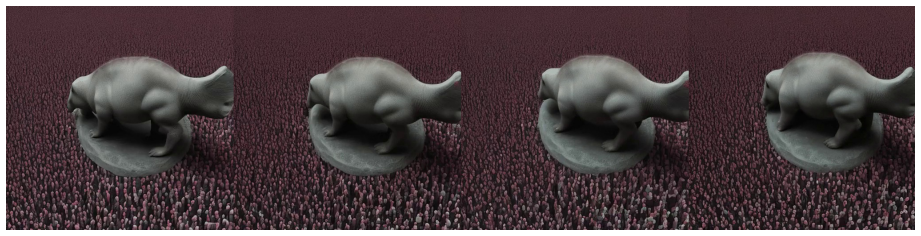
On its own terms, the paper claims to provide the first dataset specifically designed to systematically categorize hallucinations in text-to-video outputs. ViBe is constructed by prompting ten open-source T2V models with diverse MS COCO captions, manually annotating every generated video, and organizing the results into a five-category taxonomy that captures recurring failure patterns: subjects that vanish mid-video, objects omitted from the prompt, altered counts of objects, distorted forms, and physically impossible scenes. The paper further establishes a classification benchmark using video embeddings and reports baseline results, positioning ViBe as a foundation for evaluating prompt adherence and developing hallucination detectors for T2V models.
Load-bearing premise
The dataset is built only from videos that human annotators judged to contain hallucinations, and the paper does not report how many generated videos were excluded, so the benchmark's representativeness of text-to-video hallucination phenomena is unverified.
Editorial extensions
If this is right
- Any text-to-video model can be evaluated against ViBe's five categories to identify its recurring failure patterns.
- The five categories provide a shared vocabulary for comparing hallucination types across different T2V models.
- The TimeSFormer + CNN baseline of 0.345 accuracy and 0.342 F1 gives a concrete reference point that future hallucination classifiers must exceed.
- If the taxonomy holds, training detectors to flag specific hallucination types becomes a well-defined task, potentially enabling automatic evaluation and mitigation.
- The dataset's scale, over 3,700 videos, supports training and testing that the previous 50-video benchmark could not.
Reading between the lines
- Since ViBe contains only videos that human annotators judged to be hallucinated and the paper does not report how many generated videos were excluded, the dataset likely overstates how frequently hallucinations occur; a control set of non-hallucinated videos would be needed to build a true detector.
- The single-label annotation protocol may compress cases where multiple hallucination types co-occur, so a multi-label variant could change baseline performance and better reflect real T2V errors.
- With most videos lasting just one second, the distribution of hallucination types may not transfer to longer generations, where temporal consistency failures could appear differently.
- A natural extension would be to use the five categories as fine-grained feedback signals for training T2V models with human preference alignment, rather than only for detection.
Signed reviews
Editorial analysis
A structured set of objections, weighed in public.
Referee Report
Summary. The paper introduces ViBe, a benchmark dataset of 3,782 videos generated by ten open-source text-to-video (T2V) models from 837 MS COCO captions. All videos were manually annotated into one of five hallucination categories: Vanishing Subject, Omission Error, Numeric Variability, Subject Dysmorphia, and Visual Incongruity. The authors report inter-annotator Cohen's kappa scores per category, extract video embeddings with TimeSFormer and VideoMAE, and evaluate seven classifiers on the resulting five-way classification task. The best baseline, TimeSFormer+CNN, reaches 0.345 accuracy and 0.342 F1. The paper claims to provide the first large-scale resource for systematically categorizing T2V hallucinations and a benchmark for hallucination detection.
Significance. If the dataset construction is sound, ViBe is a potentially valuable resource: it is substantially larger than the only comparable prior benchmark, T2VHaluBench (50 videos), and the five-category taxonomy is intuitive and illustrated with concrete examples. The reported kappa scores (0.7474--0.8737) indicate reasonable annotation consistency, and the classification baselines provide a useful reference point for future work. However, the current manuscript does not document the sampling/filtering protocol, does not include any non-hallucinated videos, and contains internal inconsistencies in reported counts; these issues must be resolved before the benchmark's representativeness and its 'hallucination detection' framing can be accepted.
major comments (3)
- [Section 3.4, Table 2] The dataset selection protocol is not disclosed. The paper never reports how many videos were generated per model, how many were excluded because they were judged non-hallucinated, or whether a per-category quota or cap was applied. The exact repeated counts of 70 in Table 2 (e.g., AnimateLCM 2/70/70/70/70, MagicTime 70/70/70/69/70, HotShotXL 70/70/70/69/70) strongly suggest an undocumented sampling cap. This is load-bearing because without the denominator and exclusion rule, Table 2 cannot be interpreted as a natural distribution of hallucinations across models, and no model-level hallucination rate can be computed. The authors should report the total number of generated videos per model, the inclusion/exclusion criteria, and any quota used.
- [Abstract, Section 4, Table 6] The benchmark contains only hallucinated videos: all 3,782 instances are positive examples, and the classification task has exactly five hallucination-type labels with no 'no hallucination' class. Consequently, the reported TimeSFormer+CNN result of 0.345 accuracy is five-way categorization accuracy conditional on a video already being known to be hallucinated; it is not hallucination detection. The abstract and Section 4 claim 'hallucination detection,' but the experimental setup cannot support such a claim. Either non-hallucinated videos should be included and a detection task defined, or the claims and title framing should be revised to 'hallucination-type classification.'
- [Section 3.5, Figure 6] The numerical values in Figure 6 are inconsistent with Table 2 and with the prose in the same paragraph. For example, Table 2 reports 282 AnimateLCM videos and 694 MORA videos, all 1 second long, so the cumulative durations should be 282 seconds and 694 seconds, respectively, but Figure 6 lists 349 seconds and 349 seconds. Similarly, zeroscope_v2_XL (363 videos at 2 seconds = 726 seconds) is labeled 311 seconds in the figure, while the text correctly says 726 seconds. This suggests the bar labels are misassigned. The figure must be corrected, and the corresponding values in Table 2 should be cross-checked, because the internal inconsistency weakens confidence in the reported dataset counts.
minor comments (5)
- [Section 3.5] The sentence beginning 'The total duration per model refers to the cumulative time spent annotating all videos...' is garbled ("as shown in 6. 1 provides a detailed report"); it should be rewritten for clarity.
- [Appendix B] The appendix states that the average annotation time was 2.25 seconds per video, which is implausible and contradicts Figure 7, where annotation times are hundreds or thousands of minutes per model. This is likely 2.25 minutes; please correct the units.
- [Section 2] The paragraph on image-generation hallucination benchmarks cites HADES (Liu et al., 2022) as an image-generation hallucination dataset, but the reference is actually a token-level text hallucination detection benchmark; the citation or the surrounding description should be corrected.
- [References] References to Chu et al. appear as both 2024a and 2024b for what appears to be the same Sora Detector paper; please deduplicate or clarify the distinction.
- [Section 3.6] The kappa values are reported per category, but the number of annotators who labeled the 100 common videos and the procedure for adjudicating disagreements are not described; a brief note on the annotation adjudication protocol would help.
Circularity Check
No circularity: ViBe's hallucination labels are human annotations used to train and test classifiers on a held-out partition, so the benchmark results are not equivalent to the paper's inputs by construction.
full rationale
ViBe is a dataset-building and benchmark paper rather than a derivation. The five-category taxonomy is defined from observed video inconsistencies (Section 3.3), and the labels come from human annotators (Section 3.4: 'Five annotators manually categorized 3,782 videos, assigning each to the most prominent hallucination type based on a predefined taxonomy'). The classification experiments are a standard supervised evaluation: Section 4.2 states 'The dataset was partitioned into 80% for training and 20% for testing,' and Table 6 reports held-out accuracy and F1 for models trained on VideoMAE and TimeSFormer embeddings. No fitted parameter is renamed as a prediction, no result is justified solely by a self-citation, and no claimed derivation reduces to its own definition. The undocumented selection of hallucinated videos and the lack of a non-hallucinated class (Table 2, Table 6) are legitimate concerns about construct validity and representativeness, but they are data-provenance limitations, not circular reasoning. Accordingly, no circular step is identified and the score is 0.
Assumptions & free parameters
assumptions (3)
- domain assumption The five-category taxonomy (VS, OE, NV, SD, VI) is exhaustive for T2V hallucinations.
- domain assumption Human annotations of a single dominant category are reliable enough to serve as gold labels.
- domain assumption MS COCO captions are a representative prompt distribution for T2V evaluation.
Cite this review
Pith. "Pith review of ViBe: A Text-to-Video Benchmark for Evaluating Hallucination in Large Multimodal Models." pith.science (2026). https://pith.science/paper/DLOXI7VQ
@misc{pith2026241110867,
  author       = {Pith},
  title        = {Pith review of: ViBe: A Text-to-Video Benchmark for Evaluating Hallucination in Large Multimodal Models},
  year         = {2026},
  howpublished = {\url{https://pith.science/paper/DLOXI7VQ}},
  note         = {Machine review of arXiv:2411.10867}
}
read the original abstract
Recent advances in Large Multimodal Models (LMMs) have expanded their capabilities to video understanding, with Text-to-Video (T2V) models excelling in generating videos from textual prompts. However, they still frequently produce hallucinated content, revealing AI-generated inconsistencies. We introduce ViBe (https://vibe-t2v-bench.github.io/): a large-scale dataset of hallucinated videos from open-source T2V models. We identify five major hallucination types: Vanishing Subject, Omission Error, Numeric Variability, Subject Dysmorphia, and Visual Incongruity. Using ten T2V models, we generated and manually annotated 3,782 videos from 837 diverse MS COCO captions. Our proposed benchmark includes a dataset of hallucinated videos and a classification framework using video embeddings. ViBe serves as a critical resource for evaluating T2V reliability and advancing hallucination detection. We establish classification as a baseline, with the TimeSFormer + CNN ensemble achieving the best performance (0.345 accuracy, 0.342 F1 score). While initial baselines proposed achieve modest accuracy, this highlights the difficulty of automated hallucination detection and the need for improved methods. Our research aims to drive the development of more robust T2V models and evaluate their outputs based on user preferences.
Figures


Figures from the paper (17 more)


Forward citations
Cited by 2 Pith papers
-
FIFA: Unified Faithfulness Evaluation Framework for Text-to-Video and Video-to-Text Generation
A unified reference-free faithfulness metric for video-to-text and text-to-video that uses fact decomposition, semantic dependency graphs, and VideoQA models.
-
Dynamic-I2V: Exploring Image-to-Video Generation Models via Multimodal LLM
An adapter that injects Qwen2VL multimodal features into CogVideoX-I2V improves dynamic range on the authors' new DIVE benchmark, but the SOTA claims rest mainly on that self-designed metric.
Reference graph
Works this paper leans on
-
[1]
ali vilab. 2023. ali-vilab/text-to-video-ms-1.7b · hugging face. https://huggingface.co/ali-vilab/text-to-video-ms-1.7b. (Accessed on 10/28/2024)
work page 2023
-
[2]
Gedas Bertasius, Heng Wang, and Lorenzo Torresani. 2021. https://arxiv.org/abs/2102.05095 Is space-time attention all you need for video understanding? Preprint, arXiv:2102.05095
arXiv 2021
-
[3]
Tom B. Brown, Benjamin Mann, Nick Ryder, Melanie Subbiah, Jared Kaplan, Prafulla Dhariwal, Arvind Neelakantan, Pranav Shyam, Girish Sastry, Amanda Askell, Sandhini Agarwal, Ariel Herbert-Voss, Gretchen Krueger, Tom Henighan, Rewon Child, Aditya Ramesh, Daniel M. Ziegler, Jeffrey Wu, Clemens Winter, Christopher Hesse, Mark Chen, Eric Sigler, Mateusz Litwin...
arXiv 2020
-
[5]
Zhixuan Chu, Lei Zhang, Yichen Sun, Siqiao Xue, Zhibo Wang, Zhan Qin, and Kui Ren. 2024 b . Sora detector: A unified hallucination detection for large text-to-video models. arXiv preprint arXiv:2405.04180
arXiv 2024
-
[6]
Junyoung Chung, Caglar Gulcehre, KyungHyun Cho, and Yoshua Bengio. 2014. http://arxiv.org/abs/1412.3555 Empirical evaluation of gated recurrent neural networks on sequence modeling . Cite arxiv:1412.3555Comment: Presented in NIPS 2014 Deep Learning and Representation Learning Workshop
arXiv 2014
-
[7]
Corinna Cortes and Vladimir Vapnik. 1995. Support-vector networks. Machine learning, 20(3):273--297
1995
-
[8]
Yuwei Guo. 2023. guoyww/animatediff-motion-adapter-v1-5-2 · hugging face. https://huggingface.co/guoyww/animatediff-motion-adapter-v1-5-2. (Accessed on 10/28/2024)
work page 2023
-
[9]
Tin Kam Ho. 1995. Random decision forests. In Proceedings of 3rd international conference on document analysis and recognition, volume 1, pages 278--282. IEEE
work page 1995
Show all 33 references
- [10]
-
[11]
Ziqi Huang, Yinan He, Jiashuo Yu, Fan Zhang, Chenyang Si, Yuming Jiang, Yuanhan Zhang, Tianxing Wu, Qingyang Jin, Nattapol Chanpaisit, Yaohui Wang, Xinyuan Chen, Limin Wang, Dahua Lin, Yu Qiao, and Ziwei Liu. 2024. VBench : Comprehensive benchmark suite for video generative mo...
2024
-
[12]
Wishwesh Choquette Jack, Gandhi Olivier, Giroux Nick, Stam Ronny, and Krashinsky. 2025. Ieee xplore full-text pdf. https://ieeexplore.ieee.org/stamp/stamp.jsp?tp=&arnumber=9361255&tag=1. [Online; accessed 2025-02-06]
2025
-
[13]
Alex Krizhevsky, Ilya Sutskever, and Geoffrey E Hinton. 2012. https://proceedings.neurips.cc/paper_files/paper/2012/file/c399862d3b9d6b76c8436e924a68c45b-Paper.pdf Imagenet classification with deep convolutional neural networks . In Advances in Neural Information Processing Sy...
2012
-
[14]
Shanchuan Lin and Xiao Yang. 2024. https://arxiv.org/abs/2403.12706 Animatediff-lightning: Cross-model diffusion distillation . Preprint, arXiv:2403.12706
2024 arXiv
-
[15]
Lawrence Zitnick, and Piotr Dollár
Tsung-Yi Lin, Michael Maire, Serge Belongie, Lubomir Bourdev, Ross Girshick, James Hays, Pietro Perona, Deva Ramanan, C. Lawrence Zitnick, and Piotr Dollár. 2015. https://arxiv.org/abs/1405.0312 Microsoft coco: Common objects in context . Preprint, arXiv:1405.0312
2015 arXiv
-
[16]
Tianyu Liu, Yizhe Zhang, Chris Brockett, Yi Mao, Zhifang Sui, Weizhu Chen, and Bill Dolan. 2022. https://arxiv.org/abs/2104.08704 A token-level reference-free hallucination detection benchmark for free-form text generation . Preprint, arXiv:2104.08704
2022 arXiv
-
[17]
Ilya Loshchilov and Frank Hutter. 2019. https://openreview.net/forum?id=Bkg6RiCqY7 Decoupled weight decay regularization . In International Conference on Learning Representations
2019
-
[18]
Tomáš Mikolov, Martin Karafiát, Lukáš Burget, Jan Černocký, and Sanjeev Khudanpur. 2010. https://doi.org/10.21437/Interspeech.2010-343 Recurrent neural network based language model . In Interspeech 2010, pages 1045--1048
2010 doi
-
[19]
John Mullan, Duncan Crawbuck, and Aakash Sastry. 2023. https://github.com/hotshotco/hotshot-xl Hotshot-XL
2023
-
[20]
Pedregosa, G
F. Pedregosa, G. Varoquaux, A. Gramfort, V. Michel, B. Thirion, O. Grisel, M. Blondel, P. Prettenhofer, R. Weiss, V. Dubourg, J. Vanderplas, A. Passos, D. Cournapeau, M. Brucher, M. Perrot, and E. Duchesnay. 2011. Scikit-learn: Machine learning in P ython. Journal of Machine L...
2011
-
[21]
Aditya Ramesh, Prafulla Dhariwal, Alex Nichol, Casey Chu, and Mark Chen. 2022. https://arxiv.org/abs/2204.06125 Hierarchical text-conditional image generation with clip latents . Preprint, arXiv:2204.06125
2022 arXiv
-
[22]
Sara Mahdavi, Rapha Gontijo Lopes, Tim Salimans, Jonathan Ho, David J Fleet, and Mohammad Norouzi
Chitwan Saharia, William Chan, Saurabh Saxena, Lala Li, Jay Whang, Emily Denton, Seyed Kamyar Seyed Ghasemipour, Burcu Karagol Ayan, S. Sara Mahdavi, Rapha Gontijo Lopes, Tim Salimans, Jonathan Ho, David J Fleet, and Mohammad Norouzi. 2022. https://arxiv.org/abs/2205.11487 Pho...
2022 arXiv
-
[23]
Spencer Sterling. 2023 a . cerspense/zeroscope\_v2\_576w · hugging face. https://huggingface.co/cerspense/zeroscope_v2_576w. (Accessed on 10/28/2024)
2023
-
[24]
Spencer Sterling. 2023 b . cerspense/zeroscope\_v2\_xl · hugging face. https://huggingface.co/cerspense/zeroscope_v2_XL. (Accessed on 10/28/2024)
2023
-
[25]
Ilya Sutskever, Oriol Vinyals, and Quoc V Le. 2014. https://proceedings.neurips.cc/paper_files/paper/2014/file/a14ac55a4f27472c5d894ec1c3c743d2-Paper.pdf Sequence to sequence learning with neural networks . In Advances in Neural Information Processing Systems, volume 27. Curra...
2014
-
[26]
Zhan Tong, Yibing Song, Jue Wang, and Limin Wang. 2022. https://arxiv.org/abs/2203.12602 Videomae: Masked autoencoders are data-efficient learners for self-supervised video pre-training . Preprint, arXiv:2203.12602
2022 arXiv
-
[27]
Ashish Vaswani, Noam Shazeer, Niki Parmar, Jakob Uszkoreit, Llion Jones, Aidan N Gomez, ukasz Kaiser, and Illia Polosukhin. 2017. https://proceedings.neurips.cc/paper_files/paper/2017/file/3f5ee243547dee91fbd053c1c4a845aa-Paper.pdf Attention is all you need . In Advances in Ne...
2017
-
[28]
Fu-Yun Wang, Zhaoyang Huang, Weikang Bian, Xiaoyu Shi, Keqiang Sun, Guanglu Song, Yu Liu, and Hongsheng Li. 2024 a . https://arxiv.org/abs/2402.00769 Animatelcm: Computation-efficient personalized style video generation without personalized video data . Preprint, arXiv:2402.00769
2024 arXiv
-
[29]
Yuxuan Wang, Yueqian Wang, Dongyan Zhao, Cihang Xie, and Zilong Zheng. 2024 b . https://arxiv.org/abs/2406.16338 Videohallucer: Evaluating intrinsic and extrinsic hallucinations in large video-language models . Preprint, arXiv:2406.16338
2024 arXiv
-
[30]
Shenghai Yuan, Jinfa Huang, Yujun Shi, Yongqi Xu, Ruijie Zhu, Bin Lin, Xinhua Cheng, Li Yuan, and Jiebo Luo. 2024 a . https://arxiv.org/abs/2404.05014 Magictime: Time-lapse video generation models as metamorphic simulators . Preprint, arXiv:2404.05014
2024 arXiv
-
[31]
Zhengqing Yuan, Yixin Liu, Yihan Cao, Weixiang Sun, Haolong Jia, Ruoxi Chen, Zhaoxu Li, Bin Lin, Li Yuan, Lifang He, Chi Wang, Yanfang Ye, and Lichao Sun. 2024 b . https://arxiv.org/abs/2403.13248 Mora: Enabling generalist video generation via a multi-agent framework . Preprin...
2024 arXiv
-
[32]
David Junhao Zhang, Jay Zhangjie Wu, Jia-Wei Liu, Rui Zhao, Lingmin Ran, Yuchao Gu, Difei Gao, and Mike Zheng Shou. 2023. https://arxiv.org/abs/2309.15818 Show-1: Marrying pixel and latent diffusion models for text-to-video generation . Preprint, arXiv:2309.15818
2023 arXiv
-
[33]
online" 'onlinestring :=
ENTRY address archivePrefix author booktitle chapter edition editor eid eprint eprinttype howpublished institution journal key month note number organization pages publisher school series title type volume year doi pubmed url lastchecked label extra.label sort.label short.list...
-
[34]
write newline
" write newline "" before.all 'output.state := FUNCTION n.dashify 't := "" t empty not t #1 #1 substring "-" = t #1 #2 substring "--" = not "--" * t #2 global.max substring 't := t #1 #1 substring "-" = "-" * t #2 global.max substring 't := while if t #1 #1 substring * t #2 gl...
Reviewed August 12, 2026 · model on record in the stance chip above.
Discussion (0). Continue with ORCID to comment.