Value-and-Structure Alignment for Routing-Consistent Quantization of Mixture-of-Experts Models
Pith reviewed 2026-06-28 01:26 UTC · model grok-4.3
The pith
VSRAQ aligns routing values and structures in MoE models to keep expert selections unchanged after quantization.
A machine-rendered reading of the paper's core claim, the machinery that carries it, and where it could break.
Core claim
VSRAQ combines value alignment, which matches routing-relevant logits or scores, and structure alignment, which preserves expert ordering and top-k decision boundaries, to maintain pre-quantization expert-selection behavior under quantization in Mixture-of-Experts models, thereby reducing degradation without inference-time overhead and outperforming reconstruction-only and router-aware baselines.
What carries the argument
Value-and-Structure Routing Alignment for Quantization (VSRAQ), a post-training quantization objective that uses value alignment and structure alignment to preserve routing consistency.
If this is right
- Quantized MoE models retain higher expert-selection consistency than with reconstruction-only methods.
- The method integrates into existing post-training quantization frameworks without adding inference overhead.
- Recent MoE foundation models show consistent outperformance over router-aware baselines after applying VSRAQ.
- Routing stability is maintained by jointly matching logits and preserving top-k boundaries.
- Overall model quality degradation from quantization is reduced when pre-quantization routing behavior is kept intact.
Where Pith is reading between the lines
- The same dual-alignment idea could be checked on other conditional-computation architectures that use learned routing.
- If routing changes are the dominant error source, VSRAQ-style objectives might extend to other low-precision techniques such as pruning or distillation.
- The approach highlights that standard quantization losses ignore decision boundaries in the router, suggesting similar boundary-preserving terms could help in related compression settings.
Load-bearing premise
Preserving routing consistency via the two alignment objectives is the primary mechanism that reduces overall model quality degradation after quantization.
What would settle it
An experiment that applies VSRAQ to an MoE model, measures expert-selection consistency and final task accuracy, then disables the alignment objectives while keeping the same bit width and calibration data, and finds no difference in either metric would show the alignments are not driving the reported gains.
Figures
read the original abstract
Mixture-of-Experts (MoE) models scale foundation models efficiently by activating only a subset of experts for each token, but their large number of expert parameters still makes quantization essential for practical deployment. Unlike dense models, however, MoE models are sensitive to routing instability: small quantization-induced perturbations can change the top-$k$ expert selection, altering the computation path and degrading model quality. We propose Value-and-Structure Routing Alignment for Quantization (VSRAQ), a MoE-specific post-training quantization objective that preserves pre-quantization expert-selection behavior under quantization. VSRAQ combines two complementary objectives that jointly preserve expert-selection behavior: value alignment, which matches routing-relevant logits or scores, and structure alignment, which preserves expert ordering and top-$k$ decision boundaries. By maintaining routing consistency, VSRAQ reduces quantization-induced degradation without introducing any inference-time overhead and can be integrated into existing quantization frameworks. Experiments on recent MoE foundation models show that VSRAQ improves expert-selection consistency and consistently outperforms reconstruction-only and router-aware baselines.
Editorial analysis
A structured set of objections, weighed in public.
Referee Report
Summary. The paper claims to introduce VSRAQ, a MoE-specific post-training quantization objective that preserves pre-quantization expert-selection behavior by combining value alignment (matching routing logits/scores) and structure alignment (preserving expert ordering and top-k boundaries). This reduces quantization-induced degradation without inference-time overhead and can be integrated into existing frameworks. Experiments on recent MoE models are said to show improved expert-selection consistency and outperformance over baselines.
Significance. If the central claim holds, the work would provide a valuable technique for quantizing MoE models while mitigating routing instability, a key challenge not present in dense models. The no-overhead aspect makes it attractive for deployment. The dual alignment strategy represents a targeted solution that could improve quantized MoE performance across various applications.
major comments (1)
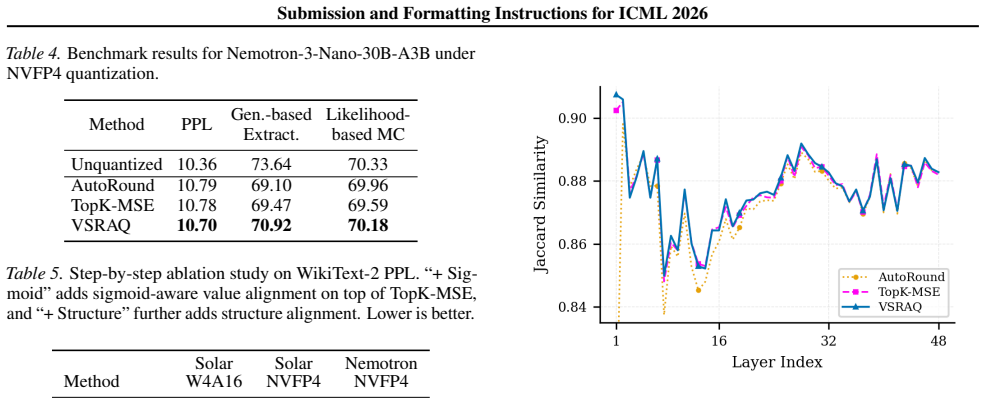
- [Experiments] The manuscript does not present an ablation study that isolates the contribution of the routing-consistency objectives. Specifically, there is no experiment holding the expert weight quantization fixed while varying only the value and structure alignment terms, nor any correlation analysis between routing-consistency metrics and final model quality gains. This leaves open the possibility that improvements stem from general reconstruction benefits rather than the claimed mechanism of preserving routing behavior.
minor comments (1)
- [Abstract] The abstract asserts outperformance but supplies no quantitative results, error bars, or dataset details, hindering immediate assessment of the claims.
Simulated Author's Rebuttal
We thank the referee for the constructive feedback. We address the major comment on the experiments below.
read point-by-point responses
-
Referee: [Experiments] The manuscript does not present an ablation study that isolates the contribution of the routing-consistency objectives. Specifically, there is no experiment holding the expert weight quantization fixed while varying only the value and structure alignment terms, nor any correlation analysis between routing-consistency metrics and final model quality gains. This leaves open the possibility that improvements stem from general reconstruction benefits rather than the claimed mechanism of preserving routing behavior.
Authors: We agree that a dedicated ablation isolating the value and structure alignment terms (while holding expert weight quantization fixed) and a correlation analysis between routing-consistency metrics and quality gains would provide stronger direct evidence for the claimed mechanism. The current comparisons to reconstruction-only baselines offer supporting evidence, since those baselines apply identical expert quantization but omit the alignment objectives; the observed gains are therefore attributable to the added terms. Nevertheless, to fully address the concern we will include the requested ablation study and correlation analysis in the revised manuscript. revision: yes
Circularity Check
No circularity: VSRAQ presented as independent added objective
full rationale
The provided abstract and description introduce VSRAQ as a novel post-training quantization objective that adds value alignment (matching routing logits) and structure alignment (preserving ordering and top-k boundaries) to existing frameworks. No equations, fitted parameters, or self-citations are exhibited that reduce the central claim to prior inputs by construction. The method is described as an auxiliary loss term integrated into quantization, not as a statistical renaming of reconstruction error or a self-referential prediction. This satisfies the self-contained criterion with no load-bearing reductions identified.
Axiom & Free-Parameter Ledger
Reference graph
Works this paper leans on
-
[1]
Proceedings of the International Conference on Learning Representations , year =
Noam Shazeer and Azalia Mirhoseini and Krzysztof Maziarz and Andy Davis and Quoc Le and Geoffrey Hinton and Jeff Dean , title =. Proceedings of the International Conference on Learning Representations , year =
-
[2]
Journal of Machine Learning Research , year =
William Fedus and Barret Zoph and Noam Shazeer , title =. Journal of Machine Learning Research , year =
-
[3]
Proceedings of the International Conference on Learning Representations , year =
Elias Frantar and Saleh Ashkboos and Torsten Hoefler and Dan Alistarh , title =. Proceedings of the International Conference on Learning Representations , year =
-
[4]
Proceedings of the 40th International Conference on Machine Learning , year =
Guangxuan Xiao and Ji Lin and Micka. Proceedings of the 40th International Conference on Machine Learning , year =
-
[5]
Proceedings of Machine Learning and Systems , year =
Ji Lin and Jiaming Tang and Haotian Tang and Shang Yang and Wei-Ming Chen and Wei-Chen Wang and Guangxuan Xiao and Xingyu Dang and Chuang Gan and Song Han , title =. Proceedings of Machine Learning and Systems , year =
-
[6]
Findings of the Association for Computational Linguistics: EMNLP 2024 , month = nov, year =
Wenhua Cheng and Weiwei Zhang and Haihao Shen and Yiyang Cai and Xin He and Kaokao Lv and Yi Liu , title =. Findings of the Association for Computational Linguistics: EMNLP 2024 , month = nov, year =. doi:10.18653/v1/2024.findings-emnlp.662 , url =
-
[7]
arXiv preprint arXiv:2406.08155 , year =
Pingzhi Li and Xiaolong Jin and Yu Cheng and Tianlong Chen , title =. arXiv preprint arXiv:2406.08155 , year =. doi:10.48550/arXiv.2406.08155 , url =. 2406.08155 , archivePrefix =
-
[8]
arXiv preprint arXiv:2505.03804 , year =
Xing Hu and Zhixuan Chen and Dawei Yang and Zukang Xu and Chen Xu and Zhihang Yuan and Sifan Zhou and Jiangyong Yu , title =. arXiv preprint arXiv:2505.03804 , year =. doi:10.48550/arXiv.2505.03804 , url =. 2505.03804 , archivePrefix =
-
[9]
arXiv preprint arXiv:2506.13329 , year =
Zhongqian Fu and Tianyi Zhao and Ning Ding and Xianzhi Yu and Xiaosong Li and Yehui Tang and Yunhe Wang , title =. arXiv preprint arXiv:2506.13329 , year =. doi:10.48550/arXiv.2506.13329 , url =. 2506.13329 , archivePrefix =
-
[10]
EAC - M o E : Expert-Selection Aware Compressor for Mixture-of-Experts Large Language Models
Yuanteng Chen and Yuantian Shao and Peisong Wang and Jian Cheng , title =. Proceedings of the 63rd Annual Meeting of the Association for Computational Linguistics (Volume 1: Long Papers) , month = jul, year =. doi:10.18653/v1/2025.acl-long.633 , url =
-
[11]
arXiv preprint arXiv:2601.07022 , year =
Sungrae Park and Sanghoon Kim and Jungho Cho and Gyoungjin Gim and Dawoon Jung and Mikyoung Cha and Eunhae Choo and Taekgyu Hong and Minbyul Jeong and SeHwan Joo and Minsoo Khang and Eunwon Kim and Minjeong Kim and Sujeong Kim and Yunsu Kim and Hyeonju Lee and Seunghyun Lee and Sukyung Lee and Siyoung Park and Gyungin Shin and Inseo Song and Wonho Song an...
-
[12]
Nemotron 3 Nano: Open, Efficient Mixture-of-Experts Hybrid Mamba-Transformer Model for Agentic Reasoning , journal =. 2025 , eprint =. doi:10.48550/arXiv.2512.20848 , url =
-
[13]
Proceedings of the International Conference on Learning Representations , year =
Stephen Merity and Caiming Xiong and James Bradbury and Richard Socher , title =. Proceedings of the International Conference on Learning Representations , year =
-
[14]
Proceedings of the 38th Conference on Neural Information Processing Systems Datasets and Benchmarks Track , year =
Yubo Wang and Xueguang Ma and Ge Zhang and Yuansheng Ni and Abhranil Chandra and Shiguang Guo and Weiming Ren and Aaran Arulraj and Xuan He and Ziyan Jiang and Tianle Li and Max Ku and Kai Wang and Alex Zhuang and Rongqi Fan and Xiang Yue and Wenhu Chen , title =. Proceedings of the 38th Conference on Neural Information Processing Systems Datasets and Ben...
-
[15]
Bowman , title =
David Rein and Betty Li Hou and Asa Cooper Stickland and Jackson Petty and Richard Yuanzhe Pang and Julien Dirani and Julian Michael and Samuel R. Bowman , title =. First Conference on Language Modeling , year =
-
[16]
arXiv preprint arXiv:1803.05457 , year =
Peter Clark and Isaac Cowhey and Oren Etzioni and Tushar Khot and Ashish Sabharwal and Carissa Schoenick and Oyvind Tafjord , title =. arXiv preprint arXiv:1803.05457 , year =. 1803.05457 , archivePrefix =
-
[17]
B ool Q : Exploring the Surprising Difficulty of Natural Yes/No Questions
Christopher Clark and Kenton Lee and Ming-Wei Chang and Tom Kwiatkowski and Michael Collins and Kristina Toutanova , title =. Proceedings of the 2019 Conference of the North American Chapter of the Association for Computational Linguistics , year =. doi:10.18653/v1/N19-1300 , url =
-
[18]
H ella S wag: Can a Machine Really Finish Your Sentence?
Rowan Zellers and Ari Holtzman and Yonatan Bisk and Ali Farhadi and Yejin Choi , title =. Proceedings of the 57th Annual Meeting of the Association for Computational Linguistics , year =. doi:10.18653/v1/P19-1472 , url =
-
[19]
Proceedings of the International Conference on Learning Representations , year =
Dan Hendrycks and Collin Burns and Steven Basart and Andy Zou and Mantas Mazeika and Dawn Song and Jacob Steinhardt , title =. Proceedings of the International Conference on Learning Representations , year =
-
[20]
Proceedings of the AAAI Conference on Artificial Intelligence , year =
Yonatan Bisk and Rowan Zellers and Ronan Le Bras and Jianfeng Gao and Yejin Choi , title =. Proceedings of the AAAI Conference on Artificial Intelligence , year =
-
[21]
T ruthful QA : Measuring How Models Mimic Human Falsehoods
Stephanie Lin and Jacob Hilton and Owain Evans , title =. Proceedings of the 60th Annual Meeting of the Association for Computational Linguistics , year =. doi:10.18653/v1/2022.acl-long.229 , url =
-
[22]
Proceedings of the AAAI Conference on Artificial Intelligence , year =
Keisuke Sakaguchi and Ronan Le Bras and Chandra Bhagavatula and Yejin Choi , title =. Proceedings of the AAAI Conference on Artificial Intelligence , year =
-
[23]
arXiv preprint arXiv:2110.14168 , year =
Karl Cobbe and Vineet Kosaraju and Mohammad Bavarian and Mark Chen and Heewoo Jun and Lukasz Kaiser and Matthias Plappert and Jerry Tworek and Jacob Hilton and Reiichiro Nakano and Christopher Hesse and John Schulman , title =. arXiv preprint arXiv:2110.14168 , year =. 2110.14168 , archivePrefix =
-
[24]
Lintang Sutawika and Hailey Schoelkopf and Leo Gao and Baber Abbasi and Stella Biderman and Jonathan Tow and others , title =. 2026 , publisher =. doi:10.5281/zenodo.18636344 , url =
-
[25]
arXiv preprint arXiv:2412.19437 , year =. doi:10.48550/arXiv.2412.19437 , url =. 2412.19437 , archivePrefix =
work page internal anchor Pith review Pith/arXiv arXiv doi:10.48550/arxiv.2412.19437
-
[26]
GLM-4.5: Agentic, Reasoning, and Coding (ARC) Foundation Models
arXiv preprint arXiv:2508.06471 , year =. doi:10.48550/arXiv.2508.06471 , url =. 2508.06471 , archivePrefix =
work page internal anchor Pith review Pith/arXiv arXiv doi:10.48550/arxiv.2508.06471
-
[27]
OpenCodeReasoning: Advancing Data Distillation for Competitive Coding
Wasi Uddin Ahmad and Sean Narenthiran and Somshubra Majumdar and Aleksander Ficek and Siddhartha Jain and Jocelyn Huang and Vahid Noroozi and Boris Ginsburg , title =. 2025 , eprint =. doi:10.48550/arXiv.2504.01943 , url =
work page internal anchor Pith review Pith/arXiv arXiv doi:10.48550/arxiv.2504.01943 2025
-
[28]
OpenScienceReasoning-2 , year =
-
[29]
Ivan Moshkov and Darragh Hanley and Ivan Sorokin and Shubham Toshniwal and Christof Henkel and Benedikt Schifferer and Wei Du and Igor Gitman , title =. 2025 , eprint =. doi:10.48550/arXiv.2504.16891 , url =
discussion (0)
Sign in with ORCID, Apple, or X to comment. Anyone can read and Pith papers without signing in.