Low-energy model for doped graphene nanoribbons
Pith reviewed 2026-06-26 02:16 UTC · model grok-4.3
The pith
Doped graphene nanoribbons map exactly onto a Kanamori model whose parameters produce open-shell high-spin states and blockade responses.
A machine-rendered reading of the paper's core claim, the machinery that carries it, and where it could break.
Core claim
An exact mapping is performed from both an extended and an on-site Hubbard model of free-standing doped graphene nanoribbons, where the chemical potential lies inside the bulk single-particle bands, to a Kanamori model that includes ferromagnetic exchange and pair-hopping interactions. The resulting Coulomb matrix elements are determined analytically and their scaling with ribbon width and length is identified. A low-energy version of the Kanamori Hamiltonian is proposed to address the response of the ribbons to external fields, and the model with appropriate ribbon parameters is shown to produce open-shell high-spin many-body states that can lead to shell- and spin-blockade responses.
What carries the argument
The exact mapping from the extended and on-site Hubbard models to the Kanamori model, which carries the argument by permitting analytic evaluation of the Coulomb matrix elements and identification of high-spin states.
If this is right
- Coulomb matrix elements are obtained analytically and scale in a definite way with ribbon width and length.
- The low-energy Kanamori Hamiltonian describes the ribbons' response to external fields for nanoelectronics use.
- Suitable ribbon parameters generate open-shell high-spin many-body states.
- These states produce shell- and spin-blockade responses in electron transport.
Where Pith is reading between the lines
- The scaling of matrix elements with dimensions may allow prediction of magnetic and transport properties for ribbons of varying sizes without repeated full many-body simulations.
- The low-energy description could reduce computational cost for modeling larger nanoribbon systems or networks.
- Analogous mappings might apply to other nanostructures possessing similar band structures or edge states.
Load-bearing premise
The chemical potential lies inside the bulk single-particle bands, allowing the exact mapping from the extended and on-site Hubbard models to the Kanamori model to hold without additional approximations.
What would settle it
A direct numerical extraction of effective interaction parameters from a full Hubbard-model calculation on a doped nanoribbon, compared against the analytically derived Coulomb matrix elements of the mapped Kanamori model.
Figures
read the original abstract
We analyse in this article the many-body behavior of free-standing doped graphene nanoribbons where the chemical potential lies inside the bulk single-particle bands. We perform an exact mapping from both an extended and an on-site Hubbard model of the ribbons to a Kanamori model, which includes ferromagnetic exchange and pair-hopping interactions. We determine the resulting Coulomb matrix elements analytically, and identify their scaling behavior as a function of ribbon width and length. We propose a low-energy version of the Kanamori Hamiltonian to address the response of the ribbons to external fields, with a view to their use as transport channels in nanoelectronics. We find that the model and the proposed ribbon parameters can produce open-shell, high-spin many-body states that can lead to shell- and spin-blockade responses.
Editorial analysis
A structured set of objections, weighed in public.
Referee Report
Summary. The manuscript analyzes the many-body behavior of free-standing doped graphene nanoribbons with chemical potential inside the bulk single-particle bands. It performs an exact mapping from both extended and on-site Hubbard models to a Kanamori model (including ferromagnetic exchange and pair-hopping), determines the resulting Coulomb matrix elements analytically, identifies their scaling with ribbon width and length, proposes a low-energy Kanamori Hamiltonian for response to external fields, and reports that the model can produce open-shell high-spin many-body states leading to shell- and spin-blockade responses in transport.
Significance. If the exact mapping and analytical results hold without hidden approximations, this provides a parameter-free low-energy effective model with explicit scaling laws for interaction parameters in nanoribbons. The analytical determination of Coulomb elements and the resulting predictions for high-spin states represent a strength, potentially aiding design of nanoelectronic transport channels. The work is grounded in standard Hubbard starting points and avoids fitting parameters.
major comments (2)
- [Abstract and mapping procedure] Abstract and the mapping procedure (presumably §2–3 where the Hubbard-to-Kanamori mapping is defined): The central claim of an 'exact mapping' without additional approximations when the chemical potential lies inside bulk bands is load-bearing for the derived Coulomb elements, their scaling, and the subsequent high-spin predictions. The manuscript does not explicitly demonstrate that residual terms vanish or that the projection remains exact once multiple subbands are partially filled, even with μ inside a bulk band; this directly impacts whether the Kanamori parameters follow directly from the Hubbard models as asserted.
- [Low-energy model and blockade responses] Section on low-energy model and blockade responses (where open-shell high-spin states are reported): The finding that the model produces shell- and spin-blockade responses relies on the mapped interaction parameters being accurate for the doping regime considered. Without verification (e.g., explicit derivation or checks for multi-subband cases) that the mapping introduces no extra approximations, the blockade predictions do not follow directly from the Hubbard starting point.
minor comments (1)
- Notation for the Kanamori Hamiltonian parameters could be clarified with a dedicated table comparing on-site, extended, and mapped values.
Simulated Author's Rebuttal
We thank the referee for the careful reading and constructive feedback on our manuscript. Below we respond point-by-point to the major comments, clarifying the mapping and agreeing to strengthen the explicit demonstrations as requested.
read point-by-point responses
-
Referee: [Abstract and mapping procedure] Abstract and the mapping procedure (presumably §2–3 where the Hubbard-to-Kanamori mapping is defined): The central claim of an 'exact mapping' without additional approximations when the chemical potential lies inside bulk bands is load-bearing for the derived Coulomb elements, their scaling, and the subsequent high-spin predictions. The manuscript does not explicitly demonstrate that residual terms vanish or that the projection remains exact once multiple subbands are partially filled, even with μ inside a bulk band; this directly impacts whether the Kanamori parameters follow directly from the Hubbard models as asserted.
Authors: The mapping is performed by rewriting the Hubbard interaction (on-site or extended) in the complete basis of the ribbon's transverse single-particle eigenstates, which become the orbital indices of the Kanamori model. Because the interaction is strictly two-body and the basis spans all subbands, the resulting matrix elements are exactly the Kanamori form (intra- and inter-orbital density-density, ferromagnetic exchange J, and pair-hopping) with vanishing residuals; this holds for any filling, including when μ lies inside the bulk bands and multiple subbands are partially occupied. We agree, however, that an explicit verification of the residual terms for the multi-subband case is not spelled out in the current text and will add a short derivation or appendix demonstrating their absence by direct computation in the subband basis. revision: yes
-
Referee: [Low-energy model and blockade responses] Section on low-energy model and blockade responses (where open-shell high-spin states are reported): The finding that the model produces shell- and spin-blockade responses relies on the mapped interaction parameters being accurate for the doping regime considered. Without verification (e.g., explicit derivation or checks for multi-subband cases) that the mapping introduces no extra approximations, the blockade predictions do not follow directly from the Hubbard starting point.
Authors: The shell- and spin-blockade predictions are obtained by diagonalizing the low-energy Kanamori Hamiltonian whose parameters are taken directly from the analytic mapping. Once the mapping is shown to be exact (as addressed in the response to the first comment), the blockade physics follows without further approximation. We will revise the low-energy-model section to include a forward reference to the added explicit verification of the mapping for the relevant doping regime. revision: yes
Circularity Check
No significant circularity; mapping is self-contained
full rationale
The paper begins from standard extended and on-site Hubbard models of the nanoribbons and states that it performs an exact mapping to a Kanamori model (with ferromagnetic exchange and pair-hopping) when the chemical potential lies inside the bulk single-particle bands. Coulomb matrix elements are then determined analytically and their scaling with width and length is identified. A low-energy version of the Kanamori Hamiltonian is subsequently proposed. No step reduces by construction to a fitted input, self-citation, or redefinition of the target result; the derivation chain remains independent of the final low-energy parameters or blockade predictions.
Axiom & Free-Parameter Ledger
axioms (1)
- domain assumption Hubbard model (on-site and extended) is an appropriate microscopic description for the electron interactions in doped graphene nanoribbons.
Reference graph
Works this paper leans on
-
[1]
Here, the third shell is completely empty
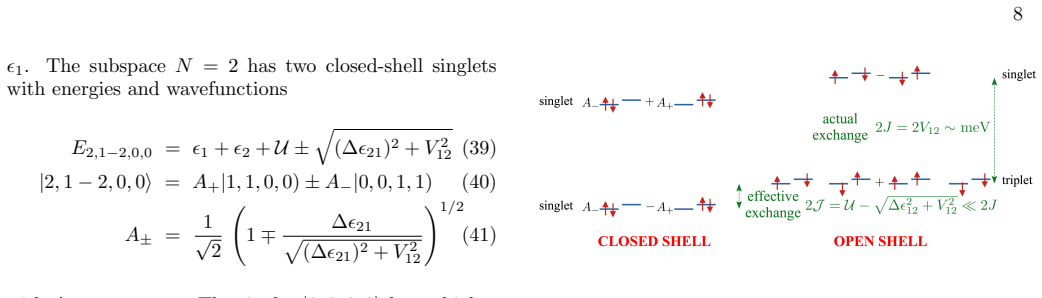
Limitϵ 3 ≫ϵ 2. Here, the third shell is completely empty. The problem thus reduces to a simpler half-filled two-shell model. The two singlet states sim- plify to |2, R,0,0⟩=A R1 |1,1,0,0⟩+A R2 |0,0,1,1⟩ whereR= 1,2, with eigen-energies E=ϵ 1 +ϵ 2 +U ± p (∆ϵ21)2 +V 2 12 The energy difference between the singlet and the triplet defines an effective exchange...
-
[2]
This limit corresponds to the closing on the lowest shell
Limitϵ 1 ≪ϵ 2. This limit corresponds to the closing on the lowest shell. Again the equations simplify so that the singlet states are |2, R,0,0⟩=A R1 |1,1,0,0⟩+A R2 |0,0,1,1⟩ whereR= 2,3, and with eigen-energies E=ϵ 2 +ϵ 3 +U ± q (∆ϵ32)2 +V 2 23 •Subspace N=3. This subspace has dimensions equal to 20 and is made up of eight doublets and a quadruplet. We l...
-
[3]
A. K. Geim, Science320, 1530 (2009)
2009
-
[4]
R. M. Westervelt, Science320, 324 (2009)
2009
-
[5]
J. Cai, P. Ruffieux, R. Jaafar, M. Bieri, T. Braun, S. Blankenburg, M. Muoth, A. P. Seitsonen, M. Saleh, X. Feng, K. Mullen, and R. Fasel, Nature466, 7305 (2010)
2010
-
[6]
Lawrence, A
J. Lawrence, A. Berdonces-Layunta, S. Edalatmanesh, J. Castro-Esteban, T. Wang, A. Jimenez-Martin, B. de la Torre, R. Castrillo-Bodero, P. Angulo-Portugal, M. Mo- hammed, A. Matej, M. Vilas-Varela, F. Schiller, M. Corso, P. Jelinek, D. Pe˜ na, and D. G. de Oteyza, Nature Chemistry14, 1451 (2022)
2022
-
[7]
Zhang, L
J. Zhang, L. Qian, G. B. Barin, A. Daaoub, P. Chen, K. Mullen, S. Sangtarash, P. Ruffieux, R. Fasel, H. Sadeghi, J. Zhang, M. Calame, and M. L. Perrin, Na- ture Electronics6, 572 (2023)
2023
-
[8]
Zhang, G
J. Zhang, G. B. Barin, R. Furrer, C.-Z. Du, X.-Y. Wang, K. Mullen, P. Ruffieux, R. Fasel, M. Calame, and M. L. Perrin, Nano Lett.23, 8474 (2023)
2023
-
[9]
W. Niu, S. Sopp, A. Lodi, A. Gee, F. Kong, T. Pei, P. Gehring, J. Nagele, C.-S. Lau, J. Ma, J. Liu, A. Narita, J. Mol, M. Burghard, K. Mullen, Y. Mai, X. Feng, and L. Bogani, Nature Materials22, 180 (2023)
2023
-
[10]
E. A. Laird, F. Kuenmeth, G. Steele, K. Grove- Rasmussen, J. Nygard, K. Flensberg, and L. P. Kouwen- hoven, Rev. Mod. Phys.87, 703 (2015)
2015
-
[11]
Konschuh, M
S. Konschuh, M. Gmitra, and J. Fabian, Phys. Rev. B 82, 245412 (2010)
2010
-
[12]
Zollner, M
K. Zollner, M. Kurpas, M. Gmitra, and J. Fabian, Nat. Rev. Physics7, 255 (2025)
2025
-
[13]
Garc´ ıa-Fuente, D
A. Garc´ ıa-Fuente, D. Carrascal, G. Ross, and J. Ferrer, Phys. Rev. B107, 115403 (2023)
2023
-
[14]
Talkachov and E
A. Talkachov and E. Babaev, Physical Review B107, 045419 (2023)
2023
-
[15]
Ferrer and A
J. Ferrer and A. Garcia-Fuente, Phys. Rev. B112, 165101 (2025)
2025
-
[16]
Fernandez-Rossier, Physical Review B77, 075430 (2008)
J. Fernandez-Rossier, Physical Review B77, 075430 (2008)
2008
-
[17]
Jung and A
J. Jung and A. H. MacDonald, Physical Review B79, 235433 (2009)
2009
-
[18]
T. O. Wehling, E. Sasioglu, C. Friedrich, A. I. Lichten- stein, M. I. Katsnelson, and S. Blugel, Phys. Rev. Lett. 106, 236805 (2011)
2011
-
[19]
Schuller, M
M. Schuller, M. Rossner, T. O. Wehling, A. I. Lichten- stein, and M. I. Katsnelson, Phys. Rev. Lett.111, 036601 (2013)
2013
-
[20]
Rossner, E
M. Rossner, E. Sasioglu, C. Friedrich, S. Blugel, and Wehling, Phys. Rev. B92, 085102 (2015)
2015
-
[21]
Kanamori, Progress of theoretical Physics30, 275 (1963)
J. Kanamori, Progress of theoretical Physics30, 275 (1963)
1963
-
[22]
Zhang, B
J. Zhang, B. Ghawri, D. Dutta, R. Fasel, M. Calame, G. B. Barin, and M. L. Perrin, Nature Reviews Materials 11, 194 (2026)
2026
-
[23]
Lieb and D
E. Lieb and D. Mattis, Physical Review125, 164 (1962)
1962
-
[24]
Tasaki, J
H. Tasaki, J. Phys.: Condens. Matt.10, 4353 (1998)
1998
-
[25]
Pieri, S
P. Pieri, S. Daul, D. Baeriswyl, M. Dzierzawa, and P. Fazekas, Physical Review B45, 9250 (1996)
1996
-
[26]
I. S. Burmistrov, D. S. Gefen, Y. Shapiro, and A. Shnir- man, Phys. Rev. Lett.124, 196801 (2020)
2020
-
[27]
D. J. Carrascal and J. Ferrer, Phys. Rev. B85, 045110 (2012)
2012
-
[28]
D. J. Carrascal, J. Ferrer, J. C. Smith, and K. Burke, J. Phys: Condens. Matter27, 393001 (2015)
2015
-
[29]
I. L. Kurland, I. L. Aleiner, and B. L. Alstshuler, Phys. Rev. B62, 14886 (2000)
2000
discussion (0)
Sign in with ORCID, Apple, or X to comment. Anyone can read and Pith papers without signing in.